UNIT 1
INDIAN FINANCIAL SYSTEM
WHAT IS FINANCIAL SYSTEM?
System which manages the flow of funds between the market players.
A financial system is an economic arrangement wherein financial institutions
facilitate the transfer of funds and assets between borrowers, lenders, and investors.
Its goal is to efficiently distribute economic resources to promote economic growth
and generate a return on investment (ROI) for market participants.
Assists to channelize funds from surplus(current income exceeds current
expenditure) to deficit Units(current expenditure exceeds current income).
Efficient Financial system efficiently mobilizes savings into different investment
avenues and help in accelerating the rate of economic development.
Dan O’Brien
(Economics editor of Irish Times newspaper)-
“The function of financial system is to channel money from people who have it but
want to save it to people who don’t have it but want to spend it.”
Robinson:
“The primary function of a financial system is to provide link between savings and
investment for creation of wealth and to permit portfolio adjustment in the
composition of existing wealth”
SIGNIFICANCE OF FINANCIAL SYSTEM
Provides a link between depositors and investors
Encourages savings and investment in the economy
Expansion of Financial Market
Promotes Banking sector as well as financial Institution
Generating Financial Instruments over the period of time.
STRUCTURE OF INDIAN FINANCIAL SYSTEM
FINANCIAL
ASSETS
FINANCIAL
INSTITUTIONS
FINANCIAL
MARKETS FINANCIAL
SERVICES
SCHEDULE
BANK
NON-
SCHEDULE
BANK
COMMERCIAL BANK
COOPERATIVE BANK
PRIVATE SECTOR, PUBLIC SECTOR,
RRB FOREIGN BANK
BANKING NON BANKING
NON-BANKING
FINANCIAL ENTITY
OTHERS
 Primary
Instruments
 Equity shares
 Preference share
 Debt instruments
 DERVIATES Instruments
 Forward
 Future
 Option
 Swaps
Money Market Capital Market
 Commercial bills
 T-bills
 Commercial papers
 Certificate of
Deposits
 Primary
 Secondary
Fund Bases Fee based
 Leasing and
hire purcahes
 Venture
capital
 Factoring
 Housing
Finance
 Capital issue
management
and merchant
banking
 Mutual Funds
 Assets
securitization
Secondary Instrument
Mutual Funds
Insurance policy
Time deposit
Provident and pension Fund
FINANCIAL INSTITUTIONS
The financial institution is the first component of the financial system. These institutions
serve as a mediator in between the borrower and investors that arranges their meeting. It
brings together the one who have surplus funds and one who is in need of funds.
Financial institutions can be categorized into: Banking and Non-Banking institutions.
Banking institutions are one that accepts deposits as well as provide credit to individuals.
Whereas, non-banking institutions do not accept deposits from public but offer them various
types of financial products and services.
BANKING INSTITUTIONS
Banking financial institutions are in the business of taking deposits from the public and making loans.
The banking institution is further divided in Schedule banks and Non-schedule bank.
Any bank which is listed in the 2nd schedule of the Reserve Bank of India Act, 1934 is considered a scheduled
bank. The Schedule consists of those banks which satisfy various parameters, criteria under clause 42 of this act.
The list includes the State Bank of India and its subsidiaries (like State Bank of Travancore), all nationalized banks
(Bank of Baroda, Bank of India etc), regional rural banks (RRBs), foreign banks (HSBC Holdings Plc, Citibank NA)
and some co-operative banks.
To qualify as a scheduled bank, the paid-up capital and collected funds of the bank must not be less than Rs5 lakh.
Scheduled banks are eligible for loans from the Reserve Bank of India at bank rate, and are given membership to
clearing-houses.
•Non-scheduled banks by definition are those which are not listed in the 2nd schedule of the RBI act,
1934.
•They don’t conform to all the criteria under clause 42, but dully follow specific guidelines as laid down
by RBI.
•Banks with a reserve capital of less than 5 lakh rupees qualify as non-scheduled banks.
•Unlike scheduled banks, they are not entitled to borrow from the RBI for normal banking purposes,
except, in an emergency or abnormal circumstances.
•Bangalore City Co-operative Bank Ltd. Bangalore, Baroda City Co-op. Bank Limited are a few
examples.
SCHEDULE COMMERCIAL BANK
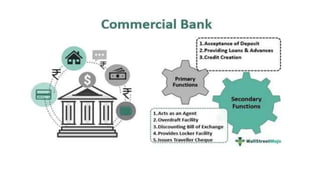
•A commercial bank is a kind of financial institution that carries all the operations related to deposit and withdrawal
of money for the general public, providing loans for investment, and other such activities. These banks are profit-
making institutions and do business only to make a profit
•Commercial banks operate on a ‘for-profit’ basis.
•They primarily engage in the acceptance of deposits and extend loans to the public, businesses and the government.
• Nowadays, some commercial banks are also providing housing loans on a long-term basis to individuals.
 Accepts deposit : The bank takes deposits in the form of saving, current, and fixed deposits. The
surplus balances collected from the firm and individuals are lent to the temporary requirements of the
commercial transactions.
Provides loan and advances : Another critical function of this bank is to offer loans and advances to
the entrepreneurs and business people, and collect interest. For every bank, it is the primary source of
making profits. In this process, a bank retains a small number of deposits as a reserve and offers
(lends) the remaining amount to the borrowers in demand loans, overdraft, cash credit, short-run
loans, and more such banks.
Credit cash: When a customer is provided with credit or loan, they are not provided with liquid cash.
First, a bank account is opened for the customer and then the money is transferred to the account. This
process allows the bank to create money.
PRIMARY FUNCTIONS
SECONDARY FUNCTIONS
 Discounting bills of exchange: It is a written agreement acknowledging the amount of money
to be paid against the goods purchased at a given point of time in the future. The amount can
also be cleared before the quoted time through a discounting method of a commercial bank.
Overdraft facility: It is an advance given to a customer by keeping the current account to
overdraw up to the given limit.
 Purchasing and selling of the securities: The bank offers you with the facility of selling and
buying the securities.
Locker facilities: A bank provides locker facilities to the customers to keep their valuables or
documents safely. The banks charge a minimum of an annual fee for this service.
Agency functions: carrying out certain functions on behalf of customers.
Types of Commercial Banks
They are further classified into the following categories:
Public Sector Banks: The term “public sector banks” refers to a situation where the majority equity stake in the banks is held by the
government. The Indian Government keeps default holdings of a minimum 51% shareholding, but management control is only with
the Central Government, thereby classifying them as Public Sector Banks. (12 banks)
Public sector banks include the State Bank of India and its Associates, Nationalized Banks (including Industrial Development Bank
of India Ltd (IDBI) since December 2004), and Regional Rural Banks.
Private: They are the banks in which individuals and corporations are the majority shareholders. In India, banks were nationalized
in two phases, in 1969 and 1980. In 1993, the Reserve Bank of India (RBI) the regulating body for all the country’s banking
organizations, allowed many new commercial banks in India to start operations. Some of the major commercial banks in India that
were given licenses are ICICI Bank, HDFC Bank, Axis Bank, Yes Bank, and Kotak Mahindra Bank. (21 banks)
Private sector banks are recognized as the banks for the new generation, providing innovative products, better IT support systems,
and competitive pricing for their products. As of the end of March 2017, there are 21 private sector banks in India. Besides these,
four local area banks are also categorized as private banks.
Foreign Banks: As the name suggests, these financial institutions operate in foreign countries but have head offices in the parent
country. The bank’s foreign branches take deposits, extend loans, engage in securities trading, and facilitate foreign exchange
functions.
HSBCBANK, CITIBANK, STANDARD CHARTERED BANK, ROYAL BANK OF SCOTLAND
CO-OPERATIVE BANKS
It is an institution established on a cooperative basis to deal with the ordinary banking business. Like other banks, cooperative banks are
founded by collecting funds through shares, accepting deposits, and granting loans.
They are Cooperative credit societies where members from a community group together to extend loans to each other, at favorable terms.
The Co-operative Banks in India are governed as per the Banking Regulations Act 1949 and Banking Laws (Co-operative Societies) Act,
1955.
A Co-operative bank is a financial entity which belongs to its members, who are at the same time the owners and the customers of their
bank.
These Banks have been opened with the motto of ‘no-profit-no-loss’ and thus, do not seek for profitable ventures and customers only. As the
name suggests, the main objective of Co-operative Banks is mutual help.
Given below are a few important features of Co-operative Banking in India:
•They work on the principle of ‘one person, one vote’. Since these banks are owned by the members, a Board of Directors is chosen
democratically and then they are responsible for controlling the Organisation.
•Farmers can avail agricultural loans on minimum interest rates from the Co-operative Banks
•Providing easy and accessible loans and credit benefits in the rural areas with scarce banking facilities
•The annual profit earned is spent on financial reserves and required resources and a part of it is distributed among the Co-operative
members, as per the prescribed limitations
•Monopoly of money lenders and money lenders end
NON-BANKING FINANCIAL INSTITUTIONS
The non-banking financial institutions are the organizations that facilitate bank-related financial
services but does not have banking licenses.
1. NBFC:
A Non-Banking Financial Company (NBFC) is a company registered under the Companies Act,
1956 engaged in the business of loans and advances, acquisition of
shares/stocks/bonds/debentures/securities issued by Government or local authority or other
marketable securities of a like nature, leasing, hire-purchase, insurance business, chit business
but does not include any institution whose principal business is that of agriculture activity, industrial
activity, purchase or sale of any goods (other than securities) or providing any services and
sale/purchase/construction of immovable property.
Meaning An NBFC is a company that
provides banking services
to people without holding a
bank license.
Bank is a government
authorized financial
intermediary that aims at
providing banking services
to the general public
Incorporated under Companies Act 1956 Banking Regulation Act,
1949
Demand Deposit Not Accepted Accepted
Maintenance of Reserve
Ratios
Not required Compulsory
BASIS FOR COMPARISON NBFC BANK
2. Insurance Companies in India are recognised by the IRDA – Insurance Regulatory and Development
Authority of India, the statutory body promoting and regulating various types of insurance companies in India.
The insurance industry comprises a total of 57 insurance companies in India.
For Life Insurance Business there are 24 companies recognised by IRDA, similarly for non-life insurance 34
companies got the approval from IRDA.
3. A mutual fund is a financial vehicle that pools assets from shareholders to invest in securities like stocks,
bonds, money market instruments, and other assets. Its introduction in India took place when the Government
launched the Unit Trust of India (UTI) in 1963.
4. Development finance Institutions
The development finance institutions or development finance companies are organizations owned by the
government or charitable institution to provide funds for low-capital projects or where their borrowers are unable
to get it from commercial lenders.
Industrial development bank ( IDBI, IFCI etc)
Agricultural Development Bank ( NABARD)
Export-import development Bank (EXIM BANK)
FINANCIAL MARKET
A financial market is a word that describes a marketplace where bonds, equity,
securities, currencies are traded. It serves as an agent between the investors and
collector by mobilizing capital between them.
In a financial market, the stock market allows investors to purchase and trade publicly
companies share.
The financial Market is divided into two Money Market and Capital Market.
FUNCTIONS
•Mobilising Funds: Among the diverse types of functions served by Financial Markets, one of the most
crucial functions is that of mobilisation of savings. Financial Markets also utilise this savings investing
it for productive use, thereby contributing to capital and economic growth.
•Determination of Prices: Another vital function served by Financial Markets is that of pricing
different securities. Essentially, demand and supply in Financial Markets along with its interaction
between investors determine these pricing.
•Liquidity of Financial Holdings: Tradable assets must be provided with liquidity for its smooth
functioning and flow. This is another role of the Financial Market which goes on to help in the
functioning of a capitalist economy. It not only allows investors to easily sell their securities and assets,
but also allows them to easily convert them into cash money.
•Ease of Access: Financial Markets also offer efficient trading since they bring traders to the same
Market. As a result, relevant parties do not have to spend any resource, be it capital or time, to find
interest buyers or sellers. Additionally, it also provides necessary information related to trading, which
also reduces the effort that interested parties must put in to complete their trades.
The money market is a financial market wherein short-
term assets and open-ended funds are traded between
institutions and traders. The market offers very high
liquidity as the assets can easily convert into cash. Thus, it
helps businesses and the government in meeting their
working capital requirements.
Unsecured and short term debt securities
Call Money
Sometimes, banks and other financial institutions may borrow for a very short
period to manage their cash flows.
Call money is the short-term borrowing or lending of funds for a day to 15
days
Treasury Bills (T-Bills)( zero coupon bond)
Treasury bills or T- Bills are issued by the Reserve Bank of India on behalf of
the Central Government for raising money. Sold to bank and normal public.
They have short term maturities with highest up to one year. Currently, T- Bills
are issued with 3 different maturity periods, which are, 91 days T-Bills, 182
days T- Bills, 1 year T – Bills.
T-Bills are issued at a discount to the face value. At maturity, the investor gets the face value amount. This difference
between the initial value and face value is the return earned by the investor. They are the safest short term fixed
income investments as they are backed by the Government of India.
Commercial papers include short term and unsecured promissory notes that are issued by reputed, large
companies. Since they are not secured, they offer higher returns than T-Bills
Maturity period is fixed( 15 days to 1 year).
Certificates of Deposits (CD)
CDs are financial assets that are issued by banks and financial institutions. They offer fixed interest rate on the
invested amount. The primary difference between a CD and a Fixed Deposit is that of the value of principal amount
that can be invested. The former is issued for large sums of money ( 1 lakh or in multiples of 1 lakh thereafter).
CAPITAL MARKET
A capital market is a place that allows the trading of funding
instruments such as shares, debentures, debt instruments,
bonds, ETFs, etc. It is a source for raising funds for
individuals, firms, and governments. There are usually long-
term investments, such as shares, shares, debt, government
securities, debentures, bonds etc.
The primary function of the capital market is to bring together
investors who buy securities with those who sell them. The
three main participants of the capital markets are savers (also
known as investors), borrowers, and stockholders.
Primary Market: The primary market is for trading freshly issued securities,
i.e., first-time trading. It enables an initial public offering It is also known as
the new issues market. In the primary market, the securities are issued by
either Initial Public Offer (IPO) or Further Public Offer (FPO). IPO is a
process through which an organization can make a public offer to the investors
for the first time to make an investment. This trade is between the investors
and the original issuer in the primary market.
Secondary Market: The trading of old securities occurs in the secondary
market, which occurs after transacting in the primary market. Both stock
markets and over-the-counter trades come under the secondary market. New
York Stock Exchange (NYSE), Bombay Stock Exchange (BSE), National
Stock Exchange (NSE), etc. are secondary markets.
Money Market Capital Market
Definition
A random course of financial institutions, bill
brokers, money dealers, banks, etc., wherein
dealing on short-term financial tools are being
settled is referred to as Money Market.
A kind of financial market where the company or
government securities are generated and patronised with the
intention of establishing long-term finance to coincide with
the capital necessary is called Capital Market.
Market Nature
Money markets are informal in nature. Capital markets are formal in nature.
Instruments involved
Commercial Papers, Treasury Certificate of
Deposit, Bills, Trade Credit, etc.
Bonds, Debentures, Shares, Asset Secularisation, Retained
Earnings, Euro Issues, etc.
Investor Types
Commercial banks, non-financial institutions,
central bank, chit funds, etc.
Stockbrokers, insurance companies, Commercial banks,
underwriters, etc.
FINANCIAL INSTRUMENTS/ASSETS
Financial instruments are key component of financial system. These are the products which are traded in
financial market. There are wide range of securities available in market as the needs of credit seekers and
investors vary from each other. Financial instruments are classified Cash Instruments and Derivatives.
1.Primary Instruments: direct securities (Equity shares, debentures etc
2. secondary securities : By intermediaries ( Mutual Funds etc )
2. Derivative Instruments
Derivative instruments are financial instruments that have values determined from underlying
assets, such as resources, currency, bonds, stocks, and stock indexes.
DERIVATIVE INSTRUMENTS
The derivatives are those financial instruments that don’t have their own value;
instead, their values is derived from underlying assets.
Forward
Futures
Options
Swaps
Forward Contracts
Forward contracts are customized contracts where two parties, meet and make a contract to trade an
underlying asset as per their assumptions of the price movement. In these contracts, there is a strike
price, which is the price at which the parties will trade the asset.
The strike price is determined when the contract is drawn between the parties. There is an expiry date
mentioned in the contract to which both the parties have to oblige. These are over-the-counter contracts
that are not regulated, and thus have huge risk factors revolving around them. These derivative contracts
give you the right as well as the obligation to buy or sell the underlying asset at the expiry of the
contract.
Mr. X and Mr. Y entered into a contract where the underlying asset is wheat. Mr. X thinks the price of
wheat will go up, and Mr. Y thinks otherwise. So, they determined the strike price to be Rs. 50 per
kilogram.The expiry of the contract is after three months. On expiry, the price of wheat rose to Rs. 65 per
kg. So, now Mr. Y has to buy wheat at Rs. 65 from the market and sell it to Mr. X at the predetermined
price of Rs. 50. So, here Mr. X makes a profit of Rs. 15 per kg while Mr. Y loses the same.
Futures Contracts
Future contracts are the same as forwarding contracts, which are only standardized instead of being
customized. These contracts also have a strike price at which the buyer and the seller will trade the
underlying asset on the expiry date of the contract. These contracts are traded on stock exchanges.
Stock B trading at Rs. 100, which is also the strike price here. Mr. X thinks that the price will go
up while Mr. Y predicts the price will go down. In the exchange, Mr. X placed an order to buy a
futures contract, and Mr. Y’s order matched the same. Now on the date of expiry, the price of
stock B decreased to Rs. 75. Now, Mr. X has to buy the stock at Rs. 100 and Mr. Y can easily buy
the stock from the stock market at Rs. 75 and sell it for Rs. 100 to Mr. X, making a profit of Rs.
25 for each share.
Options
Options are derivative contracts where the buyer of the options gets the right and not the
obligation to buy or sell the underlying asset at a predetermined price on a specified date
mentioned in the contract. For buying these contracts, the buyers have to pay a premium to the
seller of the contract.
Swap Contracts
These are the most complicated derivatives where traders bet on currencies and interest rates and
exchange cash flow. Suppose, you think the USD – INR value will go up tomorrow while another
party predicts it will go down. So, you both enter into a contract. At the expiry of the contract the
cash will be exchanged based on the final price of the USD- INR.
FINANCIAL SERVICES
Financial services refer to services provided by the banks and financial institutions in a financial system.
In general, all types of activities which are of financial nature may be regarded as financial services. In a broad
sense, the term financial services means mobilization and allocation of savings. Thus, it includes all activities
involved in the transformation of savings into investment.
Following are some of the examples of financial services:
•Banking Services – Any small or big service provided by banks like granting a loan, depositing money, issuing
debit/credit cards, opening accounts, etc.
•Insurance Services – Services like issuing of insurance, selling policies, insurance undertaking and brokerages,
etc. are all a part of the Insurance services
•Investment Services – It mostly includes asset management
•Foreign Exchange Services – Exchange of currency, foreign exchange, etc. are a part of the Foreign exchange
services
Fund Based Services
In fund-based services the firm raises funds through debt, equity,
deposits and the bank invests the funds in securities or lends to
those who are in need of capital.
•Leasing / Finance
•Hire Purchase and Consumer Credit
•Bill Discounting
•Housing Finance
•Insurance Services
Fee Based Services
Fee based financial services are those services wherein financial institutions operate
in specialized fields to earn a substantial income in the form of fees or dividends or
brokerage on operations.
The fee based/advisory services include:
Project counselling
•Issue Management
•Corporate Counseling
•Loan Syndication
•Capital Restructuring
FINANCIAL REGULATORS –
Financial Regulators refers to the government bodies which are responsible for regulating,
inspecting, monitoring the functions of various financial institutions like banks, insurance
companies, business entities, Non-banking financial companies (NBFCs) etc.
Financial Regulators are the apex bodies of financial institutions of respective sectors which
register and function under these financial regulatory institutions. Few examples of financial
regulators in India are below.
•RBI (Reserve Bank of India)
•IRDA (Insurance Regulatory and Development Authority)
•SEBI (Securities Exchange Board of India)
•PFRDA (Pension Fund Regulatory and Development Authority)
•FMC ( Forward Market Commission)
EVOLUTION OF INDIAN FINANCIAL
SYSTEM
PHASES:
Pre-Independence Phase (Before 1947)
Post-Independence Phase ( 1947-1990)
The Liberalization era (1991 and beyond)
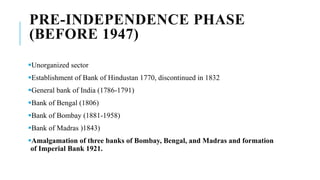
PRE-INDEPENDENCE PHASE
(BEFORE 1947)
Unorganized sector
Establishment of Bank of Hindustan 1770, discontinued in 1832
General bank of India (1786-1791)
Bank of Bengal (1806)
Bank of Bombay (1881-1958)
Bank of Madras )1843)
Amalgamation of three banks of Bombay, Bengal, and Madras and formation
of Imperial Bank 1921.
Some other Banks which were established:
Allahabad Bank (1865)
PNB (1894)
Bank of India (1906)
Bank of Baroda (1908)
Central Bank of India(1911)
1850: Several Insurance company both life and non-life were established in financial system.
Oriental Life Insurance company was first Life Insurance co. set up in 1882 in Calcutta
Insurance Act 1866 amended in 1912 and 1938.
Bombay stock exchange was established in 1875 as Asia’s First stock exchange.
RBI as a central Bank was set up By Act of 1934 as a privately owned central bank for British
India in 1935.
Nationalisation of RBI in 1949
POST-INDEPENDENCE PHASE (
1947-1990)
Majority of banks were privately owned
Rural population was still depended on Unorganised sector
Control over privately owned banks and other financial institutions became important in the wake of
Banking crises in 1950’s.
Bank Nationalization of Reserve Bank of India and establishment of Banking Regulation Act 1949.
14 other commercial banks were also nationalised in 1969
Establishment of RRB as per recommendation of Narasimha committee (1975)
NABARD est. in 1982
National Housing Bank 1988
SIDBI 1990
Evolution of Financial sector came about in 1950 with the beginning of planned economic
development.
Parliament declared the Socialistic pattern of society to be the basic objective of economic policy in
India.
National Industrial Development Corporation 1954
State Industries Development Corporation were established (2nd five year plan)
Nationalisation of Imperial Bank and renamed as SBI (1955)
Deposit Insurance corporation was set up in 1962
Export-import bank of India 1982
Tourism Financial Corporation of India was set up to provide financial assistance to tourism Industry.
General Insurance corporation of India and its four subsidiaries were nationalised in 1970:
1. The new India Assurance corporation Ltd.
2. National Insurance co. Ltd.
3. Oriental Insurance co. ltd.
4. The United India Insurance co. Ltd.
Various others Acts were also passed:
MRTP Act 1970
Capital issue control Act 1947
Foreign Exchange Regulation Act 197
The banking sector during this phase suffered from lack of competition, low capital, low
productivity. Govt banks were dominating the banking sector since nationalization.
Use of technology was minimal, quality of service given was not adequate
RUSTOM CAVASJEE COOPER V. UNION OF INDIA
FACTS
The Banking Companies (Acquisition and Transfer of Undertakings) Ordinance was passed in 1969 by the then acting
President in pursuance of the powers enshrined in Article 123(1) of the Constitution. After this ordinance was
promulgated, 14 private sector banks were nationalized.
The provisions of the Ordinance also stated that the Central Government would have to pay compensation to the banks
acquired by the government, although such amount of compensation would be decided by negotiations between the
bank and the government.
The petitioner, in this case, was one of the many petitioners who challenged the authority of the acting President to
promulgate this ordinance. Mr. R.C. Cooper was the director of the Central Bank of India.. Additionally, he also held
shares in the Central Bank of India, Bank of Baroda as well as the Union Bank of India. All these banks were
nationalized by the Government of India.
However, before the petitions could be heard by the Supreme Court, a bill was passed titled the Banking Companies
(Acquisition and Transfer of Undertakings) Act, 1970 (hereinafter referred as ‘the Act’). The language used in the bill
was the same as that of the ordinance, although the ordinance was later repealed by the provisions of this Act. The effect
of the Act was the same as that of the Ordinance. The constitutional validity of the act was challenged by the petitioner
on several grounds before the Supreme Court, stating that the act was violative of the rights enshrined under Part III of
the Constitution.
ISSUES
The court in Rustom Cavasjee Cooper v. Union of India was concerned with
the question-Whether the Banking Companies (Acquisitions and Transfer of
Undertakings) Act was constitutionally valid or not?
Can Shareholder or Director Claim F.R on behalf of Company?
Ordinance was proper?
JUDGMENT
By the majority judgment, the contentions of the petitioners were accepted by the Court. The
Court decided to strike down the Act. The rationale of the Court was that the Government had
failed in providing the compensation to the banks as per the provisions of the Act itself. The
Court held that the rights of the banks under Article 31 of the Constitution had been violated.
The Court did not delve deeper into the question as to whether the Act violated the freedom
of trade and commerce under Article 301 of the Constitution. The claims of the respondents,
in this case, that the petitioners were not holders of the property, or that the jurisdiction
should be denied by the Court, were not allowed to stand.
As for the unconstitutionality of the Act against the Part III of the Constitution, the Court held
the Act is not violative of the right under Article 19(1)(g) of the Part III of the Constitution,
but held that the Act was in contravention of the right under Article 14 of the Constitution, as
it impaired the right to equality since it prevented the banks from pursuing any business
which was not related to banking.
THE LIBERALIZATION ERA
(1991 AND BEYOND
Phase of LPG Reforms
•Rise in Prices: The inflation rate increased from around 6% to 16% and the country’s economic
position became worse.
•Rise in Fiscal Deficit: Government’s fiscal deficit increased due to increase in non-development
expenditure.
•Narasimham Committee for brining industrial reforms:
•Liberalization
•Privatization
•Globalization
Financial Sector reforms were initiated in India in 1992-1993 as a part of Liberalization and
Globalization
Private, domestic and foreign players were allowed to enter banking, insurance and mutual fund sector.
Small Industrial Development Bank of India was set up in 1990 as a wholly subsidiary of IDBI
Decline of Government share in Public Sector Bank.
Emergence of retail banking whereby banks initiated granting short and medium term loan to Individual
as well as corporates.
Enhancement of quality and variety of customer services, through technology upgradation etc.
Advising banks for reducing NPA and Introductory Risk Management system.
Participation of private sector in Insurance sector and Mutual Fund.
SEBI was formed replacing the controller of capital issues in 1988 for promoting as well as regulating
the security Market and protecting the interest of investors.
1995 SEBI authorised to regulate the rating agencies also like (CRISIL, ICRA,CARE, Etc)
UNIT 1.pptx

UNIT 1.pptx

  • 1.
  • 2.
    WHAT IS FINANCIALSYSTEM? System which manages the flow of funds between the market players. A financial system is an economic arrangement wherein financial institutions facilitate the transfer of funds and assets between borrowers, lenders, and investors. Its goal is to efficiently distribute economic resources to promote economic growth and generate a return on investment (ROI) for market participants. Assists to channelize funds from surplus(current income exceeds current expenditure) to deficit Units(current expenditure exceeds current income). Efficient Financial system efficiently mobilizes savings into different investment avenues and help in accelerating the rate of economic development.
  • 3.
    Dan O’Brien (Economics editorof Irish Times newspaper)- “The function of financial system is to channel money from people who have it but want to save it to people who don’t have it but want to spend it.” Robinson: “The primary function of a financial system is to provide link between savings and investment for creation of wealth and to permit portfolio adjustment in the composition of existing wealth”
  • 4.
    SIGNIFICANCE OF FINANCIALSYSTEM Provides a link between depositors and investors Encourages savings and investment in the economy Expansion of Financial Market Promotes Banking sector as well as financial Institution Generating Financial Instruments over the period of time.
  • 6.
    STRUCTURE OF INDIANFINANCIAL SYSTEM FINANCIAL ASSETS FINANCIAL INSTITUTIONS FINANCIAL MARKETS FINANCIAL SERVICES SCHEDULE BANK NON- SCHEDULE BANK COMMERCIAL BANK COOPERATIVE BANK PRIVATE SECTOR, PUBLIC SECTOR, RRB FOREIGN BANK BANKING NON BANKING NON-BANKING FINANCIAL ENTITY OTHERS  Primary Instruments  Equity shares  Preference share  Debt instruments  DERVIATES Instruments  Forward  Future  Option  Swaps Money Market Capital Market  Commercial bills  T-bills  Commercial papers  Certificate of Deposits  Primary  Secondary Fund Bases Fee based  Leasing and hire purcahes  Venture capital  Factoring  Housing Finance  Capital issue management and merchant banking  Mutual Funds  Assets securitization Secondary Instrument Mutual Funds Insurance policy Time deposit Provident and pension Fund
  • 7.
    FINANCIAL INSTITUTIONS The financialinstitution is the first component of the financial system. These institutions serve as a mediator in between the borrower and investors that arranges their meeting. It brings together the one who have surplus funds and one who is in need of funds. Financial institutions can be categorized into: Banking and Non-Banking institutions. Banking institutions are one that accepts deposits as well as provide credit to individuals. Whereas, non-banking institutions do not accept deposits from public but offer them various types of financial products and services.
  • 8.
    BANKING INSTITUTIONS Banking financialinstitutions are in the business of taking deposits from the public and making loans. The banking institution is further divided in Schedule banks and Non-schedule bank. Any bank which is listed in the 2nd schedule of the Reserve Bank of India Act, 1934 is considered a scheduled bank. The Schedule consists of those banks which satisfy various parameters, criteria under clause 42 of this act. The list includes the State Bank of India and its subsidiaries (like State Bank of Travancore), all nationalized banks (Bank of Baroda, Bank of India etc), regional rural banks (RRBs), foreign banks (HSBC Holdings Plc, Citibank NA) and some co-operative banks. To qualify as a scheduled bank, the paid-up capital and collected funds of the bank must not be less than Rs5 lakh. Scheduled banks are eligible for loans from the Reserve Bank of India at bank rate, and are given membership to clearing-houses.
  • 9.
    •Non-scheduled banks bydefinition are those which are not listed in the 2nd schedule of the RBI act, 1934. •They don’t conform to all the criteria under clause 42, but dully follow specific guidelines as laid down by RBI. •Banks with a reserve capital of less than 5 lakh rupees qualify as non-scheduled banks. •Unlike scheduled banks, they are not entitled to borrow from the RBI for normal banking purposes, except, in an emergency or abnormal circumstances. •Bangalore City Co-operative Bank Ltd. Bangalore, Baroda City Co-op. Bank Limited are a few examples.
  • 10.
    SCHEDULE COMMERCIAL BANK •Acommercial bank is a kind of financial institution that carries all the operations related to deposit and withdrawal of money for the general public, providing loans for investment, and other such activities. These banks are profit- making institutions and do business only to make a profit •Commercial banks operate on a ‘for-profit’ basis. •They primarily engage in the acceptance of deposits and extend loans to the public, businesses and the government. • Nowadays, some commercial banks are also providing housing loans on a long-term basis to individuals.
  • 12.
     Accepts deposit: The bank takes deposits in the form of saving, current, and fixed deposits. The surplus balances collected from the firm and individuals are lent to the temporary requirements of the commercial transactions. Provides loan and advances : Another critical function of this bank is to offer loans and advances to the entrepreneurs and business people, and collect interest. For every bank, it is the primary source of making profits. In this process, a bank retains a small number of deposits as a reserve and offers (lends) the remaining amount to the borrowers in demand loans, overdraft, cash credit, short-run loans, and more such banks. Credit cash: When a customer is provided with credit or loan, they are not provided with liquid cash. First, a bank account is opened for the customer and then the money is transferred to the account. This process allows the bank to create money. PRIMARY FUNCTIONS
  • 13.
    SECONDARY FUNCTIONS  Discountingbills of exchange: It is a written agreement acknowledging the amount of money to be paid against the goods purchased at a given point of time in the future. The amount can also be cleared before the quoted time through a discounting method of a commercial bank. Overdraft facility: It is an advance given to a customer by keeping the current account to overdraw up to the given limit.  Purchasing and selling of the securities: The bank offers you with the facility of selling and buying the securities. Locker facilities: A bank provides locker facilities to the customers to keep their valuables or documents safely. The banks charge a minimum of an annual fee for this service. Agency functions: carrying out certain functions on behalf of customers.
  • 14.
    Types of CommercialBanks They are further classified into the following categories: Public Sector Banks: The term “public sector banks” refers to a situation where the majority equity stake in the banks is held by the government. The Indian Government keeps default holdings of a minimum 51% shareholding, but management control is only with the Central Government, thereby classifying them as Public Sector Banks. (12 banks) Public sector banks include the State Bank of India and its Associates, Nationalized Banks (including Industrial Development Bank of India Ltd (IDBI) since December 2004), and Regional Rural Banks. Private: They are the banks in which individuals and corporations are the majority shareholders. In India, banks were nationalized in two phases, in 1969 and 1980. In 1993, the Reserve Bank of India (RBI) the regulating body for all the country’s banking organizations, allowed many new commercial banks in India to start operations. Some of the major commercial banks in India that were given licenses are ICICI Bank, HDFC Bank, Axis Bank, Yes Bank, and Kotak Mahindra Bank. (21 banks) Private sector banks are recognized as the banks for the new generation, providing innovative products, better IT support systems, and competitive pricing for their products. As of the end of March 2017, there are 21 private sector banks in India. Besides these, four local area banks are also categorized as private banks. Foreign Banks: As the name suggests, these financial institutions operate in foreign countries but have head offices in the parent country. The bank’s foreign branches take deposits, extend loans, engage in securities trading, and facilitate foreign exchange functions. HSBCBANK, CITIBANK, STANDARD CHARTERED BANK, ROYAL BANK OF SCOTLAND
  • 15.
    CO-OPERATIVE BANKS It isan institution established on a cooperative basis to deal with the ordinary banking business. Like other banks, cooperative banks are founded by collecting funds through shares, accepting deposits, and granting loans. They are Cooperative credit societies where members from a community group together to extend loans to each other, at favorable terms. The Co-operative Banks in India are governed as per the Banking Regulations Act 1949 and Banking Laws (Co-operative Societies) Act, 1955. A Co-operative bank is a financial entity which belongs to its members, who are at the same time the owners and the customers of their bank. These Banks have been opened with the motto of ‘no-profit-no-loss’ and thus, do not seek for profitable ventures and customers only. As the name suggests, the main objective of Co-operative Banks is mutual help. Given below are a few important features of Co-operative Banking in India: •They work on the principle of ‘one person, one vote’. Since these banks are owned by the members, a Board of Directors is chosen democratically and then they are responsible for controlling the Organisation. •Farmers can avail agricultural loans on minimum interest rates from the Co-operative Banks •Providing easy and accessible loans and credit benefits in the rural areas with scarce banking facilities •The annual profit earned is spent on financial reserves and required resources and a part of it is distributed among the Co-operative members, as per the prescribed limitations •Monopoly of money lenders and money lenders end
  • 16.
    NON-BANKING FINANCIAL INSTITUTIONS Thenon-banking financial institutions are the organizations that facilitate bank-related financial services but does not have banking licenses. 1. NBFC: A Non-Banking Financial Company (NBFC) is a company registered under the Companies Act, 1956 engaged in the business of loans and advances, acquisition of shares/stocks/bonds/debentures/securities issued by Government or local authority or other marketable securities of a like nature, leasing, hire-purchase, insurance business, chit business but does not include any institution whose principal business is that of agriculture activity, industrial activity, purchase or sale of any goods (other than securities) or providing any services and sale/purchase/construction of immovable property.
  • 17.
    Meaning An NBFCis a company that provides banking services to people without holding a bank license. Bank is a government authorized financial intermediary that aims at providing banking services to the general public Incorporated under Companies Act 1956 Banking Regulation Act, 1949 Demand Deposit Not Accepted Accepted Maintenance of Reserve Ratios Not required Compulsory BASIS FOR COMPARISON NBFC BANK
  • 18.
    2. Insurance Companiesin India are recognised by the IRDA – Insurance Regulatory and Development Authority of India, the statutory body promoting and regulating various types of insurance companies in India. The insurance industry comprises a total of 57 insurance companies in India. For Life Insurance Business there are 24 companies recognised by IRDA, similarly for non-life insurance 34 companies got the approval from IRDA. 3. A mutual fund is a financial vehicle that pools assets from shareholders to invest in securities like stocks, bonds, money market instruments, and other assets. Its introduction in India took place when the Government launched the Unit Trust of India (UTI) in 1963. 4. Development finance Institutions The development finance institutions or development finance companies are organizations owned by the government or charitable institution to provide funds for low-capital projects or where their borrowers are unable to get it from commercial lenders. Industrial development bank ( IDBI, IFCI etc) Agricultural Development Bank ( NABARD) Export-import development Bank (EXIM BANK)
  • 19.
    FINANCIAL MARKET A financialmarket is a word that describes a marketplace where bonds, equity, securities, currencies are traded. It serves as an agent between the investors and collector by mobilizing capital between them. In a financial market, the stock market allows investors to purchase and trade publicly companies share. The financial Market is divided into two Money Market and Capital Market.
  • 20.
    FUNCTIONS •Mobilising Funds: Amongthe diverse types of functions served by Financial Markets, one of the most crucial functions is that of mobilisation of savings. Financial Markets also utilise this savings investing it for productive use, thereby contributing to capital and economic growth. •Determination of Prices: Another vital function served by Financial Markets is that of pricing different securities. Essentially, demand and supply in Financial Markets along with its interaction between investors determine these pricing. •Liquidity of Financial Holdings: Tradable assets must be provided with liquidity for its smooth functioning and flow. This is another role of the Financial Market which goes on to help in the functioning of a capitalist economy. It not only allows investors to easily sell their securities and assets, but also allows them to easily convert them into cash money. •Ease of Access: Financial Markets also offer efficient trading since they bring traders to the same Market. As a result, relevant parties do not have to spend any resource, be it capital or time, to find interest buyers or sellers. Additionally, it also provides necessary information related to trading, which also reduces the effort that interested parties must put in to complete their trades.
  • 21.
    The money marketis a financial market wherein short- term assets and open-ended funds are traded between institutions and traders. The market offers very high liquidity as the assets can easily convert into cash. Thus, it helps businesses and the government in meeting their working capital requirements. Unsecured and short term debt securities
  • 22.
    Call Money Sometimes, banksand other financial institutions may borrow for a very short period to manage their cash flows. Call money is the short-term borrowing or lending of funds for a day to 15 days Treasury Bills (T-Bills)( zero coupon bond) Treasury bills or T- Bills are issued by the Reserve Bank of India on behalf of the Central Government for raising money. Sold to bank and normal public. They have short term maturities with highest up to one year. Currently, T- Bills are issued with 3 different maturity periods, which are, 91 days T-Bills, 182 days T- Bills, 1 year T – Bills. T-Bills are issued at a discount to the face value. At maturity, the investor gets the face value amount. This difference between the initial value and face value is the return earned by the investor. They are the safest short term fixed income investments as they are backed by the Government of India. Commercial papers include short term and unsecured promissory notes that are issued by reputed, large companies. Since they are not secured, they offer higher returns than T-Bills Maturity period is fixed( 15 days to 1 year). Certificates of Deposits (CD) CDs are financial assets that are issued by banks and financial institutions. They offer fixed interest rate on the invested amount. The primary difference between a CD and a Fixed Deposit is that of the value of principal amount that can be invested. The former is issued for large sums of money ( 1 lakh or in multiples of 1 lakh thereafter).
  • 23.
    CAPITAL MARKET A capitalmarket is a place that allows the trading of funding instruments such as shares, debentures, debt instruments, bonds, ETFs, etc. It is a source for raising funds for individuals, firms, and governments. There are usually long- term investments, such as shares, shares, debt, government securities, debentures, bonds etc. The primary function of the capital market is to bring together investors who buy securities with those who sell them. The three main participants of the capital markets are savers (also known as investors), borrowers, and stockholders.
  • 24.
    Primary Market: Theprimary market is for trading freshly issued securities, i.e., first-time trading. It enables an initial public offering It is also known as the new issues market. In the primary market, the securities are issued by either Initial Public Offer (IPO) or Further Public Offer (FPO). IPO is a process through which an organization can make a public offer to the investors for the first time to make an investment. This trade is between the investors and the original issuer in the primary market. Secondary Market: The trading of old securities occurs in the secondary market, which occurs after transacting in the primary market. Both stock markets and over-the-counter trades come under the secondary market. New York Stock Exchange (NYSE), Bombay Stock Exchange (BSE), National Stock Exchange (NSE), etc. are secondary markets.
  • 25.
    Money Market CapitalMarket Definition A random course of financial institutions, bill brokers, money dealers, banks, etc., wherein dealing on short-term financial tools are being settled is referred to as Money Market. A kind of financial market where the company or government securities are generated and patronised with the intention of establishing long-term finance to coincide with the capital necessary is called Capital Market. Market Nature Money markets are informal in nature. Capital markets are formal in nature. Instruments involved Commercial Papers, Treasury Certificate of Deposit, Bills, Trade Credit, etc. Bonds, Debentures, Shares, Asset Secularisation, Retained Earnings, Euro Issues, etc. Investor Types Commercial banks, non-financial institutions, central bank, chit funds, etc. Stockbrokers, insurance companies, Commercial banks, underwriters, etc.
  • 26.
    FINANCIAL INSTRUMENTS/ASSETS Financial instrumentsare key component of financial system. These are the products which are traded in financial market. There are wide range of securities available in market as the needs of credit seekers and investors vary from each other. Financial instruments are classified Cash Instruments and Derivatives. 1.Primary Instruments: direct securities (Equity shares, debentures etc 2. secondary securities : By intermediaries ( Mutual Funds etc ) 2. Derivative Instruments Derivative instruments are financial instruments that have values determined from underlying assets, such as resources, currency, bonds, stocks, and stock indexes.
  • 27.
    DERIVATIVE INSTRUMENTS The derivativesare those financial instruments that don’t have their own value; instead, their values is derived from underlying assets. Forward Futures Options Swaps
  • 28.
    Forward Contracts Forward contractsare customized contracts where two parties, meet and make a contract to trade an underlying asset as per their assumptions of the price movement. In these contracts, there is a strike price, which is the price at which the parties will trade the asset. The strike price is determined when the contract is drawn between the parties. There is an expiry date mentioned in the contract to which both the parties have to oblige. These are over-the-counter contracts that are not regulated, and thus have huge risk factors revolving around them. These derivative contracts give you the right as well as the obligation to buy or sell the underlying asset at the expiry of the contract. Mr. X and Mr. Y entered into a contract where the underlying asset is wheat. Mr. X thinks the price of wheat will go up, and Mr. Y thinks otherwise. So, they determined the strike price to be Rs. 50 per kilogram.The expiry of the contract is after three months. On expiry, the price of wheat rose to Rs. 65 per kg. So, now Mr. Y has to buy wheat at Rs. 65 from the market and sell it to Mr. X at the predetermined price of Rs. 50. So, here Mr. X makes a profit of Rs. 15 per kg while Mr. Y loses the same. Futures Contracts Future contracts are the same as forwarding contracts, which are only standardized instead of being customized. These contracts also have a strike price at which the buyer and the seller will trade the underlying asset on the expiry date of the contract. These contracts are traded on stock exchanges.
  • 29.
    Stock B tradingat Rs. 100, which is also the strike price here. Mr. X thinks that the price will go up while Mr. Y predicts the price will go down. In the exchange, Mr. X placed an order to buy a futures contract, and Mr. Y’s order matched the same. Now on the date of expiry, the price of stock B decreased to Rs. 75. Now, Mr. X has to buy the stock at Rs. 100 and Mr. Y can easily buy the stock from the stock market at Rs. 75 and sell it for Rs. 100 to Mr. X, making a profit of Rs. 25 for each share. Options Options are derivative contracts where the buyer of the options gets the right and not the obligation to buy or sell the underlying asset at a predetermined price on a specified date mentioned in the contract. For buying these contracts, the buyers have to pay a premium to the seller of the contract. Swap Contracts These are the most complicated derivatives where traders bet on currencies and interest rates and exchange cash flow. Suppose, you think the USD – INR value will go up tomorrow while another party predicts it will go down. So, you both enter into a contract. At the expiry of the contract the cash will be exchanged based on the final price of the USD- INR.
  • 30.
    FINANCIAL SERVICES Financial servicesrefer to services provided by the banks and financial institutions in a financial system. In general, all types of activities which are of financial nature may be regarded as financial services. In a broad sense, the term financial services means mobilization and allocation of savings. Thus, it includes all activities involved in the transformation of savings into investment. Following are some of the examples of financial services: •Banking Services – Any small or big service provided by banks like granting a loan, depositing money, issuing debit/credit cards, opening accounts, etc. •Insurance Services – Services like issuing of insurance, selling policies, insurance undertaking and brokerages, etc. are all a part of the Insurance services •Investment Services – It mostly includes asset management •Foreign Exchange Services – Exchange of currency, foreign exchange, etc. are a part of the Foreign exchange services
  • 31.
    Fund Based Services Infund-based services the firm raises funds through debt, equity, deposits and the bank invests the funds in securities or lends to those who are in need of capital. •Leasing / Finance •Hire Purchase and Consumer Credit •Bill Discounting •Housing Finance •Insurance Services
  • 32.
    Fee Based Services Feebased financial services are those services wherein financial institutions operate in specialized fields to earn a substantial income in the form of fees or dividends or brokerage on operations. The fee based/advisory services include: Project counselling •Issue Management •Corporate Counseling •Loan Syndication •Capital Restructuring
  • 33.
    FINANCIAL REGULATORS – FinancialRegulators refers to the government bodies which are responsible for regulating, inspecting, monitoring the functions of various financial institutions like banks, insurance companies, business entities, Non-banking financial companies (NBFCs) etc. Financial Regulators are the apex bodies of financial institutions of respective sectors which register and function under these financial regulatory institutions. Few examples of financial regulators in India are below. •RBI (Reserve Bank of India) •IRDA (Insurance Regulatory and Development Authority) •SEBI (Securities Exchange Board of India) •PFRDA (Pension Fund Regulatory and Development Authority) •FMC ( Forward Market Commission)
  • 34.
    EVOLUTION OF INDIANFINANCIAL SYSTEM PHASES: Pre-Independence Phase (Before 1947) Post-Independence Phase ( 1947-1990) The Liberalization era (1991 and beyond)
  • 35.
    PRE-INDEPENDENCE PHASE (BEFORE 1947) Unorganizedsector Establishment of Bank of Hindustan 1770, discontinued in 1832 General bank of India (1786-1791) Bank of Bengal (1806) Bank of Bombay (1881-1958) Bank of Madras )1843) Amalgamation of three banks of Bombay, Bengal, and Madras and formation of Imperial Bank 1921.
  • 36.
    Some other Bankswhich were established: Allahabad Bank (1865) PNB (1894) Bank of India (1906) Bank of Baroda (1908) Central Bank of India(1911) 1850: Several Insurance company both life and non-life were established in financial system. Oriental Life Insurance company was first Life Insurance co. set up in 1882 in Calcutta Insurance Act 1866 amended in 1912 and 1938. Bombay stock exchange was established in 1875 as Asia’s First stock exchange. RBI as a central Bank was set up By Act of 1934 as a privately owned central bank for British India in 1935. Nationalisation of RBI in 1949
  • 37.
    POST-INDEPENDENCE PHASE ( 1947-1990) Majorityof banks were privately owned Rural population was still depended on Unorganised sector Control over privately owned banks and other financial institutions became important in the wake of Banking crises in 1950’s. Bank Nationalization of Reserve Bank of India and establishment of Banking Regulation Act 1949. 14 other commercial banks were also nationalised in 1969 Establishment of RRB as per recommendation of Narasimha committee (1975) NABARD est. in 1982 National Housing Bank 1988 SIDBI 1990
  • 38.
    Evolution of Financialsector came about in 1950 with the beginning of planned economic development. Parliament declared the Socialistic pattern of society to be the basic objective of economic policy in India. National Industrial Development Corporation 1954 State Industries Development Corporation were established (2nd five year plan) Nationalisation of Imperial Bank and renamed as SBI (1955) Deposit Insurance corporation was set up in 1962 Export-import bank of India 1982 Tourism Financial Corporation of India was set up to provide financial assistance to tourism Industry. General Insurance corporation of India and its four subsidiaries were nationalised in 1970: 1. The new India Assurance corporation Ltd. 2. National Insurance co. Ltd. 3. Oriental Insurance co. ltd. 4. The United India Insurance co. Ltd.
  • 39.
    Various others Actswere also passed: MRTP Act 1970 Capital issue control Act 1947 Foreign Exchange Regulation Act 197 The banking sector during this phase suffered from lack of competition, low capital, low productivity. Govt banks were dominating the banking sector since nationalization. Use of technology was minimal, quality of service given was not adequate
  • 40.
    RUSTOM CAVASJEE COOPERV. UNION OF INDIA FACTS The Banking Companies (Acquisition and Transfer of Undertakings) Ordinance was passed in 1969 by the then acting President in pursuance of the powers enshrined in Article 123(1) of the Constitution. After this ordinance was promulgated, 14 private sector banks were nationalized. The provisions of the Ordinance also stated that the Central Government would have to pay compensation to the banks acquired by the government, although such amount of compensation would be decided by negotiations between the bank and the government. The petitioner, in this case, was one of the many petitioners who challenged the authority of the acting President to promulgate this ordinance. Mr. R.C. Cooper was the director of the Central Bank of India.. Additionally, he also held shares in the Central Bank of India, Bank of Baroda as well as the Union Bank of India. All these banks were nationalized by the Government of India. However, before the petitions could be heard by the Supreme Court, a bill was passed titled the Banking Companies (Acquisition and Transfer of Undertakings) Act, 1970 (hereinafter referred as ‘the Act’). The language used in the bill was the same as that of the ordinance, although the ordinance was later repealed by the provisions of this Act. The effect of the Act was the same as that of the Ordinance. The constitutional validity of the act was challenged by the petitioner on several grounds before the Supreme Court, stating that the act was violative of the rights enshrined under Part III of the Constitution.
  • 41.
    ISSUES The court inRustom Cavasjee Cooper v. Union of India was concerned with the question-Whether the Banking Companies (Acquisitions and Transfer of Undertakings) Act was constitutionally valid or not? Can Shareholder or Director Claim F.R on behalf of Company? Ordinance was proper?
  • 42.
    JUDGMENT By the majorityjudgment, the contentions of the petitioners were accepted by the Court. The Court decided to strike down the Act. The rationale of the Court was that the Government had failed in providing the compensation to the banks as per the provisions of the Act itself. The Court held that the rights of the banks under Article 31 of the Constitution had been violated. The Court did not delve deeper into the question as to whether the Act violated the freedom of trade and commerce under Article 301 of the Constitution. The claims of the respondents, in this case, that the petitioners were not holders of the property, or that the jurisdiction should be denied by the Court, were not allowed to stand. As for the unconstitutionality of the Act against the Part III of the Constitution, the Court held the Act is not violative of the right under Article 19(1)(g) of the Part III of the Constitution, but held that the Act was in contravention of the right under Article 14 of the Constitution, as it impaired the right to equality since it prevented the banks from pursuing any business which was not related to banking.
  • 43.
    THE LIBERALIZATION ERA (1991AND BEYOND Phase of LPG Reforms •Rise in Prices: The inflation rate increased from around 6% to 16% and the country’s economic position became worse. •Rise in Fiscal Deficit: Government’s fiscal deficit increased due to increase in non-development expenditure. •Narasimham Committee for brining industrial reforms: •Liberalization •Privatization •Globalization
  • 44.
    Financial Sector reformswere initiated in India in 1992-1993 as a part of Liberalization and Globalization Private, domestic and foreign players were allowed to enter banking, insurance and mutual fund sector. Small Industrial Development Bank of India was set up in 1990 as a wholly subsidiary of IDBI Decline of Government share in Public Sector Bank. Emergence of retail banking whereby banks initiated granting short and medium term loan to Individual as well as corporates. Enhancement of quality and variety of customer services, through technology upgradation etc. Advising banks for reducing NPA and Introductory Risk Management system. Participation of private sector in Insurance sector and Mutual Fund. SEBI was formed replacing the controller of capital issues in 1988 for promoting as well as regulating the security Market and protecting the interest of investors. 1995 SEBI authorised to regulate the rating agencies also like (CRISIL, ICRA,CARE, Etc)