Shoulder complex
Dr. Kaustubh Maktedar
M.P.T ( musculoskeletal )
Contents
• Convex concave rule
• Joints of shoulder complex
• Synovial joints
• Functional articulation joints
• Scapulohumeral rhythm
Convex concave rule
If the surface of the moving bone is convex, sliding is in
the direction opposite to that of the angular movement of
the bone.
• If the surface of the moving bone is concave, sliding is in
the same direction as the angular movement of the bone.
Joints of shoulder complex
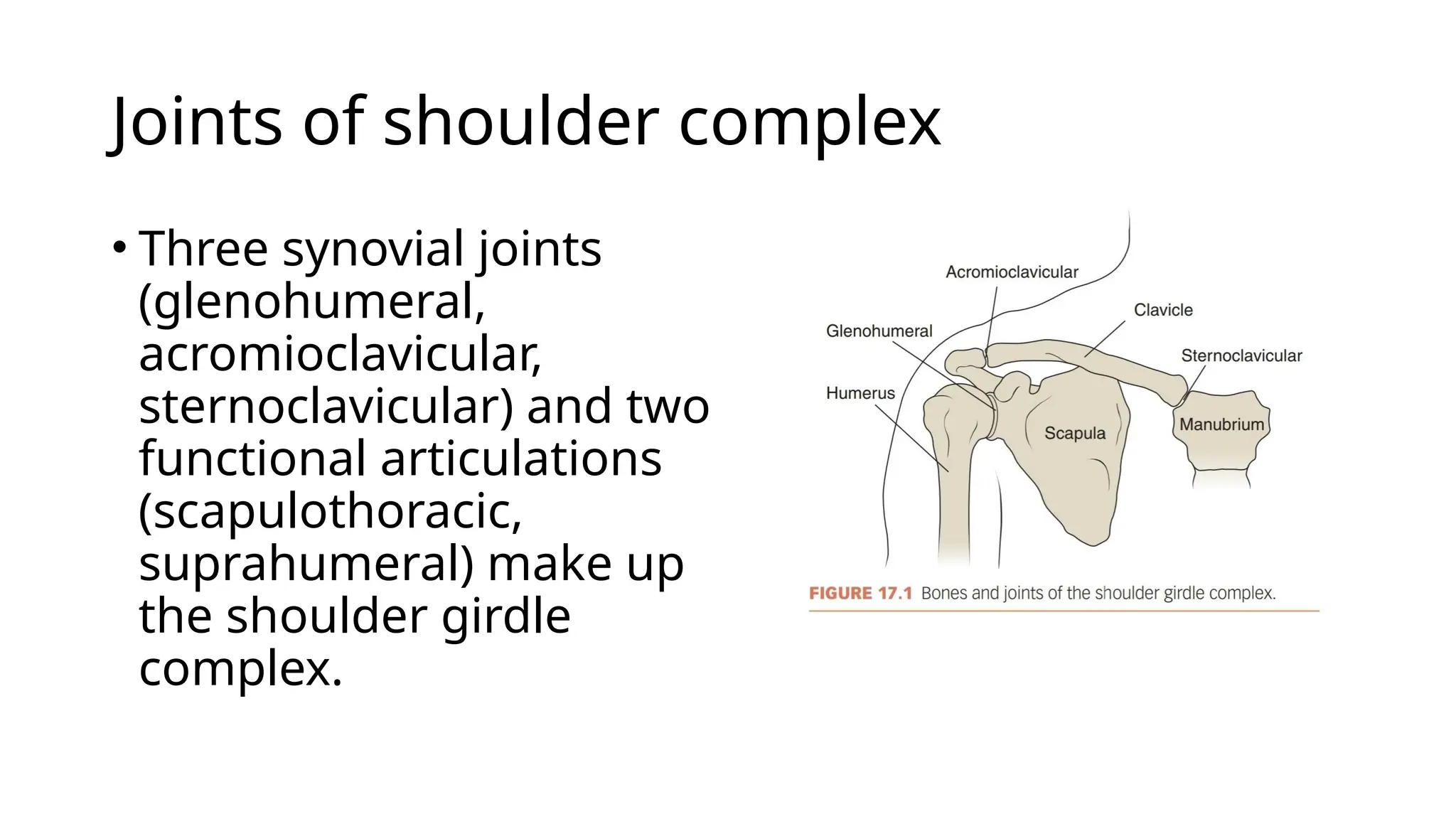
• Three synovial joints
(glenohumeral,
acromioclavicular,
sternoclavicular) and two
functional articulations
(scapulothoracic,
suprahumeral) make up
the shoulder girdle
complex.
Glenohumeral Joint
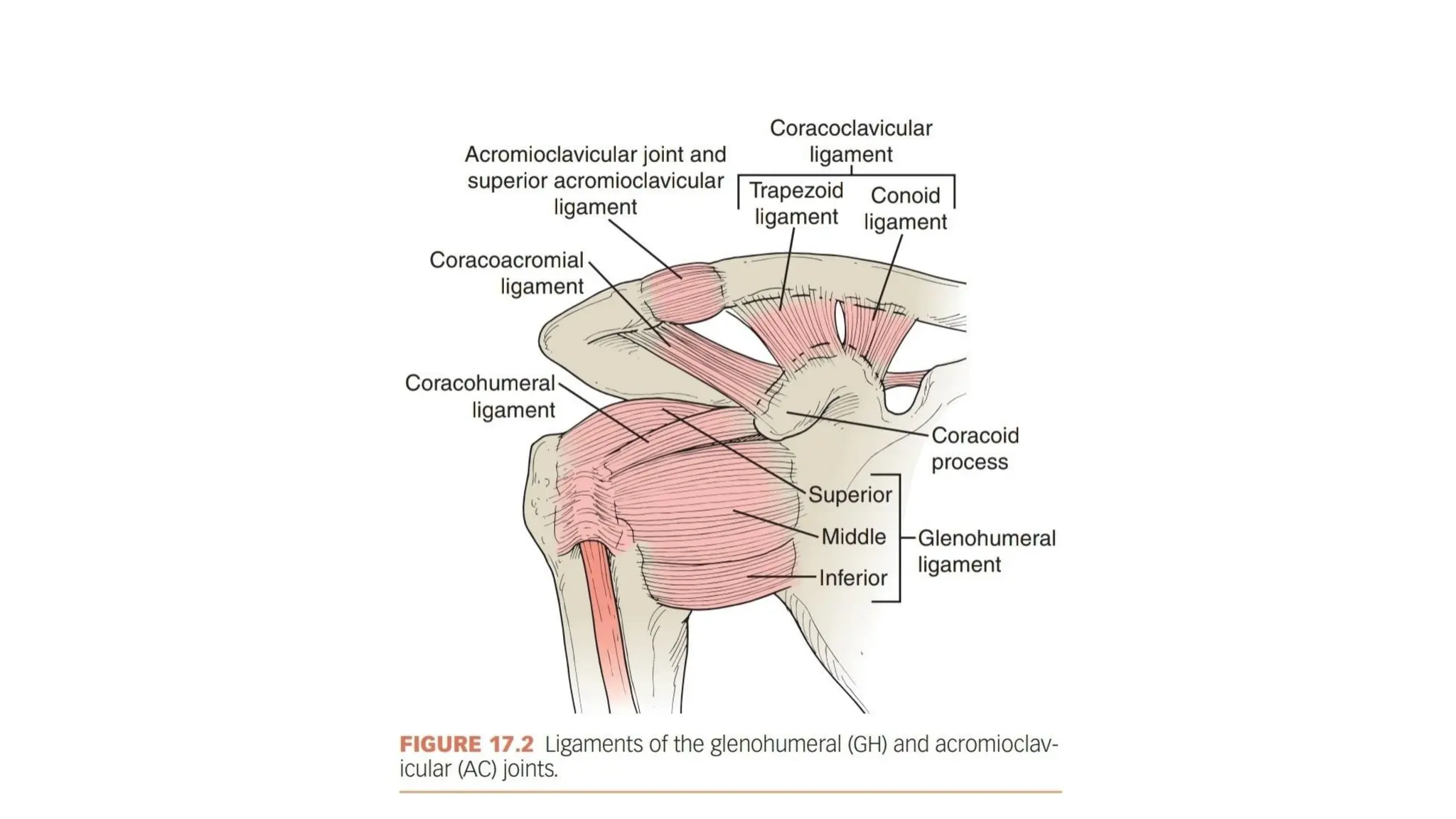
• The glenohumeral (GH) joint is an incongruous,
ball-and-socket (spheroidal) triaxial joint with a
lax joint capsule. It is supported by the tendons
of the rotator cuff and the glenohumeral
(superior, middle, inferior) and coracohumeral
ligaments.
• A fibrocartilagenous lip, the glenoid labrum,
deepens the fossa for greater congruity and
serves as the attachment site for the capsule.
Arthokinematics of GH Joint
• According to the convex-concave theory of joint motion ,
with motions of the humerus (physiological motions), the
convex head rolls in the same direction and slides in the
opposite direction in the glenoid fossa.
Stability of GH joint
Static Stability-
The structural
relationship of the
boney anatomy,
ligaments, glenoid
labrum, and the
adhesive and cohesive
forces in the joint
provide static stability.
Dynamic stability-
• The tendons of the rotator cuff blend with the ligaments and
glenoid labrum at their sites of attachment, so when the muscles
contract, they provide dynamic stability by tightening the static
restraint.
• In addition, the long head of the biceps and the long head of the
triceps brachii reinforce the capsule with their attachments and
provide superior and inferior shoulder joint support respectively,
when functioning with elbow motions.
• long head of the biceps, in particular, stabilizes against humeral
elevation and contributes to anterior stability of the glenohumeral
joint by resisting torsional forces when the shoulder is abducted
and externally rotated
Sternoclavicular joint
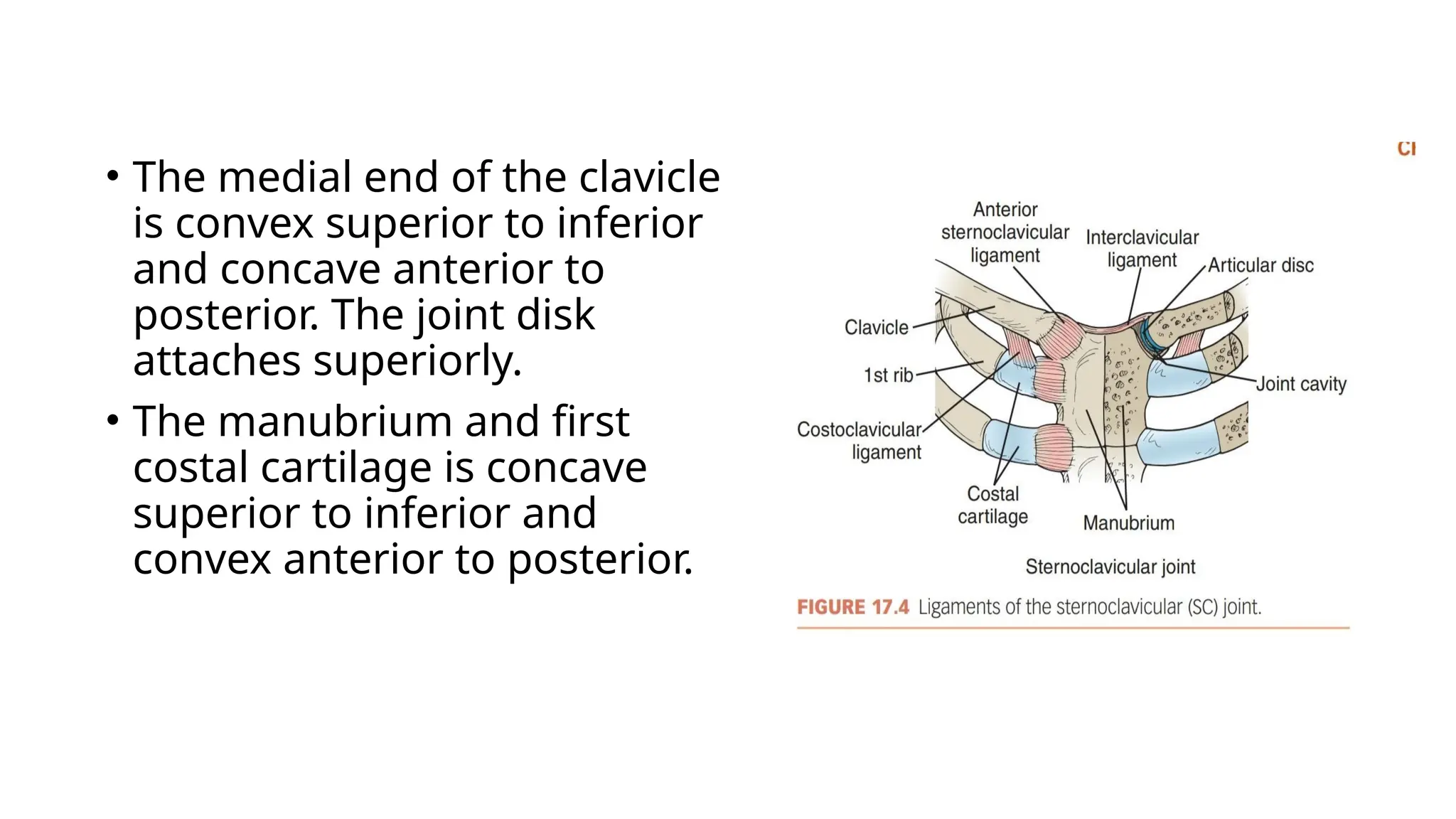
• The SC joint is an
incongruent, triaxial,
saddle-shaped join with a
disk. The joint is supported
by the anterior and
posterior SC ligaments and
the interclavicular and
costoclavicular ligaments.
• The medial end of the clavicle
is convex superior to inferior
and concave anterior to
posterior. The joint disk
attaches superiorly.
• The manubrium and first
costal cartilage is concave
superior to inferior and
convex anterior to posterior.
Arthokinematics of SC joint
• The motions of the clavicle occur as a result of the scapular
motions of elevation, depression, protraction (abduction),
and retraction (adduction).
• Posterior Rotation of the clavicle occurs as an accessory
motion when the humerus is elevated above the horizontal
position and the scapula upwardly rotates; it cannot occur
as an isolated voluntary motion.
Arthokinematics of SC joint
Stability of SC Joint
• The ligaments crossing the joint provide static stability.
There are no muscles crossing the joint for dynamic stability.
Acromioclavicular Joint
• The AC joint is a plane, triaxial
joint that may or may not have
a disk. The weak capsule is
reinforced by the superior and
inferior AC ligaments.
• The convex articular surface is
a facet on the lateral end of the
clavicle and the concave
articular surface is a facet on
the acromion of the scapula.
Arthokinematics of AC Joint
• With motions of the scapula, the concave acromial surface
slide in the same direction in which the scapula moves.
Motions affecting this joint include upward rotation (the
scapula turns so the glenoid fossa rotates upward),
downward rotation, winging of the vertebral border (also
called internal/external rotation), and tilting of the inferior
angle.
Stability of AC Joint
• The AC ligaments are supported by the strong
coracoclavicular ligament. No muscles directly cross this
joint for dynamic support.
Functional articulation joints
• Scapulothoarcic
articulations-
Motions of the Scapula .
Upward and Downward
rotation
Protraction and
Retraction
Internal and external
rotation
Anterior and posterior
tilting
Elevation and depression-
Elevation and depression occur in
the frontal plane as the scapula
moves upward and downward.
Protraction and retraction-
occur in the transverse plane
as the scapula moves away
from or toward the spinal
column.
Upward and downward
rotation:
• These motions are seen with
clavicular motions at the SC
joint and rotation at the AC
joint and occur concurrently in
various planes with motions of
the humerus.
• Upward rotation (along with
posterior tilting and external
rotation of the scapula) are
component motions that
occur with full shoulder ROM
of elevation.
Internal and external rotation and tilting (tipping):
These motions are seen with motion at the AC joint concurrently
with motions of the humerus.
Internal and external rotations are transverse plane motions in
which the medial border lifts away from (wings) or approximates
the rib cage, respectively.
Anterior tilting of the scapula occurs in conjunction with internal
rotation and extension of the humerus when reaching the hand
behind the back, while posterior tilting occurs during humeral
elevation.
Scapular stability
Weight of upper extremity creates downward rotation and
protraction moment on the scapula.
Active arm motions –
With active arm motions, the muscles of the scapula function
in synchrony to stabilize and control the position of the
scapula, so the scapulohumeral muscles can maintain an
effective length-tension relationship as they function to
stabilize and move the humerus. Without the positional
control of the scapula, the efficiency of the humeral muscles
decreases.
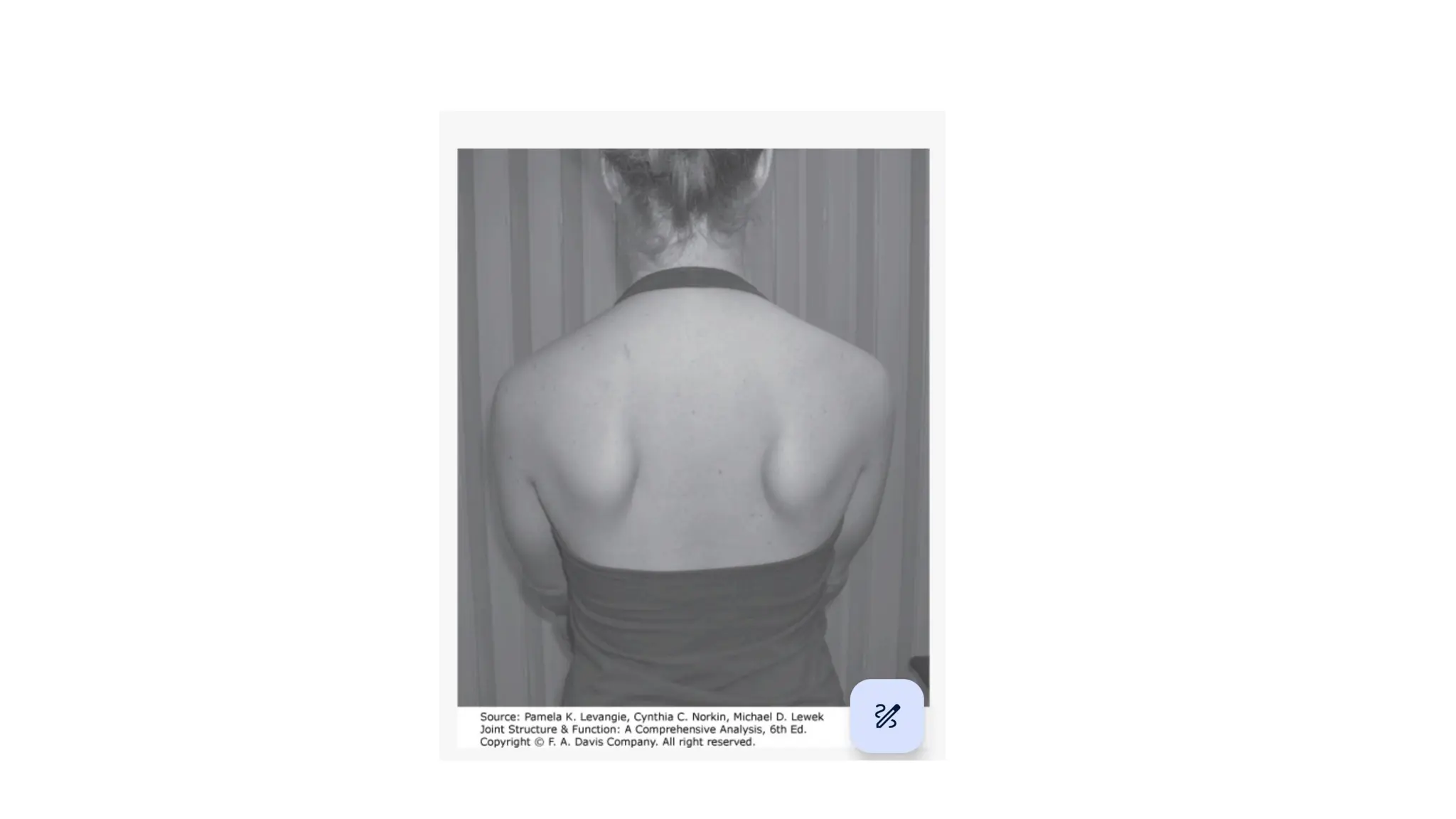
• The upper and lower trapezius along with the serratus anterior
upwardly rotate the scapula whenever the arm elevates, and the
serratus anterior protracts the scapula on the thorax to align the
scapula during flexion or pushing activities.
• During arm extension or during pulling activities, the rhomboids
function to downwardly rotate and retract the scapula in
synchrony with the latissimus dorsi, teres major, and rotator cuff
muscles. These stabilizing muscles also eccentrically control
acceleration of upward rotation and protraction of the scapula
Scapuolohumeral Rhythm
• Motion of the scapula, synchronous with motions of the humerus,
allows for 150° to 180° of shoulder ROM into flexion or abduction
with elevation.
• The ratio has considerable variation among individuals but is
commonly accepted to average 2:1 (2° of GH motion to 1° of
scapular rotation) at the end of full arm elevation.
• During the setting phase (0° to 30° abduction, 0° to 60° flexion),
motion is primarily at the GH joint, whereas the scapula seeks a
stable position. During the midrange of humeral motion, the scapula
has greater motions, approaching a 1:1 ratio with the humerus; later
in the range, the GH joint again dominates the motion
• More recent three-dimensional research demonstrated
component scapular motions to be upward rotation, posterior
tilting, and scapular external rotation with full shoulder elevation.
Clavicular Elevation and Rotation With Humeral Motion
It is commonly accepted that the first 30° of upward rotation of
the scapula occurs with elevation of the clavicle at the SC joint.
Then, as the coracoclavicular ligament becomes taut, the clavicle
rotates 38° to 55° about its longitudinal axis, which elevates its
acromial end (because it is crank shaped). This motion allows the
scapula to rotate an additional 30° at the AC joint.
External Rotation of the Humerus
With Elevation
• During elevation of the arm, the humerus externally rotates;
this allows the greater tubercle of the humerus to clear the
coracoacromial arch. Weak infraspinatus and teres minor
muscles or inadequate external rotation may result in
impingement of the soft tissues in the suprahumeral space,
causing pain, inflammation, and eventually loss of function.
Deltoid–Short Rotator Cuff
and Supraspinatus Mechanisms
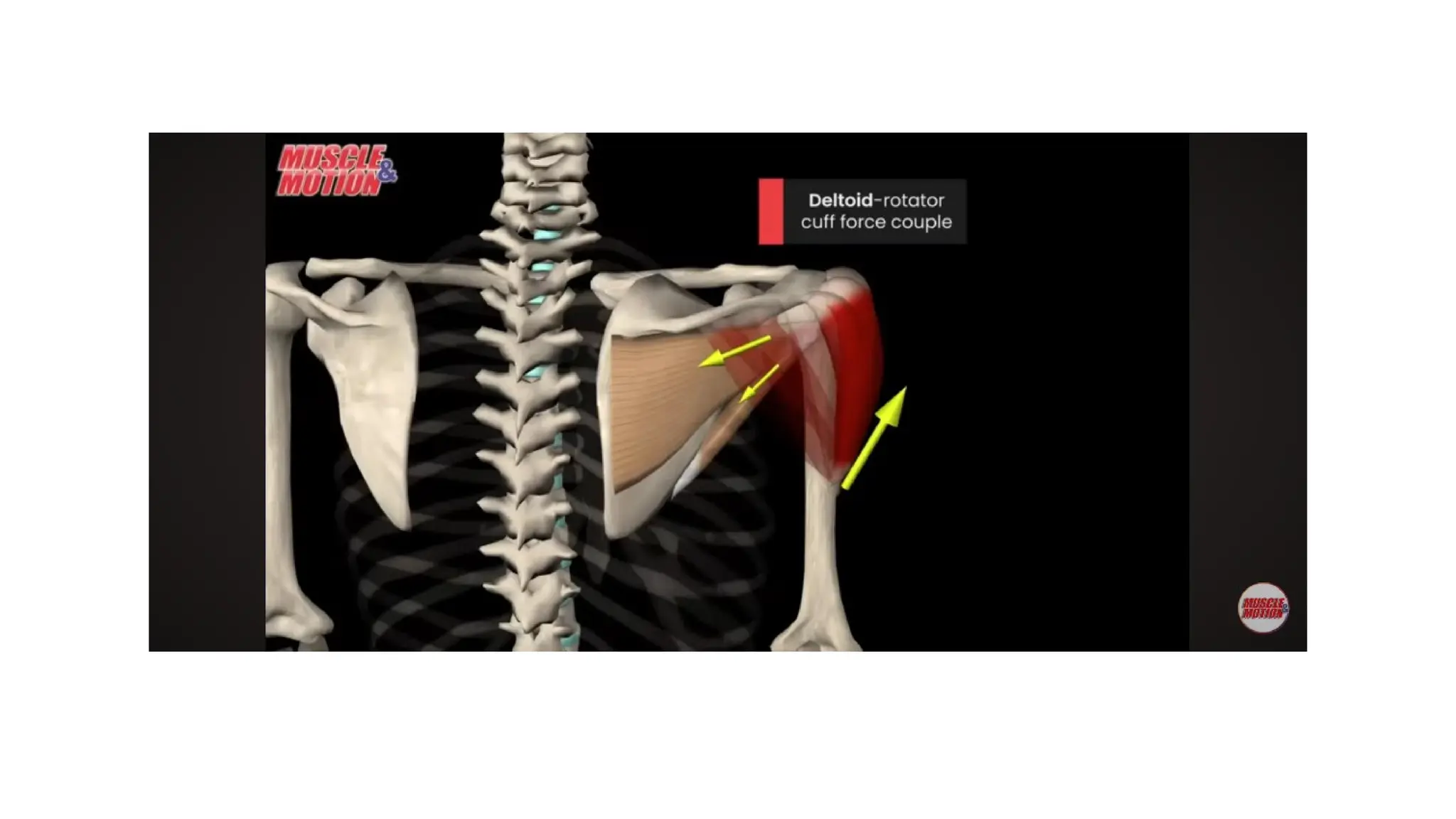
• Most of the force
produced by the deltoid
muscle causes upward
translation of the
humerus; if unopposed,
it leads to impingement
of the soft tissues in the
suprahumeral space
between the humeral
head and the
coracoacromial arch.
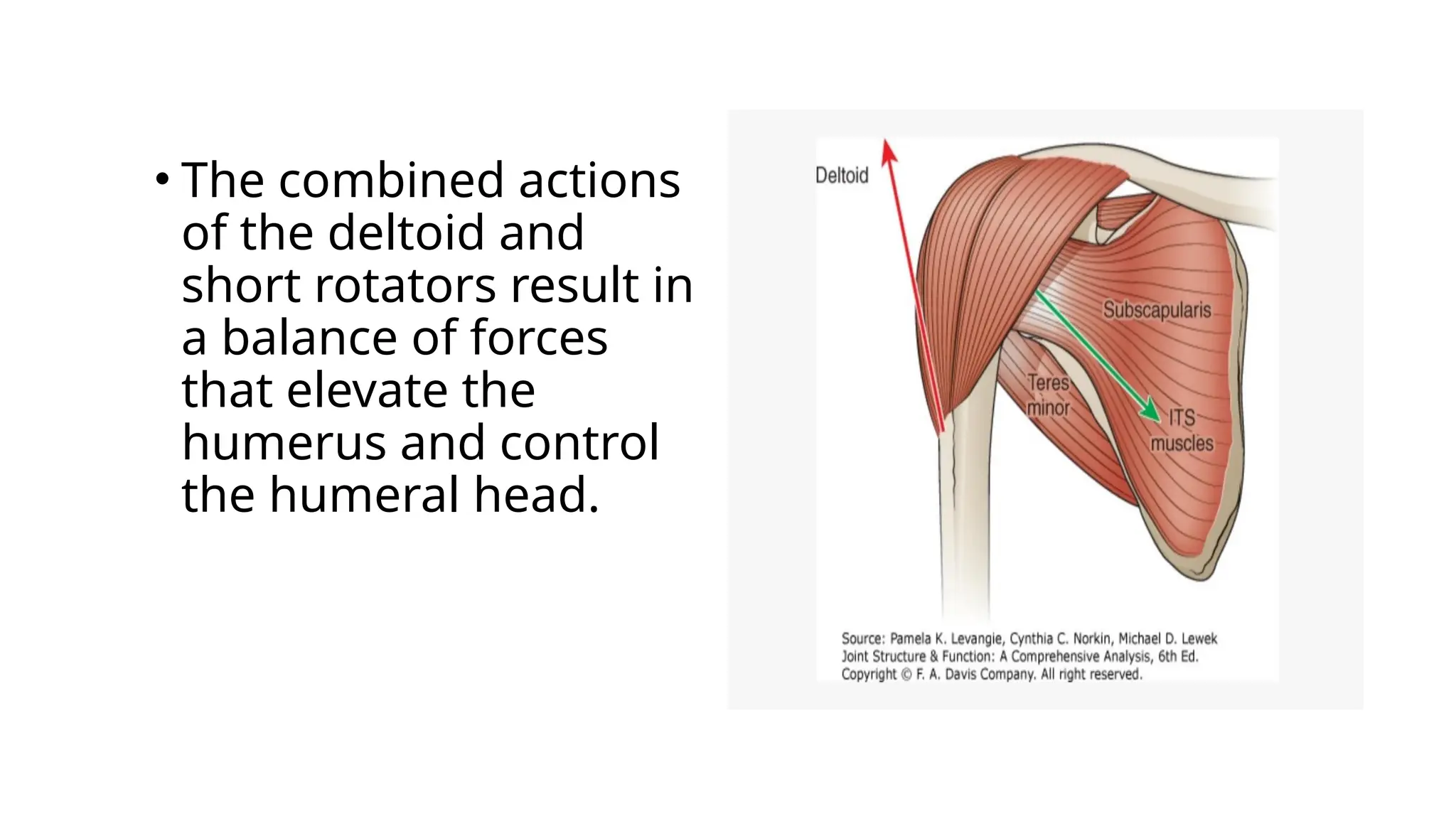
• The combined effect of
the short rotator
muscles (infraspinatus,
teres minor, and
subscapularis) produces
stabilizing compression
and downward
translation of the
humerus in the glenoid.
• The combined actions
of the deltoid and
short rotators result in
a balance of forces
that elevate the
humerus and control
the humeral head.
• The supraspinatus
muscle has a significant
stabilizing, compressive,
and slight upward
translation effect on the
humerus during arm
elevation. It functions
with the deltoid in
humeral elevation.
• The upper and lower trapezius and the serratus anterior
muscles create upward rotation of the scapula. Weakness or
complete paralysis of these muscles results in the scapula
rotating downward by the contracting deltoid and
supraspinatus as abduction or flexion is attempted. These
two muscles then reach active insufficiency, and functional
elevation of the arm cannot be reached, even though there
may be normal passive ROM and normal strength in the
shoulder abductor and flexor muscles.
References
• Therapeutic exercises foundation and techniques ,kinser
and Colby 7th
edition.
• Joint structure and function , Pamela et al 6th
edition.
Questions and answers
• What is convex – concave rule ?
• in which direction sliding occurs during shoulder
abduction?
• in which direction during shoulder elevation clavicle
rotation occurs?
Thank
you

shoulder complex by Dr kaustubh Maktedar

  • 1.
    Shoulder complex Dr. KaustubhMaktedar M.P.T ( musculoskeletal )
  • 2.
    Contents • Convex concaverule • Joints of shoulder complex • Synovial joints • Functional articulation joints • Scapulohumeral rhythm
  • 3.
    Convex concave rule Ifthe surface of the moving bone is convex, sliding is in the direction opposite to that of the angular movement of the bone. • If the surface of the moving bone is concave, sliding is in the same direction as the angular movement of the bone.
  • 5.
    Joints of shouldercomplex • Three synovial joints (glenohumeral, acromioclavicular, sternoclavicular) and two functional articulations (scapulothoracic, suprahumeral) make up the shoulder girdle complex.
  • 6.
    Glenohumeral Joint • Theglenohumeral (GH) joint is an incongruous, ball-and-socket (spheroidal) triaxial joint with a lax joint capsule. It is supported by the tendons of the rotator cuff and the glenohumeral (superior, middle, inferior) and coracohumeral ligaments. • A fibrocartilagenous lip, the glenoid labrum, deepens the fossa for greater congruity and serves as the attachment site for the capsule.
  • 8.
    Arthokinematics of GHJoint • According to the convex-concave theory of joint motion , with motions of the humerus (physiological motions), the convex head rolls in the same direction and slides in the opposite direction in the glenoid fossa.
  • 10.
    Stability of GHjoint Static Stability- The structural relationship of the boney anatomy, ligaments, glenoid labrum, and the adhesive and cohesive forces in the joint provide static stability.
  • 11.
    Dynamic stability- • Thetendons of the rotator cuff blend with the ligaments and glenoid labrum at their sites of attachment, so when the muscles contract, they provide dynamic stability by tightening the static restraint. • In addition, the long head of the biceps and the long head of the triceps brachii reinforce the capsule with their attachments and provide superior and inferior shoulder joint support respectively, when functioning with elbow motions. • long head of the biceps, in particular, stabilizes against humeral elevation and contributes to anterior stability of the glenohumeral joint by resisting torsional forces when the shoulder is abducted and externally rotated
  • 12.
    Sternoclavicular joint • TheSC joint is an incongruent, triaxial, saddle-shaped join with a disk. The joint is supported by the anterior and posterior SC ligaments and the interclavicular and costoclavicular ligaments.
  • 13.
    • The medialend of the clavicle is convex superior to inferior and concave anterior to posterior. The joint disk attaches superiorly. • The manubrium and first costal cartilage is concave superior to inferior and convex anterior to posterior.
  • 14.
    Arthokinematics of SCjoint • The motions of the clavicle occur as a result of the scapular motions of elevation, depression, protraction (abduction), and retraction (adduction). • Posterior Rotation of the clavicle occurs as an accessory motion when the humerus is elevated above the horizontal position and the scapula upwardly rotates; it cannot occur as an isolated voluntary motion.
  • 15.
  • 18.
    Stability of SCJoint • The ligaments crossing the joint provide static stability. There are no muscles crossing the joint for dynamic stability.
  • 19.
    Acromioclavicular Joint • TheAC joint is a plane, triaxial joint that may or may not have a disk. The weak capsule is reinforced by the superior and inferior AC ligaments. • The convex articular surface is a facet on the lateral end of the clavicle and the concave articular surface is a facet on the acromion of the scapula.
  • 20.
    Arthokinematics of ACJoint • With motions of the scapula, the concave acromial surface slide in the same direction in which the scapula moves. Motions affecting this joint include upward rotation (the scapula turns so the glenoid fossa rotates upward), downward rotation, winging of the vertebral border (also called internal/external rotation), and tilting of the inferior angle.
  • 21.
    Stability of ACJoint • The AC ligaments are supported by the strong coracoclavicular ligament. No muscles directly cross this joint for dynamic support.
  • 22.
    Functional articulation joints •Scapulothoarcic articulations- Motions of the Scapula . Upward and Downward rotation Protraction and Retraction Internal and external rotation Anterior and posterior tilting
  • 23.
    Elevation and depression- Elevationand depression occur in the frontal plane as the scapula moves upward and downward. Protraction and retraction- occur in the transverse plane as the scapula moves away from or toward the spinal column.
  • 24.
    Upward and downward rotation: •These motions are seen with clavicular motions at the SC joint and rotation at the AC joint and occur concurrently in various planes with motions of the humerus. • Upward rotation (along with posterior tilting and external rotation of the scapula) are component motions that occur with full shoulder ROM of elevation.
  • 26.
    Internal and externalrotation and tilting (tipping): These motions are seen with motion at the AC joint concurrently with motions of the humerus. Internal and external rotations are transverse plane motions in which the medial border lifts away from (wings) or approximates the rib cage, respectively. Anterior tilting of the scapula occurs in conjunction with internal rotation and extension of the humerus when reaching the hand behind the back, while posterior tilting occurs during humeral elevation.
  • 27.
    Scapular stability Weight ofupper extremity creates downward rotation and protraction moment on the scapula. Active arm motions – With active arm motions, the muscles of the scapula function in synchrony to stabilize and control the position of the scapula, so the scapulohumeral muscles can maintain an effective length-tension relationship as they function to stabilize and move the humerus. Without the positional control of the scapula, the efficiency of the humeral muscles decreases.
  • 28.
    • The upperand lower trapezius along with the serratus anterior upwardly rotate the scapula whenever the arm elevates, and the serratus anterior protracts the scapula on the thorax to align the scapula during flexion or pushing activities. • During arm extension or during pulling activities, the rhomboids function to downwardly rotate and retract the scapula in synchrony with the latissimus dorsi, teres major, and rotator cuff muscles. These stabilizing muscles also eccentrically control acceleration of upward rotation and protraction of the scapula
  • 30.
    Scapuolohumeral Rhythm • Motionof the scapula, synchronous with motions of the humerus, allows for 150° to 180° of shoulder ROM into flexion or abduction with elevation. • The ratio has considerable variation among individuals but is commonly accepted to average 2:1 (2° of GH motion to 1° of scapular rotation) at the end of full arm elevation. • During the setting phase (0° to 30° abduction, 0° to 60° flexion), motion is primarily at the GH joint, whereas the scapula seeks a stable position. During the midrange of humeral motion, the scapula has greater motions, approaching a 1:1 ratio with the humerus; later in the range, the GH joint again dominates the motion
  • 31.
    • More recentthree-dimensional research demonstrated component scapular motions to be upward rotation, posterior tilting, and scapular external rotation with full shoulder elevation. Clavicular Elevation and Rotation With Humeral Motion It is commonly accepted that the first 30° of upward rotation of the scapula occurs with elevation of the clavicle at the SC joint. Then, as the coracoclavicular ligament becomes taut, the clavicle rotates 38° to 55° about its longitudinal axis, which elevates its acromial end (because it is crank shaped). This motion allows the scapula to rotate an additional 30° at the AC joint.
  • 32.
    External Rotation ofthe Humerus With Elevation • During elevation of the arm, the humerus externally rotates; this allows the greater tubercle of the humerus to clear the coracoacromial arch. Weak infraspinatus and teres minor muscles or inadequate external rotation may result in impingement of the soft tissues in the suprahumeral space, causing pain, inflammation, and eventually loss of function.
  • 34.
    Deltoid–Short Rotator Cuff andSupraspinatus Mechanisms • Most of the force produced by the deltoid muscle causes upward translation of the humerus; if unopposed, it leads to impingement of the soft tissues in the suprahumeral space between the humeral head and the coracoacromial arch.
  • 35.
    • The combinedeffect of the short rotator muscles (infraspinatus, teres minor, and subscapularis) produces stabilizing compression and downward translation of the humerus in the glenoid.
  • 36.
    • The combinedactions of the deltoid and short rotators result in a balance of forces that elevate the humerus and control the humeral head.
  • 37.
    • The supraspinatus musclehas a significant stabilizing, compressive, and slight upward translation effect on the humerus during arm elevation. It functions with the deltoid in humeral elevation.
  • 40.
    • The upperand lower trapezius and the serratus anterior muscles create upward rotation of the scapula. Weakness or complete paralysis of these muscles results in the scapula rotating downward by the contracting deltoid and supraspinatus as abduction or flexion is attempted. These two muscles then reach active insufficiency, and functional elevation of the arm cannot be reached, even though there may be normal passive ROM and normal strength in the shoulder abductor and flexor muscles.
  • 44.
    References • Therapeutic exercisesfoundation and techniques ,kinser and Colby 7th edition. • Joint structure and function , Pamela et al 6th edition.
  • 45.
    Questions and answers •What is convex – concave rule ? • in which direction sliding occurs during shoulder abduction? • in which direction during shoulder elevation clavicle rotation occurs?
  • 46.