Reliability of Scale
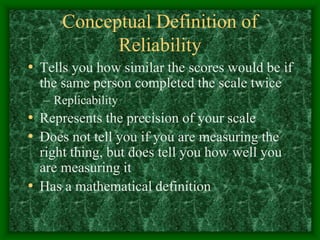
Conceptual Definition of
Reliability
• Tells you how similar the scores would be if
the same person completed the scale twice
– Replicability
• Represents the precision of your scale
• Does not tell you if you are measuring the
right thing, but does tell you how well you
are measuring it
• Has a mathematical definition
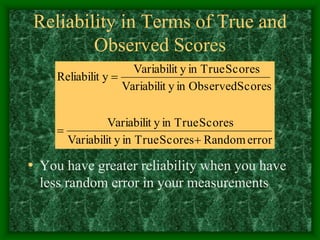
Reliability in Terms of True and
Observed Scores
• You have greater reliability when you have
less random error in your measurements
error
Random
Scores
True
in
y
Variabilit
Scores
True
in
y
Variabilit
Scores
Observed
in
y
Variabilit
Scores
True
in
y
Variabilit
y
Reliabilit



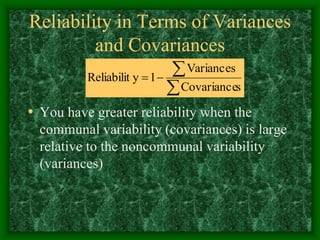
Reliability in Terms of Variances
and Covariances
• You have greater reliability when the
communal variability (covariances) is large
relative to the noncommunal variability
(variances)




s
Covariance
Variances
1
y
Reliabilit
Reliability as Internal
Consistency
• Internal consistency refers to the relations
among the items in your scale
• The reliability of a scale is usually
estimated by its internal consistency
• Chronbach’s alpha is the most common
method of determining internal consistency
Chronbach’s alpha
• Primarily determined by the mean inter-
item correlation
– Higher correlations = higher alpha
• Also influenced by the number of items
– More items = higher alpha
 r
k
r
k
1
1 



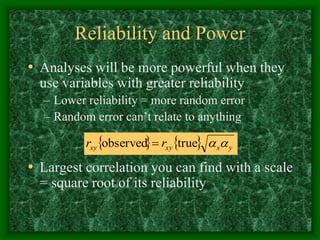
Reliability and Power
• Analyses will be more powerful when they
use variables with greater reliability
– Lower reliability = more random error
– Random error can’t relate to anything
• Largest correlation you can find with a scale
= square root of its reliability
    y
x
xy
xy r
r 

true
observed 
Estimating Reliability Using
Parallel Measurements
• You can also estimate reliability as the
correlation of two parallel measurements
– Random variability of the two measurements
shouldn’t relate
– Correlation between two measures of the same
person should just represent variability related
to the latent factor
Estimating Reliability Using
Parallel Measurements
• Even though both internal consistency and
parallel measurements can be used as
estimates of reliability, they are slightly
different
– “Random error” in internal consistency
reliability represents measurement error
– “Random error” in parallel measurements
reliability represents measurement error and
change in the construct over time
Split-Half Reliability
• One special case of parallel measurements
is when you divide your scale into two sets
of items and treat the scores on each half as
a parallel measurement
• People commonly use odd/even split
– First half/second half not appropriate because
scores in the second half might be affected by
fatigue where scores in the first half will not
Split-Half Reliability
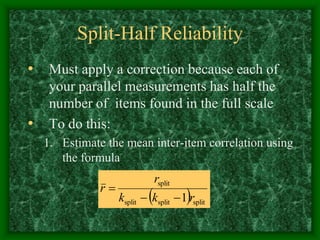
• Must apply a correction because each of
your parallel measurements has half the
number of items found in the full scale
• To do this:
1. Estimate the mean inter-item correlation using
the formula
 split
split
split
split
1 r
k
k
r
r



Split-Half Reliability
2. Calculate reliability using the formula
• Chronbach’s alpha is actually the average
of all possible split-halves
 r
k
r
k
1
1
y
reliabilit
full
full




Scale development -- Reliability

  • 1.
  • 2.
    Conceptual Definition of Reliability •Tells you how similar the scores would be if the same person completed the scale twice – Replicability • Represents the precision of your scale • Does not tell you if you are measuring the right thing, but does tell you how well you are measuring it • Has a mathematical definition
  • 3.
    Reliability in Termsof True and Observed Scores • You have greater reliability when you have less random error in your measurements error Random Scores True in y Variabilit Scores True in y Variabilit Scores Observed in y Variabilit Scores True in y Variabilit y Reliabilit   
  • 4.
    Reliability in Termsof Variances and Covariances • You have greater reliability when the communal variability (covariances) is large relative to the noncommunal variability (variances)     s Covariance Variances 1 y Reliabilit
  • 5.
    Reliability as Internal Consistency •Internal consistency refers to the relations among the items in your scale • The reliability of a scale is usually estimated by its internal consistency • Chronbach’s alpha is the most common method of determining internal consistency
  • 6.
    Chronbach’s alpha • Primarilydetermined by the mean inter- item correlation – Higher correlations = higher alpha • Also influenced by the number of items – More items = higher alpha  r k r k 1 1    
  • 7.
    Reliability and Power •Analyses will be more powerful when they use variables with greater reliability – Lower reliability = more random error – Random error can’t relate to anything • Largest correlation you can find with a scale = square root of its reliability     y x xy xy r r   true observed 
  • 8.
    Estimating Reliability Using ParallelMeasurements • You can also estimate reliability as the correlation of two parallel measurements – Random variability of the two measurements shouldn’t relate – Correlation between two measures of the same person should just represent variability related to the latent factor
  • 9.
    Estimating Reliability Using ParallelMeasurements • Even though both internal consistency and parallel measurements can be used as estimates of reliability, they are slightly different – “Random error” in internal consistency reliability represents measurement error – “Random error” in parallel measurements reliability represents measurement error and change in the construct over time
  • 10.
    Split-Half Reliability • Onespecial case of parallel measurements is when you divide your scale into two sets of items and treat the scores on each half as a parallel measurement • People commonly use odd/even split – First half/second half not appropriate because scores in the second half might be affected by fatigue where scores in the first half will not
  • 11.
    Split-Half Reliability • Mustapply a correction because each of your parallel measurements has half the number of items found in the full scale • To do this: 1. Estimate the mean inter-item correlation using the formula  split split split split 1 r k k r r   
  • 12.
    Split-Half Reliability 2. Calculatereliability using the formula • Chronbach’s alpha is actually the average of all possible split-halves  r k r k 1 1 y reliabilit full full   