Overview of Programmable Logic Control (PLC)
This presentation will allow you to get an understanding of what PLCs are.With this you will be able to recognize PLCsAnd also know the basics on how to use PLCs
 The information I have gathered gives a brief history of evolution of a programmable logic control, or PLC. The reason for changing from relay control systems to PLCs are given in this presentation. The ladder logic language, which was developed to simplify the task of programming PLCs, is introduced.Summary
ResearchLets start of by giving the definition of a PLC, it is a specialized computer used to control machines and processes.The designs of most PLCs are similar  to that of other computers.The PLC is an assembly of solid state  digital elements designed to make logical decisions and provide outputs.PLCs are used to control operate manufacturing process equipment and machinery.
PLCs offer several advantages over relay type controlsIncreased Reliability: once a program has been written and tested, it can be easily downloaded to other PLCs.More Flexibility: It has easier to create and change a program in a PLC than to wire and rewire circuit.Lower cost: PLC were originally designed to replace relay control logic, and the cost of savings have been so significant that relay control is becoming obsolete except for power applications
Advantages continuedCommunications capability: A PLC can communicate with other controllers or computer equipment to perform such functions as supervisory control, data gathering, and monitoring devices and process parameters, and down load and up load programsFaster response time: PLCs are designed for high speed and real time applicationsEasier to trouble shoot: PLCS have resident diagnostics and override functions that allow users to easily trace and correct software and hardware problems.
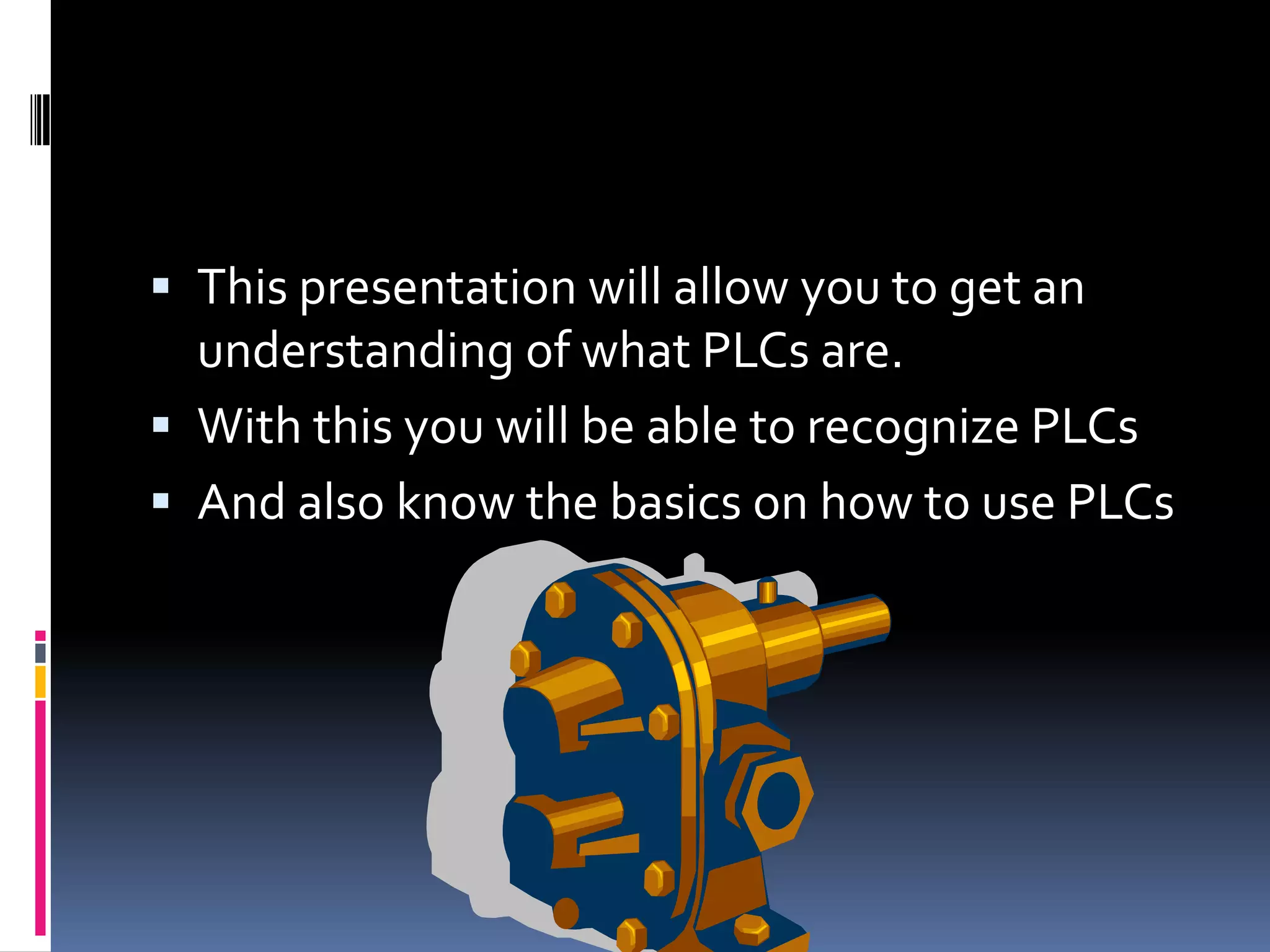
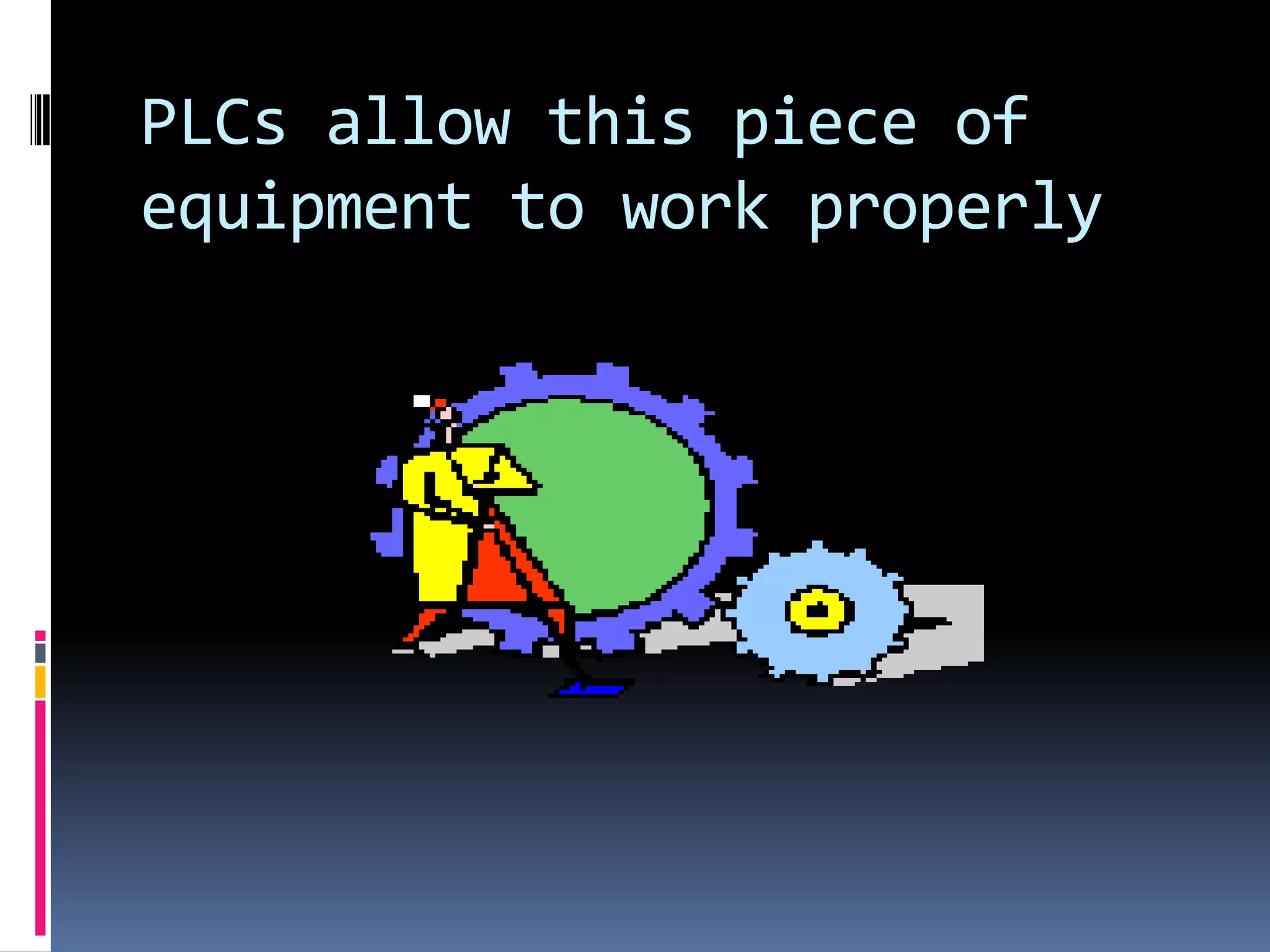
PLCs allow this piece of equipment to work properly
Components PLC hasThe central processing unit(CPU)The input/output sectionPower supply Programming device
ResearchA well designed PLC is not usually affected by the electrical noise inherent in most industrial locations.A distinction between PLCs and computers is that the hardware and the software of PLCs are designed for easy use by plant electricians and technicians.
Five classes of PLCsNanoMicroSmallMediumLargeThe criteria used in categorizing PLCs include functionally, number of inputs and outputs, cost and physical size.

Burns Presantation

  • 1.
    Overview of ProgrammableLogic Control (PLC)
  • 2.
    This presentation willallow you to get an understanding of what PLCs are.With this you will be able to recognize PLCsAnd also know the basics on how to use PLCs
  • 3.
    The informationI have gathered gives a brief history of evolution of a programmable logic control, or PLC. The reason for changing from relay control systems to PLCs are given in this presentation. The ladder logic language, which was developed to simplify the task of programming PLCs, is introduced.Summary
  • 4.
    ResearchLets start ofby giving the definition of a PLC, it is a specialized computer used to control machines and processes.The designs of most PLCs are similar to that of other computers.The PLC is an assembly of solid state digital elements designed to make logical decisions and provide outputs.PLCs are used to control operate manufacturing process equipment and machinery.
  • 5.
    PLCs offer severaladvantages over relay type controlsIncreased Reliability: once a program has been written and tested, it can be easily downloaded to other PLCs.More Flexibility: It has easier to create and change a program in a PLC than to wire and rewire circuit.Lower cost: PLC were originally designed to replace relay control logic, and the cost of savings have been so significant that relay control is becoming obsolete except for power applications
  • 6.
    Advantages continuedCommunications capability:A PLC can communicate with other controllers or computer equipment to perform such functions as supervisory control, data gathering, and monitoring devices and process parameters, and down load and up load programsFaster response time: PLCs are designed for high speed and real time applicationsEasier to trouble shoot: PLCS have resident diagnostics and override functions that allow users to easily trace and correct software and hardware problems.
  • 7.
    PLCs allow thispiece of equipment to work properly
  • 8.
    Components PLC hasThecentral processing unit(CPU)The input/output sectionPower supply Programming device
  • 9.
    ResearchA well designedPLC is not usually affected by the electrical noise inherent in most industrial locations.A distinction between PLCs and computers is that the hardware and the software of PLCs are designed for easy use by plant electricians and technicians.
  • 10.
    Five classes ofPLCsNanoMicroSmallMediumLargeThe criteria used in categorizing PLCs include functionally, number of inputs and outputs, cost and physical size.