Copyright ©2012 Pearson Inc.
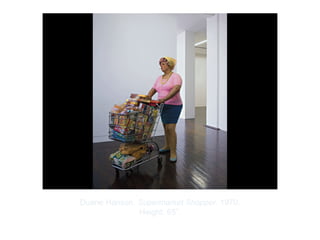
Duane Hanson. Supermarket Shopper. 1970.
Height: 65”.
Europe After the War: The Existential Quest
What is existentialism?
• Christian Existentialism: Kierkegaard, Niebuhr, and Tillich
— In the face of countless deaths, pessimism reigned, and ideological
conflict between the Western po0wers and the Eastern bloc
exacerbated a growing sense of meaninglessness, alienation, and
anxiety. Christianity found itself in crisis as well. Kierkegaard had
argued that Christians must live in a state of anguish caused by their
own freedom of choice. Niebuhr and Tillich further articulated this
position of Christian existentialism in America.
• The Philosophy of Sartre: Atheistic Existentialism — Sartre
argued for what is termed atheistic existentialism. Living in a universe
without God, and thus without revealed morality, individuals must
nevertheless choose to act ethically.
• De Beauvoir and Existential Feminism — Simone de Beauvoir
argued that women had passively allowed men to define them rather
than creating themselves.
• The Literature of Existentialism — The Stranger by Albert Camus
offers an antihero who refuses to admit to feelings that are absent even
though it condemns him. The Theater of the Absurd is a theater in
which the meaninglessness of existence is the central thematic concern
as is seen in Sartre’s No Exit. The most popular of the absurdist plays
is Samuel Beckett’s Waiting for Godot.
• The Art of Existentialism — Faced with the lack of life’s meaning
that Sartre’s existentialism proposed, painters and sculptors sought to
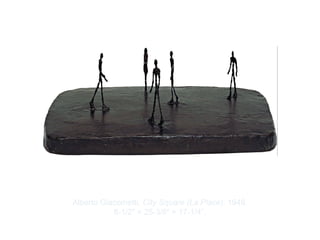
explore the truth of this condition in their own terms. Alberto Giacometti
produced City Square which was admired by Sartre. The French artist,
Jean Dubuffet created art brut, “raw art” from those unaffected by or
untrained in cultural convention.
• Discussion Question: What are the existentialist themes in the work of
Camus and Beckett?
Copyright ©2012 Pearson Inc.
Alberto Giacometti. City Square (La Place). 1948.
8-1/2" × 25-3/8" × 17-1/4”.
America After the War: Triumph and Doubt
What is Abstract Expressionism?
• The Triumph of American Art: Abstract Expressionism —
The individualistic spirit of Abstract Expressionism was seen as the
antithesis of communism, and their work was meant to convey the
message that America had not only triumphed in the war, but in art and
culture as well. New York, not Paris, was now the center of the art
world.
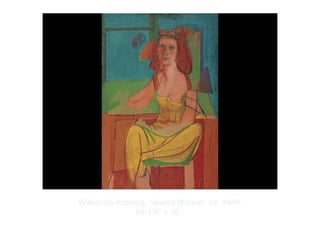
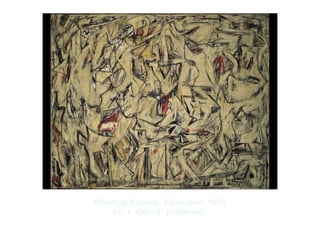
• Jackson Pollock plumbed the depths of the psyche and de Kooning
represents the psyche’s encounter with the world. Although excluded
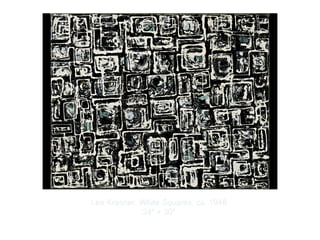
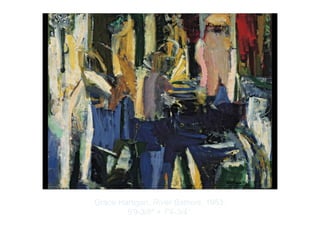
from the inner (male) circle, a number of the women associated with
Abstract Expressionism were painters of exceptional ability. Both
Elaine de Kooning and Lee Krasner developed their own styles
separate from their husband’s. Joan Mitchell was obsessed with water
and was influenced by Monet.
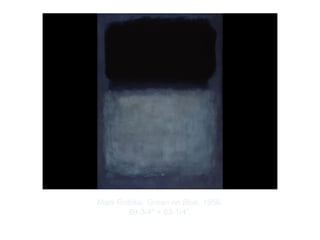
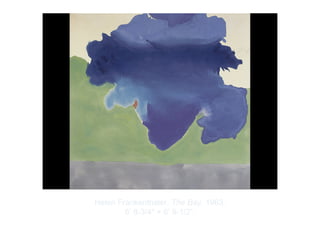
• Both Rothko and Frankenthaler offered viewers a more meditative and
quiet painting based on large expanses of relatively undifferentiated
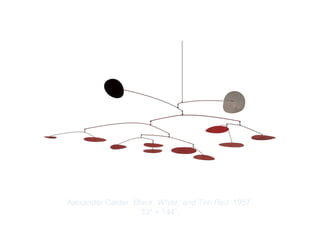
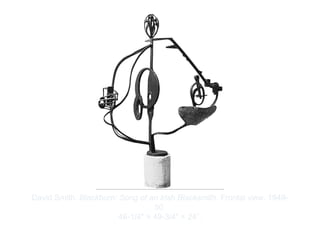
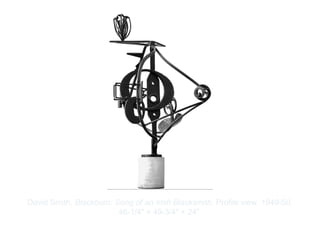
color. Calder and Smith demonstrated that sculpture could partake of
the same gestural freedom and psychological abstraction as Abstract
Expressionist painting. It could become a field of action.
• Discussion Question: What role did women play in Abstract
Expressionism?
Copyright ©2012 Pearson Inc.
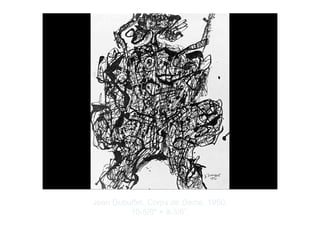
Jean Dubuffet. Corps de Dame. 1950.
10-5/8" × 8-3/8”.
Copyright ©2012 Pearson Inc.
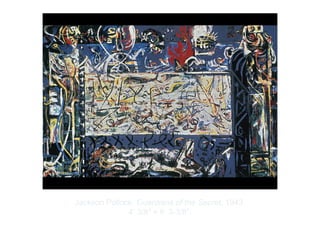
Jackson Pollock. Guardians of the Secret. 1943.
4’ 3/8" × 6’ 3-3/8”.
Copyright ©2012 Pearson Inc.
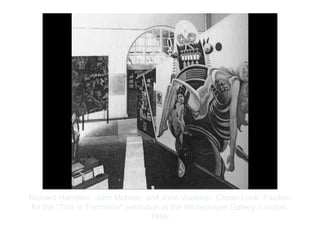
Richard Hamilton, John McHale, and John Voelcker. Closer Look: Pavilion
for the “This Is Tomorrow” exhibition at the Whitechapel Gallery, London.
1956.
 Closer Look: Richard Hamilton, Just What Is
It That Makes Today’s Homes So Different,
So Appealing?
MyArtsLabChapter 38 – After the War
Copyright ©2012 Pearson Inc.
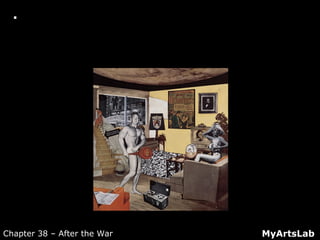
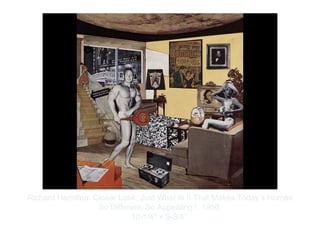
Richard Hamilton. Closer Look: Just What Is It That Makes Today’s Homes
So Different, So Appealing?. 1956.
10-1/4" × 9-3/4”.
Copyright ©2012 Pearson Inc.
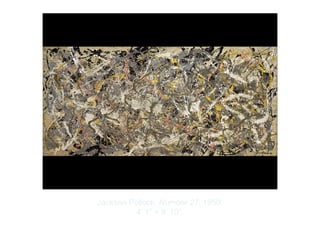
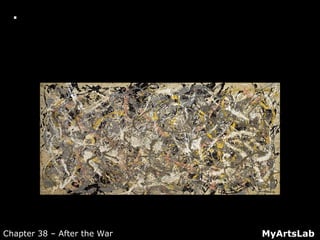
Jackson Pollock. Number 27. 1950.
4’ 1" × 8’ 10”.
 Video: Jackson Pollock at Work
MyArtsLabChapter 38 – After the War
Copyright ©2012 Pearson Inc.
Willem de Kooning. Seated Woman. ca. 1940.
54-1/4" × 36”.
Copyright ©2012 Pearson Inc.
Willem de Kooning. Pink Angels. 1945.
52" × 40”.
Copyright ©2012 Pearson Inc.
Willem de Kooning. Excavation. 1950.
81" × 100-1/4" (unframed).
Copyright ©2012 Pearson Inc.
Lee Krasner. White Squares. ca. 1948.
24" × 30”.
Copyright ©2012 Pearson Inc.
Grace Hartigan. River Bathers. 1953.
5'9-3/8" × 7'4-3/4”.
Copyright ©2012 Pearson Inc.
Joan Mitchell. Piano mécanique. 1958.
78" × 128”.
Copyright ©2012 Pearson Inc.
Mark Rothko. Green on Blue. 1956.
89-3/4" × 63-1/4”.
Copyright ©2012 Pearson Inc.
Helen Frankenthaler. The Bay. 1963.
6’ 8-3/4" × 6’ 9-1/2”.
Copyright ©2012 Pearson Inc.
Alexander Calder. Black, White, and Ten Red. 1957.
33" × 144”.
Copyright ©2012 Pearson Inc.
David Smith. Blackburn: Song of an Irish Blacksmith. Frontal view. 1949-
50.
46-1/4" × 49-3/4" × 24”.
Copyright ©2012 Pearson Inc.
David Smith. Blackburn: Song of an Irish Blacksmith. Profile view. 1949-50.
46-1/4" × 49-3/4" × 24”.
The Beat Generation
Who are the Beats?
• The Beat generation sought a heightened and, they believed, more
authentic style of life, defined by alienation, nonconformity, sexual
liberation, drugs, and alcohol.
• Robert Frank and Jack Kerouac — Frank published a book of
photographs as The Americans in 1958. The photographs captured
everyday, mundane things that might otherwise go by unseen, with a
sense of spontaneity and directness. Kerouac’s real-life adventures are
described in On the Road.
• Ginsberg and “Howl” — The work that best characterizes the Beat
generation is “Howl” by Allen Ginsberg. The publisher, Lawrence
Ferlinghetti was charged with obscenity; he was eventually acquitted.
• Cage and the Aesthetics of Chance — Ginsberg showed that
anything and everything could be admitted into the domain of art.
Composer John Cage “set about discovering means to let sounds be
themselves.” His composition 4’33” admits all manner of ambient
sound—whatever sounds happened during its performance were purely
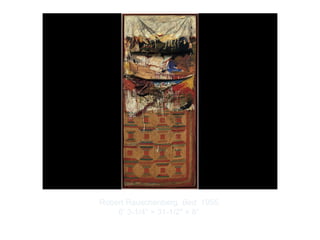
a matter of chance. Rauschenberg began to make combine paintings,
works in which all manner of materials are combined to create the work.
Theater Piece #1 inaugurated a collaboration between Cunningham
(dance, Cage (music), and Rauschenberg (décor and costume) that
would span many years. Jasper Johns focused on the most common,
seemingly obvious subject matter. Cage’s aesthetic of diversity and
inclusiveness also informs the inventive multimedia pieces of Alan
Kaprow.
• Architecture in the 1950s — The design of Frank Lloyd Wright for
the Guggenheim Museum in New York represents the spirit if
architectural innovation that still pervade the practice of architecture to
this day.
Copyright ©2012 Pearson Inc.
Robert Rauschenberg. Bed. 1955.
6’ 3-1/4" × 31-1/2" × 8”.
Copyright ©2012 Pearson Inc.
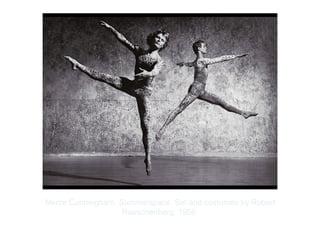
Merce Cunningham. Summerspace. Set and costumes by Robert
Rauschenberg. 1958.
Copyright ©2012 Pearson Inc.
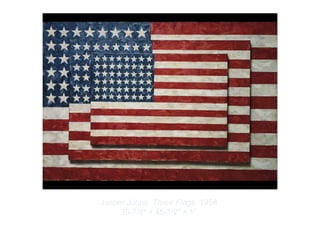
Jasper Johns. Three Flags. 1958.
30-7/8" × 45-1/2" × 5”.
Copyright ©2012 Pearson Inc.
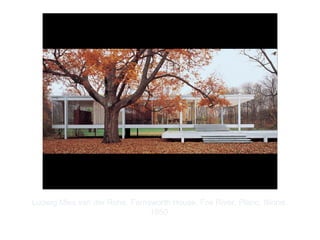
Ludwig Mies van der Rohe. Farnsworth House, Fox River, Plano, Illinois.
1950.
Copyright ©2012 Pearson Inc.
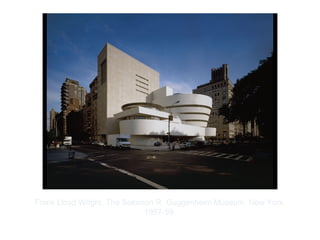
Frank Lloyd Wright. The Solomon R. Guggenheim Museum, New York.
1957-59.
Pop Art
What is Pop Art?
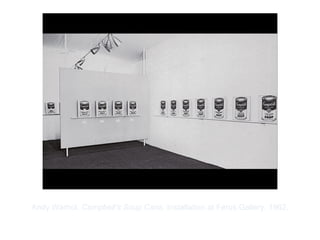
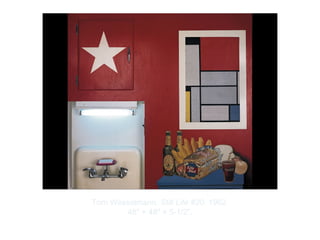
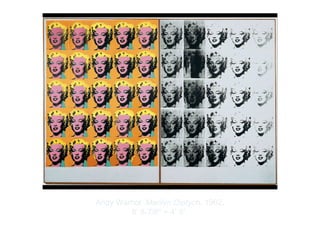
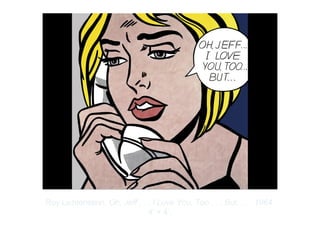
• In the early 1960s, a number of artists created a “realist” art that
represented reality in terms of the media—advertising, television, comic
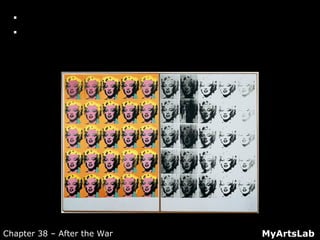
strips—the imagery of mass culture. The term Pop Art quickly became
attached to work such as Warhol’s famous paintings of Campbell’s
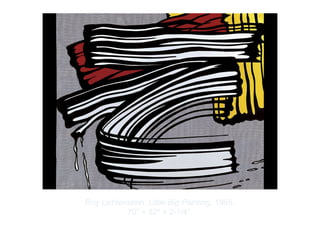
Soup cans. Roy Lichtenstein enlarged comic strip paintings. Claes
Oldenburg opened The Store, filled with life-size and over-life-size
sculptures of everything from pie a la mode, to hamburgers, hats, and
7-Up bottles.
• Discussion Question: How is pop art a rejection of commercialism?
Copyright ©2012 Pearson Inc.
Andy Warhol. Campbell’s Soup Cans. Installation at Ferus Gallery. 1962.
Copyright ©2012 Pearson Inc.
Tom Wesselmann. Still Life #20. 1962.
48" × 48" × 5-1/2”.
Copyright ©2012 Pearson Inc.
Andy Warhol. Marilyn Diptych. 1962.
6’ 8-7/8" × 4’ 9”.
 Closer Look: Andy Warhol, Marilyn Diptych
 Studio Technique Video: Silkscreen
MyArtsLabChapter 38 – After the War
Copyright ©2012 Pearson Inc.
Roy Lichtenstein. Oh, Jeff . . . I Love You, Too . . . But. . . . 1964.
4' × 4’.
Copyright ©2012 Pearson Inc.
Roy Lichtenstein. Little Big Painting. 1965.
70" × 82" × 2-1/4”.
Copyright ©2012 Pearson Inc.
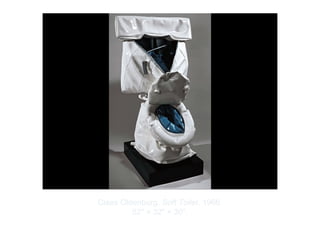
Claes Oldenburg. Soft Toilet. 1966.
52" × 32" × 30”.
Copyright ©2012 Pearson Inc.
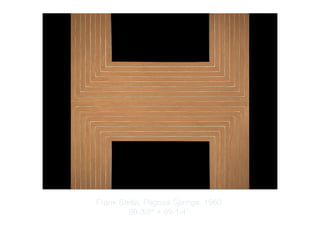
Frank Stella. Pagosa Springs. 1960.
99-3/8" × 99-1/4”.
Minimalism in Art
What is Minimalism in art?
• Nothing could be further from the onslaught of mass-media images in
the culture of consumption than Minimal Art’s almost pure and classical
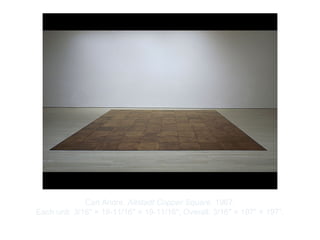
geometries. Minimalist artists were intrigued with utilizing the
processes of mass production, the use of ready-made materials, the
employment of modular units. Minimalism invites the active
engagement of the viewer in experiencing it. Frank Stella’s Pagosa
Springs, draws attention to one of the fundamental properties of
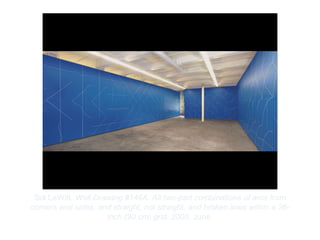
painting—the support. The room installation by Sol LeWitt began as a
set of instructions to be followed by workers who execute the work
independently of the artist.
Copyright ©2012 Pearson Inc.
Carl Andre. Altstadt Copper Square. 1967.
Each unit: 3/16" × 19-11/16" × 19-11/16"; Overall: 3/16" × 197" × 197”.
Copyright ©2012 Pearson Inc.
Sol LeWitt. Wall Drawing #146A: All two-part combinations of arcs from
corners and sides, and straight, not straight, and broken lines within a 36-
inch (90 cm) grid. 2000, June.
Copyright ©2012 Pearson Inc.
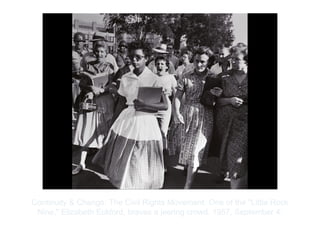
Continuity & Change: The Civil Rights Movement: One of the "Little Rock
Nine," Elizabeth Eckford, braves a jeering crowd. 1957, September 4.

Sayre2e ch38 integrated_lecture_pp_ts-150679

  • 1.
    Copyright ©2012 PearsonInc. Duane Hanson. Supermarket Shopper. 1970. Height: 65”.
  • 2.
    Europe After theWar: The Existential Quest What is existentialism? • Christian Existentialism: Kierkegaard, Niebuhr, and Tillich — In the face of countless deaths, pessimism reigned, and ideological conflict between the Western po0wers and the Eastern bloc exacerbated a growing sense of meaninglessness, alienation, and anxiety. Christianity found itself in crisis as well. Kierkegaard had argued that Christians must live in a state of anguish caused by their own freedom of choice. Niebuhr and Tillich further articulated this position of Christian existentialism in America. • The Philosophy of Sartre: Atheistic Existentialism — Sartre argued for what is termed atheistic existentialism. Living in a universe without God, and thus without revealed morality, individuals must nevertheless choose to act ethically.
  • 3.
    • De Beauvoirand Existential Feminism — Simone de Beauvoir argued that women had passively allowed men to define them rather than creating themselves. • The Literature of Existentialism — The Stranger by Albert Camus offers an antihero who refuses to admit to feelings that are absent even though it condemns him. The Theater of the Absurd is a theater in which the meaninglessness of existence is the central thematic concern as is seen in Sartre’s No Exit. The most popular of the absurdist plays is Samuel Beckett’s Waiting for Godot. • The Art of Existentialism — Faced with the lack of life’s meaning that Sartre’s existentialism proposed, painters and sculptors sought to explore the truth of this condition in their own terms. Alberto Giacometti produced City Square which was admired by Sartre. The French artist, Jean Dubuffet created art brut, “raw art” from those unaffected by or untrained in cultural convention. • Discussion Question: What are the existentialist themes in the work of Camus and Beckett?
  • 4.
    Copyright ©2012 PearsonInc. Alberto Giacometti. City Square (La Place). 1948. 8-1/2" × 25-3/8" × 17-1/4”.
  • 5.
    America After theWar: Triumph and Doubt What is Abstract Expressionism? • The Triumph of American Art: Abstract Expressionism — The individualistic spirit of Abstract Expressionism was seen as the antithesis of communism, and their work was meant to convey the message that America had not only triumphed in the war, but in art and culture as well. New York, not Paris, was now the center of the art world. • Jackson Pollock plumbed the depths of the psyche and de Kooning represents the psyche’s encounter with the world. Although excluded from the inner (male) circle, a number of the women associated with Abstract Expressionism were painters of exceptional ability. Both Elaine de Kooning and Lee Krasner developed their own styles separate from their husband’s. Joan Mitchell was obsessed with water and was influenced by Monet.
  • 6.
    • Both Rothkoand Frankenthaler offered viewers a more meditative and quiet painting based on large expanses of relatively undifferentiated color. Calder and Smith demonstrated that sculpture could partake of the same gestural freedom and psychological abstraction as Abstract Expressionist painting. It could become a field of action. • Discussion Question: What role did women play in Abstract Expressionism?
  • 7.
    Copyright ©2012 PearsonInc. Jean Dubuffet. Corps de Dame. 1950. 10-5/8" × 8-3/8”.
  • 8.
    Copyright ©2012 PearsonInc. Jackson Pollock. Guardians of the Secret. 1943. 4’ 3/8" × 6’ 3-3/8”.
  • 9.
    Copyright ©2012 PearsonInc. Richard Hamilton, John McHale, and John Voelcker. Closer Look: Pavilion for the “This Is Tomorrow” exhibition at the Whitechapel Gallery, London. 1956.
  • 10.
     Closer Look:Richard Hamilton, Just What Is It That Makes Today’s Homes So Different, So Appealing? MyArtsLabChapter 38 – After the War
  • 11.
    Copyright ©2012 PearsonInc. Richard Hamilton. Closer Look: Just What Is It That Makes Today’s Homes So Different, So Appealing?. 1956. 10-1/4" × 9-3/4”.
  • 12.
    Copyright ©2012 PearsonInc. Jackson Pollock. Number 27. 1950. 4’ 1" × 8’ 10”.
  • 13.
     Video: JacksonPollock at Work MyArtsLabChapter 38 – After the War
  • 14.
    Copyright ©2012 PearsonInc. Willem de Kooning. Seated Woman. ca. 1940. 54-1/4" × 36”.
  • 15.
    Copyright ©2012 PearsonInc. Willem de Kooning. Pink Angels. 1945. 52" × 40”.
  • 16.
    Copyright ©2012 PearsonInc. Willem de Kooning. Excavation. 1950. 81" × 100-1/4" (unframed).
  • 17.
    Copyright ©2012 PearsonInc. Lee Krasner. White Squares. ca. 1948. 24" × 30”.
  • 18.
    Copyright ©2012 PearsonInc. Grace Hartigan. River Bathers. 1953. 5'9-3/8" × 7'4-3/4”.
  • 19.
    Copyright ©2012 PearsonInc. Joan Mitchell. Piano mécanique. 1958. 78" × 128”.
  • 20.
    Copyright ©2012 PearsonInc. Mark Rothko. Green on Blue. 1956. 89-3/4" × 63-1/4”.
  • 21.
    Copyright ©2012 PearsonInc. Helen Frankenthaler. The Bay. 1963. 6’ 8-3/4" × 6’ 9-1/2”.
  • 22.
    Copyright ©2012 PearsonInc. Alexander Calder. Black, White, and Ten Red. 1957. 33" × 144”.
  • 23.
    Copyright ©2012 PearsonInc. David Smith. Blackburn: Song of an Irish Blacksmith. Frontal view. 1949- 50. 46-1/4" × 49-3/4" × 24”.
  • 24.
    Copyright ©2012 PearsonInc. David Smith. Blackburn: Song of an Irish Blacksmith. Profile view. 1949-50. 46-1/4" × 49-3/4" × 24”.
  • 25.
    The Beat Generation Whoare the Beats? • The Beat generation sought a heightened and, they believed, more authentic style of life, defined by alienation, nonconformity, sexual liberation, drugs, and alcohol. • Robert Frank and Jack Kerouac — Frank published a book of photographs as The Americans in 1958. The photographs captured everyday, mundane things that might otherwise go by unseen, with a sense of spontaneity and directness. Kerouac’s real-life adventures are described in On the Road. • Ginsberg and “Howl” — The work that best characterizes the Beat generation is “Howl” by Allen Ginsberg. The publisher, Lawrence Ferlinghetti was charged with obscenity; he was eventually acquitted.
  • 26.
    • Cage andthe Aesthetics of Chance — Ginsberg showed that anything and everything could be admitted into the domain of art. Composer John Cage “set about discovering means to let sounds be themselves.” His composition 4’33” admits all manner of ambient sound—whatever sounds happened during its performance were purely a matter of chance. Rauschenberg began to make combine paintings, works in which all manner of materials are combined to create the work. Theater Piece #1 inaugurated a collaboration between Cunningham (dance, Cage (music), and Rauschenberg (décor and costume) that would span many years. Jasper Johns focused on the most common, seemingly obvious subject matter. Cage’s aesthetic of diversity and inclusiveness also informs the inventive multimedia pieces of Alan Kaprow. • Architecture in the 1950s — The design of Frank Lloyd Wright for the Guggenheim Museum in New York represents the spirit if architectural innovation that still pervade the practice of architecture to this day.
  • 27.
    Copyright ©2012 PearsonInc. Robert Rauschenberg. Bed. 1955. 6’ 3-1/4" × 31-1/2" × 8”.
  • 28.
    Copyright ©2012 PearsonInc. Merce Cunningham. Summerspace. Set and costumes by Robert Rauschenberg. 1958.
  • 29.
    Copyright ©2012 PearsonInc. Jasper Johns. Three Flags. 1958. 30-7/8" × 45-1/2" × 5”.
  • 30.
    Copyright ©2012 PearsonInc. Ludwig Mies van der Rohe. Farnsworth House, Fox River, Plano, Illinois. 1950.
  • 31.
    Copyright ©2012 PearsonInc. Frank Lloyd Wright. The Solomon R. Guggenheim Museum, New York. 1957-59.
  • 32.
    Pop Art What isPop Art? • In the early 1960s, a number of artists created a “realist” art that represented reality in terms of the media—advertising, television, comic strips—the imagery of mass culture. The term Pop Art quickly became attached to work such as Warhol’s famous paintings of Campbell’s Soup cans. Roy Lichtenstein enlarged comic strip paintings. Claes Oldenburg opened The Store, filled with life-size and over-life-size sculptures of everything from pie a la mode, to hamburgers, hats, and 7-Up bottles. • Discussion Question: How is pop art a rejection of commercialism?
  • 33.
    Copyright ©2012 PearsonInc. Andy Warhol. Campbell’s Soup Cans. Installation at Ferus Gallery. 1962.
  • 34.
    Copyright ©2012 PearsonInc. Tom Wesselmann. Still Life #20. 1962. 48" × 48" × 5-1/2”.
  • 35.
    Copyright ©2012 PearsonInc. Andy Warhol. Marilyn Diptych. 1962. 6’ 8-7/8" × 4’ 9”.
  • 36.
     Closer Look:Andy Warhol, Marilyn Diptych  Studio Technique Video: Silkscreen MyArtsLabChapter 38 – After the War
  • 37.
    Copyright ©2012 PearsonInc. Roy Lichtenstein. Oh, Jeff . . . I Love You, Too . . . But. . . . 1964. 4' × 4’.
  • 38.
    Copyright ©2012 PearsonInc. Roy Lichtenstein. Little Big Painting. 1965. 70" × 82" × 2-1/4”.
  • 39.
    Copyright ©2012 PearsonInc. Claes Oldenburg. Soft Toilet. 1966. 52" × 32" × 30”.
  • 40.
    Copyright ©2012 PearsonInc. Frank Stella. Pagosa Springs. 1960. 99-3/8" × 99-1/4”.
  • 41.
    Minimalism in Art Whatis Minimalism in art? • Nothing could be further from the onslaught of mass-media images in the culture of consumption than Minimal Art’s almost pure and classical geometries. Minimalist artists were intrigued with utilizing the processes of mass production, the use of ready-made materials, the employment of modular units. Minimalism invites the active engagement of the viewer in experiencing it. Frank Stella’s Pagosa Springs, draws attention to one of the fundamental properties of painting—the support. The room installation by Sol LeWitt began as a set of instructions to be followed by workers who execute the work independently of the artist.
  • 42.
    Copyright ©2012 PearsonInc. Carl Andre. Altstadt Copper Square. 1967. Each unit: 3/16" × 19-11/16" × 19-11/16"; Overall: 3/16" × 197" × 197”.
  • 43.
    Copyright ©2012 PearsonInc. Sol LeWitt. Wall Drawing #146A: All two-part combinations of arcs from corners and sides, and straight, not straight, and broken lines within a 36- inch (90 cm) grid. 2000, June.
  • 44.
    Copyright ©2012 PearsonInc. Continuity & Change: The Civil Rights Movement: One of the "Little Rock Nine," Elizabeth Eckford, braves a jeering crowd. 1957, September 4.

Editor's Notes

  • #2 Duane Hanson. Supermarket Shopper . 1970. Height: 65”.
  • #3 What is existentialism? After the war, Europe was gripped by a profound pessimism. The existential philosophy of Jean-Paul Sartre was a direct response. What did Sartre mean by the phrase “Existence precedes essence”? He agreed that the human condition is defined by alienation, anxiety, lack of authenticity, and a sense of nothingness, but he said that this did not abrogate the responsibility to act and create meaning. How did Sartre’s lifelong companion, Simone de Beauvoir, extend Sartre’s argument in The Second Sex ? Others in Sartre’s circle contributed to the existential movement. What existential virtue does Albert Camus’s anti-hero Meursault, in The Stranger , possess? Sartre’s own play No Exit and Samuel Beckett’s Waiting for Godot are examples of the Theater of the Absurd. What are the characteristics of this brand of theater? In art, Alberto Giacometti’s emaciated figures seemed to capture the human condition as trapped halfway between being and nothingness. Jean Dubuffet’s art brut , “raw art,” projected a condition of formlessness that reflected the disorder and chaos of the age.
  • #5 Alberto Giacometti. City Square (La Place) . 1948. 8-1/2" × 25-3/8" × 17-1/4”.
  • #6 What is Abstract Expressionism? The unprecedented prosperity of the United States after the war included the introduction of new products and services and the mass adoption of television as the primary form of entertainment. A counternote of sincerity was struck by the Abstract Expressionists. How did they apply Sartre’s theories to the act of painting? Jackson Pollock and Willem de Kooning inspired a generation of artists, including their own wives, to abandon representation in favor of directly expressing their emotions on the canvas in totally abstract terms. Color-field painters Mark Rothko and Helen Frankenthaler created more meditative spaces based on large expanses of undifferentiated color. The sculptors Alexander Calder and David Smith created dynamic works that, in the first instance, literally moved, and in the second, required the viewer to move around them.
  • #8 Jean Dubuffet. Corps de Dame . 1950. 10-5/8" × 8-3/8”.
  • #9 Jackson Pollock. Guardians of the Secret . 1943. 4’ 3/8" × 6’ 3-3/8”.
  • #10 Richard Hamilton, John McHale, and John Voelcker. Closer Look: Pavilion for the “This Is Tomorrow” exhibition at the Whitechapel Gallery, London. 1956.
  • #12 Richard Hamilton. Closer Look: Just What Is It That Makes Today’s Homes So Different, So Appealing?. 1956. 10-1/4" × 9-3/4”.
  • #13 Jackson Pollock. Number 27 . 1950. 4’ 1" × 8’ 10”.
  • #15 Willem de Kooning. Seated Woman . ca. 1940. 54-1/4" × 36”.
  • #16 Willem de Kooning. Pink Angels . 1945. 52" × 40”.
  • #17 Willem de Kooning. Excavation . 1950. 81" × 100-1/4" (unframed).
  • #18 Lee Krasner. White Squares . ca. 1948. 24" × 30”.
  • #19 Grace Hartigan. River Bathers . 1953. 5'9-3/8" × 7'4-3/4”.
  • #20 Joan Mitchell. Piano mécanique . 1958. 78" × 128”.
  • #21 Mark Rothko. Green on Blue . 1956. 89-3/4" × 63-1/4”.
  • #22 Helen Frankenthaler. The Bay . 1963. 6’ 8-3/4" × 6’ 9-1/2”.
  • #23 Alexander Calder. Black, White, and Ten Red . 1957. 33" × 144”.
  • #24 David Smith. Blackburn: Song of an Irish Blacksmith . Frontal view. 1949-50. 46-1/4" × 49-3/4" × 24”.
  • #25 David Smith. Blackburn: Song of an Irish Blacksmith . Profile view. 1949-50. 46-1/4" × 49-3/4" × 24”.
  • #26 Who are the Beats? At the same time, the Beat generation, a younger, more rebellious generation of writers and artists, began to critique American culture. Swiss photographer Robert Frank’s The Americans revealed a side of American life that outraged a public used to seeing the country through the lens of a happy optimism. Allen Ginsberg lashed out in his poem “Howl” with a forthright and uncensored frankness that seemed to many an affront to decency. What was the nature of the collaboration between composer John Cage, dancer Merce Cunningham, and artist Robert Rauschenberg? What characterizes Rauschenberg’s combine paintings? What defines Cage’s 4 9 33 0 as music? What are the characteristics of Allan Kaprow’s Happenings? In what ways do the American Beats reflect the existentialism of Jean-Paul Sartre? In architecture, Mies van der Rohe, transplanted from the Bauhaus to Chicago, brought the International Style to America. Frank Lloyd Wright’s Solomon R. Guggenheim Museum, however, is a conscious counterstatement to Mies van der Rohe’s rationalist geometry, its organic forms echoing the natural world. To the Beats, the architecture of both represented all that was wrong with America. How would you explain their thinking?
  • #28 Robert Rauschenberg. Bed . 1955. 6’ 3-1/4" × 31-1/2" × 8”.
  • #29 Merce Cunningham. Summerspace . Set and costumes by Robert Rauschenberg. 1958.
  • #30 Jasper Johns. Three Flags . 1958. 30-7/8" × 45-1/2" × 5”.
  • #31 Ludwig Mies van der Rohe. Farnsworth House, Fox River, Plano, Illinois. 1950.
  • #32 Frank Lloyd Wright. The Solomon R. Guggenheim Museum, New York. 1957-59.
  • #33 What is Pop Art? Pop Art reflected the commodification of culture and the marketplace as a dominant cultural force. In what terms did Andy Warhol compare Marilyn Monroe to Campbell’s soup? How did Tom Wesselmann suggest that painting itself was a commodity? How did Roy Lichtenstein parody Abstract Expressionist painting? Claes Oldenburg created witty reproductions of American goods. How did he change them?
  • #34 Andy Warhol. Campbell’s Soup Cans . Installation at Ferus Gallery. 1962.
  • #35 Tom Wesselmann. Still Life #20 . 1962. 48" × 48" × 5-1/2”.
  • #36 Andy Warhol. Marilyn Diptych . 1962. 6’ 8-7/8" × 4’ 9”.
  • #38 Roy Lichtenstein. Oh, Jeff . . . I Love You, Too . . . But. . . . 1964 . 4' × 4’.
  • #39 Roy Lichtenstein. Little Big Painting . 1965. 70" × 82" × 2-1/4”.
  • #40 Claes Oldenburg. Soft Toilet . 1966. 52" × 32" × 30”.
  • #41 Frank Stella. Pagosa Springs . 1960. 99-3/8" × 99-1/4”.
  • #42 What is Minimalism in art? Minimalism reduces art to almost total formality and abstraction in terms that at first seem diametrically opposed to Pop Art. But, in fact, Pop Art and Minimalist art have much in common. What values do they share? What differentiates them?
  • #43 Carl Andre. Altstadt Copper Square . 1967. Each unit: 3/16" × 19-11/16" × 19-11/16"; Overall: 3/16" × 197" × 197”.
  • #44 Sol LeWitt. Wall Drawing #146A: All two-part combinations of arcs from corners and sides, and straight, not straight, and broken lines within a 36-inch (90 cm) grid . 2000, June.
  • #45 Continuity & Change: The Civil Rights Movement: One of the "Little Rock Nine," Elizabeth Eckford, braves a jeering crowd. 1957, September 4.