PRESENTED BY :
SAURABH VERMA
MSc.(biotechnology)
ROLLno.-16115
B.B.A.U,LUCKNOW
2018-19
What are
antibodies?
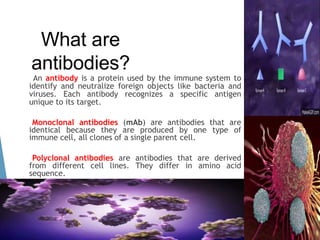
An antibody is a protein used by the immune system to
identify and neutralize foreign objects like bacteria and
viruses. Each antibody recognizes a specific antigen
unique to its target.
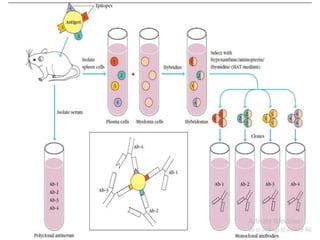
Monoclonal antibodies (mAb) are antibodies that are
identical because they are produced by one type of
immune cell, all clones of a single parent cell.
Polyclonal antibodies are antibodies that are derived
from different cell lines. They differ in amino acid
sequence.
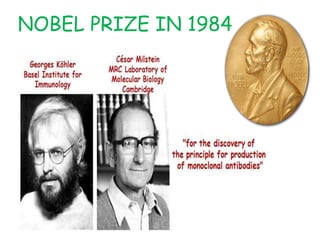
NOBEL PRIZE IN 1984
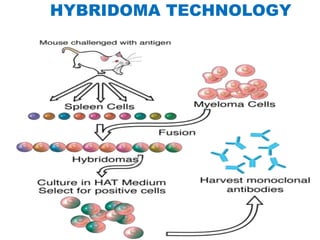
HYBRIDOMA TECHNOLOGY
bb
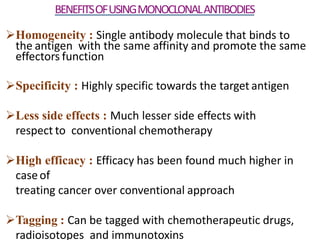
BENEFITSOFUSINGMONOCLONALANTIBODIES
Homogeneity : Single antibody molecule that binds to
the antigen with the same affinity and promote the same
effectors function
Specificity : Highly specific towards the target antigen
Less side effects : Much lesser side effects with
respect to conventional chemotherapy
High efficacy : Efficacy has been found much higher in
caseof
treating cancer over conventional approach
Tagging : Can be tagged with chemotherapeutic drugs,
radioisotopes and immunotoxins
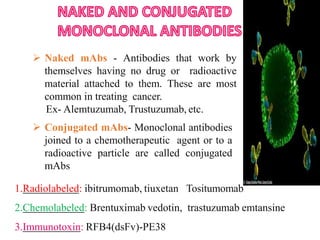
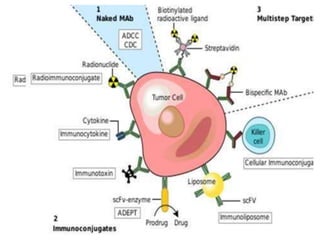
 Naked mAbs - Antibodies that work by
themselves having no drug or radioactive
material attached to them. These are most
common in treating cancer.
Ex- Alemtuzumab, Trustuzumab, etc.
 Conjugated mAbs- Monoclonal antibodies
joined to a chemotherapeutic agent or to a
radioactive particle are called conjugated
mAbs
1.Radiolabeled: ibitrumomab, tiuxetan Tositumomab
2.Chemolabeled: Brentuximab vedotin, trastuzumab emtansine
3.Immunotoxin: RFB4(dsFv)-PE38
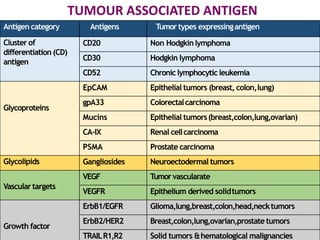
Antigen category Antigens Tumor types expressingantigen
Cluster of
differentiation (CD)
antigen
CD20 Non Hodgkinlymphoma
CD30 Hodgkin lymphoma
CD52 Chronic lymphocytic leukemia
Glycoproteins
EpCAM Epithelial tumors (breast, colon,lung)
gpA33 Colorectalcarcinoma
Mucins Epithelial tumors(breast,colon,lung,ovarian)
CA-IX Renal cellcarcinoma
PSMA Prostate carcinoma
Glycolipids Gangliosides Neuroectodermal tumors
Vascular targets
VEGF Tumorvascularate
VEGFR Epithelium derived solidtumors
Growth factor
ErbB1/EGFR Glioma,lung,breast,colon,head,necktumors
ErbB2/HER2 Breast,colon,lung,ovarian,prostatetumors
TRAILR1,R2 Solid tumors &hematological malignancies
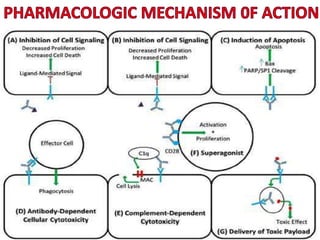
There are three mechanisms that could be responsible for the cancer
treatment:
1. mAbs act directely when binding to a cancer specific antigens and
induce immunological response to cancer cells. Such as inducing
cancer cell apoptosis, inhibiting growth, or interfering with a key
function.
2. mAbs may be modified for delivery of a toxin, radioisotope
[RADIOIMMUNOTHERAPY], cytokine or other active conjugates.
3. it is also possible to design bispecific antibodies that can bind with
their Fab regions both to target antigen and to a conjugate or
effector cell.
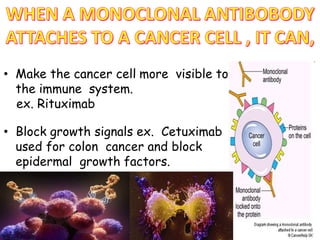
• Make the cancer cell more visible to
the immune system.
ex. Rituximab
• Block growth signals ex. Cetuximab
used for colon cancer and block
epidermal growth factors.
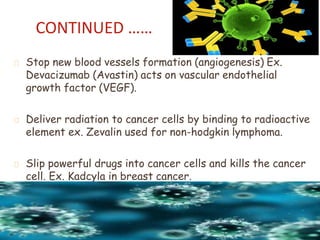
Stop new blood vessels formation (angiogenesis) Ex.
Devacizumab (Avastin) acts on vascular endothelial
growth factor (VEGF).
Deliver radiation to cancer cells by binding to radioactive
element ex. Zevalin used for non-hodgkin lymphoma.
Slip powerful drugs into cancer cells and kills the cancer
cell. Ex. Kadcyla in breast cancer.
CONTINUED ……
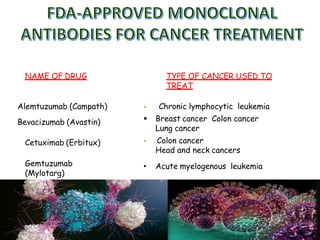
TYPE OF CANCER USED TO
TREAT
NAME OF DRUG
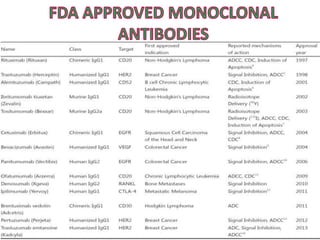
Alemtuzumab (Campath)  . Chronic lymphocytic leukemia
 Breast cancer Colon cancer
Lung cancer
 . Colon cancer
Head and neck cancers
Bevacizumab (Avastin)
Cetuximab (Erbitux)
Gemtuzumab
(Mylotarg)
• Acute myelogenous leukemia
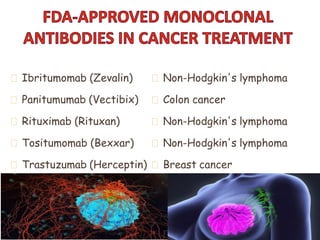
Ibritumomab (Zevalin)
Panitumumab (Vectibix)
Rituximab (Rituxan)
Tositumomab (Bexxar)
Trastuzumab (Herceptin)
Non-Hodgkin's lymphoma
Colon cancer
Non-Hodgkin's lymphoma
Breast cancer
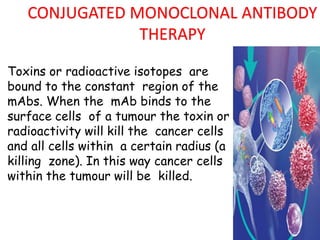
CONJUGATED MONOCLONAL ANTIBODY
THERAPY
Toxins or radioactive isotopes are
bound to the constant region of the
mAbs. When the mAb binds to the
surface cells of a tumour the toxin or
radioactivity will kill the cancer cells
and all cells within a certain radius (a
killing zone). In this way cancer cells
within the tumour will be killed.
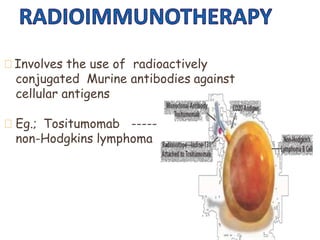
Involves the use of radioactively
conjugated Murine antibodies against
cellular antigens
Eg.; Tositumomab -----
non-Hodgkins lymphoma
In murine xenograft models, mAbs directed against tumour specific
antigens largely remain in the blood and no more than 20% of the
administered dose typically interacts with the tumor
Although great strides have been made in antibody engineering and
cancer therapy, production cost is estimated at twice that required
for conventional drugs
Among those mAbs approved for cancer therapy, only two
(trastuzumab, cetuximab) are mainly targeting solid tumours,
whereas over 85% of human cancers are solid tumours, clearly
reflecting the current limitation of mAb treatment
Although most therapeutic antibodies can trigger complement-
dependent cytotoxicity in vitro, this has not been demonstrated in
vivo so far
Saurabh monoclonal ppt

Saurabh monoclonal ppt

  • 2.
    PRESENTED BY : SAURABHVERMA MSc.(biotechnology) ROLLno.-16115 B.B.A.U,LUCKNOW 2018-19
  • 3.
    What are antibodies? An antibodyis a protein used by the immune system to identify and neutralize foreign objects like bacteria and viruses. Each antibody recognizes a specific antigen unique to its target. Monoclonal antibodies (mAb) are antibodies that are identical because they are produced by one type of immune cell, all clones of a single parent cell. Polyclonal antibodies are antibodies that are derived from different cell lines. They differ in amino acid sequence.
  • 4.
  • 5.
  • 6.
  • 7.
    BENEFITSOFUSINGMONOCLONALANTIBODIES Homogeneity : Singleantibody molecule that binds to the antigen with the same affinity and promote the same effectors function Specificity : Highly specific towards the target antigen Less side effects : Much lesser side effects with respect to conventional chemotherapy High efficacy : Efficacy has been found much higher in caseof treating cancer over conventional approach Tagging : Can be tagged with chemotherapeutic drugs, radioisotopes and immunotoxins
  • 8.
     Naked mAbs- Antibodies that work by themselves having no drug or radioactive material attached to them. These are most common in treating cancer. Ex- Alemtuzumab, Trustuzumab, etc.  Conjugated mAbs- Monoclonal antibodies joined to a chemotherapeutic agent or to a radioactive particle are called conjugated mAbs 1.Radiolabeled: ibitrumomab, tiuxetan Tositumomab 2.Chemolabeled: Brentuximab vedotin, trastuzumab emtansine 3.Immunotoxin: RFB4(dsFv)-PE38
  • 9.
    Antigen category AntigensTumor types expressingantigen Cluster of differentiation (CD) antigen CD20 Non Hodgkinlymphoma CD30 Hodgkin lymphoma CD52 Chronic lymphocytic leukemia Glycoproteins EpCAM Epithelial tumors (breast, colon,lung) gpA33 Colorectalcarcinoma Mucins Epithelial tumors(breast,colon,lung,ovarian) CA-IX Renal cellcarcinoma PSMA Prostate carcinoma Glycolipids Gangliosides Neuroectodermal tumors Vascular targets VEGF Tumorvascularate VEGFR Epithelium derived solidtumors Growth factor ErbB1/EGFR Glioma,lung,breast,colon,head,necktumors ErbB2/HER2 Breast,colon,lung,ovarian,prostatetumors TRAILR1,R2 Solid tumors &hematological malignancies
  • 12.
    There are threemechanisms that could be responsible for the cancer treatment: 1. mAbs act directely when binding to a cancer specific antigens and induce immunological response to cancer cells. Such as inducing cancer cell apoptosis, inhibiting growth, or interfering with a key function. 2. mAbs may be modified for delivery of a toxin, radioisotope [RADIOIMMUNOTHERAPY], cytokine or other active conjugates. 3. it is also possible to design bispecific antibodies that can bind with their Fab regions both to target antigen and to a conjugate or effector cell.
  • 14.
    • Make thecancer cell more visible to the immune system. ex. Rituximab • Block growth signals ex. Cetuximab used for colon cancer and block epidermal growth factors.
  • 15.
    Stop new bloodvessels formation (angiogenesis) Ex. Devacizumab (Avastin) acts on vascular endothelial growth factor (VEGF). Deliver radiation to cancer cells by binding to radioactive element ex. Zevalin used for non-hodgkin lymphoma. Slip powerful drugs into cancer cells and kills the cancer cell. Ex. Kadcyla in breast cancer. CONTINUED ……
  • 16.
    TYPE OF CANCERUSED TO TREAT NAME OF DRUG Alemtuzumab (Campath)  . Chronic lymphocytic leukemia  Breast cancer Colon cancer Lung cancer  . Colon cancer Head and neck cancers Bevacizumab (Avastin) Cetuximab (Erbitux) Gemtuzumab (Mylotarg) • Acute myelogenous leukemia
  • 17.
    Ibritumomab (Zevalin) Panitumumab (Vectibix) Rituximab(Rituxan) Tositumomab (Bexxar) Trastuzumab (Herceptin) Non-Hodgkin's lymphoma Colon cancer Non-Hodgkin's lymphoma Non-Hodgkin's lymphoma Breast cancer
  • 18.
    CONJUGATED MONOCLONAL ANTIBODY THERAPY Toxinsor radioactive isotopes are bound to the constant region of the mAbs. When the mAb binds to the surface cells of a tumour the toxin or radioactivity will kill the cancer cells and all cells within a certain radius (a killing zone). In this way cancer cells within the tumour will be killed.
  • 19.
    Involves the useof radioactively conjugated Murine antibodies against cellular antigens Eg.; Tositumomab ----- non-Hodgkins lymphoma
  • 21.
    In murine xenograftmodels, mAbs directed against tumour specific antigens largely remain in the blood and no more than 20% of the administered dose typically interacts with the tumor Although great strides have been made in antibody engineering and cancer therapy, production cost is estimated at twice that required for conventional drugs Among those mAbs approved for cancer therapy, only two (trastuzumab, cetuximab) are mainly targeting solid tumours, whereas over 85% of human cancers are solid tumours, clearly reflecting the current limitation of mAb treatment Although most therapeutic antibodies can trigger complement- dependent cytotoxicity in vitro, this has not been demonstrated in vivo so far