TYPES OF MONOCLONAL
ANTIBODIES AND USES IN
HAEMATOLOGY
MODERATOR – DR. PROF. ASHIS KUMAR SAHA(HOD)
PRESENTED BY -- RUPINDER SINGH
MEDICINE JR1
MONOCLONAL ANTIBODIES
• They are monospecific antibodies that are the same
because they are made by identical immune cells that are
all clones of a unique parent cell
• They have monovalent affinity, in that they bind to the
same epitope.
• Given almost any substance, it is possible to produce
monoclonal antibodies that specifically bind to that
substance; they can then serve to detect that substance.
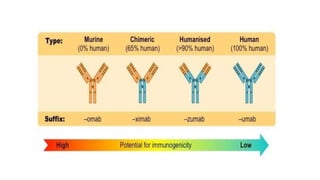
TYPES OF MONOCLONAL
ANTIBODIES
 MURINE MONOCLONAL ANTIBODIES
 CHIMERIC MONOCLONAL ANTIBODIES
 HUMANISED MONOCLONAL ANTIBODIES
 HUMAN MONOCLONAL ANTIBODIES
Pharmacokinetics: mAbs
• Routes of administration:
 Subcutaneously (Rituximab, Trastuzumab, Adalimumab)
 Intramuscularly (Palivizumab)
 Intravenously
• IV route: preferred because of 100% bioavailability
• Route for elimination of antibodies
 Via uptake & catabolism by reticuloendothelial system & target tissue.
P/K: mAbs
• Half-life
 Chimeric: 4-15 days
 Humanized: 3-24 days
 Recombinant human: 11-24 days
• Human antimouse antibody (HAMA) response develops 7-10 days following
exposure to murine antibody
ANTIBODIES IN HUMAN THERAPY
• Humans have the ability to make antibodies able to
 Recognize (by binding to) virtually any antigenic
determinant (epitope)
 To discriminate between even similar epitopes
• The remarkable specificity of antibodies makes them
promising agents for human therapy.
THERAPEUTIC SIGNIFICANCE
• MAbs have tremendous application not only in the field of
diagnostics but also in
 therapeutics and targeted drug delivery system for infectious
diseases caused by bacteria, viruses, protozoa and for cancer,
metabolic and hormonal disorders.
 They are also used in the immunological intervention with
passive antibody, magic bullet therapy with cytotoxic agents
coupled with anti mouse specific antibody.
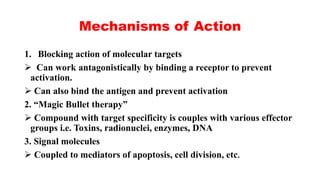
Mechanisms of Action
1. Blocking action of molecular targets
 Can work antagonistically by binding a receptor to prevent
activation.
 Can also bind the antigen and prevent activation
2. “Magic Bullet therapy”
 Compound with target specificity is couples with various effector
groups i.e. Toxins, radionuclei, enzymes, DNA
3. Signal molecules
 Coupled to mediators of apoptosis, cell division, etc.
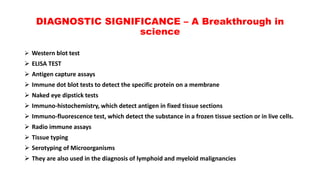
DIAGNOSTIC SIGNIFICANCE – A Breakthrough in
science
 Western blot test
 ELISA TEST
 Antigen capture assays
 Immune dot blot tests to detect the specific protein on a membrane
 Naked eye dipstick tests
 Immuno-histochemistry, which detect antigen in fixed tissue sections
 Immuno-fluorescence test, which detect the substance in a frozen tissue section or in live cells.
 Radio immune assays
 Tissue typing
 Serotyping of Microorganisms
 They are also used in the diagnosis of lymphoid and myeloid malignancies
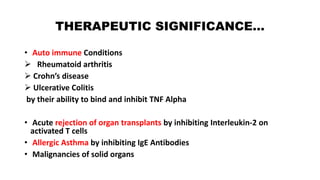
THERAPEUTIC SIGNIFICANCE…
• Auto immune Conditions
 Rheumatoid arthritis
 Crohn’s disease
 Ulcerative Colitis
by their ability to bind and inhibit TNF Alpha
• Acute rejection of organ transplants by inhibiting Interleukin-2 on
activated T cells
• Allergic Asthma by inhibiting IgE Antibodies
• Malignancies of solid organs
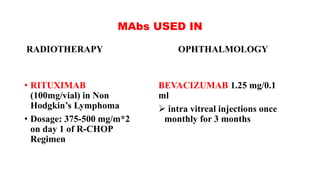
MAbs USED IN
OPHTHALMOLOGY
BEVACIZUMAB 1.25 mg/0.1
ml
 intra vitreal injections once
monthly for 3 months
RADIOTHERAPY
• RITUXIMAB
(100mg/vial) in Non
Hodgkin’s Lymphoma
• Dosage: 375-500 mg/m*2
on day 1 of R-CHOP
Regimen
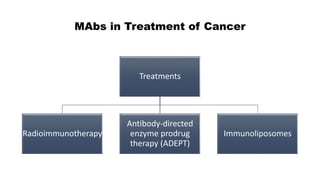
MAbs in Treatment of Cancer
Treatments
Radioimmunotherapy
Antibody-directed
enzyme prodrug
therapy (ADEPT)
Immunoliposomes
Radioimmunotherapy (RIT)
• RIT involves the use of radioactively conjugated murine
antibodies against cellular antigens to limit radiation
exposure.
• Murine antibodies were especially chosen, as their high
immunogenicity promotes rapid clearance from the body.
Ex: Tositumomab in non-Hodgkins lymphoma.
Antibody-directed enzyme prodrug therapy
(ADEPT)
• It involves the application of cancer associated
monoclonal antibodies which are linked to a drug-
activating enzyme.
• Subsequent systematic administration of a non-toxic
agent results in its conversion to a toxic drug, and
resulting in a cytotoxic effect which can be targeted at
malignant cells.
IMMUNOLIPOSOMES
Immunoliposomes are antibody- conjugated liposomes.
• Liposomes – carry drugs or therapeutic nucleotides –
conjugated with malignant cells.
• Tissue-specific gene delivery using immunoliposomes has
also been achieved in brain, and breast cancer tissue.
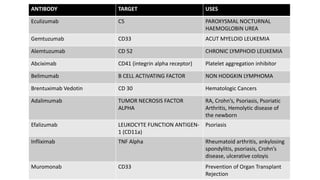
ANTIBODY TARGET USES
Eculizumab C5 PAROXYSMAL NOCTURNAL
HAEMOGLOBIN UREA
Gemtuzumab CD33 ACUT MYELOID LEUKEMIA
Alemtuzumab CD 52 CHRONIC LYMPHOID LEUKEMIA
Abciximab CD41 (integrin alpha receptor) Platelet aggregation inhibitor
Belimumab B CELL ACTIVATING FACTOR NON HODGKIN LYMPHOMA
Brentuximab Vedotin CD 30 Hematologic Cancers
Adalimumab TUMOR NECROSIS FACTOR
ALPHA
RA, Crohn’s, Psoriasis, Psoriatic
Arthritis, Hemolytic disease of
the newborn
Efalizumab LEUKOCYTE FUNCTION ANTIGEN-
1 (CD11a)
Psoriasis
Infliximab TNF Alpha Rheumatoid arthritis, ankylosing
spondylitis, psoriasis, Crohn’s
disease, ulcerative coloyis
Muromonab CD33 Prevention of Organ Transplant
Rejection
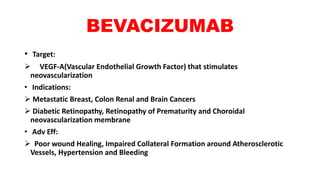
BEVACIZUMAB
• Target:
 VEGF-A(Vascular Endothelial Growth Factor) that stimulates
neovascularization
• Indications:
 Metastatic Breast, Colon Renal and Brain Cancers
 Diabetic Retinopathy, Retinopathy of Prematurity and Choroidal
neovascularization membrane
• Adv Eff:
 Poor wound Healing, Impaired Collateral Formation around Atherosclerotic
Vessels, Hypertension and Bleeding
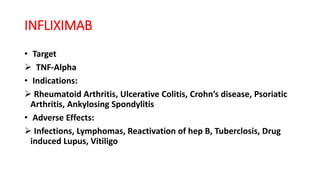
INFLIXIMAB
• Target
 TNF-Alpha
• Indications:
 Rheumatoid Arthritis, Ulcerative Colitis, Crohn’s disease, Psoriatic
Arthritis, Ankylosing Spondylitis
• Adverse Effects:
 Infections, Lymphomas, Reactivation of hep B, Tuberclosis, Drug
induced Lupus, Vitiligo
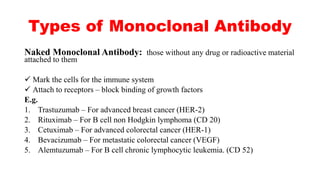
Types of Monoclonal Antibody
Naked Monoclonal Antibody: those without any drug or radioactive material
attached to them
 Mark the cells for the immune system
 Attach to receptors – block binding of growth factors
E.g.
1. Trastuzumab – For advanced breast cancer (HER-2)
2. Rituximab – For B cell non Hodgkin lymphoma (CD 20)
3. Cetuximab – For advanced colorectal cancer (HER-1)
4. Bevacizumab – For metastatic colorectal cancer (VEGF)
5. Alemtuzumab – For B cell chronic lymphocytic leukemia. (CD 52)
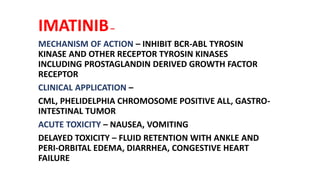
IMATINIB–
MECHANISM OF ACTION – INHIBIT BCR-ABL TYROSIN
KINASE AND OTHER RECEPTOR TYROSIN KINASES
INCLUDING PROSTAGLANDIN DERIVED GROWTH FACTOR
RECEPTOR
CLINICAL APPLICATION –
CML, PHELIDELPHIA CHROMOSOME POSITIVE ALL, GASTRO-
INTESTINAL TUMOR
ACUTE TOXICITY – NAUSEA, VOMITING
DELAYED TOXICITY – FLUID RETENTION WITH ANKLE AND
PERI-ORBITAL EDEMA, DIARRHEA, CONGESTIVE HEART
FAILURE
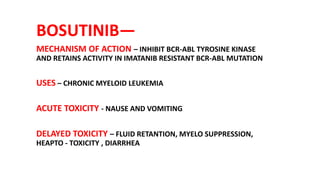
BOSUTINIB—
MECHANISM OF ACTION – INHIBIT BCR-ABL TYROSINE KINASE
AND RETAINS ACTIVITY IN IMATANIB RESISTANT BCR-ABL MUTATION
USES – CHRONIC MYELOID LEUKEMIA
ACUTE TOXICITY - NAUSE AND VOMITING
DELAYED TOXICITY – FLUID RETANTION, MYELO SUPPRESSION,
HEAPTO - TOXICITY , DIARRHEA
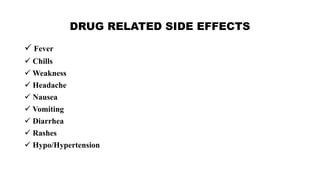
DRUG RELATED SIDE EFFECTS
 Fever
 Chills
 Weakness
 Headache
 Nausea
 Vomiting
 Diarrhea
 Rashes
 Hypo/Hypertension
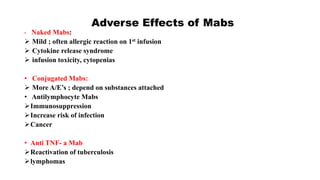
Adverse Effects of Mabs
• Naked Mabs:
 Mild ; often allergic reaction on 1st infusion
 Cytokine release syndrome
 infusion toxicity, cytopenias
• Conjugated Mabs:
 More A/E’s ; depend on substances attached
• Antilymphocyte Mabs
Immunosuppression
Increase risk of infection
Cancer
• Anti TNF- a Mab
Reactivation of tuberculosis
lymphomas
THANK YOU

MAbs Presentation.pptx

  • 1.
    TYPES OF MONOCLONAL ANTIBODIESAND USES IN HAEMATOLOGY MODERATOR – DR. PROF. ASHIS KUMAR SAHA(HOD) PRESENTED BY -- RUPINDER SINGH MEDICINE JR1
  • 2.
    MONOCLONAL ANTIBODIES • Theyare monospecific antibodies that are the same because they are made by identical immune cells that are all clones of a unique parent cell • They have monovalent affinity, in that they bind to the same epitope. • Given almost any substance, it is possible to produce monoclonal antibodies that specifically bind to that substance; they can then serve to detect that substance.
  • 3.
    TYPES OF MONOCLONAL ANTIBODIES MURINE MONOCLONAL ANTIBODIES  CHIMERIC MONOCLONAL ANTIBODIES  HUMANISED MONOCLONAL ANTIBODIES  HUMAN MONOCLONAL ANTIBODIES
  • 5.
    Pharmacokinetics: mAbs • Routesof administration:  Subcutaneously (Rituximab, Trastuzumab, Adalimumab)  Intramuscularly (Palivizumab)  Intravenously • IV route: preferred because of 100% bioavailability • Route for elimination of antibodies  Via uptake & catabolism by reticuloendothelial system & target tissue.
  • 6.
    P/K: mAbs • Half-life Chimeric: 4-15 days  Humanized: 3-24 days  Recombinant human: 11-24 days • Human antimouse antibody (HAMA) response develops 7-10 days following exposure to murine antibody
  • 7.
    ANTIBODIES IN HUMANTHERAPY • Humans have the ability to make antibodies able to  Recognize (by binding to) virtually any antigenic determinant (epitope)  To discriminate between even similar epitopes • The remarkable specificity of antibodies makes them promising agents for human therapy.
  • 8.
    THERAPEUTIC SIGNIFICANCE • MAbshave tremendous application not only in the field of diagnostics but also in  therapeutics and targeted drug delivery system for infectious diseases caused by bacteria, viruses, protozoa and for cancer, metabolic and hormonal disorders.  They are also used in the immunological intervention with passive antibody, magic bullet therapy with cytotoxic agents coupled with anti mouse specific antibody.
  • 9.
    Mechanisms of Action 1.Blocking action of molecular targets  Can work antagonistically by binding a receptor to prevent activation.  Can also bind the antigen and prevent activation 2. “Magic Bullet therapy”  Compound with target specificity is couples with various effector groups i.e. Toxins, radionuclei, enzymes, DNA 3. Signal molecules  Coupled to mediators of apoptosis, cell division, etc.
  • 10.
    DIAGNOSTIC SIGNIFICANCE –A Breakthrough in science  Western blot test  ELISA TEST  Antigen capture assays  Immune dot blot tests to detect the specific protein on a membrane  Naked eye dipstick tests  Immuno-histochemistry, which detect antigen in fixed tissue sections  Immuno-fluorescence test, which detect the substance in a frozen tissue section or in live cells.  Radio immune assays  Tissue typing  Serotyping of Microorganisms  They are also used in the diagnosis of lymphoid and myeloid malignancies
  • 11.
    THERAPEUTIC SIGNIFICANCE… • Autoimmune Conditions  Rheumatoid arthritis  Crohn’s disease  Ulcerative Colitis by their ability to bind and inhibit TNF Alpha • Acute rejection of organ transplants by inhibiting Interleukin-2 on activated T cells • Allergic Asthma by inhibiting IgE Antibodies • Malignancies of solid organs
  • 12.
    MAbs USED IN OPHTHALMOLOGY BEVACIZUMAB1.25 mg/0.1 ml  intra vitreal injections once monthly for 3 months RADIOTHERAPY • RITUXIMAB (100mg/vial) in Non Hodgkin’s Lymphoma • Dosage: 375-500 mg/m*2 on day 1 of R-CHOP Regimen
  • 13.
    MAbs in Treatmentof Cancer Treatments Radioimmunotherapy Antibody-directed enzyme prodrug therapy (ADEPT) Immunoliposomes
  • 14.
    Radioimmunotherapy (RIT) • RITinvolves the use of radioactively conjugated murine antibodies against cellular antigens to limit radiation exposure. • Murine antibodies were especially chosen, as their high immunogenicity promotes rapid clearance from the body. Ex: Tositumomab in non-Hodgkins lymphoma.
  • 15.
    Antibody-directed enzyme prodrugtherapy (ADEPT) • It involves the application of cancer associated monoclonal antibodies which are linked to a drug- activating enzyme. • Subsequent systematic administration of a non-toxic agent results in its conversion to a toxic drug, and resulting in a cytotoxic effect which can be targeted at malignant cells.
  • 16.
    IMMUNOLIPOSOMES Immunoliposomes are antibody-conjugated liposomes. • Liposomes – carry drugs or therapeutic nucleotides – conjugated with malignant cells. • Tissue-specific gene delivery using immunoliposomes has also been achieved in brain, and breast cancer tissue.
  • 17.
    ANTIBODY TARGET USES EculizumabC5 PAROXYSMAL NOCTURNAL HAEMOGLOBIN UREA Gemtuzumab CD33 ACUT MYELOID LEUKEMIA Alemtuzumab CD 52 CHRONIC LYMPHOID LEUKEMIA Abciximab CD41 (integrin alpha receptor) Platelet aggregation inhibitor Belimumab B CELL ACTIVATING FACTOR NON HODGKIN LYMPHOMA Brentuximab Vedotin CD 30 Hematologic Cancers Adalimumab TUMOR NECROSIS FACTOR ALPHA RA, Crohn’s, Psoriasis, Psoriatic Arthritis, Hemolytic disease of the newborn Efalizumab LEUKOCYTE FUNCTION ANTIGEN- 1 (CD11a) Psoriasis Infliximab TNF Alpha Rheumatoid arthritis, ankylosing spondylitis, psoriasis, Crohn’s disease, ulcerative coloyis Muromonab CD33 Prevention of Organ Transplant Rejection
  • 18.
    BEVACIZUMAB • Target:  VEGF-A(VascularEndothelial Growth Factor) that stimulates neovascularization • Indications:  Metastatic Breast, Colon Renal and Brain Cancers  Diabetic Retinopathy, Retinopathy of Prematurity and Choroidal neovascularization membrane • Adv Eff:  Poor wound Healing, Impaired Collateral Formation around Atherosclerotic Vessels, Hypertension and Bleeding
  • 19.
    INFLIXIMAB • Target  TNF-Alpha •Indications:  Rheumatoid Arthritis, Ulcerative Colitis, Crohn’s disease, Psoriatic Arthritis, Ankylosing Spondylitis • Adverse Effects:  Infections, Lymphomas, Reactivation of hep B, Tuberclosis, Drug induced Lupus, Vitiligo
  • 20.
    Types of MonoclonalAntibody Naked Monoclonal Antibody: those without any drug or radioactive material attached to them  Mark the cells for the immune system  Attach to receptors – block binding of growth factors E.g. 1. Trastuzumab – For advanced breast cancer (HER-2) 2. Rituximab – For B cell non Hodgkin lymphoma (CD 20) 3. Cetuximab – For advanced colorectal cancer (HER-1) 4. Bevacizumab – For metastatic colorectal cancer (VEGF) 5. Alemtuzumab – For B cell chronic lymphocytic leukemia. (CD 52)
  • 21.
    IMATINIB– MECHANISM OF ACTION– INHIBIT BCR-ABL TYROSIN KINASE AND OTHER RECEPTOR TYROSIN KINASES INCLUDING PROSTAGLANDIN DERIVED GROWTH FACTOR RECEPTOR CLINICAL APPLICATION – CML, PHELIDELPHIA CHROMOSOME POSITIVE ALL, GASTRO- INTESTINAL TUMOR ACUTE TOXICITY – NAUSEA, VOMITING DELAYED TOXICITY – FLUID RETENTION WITH ANKLE AND PERI-ORBITAL EDEMA, DIARRHEA, CONGESTIVE HEART FAILURE
  • 22.
    BOSUTINIB— MECHANISM OF ACTION– INHIBIT BCR-ABL TYROSINE KINASE AND RETAINS ACTIVITY IN IMATANIB RESISTANT BCR-ABL MUTATION USES – CHRONIC MYELOID LEUKEMIA ACUTE TOXICITY - NAUSE AND VOMITING DELAYED TOXICITY – FLUID RETANTION, MYELO SUPPRESSION, HEAPTO - TOXICITY , DIARRHEA
  • 23.
    DRUG RELATED SIDEEFFECTS  Fever  Chills  Weakness  Headache  Nausea  Vomiting  Diarrhea  Rashes  Hypo/Hypertension
  • 24.
    Adverse Effects ofMabs • Naked Mabs:  Mild ; often allergic reaction on 1st infusion  Cytokine release syndrome  infusion toxicity, cytopenias • Conjugated Mabs:  More A/E’s ; depend on substances attached • Antilymphocyte Mabs Immunosuppression Increase risk of infection Cancer • Anti TNF- a Mab Reactivation of tuberculosis lymphomas
  • 25.