•To share important information about
KS2 SATs
•To answer any questions about KS2
SATs
•Discuss / share ideas about how you as a
parent can help your child at home
Aims of the session
•Standard Assessment Tests
•All children have to be tested before they
go to secondary school
•Provide assessment information for
secondary schools
•Purpose – assign National Curriculum levels
to children before they leave primary school
What are KS2 SATs?
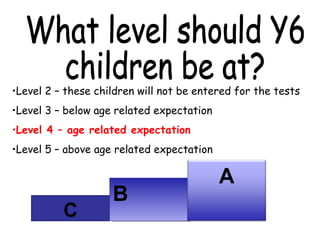
•Level 2 – these children will not be entered for the tests
•Level 3 – below age related expectation
•Level 4 – age related expectation
•Level 5 – above age related expectation
C
BB
A
What other information do
secondary schools want?
• SATs results
• Teacher assessments
• Tests administered by the high schools
•Teacher assessment draws together everything the
teacher or teachers know about a child, including
observations, marked work and school assessments.
•Teacher assessment is not a ‘snapshot’ like tests and is
therefore more reliable.
•There can be a difference between teacher assessment
results and test levels.
What does teacher assessment involve,
and is it different from testing?
•A timetable is issued to school by government, telling us on
which days/sessions tests must be administered.
•All children must sit the tests at the same time.
•Test papers can only be opened 1 hour before the tests
begin (normally in front of the children).
•Tests are completed in classrooms, with any displays that
may help covered over.
•Some children may be divided into groups for test
administration to ensure they are supported and feel secure.
•The tests are collated in alphabetical order, prepared for
collection and sent for external marking (many of them
marked electronically)
How is SATs week organised?
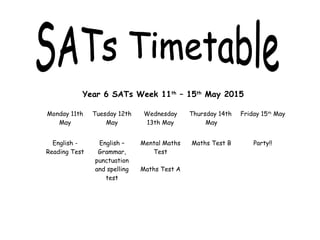
Year 6 SATs Week 11th
– 15th
May 2015
Monday 11th
May
Tuesday 12th
May
Wednesday
13th May
Thursday 14th
May
Friday 15th
May
English -
Reading Test
English –
Grammar,
punctuation
and spelling
test
Mental Maths
Test
Maths Test A
Maths Test B Party!!
During SATs week:
•Please ensure that your child is in school every day
during SATs week.
•Ensure that they are in school on time
• We will be offering a breakfast club from
8.15am where your child can have a variety of
food before the test.
•Please don’t book anything during this week e.g.
doctor’s appointments, holidays etc
•If your child is ill, let us know immediately.
English SATs consist of:
•A reading test
•A grammar, punctuation and spelling test
•Writing is a Teacher Assessment
•1 hour to read booklet and answer questions.
•There will be 3 texts and sets of questions which
are all different difficulty levels.
•There are a variety of different questions to
be answered in different ways
•Children cannot have any adult help in this test
•There are 4 main types of questions on the reading paper:
•Literal – answer is there in the text
•Deductive – look for clues
•Inferential – read between the lines
•Authorial intent – e.g. why does an author use a particular
word
As the afternoon light started to fade, the cow stopped
eating grass, stood instead with its head over the gate and
gazed expectantly down the lane.
Sentence from:
‘A Day in the English Countryside’
1. How light was it? (Literal)
2. What three things did the cow do? (Literal)
3. What time of day was it? (Deductive)
4. Where was the cow? (Deductive)
5. What do you think the cow was expecting? (Inferential)
6. What strategies does the writer use to give the reader so
much information in a single sentence? (Authorial intent)
How can parents help with
reading?
• Ensure your child reads every night!
• Encourage them to read fiction and non-fiction.
• Try to ask them questions about the text.
• Help them with the different skills of reading especially
‘skim’ reading where they are looking for key words in the
text.
• Speed reading
•Writing will be assessed by teacher and moderated
together (also moderated across the Academy)
•Children’s writing will be levelled at each ‘End of
Unit’ piece of writing.
•Writing from other areas of the curriculum will
also be used to provide evidence.
•There is a possibility of the LEA visiting to agree
the SATs levels for a selection of children
•Again, reading a variety of texts – the more
children read, the more familiar they become
with different text types
•Spelling homework – spelling lists / rules every
week
•Encouraging your child to complete all
homework and discussing their work with them.
How can parents help with
writing?
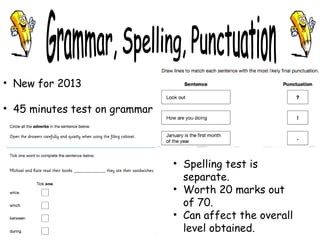
• New for 2013
• 45 minutes test on grammar
• Spelling test is
separate.
• Worth 20 marks out
of 70.
• Can affect the overall
level obtained.
•Mathematics SATs consist of:
This is a 20 minute orally delivered, taped assessment. The
mental mathematics test has a subject weighting of 20%.
•A mental mathematics test.
•Two written test papers
Test A and Test B
This year, there will not be a calculator test.
•Some questions are worth one mark and therefore
accuracy is important.
•Other questions are worth two marks and even if the
answer is wrong, a mark may be given for correct working.
•Teachers may read questions in both written papers to
pupils if asked.
Typical mental maths questions
5 second questions:
What is double ninety?
What time is it half an hour after ten-fifteen?
10 second questions:
The temperature was three degrees Celsius. It goes down by eight
degrees. Write the new temperature.
Add three point three to seven point seven.
Lara spends three pounds fifty-five. She pays with a ten pound note. How
much change does she get?
15 second questions:
Multiply thirty-five by six.
Nine is half of a number. What is one-third of the number?
Four oranges cost ninety-five pence.
How much do 12 oranges cost?
•Support with homework – not just helping with the Maths
but reading the question can really help.
•TIMES TABLES!
•Help your child to check their work through – this will
help them to spot mistakes that can sometimes be easily
fixed.
How can parents help
with Maths?
What are we doing?
•Cross-curricular teaching
•Grouping children with similar misconceptions or ‘gaps’
in their knowledge.
•Targeted teaching assistant support
•Booster classes after or before school
•Homework – via class blogs, worksheets or on the
internet
•Test preparation
•Positive encouragement, focused on effort
•The best help is interest taken in learning
and progress.
•Supporting homework.
•Good communication between the school
and home.
•Getting a good sleep on a school night!
•Ensuring attendance at school from now
How can parents help?
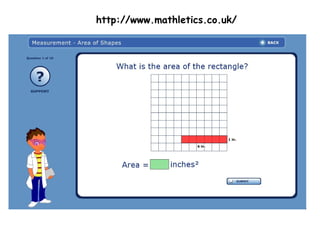
http://www.mathletics.co.uk/
http://readingeggs.co.uk/
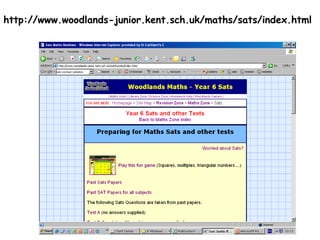
http://www.woodlands-junior.kent.sch.uk/maths/sats/index.html
http://www.bbc.co.uk/bitesize/ks2/
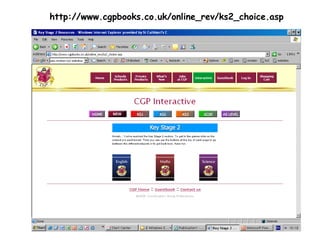
http://www.cgpbooks.co.uk/online_rev/ks2_choice.asp
School Website – There are links to different games or revision notes:-
http://ectonbrookprimaryblogs.net/
and finally ...
whatever happens your child
will get the result which
reflects where they
are.....rest assured, they have
all made progress and nobody
could ask more from them!

Sats meeting - January 2015

  • 2.
    •To share importantinformation about KS2 SATs •To answer any questions about KS2 SATs •Discuss / share ideas about how you as a parent can help your child at home Aims of the session
  • 3.
    •Standard Assessment Tests •Allchildren have to be tested before they go to secondary school •Provide assessment information for secondary schools •Purpose – assign National Curriculum levels to children before they leave primary school What are KS2 SATs?
  • 4.
    •Level 2 –these children will not be entered for the tests •Level 3 – below age related expectation •Level 4 – age related expectation •Level 5 – above age related expectation C BB A
  • 5.
    What other informationdo secondary schools want? • SATs results • Teacher assessments • Tests administered by the high schools
  • 6.
    •Teacher assessment drawstogether everything the teacher or teachers know about a child, including observations, marked work and school assessments. •Teacher assessment is not a ‘snapshot’ like tests and is therefore more reliable. •There can be a difference between teacher assessment results and test levels. What does teacher assessment involve, and is it different from testing?
  • 7.
    •A timetable isissued to school by government, telling us on which days/sessions tests must be administered. •All children must sit the tests at the same time. •Test papers can only be opened 1 hour before the tests begin (normally in front of the children). •Tests are completed in classrooms, with any displays that may help covered over. •Some children may be divided into groups for test administration to ensure they are supported and feel secure. •The tests are collated in alphabetical order, prepared for collection and sent for external marking (many of them marked electronically) How is SATs week organised?
  • 8.
    Year 6 SATsWeek 11th – 15th May 2015 Monday 11th May Tuesday 12th May Wednesday 13th May Thursday 14th May Friday 15th May English - Reading Test English – Grammar, punctuation and spelling test Mental Maths Test Maths Test A Maths Test B Party!!
  • 9.
    During SATs week: •Pleaseensure that your child is in school every day during SATs week. •Ensure that they are in school on time • We will be offering a breakfast club from 8.15am where your child can have a variety of food before the test. •Please don’t book anything during this week e.g. doctor’s appointments, holidays etc •If your child is ill, let us know immediately.
  • 10.
    English SATs consistof: •A reading test •A grammar, punctuation and spelling test •Writing is a Teacher Assessment
  • 11.
    •1 hour toread booklet and answer questions. •There will be 3 texts and sets of questions which are all different difficulty levels. •There are a variety of different questions to be answered in different ways •Children cannot have any adult help in this test
  • 12.
    •There are 4main types of questions on the reading paper: •Literal – answer is there in the text •Deductive – look for clues •Inferential – read between the lines •Authorial intent – e.g. why does an author use a particular word
  • 13.
    As the afternoonlight started to fade, the cow stopped eating grass, stood instead with its head over the gate and gazed expectantly down the lane. Sentence from: ‘A Day in the English Countryside’ 1. How light was it? (Literal) 2. What three things did the cow do? (Literal) 3. What time of day was it? (Deductive) 4. Where was the cow? (Deductive) 5. What do you think the cow was expecting? (Inferential) 6. What strategies does the writer use to give the reader so much information in a single sentence? (Authorial intent)
  • 14.
    How can parentshelp with reading? • Ensure your child reads every night! • Encourage them to read fiction and non-fiction. • Try to ask them questions about the text. • Help them with the different skills of reading especially ‘skim’ reading where they are looking for key words in the text. • Speed reading
  • 15.
    •Writing will beassessed by teacher and moderated together (also moderated across the Academy) •Children’s writing will be levelled at each ‘End of Unit’ piece of writing. •Writing from other areas of the curriculum will also be used to provide evidence. •There is a possibility of the LEA visiting to agree the SATs levels for a selection of children
  • 16.
    •Again, reading avariety of texts – the more children read, the more familiar they become with different text types •Spelling homework – spelling lists / rules every week •Encouraging your child to complete all homework and discussing their work with them. How can parents help with writing?
  • 17.
    • New for2013 • 45 minutes test on grammar • Spelling test is separate. • Worth 20 marks out of 70. • Can affect the overall level obtained.
  • 18.
    •Mathematics SATs consistof: This is a 20 minute orally delivered, taped assessment. The mental mathematics test has a subject weighting of 20%. •A mental mathematics test. •Two written test papers Test A and Test B This year, there will not be a calculator test.
  • 19.
    •Some questions areworth one mark and therefore accuracy is important. •Other questions are worth two marks and even if the answer is wrong, a mark may be given for correct working. •Teachers may read questions in both written papers to pupils if asked.
  • 20.
    Typical mental mathsquestions 5 second questions: What is double ninety? What time is it half an hour after ten-fifteen? 10 second questions: The temperature was three degrees Celsius. It goes down by eight degrees. Write the new temperature. Add three point three to seven point seven. Lara spends three pounds fifty-five. She pays with a ten pound note. How much change does she get? 15 second questions: Multiply thirty-five by six. Nine is half of a number. What is one-third of the number? Four oranges cost ninety-five pence. How much do 12 oranges cost?
  • 21.
    •Support with homework– not just helping with the Maths but reading the question can really help. •TIMES TABLES! •Help your child to check their work through – this will help them to spot mistakes that can sometimes be easily fixed. How can parents help with Maths?
  • 22.
    What are wedoing? •Cross-curricular teaching •Grouping children with similar misconceptions or ‘gaps’ in their knowledge. •Targeted teaching assistant support •Booster classes after or before school •Homework – via class blogs, worksheets or on the internet •Test preparation •Positive encouragement, focused on effort
  • 23.
    •The best helpis interest taken in learning and progress. •Supporting homework. •Good communication between the school and home. •Getting a good sleep on a school night! •Ensuring attendance at school from now How can parents help?
  • 25.
  • 26.
  • 27.
  • 28.
  • 29.
  • 30.
    School Website –There are links to different games or revision notes:- http://ectonbrookprimaryblogs.net/
  • 31.
    and finally ... whateverhappens your child will get the result which reflects where they are.....rest assured, they have all made progress and nobody could ask more from them!