Market-driven S&OP
A Guidebook on How to Build a Market-driven S&OP Process

                        7/15/2012


                                           By Lora Cecere
                                            Founder and CEO

                                    Supply Chain Insights LLC
Contents
Research ................................................................................................................................... 2

Disclosure .................................................................................................................................. 2

Ecosystem Input ........................................................................................................................ 2

Executive Summary ................................................................................................................... 3

The Journey to Drive Excellence through S&OP ........................................................................ 5

The S&OP Evolution .................................................................................................................. 5

   Stage 1: .................................................................................................................................. 6

      Goal - Deliver a Feasible Plan............................................................................................. 6

   Stage 2: .................................................................................................................................. 7

      Goal - Match Demand with Supply. ..................................................................................... 7

   Stage 3: .................................................................................................................................10

      Goal - Drive the Most Profitable Response. .......................................................................10

      Sales & Operations Planning (S&OP) Case Study .............................................................12

   Stage 4: .................................................................................................................................13

      Goal - Build Demand-Driven Supply Chain Capabilities. ....................................................13

   Stage 5: .................................................................................................................................14

      Goal - Orchestrate Through Market-driven Value Networks. ..............................................14

What does Good Look Like? .....................................................................................................16

Recommendations, Pitfalls and Roadblocks .............................................................................17

Why does it Matter? ..................................................................................................................19

About Supply Chain Insights LLC ..............................................................................................20

About Lora Cecere ....................................................................................................................20


Copyright © 2012                                     Supply Chain Insights LLC                                                        Page 1
Research
This independent research was 100% funded by Supply Chain Insights and is published using
the principle of Open Content research.

It is intended for you to read, share, and use to improve your decisions in buying supply chain
technologies. All we ask for in return is attribution of anything you quote or use publically. We
publish under the Attribution-Noncommercial-Share Alike 3.0 United States Creative Commons
License. The policy for citation is outlined on our website at Supply Chain Insights.


Disclosure
Your trust is important to us. As such, we are open and transparent about our financial
relationships and our research process.


Ecosystem Input
The research for this report is based on one-on-one experiences in working with over eighty
companies in the past three years. It is augmented by insights from three Supply Chain Insights
quantitative research studies:

   •   Voice of the Supply Chain Leader. During the period of March-April 2012, data was
       collected from 61 respondents from over 40 companies to understand supply chain
       trends.
   •   Sales and Operations Planning Improves Agility. During the period March-April 2012,
       there were 117 supply chain respondents from over 50 companies to better understand
       the role of S&OP processes in driving supply chain agility.
   •   Supply Chain Big Data. Study data collected in the period of April-June 2012 from 53
       respondents from over 40 companies to gain insights on the role of big data in current
       and future supply chain processes.

These three studies allow us to triangulate the market. To maximize insights, we have validated
the findings of the studies with supply chain leadership teams.


Copyright © 2012                     Supply Chain Insights LLC                               Page 2
Executive Summary
For manufacturers and retailers, supply chain is business. The Sales and Operations Planning
(S&OP) process aligns the organization to the business strategy. As companies have become
more global and face rising complexity, volatility and uncertainty, the importance of S&OP has
increased. However, business complexity has created a gap between what companies have and
what is needed. From our research, here we cite examples of these gaps:

   •   Commodity Prices Increasing. In 2011, 58% of the Fortune 100 companies list
       commodity pressures as a risk to earnings. Based on our one-to-one experience with
       companies, less than 2% of companies can look at market volatility within buy- and sell-
       side markets and translate the impacts into a feasible S&OP plan.
   •   Risk is Higher. In 2011, based on analysis of annual reports, 65% percent of supply
       chains experienced a disruption. Yet, in our surveys, only 13% of companies feel that
       they can successfully tie S&OP planning to execution.
   •   Business Complexity is Growing. Eight years ago,
       companies had one S&OP process. Not so anymore.
                                                                    “The word ‘supply chain’ is
       Today, on average, companies have five S&OP
                                                                    so different for everyone in
       processes. In our research studies, 63% of companies
                                                                    the company.”
       report having more than one process.
   •   Supply Chain Matters More than Ever. For most                Director of Planning, Nestle
       industries, growth is stalled (reference Supply Chain
       Insights Report, Building Market-driven Value Networks) and industry progress on
       inventory reduction and supply chain working capital is stagnating. As a result, supply
       chain excellence matters more now than ever.
   •   Gap in Technology. Many companies have inherited technologies implemented over
       the past decade that focus on tight integration and less on optimization and decision
       support. For most, they are not adequate. Today, we find that 87% percent of companies
       are struggling with the integration of business planning and supply chain planning
       technologies. Only 8% of companies are satisfied with current modeling capabilities in
       their existing supply chain planning systems.
   •   Lack of Balance and Alignment. Today, based on a web survey of 40 companies, only
       20% of supply chain leaders feel that they have balance today between sales and
       operations groups within the organization. Supply chains are more global and today,
       77% of companies surveyed feel that they have a global supply chain. It is common
       when a company has a global supply chain for them to also have a supply chain center
       of excellence. In our research, 64% of companies have a supply chain center of

Copyright © 2012                    Supply Chain Insights LLC                               Page 3
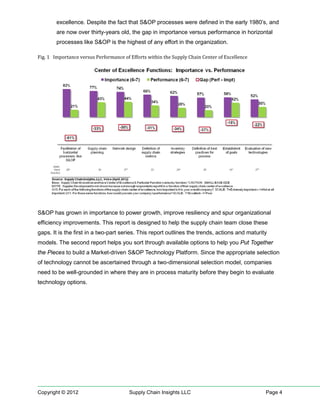
excellence. Despite the fact that S&OP processes were defined in the early 1980’s, and
        are now over thirty-years old, the gap in importance versus performance in horizontal
        processes like S&OP is the highest of any effort in the organization.

Fig. 1 Importance versus Performance of Efforts within the Supply Chain Center of Excellence


S&OP has grown in importance to power growth, improve resiliency and spur organizational
efficiency improvements. This report is designed to help the supply chain team close these
gaps. It is the first in a two-part series. This report outlines the trends, actions and maturity
models. The second report helps you sort through available options to help you Put Together
the Pieces to build a Market-driven S&OP Technology Platform. Since the appropriate selection
of technology cannot be ascertained through a two-dimensional selection model, companies
need to be well-grounded in where they are in process maturity before they begin to evaluate
technology options.


Copyright © 2012                        Supply Chain Insights LLC                               Page 4
The Journey to Drive Excellence through S&OP
What is S&OP? It looks different at every company. No two processes are the same. While
Sales and Operations Planning (S&OP) is defined by the Association of Production and
Inventory Control Systems (APICS) as “A process to develop tactical plans that provide
management the ability to strategically direct its
businesses to achieve competitive advantage on a          “Why am I focused on the supply
continuous basis by integrating customer-focused          chain? The answer is simple. It is
marketing plans for new and existing products with        a barometer of my business. All
the management of the supply chain …,” the                the problems show up first in the
implementation of this process is easier said than        supply chain….”
done. In this report, we share insights on how to
build an S&OP process to better align the                 Michael Dell

organization market-to-market to reduce risk and          Dell founder, chairman and CEO

maximize opportunity.

To achieve this goal, companies need to adapt their supply chain processes to be market-
driven. This is in stark contrast to the definition of traditional supply chain processes. The
definition of a market-driven value network is: A market-driven value network is an adaptive
supply chain that can quickly drive alignment within the organization market-to-market to
improve value-based outcomes. These supply chain processes sense and translate market
changes (buy- and sell-side markets) bidirectionally with near real-time data latency to better
optimize and align sell, deliver, make and sourcing operations to the goal. The focus is on
horizontal process orchestration. The redefinition of S&OP processes to be market-driven is a
fundamental building block to a market-driven strategy.


The S&OP Evolution
The term S&OP is thirty years old. However, as supply chain processes have matured, it has
been redefined. Today, companies are at five stages of maturity. They are: develop a feasible
plan, match demand with supply, drive a profitable plan, become demand driven and drive a
market-driven response. Each stage offers increasing opportunity and Return on Investment
(ROI). However, moving from one step to another can often mean a redefining of the data model
and data inputs.

While most companies just move from stage to stage in S&OP without deliberate alignment to a
goal, this aimless wandering is a mistake. Each step of the S&OP maturity model has a different
goal. The fastest progress is made when companies are deliberate and work the process

Copyright © 2012                      Supply Chain Insights LLC                                  Page 5
against a road map of improvement. Supply chain maturity in S&OP can be answered quickly by
answering these five questions:

       1) What is your S&OP goal?
       2) How do you achieve the correct balance between demand and supply?
       3) How do you make decisions?
       4) How does your organization measure success?
       5) How do you tie S&OP planning to execution?

While each stage of S&OP process maturity has a different process goal, based on our
experience, over 75% of companies lack goal clarity and over 80% of companies are not clear
on the definition of supply chain strategy, which undermines S&OP success. The definition of
supply chain excellence should be a prerequisite for the formation of a team to work on S&OP.
Frequently, cross-functional teams form with a different, often unexpressed, goal in mind. They
will each say “supply chain,” but the term will have a very
DIFFERENT meaning to each person. In these cases, the             The most mature companies in
team will struggle for months—or years—to gain                    the selection of S&OP
alignment.                                                        processes can easily answer
                                                                  five questions:
Stage 1:                                                          1) What is your S&OP goal?
                                                                  2) How do you achieve
Goal - Deliver a Feasible Plan.                                       balance between demand

The original S&OP processes originated with the goal of               and supply?

developing a feasible plan. Early evolution of the                3) How do you make
                                                                      decisions?
Advanced Planning Solution (APS) market enabled
                                                                  4) How does your
organizations to develop a forecast, visualize operational
                                                                      organization measure
requirements and align metrics. The introduction of
                                                                      success?
Theory of Constraints (TOC) in 1984, and the evolution of
                                                                  5) How do you tie S&OP
the concepts into manufacturing planning applications,                planning to execution?
enhanced this capability. It allowed organizations to
identify constraints and build a feasible, or realistic, plan. Note that these models are very
industry-specific. A conglomerate composed of process, discrete and apparel manufacturing
may find that it needs multiple systems to model operations. Likewise, the building of a one-
size-fits-all model by the ERP expansionists has delivered generic supply models that do not fit
any company very well. This often results in tension between the CIO that wants to simplify the
number of IT systems and the line of business user that wants modeling capability. We see the
best results for companies when they absorb the higher IT expense and give the teams the


Copyright © 2012                     Supply Chain Insights LLC                                   Page 6
modeling tools they need. Depth of modeling is more important than tight integration to
transactional systems for S&OP success.

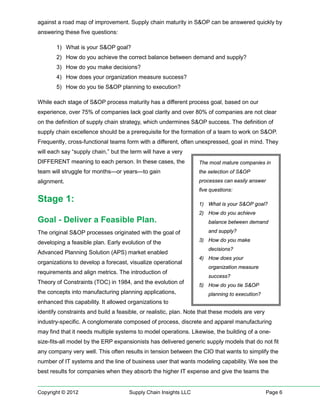
With the resurgence of interest in S&OP, many companies forget that they MUST be sure that
they have a feasible plan. IT IS a PREREQUISITE condition for subsequent phases.

Fig. 2 Stages of Sales and Operations Maturity


Stage 2:

Goal - Match Demand with Supply.
As organizations mature, teams need a solution with more advanced capabilities to model the
trade-offs of volume and product mix. These trade-offs are complex. Through the use of
technologies, companies are able to visualize and balance customer service and assess
strategies and inventory plans to best match demand with supply. To meet this requirement,
companies have invested in “what-if” modeling environments. Over the last ten years, these
processes were augmented by inventory management specialist capabilities to evaluate multi-
tier inventory analysis.

However, despite vast improvements in modeling technologies and computer visualization
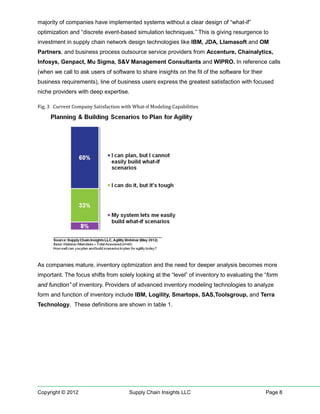
techniques, today, only 8% of companies are satisfied with their modeling capabilities. The


Copyright © 2012                        Supply Chain Insights LLC                         Page 7
majority of companies have implemented systems without a clear design of “what-if”
optimization and “discrete event-based simulation techniques.” This is giving resurgence to
investment in supply chain network design technologies like IBM, JDA, Llamasoft and OM
Partners, and business process outsource service providers from Accenture, Chainalytics,
Infosys, Genpact, Mu Sigma, S&V Management Consultants and WIPRO. In reference calls
(when we call to ask users of software to share insights on the fit of the software for their
business requirements), line of business users express the greatest satisfaction with focused
niche providers with deep expertise.

Fig. 3 Current Company Satisfaction with What-if Modeling Capabilities


As companies mature, inventory optimization and the need for deeper analysis becomes more
important. The focus shifts from solely looking at the “level” of inventory to evaluating the “form
and function” of inventory. Providers of advanced inventory modeling technologies to analyze
form and function of inventory include IBM, Logility, Smartops, SAS,Toolsgroup, and Terra
Technology. These definitions are shown in table 1.


Copyright © 2012                       Supply Chain Insights LLC                                Page 8
Table 1 Inventory Definitions
             Forms of Inventory                                  Functions of Inventory
Raw Material: The required materials as defined      Cycle Stock: Inventory required to cycle through
by the bill of material. In market-driven value      production and distribution constraints to optimize
networks, there is a need to tie alternate bill of   make, source and deliver.
materials to what-if simulation to make trade-
offs on market to market volatility.

Semi-finished Product: The determination of          Events: Forward coverage of events: promotions,
the best form of product to store a unit based       new product launch, and marketing programs.
on postponement logic.

Finished Product: A shippable unit.                  Safety Stock: Inventory buffer for demand and
                                                     supply volatility.


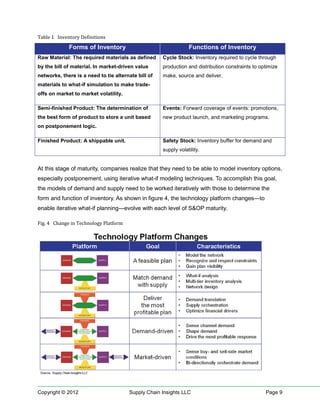
At this stage of maturity, companies realize that they need to be able to model inventory options,
especially postponement, using iterative what-if modeling techniques. To accomplish this goal,
the models of demand and supply need to be worked iteratively with those to determine the
form and function of inventory. As shown in figure 4, the technology platform changes—to
enable iterative what-if planning—evolve with each level of S&OP maturity.

Fig. 4 Change in Technology Platform


Copyright © 2012                       Supply Chain Insights LLC                                  Page 9
Stage 3:

Goal - Drive the Most Profitable Response.
While stage 1 is supply-driven and stage 2 is sales/marketing-driven, stage 3 is business-
planning-driven. This is commonly dubbed Integrated Business Planning (IBP). At this stage, it
is critical to have a clear supply chain strategy and well-defined definition of supply chain
excellence. For most, this is a gating factor for success.

Dirty data is a problem for all, and getting to financial data is difficult for all companies
interviewed for this report. As a result, for most, the modeling of supply chain profitability is
aspirational. If the data is available, to accomplish this modeling, the demand and supply
hierarchies must be decoupled to enable volume/mix “what-if” trade-offs iteratively between
demand, supply and inventory models.

One of the issues in this stage of S&OP is unit conversion. The average company will have five
to seven definitions of “volume” that require translation. Additionally, to properly determine
trade-offs the analysis needs to be calculated in “volume” not “currency.” The organization starts
to become bilingual to discuss issues in both currency and volume and the impact of changes in
“product mix.”

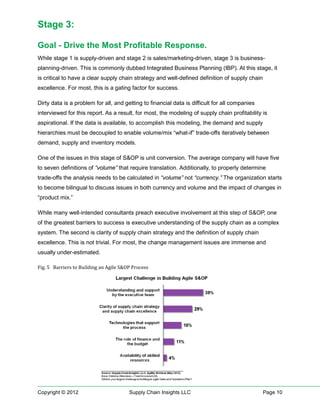
While many well-intended consultants preach executive involvement at this step of S&OP, one
of the greatest barriers to success is executive understanding of the supply chain as a complex
system. The second is clarity of supply chain strategy and the definition of supply chain
excellence. This is not trivial. For most, the change management issues are immense and
usually under-estimated.

Fig. 5 Barriers to Building an Agile S&OP Process


Copyright © 2012                        Supply Chain Insights LLC                               Page 10
Advanced financial modeling requires the augmentation of the S&OP process with specific
financial modeling technologies. This includes technologies from Acorn Systems, Equazion,
Jonova, SAS, River Logic, and Tagetik. Each technology is very specific, targeting a different
financial modeling problem.

The buyer of technologies will quickly get frustrated speaking to providers in this area. The
worlds of supply chain and financial modeling are worlds apart. Thought leaders from these two
different areas speak different languages and very rarely understand the nuances of the two
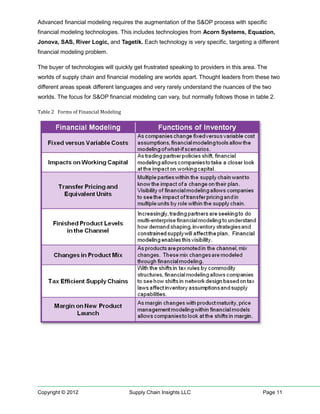
worlds. The focus for S&OP financial modeling can vary, but normally follows those in table 2.

Table 2 Forms of Financial Modeling


Copyright © 2012                      Supply Chain Insights LLC                            Page 11
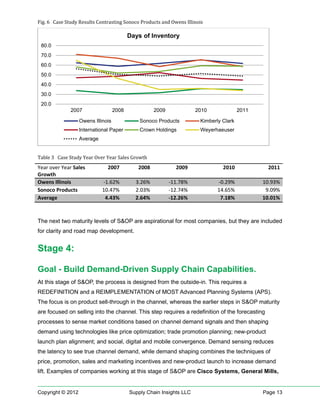
Sales & Operations Planning (S&OP) Case Study
Sonoco Products and Owens Illinois compete for market share in the delivery of
packaging materials to the food manufacturing industry. Sonoco Products, a $4.5B dollar
company located in South Carolina, manufactures packaging film. The company has been on a
six-year journey to become more demand-driven with a strong focus on Sales and Operations
Planning (S&OP). The company is currently at Stage #3 in the S&OP model.


  “To drive S&OP excellence, we need to be bilingual. Companies need to speak both the
  language of “volume” and “currency.” “Currency” is the lingua franca for discussions
  with finance, but “volume” is necessary to determine the “feasible plan.”

  Pat Bower, Senior Director of Supply Chain Planning, Combe International


In contrast, Owens Illinois (OI), a $6.3B company, manufacturer of glass containers with US
headquarters in Ohio, has been more focused on transactional efficiency, procurement and IT
standardization.

This company has a more traditional definition of S&OP and is between stage 1 and 2 as
outlined in this report. OI has had more inventory than their peer group for the past six years. In
contrast, Sonoco Products has driven growth (with 65% less spending in R&D than OI), and
managed inventories at better than peer group averages over the course of their S&OP
transition. One of the keys to success for Sonoco Products is the early identification of
opportunities to “sell available manufacturing capacity” in the channel through closer
coordination with their upstream customers. In the words of Keith Holiday, Sonoco Products,
“S&OP has been a strong contributor to the company’s ability to drive growth while controlling
inventories below peer group levels.”


Copyright © 2012                     Supply Chain Insights LLC                              Page 12
Fig. 6 Case Study Results Contrasting Sonoco Products and Owens Illinois

                                           Days of Inventory
 80.0
 70.0
 60.0
 50.0
 40.0
 30.0
 20.0
              2007                  2008             2009              2010              2011

                   Owens Illinois              Sonoco Products          Kimberly Clark
                   International Paper         Crown Holdings           Weyerhaeuser
                   Average


Table 3 Case Study Year Over Year Sales Growth
Year over Year Sales           2007           2008            2009               2010            2011
Growth
Owens Illinois               -1.62%          3.26%          -11.78%            -0.29%           10.93%
Sonoco Products              10.47%          2.03%          -12.74%            14.65%            9.09%
Average                       4.43%          2.64%          -12.26%             7.18%           10.01%


The next two maturity levels of S&OP are aspirational for most companies, but they are included
for clarity and road map development.


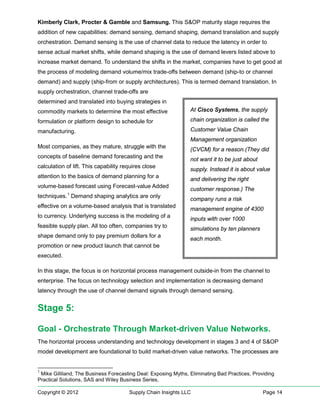
Stage 4:

Goal - Build Demand-Driven Supply Chain Capabilities.
At this stage of S&OP, the process is designed from the outside-in. This requires a
REDEFINITION and a REIMPLEMENTATION of MOST Advanced Planning Systems (APS).
The focus is on product sell-through in the channel, whereas the earlier steps in S&OP maturity
are focused on selling into the channel. This step requires a redefinition of the forecasting
processes to sense market conditions based on channel demand signals and then shaping
demand using technologies like price optimization; trade promotion planning; new-product
launch plan alignment; and social, digital and mobile convergence. Demand sensing reduces
the latency to see true channel demand, while demand shaping combines the techniques of
price, promotion, sales and marketing incentives and new-product launch to increase demand
lift. Examples of companies working at this stage of S&OP are Cisco Systems, General Mills,


Copyright © 2012                           Supply Chain Insights LLC                            Page 13
Kimberly Clark, Procter & Gamble and Samsung. This S&OP maturity stage requires the
addition of new capabilities: demand sensing, demand shaping, demand translation and supply
orchestration. Demand sensing is the use of channel data to reduce the latency in order to
sense actual market shifts, while demand shaping is the use of demand levers listed above to
increase market demand. To understand the shifts in the market, companies have to get good at
the process of modeling demand volume/mix trade-offs between demand (ship-to or channel
demand) and supply (ship-from or supply architectures). This is termed demand translation. In
supply orchestration, channel trade-offs are
determined and translated into buying strategies in
commodity markets to determine the most effective               At Cisco Systems, the supply

formulation or platform design to schedule for                  chain organization is called the

manufacturing.                                                  Customer Value Chain
                                                                Management organization
Most companies, as they mature, struggle with the
                                                                (CVCM) for a reason.(They did
concepts of baseline demand forecasting and the
                                                                not want it to be just about
calculation of lift. This capability requires close
                                                                supply. Instead it is about value
attention to the basics of demand planning for a
                                                                and delivering the right
volume-based forecast using Forecast-value Added
                                                                customer response.) The
techniques. 1 Demand shaping analytics are only
                                                                company runs a risk
effective on a volume-based analysis that is translated
                                                                management engine of 4300
to currency. Underlying success is the modeling of a
                                                                inputs with over 1000
feasible supply plan. All too often, companies try to           simulations by ten planners
shape demand only to pay premium dollars for a
                                                                each month.
promotion or new product launch that cannot be
executed.

In this stage, the focus is on horizontal process management outside-in from the channel to
enterprise. The focus on technology selection and implementation is decreasing demand
latency through the use of channel demand signals through demand sensing.


Stage 5:

Goal - Orchestrate Through Market-driven Value Networks.
The horizontal process understanding and technology development in stages 3 and 4 of S&OP
model development are foundational to build market-driven value networks. The processes are


1
 Mike Gilliland, The Business Forecasting Deal: Exposing Myths, Eliminating Bad Practices, Providing
Practical Solutions, SAS and Wiley Business Series,

Copyright © 2012                       Supply Chain Insights LLC                               Page 14
progressive and build on each other. The evolution of the technology portfolio as outlined in
figure 4 helps companies to sense and shape demand and supply bidirectionally between sell-
and buy-side markets. This process of bidirectional trade-offs between demand and a
commodity market is termed demand orchestration. This capability allows companies to win in
this new world of changing opportunities and supply constraints. It is especially relevant with the
tightening of commodity markets. This stage is aspirational. It requires the redefinition of supply
chain practices and the building of demand-driven concepts market-to-market.

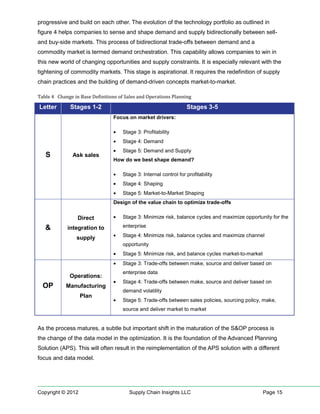
Table 4 Change in Base Definitions of Sales and Operations Planning

Letter        Stages 1-2                                           Stages 3-5
                                 Focus on market drivers:

                                 •   Stage 3: Profitability
                                 •   Stage 4: Demand
                                 •   Stage 5: Demand and Supply
   S           Ask sales
                                 How do we best shape demand?

                                 •   Stage 3: Internal control for profitability
                                 •   Stage 4: Shaping
                                 •   Stage 5: Market-to-Market Shaping
                                 Design of the value chain to optimize trade-offs


                 Direct          •   Stage 3: Minimize risk, balance cycles and maximize opportunity for the

   &        integration to           enterprise

                supply           •   Stage 4: Minimize risk, balance cycles and maximize channel
                                     opportunity
                                 •   Stage 5: Minimize risk, and balance cycles market-to-market
                                 •   Stage 3: Trade-offs between make, source and deliver based on
                                     enterprise data
             Operations:
                                 •   Stage 4: Trade-offs between make, source and deliver based on
  OP        Manufacturing
                                     demand volatility
                   Plan
                                 •   Stage 5: Trade-offs between sales policies, sourcing policy, make,
                                     source and deliver market to market


As the process matures, a subtle but important shift in the maturation of the S&OP process is
the change of the data model in the optimization. It is the foundation of the Advanced Planning
Solution (APS). This will often result in the reimplementation of the APS solution with a different
focus and data model.


Copyright © 2012                        Supply Chain Insights LLC                                  Page 15
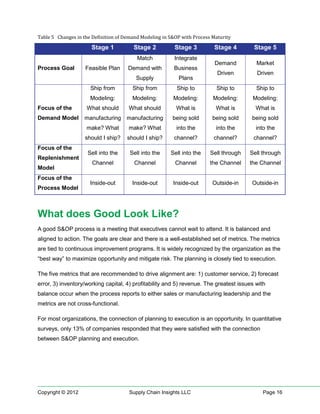
Table 5 Changes in the Definition of Demand Modeling in S&OP with Process Maturity

                      Stage 1           Stage 2           Stage 3          Stage 4       Stage 5
                                          Match           Integrate
                                                                           Demand         Market
Process Goal        Feasible Plan     Demand with        Business
                                                                            Driven        Driven
                                         Supply            Plans
                      Ship from         Ship from          Ship to         Ship to        Ship to
                      Modeling:         Modeling:        Modeling:        Modeling:      Modeling:
Focus of the        What should       What should         What is          What is        What is
Demand Model       manufacturing manufacturing           being sold       being sold    being sold
                    make? What        make? What          into the         into the       into the
                    should I ship?    should I ship?     channel?         channel?       channel?
Focus of the
                     Sell into the     Sell into the    Sell into the    Sell through   Sell through
Replenishment
                       Channel           Channel          Channel        the Channel    the Channel
Model
Focus of the
                      Inside-out        Inside-out       Inside-out       Outside-in    Outside-in
Process Model


What does Good Look Like?
A good S&OP process is a meeting that executives cannot wait to attend. It is balanced and
aligned to action. The goals are clear and there is a well-established set of metrics. The metrics
are tied to continuous improvement programs. It is widely recognized by the organization as the
“best way” to maximize opportunity and mitigate risk. The planning is closely tied to execution.

The five metrics that are recommended to drive alignment are: 1) customer service, 2) forecast
error, 3) inventory/working capital, 4) profitability and 5) revenue. The greatest issues with
balance occur when the process reports to either sales or manufacturing leadership and the
metrics are not cross-functional.

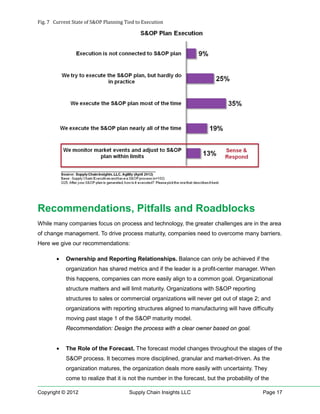
For most organizations, the connection of planning to execution is an opportunity. In quantitative
surveys, only 13% of companies responded that they were satisfied with the connection
between S&OP planning and execution.


Copyright © 2012                      Supply Chain Insights LLC                              Page 16
Fig. 7 Current State of S&OP Planning Tied to Execution


Recommendations, Pitfalls and Roadblocks
While many companies focus on process and technology, the greater challenges are in the area
of change management. To drive process maturity, companies need to overcome many barriers.
Here we give our recommendations:

        •   Ownership and Reporting Relationships. Balance can only be achieved if the
            organization has shared metrics and if the leader is a profit-center manager. When
            this happens, companies can more easily align to a common goal. Organizational
            structure matters and will limit maturity. Organizations with S&OP reporting
            structures to sales or commercial organizations will never get out of stage 2; and
            organizations with reporting structures aligned to manufacturing will have difficulty
            moving past stage 1 of the S&OP maturity model.
            Recommendation: Design the process with a clear owner based on goal.


        •   The Role of the Forecast. The forecast model changes throughout the stages of the
            S&OP process. It becomes more disciplined, granular and market-driven. As the
            organization matures, the organization deals more easily with uncertainty. They
            come to realize that it is not the number in the forecast, but the probability of the

Copyright © 2012                        Supply Chain Insights LLC                             Page 17
number that matters. Companies that implement Forecast Value Added Analysis into
           continuous improvement programs make the fastest progress.
           Recommendation: Design and implement continuous improvement programs for
           demand planning using Forecast Value Added Analysis.


       •   The Role of the Budget. Integration of the financial plan into the tactical operational
           plan is the number one change management issue for companies in tactical planning
           processes at Stages 2 & 3. One reason is that the words “budget” and “supply chain”
           are loaded terms. By definition, the financial budget is a static document in a
           dynamic world. For this reason, tight integration between financial and operational
           processes is NEVER recommended. It can be an input, but should never be a
           constraint in the S&OP process. Organizational training is critical to get past this
           obstacle.
           Recommendation: Facilitate a common understanding for team members in the
           S&OP process on the terms “supply chain” and “budget”.


       •   Planning Skills and Capabilities. What-if functionality in predictive analytics is
           evolving, and it is a critical skill set for an effective S&OP process. One of the limiting
           factors for many organizations is supply chain planning talent. There are three
           issues: skills, job definition and turnover. While skills can be improved through
           training, companies will need to redefine the job descriptions for supply chain
           planners to give them more time to “plan” as the company matures through the
           S&OP maturity model. Additionally, with one in four demand planning jobs vacant,
           and a job shortage in emerging economies, companies need to plan for job turnover.
           Recommendation: Redesign planning job descriptions to allow planners more time to
           plan. Build contingency plans to ensure business process continuity with supply
           chain planning turnover.


       •   The Hoax of One Number Forecasting. A forecast is a hierarchy of numbers based
           on primary keys or attributes. In modern forecasting tools, there are multiple views,
           and representations of the forecast in multiple units of measure. There are also
           multiple forecasts in the organization (e.g., sales forecast, financial forecast, material
           forecast). Each forecasting process is built with a goal in mind; and as a result, the
           underlying context of the data is different. The multiple forecasts can be
           synchronized using a common set of assumptions, but the goal of tight integration or
           having “one number” hamstrings an organization. As a result, the promise of “one


Copyright © 2012                      Supply Chain Insights LLC                               Page 18
number” is too simplistic. The goal should not be for one number; instead, the goal
           should be a common plan.
           Recommendation: Focus on a common plan based on market drivers.


Why does it Matter?
Each step in advancement of the S&OP process delivers incremental, positive business results.
Companies reaching stage 2 of supply chain maturity in Sales and Operations Planning are able
to drive an average improvement of 2% increase in growth and a 3% to 7% improvement in
asset utilization. While many supply chain processes will improve one to two metrics, the
benefits of improving S&OP maturity are pervasive, touching many metrics, and raising the bar
of total performance.


Copyright © 2012                    Supply Chain Insights LLC                               Page 19
About Supply Chain Insights LLC
Supply Chain Insights LLC (SCI) is a research and advisory firm focused on helping supply
chain teams improve value-based outcomes. The offerings include research-based Advisory
Services, a Dedicated Supply Chain Community and Web-based Training. Formed in February
2012, the company helps technology providers and users of technologies gain first mover
advantage.


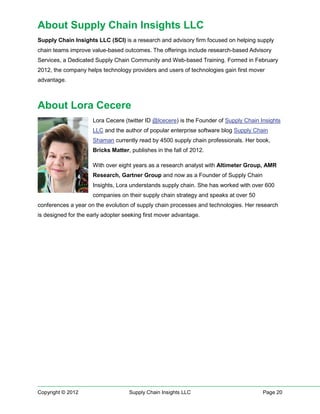
About Lora Cecere
                     Lora Cecere (twitter ID @lcecere) is the Founder of Supply Chain Insights
                     LLC and the author of popular enterprise software blog Supply Chain
                     Shaman currently read by 4500 supply chain professionals. Her book,
                     Bricks Matter, publishes in the fall of 2012.

                     With over eight years as a research analyst with Altimeter Group, AMR
                     Research, Gartner Group and now as a Founder of Supply Chain
                     Insights, Lora understands supply chain. She has worked with over 600
                     companies on their supply chain strategy and speaks at over 50
conferences a year on the evolution of supply chain processes and technologies. Her research
is designed for the early adopter seeking first mover advantage.


Copyright © 2012                    Supply Chain Insights LLC                          Page 20

Market-driven S&OP Report - 16 July 2012

  • 1.
    Market-driven S&OP A Guidebookon How to Build a Market-driven S&OP Process 7/15/2012 By Lora Cecere Founder and CEO Supply Chain Insights LLC
  • 2.
    Contents Research ................................................................................................................................... 2 Disclosure.................................................................................................................................. 2 Ecosystem Input ........................................................................................................................ 2 Executive Summary ................................................................................................................... 3 The Journey to Drive Excellence through S&OP ........................................................................ 5 The S&OP Evolution .................................................................................................................. 5 Stage 1: .................................................................................................................................. 6 Goal - Deliver a Feasible Plan............................................................................................. 6 Stage 2: .................................................................................................................................. 7 Goal - Match Demand with Supply. ..................................................................................... 7 Stage 3: .................................................................................................................................10 Goal - Drive the Most Profitable Response. .......................................................................10 Sales & Operations Planning (S&OP) Case Study .............................................................12 Stage 4: .................................................................................................................................13 Goal - Build Demand-Driven Supply Chain Capabilities. ....................................................13 Stage 5: .................................................................................................................................14 Goal - Orchestrate Through Market-driven Value Networks. ..............................................14 What does Good Look Like? .....................................................................................................16 Recommendations, Pitfalls and Roadblocks .............................................................................17 Why does it Matter? ..................................................................................................................19 About Supply Chain Insights LLC ..............................................................................................20 About Lora Cecere ....................................................................................................................20 Copyright © 2012 Supply Chain Insights LLC Page 1
  • 3.
    Research This independent researchwas 100% funded by Supply Chain Insights and is published using the principle of Open Content research. It is intended for you to read, share, and use to improve your decisions in buying supply chain technologies. All we ask for in return is attribution of anything you quote or use publically. We publish under the Attribution-Noncommercial-Share Alike 3.0 United States Creative Commons License. The policy for citation is outlined on our website at Supply Chain Insights. Disclosure Your trust is important to us. As such, we are open and transparent about our financial relationships and our research process. Ecosystem Input The research for this report is based on one-on-one experiences in working with over eighty companies in the past three years. It is augmented by insights from three Supply Chain Insights quantitative research studies: • Voice of the Supply Chain Leader. During the period of March-April 2012, data was collected from 61 respondents from over 40 companies to understand supply chain trends. • Sales and Operations Planning Improves Agility. During the period March-April 2012, there were 117 supply chain respondents from over 50 companies to better understand the role of S&OP processes in driving supply chain agility. • Supply Chain Big Data. Study data collected in the period of April-June 2012 from 53 respondents from over 40 companies to gain insights on the role of big data in current and future supply chain processes. These three studies allow us to triangulate the market. To maximize insights, we have validated the findings of the studies with supply chain leadership teams. Copyright © 2012 Supply Chain Insights LLC Page 2
  • 4.
    Executive Summary For manufacturersand retailers, supply chain is business. The Sales and Operations Planning (S&OP) process aligns the organization to the business strategy. As companies have become more global and face rising complexity, volatility and uncertainty, the importance of S&OP has increased. However, business complexity has created a gap between what companies have and what is needed. From our research, here we cite examples of these gaps: • Commodity Prices Increasing. In 2011, 58% of the Fortune 100 companies list commodity pressures as a risk to earnings. Based on our one-to-one experience with companies, less than 2% of companies can look at market volatility within buy- and sell- side markets and translate the impacts into a feasible S&OP plan. • Risk is Higher. In 2011, based on analysis of annual reports, 65% percent of supply chains experienced a disruption. Yet, in our surveys, only 13% of companies feel that they can successfully tie S&OP planning to execution. • Business Complexity is Growing. Eight years ago, companies had one S&OP process. Not so anymore. “The word ‘supply chain’ is Today, on average, companies have five S&OP so different for everyone in processes. In our research studies, 63% of companies the company.” report having more than one process. • Supply Chain Matters More than Ever. For most Director of Planning, Nestle industries, growth is stalled (reference Supply Chain Insights Report, Building Market-driven Value Networks) and industry progress on inventory reduction and supply chain working capital is stagnating. As a result, supply chain excellence matters more now than ever. • Gap in Technology. Many companies have inherited technologies implemented over the past decade that focus on tight integration and less on optimization and decision support. For most, they are not adequate. Today, we find that 87% percent of companies are struggling with the integration of business planning and supply chain planning technologies. Only 8% of companies are satisfied with current modeling capabilities in their existing supply chain planning systems. • Lack of Balance and Alignment. Today, based on a web survey of 40 companies, only 20% of supply chain leaders feel that they have balance today between sales and operations groups within the organization. Supply chains are more global and today, 77% of companies surveyed feel that they have a global supply chain. It is common when a company has a global supply chain for them to also have a supply chain center of excellence. In our research, 64% of companies have a supply chain center of Copyright © 2012 Supply Chain Insights LLC Page 3
  • 5.
    excellence. Despite thefact that S&OP processes were defined in the early 1980’s, and are now over thirty-years old, the gap in importance versus performance in horizontal processes like S&OP is the highest of any effort in the organization. Fig. 1 Importance versus Performance of Efforts within the Supply Chain Center of Excellence S&OP has grown in importance to power growth, improve resiliency and spur organizational efficiency improvements. This report is designed to help the supply chain team close these gaps. It is the first in a two-part series. This report outlines the trends, actions and maturity models. The second report helps you sort through available options to help you Put Together the Pieces to build a Market-driven S&OP Technology Platform. Since the appropriate selection of technology cannot be ascertained through a two-dimensional selection model, companies need to be well-grounded in where they are in process maturity before they begin to evaluate technology options. Copyright © 2012 Supply Chain Insights LLC Page 4
  • 6.
    The Journey toDrive Excellence through S&OP What is S&OP? It looks different at every company. No two processes are the same. While Sales and Operations Planning (S&OP) is defined by the Association of Production and Inventory Control Systems (APICS) as “A process to develop tactical plans that provide management the ability to strategically direct its businesses to achieve competitive advantage on a “Why am I focused on the supply continuous basis by integrating customer-focused chain? The answer is simple. It is marketing plans for new and existing products with a barometer of my business. All the management of the supply chain …,” the the problems show up first in the implementation of this process is easier said than supply chain….” done. In this report, we share insights on how to build an S&OP process to better align the Michael Dell organization market-to-market to reduce risk and Dell founder, chairman and CEO maximize opportunity. To achieve this goal, companies need to adapt their supply chain processes to be market- driven. This is in stark contrast to the definition of traditional supply chain processes. The definition of a market-driven value network is: A market-driven value network is an adaptive supply chain that can quickly drive alignment within the organization market-to-market to improve value-based outcomes. These supply chain processes sense and translate market changes (buy- and sell-side markets) bidirectionally with near real-time data latency to better optimize and align sell, deliver, make and sourcing operations to the goal. The focus is on horizontal process orchestration. The redefinition of S&OP processes to be market-driven is a fundamental building block to a market-driven strategy. The S&OP Evolution The term S&OP is thirty years old. However, as supply chain processes have matured, it has been redefined. Today, companies are at five stages of maturity. They are: develop a feasible plan, match demand with supply, drive a profitable plan, become demand driven and drive a market-driven response. Each stage offers increasing opportunity and Return on Investment (ROI). However, moving from one step to another can often mean a redefining of the data model and data inputs. While most companies just move from stage to stage in S&OP without deliberate alignment to a goal, this aimless wandering is a mistake. Each step of the S&OP maturity model has a different goal. The fastest progress is made when companies are deliberate and work the process Copyright © 2012 Supply Chain Insights LLC Page 5
  • 7.
    against a roadmap of improvement. Supply chain maturity in S&OP can be answered quickly by answering these five questions: 1) What is your S&OP goal? 2) How do you achieve the correct balance between demand and supply? 3) How do you make decisions? 4) How does your organization measure success? 5) How do you tie S&OP planning to execution? While each stage of S&OP process maturity has a different process goal, based on our experience, over 75% of companies lack goal clarity and over 80% of companies are not clear on the definition of supply chain strategy, which undermines S&OP success. The definition of supply chain excellence should be a prerequisite for the formation of a team to work on S&OP. Frequently, cross-functional teams form with a different, often unexpressed, goal in mind. They will each say “supply chain,” but the term will have a very DIFFERENT meaning to each person. In these cases, the The most mature companies in team will struggle for months—or years—to gain the selection of S&OP alignment. processes can easily answer five questions: Stage 1: 1) What is your S&OP goal? 2) How do you achieve Goal - Deliver a Feasible Plan. balance between demand The original S&OP processes originated with the goal of and supply? developing a feasible plan. Early evolution of the 3) How do you make decisions? Advanced Planning Solution (APS) market enabled 4) How does your organizations to develop a forecast, visualize operational organization measure requirements and align metrics. The introduction of success? Theory of Constraints (TOC) in 1984, and the evolution of 5) How do you tie S&OP the concepts into manufacturing planning applications, planning to execution? enhanced this capability. It allowed organizations to identify constraints and build a feasible, or realistic, plan. Note that these models are very industry-specific. A conglomerate composed of process, discrete and apparel manufacturing may find that it needs multiple systems to model operations. Likewise, the building of a one- size-fits-all model by the ERP expansionists has delivered generic supply models that do not fit any company very well. This often results in tension between the CIO that wants to simplify the number of IT systems and the line of business user that wants modeling capability. We see the best results for companies when they absorb the higher IT expense and give the teams the Copyright © 2012 Supply Chain Insights LLC Page 6
  • 8.
    modeling tools theyneed. Depth of modeling is more important than tight integration to transactional systems for S&OP success. With the resurgence of interest in S&OP, many companies forget that they MUST be sure that they have a feasible plan. IT IS a PREREQUISITE condition for subsequent phases. Fig. 2 Stages of Sales and Operations Maturity Stage 2: Goal - Match Demand with Supply. As organizations mature, teams need a solution with more advanced capabilities to model the trade-offs of volume and product mix. These trade-offs are complex. Through the use of technologies, companies are able to visualize and balance customer service and assess strategies and inventory plans to best match demand with supply. To meet this requirement, companies have invested in “what-if” modeling environments. Over the last ten years, these processes were augmented by inventory management specialist capabilities to evaluate multi- tier inventory analysis. However, despite vast improvements in modeling technologies and computer visualization techniques, today, only 8% of companies are satisfied with their modeling capabilities. The Copyright © 2012 Supply Chain Insights LLC Page 7
  • 9.
    majority of companieshave implemented systems without a clear design of “what-if” optimization and “discrete event-based simulation techniques.” This is giving resurgence to investment in supply chain network design technologies like IBM, JDA, Llamasoft and OM Partners, and business process outsource service providers from Accenture, Chainalytics, Infosys, Genpact, Mu Sigma, S&V Management Consultants and WIPRO. In reference calls (when we call to ask users of software to share insights on the fit of the software for their business requirements), line of business users express the greatest satisfaction with focused niche providers with deep expertise. Fig. 3 Current Company Satisfaction with What-if Modeling Capabilities As companies mature, inventory optimization and the need for deeper analysis becomes more important. The focus shifts from solely looking at the “level” of inventory to evaluating the “form and function” of inventory. Providers of advanced inventory modeling technologies to analyze form and function of inventory include IBM, Logility, Smartops, SAS,Toolsgroup, and Terra Technology. These definitions are shown in table 1. Copyright © 2012 Supply Chain Insights LLC Page 8
  • 10.
    Table 1 InventoryDefinitions Forms of Inventory Functions of Inventory Raw Material: The required materials as defined Cycle Stock: Inventory required to cycle through by the bill of material. In market-driven value production and distribution constraints to optimize networks, there is a need to tie alternate bill of make, source and deliver. materials to what-if simulation to make trade- offs on market to market volatility. Semi-finished Product: The determination of Events: Forward coverage of events: promotions, the best form of product to store a unit based new product launch, and marketing programs. on postponement logic. Finished Product: A shippable unit. Safety Stock: Inventory buffer for demand and supply volatility. At this stage of maturity, companies realize that they need to be able to model inventory options, especially postponement, using iterative what-if modeling techniques. To accomplish this goal, the models of demand and supply need to be worked iteratively with those to determine the form and function of inventory. As shown in figure 4, the technology platform changes—to enable iterative what-if planning—evolve with each level of S&OP maturity. Fig. 4 Change in Technology Platform Copyright © 2012 Supply Chain Insights LLC Page 9
  • 11.
    Stage 3: Goal -Drive the Most Profitable Response. While stage 1 is supply-driven and stage 2 is sales/marketing-driven, stage 3 is business- planning-driven. This is commonly dubbed Integrated Business Planning (IBP). At this stage, it is critical to have a clear supply chain strategy and well-defined definition of supply chain excellence. For most, this is a gating factor for success. Dirty data is a problem for all, and getting to financial data is difficult for all companies interviewed for this report. As a result, for most, the modeling of supply chain profitability is aspirational. If the data is available, to accomplish this modeling, the demand and supply hierarchies must be decoupled to enable volume/mix “what-if” trade-offs iteratively between demand, supply and inventory models. One of the issues in this stage of S&OP is unit conversion. The average company will have five to seven definitions of “volume” that require translation. Additionally, to properly determine trade-offs the analysis needs to be calculated in “volume” not “currency.” The organization starts to become bilingual to discuss issues in both currency and volume and the impact of changes in “product mix.” While many well-intended consultants preach executive involvement at this step of S&OP, one of the greatest barriers to success is executive understanding of the supply chain as a complex system. The second is clarity of supply chain strategy and the definition of supply chain excellence. This is not trivial. For most, the change management issues are immense and usually under-estimated. Fig. 5 Barriers to Building an Agile S&OP Process Copyright © 2012 Supply Chain Insights LLC Page 10
  • 12.
    Advanced financial modelingrequires the augmentation of the S&OP process with specific financial modeling technologies. This includes technologies from Acorn Systems, Equazion, Jonova, SAS, River Logic, and Tagetik. Each technology is very specific, targeting a different financial modeling problem. The buyer of technologies will quickly get frustrated speaking to providers in this area. The worlds of supply chain and financial modeling are worlds apart. Thought leaders from these two different areas speak different languages and very rarely understand the nuances of the two worlds. The focus for S&OP financial modeling can vary, but normally follows those in table 2. Table 2 Forms of Financial Modeling Copyright © 2012 Supply Chain Insights LLC Page 11
  • 13.
    Sales & OperationsPlanning (S&OP) Case Study Sonoco Products and Owens Illinois compete for market share in the delivery of packaging materials to the food manufacturing industry. Sonoco Products, a $4.5B dollar company located in South Carolina, manufactures packaging film. The company has been on a six-year journey to become more demand-driven with a strong focus on Sales and Operations Planning (S&OP). The company is currently at Stage #3 in the S&OP model. “To drive S&OP excellence, we need to be bilingual. Companies need to speak both the language of “volume” and “currency.” “Currency” is the lingua franca for discussions with finance, but “volume” is necessary to determine the “feasible plan.” Pat Bower, Senior Director of Supply Chain Planning, Combe International In contrast, Owens Illinois (OI), a $6.3B company, manufacturer of glass containers with US headquarters in Ohio, has been more focused on transactional efficiency, procurement and IT standardization. This company has a more traditional definition of S&OP and is between stage 1 and 2 as outlined in this report. OI has had more inventory than their peer group for the past six years. In contrast, Sonoco Products has driven growth (with 65% less spending in R&D than OI), and managed inventories at better than peer group averages over the course of their S&OP transition. One of the keys to success for Sonoco Products is the early identification of opportunities to “sell available manufacturing capacity” in the channel through closer coordination with their upstream customers. In the words of Keith Holiday, Sonoco Products, “S&OP has been a strong contributor to the company’s ability to drive growth while controlling inventories below peer group levels.” Copyright © 2012 Supply Chain Insights LLC Page 12
  • 14.
    Fig. 6 CaseStudy Results Contrasting Sonoco Products and Owens Illinois Days of Inventory 80.0 70.0 60.0 50.0 40.0 30.0 20.0 2007 2008 2009 2010 2011 Owens Illinois Sonoco Products Kimberly Clark International Paper Crown Holdings Weyerhaeuser Average Table 3 Case Study Year Over Year Sales Growth Year over Year Sales 2007 2008 2009 2010 2011 Growth Owens Illinois -1.62% 3.26% -11.78% -0.29% 10.93% Sonoco Products 10.47% 2.03% -12.74% 14.65% 9.09% Average 4.43% 2.64% -12.26% 7.18% 10.01% The next two maturity levels of S&OP are aspirational for most companies, but they are included for clarity and road map development. Stage 4: Goal - Build Demand-Driven Supply Chain Capabilities. At this stage of S&OP, the process is designed from the outside-in. This requires a REDEFINITION and a REIMPLEMENTATION of MOST Advanced Planning Systems (APS). The focus is on product sell-through in the channel, whereas the earlier steps in S&OP maturity are focused on selling into the channel. This step requires a redefinition of the forecasting processes to sense market conditions based on channel demand signals and then shaping demand using technologies like price optimization; trade promotion planning; new-product launch plan alignment; and social, digital and mobile convergence. Demand sensing reduces the latency to see true channel demand, while demand shaping combines the techniques of price, promotion, sales and marketing incentives and new-product launch to increase demand lift. Examples of companies working at this stage of S&OP are Cisco Systems, General Mills, Copyright © 2012 Supply Chain Insights LLC Page 13
  • 15.
    Kimberly Clark, Procter& Gamble and Samsung. This S&OP maturity stage requires the addition of new capabilities: demand sensing, demand shaping, demand translation and supply orchestration. Demand sensing is the use of channel data to reduce the latency in order to sense actual market shifts, while demand shaping is the use of demand levers listed above to increase market demand. To understand the shifts in the market, companies have to get good at the process of modeling demand volume/mix trade-offs between demand (ship-to or channel demand) and supply (ship-from or supply architectures). This is termed demand translation. In supply orchestration, channel trade-offs are determined and translated into buying strategies in commodity markets to determine the most effective At Cisco Systems, the supply formulation or platform design to schedule for chain organization is called the manufacturing. Customer Value Chain Management organization Most companies, as they mature, struggle with the (CVCM) for a reason.(They did concepts of baseline demand forecasting and the not want it to be just about calculation of lift. This capability requires close supply. Instead it is about value attention to the basics of demand planning for a and delivering the right volume-based forecast using Forecast-value Added customer response.) The techniques. 1 Demand shaping analytics are only company runs a risk effective on a volume-based analysis that is translated management engine of 4300 to currency. Underlying success is the modeling of a inputs with over 1000 feasible supply plan. All too often, companies try to simulations by ten planners shape demand only to pay premium dollars for a each month. promotion or new product launch that cannot be executed. In this stage, the focus is on horizontal process management outside-in from the channel to enterprise. The focus on technology selection and implementation is decreasing demand latency through the use of channel demand signals through demand sensing. Stage 5: Goal - Orchestrate Through Market-driven Value Networks. The horizontal process understanding and technology development in stages 3 and 4 of S&OP model development are foundational to build market-driven value networks. The processes are 1 Mike Gilliland, The Business Forecasting Deal: Exposing Myths, Eliminating Bad Practices, Providing Practical Solutions, SAS and Wiley Business Series, Copyright © 2012 Supply Chain Insights LLC Page 14
  • 16.
    progressive and buildon each other. The evolution of the technology portfolio as outlined in figure 4 helps companies to sense and shape demand and supply bidirectionally between sell- and buy-side markets. This process of bidirectional trade-offs between demand and a commodity market is termed demand orchestration. This capability allows companies to win in this new world of changing opportunities and supply constraints. It is especially relevant with the tightening of commodity markets. This stage is aspirational. It requires the redefinition of supply chain practices and the building of demand-driven concepts market-to-market. Table 4 Change in Base Definitions of Sales and Operations Planning Letter Stages 1-2 Stages 3-5 Focus on market drivers: • Stage 3: Profitability • Stage 4: Demand • Stage 5: Demand and Supply S Ask sales How do we best shape demand? • Stage 3: Internal control for profitability • Stage 4: Shaping • Stage 5: Market-to-Market Shaping Design of the value chain to optimize trade-offs Direct • Stage 3: Minimize risk, balance cycles and maximize opportunity for the & integration to enterprise supply • Stage 4: Minimize risk, balance cycles and maximize channel opportunity • Stage 5: Minimize risk, and balance cycles market-to-market • Stage 3: Trade-offs between make, source and deliver based on enterprise data Operations: • Stage 4: Trade-offs between make, source and deliver based on OP Manufacturing demand volatility Plan • Stage 5: Trade-offs between sales policies, sourcing policy, make, source and deliver market to market As the process matures, a subtle but important shift in the maturation of the S&OP process is the change of the data model in the optimization. It is the foundation of the Advanced Planning Solution (APS). This will often result in the reimplementation of the APS solution with a different focus and data model. Copyright © 2012 Supply Chain Insights LLC Page 15
  • 17.
    Table 5 Changesin the Definition of Demand Modeling in S&OP with Process Maturity Stage 1 Stage 2 Stage 3 Stage 4 Stage 5 Match Integrate Demand Market Process Goal Feasible Plan Demand with Business Driven Driven Supply Plans Ship from Ship from Ship to Ship to Ship to Modeling: Modeling: Modeling: Modeling: Modeling: Focus of the What should What should What is What is What is Demand Model manufacturing manufacturing being sold being sold being sold make? What make? What into the into the into the should I ship? should I ship? channel? channel? channel? Focus of the Sell into the Sell into the Sell into the Sell through Sell through Replenishment Channel Channel Channel the Channel the Channel Model Focus of the Inside-out Inside-out Inside-out Outside-in Outside-in Process Model What does Good Look Like? A good S&OP process is a meeting that executives cannot wait to attend. It is balanced and aligned to action. The goals are clear and there is a well-established set of metrics. The metrics are tied to continuous improvement programs. It is widely recognized by the organization as the “best way” to maximize opportunity and mitigate risk. The planning is closely tied to execution. The five metrics that are recommended to drive alignment are: 1) customer service, 2) forecast error, 3) inventory/working capital, 4) profitability and 5) revenue. The greatest issues with balance occur when the process reports to either sales or manufacturing leadership and the metrics are not cross-functional. For most organizations, the connection of planning to execution is an opportunity. In quantitative surveys, only 13% of companies responded that they were satisfied with the connection between S&OP planning and execution. Copyright © 2012 Supply Chain Insights LLC Page 16
  • 18.
    Fig. 7 CurrentState of S&OP Planning Tied to Execution Recommendations, Pitfalls and Roadblocks While many companies focus on process and technology, the greater challenges are in the area of change management. To drive process maturity, companies need to overcome many barriers. Here we give our recommendations: • Ownership and Reporting Relationships. Balance can only be achieved if the organization has shared metrics and if the leader is a profit-center manager. When this happens, companies can more easily align to a common goal. Organizational structure matters and will limit maturity. Organizations with S&OP reporting structures to sales or commercial organizations will never get out of stage 2; and organizations with reporting structures aligned to manufacturing will have difficulty moving past stage 1 of the S&OP maturity model. Recommendation: Design the process with a clear owner based on goal. • The Role of the Forecast. The forecast model changes throughout the stages of the S&OP process. It becomes more disciplined, granular and market-driven. As the organization matures, the organization deals more easily with uncertainty. They come to realize that it is not the number in the forecast, but the probability of the Copyright © 2012 Supply Chain Insights LLC Page 17
  • 19.
    number that matters.Companies that implement Forecast Value Added Analysis into continuous improvement programs make the fastest progress. Recommendation: Design and implement continuous improvement programs for demand planning using Forecast Value Added Analysis. • The Role of the Budget. Integration of the financial plan into the tactical operational plan is the number one change management issue for companies in tactical planning processes at Stages 2 & 3. One reason is that the words “budget” and “supply chain” are loaded terms. By definition, the financial budget is a static document in a dynamic world. For this reason, tight integration between financial and operational processes is NEVER recommended. It can be an input, but should never be a constraint in the S&OP process. Organizational training is critical to get past this obstacle. Recommendation: Facilitate a common understanding for team members in the S&OP process on the terms “supply chain” and “budget”. • Planning Skills and Capabilities. What-if functionality in predictive analytics is evolving, and it is a critical skill set for an effective S&OP process. One of the limiting factors for many organizations is supply chain planning talent. There are three issues: skills, job definition and turnover. While skills can be improved through training, companies will need to redefine the job descriptions for supply chain planners to give them more time to “plan” as the company matures through the S&OP maturity model. Additionally, with one in four demand planning jobs vacant, and a job shortage in emerging economies, companies need to plan for job turnover. Recommendation: Redesign planning job descriptions to allow planners more time to plan. Build contingency plans to ensure business process continuity with supply chain planning turnover. • The Hoax of One Number Forecasting. A forecast is a hierarchy of numbers based on primary keys or attributes. In modern forecasting tools, there are multiple views, and representations of the forecast in multiple units of measure. There are also multiple forecasts in the organization (e.g., sales forecast, financial forecast, material forecast). Each forecasting process is built with a goal in mind; and as a result, the underlying context of the data is different. The multiple forecasts can be synchronized using a common set of assumptions, but the goal of tight integration or having “one number” hamstrings an organization. As a result, the promise of “one Copyright © 2012 Supply Chain Insights LLC Page 18
  • 20.
    number” is toosimplistic. The goal should not be for one number; instead, the goal should be a common plan. Recommendation: Focus on a common plan based on market drivers. Why does it Matter? Each step in advancement of the S&OP process delivers incremental, positive business results. Companies reaching stage 2 of supply chain maturity in Sales and Operations Planning are able to drive an average improvement of 2% increase in growth and a 3% to 7% improvement in asset utilization. While many supply chain processes will improve one to two metrics, the benefits of improving S&OP maturity are pervasive, touching many metrics, and raising the bar of total performance. Copyright © 2012 Supply Chain Insights LLC Page 19
  • 21.
    About Supply ChainInsights LLC Supply Chain Insights LLC (SCI) is a research and advisory firm focused on helping supply chain teams improve value-based outcomes. The offerings include research-based Advisory Services, a Dedicated Supply Chain Community and Web-based Training. Formed in February 2012, the company helps technology providers and users of technologies gain first mover advantage. About Lora Cecere Lora Cecere (twitter ID @lcecere) is the Founder of Supply Chain Insights LLC and the author of popular enterprise software blog Supply Chain Shaman currently read by 4500 supply chain professionals. Her book, Bricks Matter, publishes in the fall of 2012. With over eight years as a research analyst with Altimeter Group, AMR Research, Gartner Group and now as a Founder of Supply Chain Insights, Lora understands supply chain. She has worked with over 600 companies on their supply chain strategy and speaks at over 50 conferences a year on the evolution of supply chain processes and technologies. Her research is designed for the early adopter seeking first mover advantage. Copyright © 2012 Supply Chain Insights LLC Page 20