CASE-H8247.qxd

11/10/06

21:25

Page 146

Appendix B

Questionnaire on Cross-Cultural
Management*
In the statements that follow, please choose the number that accurately represents the
extent to which you agree with either the statement on the left or the statement on the right:
Check 1—if you agree strongly with the statement on the left
2—if you agree with the statement on the left
3—if you are somewhat indifferent, but tend to agree more with the statement
on the left
4—if you are somewhat indifferent, but tend to agree more with the statement
on the right
5—if you agree with the statement on the right
6—if you agree strongly with the statement on the right
Check only one number for each question.

Planning, Evaluation, Innovating
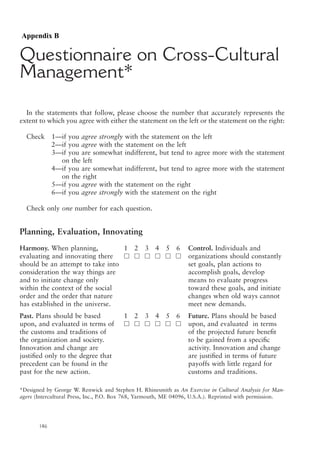
Harmony. When planning,
1 2 3 4 5 6
evaluating and innovating there
ᮀ ᮀ ᮀ ᮀ ᮀ ᮀ
should be an attempt to take into
consideration the way things are
and to initiate change only
within the context of the social
order and the order that nature
has established in the universe.
Past. Plans should be based
upon, and evaluated in terms of
the customs and traditions of
the organization and society.
Innovation and change are
justified only to the degree that
precedent can be found in the
past for the new action.
G

Control. Individuals and
organizations should constantly
set goals, plan actions to
accomplish goals, develop
means to evaluate progress
toward these goals, and initiate
changes when old ways cannot
meet new demands.
Future. Plans should be based
upon, and evaluated in terms
of the projected future benefit
to be gained from a specific
activity. Innovation and change
are justified in terms of future
payoffs with little regard for
customs and traditions.

1 2 3 4 5 6
ᮀ ᮀ ᮀ ᮀ ᮀ ᮀ

*Designed by George W. Renwick and Stephen H. Rhinesmith as An Exercise in Cultural Analysis for Managers (Intercultural Press, Inc., P.O. Box 768, Yarmouth, ME 04096, U.S.A.). Reprinted with permission.

146

Copyright © 2007 Elsevier, Inc.
CASE-H8247.qxd

11/10/06

21:25

Page 147

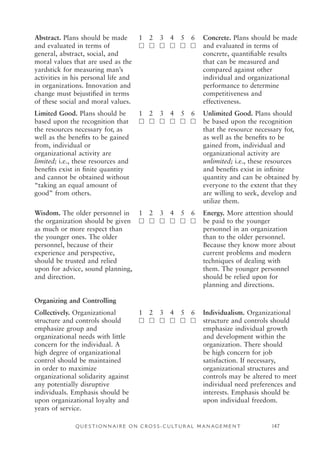
Abstract. Plans should be made
and evaluated in terms of
general, abstract, social, and
moral values that are used as the
yardstick for measuring man’s
activities in his personal life and
in organizations. Innovation and
change must bejustified in terms
of these social and moral values.

1 2 3 4 5 6
ᮀ ᮀ ᮀ ᮀ ᮀ ᮀ

Concrete. Plans should be made
and evaluated in terms of
concrete, quantifiable results
that can be measured and
compared against other
individual and organizational
performance to determine
competitiveness and
effectiveness.

Limited Good. Plans should be
based upon the recognition that
the resources necessary for, as
well as the benefits to be gained
from, individual or
organizational activity are
limited; i.e., these resources and
benefits exist in finite quantity
and cannot be obtained without
“taking an equal amount of
good” from others.

1 2 3 4 5 6
ᮀ ᮀ ᮀ ᮀ ᮀ ᮀ

Unlimited Good. Plans should
be based upon the recognition
that the resource necessary for,
as well as the benefits to be
gained from, individual and
organizational activity are
unlimited; i.e., these resources
and benefits exist in infinite
quantity and can be obtained by
everyone to the extent that they
are willing to seek, develop and
utilize them.

Wisdom. The older personnel in 1 2 3 4 5 6
the organization should be given ᮀ ᮀ ᮀ ᮀ ᮀ ᮀ
as much or more respect than
the younger ones. The older
personnel, because of their
experience and perspective,
should be trusted and relied
upon for advice, sound planning,
and direction.

Energy. More attention should
be paid to the younger
personnel in an organization
than to the older personnel.
Because they know more about
current problems and modern
techniques of dealing with
them. The younger personnel
should be relied upon for
planning and directions.

Organizing and Controlling
Collectively. Organizational
structure and controls should
emphasize group and
organizational needs with little
concern for the individual. A
high degree of organizational
control should be maintained
in order to maximize
organizational solidarity against
any potentially disruptive
individuals. Emphasis should be
upon organizational loyalty and
years of service.

1 2 3 4 5 6
ᮀ ᮀ ᮀ ᮀ ᮀ ᮀ

Individualism. Organizational
structure and controls should
emphasize individual growth
and development within the
organization. There should
be high concern for job
satisfaction. If necessary,
organizational structures and
controls may be altered to meet
individual need preferences and
interests. Emphasis should be
upon individual freedom.

Q U E S T I O N N A I R E O N C R O S S - C U LT U R A L M A N A G E M E N T

Copyright © 2007 Elsevier, Inc.

147

G
CASE-H8247.qxd

11/10/06

21:25

Page 148

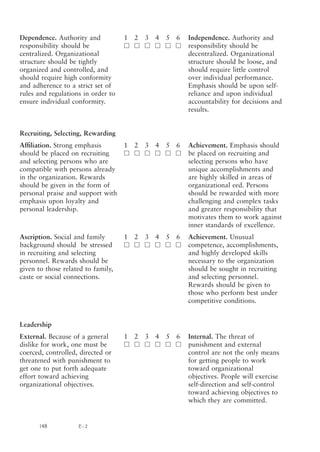
Dependence. Authority and
responsibility should be
centralized. Organizational
structure should be tightly
organized and controlled, and
should require high conformity
and adherence to a strict set of
rules and regulations in order to
ensure individual conformity.

1 2 3 4 5 6
ᮀ ᮀ ᮀ ᮀ ᮀ ᮀ

Independence. Authority and
responsibility should be
decentralized. Organizational
structure should be loose, and
should require little control
over individual performance.
Emphasis should be upon selfreliance and upon individual
accountability for decisions and
results.

Affiliation. Strong emphasis
should be placed on recruiting
and selecting persons who are
compatible with persons already
in the organization. Rewards
should be given in the form of
personal praise and support with
emphasis upon loyalty and
personal leadership.

1 2 3 4 5 6
ᮀ ᮀ ᮀ ᮀ ᮀ ᮀ

Achievement. Emphasis should
be placed on recruiting and
selecting persons who have
unique accomplishments and
are highly skilled in areas of
organizational eed. Persons
should be rewarded with more
challenging and complex tasks
and greater responsibility that
motivates them to work against
inner standards of excellence.

Ascription. Social and family
background should be stressed
in recruiting and selecting
personnel. Rewards should be
given to those related to family,
caste or social connections.

1 2 3 4 5 6
ᮀ ᮀ ᮀ ᮀ ᮀ ᮀ

Achievement. Unusual
competence, accomplishments,
and highly developed skills
necessary to the organization
should be sought in recruiting
and selecting personnel.
Rewards should be given to
those who perform best under
competitive conditions.

1 2 3 4 5 6
ᮀ ᮀ ᮀ ᮀ ᮀ ᮀ

Internal. The threat of
punishment and external
control are not the only means
for getting people to work
toward organizational
objectives. People will exercise
self-direction and self-control
toward achieving objectives to
which they are committed.

Recruiting, Selecting, Rewarding

Leadership
External. Because of a general
dislike for work, one must be
coerced, controlled, directed or
threatened with punishment to
get one to put forth adequate
effort toward achieving
organizational objectives.
G

148

E-2

Copyright © 2007 Elsevier, Inc.
CASE-H8247.qxd

11/10/06

21:25

Page 149

Communication
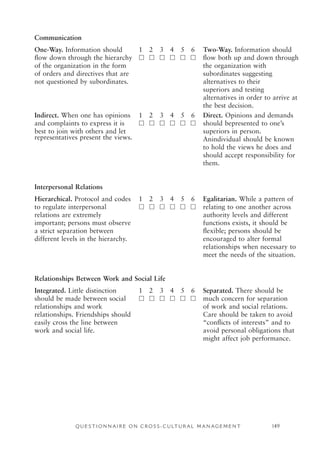
One-Way. Information should
1 2 3 4 5 6
flow down through the hierarchy ᮀ ᮀ ᮀ ᮀ ᮀ ᮀ
of the organization in the form
of orders and directives that are
not questioned by subordinates.

Indirect. When one has opinions 1 2 3 4 5 6
and complaints to express it is
ᮀ ᮀ ᮀ ᮀ ᮀ ᮀ
best to join with others and let
representatives present the views.

Two-Way. Information should
flow both up and down through
the organization with
subordinates suggesting
alternatives to their
superiors and testing
alternatives in order to arrive at
the best decision.
Direct. Opinions and demands
should bepresented to one’s
superiors in person.
Anindividual should be known
to hold the views he does and
should accept responsibility for
them.

Interpersonal Relations
Hierarchical. Protocol and codes
to regulate interpersonal
relations are extremely
important; persons must observe
a strict separation between
different levels in the hierarchy.

1 2 3 4 5 6
ᮀ ᮀ ᮀ ᮀ ᮀ ᮀ

Egalitarian. While a pattern of
relating to one another across
authority levels and different
functions exists, it should be
flexible; persons should be
encouraged to alter formal
relationships when necessary to
meet the needs of the situation.

Relationships Between Work and Social Life
Integrated. Little distinction
should be made between social
relationships and work
relationships. Friendships should
easily cross the line between
work and social life.

1 2 3 4 5 6
ᮀ ᮀ ᮀ ᮀ ᮀ ᮀ

Separated. There should be
much concern for separation
of work and social relations.
Care should be taken to avoid
“conflicts of interests” and to
avoid personal obligations that
might affect job performance.

G

Q U E S T I O N N A I R E O N C R O S S - C U LT U R A L M A N A G E M E N T

Copyright © 2007 Elsevier, Inc.

149
CASE-H8247.qxd

11/10/06

21:25

Page 150

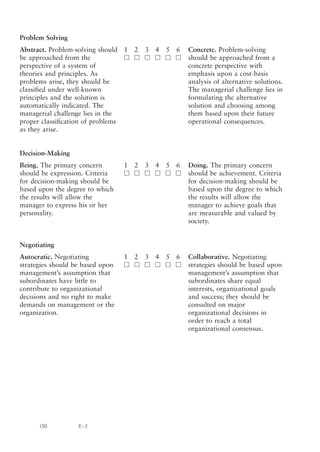
Problem Solving
Abstract. Problem-solving should 1 2 3 4 5 6
be approached from the
ᮀ ᮀ ᮀ ᮀ ᮀ ᮀ
perspective of a system of
theories and principles. As
problems arise, they should be
classified under well-known
principles and the solution is
automatically indicated. The
managerial challenge lies in the
proper classification of problems
as they arise.

Concrete. Problem-solving
should be approached from a
concrete perspective with
emphasis upon a cost-basis
analysis of alternative solutions.
The managerial challenge lies in
formulating the alternative
solution and choosing among
them based upon their future
operational consequences.

Decision-Making
Being. The primary concern
should be expression. Criteria
for decision-making should be
based upon the degree to which
the results will allow the
manager to express his or her
personality.

1 2 3 4 5 6
ᮀ ᮀ ᮀ ᮀ ᮀ ᮀ

Doing. The primary concern
should be achievement. Criteria
for decision-making should be
based upon the degree to which
the results will allow the
manager to achieve goals that
are measurable and valued by
society.

1 2 3 4 5 6
ᮀ ᮀ ᮀ ᮀ ᮀ ᮀ

Collaborative. Negotiating
strategies should be based upon
management’s assumption that
subordinates share equal
interests, organizational goals
and success; they should be
consulted on major
organizational decisions in
order to reach a total
organizational consensus.

Negotiating
Autocratic. Negotiating
strategies should be based upon
management’s assumption that
subordinates have little to
contribute to organizational
decisions and no right to make
demands on management or the
organization.

G

150

E-2

Copyright © 2007 Elsevier, Inc.
CASE-H8247.qxd

11/10/06

21:25

Page 151

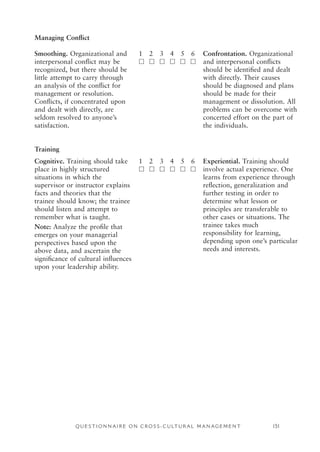
Managing Conflict
Smoothing. Organizational and
interpersonal conflict may be
recognized, but there should be
little attempt to carry through
an analysis of the conflict for
management or resolution.
Conflicts, if concentrated upon
and dealt with directly, are
seldom resolved to anyone’s
satisfaction.

1 2 3 4 5 6
ᮀ ᮀ ᮀ ᮀ ᮀ ᮀ

Confrontation. Organizational
and interpersonal conflicts
should be identified and dealt
with directly. Their causes
should be diagnosed and plans
should be made for their
management or dissolution. All
problems can be overcome with
concerted effort on the part of
the individuals.

1 2 3 4 5 6
ᮀ ᮀ ᮀ ᮀ ᮀ ᮀ

Experiential. Training should
involve actual experience. One
learns from experience through
reflection, generalization and
further testing in order to
determine what lesson or
principles are transferable to
other cases or situations. The
trainee takes much
responsibility for learning,
depending upon one’s particular
needs and interests.

Training
Cognitive. Training should take
place in highly structured
situations in which the
supervisor or instructor explains
facts and theories that the
trainee should know; the trainee
should listen and attempt to
remember what is taught.
Note: Analyze the profile that
emerges on your managerial
perspectives based upon the
above data, and ascertain the
significance of cultural influences
upon your leadership ability.

G

Q U E S T I O N N A I R E O N C R O S S - C U LT U R A L M A N A G E M E N T

Copyright © 2007 Elsevier, Inc.

151

Test cross cultural big

  • 1.
    CASE-H8247.qxd 11/10/06 21:25 Page 146 Appendix B Questionnaireon Cross-Cultural Management* In the statements that follow, please choose the number that accurately represents the extent to which you agree with either the statement on the left or the statement on the right: Check 1—if you agree strongly with the statement on the left 2—if you agree with the statement on the left 3—if you are somewhat indifferent, but tend to agree more with the statement on the left 4—if you are somewhat indifferent, but tend to agree more with the statement on the right 5—if you agree with the statement on the right 6—if you agree strongly with the statement on the right Check only one number for each question. Planning, Evaluation, Innovating Harmony. When planning, 1 2 3 4 5 6 evaluating and innovating there ᮀ ᮀ ᮀ ᮀ ᮀ ᮀ should be an attempt to take into consideration the way things are and to initiate change only within the context of the social order and the order that nature has established in the universe. Past. Plans should be based upon, and evaluated in terms of the customs and traditions of the organization and society. Innovation and change are justified only to the degree that precedent can be found in the past for the new action. G Control. Individuals and organizations should constantly set goals, plan actions to accomplish goals, develop means to evaluate progress toward these goals, and initiate changes when old ways cannot meet new demands. Future. Plans should be based upon, and evaluated in terms of the projected future benefit to be gained from a specific activity. Innovation and change are justified in terms of future payoffs with little regard for customs and traditions. 1 2 3 4 5 6 ᮀ ᮀ ᮀ ᮀ ᮀ ᮀ *Designed by George W. Renwick and Stephen H. Rhinesmith as An Exercise in Cultural Analysis for Managers (Intercultural Press, Inc., P.O. Box 768, Yarmouth, ME 04096, U.S.A.). Reprinted with permission. 146 Copyright © 2007 Elsevier, Inc.
  • 2.
    CASE-H8247.qxd 11/10/06 21:25 Page 147 Abstract. Plansshould be made and evaluated in terms of general, abstract, social, and moral values that are used as the yardstick for measuring man’s activities in his personal life and in organizations. Innovation and change must bejustified in terms of these social and moral values. 1 2 3 4 5 6 ᮀ ᮀ ᮀ ᮀ ᮀ ᮀ Concrete. Plans should be made and evaluated in terms of concrete, quantifiable results that can be measured and compared against other individual and organizational performance to determine competitiveness and effectiveness. Limited Good. Plans should be based upon the recognition that the resources necessary for, as well as the benefits to be gained from, individual or organizational activity are limited; i.e., these resources and benefits exist in finite quantity and cannot be obtained without “taking an equal amount of good” from others. 1 2 3 4 5 6 ᮀ ᮀ ᮀ ᮀ ᮀ ᮀ Unlimited Good. Plans should be based upon the recognition that the resource necessary for, as well as the benefits to be gained from, individual and organizational activity are unlimited; i.e., these resources and benefits exist in infinite quantity and can be obtained by everyone to the extent that they are willing to seek, develop and utilize them. Wisdom. The older personnel in 1 2 3 4 5 6 the organization should be given ᮀ ᮀ ᮀ ᮀ ᮀ ᮀ as much or more respect than the younger ones. The older personnel, because of their experience and perspective, should be trusted and relied upon for advice, sound planning, and direction. Energy. More attention should be paid to the younger personnel in an organization than to the older personnel. Because they know more about current problems and modern techniques of dealing with them. The younger personnel should be relied upon for planning and directions. Organizing and Controlling Collectively. Organizational structure and controls should emphasize group and organizational needs with little concern for the individual. A high degree of organizational control should be maintained in order to maximize organizational solidarity against any potentially disruptive individuals. Emphasis should be upon organizational loyalty and years of service. 1 2 3 4 5 6 ᮀ ᮀ ᮀ ᮀ ᮀ ᮀ Individualism. Organizational structure and controls should emphasize individual growth and development within the organization. There should be high concern for job satisfaction. If necessary, organizational structures and controls may be altered to meet individual need preferences and interests. Emphasis should be upon individual freedom. Q U E S T I O N N A I R E O N C R O S S - C U LT U R A L M A N A G E M E N T Copyright © 2007 Elsevier, Inc. 147 G
  • 3.
    CASE-H8247.qxd 11/10/06 21:25 Page 148 Dependence. Authorityand responsibility should be centralized. Organizational structure should be tightly organized and controlled, and should require high conformity and adherence to a strict set of rules and regulations in order to ensure individual conformity. 1 2 3 4 5 6 ᮀ ᮀ ᮀ ᮀ ᮀ ᮀ Independence. Authority and responsibility should be decentralized. Organizational structure should be loose, and should require little control over individual performance. Emphasis should be upon selfreliance and upon individual accountability for decisions and results. Affiliation. Strong emphasis should be placed on recruiting and selecting persons who are compatible with persons already in the organization. Rewards should be given in the form of personal praise and support with emphasis upon loyalty and personal leadership. 1 2 3 4 5 6 ᮀ ᮀ ᮀ ᮀ ᮀ ᮀ Achievement. Emphasis should be placed on recruiting and selecting persons who have unique accomplishments and are highly skilled in areas of organizational eed. Persons should be rewarded with more challenging and complex tasks and greater responsibility that motivates them to work against inner standards of excellence. Ascription. Social and family background should be stressed in recruiting and selecting personnel. Rewards should be given to those related to family, caste or social connections. 1 2 3 4 5 6 ᮀ ᮀ ᮀ ᮀ ᮀ ᮀ Achievement. Unusual competence, accomplishments, and highly developed skills necessary to the organization should be sought in recruiting and selecting personnel. Rewards should be given to those who perform best under competitive conditions. 1 2 3 4 5 6 ᮀ ᮀ ᮀ ᮀ ᮀ ᮀ Internal. The threat of punishment and external control are not the only means for getting people to work toward organizational objectives. People will exercise self-direction and self-control toward achieving objectives to which they are committed. Recruiting, Selecting, Rewarding Leadership External. Because of a general dislike for work, one must be coerced, controlled, directed or threatened with punishment to get one to put forth adequate effort toward achieving organizational objectives. G 148 E-2 Copyright © 2007 Elsevier, Inc.
  • 4.
    CASE-H8247.qxd 11/10/06 21:25 Page 149 Communication One-Way. Informationshould 1 2 3 4 5 6 flow down through the hierarchy ᮀ ᮀ ᮀ ᮀ ᮀ ᮀ of the organization in the form of orders and directives that are not questioned by subordinates. Indirect. When one has opinions 1 2 3 4 5 6 and complaints to express it is ᮀ ᮀ ᮀ ᮀ ᮀ ᮀ best to join with others and let representatives present the views. Two-Way. Information should flow both up and down through the organization with subordinates suggesting alternatives to their superiors and testing alternatives in order to arrive at the best decision. Direct. Opinions and demands should bepresented to one’s superiors in person. Anindividual should be known to hold the views he does and should accept responsibility for them. Interpersonal Relations Hierarchical. Protocol and codes to regulate interpersonal relations are extremely important; persons must observe a strict separation between different levels in the hierarchy. 1 2 3 4 5 6 ᮀ ᮀ ᮀ ᮀ ᮀ ᮀ Egalitarian. While a pattern of relating to one another across authority levels and different functions exists, it should be flexible; persons should be encouraged to alter formal relationships when necessary to meet the needs of the situation. Relationships Between Work and Social Life Integrated. Little distinction should be made between social relationships and work relationships. Friendships should easily cross the line between work and social life. 1 2 3 4 5 6 ᮀ ᮀ ᮀ ᮀ ᮀ ᮀ Separated. There should be much concern for separation of work and social relations. Care should be taken to avoid “conflicts of interests” and to avoid personal obligations that might affect job performance. G Q U E S T I O N N A I R E O N C R O S S - C U LT U R A L M A N A G E M E N T Copyright © 2007 Elsevier, Inc. 149
  • 5.
    CASE-H8247.qxd 11/10/06 21:25 Page 150 Problem Solving Abstract.Problem-solving should 1 2 3 4 5 6 be approached from the ᮀ ᮀ ᮀ ᮀ ᮀ ᮀ perspective of a system of theories and principles. As problems arise, they should be classified under well-known principles and the solution is automatically indicated. The managerial challenge lies in the proper classification of problems as they arise. Concrete. Problem-solving should be approached from a concrete perspective with emphasis upon a cost-basis analysis of alternative solutions. The managerial challenge lies in formulating the alternative solution and choosing among them based upon their future operational consequences. Decision-Making Being. The primary concern should be expression. Criteria for decision-making should be based upon the degree to which the results will allow the manager to express his or her personality. 1 2 3 4 5 6 ᮀ ᮀ ᮀ ᮀ ᮀ ᮀ Doing. The primary concern should be achievement. Criteria for decision-making should be based upon the degree to which the results will allow the manager to achieve goals that are measurable and valued by society. 1 2 3 4 5 6 ᮀ ᮀ ᮀ ᮀ ᮀ ᮀ Collaborative. Negotiating strategies should be based upon management’s assumption that subordinates share equal interests, organizational goals and success; they should be consulted on major organizational decisions in order to reach a total organizational consensus. Negotiating Autocratic. Negotiating strategies should be based upon management’s assumption that subordinates have little to contribute to organizational decisions and no right to make demands on management or the organization. G 150 E-2 Copyright © 2007 Elsevier, Inc.
  • 6.
    CASE-H8247.qxd 11/10/06 21:25 Page 151 Managing Conflict Smoothing.Organizational and interpersonal conflict may be recognized, but there should be little attempt to carry through an analysis of the conflict for management or resolution. Conflicts, if concentrated upon and dealt with directly, are seldom resolved to anyone’s satisfaction. 1 2 3 4 5 6 ᮀ ᮀ ᮀ ᮀ ᮀ ᮀ Confrontation. Organizational and interpersonal conflicts should be identified and dealt with directly. Their causes should be diagnosed and plans should be made for their management or dissolution. All problems can be overcome with concerted effort on the part of the individuals. 1 2 3 4 5 6 ᮀ ᮀ ᮀ ᮀ ᮀ ᮀ Experiential. Training should involve actual experience. One learns from experience through reflection, generalization and further testing in order to determine what lesson or principles are transferable to other cases or situations. The trainee takes much responsibility for learning, depending upon one’s particular needs and interests. Training Cognitive. Training should take place in highly structured situations in which the supervisor or instructor explains facts and theories that the trainee should know; the trainee should listen and attempt to remember what is taught. Note: Analyze the profile that emerges on your managerial perspectives based upon the above data, and ascertain the significance of cultural influences upon your leadership ability. G Q U E S T I O N N A I R E O N C R O S S - C U LT U R A L M A N A G E M E N T Copyright © 2007 Elsevier, Inc. 151