
SIEM-plifying security
monitoring: A different
approach to security
visibility

Dave Shackleford, Voodoo Security and SANS
Joe Schreiber, AlienVault

© 2014 The SANS™ Institute - www.sans.org
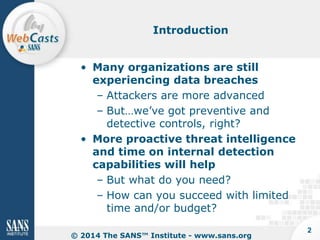
Introduction

• Many organizations are still
experiencing data breaches
– Attackers are more advanced
– But…we’ve got preventive and
detective controls, right?
• More proactive threat intelligence
and time on internal detection
capabilities will help
– But what do you need?
– How can you succeed with limited
time and/or budget?
© 2014 The SANS™ Institute - www.sans.org

2
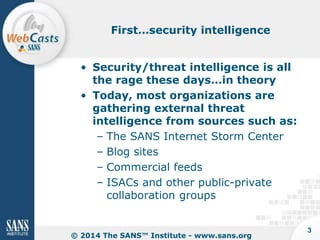
First…security intelligence

• Security/threat intelligence is all
the rage these days…in theory
• Today, most organizations are
gathering external threat
intelligence from sources such as:
– The SANS Internet Storm Center
– Blog sites
– Commercial feeds
– ISACs and other public-private
collaboration groups

© 2014 The SANS™ Institute - www.sans.org

3
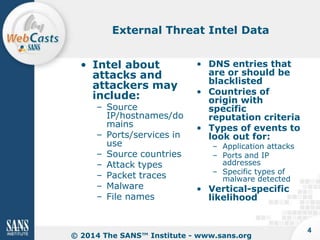
External Threat Intel Data
• Intel about
attacks and
attackers may
include:

– Source
IP/hostnames/do
mains
– Ports/services in
use
– Source countries
– Attack types
– Packet traces
– Malware
– File names

• DNS entries that
are or should be
blacklisted
• Countries of
origin with
specific
reputation criteria
• Types of events to
look out for:
– Application attacks
– Ports and IP
addresses
– Specific types of
malware detected

• Vertical-specific
likelihood

© 2014 The SANS™ Institute - www.sans.org

4
Internal sources of threat intel data
• Baseline security controls:
– Firewalls and router ACLs
– IDS/IPS
– Antivirus
– Proxies and load balancers
– Log management
• More advanced controls
– SIEM
– Host IDS/whitelisting
– Malware sandboxing
• So why are we still getting hacked?!
© 2014 The SANS™ Institute - www.sans.org

5
Collaborative Threat Intelligence

• Diversity in Threat Intelligence limits
attackers’ ability to isolate targets by
industry, location, size, etc
• The AlienVault Open Threat
ExchangeTM (OTX) is the world’s
largest collaborative threat
intelligence system

• AlienVault Labs validates threat data
and contributes from their research

© 2014 The SANS™ Institute - www.sans.org

6
SIEM Challenges Abound
• Many SIEM users have had
challenges getting needed insights
• Why?
• A vast variety of issues can lead us
here:
– Difficulty deploying
– Lack of integration
– Challenging UI and usability
– No threat intelligence
– Difficult correlation rules
– Poor planning
© 2014 The SANS™ Institute - www.sans.org

7
© 2014 The SANS™ Institute - www.sans.org

8
Lessons Learned the Hard Way

• Situation: "Tribal" knowledge and a
move to an MSSP
– Lesson Learned: Improve
documentation and planning around
internal data types and use cases
• Situation: “You are what you eat”
– Lesson Learned: Review your data
sources before AND after your
deployment

© 2014 The SANS™ Institute - www.sans.org

9
Getting More From a SIEM

• There are several important
things organizations can do to
improve SIEM success:
– Assess integration with data/tools
– Discuss outcomes/use cases
– Assess ease-of-use and
implementation
– Look for threat intelligence
integration - both external and
internal

© 2014 The SANS™ Institute - www.sans.org

10
Fundamental SIEM
Integration Points
• Asset discovery and inventory
• Vulnerability assessment
• Network packet/flow analysis
(packet capture)
• Wireless intrusion detection (WIDS)
• Host-based intrusion detection
(HIDS)
• Network-based intrusion detection
(NIDS)
• File Integrity Monitoring
• Log management

© 2014 The SANS™ Institute - www.sans.org

11
Discuss Outcomes & Use Cases

• Every organization is different
– Business use cases
– Compliance/security priorities
– Existing gaps
• Build technical rule
implementations of business use
cases
– Identify & monitor privileged users
– Build behavior profiles
– Detect C&C channels more rapidly
© 2014 The SANS™ Institute - www.sans.org

12
Ease-of-use & Implementation
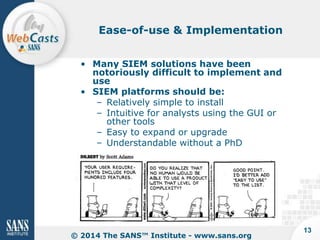
• Many SIEM solutions have been
notoriously difficult to implement and
use
• SIEM platforms should be:
– Relatively simple to install
– Intuitive for analysts using the GUI or
other tools
– Easy to expand or upgrade
– Understandable without a PhD

© 2014 The SANS™ Institute - www.sans.org

13
Questions for SIEM Vendors
Hint: Print this out for the next time they call you…

 How long will it take to go from software installation to
security insight? For reals.
 How many staff members or outside consultants will I
need for the integration work?
 What can I do if I don’t have all of the external security
technologies in place that can feed the SIEM (e.g. asset
inventories, IDS, vulnerability scans, netflows, etc.)?
 What is the anticipated mix of licensing costs to
consulting and implementation fees?
 Do your alerts provide step-by-step instructions for how
to mitigate and respond to investigations?

© 2014 The SANS™ Institute - www.sans.org

14
Threat Intelligence:
Questions to Ask

• What sources of threat
intelligence are available?
• Are intelligence sources widely
distributed, representing a range
of organizations and technology?
• How is threat intelligence
integrated with internal data sets?
• How can threat intelligence be
shared securely?

© 2014 The SANS™ Institute - www.sans.org

15
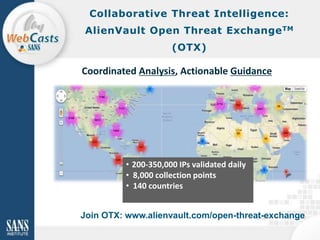
Collaborative Threat Intelligence:
AlienVault Open Threat Exchange TM
(OTX)

Coordinated Analysis, Actionable Guidance

• 200-350,000 IPs validated daily
• 8,000 collection points
• 140 countries
Join OTX: www.alienvault.com/open-threat-exchange
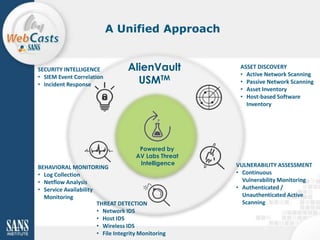
A Unified Approach

SECURITY INTELLIGENCE
• SIEM Event Correlation
• Incident Response

AlienVault
USMTM

Powered by
AV Labs Threat
Intelligence

BEHAVIORAL MONITORING
• Log Collection
• Netflow Analysis
• Service Availability
Monitoring
THREAT DETECTION
• Network IDS
• Host IDS
• Wireless IDS
• File Integrity Monitoring

ASSET DISCOVERY
• Active Network Scanning
• Passive Network Scanning
• Asset Inventory
• Host-based Software
Inventory

VULNERABILITY ASSESSMENT
• Continuous
Vulnerability Monitoring
• Authenticated /
Unauthenticated Active
Scanning
Conclusion

• Some organizations have
traditionally been afraid of SIEM…
– But do they need to be?
• SIEM platforms *can* be
implemented and managed
without horror stories
• They key is planning up front, and
asking key questions of potential
vendors
• A unified approach will prove
more successful with limited
resources
© 2014 The SANS™ Institute - www.sans.org

18
Questions?

Q@SANS.ORG

Three Ways to Test Drive
AlienVault USM
Download a Free 30-Day Trial
http://www.alienvault.com/free-trial

Try our Interactive Demo
http://www.alienvault.com/live-demo-site

Join us for a LIVE Demo!
http://www.alienvault.com/marketing/ali
envault-usm-live-demo

Thank You!
© 2014 The SANS™ Institute - www.sans.org

19

SIEM-plifying security monitoring: A different approach to security visibility

  • 1.
    SIEM-plifying security monitoring: Adifferent approach to security visibility Dave Shackleford, Voodoo Security and SANS Joe Schreiber, AlienVault © 2014 The SANS™ Institute - www.sans.org
  • 2.
    Introduction • Many organizationsare still experiencing data breaches – Attackers are more advanced – But…we’ve got preventive and detective controls, right? • More proactive threat intelligence and time on internal detection capabilities will help – But what do you need? – How can you succeed with limited time and/or budget? © 2014 The SANS™ Institute - www.sans.org 2
  • 3.
    First…security intelligence • Security/threatintelligence is all the rage these days…in theory • Today, most organizations are gathering external threat intelligence from sources such as: – The SANS Internet Storm Center – Blog sites – Commercial feeds – ISACs and other public-private collaboration groups © 2014 The SANS™ Institute - www.sans.org 3
  • 4.
    External Threat IntelData • Intel about attacks and attackers may include: – Source IP/hostnames/do mains – Ports/services in use – Source countries – Attack types – Packet traces – Malware – File names • DNS entries that are or should be blacklisted • Countries of origin with specific reputation criteria • Types of events to look out for: – Application attacks – Ports and IP addresses – Specific types of malware detected • Vertical-specific likelihood © 2014 The SANS™ Institute - www.sans.org 4
  • 5.
    Internal sources ofthreat intel data • Baseline security controls: – Firewalls and router ACLs – IDS/IPS – Antivirus – Proxies and load balancers – Log management • More advanced controls – SIEM – Host IDS/whitelisting – Malware sandboxing • So why are we still getting hacked?! © 2014 The SANS™ Institute - www.sans.org 5
  • 6.
    Collaborative Threat Intelligence •Diversity in Threat Intelligence limits attackers’ ability to isolate targets by industry, location, size, etc • The AlienVault Open Threat ExchangeTM (OTX) is the world’s largest collaborative threat intelligence system • AlienVault Labs validates threat data and contributes from their research © 2014 The SANS™ Institute - www.sans.org 6
  • 7.
    SIEM Challenges Abound •Many SIEM users have had challenges getting needed insights • Why? • A vast variety of issues can lead us here: – Difficulty deploying – Lack of integration – Challenging UI and usability – No threat intelligence – Difficult correlation rules – Poor planning © 2014 The SANS™ Institute - www.sans.org 7
  • 8.
    © 2014 TheSANS™ Institute - www.sans.org 8
  • 9.
    Lessons Learned theHard Way • Situation: "Tribal" knowledge and a move to an MSSP – Lesson Learned: Improve documentation and planning around internal data types and use cases • Situation: “You are what you eat” – Lesson Learned: Review your data sources before AND after your deployment © 2014 The SANS™ Institute - www.sans.org 9
  • 10.
    Getting More Froma SIEM • There are several important things organizations can do to improve SIEM success: – Assess integration with data/tools – Discuss outcomes/use cases – Assess ease-of-use and implementation – Look for threat intelligence integration - both external and internal © 2014 The SANS™ Institute - www.sans.org 10
  • 11.
    Fundamental SIEM Integration Points •Asset discovery and inventory • Vulnerability assessment • Network packet/flow analysis (packet capture) • Wireless intrusion detection (WIDS) • Host-based intrusion detection (HIDS) • Network-based intrusion detection (NIDS) • File Integrity Monitoring • Log management © 2014 The SANS™ Institute - www.sans.org 11
  • 12.
    Discuss Outcomes &Use Cases • Every organization is different – Business use cases – Compliance/security priorities – Existing gaps • Build technical rule implementations of business use cases – Identify & monitor privileged users – Build behavior profiles – Detect C&C channels more rapidly © 2014 The SANS™ Institute - www.sans.org 12
  • 13.
    Ease-of-use & Implementation •Many SIEM solutions have been notoriously difficult to implement and use • SIEM platforms should be: – Relatively simple to install – Intuitive for analysts using the GUI or other tools – Easy to expand or upgrade – Understandable without a PhD © 2014 The SANS™ Institute - www.sans.org 13
  • 14.
    Questions for SIEMVendors Hint: Print this out for the next time they call you…  How long will it take to go from software installation to security insight? For reals.  How many staff members or outside consultants will I need for the integration work?  What can I do if I don’t have all of the external security technologies in place that can feed the SIEM (e.g. asset inventories, IDS, vulnerability scans, netflows, etc.)?  What is the anticipated mix of licensing costs to consulting and implementation fees?  Do your alerts provide step-by-step instructions for how to mitigate and respond to investigations? © 2014 The SANS™ Institute - www.sans.org 14
  • 15.
    Threat Intelligence: Questions toAsk • What sources of threat intelligence are available? • Are intelligence sources widely distributed, representing a range of organizations and technology? • How is threat intelligence integrated with internal data sets? • How can threat intelligence be shared securely? © 2014 The SANS™ Institute - www.sans.org 15
  • 16.
    Collaborative Threat Intelligence: AlienVaultOpen Threat Exchange TM (OTX) Coordinated Analysis, Actionable Guidance • 200-350,000 IPs validated daily • 8,000 collection points • 140 countries Join OTX: www.alienvault.com/open-threat-exchange
  • 17.
    A Unified Approach SECURITYINTELLIGENCE • SIEM Event Correlation • Incident Response AlienVault USMTM Powered by AV Labs Threat Intelligence BEHAVIORAL MONITORING • Log Collection • Netflow Analysis • Service Availability Monitoring THREAT DETECTION • Network IDS • Host IDS • Wireless IDS • File Integrity Monitoring ASSET DISCOVERY • Active Network Scanning • Passive Network Scanning • Asset Inventory • Host-based Software Inventory VULNERABILITY ASSESSMENT • Continuous Vulnerability Monitoring • Authenticated / Unauthenticated Active Scanning
  • 18.
    Conclusion • Some organizationshave traditionally been afraid of SIEM… – But do they need to be? • SIEM platforms *can* be implemented and managed without horror stories • They key is planning up front, and asking key questions of potential vendors • A unified approach will prove more successful with limited resources © 2014 The SANS™ Institute - www.sans.org 18
  • 19.
    Questions? Q@SANS.ORG Three Ways toTest Drive AlienVault USM Download a Free 30-Day Trial http://www.alienvault.com/free-trial Try our Interactive Demo http://www.alienvault.com/live-demo-site Join us for a LIVE Demo! http://www.alienvault.com/marketing/ali envault-usm-live-demo Thank You! © 2014 The SANS™ Institute - www.sans.org 19