Sikhism
Dr. Vijay Kumar
School of Education
Apeejay Stya University
What is Sikhism?
 A 500 year old, monotheistic religion of Northwest
India, followed by some 20 million people
 Founded in the year 1469
 Seeks to make religion a uniting rather than dividing
force
 All people – male and female, Brahmin and Shudra,
Hindu and Muslim – are united as brothers and sisters
in devotion to the one God:
 "there is no Muslim, there is no Hindu; all are equal
human beings because they are the children of the same
Father, God.“ – Guru Nanak
3/20/2020
Sikhism by Dr. Vijay Kumar,
Teacher Educator 2
3/20/2020
Sikhism by Dr. Vijay Kumar,
Teacher Educator 3
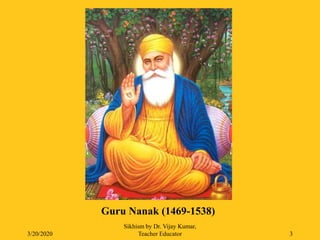
Guru Nanak (1469-1538)
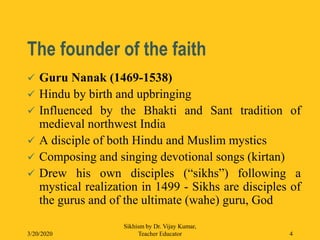
The founder of the faith
 Guru Nanak (1469-1538)
 Hindu by birth and upbringing
 Influenced by the Bhakti and Sant tradition of
medieval northwest India
 A disciple of both Hindu and Muslim mystics
 Composing and singing devotional songs (kirtan)
 Drew his own disciples (“sikhs”) following a
mystical realization in 1499 - Sikhs are disciples of
the gurus and of the ultimate (wahe) guru, God
3/20/2020
Sikhism by Dr. Vijay Kumar,
Teacher Educator 4
Guru Nanak’s Teaching
 Preached a unifying message that overcame
religious differences, uniting both Hindu and
Muslim in common devotion to the same God
 Recognized that behind all human names and
forms for God, is one True God (Sat Nam – the
“true name”)
 Rejected meaningless ritual, images and idols of
gods in favor of simple, heartfelt devotion
3/20/2020
Sikhism by Dr. Vijay Kumar,
Teacher Educator 5
Beliefs
 One God (whom people call by many names)
Sat Nam = “true name”
Waheguru =“great guru”
 Equality of all human beings
-Rejected caste distinctions
 Karma and reincarnation
 Reject asceticism
-No monastic life in Sikhism
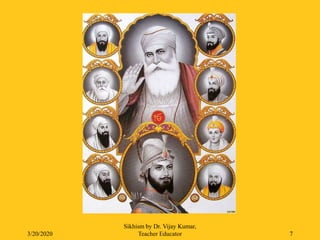
 The spirit of the guru (Nanak) continued for 200 years
through a succession of ten human gurus…
3/20/2020
Sikhism by Dr. Vijay Kumar,
Teacher Educator 6
3/20/2020
Sikhism by Dr. Vijay Kumar,
Teacher Educator 7
Development of the faith
 2nd guru Guru Angad Dev developed written
form of Punjabi language for recording hymns
 3rd guru Guru Amar Das instituted the community
kitchen (Langar) to feed all in need
 4th guru Guru Ram Das built the Sikh holy city of
Amritsar in Punjab
 5th guru Guru Arjun Dev built the Golden Temple in
Amritsar as the center of the Sikh world; also compiled
hymns of the earlier gurus, creating the Sikh holy book:
Adi Granth
3/20/2020
Sikhism by Dr. Vijay Kumar,
Teacher Educator 8
Martyrdom and defense
 5th guru was martyred, 6th guru Guru Har Gobind
began a tradition of training Sikhs in martial arts to
protectthose persecuted for their religion (Sikh,
Hindu or otherwise)
 7th guru Guru Har Rai best known for opening
hospitals and offering free medical treatment to those
in need
 8th guru Guru Har Krishan was just a child but
continued caring for the sick (died at age 8)
 9th guru Guru Tegh Bahadur worked to combat
religious persecution, ultimately became the 2nd
Sikh martyr
3/20/2020
Sikhism by Dr. Vijay Kumar,
Teacher Educator 9
3/20/2020
Sikhism by Dr. Vijay Kumar,
Teacher Educator 10
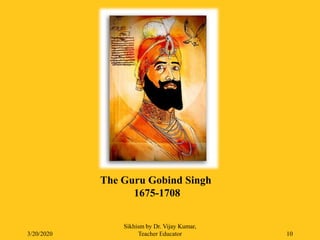
The Guru Gobind Singh
1675-1708
The 10th Guru – Gobind Singh
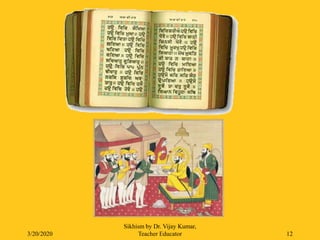
 Wrote hymns and completed the compilation of the
Adi Granth
 In 1699, Initiated the Sikh Khalsa (“brotherhood”) as
a military defense force
 Declared the end of the line of human gurus,
transferring guruship to the Khalsa
community and the holy book, now
known as “Guru Granth Sahib”
 Died 1708
3/20/2020
Sikhism by Dr. Vijay Kumar,
Teacher Educator 11
3/20/2020
Sikhism by Dr. Vijay Kumar,
Teacher Educator 12
The Khalsa
 Today, the Khalsa is simply the community of the
faithful
 Amrit ceremony as baptism and initiation into the
Khalsa (male and female, must be at least 16 years of
age)
 Khalsa members take a new last name: Singh (“lion”)
for men, Kaur (“princess”) for women
 Khalsa members wear the “Five K’s” as symbols of
their faith…
3/20/2020
Sikhism by Dr. Vijay Kumar,
Teacher Educator 13
3/20/2020
Sikhism by Dr. Vijay Kumar,
Teacher Educator 14
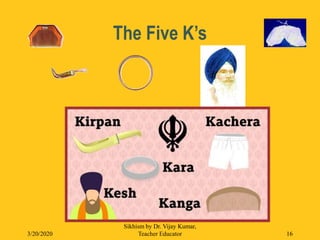
The Five K’s
Every man and woman who belongs to the
Khalsa must wear five symbols which show that
they are Sikhs.
They are usually called the Five K’s because in
Punjabi their names all begin with the letter ‘K’.
3/20/2020
Sikhism by Dr. Vijay Kumar,
Teacher Educator 15
The Five K’s
3/20/2020
Sikhism by Dr. Vijay Kumar,
Teacher Educator 16
Kesh
 Long, uncut hair (both men and women)
 Men wear a turban to cover their hair
 Kesh is hair. Sikhs promise not to cut their hair but let
it grow as a symbol of their faith.
 Because during their lifetimes it will get very long they
wear turbans to keep it tidy.
 They believe that this demonstrates their obedience
to God.
3/20/2020
Sikhism by Dr. Vijay Kumar,
Teacher Educator 17
Kangha
 A comb to keep the hair clean and presentable
 The Kangha is a small wooden comb.
 It keeps the hair fixed in place, and is a symbol
of cleanliness.
 Combing their hair reminds Sikhs that their lives
should be tidy and organised.
 Take note year 6
3/20/2020
Sikhism by Dr. Vijay Kumar,
Teacher Educator 18
Kara
 A steel bracelet worn on the right wrist as a
reminder to think of God and do one’s duty
 The kara is a steel bangle worn on the arm.
 It is a closed circle with no beginning and no
end...as with God there is no beginning and no
end.
 It is a reminder to behave well, keep faith and
restrain from wrong doing.
 Wearing it will remind a sikh of his duties.
3/20/2020
Sikhism by Dr. Vijay Kumar,
Teacher Educator 19
 The Last two are a reminder that
Sikhs are warriors and
 always fight for what is right!
3/20/2020
Sikhism by Dr. Vijay Kumar,
Teacher Educator 20
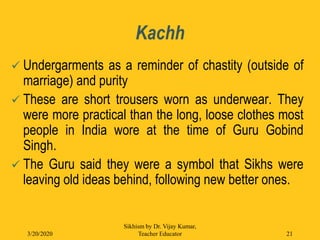
Kachh
 Undergarments as a reminder of chastity (outside of
marriage) and purity
 These are short trousers worn as underwear. They
were more practical than the long, loose clothes most
people in India wore at the time of Guru Gobind
Singh.
 The Guru said they were a symbol that Sikhs were
leaving old ideas behind, following new better ones.
3/20/2020
Sikhism by Dr. Vijay Kumar,
Teacher Educator 21
Kirpan
 A defensive sword symbolic of God’s power and the
Sikh duty to protect the weak and persecuted
 The warriors sword. These days a very tiny one is
worn as a symbol of dignity and self respect.
 It demonstrates power and reminds sikhs that they
must fight a spiritual battle, defend the weak and
oppressed, and uphold the truth.
3/20/2020
Sikhism by Dr. Vijay Kumar,
Teacher Educator 22
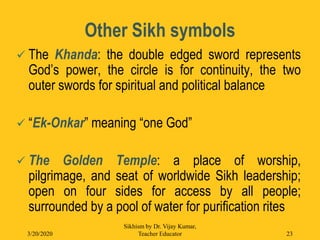
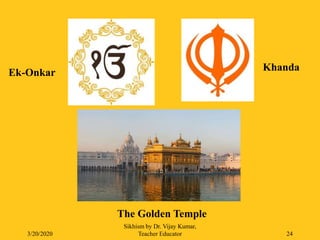
Other Sikh symbols
 The Khanda: the double edged sword represents
God’s power, the circle is for continuity, the two
outer swords for spiritual and political balance
 “Ek-Onkar” meaning “one God”
 The Golden Temple: a place of worship,
pilgrimage, and seat of worldwide Sikh leadership;
open on four sides for access by all people;
surrounded by a pool of water for purification rites
3/20/2020
Sikhism by Dr. Vijay Kumar,
Teacher Educator 23
3/20/2020
Sikhism by Dr. Vijay Kumar,
Teacher Educator 24
KhandaEk-Onkar
The Golden Temple
Major Teachings of Sikhism
The 10 gurus and Guru Granth Sahib provide Sikhs with a
beliefs system on how to worship and live their lives.
1. Monotheism:
1. There is only one God: Creator, Timeless, Unincarnated
(without a physical body), Eternal.
2. The Reality of the World.
1. The world is good – it is not an illusion, nor a source of
suffering.
2. Human life is an opportunity to become one with God.
3/20/2020
Sikhism by Dr. Vijay Kumar,
Teacher Educator 25
3. Spiritual Achievement in This Life
1. The goal of life is to escape our self-will or self-interest and
become one with God.
2. The highest achievement is to become a Gurmukh (a God-
man), who is selfless and completely in touch with the will
of God.
4. Union of Spiritual and Worldly Lives
1. Guru Nanak did not believe in asceticism.
2. Sikhs are involved in community life, take care of the poor,
and act against injustice.
3. Consumerism and materialism are strongly discouraged.
3/20/2020
Sikhism by Dr. Vijay Kumar,
Teacher Educator 26
3/20/2020
Sikhism by Dr. Vijay Kumar,
Teacher Educator 27
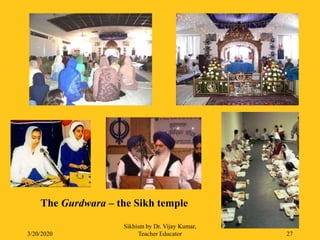
The Gurdwara – the Sikh temple
3/20/2020
Sikhism by Dr. Vijay Kumar,
Teacher Educator 28
The Gurdwara – the Sikh temple
 “Door to the Guru,” housing and honoring the Guru
Granth Sahib
 A “Granthi” (priest) is caretaker of the Gurdwara and
the holy book as well as spiritual leader of the
community
 Contains a kitchen and dining hall (for Langar) and
prayer hall for singing of Kirtan (hymns) from the holy
book
3/20/2020
Sikhism by Dr. Vijay Kumar,
Teacher Educator 29
 Open daily (in India) with continuous
reading and singing from holy book,
serving food to all who come
 Following worship, all partake in the
Langar, sitting (on the floor) and eating
a meal together (equality)
3/20/2020
Sikhism by Dr. Vijay Kumar,
Teacher Educator 30
The Gurdwara – the Sikh temple
Akhand Path Tradition and the Rites of Passage
Every major change in a person's life is accompanied by a tradition
of Akhand Path, the continuous reading of the Sri Guru Granth Sahib
cover to cover without stopping.
It takes around two full days to complete.
Usually, family members take turns reading so participants can rest.
The reading must be done at a normal pace with clear speech and
correctly relating the exact words on the page.
Common events where such a reading occurs are typical rites of passage
events , such as birth, baptism, reaching adulthood, marriage, moving to
a new home, and death.
Rites of passage are significant moments in a person's life signifying a
transition from one state of being to another, often noted by a religious
ceremony or traditional activity.
3/20/2020
Sikhism by Dr. Vijay Kumar,
Teacher Educator 31
Sikh holy days and ceremonies
 Rituals in a ‘Religion Against Rituals’
 It is strongly against practicing rituals blindly for
the sake of tradition or expectation.
 Religious holidays that mark events in the lives of the
Gurus are called Gurpurbs
 Vaisakhi: April 13th, anniversary of founding of the Khalsa
 Guru Nanak’s birthday (November)
 Baby naming- Naam Karan
3/20/2020
Sikhism by Dr. Vijay Kumar,
Teacher Educator 32
3/20/2020
Sikhism by Dr. Vijay Kumar,
Teacher Educator 33
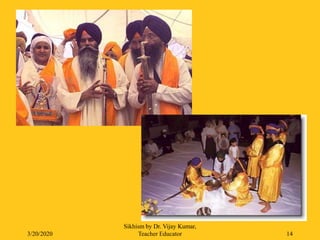
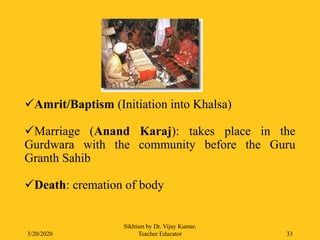
Amrit/Baptism (Initiation into Khalsa)
Marriage (Anand Karaj): takes place in the
Gurdwara with the community before the Guru
Granth Sahib
Death: cremation of body
The Sikh way of life
Mediation and personal prayer morning and
evening
Honest and hard work
Charity
Service to humanity, God, and guru
Strong family values
Strong identity with the Sikh community
Khalsa members abstain from smoking, drinking
and illicit drugs
3/20/2020
Sikhism by Dr. Vijay Kumar,
Teacher Educator 34

Sikhism by Dr. Vijay Kumar, Teacher Educator

  • 1.
    Sikhism Dr. Vijay Kumar Schoolof Education Apeejay Stya University
  • 2.
    What is Sikhism? A 500 year old, monotheistic religion of Northwest India, followed by some 20 million people  Founded in the year 1469  Seeks to make religion a uniting rather than dividing force  All people – male and female, Brahmin and Shudra, Hindu and Muslim – are united as brothers and sisters in devotion to the one God:  "there is no Muslim, there is no Hindu; all are equal human beings because they are the children of the same Father, God.“ – Guru Nanak 3/20/2020 Sikhism by Dr. Vijay Kumar, Teacher Educator 2
  • 3.
    3/20/2020 Sikhism by Dr.Vijay Kumar, Teacher Educator 3 Guru Nanak (1469-1538)
  • 4.
    The founder ofthe faith  Guru Nanak (1469-1538)  Hindu by birth and upbringing  Influenced by the Bhakti and Sant tradition of medieval northwest India  A disciple of both Hindu and Muslim mystics  Composing and singing devotional songs (kirtan)  Drew his own disciples (“sikhs”) following a mystical realization in 1499 - Sikhs are disciples of the gurus and of the ultimate (wahe) guru, God 3/20/2020 Sikhism by Dr. Vijay Kumar, Teacher Educator 4
  • 5.
    Guru Nanak’s Teaching Preached a unifying message that overcame religious differences, uniting both Hindu and Muslim in common devotion to the same God  Recognized that behind all human names and forms for God, is one True God (Sat Nam – the “true name”)  Rejected meaningless ritual, images and idols of gods in favor of simple, heartfelt devotion 3/20/2020 Sikhism by Dr. Vijay Kumar, Teacher Educator 5
  • 6.
    Beliefs  One God(whom people call by many names) Sat Nam = “true name” Waheguru =“great guru”  Equality of all human beings -Rejected caste distinctions  Karma and reincarnation  Reject asceticism -No monastic life in Sikhism  The spirit of the guru (Nanak) continued for 200 years through a succession of ten human gurus… 3/20/2020 Sikhism by Dr. Vijay Kumar, Teacher Educator 6
  • 7.
    3/20/2020 Sikhism by Dr.Vijay Kumar, Teacher Educator 7
  • 8.
    Development of thefaith  2nd guru Guru Angad Dev developed written form of Punjabi language for recording hymns  3rd guru Guru Amar Das instituted the community kitchen (Langar) to feed all in need  4th guru Guru Ram Das built the Sikh holy city of Amritsar in Punjab  5th guru Guru Arjun Dev built the Golden Temple in Amritsar as the center of the Sikh world; also compiled hymns of the earlier gurus, creating the Sikh holy book: Adi Granth 3/20/2020 Sikhism by Dr. Vijay Kumar, Teacher Educator 8
  • 9.
    Martyrdom and defense 5th guru was martyred, 6th guru Guru Har Gobind began a tradition of training Sikhs in martial arts to protectthose persecuted for their religion (Sikh, Hindu or otherwise)  7th guru Guru Har Rai best known for opening hospitals and offering free medical treatment to those in need  8th guru Guru Har Krishan was just a child but continued caring for the sick (died at age 8)  9th guru Guru Tegh Bahadur worked to combat religious persecution, ultimately became the 2nd Sikh martyr 3/20/2020 Sikhism by Dr. Vijay Kumar, Teacher Educator 9
  • 10.
    3/20/2020 Sikhism by Dr.Vijay Kumar, Teacher Educator 10 The Guru Gobind Singh 1675-1708
  • 11.
    The 10th Guru– Gobind Singh  Wrote hymns and completed the compilation of the Adi Granth  In 1699, Initiated the Sikh Khalsa (“brotherhood”) as a military defense force  Declared the end of the line of human gurus, transferring guruship to the Khalsa community and the holy book, now known as “Guru Granth Sahib”  Died 1708 3/20/2020 Sikhism by Dr. Vijay Kumar, Teacher Educator 11
  • 12.
    3/20/2020 Sikhism by Dr.Vijay Kumar, Teacher Educator 12
  • 13.
    The Khalsa  Today,the Khalsa is simply the community of the faithful  Amrit ceremony as baptism and initiation into the Khalsa (male and female, must be at least 16 years of age)  Khalsa members take a new last name: Singh (“lion”) for men, Kaur (“princess”) for women  Khalsa members wear the “Five K’s” as symbols of their faith… 3/20/2020 Sikhism by Dr. Vijay Kumar, Teacher Educator 13
  • 14.
    3/20/2020 Sikhism by Dr.Vijay Kumar, Teacher Educator 14
  • 15.
    The Five K’s Everyman and woman who belongs to the Khalsa must wear five symbols which show that they are Sikhs. They are usually called the Five K’s because in Punjabi their names all begin with the letter ‘K’. 3/20/2020 Sikhism by Dr. Vijay Kumar, Teacher Educator 15
  • 16.
    The Five K’s 3/20/2020 Sikhismby Dr. Vijay Kumar, Teacher Educator 16
  • 17.
    Kesh  Long, uncuthair (both men and women)  Men wear a turban to cover their hair  Kesh is hair. Sikhs promise not to cut their hair but let it grow as a symbol of their faith.  Because during their lifetimes it will get very long they wear turbans to keep it tidy.  They believe that this demonstrates their obedience to God. 3/20/2020 Sikhism by Dr. Vijay Kumar, Teacher Educator 17
  • 18.
    Kangha  A combto keep the hair clean and presentable  The Kangha is a small wooden comb.  It keeps the hair fixed in place, and is a symbol of cleanliness.  Combing their hair reminds Sikhs that their lives should be tidy and organised.  Take note year 6 3/20/2020 Sikhism by Dr. Vijay Kumar, Teacher Educator 18
  • 19.
    Kara  A steelbracelet worn on the right wrist as a reminder to think of God and do one’s duty  The kara is a steel bangle worn on the arm.  It is a closed circle with no beginning and no end...as with God there is no beginning and no end.  It is a reminder to behave well, keep faith and restrain from wrong doing.  Wearing it will remind a sikh of his duties. 3/20/2020 Sikhism by Dr. Vijay Kumar, Teacher Educator 19
  • 20.
     The Lasttwo are a reminder that Sikhs are warriors and  always fight for what is right! 3/20/2020 Sikhism by Dr. Vijay Kumar, Teacher Educator 20
  • 21.
    Kachh  Undergarments asa reminder of chastity (outside of marriage) and purity  These are short trousers worn as underwear. They were more practical than the long, loose clothes most people in India wore at the time of Guru Gobind Singh.  The Guru said they were a symbol that Sikhs were leaving old ideas behind, following new better ones. 3/20/2020 Sikhism by Dr. Vijay Kumar, Teacher Educator 21
  • 22.
    Kirpan  A defensivesword symbolic of God’s power and the Sikh duty to protect the weak and persecuted  The warriors sword. These days a very tiny one is worn as a symbol of dignity and self respect.  It demonstrates power and reminds sikhs that they must fight a spiritual battle, defend the weak and oppressed, and uphold the truth. 3/20/2020 Sikhism by Dr. Vijay Kumar, Teacher Educator 22
  • 23.
    Other Sikh symbols The Khanda: the double edged sword represents God’s power, the circle is for continuity, the two outer swords for spiritual and political balance  “Ek-Onkar” meaning “one God”  The Golden Temple: a place of worship, pilgrimage, and seat of worldwide Sikh leadership; open on four sides for access by all people; surrounded by a pool of water for purification rites 3/20/2020 Sikhism by Dr. Vijay Kumar, Teacher Educator 23
  • 24.
    3/20/2020 Sikhism by Dr.Vijay Kumar, Teacher Educator 24 KhandaEk-Onkar The Golden Temple
  • 25.
    Major Teachings ofSikhism The 10 gurus and Guru Granth Sahib provide Sikhs with a beliefs system on how to worship and live their lives. 1. Monotheism: 1. There is only one God: Creator, Timeless, Unincarnated (without a physical body), Eternal. 2. The Reality of the World. 1. The world is good – it is not an illusion, nor a source of suffering. 2. Human life is an opportunity to become one with God. 3/20/2020 Sikhism by Dr. Vijay Kumar, Teacher Educator 25
  • 26.
    3. Spiritual Achievementin This Life 1. The goal of life is to escape our self-will or self-interest and become one with God. 2. The highest achievement is to become a Gurmukh (a God- man), who is selfless and completely in touch with the will of God. 4. Union of Spiritual and Worldly Lives 1. Guru Nanak did not believe in asceticism. 2. Sikhs are involved in community life, take care of the poor, and act against injustice. 3. Consumerism and materialism are strongly discouraged. 3/20/2020 Sikhism by Dr. Vijay Kumar, Teacher Educator 26
  • 27.
    3/20/2020 Sikhism by Dr.Vijay Kumar, Teacher Educator 27 The Gurdwara – the Sikh temple
  • 28.
    3/20/2020 Sikhism by Dr.Vijay Kumar, Teacher Educator 28 The Gurdwara – the Sikh temple
  • 29.
    The Gurdwara –the Sikh temple  “Door to the Guru,” housing and honoring the Guru Granth Sahib  A “Granthi” (priest) is caretaker of the Gurdwara and the holy book as well as spiritual leader of the community  Contains a kitchen and dining hall (for Langar) and prayer hall for singing of Kirtan (hymns) from the holy book 3/20/2020 Sikhism by Dr. Vijay Kumar, Teacher Educator 29
  • 30.
     Open daily(in India) with continuous reading and singing from holy book, serving food to all who come  Following worship, all partake in the Langar, sitting (on the floor) and eating a meal together (equality) 3/20/2020 Sikhism by Dr. Vijay Kumar, Teacher Educator 30 The Gurdwara – the Sikh temple
  • 31.
    Akhand Path Traditionand the Rites of Passage Every major change in a person's life is accompanied by a tradition of Akhand Path, the continuous reading of the Sri Guru Granth Sahib cover to cover without stopping. It takes around two full days to complete. Usually, family members take turns reading so participants can rest. The reading must be done at a normal pace with clear speech and correctly relating the exact words on the page. Common events where such a reading occurs are typical rites of passage events , such as birth, baptism, reaching adulthood, marriage, moving to a new home, and death. Rites of passage are significant moments in a person's life signifying a transition from one state of being to another, often noted by a religious ceremony or traditional activity. 3/20/2020 Sikhism by Dr. Vijay Kumar, Teacher Educator 31
  • 32.
    Sikh holy daysand ceremonies  Rituals in a ‘Religion Against Rituals’  It is strongly against practicing rituals blindly for the sake of tradition or expectation.  Religious holidays that mark events in the lives of the Gurus are called Gurpurbs  Vaisakhi: April 13th, anniversary of founding of the Khalsa  Guru Nanak’s birthday (November)  Baby naming- Naam Karan 3/20/2020 Sikhism by Dr. Vijay Kumar, Teacher Educator 32
  • 33.
    3/20/2020 Sikhism by Dr.Vijay Kumar, Teacher Educator 33 Amrit/Baptism (Initiation into Khalsa) Marriage (Anand Karaj): takes place in the Gurdwara with the community before the Guru Granth Sahib Death: cremation of body
  • 34.
    The Sikh wayof life Mediation and personal prayer morning and evening Honest and hard work Charity Service to humanity, God, and guru Strong family values Strong identity with the Sikh community Khalsa members abstain from smoking, drinking and illicit drugs 3/20/2020 Sikhism by Dr. Vijay Kumar, Teacher Educator 34