BENEMÉRITA UNIVERSIDAD
AUTONOMA DE PUEBLA
SUBJECT - INTRODUCTORY
MISS ELBA MÉNDEZ GARCÍA

WHY DO I FEEL I AM AN
AUTONOMOUS LEARNER
INTRODUCTION
• Little, D. (2001) Over the last two decades the concept of
learning autonomy and independence has gained importance.
• Taylor, P. G.(2000) The emerging Knowledge-based society is
transforming pedagogical practices in the post compulsory education
sector.
Benson (2001) Learner autonomy is a problematic term
because it is widely confused with self-instruction.
AUTONOMOUS LEARNER DEFINITION
Benson, P. (2007) The capacity to control your own
learning and take challenge and responsibilities in what
you want.
Taylor, P. G. (2007) The need to explore a set of
strategies for extending the reach of higher education.
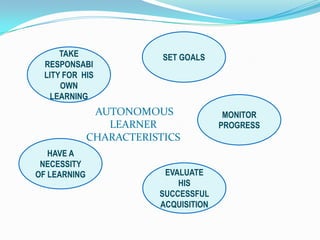
TAKE
RESPONSABI
LITY FOR HIS
OWN
LEARNING

SET GOALS

AUTONOMOUS
LEARNER
CHARACTERISTICS
HAVE A
NECESSITY
OF LEARNING

EVALUATE
HIS
SUCCESSFUL
ACQUISITION

MONITOR
PROGRESS
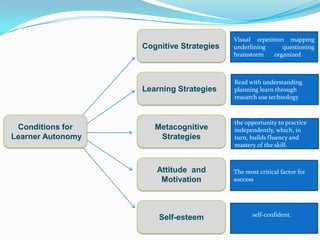
Cognitive Strategies

Learning Strategies

Conditions for
Learner Autonomy

Visual repetition mapping
underlining
questioning
brainstorm
organized

Read with understanding
planning learn through
research use technology

Metacognitive
Strategies

Strategies provide students
the opportunity to practice
independently, which, in
turn, builds fluency and
mastery of the skill.

Attitude and
Motivation

The most critical factor for
success

Self-esteem

self-confident.
CONCLUCION
Through my own experience I have
discovered that I am an autonomous
learner because I love studying by
myself and searching information from
different sources.
REFERENCES
Taylor, P. G. (2000). Changing Expectations: Preparing students for Flexible
Learning.The International Journal of Academic Development 5
(2), 107–115.
Little, D. (2001) Learner Autonomy and human independence: Future
directions , 15-23. Harlow: Longman/Pearson Education.
Benson, P. (2007) Autonomy and Independence in Language Learning.
London: Longman.
 Visual repetition mapping underlining questioning

brainstorm

organized

 Read with understanding planning learn through

research use technology
 Planning predicting monitoring evaluating and

revising strategies.
 The most critical factor for success
 self-confident.

Sandra muñoz

  • 1.
    BENEMÉRITA UNIVERSIDAD AUTONOMA DEPUEBLA SUBJECT - INTRODUCTORY MISS ELBA MÉNDEZ GARCÍA WHY DO I FEEL I AM AN AUTONOMOUS LEARNER
  • 2.
    INTRODUCTION • Little, D.(2001) Over the last two decades the concept of learning autonomy and independence has gained importance. • Taylor, P. G.(2000) The emerging Knowledge-based society is transforming pedagogical practices in the post compulsory education sector. Benson (2001) Learner autonomy is a problematic term because it is widely confused with self-instruction.
  • 3.
    AUTONOMOUS LEARNER DEFINITION Benson,P. (2007) The capacity to control your own learning and take challenge and responsibilities in what you want. Taylor, P. G. (2007) The need to explore a set of strategies for extending the reach of higher education.
  • 4.
    TAKE RESPONSABI LITY FOR HIS OWN LEARNING SETGOALS AUTONOMOUS LEARNER CHARACTERISTICS HAVE A NECESSITY OF LEARNING EVALUATE HIS SUCCESSFUL ACQUISITION MONITOR PROGRESS
  • 5.
    Cognitive Strategies Learning Strategies Conditionsfor Learner Autonomy Visual repetition mapping underlining questioning brainstorm organized Read with understanding planning learn through research use technology Metacognitive Strategies Strategies provide students the opportunity to practice independently, which, in turn, builds fluency and mastery of the skill. Attitude and Motivation The most critical factor for success Self-esteem self-confident.
  • 6.
    CONCLUCION Through my ownexperience I have discovered that I am an autonomous learner because I love studying by myself and searching information from different sources.
  • 7.
    REFERENCES Taylor, P. G.(2000). Changing Expectations: Preparing students for Flexible Learning.The International Journal of Academic Development 5 (2), 107–115. Little, D. (2001) Learner Autonomy and human independence: Future directions , 15-23. Harlow: Longman/Pearson Education. Benson, P. (2007) Autonomy and Independence in Language Learning. London: Longman.
  • 8.
     Visual repetitionmapping underlining questioning brainstorm organized  Read with understanding planning learn through research use technology  Planning predicting monitoring evaluating and revising strategies.  The most critical factor for success  self-confident.