Autonomous Learning
H.O.D. Noura Al-Bedaiwi
Autonomous learning
“autonomy in learning is defined as “the principle that learners should be
encouraged to assume a maximum amount of responsibility for what they
learn and how they learn it”
Promoting Learner Autonomy in Foreign Language Learning by Using
Student Journals. Luzime Kamberi, PhD. State University of Tetova, Republic
of Macedonia
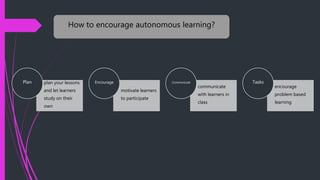
plan your lessons
and let learners
study on their
own
Plan
motivate learners
to participate
Encourage
communicate
with learners in
class
Communicate
encourage
problem based
learning
Tasks
How to encourage autonomous learning?
Autonomous learners:
 Are active learners, who act upon their learning.
 Not passive; they learn but do not use the information they acquired.
 Can search and find information independently.
 Collaborate with their peers and discuss results and data.
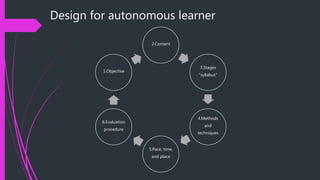
Design for autonomous learner
2.Content
3.Stages
“syllabus”
4.Methods
and
techniques
5.Pace, time,
and place
6.Evaluation
procedure
1.Objective
Conclusion
Autonomous learning is self independent and includes using
varied methods and techniques in class designed by learners.
It is a self integration from pedagogy to andragogy and from
being a learner to a self independent learner.

Autonomous learning

  • 1.
  • 2.
    Autonomous learning “autonomy inlearning is defined as “the principle that learners should be encouraged to assume a maximum amount of responsibility for what they learn and how they learn it” Promoting Learner Autonomy in Foreign Language Learning by Using Student Journals. Luzime Kamberi, PhD. State University of Tetova, Republic of Macedonia
  • 3.
    plan your lessons andlet learners study on their own Plan motivate learners to participate Encourage communicate with learners in class Communicate encourage problem based learning Tasks How to encourage autonomous learning?
  • 4.
    Autonomous learners:  Areactive learners, who act upon their learning.  Not passive; they learn but do not use the information they acquired.  Can search and find information independently.  Collaborate with their peers and discuss results and data.
  • 5.
    Design for autonomouslearner 2.Content 3.Stages “syllabus” 4.Methods and techniques 5.Pace, time, and place 6.Evaluation procedure 1.Objective
  • 6.
    Conclusion Autonomous learning isself independent and includes using varied methods and techniques in class designed by learners. It is a self integration from pedagogy to andragogy and from being a learner to a self independent learner.