Helsinki Chemicals Forum 2016
Concluding Remarks
First Day
Jukka Malm
European Chemicals Agency
Circular Economy –
Opportunities and
Challenges for Chemicals
Regulation
Panel 1
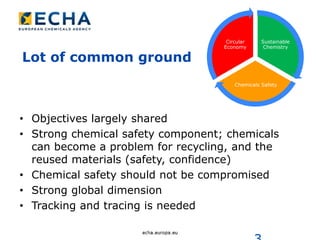
Lot of common ground
• Objectives largely shared
• Strong chemical safety component; chemicals
can become a problem for recycling, and the
reused materials (safety, confidence)
• Chemical safety should not be compromised
• Strong global dimension
• Tracking and tracing is needed
Sustainable
Chemistry
Chemicals Safety
Circular
Economy
How to move on?
• Devil is in the detail; how not to get lost in
detail - how to ensure a vision and steer for
innovation and business?
• Change management
• REACH data and processes can already
contribute a lot
• REACH principles also can be applied
• Foster proactive innovation instead of just
reactive authority driven approach
4
Perfluorinated chemicals –
A global chemicals
management issue in the
need of global agreement
Panel 2
6
Perfluorinated compounds
• An example of substances relevant to circular economy
• Wide spread use in products and articles, wide spread
environmental contamination
• Look as a group of substances to avoid regrettable
substitution
• Lack of hazard data on alternative compounds?
• Standard data sets not sufficient to address the relevant concerns
• Better information needed on uses, including use in articles
• Performance of non-fluorinated alternatives?
• Many countries/regions are working on PFAS
How to facilitate global risk reduction?
• Industry voluntary action since 2000
• Extend to other regions/manufacturers?
• Create incentives for others to join
• REACH restriction proposal on PFOA
• PFOS listed as POPs, proposal for PFOA
• Combination of regulatory/voluntary
• What are the lessons learned?
• For sustainable chemistry & circular economy
7
Global Data Sharing – How
Can Businesses and
Regulators Make Smarter
Use of Data Already
Available?
Panel 3
9
Opportunities
• Time for an global vision – post-2020 SAICM
• Many elements in place already from OECD
• Mutual Acceptance of Data
• Technical convergence (standards and tools)
• Less advanced on use information
• Data sharing between companies
• Acceptance of data sets by authorities
• Sharing of/accepting assessments by authorities
• Harmonising data requirements
• Benefits
• Sharing cost, workload, experiences, transparency,
predictability…
10
How to eliminate barriers
• Define a goal and ambition
• Work in partnership – win/win approaches
• Modular/layered approach – allow stepwise
progress
• Anticipate how to deal with data generated by
new alternative approaches (IATA, AOP,…)
• Intellectual Property Rights & CBI
Thank you!
Subscribe to our news at
echa.europa.eu/subscribe
Follow us on Twitter
@EU_ECHA
Follow us on Facebook
Facebook.com/EUECHA
jukka.malm@echa.europa.eu

HCF 2016: Jukka Malm

  • 1.
    Helsinki Chemicals Forum2016 Concluding Remarks First Day Jukka Malm European Chemicals Agency
  • 2.
    Circular Economy – Opportunitiesand Challenges for Chemicals Regulation Panel 1
  • 3.
    Lot of commonground • Objectives largely shared • Strong chemical safety component; chemicals can become a problem for recycling, and the reused materials (safety, confidence) • Chemical safety should not be compromised • Strong global dimension • Tracking and tracing is needed Sustainable Chemistry Chemicals Safety Circular Economy
  • 4.
    How to moveon? • Devil is in the detail; how not to get lost in detail - how to ensure a vision and steer for innovation and business? • Change management • REACH data and processes can already contribute a lot • REACH principles also can be applied • Foster proactive innovation instead of just reactive authority driven approach 4
  • 5.
    Perfluorinated chemicals – Aglobal chemicals management issue in the need of global agreement Panel 2
  • 6.
    6 Perfluorinated compounds • Anexample of substances relevant to circular economy • Wide spread use in products and articles, wide spread environmental contamination • Look as a group of substances to avoid regrettable substitution • Lack of hazard data on alternative compounds? • Standard data sets not sufficient to address the relevant concerns • Better information needed on uses, including use in articles • Performance of non-fluorinated alternatives? • Many countries/regions are working on PFAS
  • 7.
    How to facilitateglobal risk reduction? • Industry voluntary action since 2000 • Extend to other regions/manufacturers? • Create incentives for others to join • REACH restriction proposal on PFOA • PFOS listed as POPs, proposal for PFOA • Combination of regulatory/voluntary • What are the lessons learned? • For sustainable chemistry & circular economy 7
  • 8.
    Global Data Sharing– How Can Businesses and Regulators Make Smarter Use of Data Already Available? Panel 3
  • 9.
    9 Opportunities • Time foran global vision – post-2020 SAICM • Many elements in place already from OECD • Mutual Acceptance of Data • Technical convergence (standards and tools) • Less advanced on use information • Data sharing between companies • Acceptance of data sets by authorities • Sharing of/accepting assessments by authorities • Harmonising data requirements • Benefits • Sharing cost, workload, experiences, transparency, predictability…
  • 10.
    10 How to eliminatebarriers • Define a goal and ambition • Work in partnership – win/win approaches • Modular/layered approach – allow stepwise progress • Anticipate how to deal with data generated by new alternative approaches (IATA, AOP,…) • Intellectual Property Rights & CBI
  • 11.
    Thank you! Subscribe toour news at echa.europa.eu/subscribe Follow us on Twitter @EU_ECHA Follow us on Facebook Facebook.com/EUECHA jukka.malm@echa.europa.eu