Stylianos Kephalopoulos
Leader of Competence Group ‘Exposure’
Chemical Assessment and Testing Unit
Institute for Health and Consumer Protection
26-27 May 2016, Helsinki
Assessing chemicals in
construction products within
a holistic view of buildings’
“efficiency” in EU
2
Promoting the implementation of a holistic view of buildings’
“efficiency”: safety, health, energy-efficiency & sustainability
The conception and integrated and
efficient implementation of
building related policies,
regulations and standards in EU
should be performed considering the
multi-dimensional based holisitic
concept of buildings’ “efficiency”
which encompasses socioeconomic,
energy efficiency, health, safety
of constructions and
sustainability aspects.
ENERGY EFFICIENCY MEETING HEALTH
3
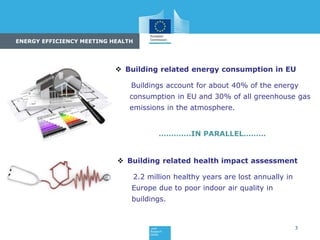
 Building related energy consumption in EU
Buildings account for about 40% of the energy
consumption in EU and 30% of all greenhouse gas
emissions in the atmosphere.
ENERGY EFFICIENCY MEETING HEALTH
……….…IN PARALLEL………
 Building related health impact assessment
2.2 million healthy years are lost annually in
Europe due to poor indoor air quality in
buildings.
4
ENERGY EFFICIENCY MEETING HEALTH
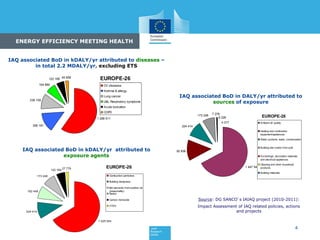
EUROPE-26
1 288 511
306 181
238 159
154 880
122 169 45 658
CV-diseases
Asthma & allergy
Lung cancer
U&L Respiratory symptoms
Acute toxication
COPD
IAQ associated BoD in kDALY/yr attributed to diseases –
in total 2.2 MDALY/yr, excluding ETS
EUROPE-26
1 425 504
224 414
182 448
173 248
122 169
27 776
Combustion particless
Building dampness
Bio-aerosols from outdoor air
(seasonality)
Radon
Carbon monoxide
VOCs
IAQ associated BoD in kDALY/yr attributed to
exposure agents
IAQ associated BoD in DALY/yr attributed to
sources of exposure
EUROPE-26
1 447 541
292 836
224 414
173 248 7 276
4 017
6 226
Ambient air quality
Heating and combustion
equipment/appliances
Water systems, leaks, condensation
Building site (radon from soil)
Furnishings, decoration materials
and electrical appliances
Cleaning and other household
products
Building materials
Source: DG SANCO’s IAIAQ project (2010-2011):
Impact Assessment of IAQ related policies, actions
and projects
5
STRATEGIES TO REDUCE HEALTH RISKS IN ENERGY
EFFICIENT BUILDINGS
1. Reducing pollution at source
2. Diluting pollution through ventilation
3. Producing innovative and safety by design solutions for
construction materials and consumer products
…………a combination of 3
strategies………
STRATEGIES TO REDUCE HEALTH RISKS
6
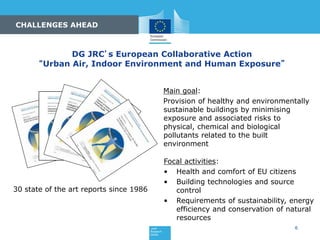
DG JRC’s European Collaborative Action
“Urban Air, Indoor Environment and Human Exposure”
30 state of the art reports since 1986
Focal activities:
• Health and comfort of EU citizens
• Building technologies and source
control
• Requirements of sustainability, energy
efficiency and conservation of natural
resources
Main goal:
Provision of healthy and environmentally
sustainable buildings by minimising
exposure and associated risks to
physical, chemical and biological
pollutants related to the built
environment
CHALLENGES AHEAD
7
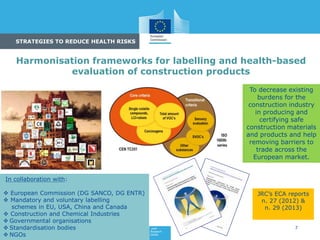
Harmonisation frameworks for labelling and health-based
evaluation of construction products
JRC’s ECA reports
n. 27 (2012) &
n. 29 (2013)
STRATEGIES TO REDUCE HEALTH RISKS
In collaboration with:
 European Commission (DG SANCO, DG ENTR)
 Mandatory and voluntary labelling
schemes in EU, USA, China and Canada
 Construction and Chemical Industries
 Governmental organisations
 Standardisation bodies
 NGOs
To decrease existing
burdens for the
construction industry
in producing and
certifying safe
construction materials
and products and help
removing barriers to
trade across the
European market.
8
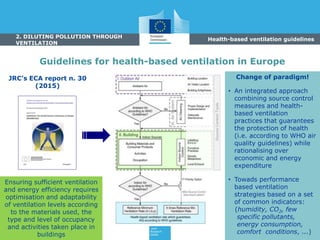
Guidelines for health-based ventilation in Europe
JRC’s ECA report n. 30
(2015)
Change of paradigm!
• An integrated approach
combining source control
measures and health-
based ventilation
practices that guarantees
the protection of health
(i.e. according to WHO air
quality guidelines) while
rationalising over
economic and energy
expenditure
• Towads performance
based ventilation
strategies based on a set
of common indicators:
(humidity, CO2, few
specific pollutants,
energy consumption,
comfort conditions, ...)
2. DILUTING POLLUTION THROUGH
VENTILATION
Ensuring sufficient ventilation
and energy efficiency requires
optimisation and adaptability
of ventilation levels according
to the materials used, the
type and level of occupancy
and activities taken place in
buildings
Health-based ventilation guidelines
9
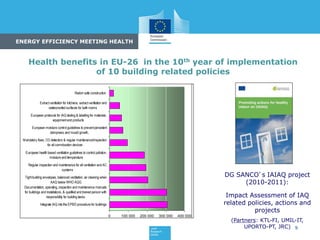
Health benefits in EU-26 in the 10th year of implementation
of 10 building related policies
DG SANCO’s IAIAQ project
(2010-2011):
Impact Assessment of IAQ
related policies, actions and
projects
(Partners: KTL-FI, UMIL-IT,
UPORTO-PT, JRC)
Potential DALY/a benefits at the 10th
year of
implementation of 10 IAQ policies in EUROPE-26
0 100 000 200 000 300 000 400 000
Integrate IAQ into the EPBD procedure for buildings
Documentation, operating, inspection and maintenance manuals
for buildings and installations, & qualified and trained person with
responsibility for building tasks
Tightbuilding envelopes, balanced ventilation, air cleaning when
AAQ below WHO AQG
Regular inspection and maintenance for all ventilation and AC
systems
European health based ventilation guidelines to control pollution,
moisture and temperature
Mandatory flues, CO detectors & regular maintenance/inspection
for all comnbustion devices
European moisture control guidelines to preventpersistent
dampness and mould growth.
European protocols for IAQ testing & labelling for materials,
equipmentand products
Extractventilation for kitchens, extractventilation and
waterproofed surfaces for bath rooms
Radon safe construction
ENERGY EFFICIENCY MEETING HEALTH
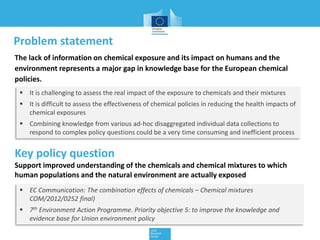
 EC Communication: The combination effects of chemicals – Chemical mixtures
COM/2012/0252 final)
 7th Environment Action Programme. Priority objective 5: to improve the knowledge and
evidence base for Union environment policy
Key policy question
Support improved understanding of the chemicals and chemical mixtures to which
human populations and the natural environment are actually exposed
The lack of information on chemical exposure and its impact on humans and the
environment represents a major gap in knowledge base for the European chemical
policies.
 It is challenging to assess the real impact of the exposure to chemicals and their mixtures
 It is difficult to assess the effectiveness of chemical policies in reducing the health impacts of
chemical exposures
 Combining knowledge from various ad-hoc disaggregated individual data collections to
respond to complex policy questions could be a very time consuming and inefficient process
Problem statement
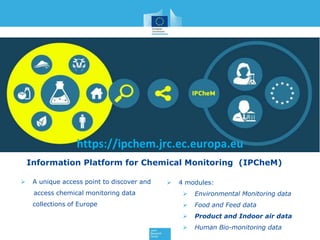
https://ipchem.jrc.ec.europa.eu
Information Platform for Chemical Monitoring (IPCheM)
 A unique access point to discover and
access chemical monitoring data
collections of Europe
 4 modules:
 Environmental Monitoring data
 Food and Feed data
 Product and Indoor air data
 Human Bio-monitoring data
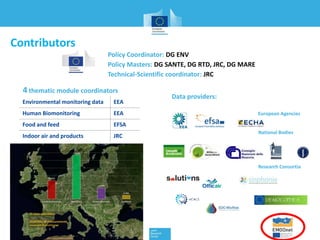
Contributors
Policy Coordinator: DG ENV
Policy Masters: DG SANTE, DG RTD, JRC, DG MARE
Technical-Scientific coordinator: JRC
Data providers:
European Agencies
National Bodies
Research Consortia
4 thematic module coordinators
Environmental monitoring data EEA
Human Biomonitoring EEA
Food and feed EFSA
Indoor air and products JRC
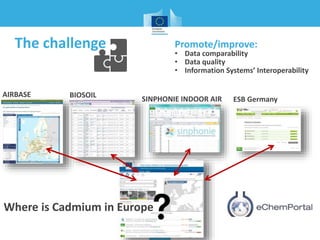
Promote/improve:
• Data comparability
• Data quality
• Information Systems’ Interoperability
AIRBASE
SINPHONIE INDOOR AIR
BIOSOIL
The challenge
Where is Cadmium in Europe
ESB Germany
14
IPCheM next generation development
 Help reducing cost burdens by allowing a more efficient use of data and
reporting obligations, in line with the latest Commission Communication on
REFIT (2015) which has announced a fitness check of environmental
legislation.
 Contribute to the circular economy package by providing the basis for
addressing chemicals in products and enhancing traceability of chemical
composition (which is important for recycling).
 IPCheM will progressively build into an information hub for retrieving and
integrating environment, health and chemicals data that are really fit-for-
purpose to serve particular societal/policy challenges. The aim is to combine
environmental monitoring and exposure data with toxicology and health
information, seeking to establish meaningful correlations that can inform and
guide policy decisions in the field of health and environmental protection
IPCheM videos on Youtube
https://www.youtube.com/watch?v=h5IR6CXBPZw&feature=youtu.be&list=PLGI5zHT2w7jCXDhxf32JGP6ChuUyfp4HZ
16
CONCLUSIONS (1/2)
 Assessing chemicals in construction products within a holistic view of buildings’
“efficiency” in EU requires an integrated approach combining source control
measures and health-based ventilation practices that guarantees the protection
of health (i.e. according to WHO air quality guidelines) while rationalising over
economic and energy expenditure.
 The interface between chemicals, products and waste legislation is complex,
and the Circular Economy action plan indicates that further analyses should be
carried out before proposals are made. Two directions are considered: the
tracking of chemicals and the promotion of non-toxic material cycles.
 EC efforts are dedicated to facilitating the systematic retrieval and use of
quality and comparable data concerning product emissions, exposure and
human bio-monitoring data as an important prerequisite for assessing the
effectiveness of chemical policies in reducing the health impact of chemical
exposure (IPCheM).
17
CONCLUSIONS (2/2)
 Understand and prioritize chemicals/parameters causing risk, and track the
chemicals back to their sources/uses.
 Chemical toxicity of products should be evaluated besides from a risk
assessment perspective also within a Life Cycle Analysis perspective. EC’s work
is on-going with the European Chemical Agency (ECHA) to built a database of
emission-specific characterisation factors using REACH data to evaluate the
impact of products in the context of LCA.
 EC is working to increase coherence across EU product policies (in particular
Ecolabel, Green Public Procurement, Ecodesign and Energy Labelling).
 Two recently launched REFIT (Regulation Fitness Check) exercises by the EC
focus on European regulations covering health and safety in construction and
aim to assess the burdens, costs and benefits of the implementation of the
Construction Products Regulation (CPR) in relation to Energy Performance
Buildings Directive (EPBD), dangerous substances and sustainability.
Stay in touch
JRC Science Hub:
ec.europa.eu/jrc
Twitter:
@EU_ScienceHub
YouTube:
JRC Audiovisuals
Facebook:
EU Science Hub – Joint Research Centre
LinkedIn:
Joint Research Centre (JRC) - European
Commission's Science Service
DISCLAIMER: This presentation and its contents do not constitute an official position of the
European Commission or any of its services. Neither the European Commission nor any person
acting on behalf of the Commission is responsible for the use which might be made of this
presentation or its contents.

HCF 2016: Stylianos Kephalopoulos

  • 1.
    Stylianos Kephalopoulos Leader ofCompetence Group ‘Exposure’ Chemical Assessment and Testing Unit Institute for Health and Consumer Protection 26-27 May 2016, Helsinki Assessing chemicals in construction products within a holistic view of buildings’ “efficiency” in EU
  • 2.
    2 Promoting the implementationof a holistic view of buildings’ “efficiency”: safety, health, energy-efficiency & sustainability The conception and integrated and efficient implementation of building related policies, regulations and standards in EU should be performed considering the multi-dimensional based holisitic concept of buildings’ “efficiency” which encompasses socioeconomic, energy efficiency, health, safety of constructions and sustainability aspects. ENERGY EFFICIENCY MEETING HEALTH
  • 3.
    3  Building relatedenergy consumption in EU Buildings account for about 40% of the energy consumption in EU and 30% of all greenhouse gas emissions in the atmosphere. ENERGY EFFICIENCY MEETING HEALTH ……….…IN PARALLEL………  Building related health impact assessment 2.2 million healthy years are lost annually in Europe due to poor indoor air quality in buildings.
  • 4.
    4 ENERGY EFFICIENCY MEETINGHEALTH EUROPE-26 1 288 511 306 181 238 159 154 880 122 169 45 658 CV-diseases Asthma & allergy Lung cancer U&L Respiratory symptoms Acute toxication COPD IAQ associated BoD in kDALY/yr attributed to diseases – in total 2.2 MDALY/yr, excluding ETS EUROPE-26 1 425 504 224 414 182 448 173 248 122 169 27 776 Combustion particless Building dampness Bio-aerosols from outdoor air (seasonality) Radon Carbon monoxide VOCs IAQ associated BoD in kDALY/yr attributed to exposure agents IAQ associated BoD in DALY/yr attributed to sources of exposure EUROPE-26 1 447 541 292 836 224 414 173 248 7 276 4 017 6 226 Ambient air quality Heating and combustion equipment/appliances Water systems, leaks, condensation Building site (radon from soil) Furnishings, decoration materials and electrical appliances Cleaning and other household products Building materials Source: DG SANCO’s IAIAQ project (2010-2011): Impact Assessment of IAQ related policies, actions and projects
  • 5.
    5 STRATEGIES TO REDUCEHEALTH RISKS IN ENERGY EFFICIENT BUILDINGS 1. Reducing pollution at source 2. Diluting pollution through ventilation 3. Producing innovative and safety by design solutions for construction materials and consumer products …………a combination of 3 strategies……… STRATEGIES TO REDUCE HEALTH RISKS
  • 6.
    6 DG JRC’s EuropeanCollaborative Action “Urban Air, Indoor Environment and Human Exposure” 30 state of the art reports since 1986 Focal activities: • Health and comfort of EU citizens • Building technologies and source control • Requirements of sustainability, energy efficiency and conservation of natural resources Main goal: Provision of healthy and environmentally sustainable buildings by minimising exposure and associated risks to physical, chemical and biological pollutants related to the built environment CHALLENGES AHEAD
  • 7.
    7 Harmonisation frameworks forlabelling and health-based evaluation of construction products JRC’s ECA reports n. 27 (2012) & n. 29 (2013) STRATEGIES TO REDUCE HEALTH RISKS In collaboration with:  European Commission (DG SANCO, DG ENTR)  Mandatory and voluntary labelling schemes in EU, USA, China and Canada  Construction and Chemical Industries  Governmental organisations  Standardisation bodies  NGOs To decrease existing burdens for the construction industry in producing and certifying safe construction materials and products and help removing barriers to trade across the European market.
  • 8.
    8 Guidelines for health-basedventilation in Europe JRC’s ECA report n. 30 (2015) Change of paradigm! • An integrated approach combining source control measures and health- based ventilation practices that guarantees the protection of health (i.e. according to WHO air quality guidelines) while rationalising over economic and energy expenditure • Towads performance based ventilation strategies based on a set of common indicators: (humidity, CO2, few specific pollutants, energy consumption, comfort conditions, ...) 2. DILUTING POLLUTION THROUGH VENTILATION Ensuring sufficient ventilation and energy efficiency requires optimisation and adaptability of ventilation levels according to the materials used, the type and level of occupancy and activities taken place in buildings Health-based ventilation guidelines
  • 9.
    9 Health benefits inEU-26 in the 10th year of implementation of 10 building related policies DG SANCO’s IAIAQ project (2010-2011): Impact Assessment of IAQ related policies, actions and projects (Partners: KTL-FI, UMIL-IT, UPORTO-PT, JRC) Potential DALY/a benefits at the 10th year of implementation of 10 IAQ policies in EUROPE-26 0 100 000 200 000 300 000 400 000 Integrate IAQ into the EPBD procedure for buildings Documentation, operating, inspection and maintenance manuals for buildings and installations, & qualified and trained person with responsibility for building tasks Tightbuilding envelopes, balanced ventilation, air cleaning when AAQ below WHO AQG Regular inspection and maintenance for all ventilation and AC systems European health based ventilation guidelines to control pollution, moisture and temperature Mandatory flues, CO detectors & regular maintenance/inspection for all comnbustion devices European moisture control guidelines to preventpersistent dampness and mould growth. European protocols for IAQ testing & labelling for materials, equipmentand products Extractventilation for kitchens, extractventilation and waterproofed surfaces for bath rooms Radon safe construction ENERGY EFFICIENCY MEETING HEALTH
  • 10.
     EC Communication:The combination effects of chemicals – Chemical mixtures COM/2012/0252 final)  7th Environment Action Programme. Priority objective 5: to improve the knowledge and evidence base for Union environment policy Key policy question Support improved understanding of the chemicals and chemical mixtures to which human populations and the natural environment are actually exposed The lack of information on chemical exposure and its impact on humans and the environment represents a major gap in knowledge base for the European chemical policies.  It is challenging to assess the real impact of the exposure to chemicals and their mixtures  It is difficult to assess the effectiveness of chemical policies in reducing the health impacts of chemical exposures  Combining knowledge from various ad-hoc disaggregated individual data collections to respond to complex policy questions could be a very time consuming and inefficient process Problem statement
  • 11.
    https://ipchem.jrc.ec.europa.eu Information Platform forChemical Monitoring (IPCheM)  A unique access point to discover and access chemical monitoring data collections of Europe  4 modules:  Environmental Monitoring data  Food and Feed data  Product and Indoor air data  Human Bio-monitoring data
  • 12.
    Contributors Policy Coordinator: DGENV Policy Masters: DG SANTE, DG RTD, JRC, DG MARE Technical-Scientific coordinator: JRC Data providers: European Agencies National Bodies Research Consortia 4 thematic module coordinators Environmental monitoring data EEA Human Biomonitoring EEA Food and feed EFSA Indoor air and products JRC
  • 13.
    Promote/improve: • Data comparability •Data quality • Information Systems’ Interoperability AIRBASE SINPHONIE INDOOR AIR BIOSOIL The challenge Where is Cadmium in Europe ESB Germany
  • 14.
    14 IPCheM next generationdevelopment  Help reducing cost burdens by allowing a more efficient use of data and reporting obligations, in line with the latest Commission Communication on REFIT (2015) which has announced a fitness check of environmental legislation.  Contribute to the circular economy package by providing the basis for addressing chemicals in products and enhancing traceability of chemical composition (which is important for recycling).  IPCheM will progressively build into an information hub for retrieving and integrating environment, health and chemicals data that are really fit-for- purpose to serve particular societal/policy challenges. The aim is to combine environmental monitoring and exposure data with toxicology and health information, seeking to establish meaningful correlations that can inform and guide policy decisions in the field of health and environmental protection
  • 15.
    IPCheM videos onYoutube https://www.youtube.com/watch?v=h5IR6CXBPZw&feature=youtu.be&list=PLGI5zHT2w7jCXDhxf32JGP6ChuUyfp4HZ
  • 16.
    16 CONCLUSIONS (1/2)  Assessingchemicals in construction products within a holistic view of buildings’ “efficiency” in EU requires an integrated approach combining source control measures and health-based ventilation practices that guarantees the protection of health (i.e. according to WHO air quality guidelines) while rationalising over economic and energy expenditure.  The interface between chemicals, products and waste legislation is complex, and the Circular Economy action plan indicates that further analyses should be carried out before proposals are made. Two directions are considered: the tracking of chemicals and the promotion of non-toxic material cycles.  EC efforts are dedicated to facilitating the systematic retrieval and use of quality and comparable data concerning product emissions, exposure and human bio-monitoring data as an important prerequisite for assessing the effectiveness of chemical policies in reducing the health impact of chemical exposure (IPCheM).
  • 17.
    17 CONCLUSIONS (2/2)  Understandand prioritize chemicals/parameters causing risk, and track the chemicals back to their sources/uses.  Chemical toxicity of products should be evaluated besides from a risk assessment perspective also within a Life Cycle Analysis perspective. EC’s work is on-going with the European Chemical Agency (ECHA) to built a database of emission-specific characterisation factors using REACH data to evaluate the impact of products in the context of LCA.  EC is working to increase coherence across EU product policies (in particular Ecolabel, Green Public Procurement, Ecodesign and Energy Labelling).  Two recently launched REFIT (Regulation Fitness Check) exercises by the EC focus on European regulations covering health and safety in construction and aim to assess the burdens, costs and benefits of the implementation of the Construction Products Regulation (CPR) in relation to Energy Performance Buildings Directive (EPBD), dangerous substances and sustainability.
  • 19.
    Stay in touch JRCScience Hub: ec.europa.eu/jrc Twitter: @EU_ScienceHub YouTube: JRC Audiovisuals Facebook: EU Science Hub – Joint Research Centre LinkedIn: Joint Research Centre (JRC) - European Commission's Science Service DISCLAIMER: This presentation and its contents do not constitute an official position of the European Commission or any of its services. Neither the European Commission nor any person acting on behalf of the Commission is responsible for the use which might be made of this presentation or its contents.

Editor's Notes

  • #13  IPCheM is involving the active participation of a large number of Institutions…
  • #14 RESPONSE: We designed and developed a de-centralised system which establishes remote access with the different data collections Users search and retrieve data not only metadata Origin datasets are transformed and harmonised on the fly, displayed in a unique interface with a set of common attributes, in this way is also possible to immediately correlate different data Data providers remain responsible of their data and we respect their conditions of data access and use