Click to start
Tornado Safety Basics SEASONAL SAFETY T201106-01 ©2011 Bongarde
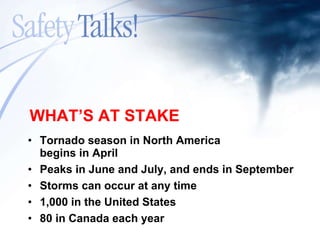
Tornado season in North America begins in April Peaks in June and July, and ends in September Storms can occur at any time 1,000 in the United States 80 in Canada each year WHAT’S AT STAKE
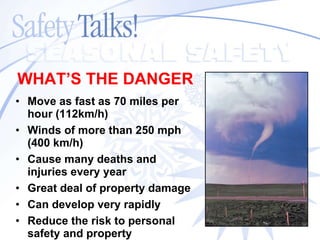
Move as fast as 70 miles per hour (112km/h) Winds of more than 250 mph (400 km/h) Cause many deaths and injuries every year Great deal of property damage Can develop very rapidly Reduce the risk to personal  safety and property WHAT’S THE   DANGER
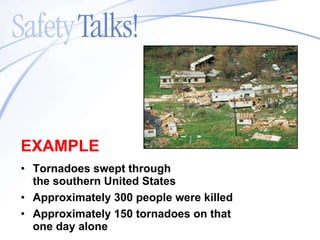
Tornadoes swept through  the southern United States Approximately 300 people were killed Approximately 150 tornadoes on that one day alone EXAMPLE
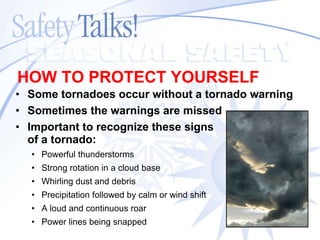
Some tornadoes occur without a tornado warning Sometimes the warnings are missed Important to recognize these signs  of a tornado: Powerful thunderstorms Strong rotation in a cloud base Whirling dust and debris Precipitation followed by calm or wind shift A loud and continuous roar Power lines being snapped HOW TO PROTECT YOURSELF
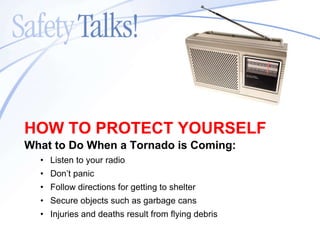
What to Do When a Tornado is Coming: Listen to your radio Don’t panic Follow directions for getting to shelter Secure objects such as garbage cans Injuries and deaths result from flying debris HOW TO PROTECT YOURSELF
What to Do When a Tornado is Coming: Take cover Go to the basement Crouch down under the stairs Do not take an elevator Go into the closet Underneath a sturdy piece of furniture Stay away from windows and outside doors HOW TO PROTECT YOURSELF
What to Do When a Tornado is Coming: Not below heavy objects on a floor above you Protect your head with your hands If you are driving, safely park your car Get to a building Get away from the car Lie flat and face down in low ground Stay far from other cars or trees Avoid being in a building with a wide-span roof HOW TO PROTECT YOURSELF
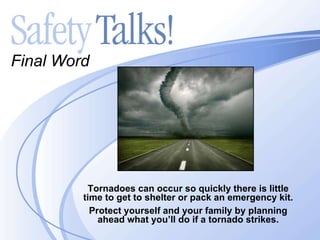
Final Word Tornadoes can occur so quickly there is little time to get to shelter or pack an emergency kit. Protect yourself and your family by planning ahead what you’ll do if a tornado strikes.

Tornado safety awareness

  • 1.
  • 2.
    Tornado Safety BasicsSEASONAL SAFETY T201106-01 ©2011 Bongarde
  • 3.
    Tornado season inNorth America begins in April Peaks in June and July, and ends in September Storms can occur at any time 1,000 in the United States 80 in Canada each year WHAT’S AT STAKE
  • 4.
    Move as fastas 70 miles per hour (112km/h) Winds of more than 250 mph (400 km/h) Cause many deaths and injuries every year Great deal of property damage Can develop very rapidly Reduce the risk to personal safety and property WHAT’S THE DANGER
  • 5.
    Tornadoes swept through the southern United States Approximately 300 people were killed Approximately 150 tornadoes on that one day alone EXAMPLE
  • 6.
    Some tornadoes occurwithout a tornado warning Sometimes the warnings are missed Important to recognize these signs of a tornado: Powerful thunderstorms Strong rotation in a cloud base Whirling dust and debris Precipitation followed by calm or wind shift A loud and continuous roar Power lines being snapped HOW TO PROTECT YOURSELF
  • 7.
    What to DoWhen a Tornado is Coming: Listen to your radio Don’t panic Follow directions for getting to shelter Secure objects such as garbage cans Injuries and deaths result from flying debris HOW TO PROTECT YOURSELF
  • 8.
    What to DoWhen a Tornado is Coming: Take cover Go to the basement Crouch down under the stairs Do not take an elevator Go into the closet Underneath a sturdy piece of furniture Stay away from windows and outside doors HOW TO PROTECT YOURSELF
  • 9.
    What to DoWhen a Tornado is Coming: Not below heavy objects on a floor above you Protect your head with your hands If you are driving, safely park your car Get to a building Get away from the car Lie flat and face down in low ground Stay far from other cars or trees Avoid being in a building with a wide-span roof HOW TO PROTECT YOURSELF
  • 10.
    Final Word Tornadoescan occur so quickly there is little time to get to shelter or pack an emergency kit. Protect yourself and your family by planning ahead what you’ll do if a tornado strikes.