PREPARING FOR AND RESPONDING
TO ENVIRONMENTAL EMERGENCIES
Suzanne Ilene Schiller, Esq.
Michael C. Nines, P.E., LEED AP
Manko, Gold, Katcher & Fox, LLP
© Copyright 2015
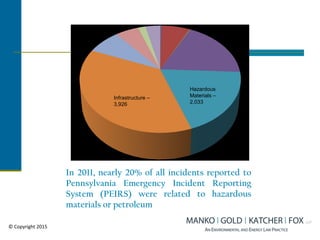
In 2011, nearly 20% of all incidents reported to
Pennsylvania Emergency Incident Reporting
System (PEIRS) were related to hazardous
materials or petroleum
© Copyright 2015
Infrastructure –
3,926
Hazardous
Materials –
2,033
Topics
 Legal Framework for Environmental Emergencies
 Planning for Environmental Emergencies
 Identifying Sources of Potential Environmental
Hazards
 Special Response Considerations for
Environmental Emergencies
 NIMS/ESF #10 Oil and Hazardous Materials
© Copyright 2015
PA Legal Framework
Emergency Management Services Code, 35 Pa.C.S.
Sections 7101-7707 (1978)
Intrastate Mutual Aid Act (Act 93 of 2008) , 35
Pa.C.S. Sections 7331-7340
Hazardous Material Emergency Planning and
Response Act, Pennsylvania Act 1990-165
© Copyright 2015
Emergency Management Services
Code
Directs and authorizes every county, city, borough,
incorporated town, and township to have an
emergency management program that includes:
 an Emergency Management Coordinator (EMC)
 an Emergency Operations Plan (EOP)
 an Emergency Operations Center (EOC)
© Copyright 2015
Intrastate Mutual Aid Act
Creates a system of mutual aid between political
subdivisions.
“It shall be the responsibility of each participating
political subdivision with jurisdiction over and
responsibility for emergency management within
that political subdivision to . . . [i]dentify potential
hazards that could affect the participating political
subdivision . . . “
35 Pa. C. S. Section
7334(c)(1)
© Copyright 2015
Hazardous Material Emergency
Planning and Response Act
 Implements SARA Title III (Emergency Planning
and Community Right-To- Know Act or EPCRA)
 EPCRA has four provisions:
 Emergency Planning
 Emergency Release Notification
 Hazardous Chemical Storage Reporting
Requirements
 Toxic Chemical Release Inventory
© Copyright 2015
Hazardous Material Emergency
Planning and Response Act (cont.)
 Requires a Local Emergency Planning Committee
(LEPC) in each county to develop emergency
response plans for facilities which contain certain
hazardous chemicals in amounts over specific
thresholds
 Requires reporting of a release of any “reportable
quantity” of a hazardous substance
© Copyright 2015
Hazardous Material Emergency
Planning and Response Act (cont.)
 Requires certain facilities to prepare or have
Material Safety Data Sheets for hazardous
chemicals it has on site, in excess of certain
amounts
 Requires certain facilities to report the chemicals
that are on site
 Requires reporting of routine toxic chemical
emissions from certain facilities
© Copyright 2015
Planning for Environmental
Emergencies
 You can’t manage what you don’t measure.
 Know potential risks and hazards in your Township.
 Environmental regulations require permitting,
reporting, and/or other approvals to control impacts
from various industries, developments, and commercial
operations.
 Helpful planning information is readily ascertainable
through publicly available data resources.
 Federal and State databases and Geographical
Information System (GIS) tools will be explored.
 Free solution for “data mining” – just need the time to
research.
Readily Ascertainable Information to Help
You Plan
 Hazardous Waste Generators
 where are they and what wastes do they generate?
 Sources of emissions of Hazardous Air Pollutants
 where are stack vents, what is volume of pollutants
routinely emitted to atmosphere?
 Storage of Hazardous substances
 where are petroleum and other hazardous materials
stored?
 Releases of Toxic Substances
 indicator of throughput of toxic materials at a given site.
 Locations of Radiation Producing equipment
© Copyright 2015
Electronic Tools as a Starting Point
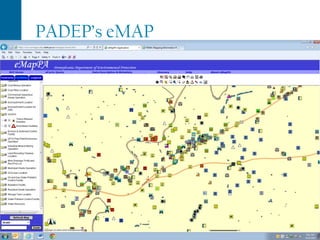
 PADEP’s eMAP
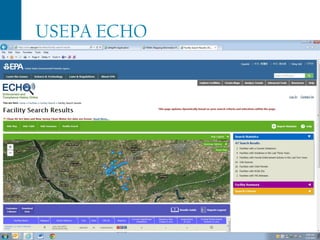
 USEPA’ Enforcement Compliance History On-line (ECHO)
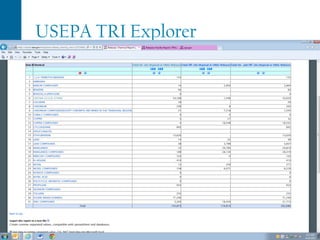
 USEPA’s Toxic Release Inventory
 Google Earth
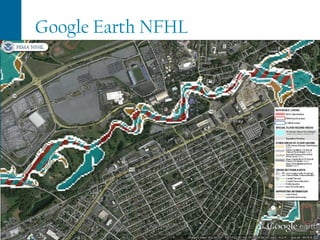
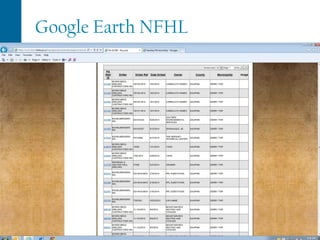
 FEMA National Flood Hazard Layer (NFHL)
 Are sites of concern identified in databases within a floodplain?
 Private Well mapping with PA Groundwater Records Online
© Copyright 2015
PADEP’s eMAP
USEPA ECHO
USEPA TRI Explorer
Google Earth NFHL
Google Earth NFHL
Next Level of Analysis
 Conduct review of local Fire Department Records
 Tier II reporting of hazardous substances should have been
submitted by regulated entities storing more than 10,000 pounds
of hazardous materials or less for extremely hazardous
substances.
 Conduct Review of State Agency files under FOIA request.
 Would obtain detailed information related to air permits,
wastewater discharges, well installations, etc.
 Determine Emergency Coordinator at Facilities of Concern
© Copyright 2015
Special Response Considerations for
Environmental Emergencies
PADEP Emergency Response Phone Numbers:
https://www.portal.state.pa.us/portal/server.pt/com
munity/report_an_incident/6010
Statewide: 1-800-541-2050
Certified PA HazMat Teams:
http://www.pema.pa.gov/planningandpreparedness
/Documents/Certified%20Hazardous%20Materials
%20Teams%20Feb%202014.pdf
© Copyright 2015
Response Considerations
Drinking Water
 Identify Wells Within Jurisdiction, Registered and
Unregistered
 Identify Existing Monitoring Programs
 Identify Alternative Sources of Drinking Water
Air
 Identify Potential Sources of Air Emissions
 Identify Existing Monitoring Programs
 Prepare for “Shelter in Place” or Evacuation
© Copyright 2015
Response Considerations
Know Your Local Resources
 Supplies
 Home Depot, Lowes
 Pharmacies
 Food
 Wawa/Sheetz
 Communications
 Rental Community Managers
 Mobile Home Community Managers
© Copyright 2015
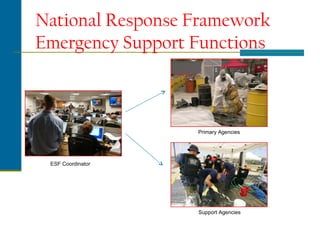
National Response Framework
Emergency Support Functions
ESF Coordinator
Primary Agencies
Support Agencies
ESF #10 – Oil and Hazardous
Materials
“Hazardous Materials” is a general term intended to mean
hazardous substances, pollutants, and contaminants as
defined in the National Contingency Plan. Hazardous
materials include chemical, biological, and radiological
substances, whether accidentally or intentionally released.
Provides mechanism for coordinating Federal assistance to
supplement state and local response to a potential or
actual discharge of oil and/or an uncontrolled release of
hazardous material.
ESF #10 Structure
 EPA is the Coordinating Agency
 EPA is the Primary Agency for inland discharges
 US Coast Guard is the Primary Agency for coastal
discharges
ESF #10 Structure
 Supporting Agencies:
 Department of Agriculture (provides logistics support)
 National Oceanic and Atmospheric Administration
(provides modeling of spread of contamination)
 Department of Energy (advises on removal and
disposal of radioactive contamination)
 Department of Health and Human Services (assesses
health hazards)
 Department of the Interior (supports protection of
natural and cultural resources)
 Department of Defense (directs response for release
of its own hazardous materials)
Actions Taken Under ESF #10
 Assessment
 Contain, stabilize, treat and dispose
 Issue Permits for treatment, disposal
 Monitor air and water
Questions?
Suzanne Ilene Schiller, Esq. – 484-430-2354
Michael C. Nines, P.E. – 484-430-2350
© Copyright 2015

PSAT Presentations (1417246_1).PPT

  • 1.
    PREPARING FOR ANDRESPONDING TO ENVIRONMENTAL EMERGENCIES Suzanne Ilene Schiller, Esq. Michael C. Nines, P.E., LEED AP Manko, Gold, Katcher & Fox, LLP © Copyright 2015
  • 2.
    In 2011, nearly20% of all incidents reported to Pennsylvania Emergency Incident Reporting System (PEIRS) were related to hazardous materials or petroleum © Copyright 2015 Infrastructure – 3,926 Hazardous Materials – 2,033
  • 3.
    Topics  Legal Frameworkfor Environmental Emergencies  Planning for Environmental Emergencies  Identifying Sources of Potential Environmental Hazards  Special Response Considerations for Environmental Emergencies  NIMS/ESF #10 Oil and Hazardous Materials © Copyright 2015
  • 4.
    PA Legal Framework EmergencyManagement Services Code, 35 Pa.C.S. Sections 7101-7707 (1978) Intrastate Mutual Aid Act (Act 93 of 2008) , 35 Pa.C.S. Sections 7331-7340 Hazardous Material Emergency Planning and Response Act, Pennsylvania Act 1990-165 © Copyright 2015
  • 5.
    Emergency Management Services Code Directsand authorizes every county, city, borough, incorporated town, and township to have an emergency management program that includes:  an Emergency Management Coordinator (EMC)  an Emergency Operations Plan (EOP)  an Emergency Operations Center (EOC) © Copyright 2015
  • 6.
    Intrastate Mutual AidAct Creates a system of mutual aid between political subdivisions. “It shall be the responsibility of each participating political subdivision with jurisdiction over and responsibility for emergency management within that political subdivision to . . . [i]dentify potential hazards that could affect the participating political subdivision . . . “ 35 Pa. C. S. Section 7334(c)(1) © Copyright 2015
  • 7.
    Hazardous Material Emergency Planningand Response Act  Implements SARA Title III (Emergency Planning and Community Right-To- Know Act or EPCRA)  EPCRA has four provisions:  Emergency Planning  Emergency Release Notification  Hazardous Chemical Storage Reporting Requirements  Toxic Chemical Release Inventory © Copyright 2015
  • 8.
    Hazardous Material Emergency Planningand Response Act (cont.)  Requires a Local Emergency Planning Committee (LEPC) in each county to develop emergency response plans for facilities which contain certain hazardous chemicals in amounts over specific thresholds  Requires reporting of a release of any “reportable quantity” of a hazardous substance © Copyright 2015
  • 9.
    Hazardous Material Emergency Planningand Response Act (cont.)  Requires certain facilities to prepare or have Material Safety Data Sheets for hazardous chemicals it has on site, in excess of certain amounts  Requires certain facilities to report the chemicals that are on site  Requires reporting of routine toxic chemical emissions from certain facilities © Copyright 2015
  • 10.
    Planning for Environmental Emergencies You can’t manage what you don’t measure.  Know potential risks and hazards in your Township.  Environmental regulations require permitting, reporting, and/or other approvals to control impacts from various industries, developments, and commercial operations.  Helpful planning information is readily ascertainable through publicly available data resources.  Federal and State databases and Geographical Information System (GIS) tools will be explored.  Free solution for “data mining” – just need the time to research.
  • 11.
    Readily Ascertainable Informationto Help You Plan  Hazardous Waste Generators  where are they and what wastes do they generate?  Sources of emissions of Hazardous Air Pollutants  where are stack vents, what is volume of pollutants routinely emitted to atmosphere?  Storage of Hazardous substances  where are petroleum and other hazardous materials stored?  Releases of Toxic Substances  indicator of throughput of toxic materials at a given site.  Locations of Radiation Producing equipment © Copyright 2015
  • 12.
    Electronic Tools asa Starting Point  PADEP’s eMAP  USEPA’ Enforcement Compliance History On-line (ECHO)  USEPA’s Toxic Release Inventory  Google Earth  FEMA National Flood Hazard Layer (NFHL)  Are sites of concern identified in databases within a floodplain?  Private Well mapping with PA Groundwater Records Online © Copyright 2015
  • 13.
  • 14.
  • 15.
  • 16.
  • 17.
  • 18.
    Next Level ofAnalysis  Conduct review of local Fire Department Records  Tier II reporting of hazardous substances should have been submitted by regulated entities storing more than 10,000 pounds of hazardous materials or less for extremely hazardous substances.  Conduct Review of State Agency files under FOIA request.  Would obtain detailed information related to air permits, wastewater discharges, well installations, etc.  Determine Emergency Coordinator at Facilities of Concern © Copyright 2015
  • 19.
    Special Response Considerationsfor Environmental Emergencies PADEP Emergency Response Phone Numbers: https://www.portal.state.pa.us/portal/server.pt/com munity/report_an_incident/6010 Statewide: 1-800-541-2050 Certified PA HazMat Teams: http://www.pema.pa.gov/planningandpreparedness /Documents/Certified%20Hazardous%20Materials %20Teams%20Feb%202014.pdf © Copyright 2015
  • 20.
    Response Considerations Drinking Water Identify Wells Within Jurisdiction, Registered and Unregistered  Identify Existing Monitoring Programs  Identify Alternative Sources of Drinking Water Air  Identify Potential Sources of Air Emissions  Identify Existing Monitoring Programs  Prepare for “Shelter in Place” or Evacuation © Copyright 2015
  • 21.
    Response Considerations Know YourLocal Resources  Supplies  Home Depot, Lowes  Pharmacies  Food  Wawa/Sheetz  Communications  Rental Community Managers  Mobile Home Community Managers © Copyright 2015
  • 22.
    National Response Framework EmergencySupport Functions ESF Coordinator Primary Agencies Support Agencies
  • 23.
    ESF #10 –Oil and Hazardous Materials “Hazardous Materials” is a general term intended to mean hazardous substances, pollutants, and contaminants as defined in the National Contingency Plan. Hazardous materials include chemical, biological, and radiological substances, whether accidentally or intentionally released. Provides mechanism for coordinating Federal assistance to supplement state and local response to a potential or actual discharge of oil and/or an uncontrolled release of hazardous material.
  • 24.
    ESF #10 Structure EPA is the Coordinating Agency  EPA is the Primary Agency for inland discharges  US Coast Guard is the Primary Agency for coastal discharges
  • 25.
    ESF #10 Structure Supporting Agencies:  Department of Agriculture (provides logistics support)  National Oceanic and Atmospheric Administration (provides modeling of spread of contamination)  Department of Energy (advises on removal and disposal of radioactive contamination)  Department of Health and Human Services (assesses health hazards)  Department of the Interior (supports protection of natural and cultural resources)  Department of Defense (directs response for release of its own hazardous materials)
  • 26.
    Actions Taken UnderESF #10  Assessment  Contain, stabilize, treat and dispose  Issue Permits for treatment, disposal  Monitor air and water
  • 27.
    Questions? Suzanne Ilene Schiller,Esq. – 484-430-2354 Michael C. Nines, P.E. – 484-430-2350 © Copyright 2015