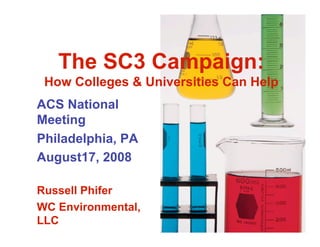
The SC3 Campaign:
 How Colleges & Universities Can Help
ACS National
Meeting
Philadelphia, PA
August17, 2008

Russell Phifer
WC Environmental,
LLC
Identify Schools with Needs

•  Local
     –  Its easier to help!
•    Poorly funded
•    Those without adequate staffing
•    Older schools may have greatest need
•    Referrals from EPA regional
     coordinators
What do you have to offer?

•  Expertise
  –  Familiarity with regulations
  –  Experience managing chemical wastes
  –  Knowledge of vendors & technologies
•  Resources
  –  Reference materials
  –  Equipment / supplies
  –  Inventory management background or
      software
Management Assistance

•  Help schools incorporate chemical
   safety into curriculum, business
   practices, and budget development
•  Work with other community stakeholders
   to get them involved
•  Set goals and measures
•  Establish procedure for maintaining an
   effective program
Training

•    Chemical safety
•    Proper storage
•    Waste determinations
•    Segregation / consolidation
•    Contracting
•    Manifest / paperwork review
Hands on help

•  Review chemical inventory
  –  Determine which chemicals are particularly
     hazardous
  –  Help decide what chemicals are not used
  –  Classify for storage
  –  Physical handling if needed
A Step Further…

•  Piggy-back on milk runs
•  Help with contracting
•  Packaging & transport where permitted
Why should you help?

•    Be a good neighbor
•    Public relations
•    Good for training your staff
•    For the experience
Chemical Security

•  Review how chemicals are stored and
   secured
•  Are there chemicals which might be
   deliberately abused?

Phifer Sc3 Assistance

  • 1.
    The SC3 Campaign: How Colleges & Universities Can Help ACS National Meeting Philadelphia, PA August17, 2008 Russell Phifer WC Environmental, LLC
  • 2.
    Identify Schools withNeeds •  Local –  Its easier to help! •  Poorly funded •  Those without adequate staffing •  Older schools may have greatest need •  Referrals from EPA regional coordinators
  • 3.
    What do youhave to offer? •  Expertise –  Familiarity with regulations –  Experience managing chemical wastes –  Knowledge of vendors & technologies •  Resources –  Reference materials –  Equipment / supplies –  Inventory management background or software
  • 4.
    Management Assistance •  Helpschools incorporate chemical safety into curriculum, business practices, and budget development •  Work with other community stakeholders to get them involved •  Set goals and measures •  Establish procedure for maintaining an effective program
  • 5.
    Training •  Chemical safety •  Proper storage •  Waste determinations •  Segregation / consolidation •  Contracting •  Manifest / paperwork review
  • 6.
    Hands on help • Review chemical inventory –  Determine which chemicals are particularly hazardous –  Help decide what chemicals are not used –  Classify for storage –  Physical handling if needed
  • 7.
    A Step Further… • Piggy-back on milk runs •  Help with contracting •  Packaging & transport where permitted
  • 8.
    Why should youhelp? •  Be a good neighbor •  Public relations •  Good for training your staff •  For the experience
  • 9.
    Chemical Security •  Reviewhow chemicals are stored and secured •  Are there chemicals which might be deliberately abused?