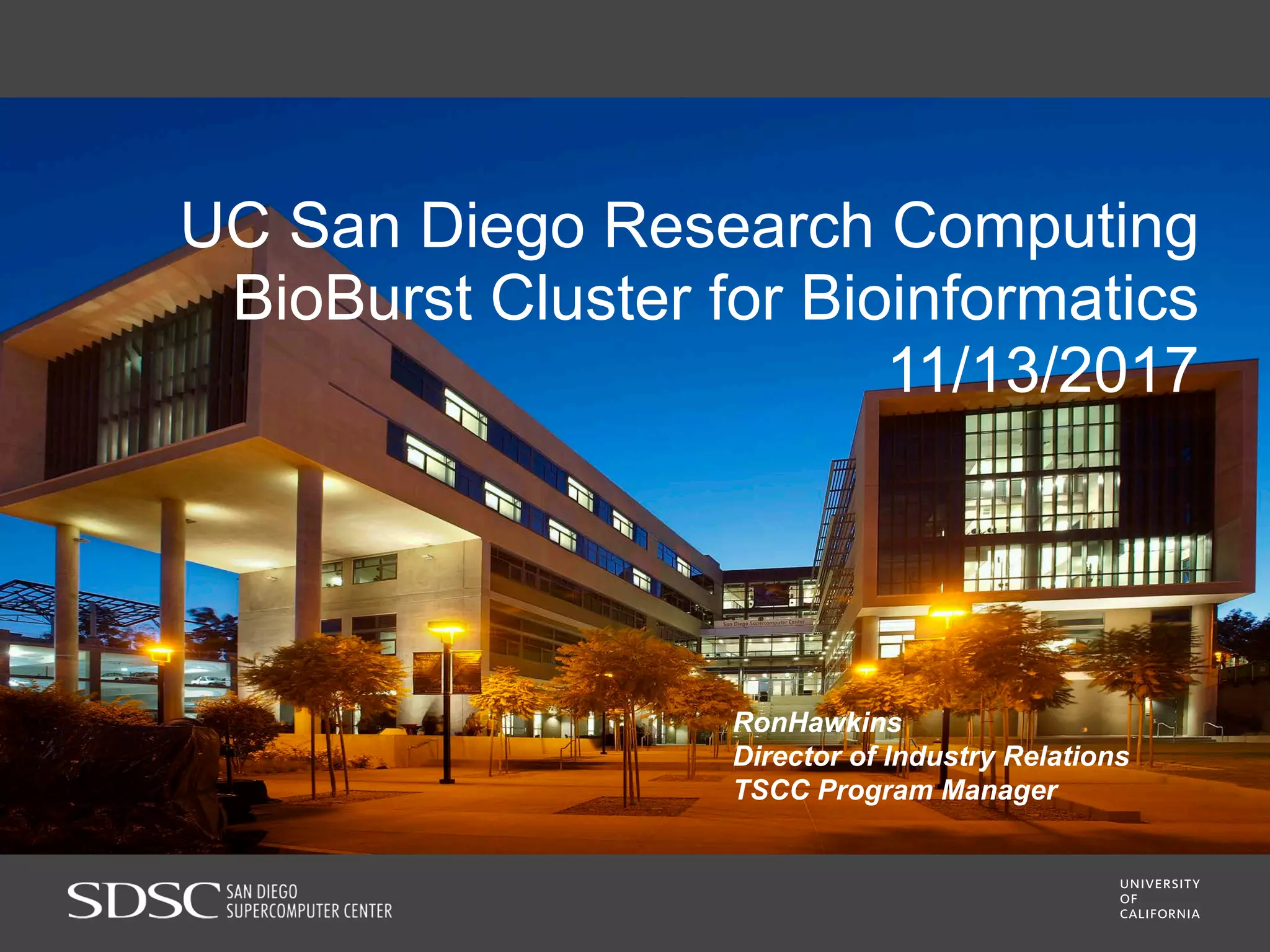
UC San Diego Research Computing
BioBurst Cluster for Bioinformatics
11/13/2017
RonHawkins
Director of Industry Relations
TSCC Program Manager
Acknowledgement
• This material is based upon work supported by the
National Science Foundation under Grant No. ACI-
1659104
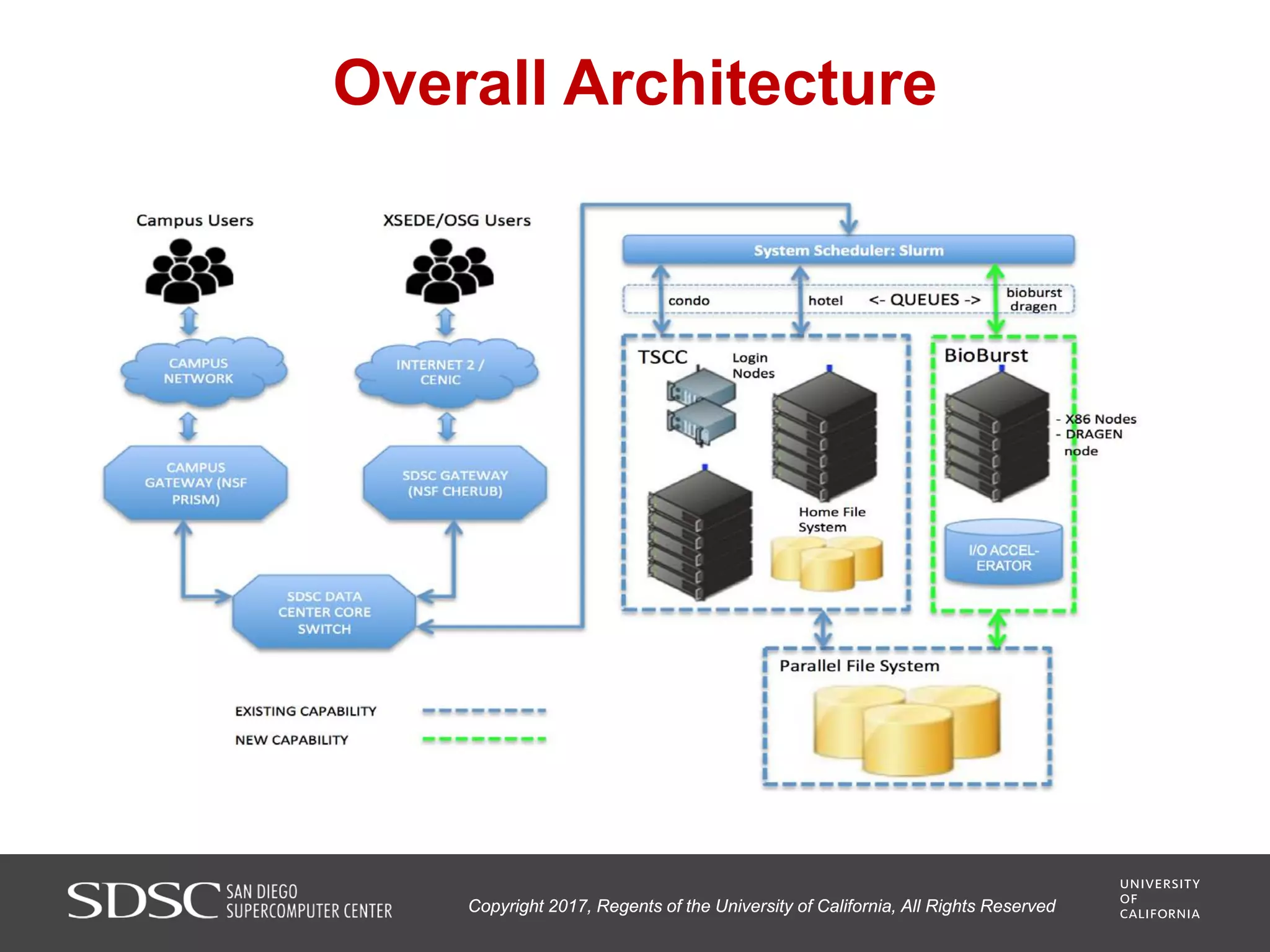
• Any opinions, findings, and conclusions or
recommendations expressed in this material are those of
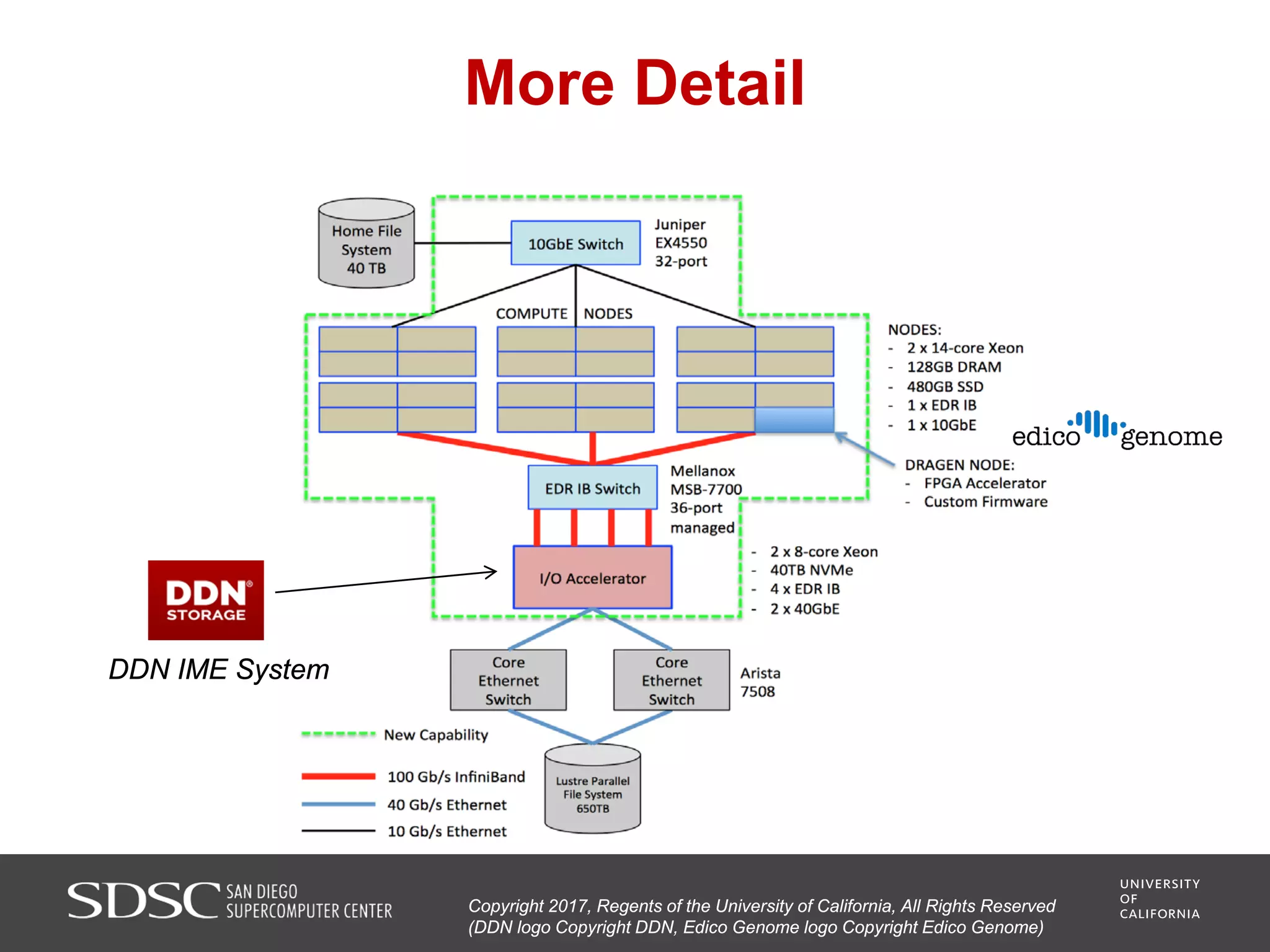
the author(s) and do not necessarily reflect the views of
the National Science Foundation
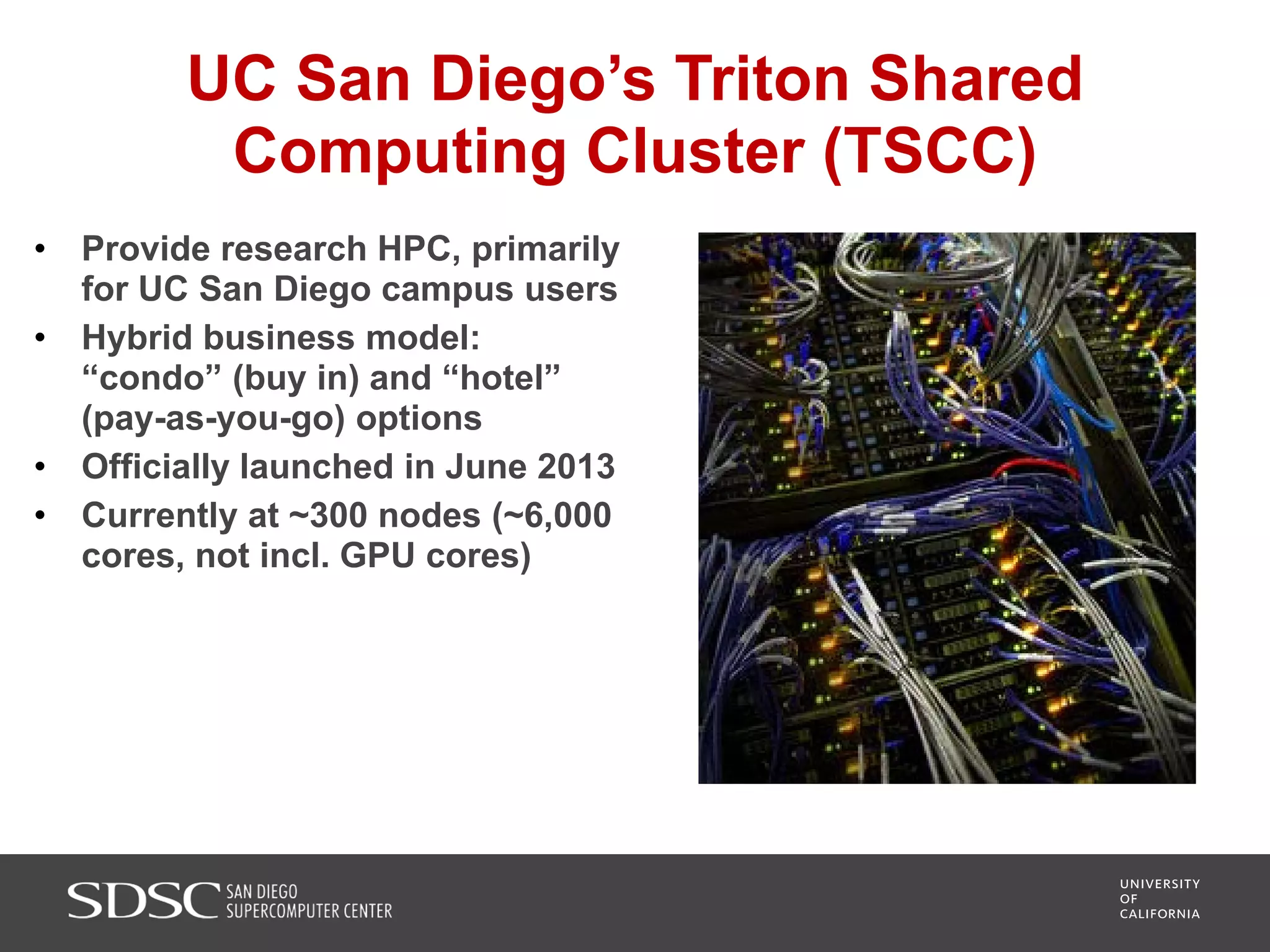
UC San Diego’s Triton Shared
Computing Cluster (TSCC)
• Provide research HPC, primarily
for UC San Diego campus users
• Hybrid business model:
“condo” (buy in) and “hotel”
(pay-as-you-go) options
• Officially launched in June 2013
• Currently at ~300 nodes (~6,000
cores, not incl. GPU cores)
Program Objectives
• Provide a robust research computing program at UC San
Diego that
1. Enhances research competitiveness
2. Provides a medium- to large-scale computing resource
• Access to a larger resource than most PI’s could afford just for their lab
3. Is readily accessible (without competitive proposals or long wait
times)
4. Follows best practices at other universities
5. Is cost-effective and energy-efficient
• Alternative to “closet clusters”
6. Provides for professional administration/maintenance (freeing up
postdocs & grad students to focus on research)
Condo Model Mechanics
Condo Cluster
Group 1’s
Purchased Nodes
Group 2’s
Purchased Nodes
TSCC Group Purchases
Common Infrastructure
Nodes are purchased directly and
are property of the lab/group or
funding agency
Common equipment is purchased
via assessment of a one-time, per-
node “infrastructure fee”
• Once purchased nodes are in place, group
may run on purchased nodes or entire
cluster according to usage rules
• Labs/groups are assessed an annual per-
node operations fee (~27% of total cost)
Copyright 2017, Regents of the University of California, All Rights Reserved
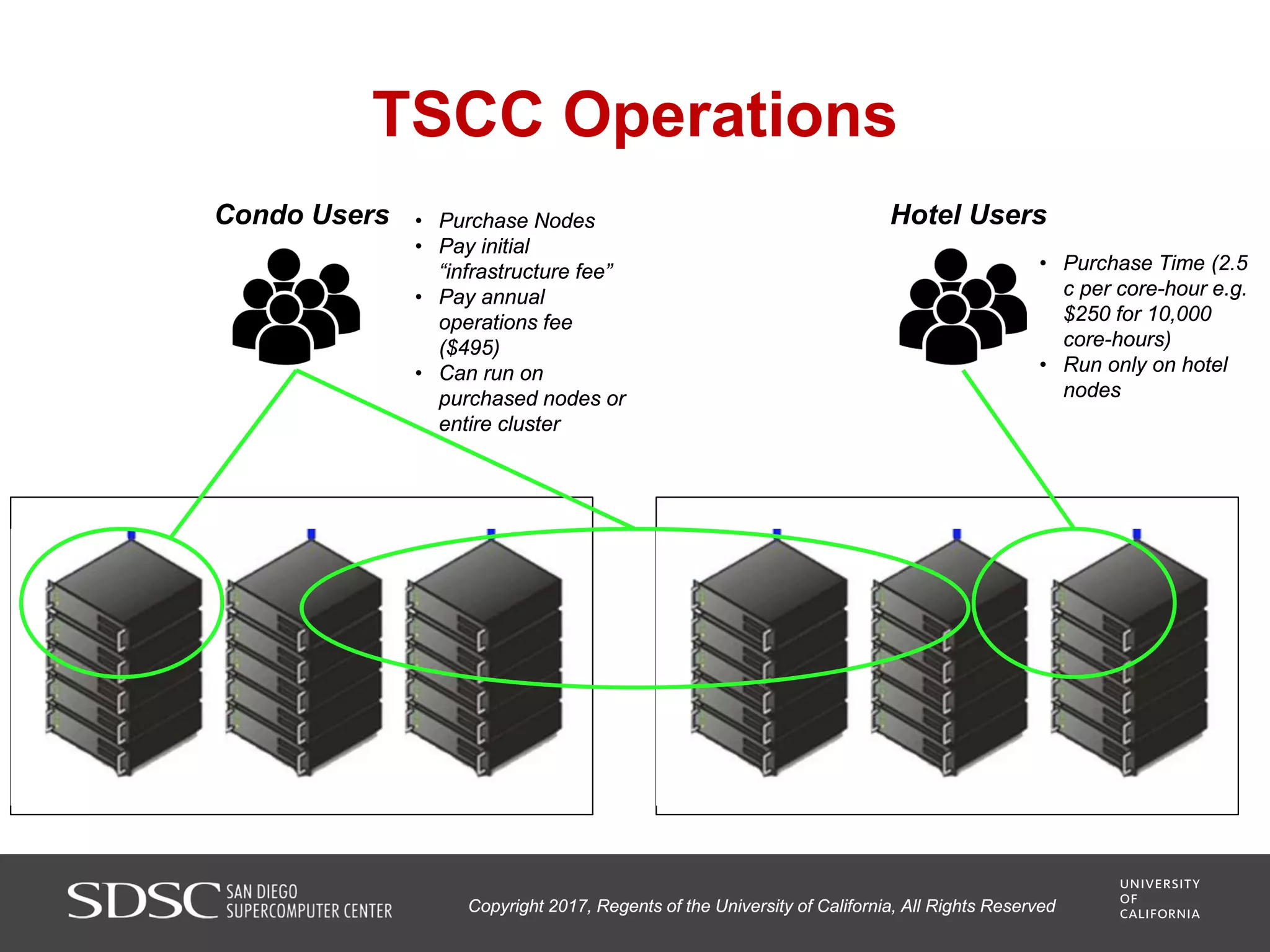
TSCC Operations
Condo Users Hotel Users• Purchase Nodes
• Pay initial
“infrastructure fee”
• Pay annual
operations fee
($495)
• Can run on
purchased nodes or
entire cluster
• Purchase Time (2.5
c per core-hour e.g.
$250 for 10,000
core-hours)
• Run only on hotel
nodes
Copyright 2017, Regents of the University of California, All Rights Reserved
Node Characteristics
• Nodes comprise dual-socket, Sandy Bridge,
Haswell and Broadwell processors, 16-28
cores/node, and 64-128GB main memory
• Mixed 10GbE and QDR InfiniBand interconnect
(BioBurst cluster is EDR)
• GPU nodes are mix of NVIDIA GTX
980/1080/1080Ti and Titan-X GPUs
CC* BioBurst for TSCC
• NSF Campus Cyberinfrastructure (CC*) Award
• Objective is to augment TSCC with capabilities
to address the growing bioinformatics workload
• Award value: $500K
• Award start date: Feb 1, 2017
Objective
• The overall objective of BioBurst
• Improve research productivity by providing a separately-
scheduled campus computing resource designed to
address performance bottlenecks found in a class of
applications important to campus researchers, including
genomics, transcriptomics, and other bioinformatics
pipelines.
• Specifically, the small block / small file I/O
problem with codes such as GATK – see
references 1-4
Key Features
More specifically, BioBurst will incorporate the following major
components and operational characteristics:
• A software-defined I/O accelerator appliance with 40 terabytes of
non-volatile (“flash”) memory and software designed to alleviate the
small-block/small-file random access I/O problem characteristic of
many bioinformatics codes;
• Derived from Exascale program “burst buffer” technology
• An FPGA-based computational accelerator node (Edico Genome
DRAGEN) that has been shown to conduct demultiplexing, mapping,
and variant calling of a single human genome in 22 minutes as
compared to ~10 hours on standard computing hardware [2];
• 672 commodity (x86) computing cores providing a separately
scheduled resource for running various bioinformatics
computations;
• Integration with a Lustre parallel file system, which supports
streaming I/O, and has the capacity to stage large amounts of data
characteristic of many bioinformatics studies; and,
Overall Architecture
Copyright 2017, Regents of the University of California, All Rights Reserved
More Detail
Copyright 2017, Regents of the University of California, All Rights Reserved
(DDN logo Copyright DDN, Edico Genome logo Copyright Edico Genome)
DDN IME System
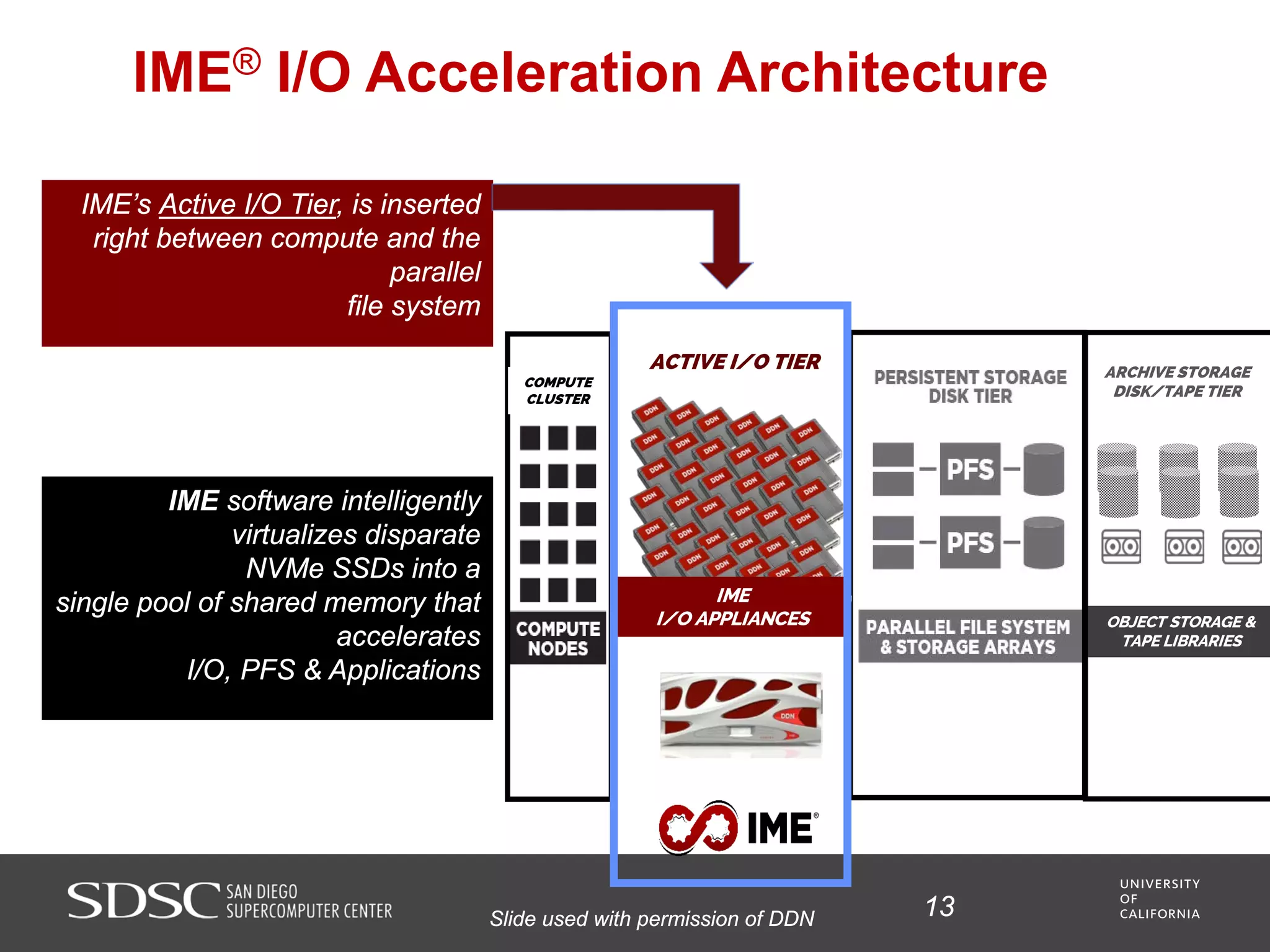
IME® I/O Acceleration Architecture
13
OBJECT STORAGE &
TAPE LIBRARIES
ARCHIVE STORAGE
DISK/TAPE TIER
IME’s Active I/O Tier, is inserted
right between compute and the
parallel
file system
IME software intelligently
virtualizes disparate
NVMe SSDs into a
single pool of shared memory that
accelerates
I/O, PFS & Applications
ACTIVE I/O TIER
IME
I/O APPLIANCES
COMPUTE
CLUSTER
Slide used with permission of DDN
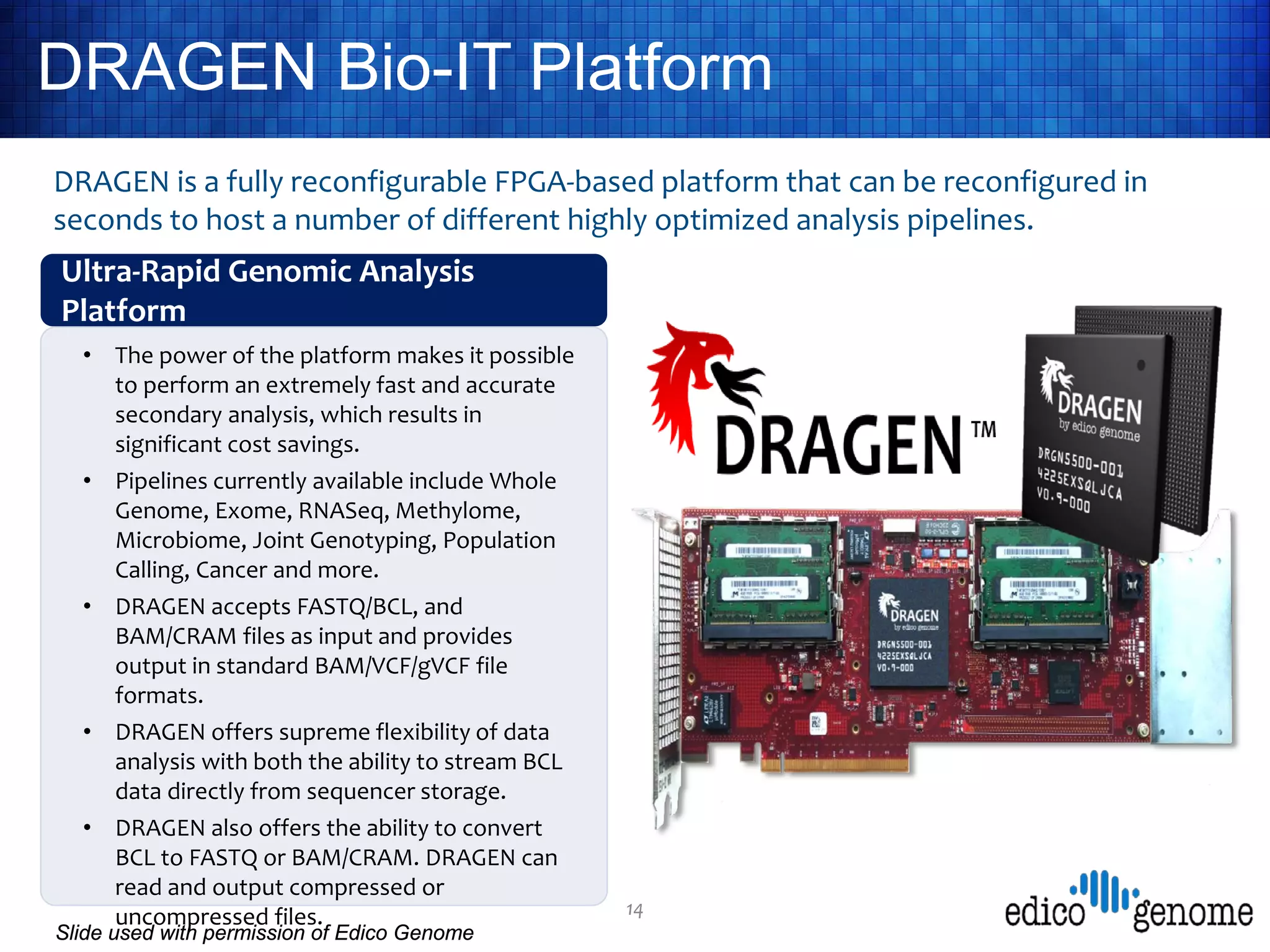
DRAGEN Bio-IT Platform
14
Ultra-Rapid Genomic Analysis
Platform
• The power of the platform makes it possible
to perform an extremely fast and accurate
secondary analysis, which results in
significant cost savings.
• Pipelines currently available include Whole
Genome, Exome, RNASeq, Methylome,
Microbiome, Joint Genotyping, Population
Calling, Cancer and more.
• DRAGEN accepts FASTQ/BCL, and
BAM/CRAM files as input and provides
output in standard BAM/VCF/gVCF file
formats.
• DRAGEN offers supreme flexibility of data
analysis with both the ability to stream BCL
data directly from sequencer storage.
• DRAGEN also offers the ability to convert
BCL to FASTQ or BAM/CRAM. DRAGEN can
read and output compressed or
uncompressed files.
DRAGEN is a fully reconfigurable FPGA-based platform that can be reconfigured in
seconds to host a number of different highly optimized analysis pipelines.
Slide used with permission of Edico Genome
Science Use Cases
• Investigating Genetic Causes and Treatments for
Pediatric Brain Disease – Dr. Joe Gleeson, UCSD
• Understanding the Role of Gene Expression in
Development and Aging – Dr. Gene Yeo, UCSD
• Revolutionizing the Development of Human
Vaccines – Dr. Richard Scheurmann (J. Craig
Venter Institute) and Dr. Robert Sinkovits (SDSC)
• Molecular Basis of Neuropsychiatric Disorders –
Dr. Jonathan Sebat, UCSD
Status
• All equipment has been received and installed in the
cluster
• New cluster nodes up and running
• Still working on software/scheduler integration for
Dragen node and IME system
• Expect full production by December
Questions?
Contact:
Ron Hawkins
rhawkins@sdsc.edu
References
1. Kovatch, P., Costa, A., Giles, Z., Fluder, E., Cho, H., Mazurkova, S., Big Omics Data
Experience. Proceedings of the International Conference for High Performance
Computing, Networking, Storage and Analysis, SC ’15, pages 39:1– 39:12, New York,
NY, USA, 2015. ACM.
2. P. Carns, S. Lang, R. Ross, M. Vilayannur, J. Kunkel, and T. Ludwig, “Small-file access
in parallel file systems,” in Proceedings of IEEE International Parallel and Distributed
Processing Symposium, 2009.
3. Lin, H., Ma, X., Feng, W., Samatova, N., “Coordinating Computation and I/O in
Massively Parallel Sequence Search,” in IEEE Transactions on Parallel and
Distributed Systems, Vol. 22, No. 4, April, 2011.
4. Lee, S., Min, H., Yoon, S., “Will solid-state drives accelerate your bioninformatics? In-
depth profiling, performance analysis, and beyond,” in Briefings in Bioinformatics,
Vol. 17, Issue 4, pp. 713-727, 1 Sep 2015.

San diego-supercomputing-sc17-user-group

  • 1.
    UC San DiegoResearch Computing BioBurst Cluster for Bioinformatics 11/13/2017 RonHawkins Director of Industry Relations TSCC Program Manager
  • 2.
    Acknowledgement • This materialis based upon work supported by the National Science Foundation under Grant No. ACI- 1659104 • Any opinions, findings, and conclusions or recommendations expressed in this material are those of the author(s) and do not necessarily reflect the views of the National Science Foundation
  • 3.
    UC San Diego’sTriton Shared Computing Cluster (TSCC) • Provide research HPC, primarily for UC San Diego campus users • Hybrid business model: “condo” (buy in) and “hotel” (pay-as-you-go) options • Officially launched in June 2013 • Currently at ~300 nodes (~6,000 cores, not incl. GPU cores)
  • 4.
    Program Objectives • Providea robust research computing program at UC San Diego that 1. Enhances research competitiveness 2. Provides a medium- to large-scale computing resource • Access to a larger resource than most PI’s could afford just for their lab 3. Is readily accessible (without competitive proposals or long wait times) 4. Follows best practices at other universities 5. Is cost-effective and energy-efficient • Alternative to “closet clusters” 6. Provides for professional administration/maintenance (freeing up postdocs & grad students to focus on research)
  • 5.
    Condo Model Mechanics CondoCluster Group 1’s Purchased Nodes Group 2’s Purchased Nodes TSCC Group Purchases Common Infrastructure Nodes are purchased directly and are property of the lab/group or funding agency Common equipment is purchased via assessment of a one-time, per- node “infrastructure fee” • Once purchased nodes are in place, group may run on purchased nodes or entire cluster according to usage rules • Labs/groups are assessed an annual per- node operations fee (~27% of total cost) Copyright 2017, Regents of the University of California, All Rights Reserved
  • 6.
    TSCC Operations Condo UsersHotel Users• Purchase Nodes • Pay initial “infrastructure fee” • Pay annual operations fee ($495) • Can run on purchased nodes or entire cluster • Purchase Time (2.5 c per core-hour e.g. $250 for 10,000 core-hours) • Run only on hotel nodes Copyright 2017, Regents of the University of California, All Rights Reserved
  • 7.
    Node Characteristics • Nodescomprise dual-socket, Sandy Bridge, Haswell and Broadwell processors, 16-28 cores/node, and 64-128GB main memory • Mixed 10GbE and QDR InfiniBand interconnect (BioBurst cluster is EDR) • GPU nodes are mix of NVIDIA GTX 980/1080/1080Ti and Titan-X GPUs
  • 8.
    CC* BioBurst forTSCC • NSF Campus Cyberinfrastructure (CC*) Award • Objective is to augment TSCC with capabilities to address the growing bioinformatics workload • Award value: $500K • Award start date: Feb 1, 2017
  • 9.
    Objective • The overallobjective of BioBurst • Improve research productivity by providing a separately- scheduled campus computing resource designed to address performance bottlenecks found in a class of applications important to campus researchers, including genomics, transcriptomics, and other bioinformatics pipelines. • Specifically, the small block / small file I/O problem with codes such as GATK – see references 1-4
  • 10.
    Key Features More specifically,BioBurst will incorporate the following major components and operational characteristics: • A software-defined I/O accelerator appliance with 40 terabytes of non-volatile (“flash”) memory and software designed to alleviate the small-block/small-file random access I/O problem characteristic of many bioinformatics codes; • Derived from Exascale program “burst buffer” technology • An FPGA-based computational accelerator node (Edico Genome DRAGEN) that has been shown to conduct demultiplexing, mapping, and variant calling of a single human genome in 22 minutes as compared to ~10 hours on standard computing hardware [2]; • 672 commodity (x86) computing cores providing a separately scheduled resource for running various bioinformatics computations; • Integration with a Lustre parallel file system, which supports streaming I/O, and has the capacity to stage large amounts of data characteristic of many bioinformatics studies; and,
  • 11.
    Overall Architecture Copyright 2017,Regents of the University of California, All Rights Reserved
  • 12.
    More Detail Copyright 2017,Regents of the University of California, All Rights Reserved (DDN logo Copyright DDN, Edico Genome logo Copyright Edico Genome) DDN IME System
  • 13.
    IME® I/O AccelerationArchitecture 13 OBJECT STORAGE & TAPE LIBRARIES ARCHIVE STORAGE DISK/TAPE TIER IME’s Active I/O Tier, is inserted right between compute and the parallel file system IME software intelligently virtualizes disparate NVMe SSDs into a single pool of shared memory that accelerates I/O, PFS & Applications ACTIVE I/O TIER IME I/O APPLIANCES COMPUTE CLUSTER Slide used with permission of DDN
  • 14.
    DRAGEN Bio-IT Platform 14 Ultra-RapidGenomic Analysis Platform • The power of the platform makes it possible to perform an extremely fast and accurate secondary analysis, which results in significant cost savings. • Pipelines currently available include Whole Genome, Exome, RNASeq, Methylome, Microbiome, Joint Genotyping, Population Calling, Cancer and more. • DRAGEN accepts FASTQ/BCL, and BAM/CRAM files as input and provides output in standard BAM/VCF/gVCF file formats. • DRAGEN offers supreme flexibility of data analysis with both the ability to stream BCL data directly from sequencer storage. • DRAGEN also offers the ability to convert BCL to FASTQ or BAM/CRAM. DRAGEN can read and output compressed or uncompressed files. DRAGEN is a fully reconfigurable FPGA-based platform that can be reconfigured in seconds to host a number of different highly optimized analysis pipelines. Slide used with permission of Edico Genome
  • 15.
    Science Use Cases •Investigating Genetic Causes and Treatments for Pediatric Brain Disease – Dr. Joe Gleeson, UCSD • Understanding the Role of Gene Expression in Development and Aging – Dr. Gene Yeo, UCSD • Revolutionizing the Development of Human Vaccines – Dr. Richard Scheurmann (J. Craig Venter Institute) and Dr. Robert Sinkovits (SDSC) • Molecular Basis of Neuropsychiatric Disorders – Dr. Jonathan Sebat, UCSD
  • 16.
    Status • All equipmenthas been received and installed in the cluster • New cluster nodes up and running • Still working on software/scheduler integration for Dragen node and IME system • Expect full production by December
  • 17.
  • 18.
    References 1. Kovatch, P.,Costa, A., Giles, Z., Fluder, E., Cho, H., Mazurkova, S., Big Omics Data Experience. Proceedings of the International Conference for High Performance Computing, Networking, Storage and Analysis, SC ’15, pages 39:1– 39:12, New York, NY, USA, 2015. ACM. 2. P. Carns, S. Lang, R. Ross, M. Vilayannur, J. Kunkel, and T. Ludwig, “Small-file access in parallel file systems,” in Proceedings of IEEE International Parallel and Distributed Processing Symposium, 2009. 3. Lin, H., Ma, X., Feng, W., Samatova, N., “Coordinating Computation and I/O in Massively Parallel Sequence Search,” in IEEE Transactions on Parallel and Distributed Systems, Vol. 22, No. 4, April, 2011. 4. Lee, S., Min, H., Yoon, S., “Will solid-state drives accelerate your bioninformatics? In- depth profiling, performance analysis, and beyond,” in Briefings in Bioinformatics, Vol. 17, Issue 4, pp. 713-727, 1 Sep 2015.