Daxaben N Mehta
Smt.S.C.U.Shah Home Science
    and C.U.Shah Arts &
 Commerce Mahila College
        Wadhwancity
Define population (N) to be sampled
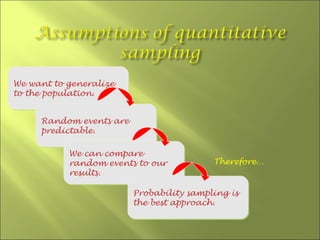
Quantitative assumptions in sampling
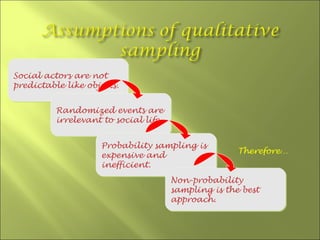
Qualitative assumptions in sampling
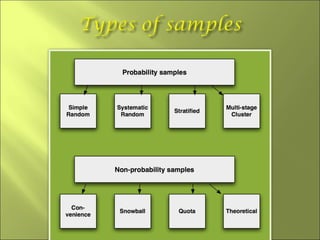
Types of sampling
Ethnographic sampling
Interview sampling
Content analysis sampling
How many? Determine sample size (n)
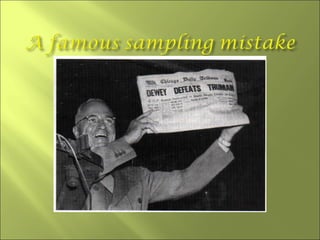
A famous sampling mistake
Control for bias and error
   The process of selecting a number
    of individuals for a study in such
    a way that the individuals
    represent the larger group from
    which they were selected
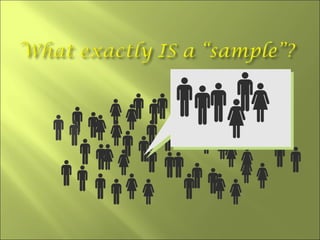
Sample…
…the representatives selected for a
 study whose characteristics
 exemplify the larger group from
 which they were selected
Population…
…the larger group from which
 individuals are selected to
 participate in a study
   To gather data about the
    population in order to make an
    inference that can be generalized
    to the population
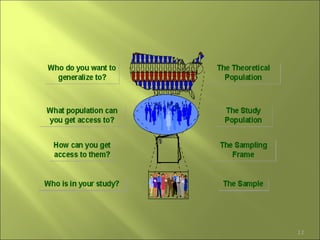
Identify the group of interest and
 its characteristics to which the
 findings of the study will be
 generalized
   …called the “target” population
      (the ideal selection)
…oftentimes the “accessible” or
  “available” population must be
  used (the realistic selection)
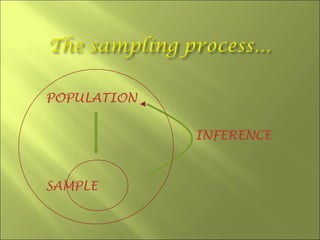
POPULATION


             INFERENCE


SAMPLE
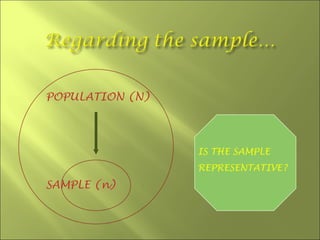
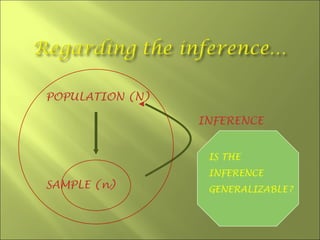
POPULATION (N)


                 IS THE SAMPLE
                 REPRESENTATIVE?
SAMPLE (n)
POPULATION (N)

                 INFERENCE


                  IS THE
                  INFERENCE
SAMPLE (n)        GENERALIZABLE?
11
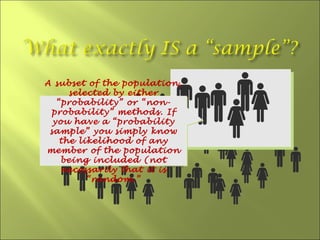
A subset of the population,
      selected by either
   “probability” or “non-
 probability” methods. If
  you have a “probability
 sample” you simply know
    the likelihood of any
member of the population
    being included (not
    necessarily that it is
          “random.”
I really spend
I want to   a lot of time                     I want to
know what   wondering                         make sure
                             I wonder how
causes      how to                            others can
                             small patterns
something   measure                           repeat my
                             generalize to
else.       things.                           findings.
                             big patterns.
We want to generalize
to the population.


     Random events are
     predictable.

           We can compare
           random events to our           Therefore…
           results.

                         Probability sampling is
                         the best approach.
I really want
                                                  my research
I want to see   I want to                         approach to
                describe the     I want to show
the world                                         be flexible
                context in a     how social
through the                                       and able to
                lot of detail.   change occurs.
eyes of my                                        change.
                                 I’m interested
respondents.
                                 in how things
                                 come to be.
Social actors are not
predictable like objects.


          Randomized events are
          irrelevant to social life.


                    Probability sampling is
                                                      Therefore…
                    expensive and
                    inefficient.
                                       Non-probability
                                       sampling is the best
                                       approach.
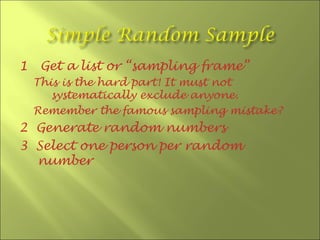
1    Get a list or “sampling frame”
    This is the hard part! It must not
       systematically exclude anyone.
    Remember the famous sampling mistake?
2 Generate random numbers
3 Select one person per random
  number
advantages…

 easy to conduct
 strategy requires minimum knowledge
 of the population to be sampled
disadvantages…

 need names of all population members
 may over- represent or under-
 estimate sample members
 there is difficulty in reaching all
 selected in the sample
1  Select a random number, which will
  be known as k
2 Get a list of people, or observe a flow
  of people (e.g., pedestrians on a
  corner)
3 Select every kthperson
    Careful that there is no systematic rhythm
        to the flow or list of people.
    If every 4th person on the list is, say, “rich” or
        “senior” or some other consistent pattern,
        avoid this method
advantages…

 sample selection is simple
disadvantages…

 all members of the population do not
 have an equal chance of being
 selected
 the Kth person may be related to a
 periodical order in the population list,
 producing unrepresentativeness in the
 sample
1  Separate your population into
  groups or “strata”
2 Do either a simple random sample
  or systematic random sample from
  there
    Note you must know easily what the “strata”
        are before attempting this
    If your sampling frame is sorted by, say,
        school district, then you’re able to use
        this method
advantages…
…more precise sample
…can be used for both proportions and
  stratification sampling
…sample represents the desired strata
disadvantages…
…need names of all population members
…there is difficulty in reaching all
  selected in the sample
…researcher must have names of all
  populations
1 Get a list of “clusters,” e.g., branches
  of a company
2 Randomly sample clusters from that
  list
3 Have a list of, say, 10 branches
4 Randomly sample people within those
  branches
  This method is complex and expensive!
advantages…
…efficient
…researcher doesn’t need names of all
  population members
…reduces travel to site
…useful for educational research
disadvantages…
…fewer sampling points make it less like
  that the sample is representative
Convenience sampling
Purposive sampling

Quota sampling
Convenience sampling
the process of including whoever
  happens to be available at the time
 …called “accidental” or “haphazard”
  sampling
 Find some people that are easy to find
disadvantages…
…difficulty in determining how
 much of the effect (dependent
 variable) results from the cause
 (independent variable)
Purposive sampling
the process whereby the researcher
  selects a sample based on experience
  or knowledge of the group to be
  sampled
 …called “judgment ” sampling
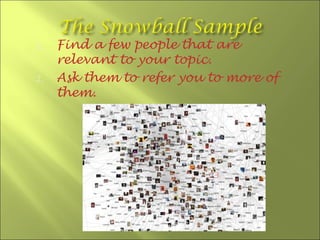
1.   Find a few people that are
     relevant to your topic.
2.   Ask them to refer you to more of
     them.
disadvantages…
…potential for inaccuracy in the
 researcher’s criteria and resulting
 sample selections
Quota sampling
the process whereby a researcher
  gathers data from individuals
  possessing identified characteristics
  and quotas
1   Determine what the population
    looks like in terms of specific
    qualities.
2   Create “quotas” based on those
    qualities.
3   Select people for each quota.
4   the process whereby a researcher
    gathers data from individuals
    possessing identified
    characteristics and quotas
disadvantages…

…people who are less accessible (more
 difficult to contact, more reluctant
 to participate) are under-
 represented
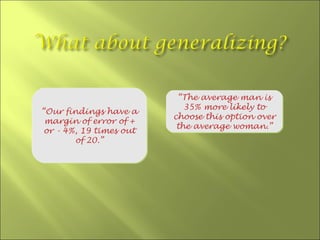
“The average man is
                            35% more likely to
“Our findings have a
                         choose this option over
 margin of error of +
                          the average woman.”
 or - 4%, 19 times out

        of 20.”
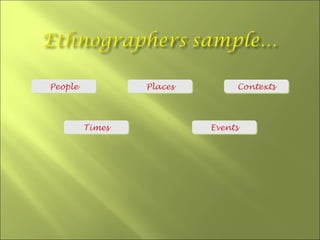
People           Places        Contexts


         Times            Events
People           Places


         Times
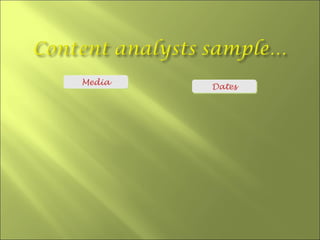
Media
        Dates
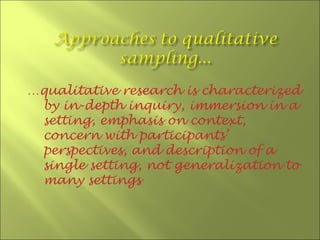
…qualitative research is characterized
 by in-depth inquiry, immersion in a
 setting, emphasis on context,
 concern with participants’
 perspectives, and description of a
 single setting, not generalization to
 many settings
…because samples need to be small
 and many potential participants
 are unwilling to undergo the
 demands of participation, most
 qualitative research samples are
 purposive
…representativeness is secondary to the
  quality of the participants’ ability to
  provide the desired information
  about self and setting
1. Intensity sampling: selecting
  participants who permit study of
  different levels of the research topic
2. Homogeneous sampling: selecting
  participants who are very similar in
  experience, perspective, or outlook
3. Criterion sampling: selecting all
  cases that meet some pre-defined
  characteristic
4. Snowball sampling: selecting a few
  individuals who can identify other
  individuals who can identify still
  other individuals who might be
  good participants for a study
5. Random purposive sampling: with a
  small sample, selecting by random
  means participants who were
  purposively selected and are too
  numerous to include all in the study
   Qualitative researchers seek
    “saturation”
     “How many” isn’t the issue. Do you
      understand the phenomenon? Have you
      learned enough?
     Mere numbers are irrelevant. You want
      “verstehn” or deep understanding
   Quantitative researchers seek statistical
    validity
       Can you safely generalize to the population?
        Have you systematically excluded anyone?
   The size of the sample influences
    both the representativeness of the
    sample and the statistical
    analysis of the data
    …larger samples are more likely
     to detect a difference between
     different groups
    …smaller samples are more likely
      not to be representative
1. The larger the population size, the
   smaller the percentage of the
   population required to get a
   representative sample
2. For smaller samples (N ‹ 100), there
   is little point in sampling. Survey
   the entire population.
3. If the population size is around 500
  (give or take 100), 50% should be
  sampled.
4. If the population size is around
  1500, 20% should be sampled.
5. Beyond a certain point (N =
  5000), the population size is almost
  irrelevant and a sample size of 400
  may be adequate.
1. Sampling error
2. Sampling bias

 …which threaten to render a study’s
  findings invalid
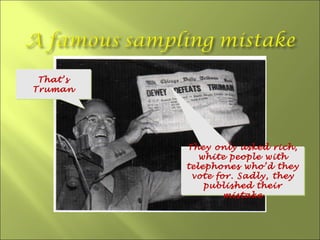
That’s
Truman


          They only asked rich,
            white people with
          telephones who’d they
           vote for. Sadly, they
              published their
                  mistake
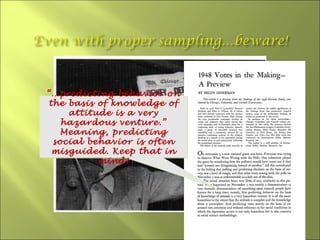
“…predicting behavior on
the basis of knowledge of
    attitude is a very
   hazardous venture.”
   Meaning, predicting
 social behavior is often
 misguided. Keep that in
          mind!
Sampling error…
…the chance and random variation in
 variables that occurs when any
 sample is selected from the population

…sampling error is to be expected
…to avoid sampling error, a census of
 the entire population must be taken
…to control for sampling error,
 researchers use various sampling
 methods
Sampling bias…

…nonrandom differences, generally the
 fault of the researcher, which cause
 the sample is over-represent
 individuals or groups within the
 population and which lead to
 invalid findings
…sources of sampling bias include the
 use of volunteers and available
 groups
   Be aware of the sources of sampling
    bias and identify how to avoid it
       Decide whether the bias is so severe
        that the results of the study will be
        seriously affected
       In the final report, document
        awareness of bias, rationale for
        proceeding, and potential effects
Questions???


               63

Sampling procedure30 jan2012

  • 1.
    Daxaben N Mehta Smt.S.C.U.ShahHome Science and C.U.Shah Arts & Commerce Mahila College Wadhwancity
  • 2.
    Define population (N)to be sampled Quantitative assumptions in sampling Qualitative assumptions in sampling Types of sampling Ethnographic sampling Interview sampling Content analysis sampling How many? Determine sample size (n) A famous sampling mistake Control for bias and error
  • 3.
    The process of selecting a number of individuals for a study in such a way that the individuals represent the larger group from which they were selected
  • 4.
    Sample… …the representatives selectedfor a study whose characteristics exemplify the larger group from which they were selected
  • 5.
    Population… …the larger groupfrom which individuals are selected to participate in a study
  • 6.
    To gather data about the population in order to make an inference that can be generalized to the population
  • 7.
    Identify the groupof interest and its characteristics to which the findings of the study will be generalized …called the “target” population (the ideal selection) …oftentimes the “accessible” or “available” population must be used (the realistic selection)
  • 8.
    POPULATION INFERENCE SAMPLE
  • 9.
    POPULATION (N) IS THE SAMPLE REPRESENTATIVE? SAMPLE (n)
  • 10.
    POPULATION (N) INFERENCE IS THE INFERENCE SAMPLE (n) GENERALIZABLE?
  • 11.
  • 13.
    A subset ofthe population, selected by either “probability” or “non- probability” methods. If you have a “probability sample” you simply know the likelihood of any member of the population being included (not necessarily that it is “random.”
  • 14.
    I really spend Iwant to a lot of time I want to know what wondering make sure I wonder how causes how to others can small patterns something measure repeat my generalize to else. things. findings. big patterns.
  • 15.
    We want togeneralize to the population. Random events are predictable. We can compare random events to our Therefore… results. Probability sampling is the best approach.
  • 16.
    I really want my research I want to see I want to approach to describe the I want to show the world be flexible context in a how social through the and able to lot of detail. change occurs. eyes of my change. I’m interested respondents. in how things come to be.
  • 17.
    Social actors arenot predictable like objects. Randomized events are irrelevant to social life. Probability sampling is Therefore… expensive and inefficient. Non-probability sampling is the best approach.
  • 19.
    1 Get a list or “sampling frame” This is the hard part! It must not systematically exclude anyone. Remember the famous sampling mistake? 2 Generate random numbers 3 Select one person per random number
  • 20.
    advantages… easy toconduct strategy requires minimum knowledge of the population to be sampled
  • 21.
    disadvantages… need namesof all population members may over- represent or under- estimate sample members there is difficulty in reaching all selected in the sample
  • 22.
    1 Selecta random number, which will be known as k 2 Get a list of people, or observe a flow of people (e.g., pedestrians on a corner) 3 Select every kthperson Careful that there is no systematic rhythm to the flow or list of people. If every 4th person on the list is, say, “rich” or “senior” or some other consistent pattern, avoid this method
  • 23.
  • 24.
    disadvantages… all membersof the population do not have an equal chance of being selected the Kth person may be related to a periodical order in the population list, producing unrepresentativeness in the sample
  • 25.
    1 Separateyour population into groups or “strata” 2 Do either a simple random sample or systematic random sample from there Note you must know easily what the “strata” are before attempting this If your sampling frame is sorted by, say, school district, then you’re able to use this method
  • 26.
    advantages… …more precise sample …canbe used for both proportions and stratification sampling …sample represents the desired strata
  • 27.
    disadvantages… …need names ofall population members …there is difficulty in reaching all selected in the sample …researcher must have names of all populations
  • 28.
    1 Get alist of “clusters,” e.g., branches of a company 2 Randomly sample clusters from that list 3 Have a list of, say, 10 branches 4 Randomly sample people within those branches This method is complex and expensive!
  • 29.
    advantages… …efficient …researcher doesn’t neednames of all population members …reduces travel to site …useful for educational research
  • 30.
    disadvantages… …fewer sampling pointsmake it less like that the sample is representative
  • 31.
  • 32.
    Convenience sampling the processof including whoever happens to be available at the time …called “accidental” or “haphazard” sampling Find some people that are easy to find
  • 33.
    disadvantages… …difficulty in determininghow much of the effect (dependent variable) results from the cause (independent variable)
  • 34.
    Purposive sampling the processwhereby the researcher selects a sample based on experience or knowledge of the group to be sampled …called “judgment ” sampling
  • 35.
    1. Find a few people that are relevant to your topic. 2. Ask them to refer you to more of them.
  • 36.
    disadvantages… …potential for inaccuracyin the researcher’s criteria and resulting sample selections
  • 37.
    Quota sampling the processwhereby a researcher gathers data from individuals possessing identified characteristics and quotas
  • 38.
    1 Determine what the population looks like in terms of specific qualities. 2 Create “quotas” based on those qualities. 3 Select people for each quota. 4 the process whereby a researcher gathers data from individuals possessing identified characteristics and quotas
  • 39.
    disadvantages… …people who areless accessible (more difficult to contact, more reluctant to participate) are under- represented
  • 41.
    “The average manis 35% more likely to “Our findings have a choose this option over margin of error of + the average woman.” or - 4%, 19 times out of 20.”
  • 42.
    People Places Contexts Times Events

  • 43.
    People Places Times
  • 44.
    Media Dates
  • 45.
    …qualitative research ischaracterized by in-depth inquiry, immersion in a setting, emphasis on context, concern with participants’ perspectives, and description of a single setting, not generalization to many settings
  • 46.
    …because samples needto be small and many potential participants are unwilling to undergo the demands of participation, most qualitative research samples are purposive
  • 47.
    …representativeness is secondaryto the quality of the participants’ ability to provide the desired information about self and setting
  • 48.
    1. Intensity sampling:selecting participants who permit study of different levels of the research topic 2. Homogeneous sampling: selecting participants who are very similar in experience, perspective, or outlook
  • 49.
    3. Criterion sampling:selecting all cases that meet some pre-defined characteristic 4. Snowball sampling: selecting a few individuals who can identify other individuals who can identify still other individuals who might be good participants for a study
  • 50.
    5. Random purposivesampling: with a small sample, selecting by random means participants who were purposively selected and are too numerous to include all in the study
  • 51.
    Qualitative researchers seek “saturation”  “How many” isn’t the issue. Do you understand the phenomenon? Have you learned enough?  Mere numbers are irrelevant. You want “verstehn” or deep understanding  Quantitative researchers seek statistical validity  Can you safely generalize to the population? Have you systematically excluded anyone?
  • 52.
    The size of the sample influences both the representativeness of the sample and the statistical analysis of the data …larger samples are more likely to detect a difference between different groups …smaller samples are more likely not to be representative
  • 53.
    1. The largerthe population size, the smaller the percentage of the population required to get a representative sample 2. For smaller samples (N ‹ 100), there is little point in sampling. Survey the entire population.
  • 54.
    3. If thepopulation size is around 500 (give or take 100), 50% should be sampled. 4. If the population size is around 1500, 20% should be sampled. 5. Beyond a certain point (N = 5000), the population size is almost irrelevant and a sample size of 400 may be adequate.
  • 55.
    1. Sampling error 2.Sampling bias …which threaten to render a study’s findings invalid
  • 57.
    That’s Truman They only asked rich, white people with telephones who’d they vote for. Sadly, they published their mistake
  • 58.
    “…predicting behavior on thebasis of knowledge of attitude is a very hazardous venture.” Meaning, predicting social behavior is often misguided. Keep that in mind!
  • 59.
    Sampling error… …the chanceand random variation in variables that occurs when any sample is selected from the population …sampling error is to be expected
  • 60.
    …to avoid samplingerror, a census of the entire population must be taken …to control for sampling error, researchers use various sampling methods
  • 61.
    Sampling bias… …nonrandom differences,generally the fault of the researcher, which cause the sample is over-represent individuals or groups within the population and which lead to invalid findings …sources of sampling bias include the use of volunteers and available groups
  • 62.
    Be aware of the sources of sampling bias and identify how to avoid it  Decide whether the bias is so severe that the results of the study will be seriously affected  In the final report, document awareness of bias, rationale for proceeding, and potential effects
  • 63.