Objectives
You willbe able to
Understand the concept of sample and sampling
methodology.
Understand the characteristics of population.
Differentiate b/w parameter and statistic.
Choose sample by appropriate method.
Know about types of sampling.
Study Unit
The unitof selection in study population can be a
Person
Household
Family
School
Patient with a particular disease
Patient undergoing a particular
surgical procedure
Patient receiving a particular
medicine.
5.
Sampling
• The procedureof selecting certain number of
study units from a defined population is called
Sampling.
• A representative sample has all important
characteristics of the population from which it
is drawn.
6.
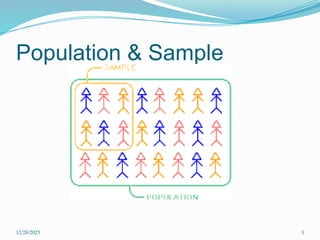
Population & Sample
Parameter: A calculated value from Population
Statistic: A calculated value from sample
12/20/2025 6
7.
Purpose of Sampling
•statistical inference is to obtain information about a
population from information contained in a sample.
•The sample results provide only estimates of the
values of the population characteristics.
•With proper sampling methods, the sample results
will provide “good” estimates of the population
characteristics.
8.
Advantages of Sampling
oSampling Saves Money And Time
o useful when sampling unit are sensitive
o for Infinite Population
o Smaller Non-Response
9.
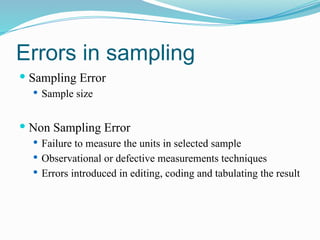
Errors in sampling
Sampling Error
Sample size
Non Sampling Error
Failure to measure the units in selected sample
Observational or defective measurements techniques
Errors introduced in editing, coding and tabulating the result
10.
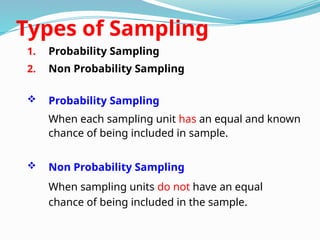
Types of Sampling
1.Probability Sampling
2. Non Probability Sampling
Probability Sampling
When each sampling unit has an equal and known
chance of being included in sample.
Non Probability Sampling
When sampling units do not have an equal
chance of being included in the sample.
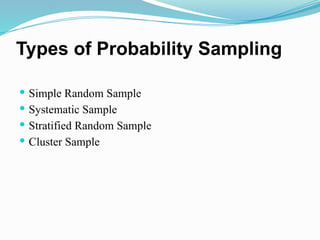
Types of ProbabilitySampling
Simple Random Sample
Systematic Sample
Stratified Random Sample
Cluster Sample
14.
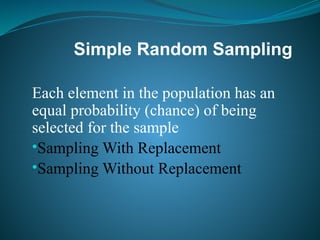
Simple Random Sampling
Eachelement in the population has an
equal probability (chance) of being
selected for the sample
•Sampling With Replacement
•Sampling Without Replacement
15.
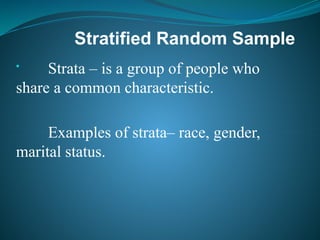
Stratified Random Sample
•Strata – is a group of people who
share a common characteristic.
Examples of strata– race, gender,
marital status.
16.
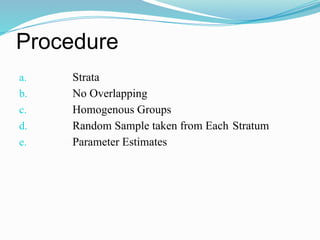
Procedure
a. Strata
b. NoOverlapping
c. Homogenous Groups
d. Random Sample taken from Each Stratum
e. Parameter Estimates
17.
Cluster Sampling
• Thepopulation is first divided into separate groups
of elements called clusters.
• Ideally, each cluster is a representative small-scale
version of the population (i.e. heterogeneous group).
• A simple random sample of the clusters is then
taken.
• All elements within each sampled (chosen) cluster
form the sample.
Systematic Random Sampling
In systematic random sampling, the sampling
units are selected at regular intervals (e.g. every
5th, 15th, 34th
) from the sampling frame.
Ideally, we randomly select a number to tell us
where to start selecting individuals from the list.
20.
Multi-stage Sampling
In verylarge and diverse populations, sampling may
be done in two or more stages. This is often the case
in the community based studies, where the people
are to be contacted in different villages and villages
are to be chosen from different areas.
The sampling procedure is carried out in
phases.
21.
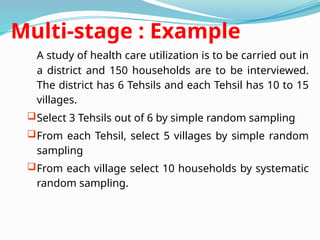
Multi-stage : Example
Astudy of health care utilization is to be carried out in
a district and 150 households are to be interviewed.
The district has 6 Tehsils and each Tehsil has 10 to 15
villages.
Select 3 Tehsils out of 6 by simple random sampling
From each Tehsil, select 5 villages by simple random
sampling
From each village select 10 households by systematic
random sampling.
Convenience Sampling
In thismethod, the study units that happen to be
available at the time of data collection, are
selected in the sample.
25.
Quota Sampling
This methodensure that a certain number of study
units from different categories with specific
characteristics appear in the sample so that all
these characteristics are represented.
26.
Snow – ballSampling
When individuals with certain characteristics are
asked to identify similar individuals for
inclusion in the study.




![ONFH[AVN HIP] -TRIPLE REGIME -A NOVAL SURGICAL CONCEPT .pptx](https://cdn.slidesharecdn.com/ss_thumbnails/onfhavnhip2026koaconcalicutdrgokuldevdrmashraf-260210064517-213ec005-thumbnail.jpg?width=640&height=640&fit=bounds)


![CTEV [ clubfoot] DR ARUN LAL ,DR MOHAMED ASHRAF travancore medical college k...](https://cdn.slidesharecdn.com/ss_thumbnails/ctevclubfootdrarunlaldrmohamedashraftravancoremedicalcollegekollamkeralaindia-260208063247-18fc466c-thumbnail.jpg?width=640&height=640&fit=bounds)


![PERI-PROSTHETIC FRACTURE NAIL-PLATE CONSTRUCT [NPC].pptx](https://cdn.slidesharecdn.com/ss_thumbnails/drarunkumardrmohamedashrafperiprostheticfrasturenail-plateconstructnpc-260209164459-7e9d15a1-thumbnail.jpg?width=640&height=640&fit=bounds)


