
SAMPLING & CENCUS
Probability & Nonprobability
Sampling
Presented by:
Anu Thapa(700408)
Navin Mandal(700415)
Rupesh Chaudhary(700420)
SAMPLING
INTRODUCTION
The few selected unit is called sample and
the method of selecting the sample is
called sampling.
process of selecting sample from the
universe or target population by the
researchers
.
TARGET POPULATION OR UNIVERSE
The population to which the investigator
wants to generalized his results
SAMPLING UNIT
Smallest unit from which sample can be
selected
Demerits of sampling
technique
Less accuracy
Misleading conclusion
Needs for specialized knowledge
When sampling is not possible
In case of :-
oWhen 100% accuracy is required
oThe population is heterogeneous
o When population is very small
Why Sample?
Get information about large populations
Lower cost
More accuracy of results
High speed of data collection
Availability of population elements.
Less field time
When it’s impossible to study the
whole population
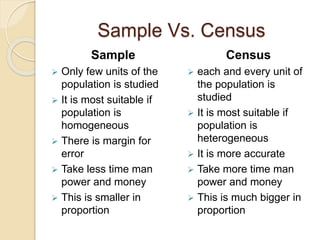
Sample Vs. Census
Sample
 Only few units of the
population is studied
 It is most suitable if
population is
homogeneous
 There is margin for
error
 Take less time man
power and money
 This is smaller in
proportion
Census
 each and every unit of
the population is
studied
 It is most suitable if
population is
heterogeneous
 It is more accurate
 Take more time man
power and money
 This is much bigger in
proportion
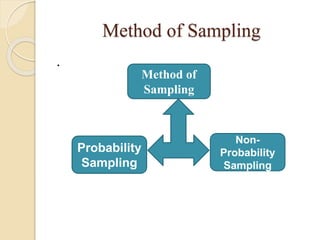
Method of Sampling
.
Method of
Sampling
Probability
Sampling
Non-
Probability
Sampling
Probability Sampling
 Scientific method of selecting sample
 Each unit of population has equal chance of
selection
Non-Probability Sampling
 Does not involve random selection and methods
 are not based on the rationale of probability
theory.
Types of probability sampling
1. Simple Random Sampling (SRS)
 Simplest method of sampling
 A random no. table or lottery method is used
to determine which units are to be selected.
 Types
oSimple random sampling without replacement
(Srswor)
oSimple random sampling with replacement (Srswr)
Example :
Suppose a population consists of 18 units
and a sample size of 5 is to be selected.
From the random table or lottery method,
selected random no. are 65,43,63,54,46
65/18,43/18,62/18,54/18,46/18
11,7,8,0,10:- selected as sample
2.Systematic Sampling
Obtain the information from cards or
register which are in serial order.
Example: Suppose a population consists
of 440 units and a sample size of 40 is to
be selected.
K=
𝑁
n
=
440
40
=11
J=6 (Random no. taken between 1 to 11)
Now,
J,J+K,J+2K,J+3K…………………J+39K
6,17,28,39,………………………..,435
Every 11th person is selected from a list of all
population.
3.Stratified Sampling
 The population is divided into two or more
groups called strata,
 according to some criterion, such as
geographical location, grade level, age,
gender or income.
 and subsamples are randomly selected from
each strata.
 Each stratum is more homogeneous then the
total population
 Stratified sampling results in more reliable
and details information
Types of Non –Probability
Sampling
1. Judgmental Sampling
 Based on experience & qualification of
researchers.
 This sampling also known as purposive
sampling.
 If the researcher is experience an experts it is
possible that judgment sampling may useful
results.
2. Accidental Sampling
 Pedestrian are used as sample in accidental
 This is very economical
.
3.Quota Sampling
 Quota is directly proportional to the size of
stratum.
4.Sequencing Sampling
 Sequencing sampling also known as acceptance
of sampling
 Sample is accepted when it confirms
specifications
5. Convenience sampling
 Telephone Sampling
 197
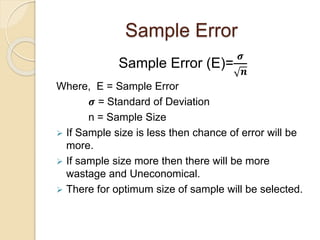
Sample Error
Sample Error (E)=
𝝈
𝒏
Where, E = Sample Error
𝝈 = Standard of Deviation
n = Sample Size
 If Sample size is less then chance of error will be
more.
 If sample size more then there will be more
wastage and Uneconomical.
 There for optimum size of sample will be selected.
THANK YOU
.

Sampling, Census

  • 1.
    SAMPLING & CENCUS Probability& Nonprobability Sampling Presented by: Anu Thapa(700408) Navin Mandal(700415) Rupesh Chaudhary(700420)
  • 2.
    SAMPLING INTRODUCTION The few selectedunit is called sample and the method of selecting the sample is called sampling. process of selecting sample from the universe or target population by the researchers
  • 3.
    . TARGET POPULATION ORUNIVERSE The population to which the investigator wants to generalized his results SAMPLING UNIT Smallest unit from which sample can be selected
  • 4.
    Demerits of sampling technique Lessaccuracy Misleading conclusion Needs for specialized knowledge When sampling is not possible In case of :- oWhen 100% accuracy is required oThe population is heterogeneous o When population is very small
  • 5.
    Why Sample? Get informationabout large populations Lower cost More accuracy of results High speed of data collection Availability of population elements. Less field time When it’s impossible to study the whole population
  • 6.
    Sample Vs. Census Sample Only few units of the population is studied  It is most suitable if population is homogeneous  There is margin for error  Take less time man power and money  This is smaller in proportion Census  each and every unit of the population is studied  It is most suitable if population is heterogeneous  It is more accurate  Take more time man power and money  This is much bigger in proportion
  • 7.
    Method of Sampling . Methodof Sampling Probability Sampling Non- Probability Sampling
  • 8.
    Probability Sampling  Scientificmethod of selecting sample  Each unit of population has equal chance of selection Non-Probability Sampling  Does not involve random selection and methods  are not based on the rationale of probability theory.
  • 9.
    Types of probabilitysampling 1. Simple Random Sampling (SRS)  Simplest method of sampling  A random no. table or lottery method is used to determine which units are to be selected.  Types oSimple random sampling without replacement (Srswor) oSimple random sampling with replacement (Srswr)
  • 10.
    Example : Suppose apopulation consists of 18 units and a sample size of 5 is to be selected. From the random table or lottery method, selected random no. are 65,43,63,54,46 65/18,43/18,62/18,54/18,46/18 11,7,8,0,10:- selected as sample
  • 11.
    2.Systematic Sampling Obtain theinformation from cards or register which are in serial order. Example: Suppose a population consists of 440 units and a sample size of 40 is to be selected. K= 𝑁 n = 440 40 =11 J=6 (Random no. taken between 1 to 11) Now, J,J+K,J+2K,J+3K…………………J+39K 6,17,28,39,………………………..,435 Every 11th person is selected from a list of all population.
  • 12.
    3.Stratified Sampling  Thepopulation is divided into two or more groups called strata,  according to some criterion, such as geographical location, grade level, age, gender or income.  and subsamples are randomly selected from each strata.  Each stratum is more homogeneous then the total population  Stratified sampling results in more reliable and details information
  • 13.
    Types of Non–Probability Sampling 1. Judgmental Sampling  Based on experience & qualification of researchers.  This sampling also known as purposive sampling.  If the researcher is experience an experts it is possible that judgment sampling may useful results. 2. Accidental Sampling  Pedestrian are used as sample in accidental  This is very economical
  • 14.
    . 3.Quota Sampling  Quotais directly proportional to the size of stratum. 4.Sequencing Sampling  Sequencing sampling also known as acceptance of sampling  Sample is accepted when it confirms specifications 5. Convenience sampling  Telephone Sampling  197
  • 15.
    Sample Error Sample Error(E)= 𝝈 𝒏 Where, E = Sample Error 𝝈 = Standard of Deviation n = Sample Size  If Sample size is less then chance of error will be more.  If sample size more then there will be more wastage and Uneconomical.  There for optimum size of sample will be selected.
  • 16.