ORAL
COMMUNICATION
Meaning
Oral communication is the process of
expressing information or ideas by word of
mouth.
Oral communication is the process of
verbally transmitting information and ideas
from one individual or group to another.
Oral communication can be either
Formal or Informal. Examples of
informal oral communication
include:
Face-to-face conversations
Telephone conversations
Discussions that take place at
business meetings
More formal types of oral
communication include:
Presentations at business
meetings
Classroom lectures
Commencement speech given
at a graduation ceremony
Advantages
There are many situations in which it
makes sense to choose oral over written
communication. Oral communication is
more personal and less formal than
written communication. If time is limited
and a business matter requires quick
resolution, it may be best to have a face-
to-face or telephone conversation. There
is also more flexibility in oral
communication; you can discuss different
aspects of an issue and make decisions
more quickly than you can in writing.
Oral communication can be
especially effective in
addressing conflicts or
problems. Talking things over is
often the best way to settle
disagreements or
misunderstandings. Finally,
oral communication is a great
way to promote employee
morale and maintain energy
and enthusiasm within a team.
Disadvantages
Despite the many benefits of oral communication, there
are times when written communication is more effective.
For example, you may want to exchange important
information that needs to be documented using written
communication. A lot of transactions in the business world
require some type of written record, and you will find that
even strong verbal skills are not a substitute for putting
things in writing. Additionally, oral communication tends
to be less detailed and more subject to misunderstanding
than written communication. It's best to always think
carefully about which method of communication best fits
your objective
Six Types of
Oral Communication Activities
There are six broad types of oral communication
activities that might be incorporated into curricula
in many fields of study. Most are conducive to
either formal or informal assignments. Some are
realistically possible only in smaller classes or
recitation sections, while others are appropriate
for large lectures as well.
1. One-on-One Speaking (Student-Student or
Student-Teacher)
Can range from moments punctuating a
lecture, where students are asked to discuss or
explain some question or problem with the person
next to them, to formal student conferences with
their instructor.
2. Small-Group or Team-Based Oral Work:
Smaller-scale settings for discussion,
deliberation, and problem solving. Appropriate for
both large lectures and smaller classes and allows
levels of participation not possible in larger groups
3. Full-Class Discussions (Teacher- or Student-Led):
Typically less agonistic, argument-based, and competitive
than debate and deliberation but still dialogic in character.
Often times has the quality of creating an atmosphere of
collective, out-loud thinking about some question, idea,
problem, text, event, or artifact. Like deliberation and debate, a
good way to encourage active learning.
4. In-Class Debates and Deliberations:
A structured consideration of some issue from two or
more points of view. Debates typically involve participants who
argue one side throughout, while deliberation allows for
movement by individuals within the process. Both feature
reason-giving argument. Can be applied to issues of many kinds,
from disputed scientific facts to theories, policy questions, the
meaning of a text, or the quality of an artistic production. Can
range from two participants to a lecture hall.
5. Speeches and Presentations:
Classically, the stand-up, podium speech delivered by an
individual from an outline or script. Also includes group
presentations or impromptu speaking. A strong element of
monologue, but dialogue can be built in with question and
answer or discussion with the audience afterward.
6. Oral Examinations:
Can take place in the instructor’s office, in small groups,
or before a whole class. Range from one oral question on
an otherwise written exam to an oral defense of a written
answer or paper to an entirely oral quiz or examination.
Difficult with very large groups, but an excellent way to
determine the depth and range of student knowledge and
to stimulate high levels of preparation.
Communication Styles
direct/indirect communication
style
elaborate/succinct communication
style
personal, or
person-centered/contextual
communication style
instrumental/affective
communication style
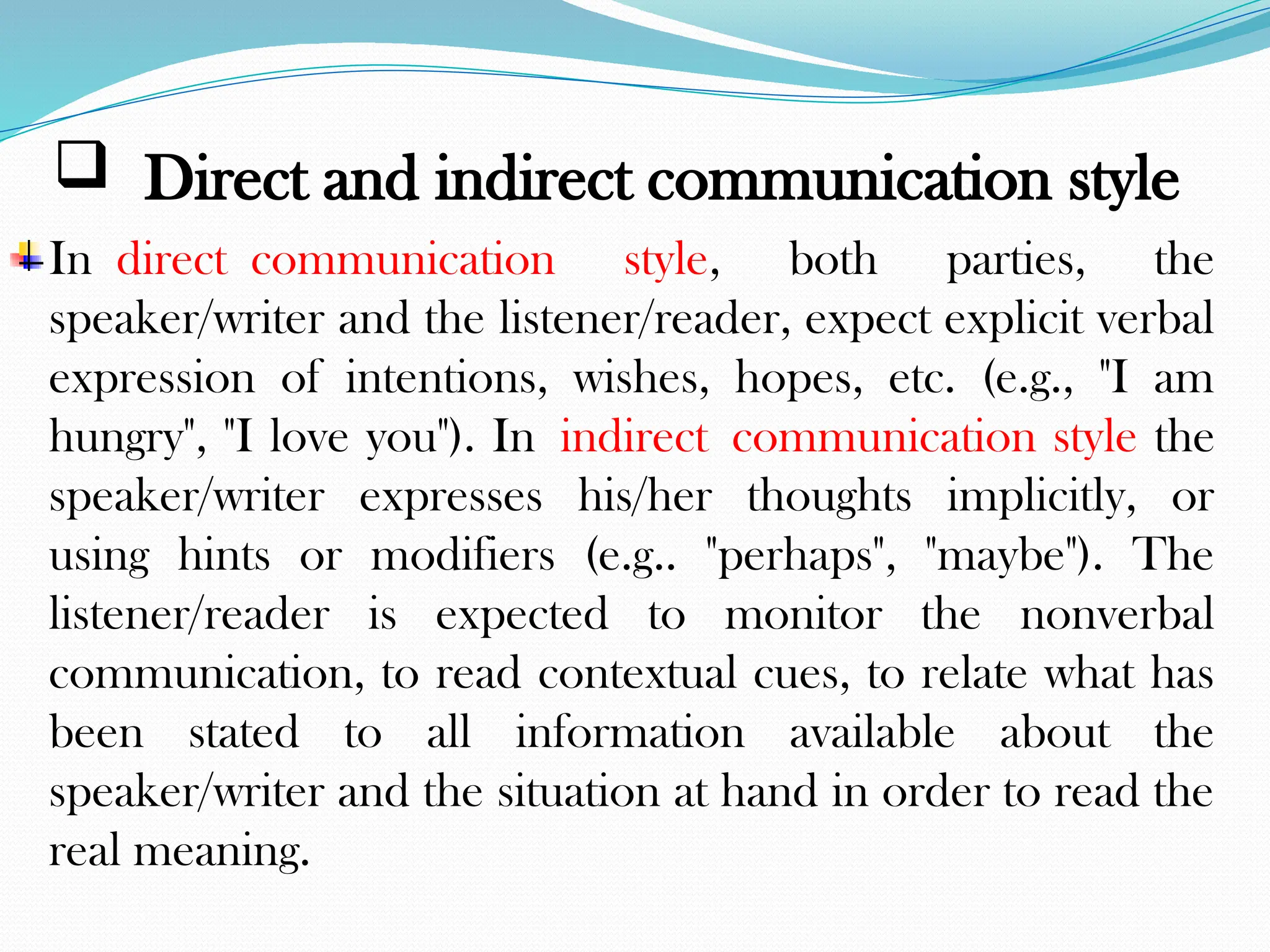
 Direct and indirect communication style
In direct communication style, both parties, the
speaker/writer and the listener/reader, expect explicit verbal
expression of intentions, wishes, hopes, etc. (e.g., "I am
hungry", "I love you"). In indirect communication style the
speaker/writer expresses his/her thoughts implicitly, or
using hints or modifiers (e.g.. "perhaps", "maybe"). The
listener/reader is expected to monitor the nonverbal
communication, to read contextual cues, to relate what has
been stated to all information available about the
speaker/writer and the situation at hand in order to read the
real meaning.
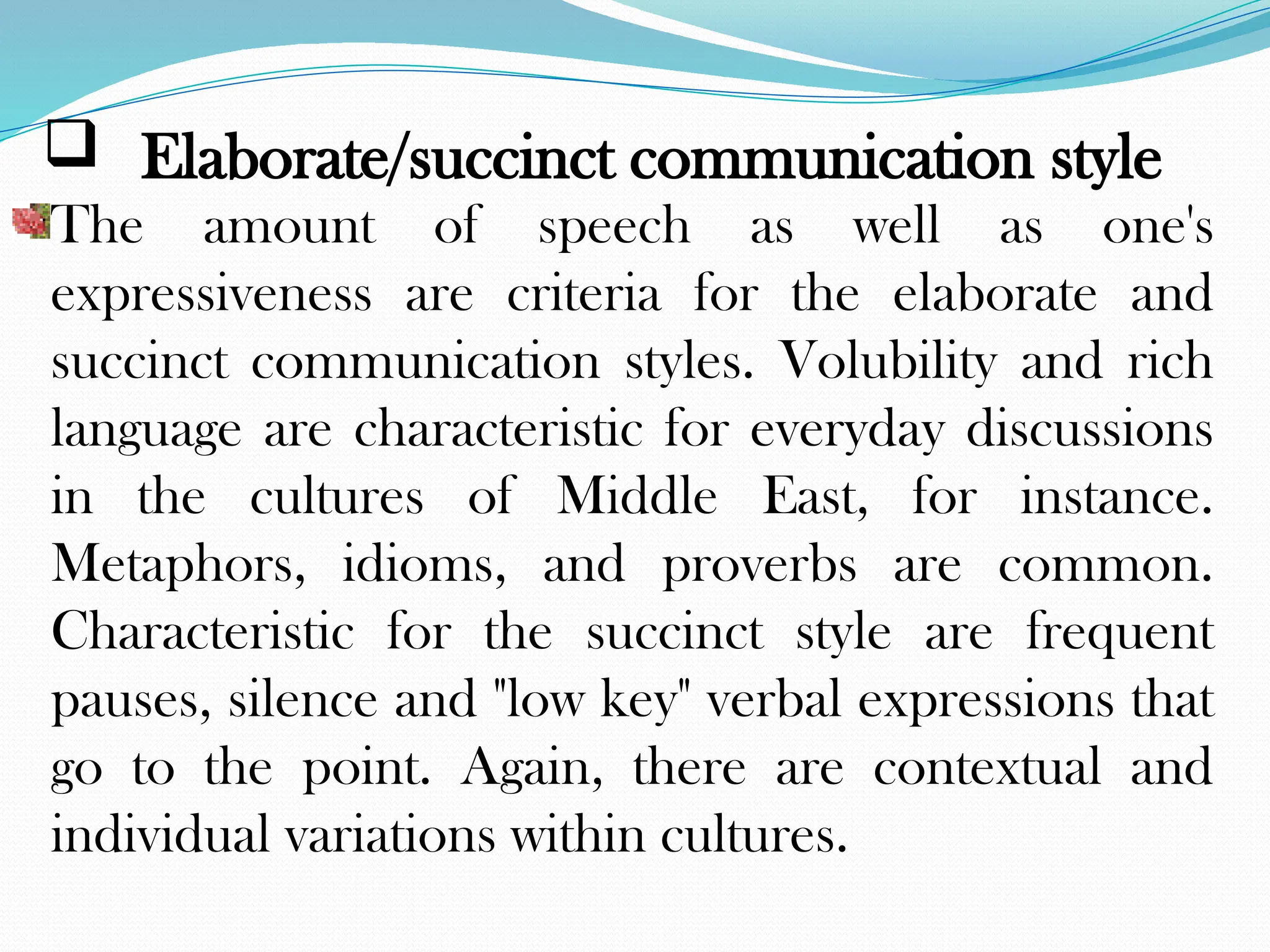
 Elaborate/succinct communication style
The amount of speech as well as one's
expressiveness are criteria for the elaborate and
succinct communication styles. Volubility and rich

language are characteristic for everyday discussions
in the cultures of Middle East, for instance.
Metaphors, idioms, and proverbs are common.
Characteristic for the succinct style are frequent
pauses, silence and "low key" verbal expressions that
go to the point. Again, there are contextual and
individual variations within cultures.
 Personal, or person-centered /contextual
style
Like directness and indirectness, personal and contextual
communication styles also are related in cross-cultural studies to
individualism and collectivism. Gudykunst and Ting-Toomey
(1988) suggest these styles also express cultural differences in
power distance (hierarchy). Person-centered communication style
is informal and emphasizes the individual and equalitarian
relationships. The person-centeredness is reflected, for instance,
by the use of the pronoun “I”. The contextual style is status and
role oriented. Formality and asymmetrical power distance is
often emphasized. Personal pronouns are not often used. All
information does not need to be explicitly expressed. Yet
common background knowledge is assumed, or in essential parts
conveyed during the interaction, often indirectly.
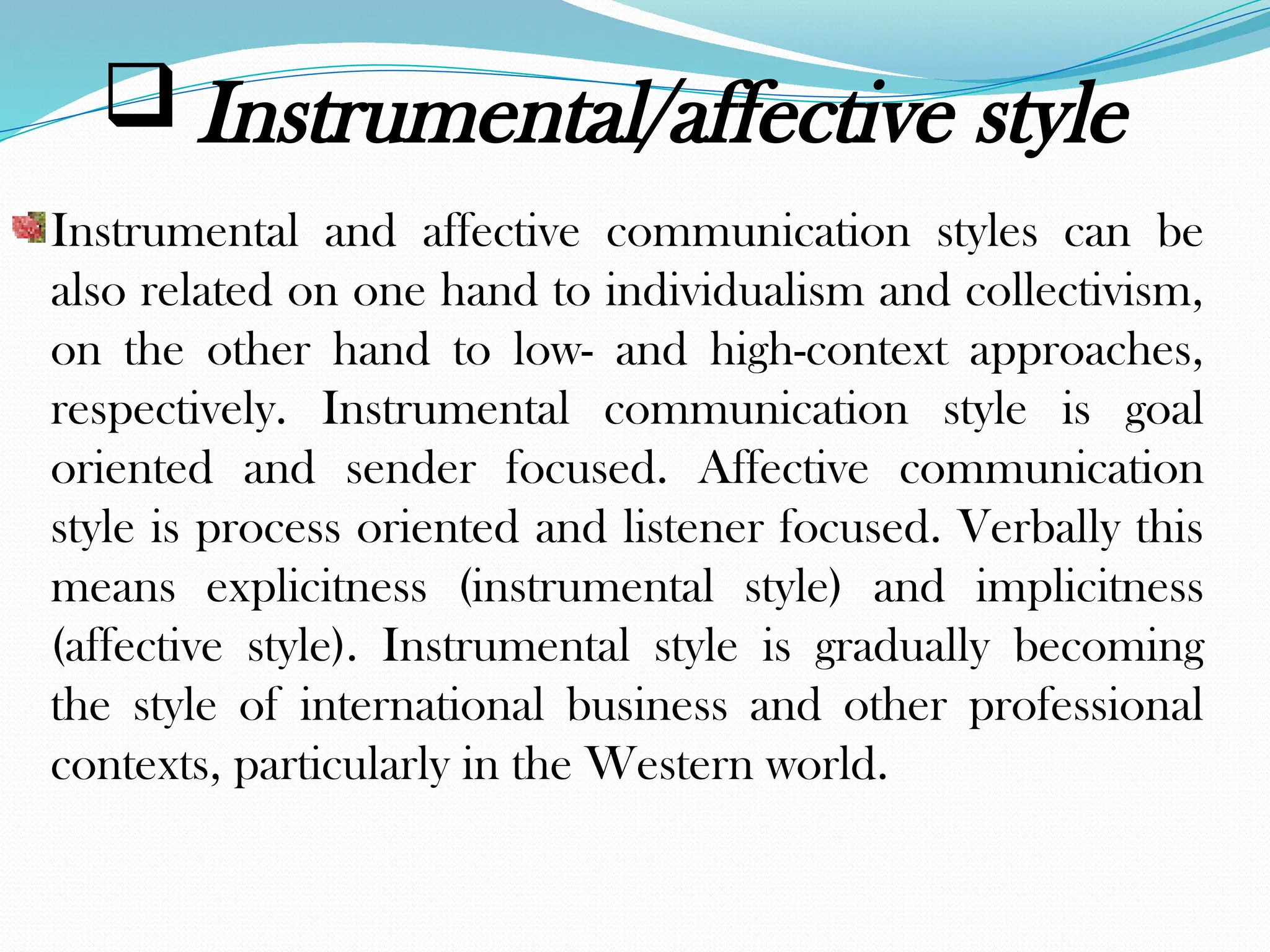
 Instrumental/affective style
Instrumental and affective communication styles can be
also related on one hand to individualism and collectivism,
on the other hand to low- and high-context approaches,
respectively. Instrumental communication style is goal
oriented and sender focused. Affective communication
style is process oriented and listener focused. Verbally this
means explicitness (instrumental style) and implicitness
(affective style). Instrumental style is gradually becoming
the style of international business and other professional
contexts, particularly in the Western world.
THANKYOU

samples of oral communication activities

  • 1.
  • 2.
    Meaning Oral communication isthe process of expressing information or ideas by word of mouth. Oral communication is the process of verbally transmitting information and ideas from one individual or group to another.
  • 3.
    Oral communication canbe either Formal or Informal. Examples of informal oral communication include: Face-to-face conversations Telephone conversations Discussions that take place at business meetings
  • 4.
    More formal typesof oral communication include: Presentations at business meetings Classroom lectures Commencement speech given at a graduation ceremony
  • 5.
    Advantages There are manysituations in which it makes sense to choose oral over written communication. Oral communication is more personal and less formal than written communication. If time is limited and a business matter requires quick resolution, it may be best to have a face- to-face or telephone conversation. There is also more flexibility in oral communication; you can discuss different aspects of an issue and make decisions more quickly than you can in writing.
  • 6.
    Oral communication canbe especially effective in addressing conflicts or problems. Talking things over is often the best way to settle disagreements or misunderstandings. Finally, oral communication is a great way to promote employee morale and maintain energy and enthusiasm within a team.
  • 7.
    Disadvantages Despite the manybenefits of oral communication, there are times when written communication is more effective. For example, you may want to exchange important information that needs to be documented using written communication. A lot of transactions in the business world require some type of written record, and you will find that even strong verbal skills are not a substitute for putting things in writing. Additionally, oral communication tends to be less detailed and more subject to misunderstanding than written communication. It's best to always think carefully about which method of communication best fits your objective
  • 8.
    Six Types of OralCommunication Activities There are six broad types of oral communication activities that might be incorporated into curricula in many fields of study. Most are conducive to either formal or informal assignments. Some are realistically possible only in smaller classes or recitation sections, while others are appropriate for large lectures as well.
  • 9.
    1. One-on-One Speaking(Student-Student or Student-Teacher) Can range from moments punctuating a lecture, where students are asked to discuss or explain some question or problem with the person next to them, to formal student conferences with their instructor. 2. Small-Group or Team-Based Oral Work: Smaller-scale settings for discussion, deliberation, and problem solving. Appropriate for both large lectures and smaller classes and allows levels of participation not possible in larger groups
  • 10.
    3. Full-Class Discussions(Teacher- or Student-Led): Typically less agonistic, argument-based, and competitive than debate and deliberation but still dialogic in character. Often times has the quality of creating an atmosphere of collective, out-loud thinking about some question, idea, problem, text, event, or artifact. Like deliberation and debate, a good way to encourage active learning. 4. In-Class Debates and Deliberations: A structured consideration of some issue from two or more points of view. Debates typically involve participants who argue one side throughout, while deliberation allows for movement by individuals within the process. Both feature reason-giving argument. Can be applied to issues of many kinds, from disputed scientific facts to theories, policy questions, the meaning of a text, or the quality of an artistic production. Can range from two participants to a lecture hall.
  • 11.
    5. Speeches andPresentations: Classically, the stand-up, podium speech delivered by an individual from an outline or script. Also includes group presentations or impromptu speaking. A strong element of monologue, but dialogue can be built in with question and answer or discussion with the audience afterward. 6. Oral Examinations: Can take place in the instructor’s office, in small groups, or before a whole class. Range from one oral question on an otherwise written exam to an oral defense of a written answer or paper to an entirely oral quiz or examination. Difficult with very large groups, but an excellent way to determine the depth and range of student knowledge and to stimulate high levels of preparation.
  • 12.
    Communication Styles direct/indirect communication style elaborate/succinctcommunication style personal, or person-centered/contextual communication style instrumental/affective communication style
  • 13.
     Direct andindirect communication style In direct communication style, both parties, the speaker/writer and the listener/reader, expect explicit verbal expression of intentions, wishes, hopes, etc. (e.g., "I am hungry", "I love you"). In indirect communication style the speaker/writer expresses his/her thoughts implicitly, or using hints or modifiers (e.g.. "perhaps", "maybe"). The listener/reader is expected to monitor the nonverbal communication, to read contextual cues, to relate what has been stated to all information available about the speaker/writer and the situation at hand in order to read the real meaning.
  • 14.
     Elaborate/succinct communicationstyle The amount of speech as well as one's expressiveness are criteria for the elaborate and succinct communication styles. Volubility and rich language are characteristic for everyday discussions in the cultures of Middle East, for instance. Metaphors, idioms, and proverbs are common. Characteristic for the succinct style are frequent pauses, silence and "low key" verbal expressions that go to the point. Again, there are contextual and individual variations within cultures.
  • 15.
     Personal, orperson-centered /contextual style Like directness and indirectness, personal and contextual communication styles also are related in cross-cultural studies to individualism and collectivism. Gudykunst and Ting-Toomey (1988) suggest these styles also express cultural differences in power distance (hierarchy). Person-centered communication style is informal and emphasizes the individual and equalitarian relationships. The person-centeredness is reflected, for instance, by the use of the pronoun “I”. The contextual style is status and role oriented. Formality and asymmetrical power distance is often emphasized. Personal pronouns are not often used. All information does not need to be explicitly expressed. Yet common background knowledge is assumed, or in essential parts conveyed during the interaction, often indirectly.
  • 16.
     Instrumental/affective style Instrumentaland affective communication styles can be also related on one hand to individualism and collectivism, on the other hand to low- and high-context approaches, respectively. Instrumental communication style is goal oriented and sender focused. Affective communication style is process oriented and listener focused. Verbally this means explicitness (instrumental style) and implicitness (affective style). Instrumental style is gradually becoming the style of international business and other professional contexts, particularly in the Western world.
  • 17.