GRADES 1 to 12
DAILY LESSON LOG
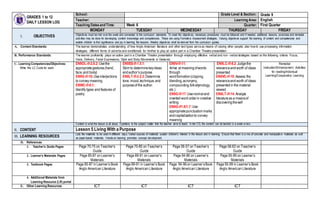
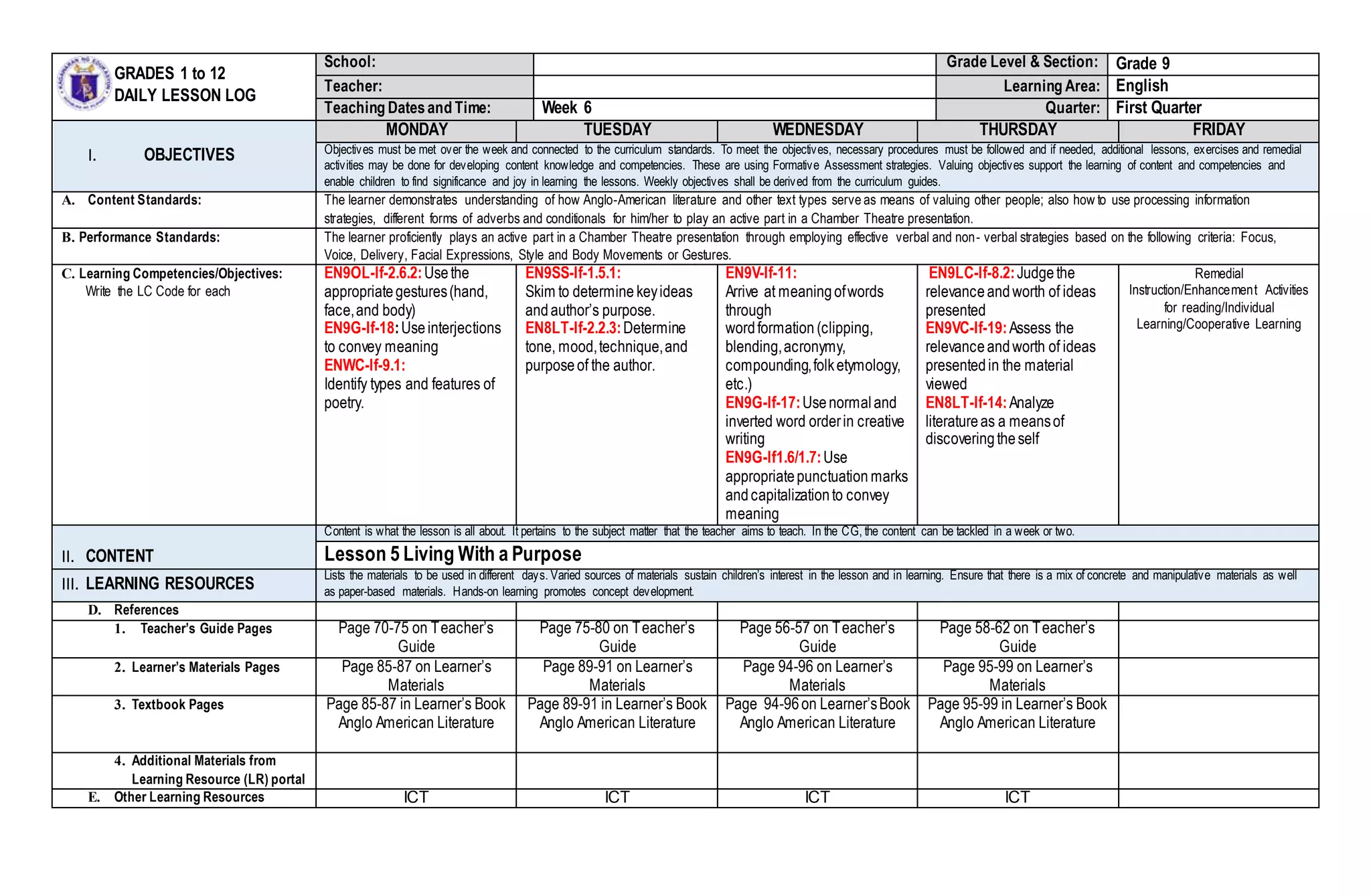
School: Grade Level & Section: Grade 9
Teacher: Learning Area: English
Teaching Datesand Time: Week 6 Quarter: First Quarter
I. OBJECTIVES
MONDAY TUESDAY WEDNESDAY THURSDAY FRIDAY
Objectives must be met over the week and connected to the curriculum standards. To meet the objectives, necessary procedures must be followed and if needed, additional lessons, exercises and remedial
activities may be done for developing content knowledge and competencies. These are using Formative Assessment strategies. Valuing objectives support the learning of content and competencies and
enable children to find significance and joy in learning the lessons. Weekly objectives shall be derived from the curriculum guides.
A. Content Standards: The learner demonstrates understanding of how Anglo-American literature and other text types serve as means of valuing other people; also how to use processing information
strategies, different forms of adverbs and conditionals for him/her to play an active part in a Chamber Theatre presentation.
B. Performance Standards: The learner proficiently plays an active part in a Chamber Theatre presentation through employing effective verbal and non- verbal strategies based on the following criteria: Focus,
Voice, Delivery, Facial Expressions, Style and Body Movements or Gestures.
C. Learning Competencies/Objectives:
Write the LC Code for each
EN9OL-If-2.6.2:Usethe
appropriategestures(hand,
face,and body)
EN9G-If-18:Useinterjections
to convey meaning
ENWC-If-9.1:
Identify types and features of
poetry.
EN9SS-If-1.5.1:
Skim to determine keyideas
andauthor’s purpose.
EN8LT-If-2.2.3:Determine
tone, mood,technique,and
purposeof the author.
EN9V-If-11:
Arrive at meaningofwords
through
wordformation (clipping,
blending,acronymy,
compounding,folketymology,
etc.)
EN9G-If-17:Usenormaland
inverted word orderin creative
writing
EN9G-If1.6/1.7:Use
appropriatepunctuation marks
andcapitalizationto convey
meaning
EN9LC-If-8.2:Judgethe
relevanceandworth of ideas
presented
EN9VC-If-19:Assess the
relevanceandworth of ideas
presentedin the material
viewed
EN8LT-If-14:Analyze
literatureas a meansof
discoveringtheself
Remedial
Instruction/Enhancement Activities
for reading/Individual
Learning/Cooperative Learning
II. CONTENT
Content is what the lesson is all about. It pertains to the subject matter that the teacher aims to teach. In the CG, the content can be tackled in a week or two.
Lesson 5 Living With a Purpose
III. LEARNING RESOURCES
Lists the materials to be used in different days. Varied sources of materials sustain children’s interest in the lesson and in learning. Ensure that there is a mix of concrete and manipulative materials as well
as paper-based materials. Hands-on learning promotes concept development.
D. References
1. Teacher’s Guide Pages Page 70-75 on Teacher’s
Guide
Page 75-80 on Teacher’s
Guide
Page 56-57 on Teacher’s
Guide
Page 58-62 on Teacher’s
Guide
2. Learner’s Materials Pages Page 85-87 on Learner’s
Materials
Page 89-91 on Learner’s
Materials
Page 94-96 on Learner’s
Materials
Page 95-99 on Learner’s
Materials
3. Textbook Pages Page 85-87 in Learner’s Book
Anglo American Literature
Page 89-91 in Learner’s Book
Anglo American Literature
Page 94-96on Learner’sBook
Anglo American Literature
Page 95-99 in Learner’s Book
Anglo American Literature
4. Additional Materials from
Learning Resource (LR) portal
E. Other Learning Resources ICT ICT ICT ICT
(Television, Laptops,
Video Clips)
Copy of the Text
Textbook
(Television, Laptops,
Video Clips)
Copy of the Text
Textbook
(Television, Laptops,
Video Clips)
Copy of the Text
Textbook
(Television, Laptops,
Video Clips)
Copy of the Text
Rubric
Textbook
IV. PROCEDURES
MONDAY TUESDAY WEDNESDAY THURSDAY FRIDAY
These steps should be done across the week. Spread out the activities appropriately so that students will learn well. Always be guided by demonstration of learning by the students which you can infer from
formative assessment activities. Sustain learning systematically by providing students with multiple ways to learn new things, practice their learning, question their learning processes, and draw conclusions
about what they learned in relation to their life experiences and previous knowledge. Indicate the time allotment for each step.
A. Reviewing Previous Lesson or
Presenting the New Lesson
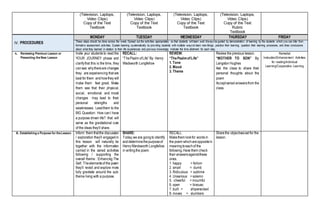
Invite your students to read the
YOUR JOURNEY phase and
clarifythat this is the time, they
cansee whythereare changes
they are experiencing that are
best for them andhowthey will
make them feel great. Make
them see that their physical,
social, emotional and moral
changes may lead to their
personal strengths and
weaknesses. Leadthem to the
BIG Question: How canI have
a purpose driven life? that will
serve as the gravitational core
of the ideas they’ll share.
RECALL:
“ThePsalm ofLife” By: Henry
Wadsworth Longfellow
REVIEW:
“ThePsalmofLife”
1. Tone
2. Mood
3. Theme
Review the previous lesson.
“MOTHER TO SON” By:
Langston Hughes
Ask the class to share their
personal thoughts about the
poem
Acceptvaried answersfrom the
class.
Remedial
Instruction/Enhancement Activities
for reading/Individual
Learning/Cooperative Learning
B. Establishing a Purpose for the Lesson Inform them thatthe discussion
/ exploration they’ll engaged in
this lesson will naturally tie
together with the information
carried in the varied activities
following / supporting the
overall theme : Enhancing The
Self. Theelementsof the poem
they’ll revisit and explore more
fully gravitate around the sub-
theme living with a purpose.
SHARE:
Today,we are goingto identify
anddeterminethepurposeof
HenryWardsworth Longfellow
in writingthe poem.
RECALL:
Makethem lookfor wordsin
the poem whichareoppositein
meaningtoeachof the
following.Have them check
their answersagainstthese
ones.
1. happy = forlorn
2. smart = dumb
3. Ridiculous = sublime
4. Unserious = solemn
5. cheerful = mournful
6. open = bivouac
7. built = shipwrecked
8. moves = slumbers
Sharethe objectivesset for the
lesson.
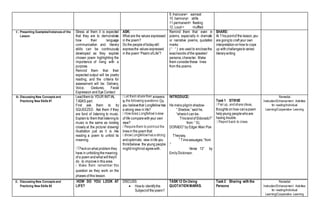
9. Insincere= earnest
10 .harmony= strife
11.permanent= fleeting
12. Loud= muffled
C. Presenting Examples/Instances of the
Lesson
Stress at them it is expected
that they are to demonstrate
how their language
communication and literary
skills can be continuously
developed as they explore
chosen poem highlighting the
importance of living with a
purpose.
Remind them that their
expected output will be poetry
reading, and the criteria for
assessment will be: Delivery,
Voice, Gestures, Facial
Expression and Eye Contact
ASK:
What are the values expressed
in the poem?
Do the peopleof todaystill
expressthe values expressed
in the poem “Psalm ofLife”?
Remind them that even in
poems, especially in dramatic
or narrative poems, quotation
marks
( “ “ ) are used to enclosethe
exactwords of the speaker/
persona,character. Make
them considerthese lines
from the poems.
SHARE:
At Thispointof the lesson,you
are goingto craft your own
interpretationonhow to cope
up withchallengestovaried
literarywriting
D. Discussing New Concepts and
Practicing New Skills #1
Leadthem to YOUR INITIAL
TASKS part.
First ask them to try
SQUEEZED. Ask them if they
are fond of listening to music.
Explainto them that listeningto
music is the same as looking
closely at the picture/ drawing/
illustration just as it is like
reading a poem to unfold its
meaning.
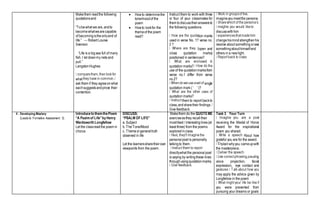
eckonwhat problem they
have in unfoldingthemeaning
of a poem andwhat willthey’ll
do to improvein this area.
question as they work on the
phases of this lesson.
answers
to Do
you believethat Longfellowhas
a strong view in life?
of life comparewithyour own
view?
linesin the poem that
andoptimistic view inlife you
think/believe the young people
might/mightnot agreewith.
INTRODUCE:
He meta pilgrim shadow-
“ Shadow,”said he,
“whereit canbe-
Thislandof Eldorado?”
from: “ EL
DORADO”by Edgar Allan Poe
Theysay,
“ Timeassuages.”from
:”
Verse 13” by
EmilyDickinson.
Task1 STRIVE
thoughts onhow canapoem
helpyoung peoplewhoare
having trouble.
Remedial
Instruction/Enhancement Activities
for reading/Individual
Learning/Cooperative Learning
E. Discussing New Concepts and
Practicing New Skills #2
HOW DO YOU LOOK AT
LIFE?
DISCUSS:
 Howto identifythe
Subjectof the poem?
TASK12 On Using
QUOTATIONMARKS.
Task2 Sharing with the
Persona
Remedial
Instruction/Enhancement Activities
for reading/Individual
Learning/Cooperative Learning
Makethem readthe following
quotationsand
“Tobewhat we are, andto
becomewhatwearecapable
of becomingistheonlyend of
life.” --- Robert Louise
Svenson
“Life is a bigsea full of many
fish. I let downmy nets and
pull.”
LangstonHughes
what
ask them if they agreeonwhat
eachsuggestsandprove their
contention.
 Howto determinethe
tone/moodof the
poem
 Howto lookfor the
themeof the poem
read?
Instruct them to work with three
or four of your classmates for
them todiscusstheiranswersto
the following questions.
tion marks
used in verse No. 1? verse no.
2 ?
open and
close quotation marks)
positioned in sentences?
quotation marks?
use of the quotationmarksfrom
verse no.1 differ from verse
no.2?
single
quotation mark ( ‘ ‘ )?
quotation marks?
them to report backto
class,andsharetheir findings.
Give feedback.
imagineyoumeetthe persona.
discusswithhim
changehismindstrengthenhis
resolve about somethingorsee
somethingabouthimselfand
others in a newlight.
F. Developing Mastery
(Leads to Formative Assessment 3)
Introduceto themthePoem
“A Psalmof Life”byHenry
Wardsworth Longfellow
Let the classreadthe poem in
chorus
DISCUSS:
“PSALM OF LIFE”
a. Subject
b. TheTone/Mood
c. Themeorgeneraltruth
observed in life
Let the learnerssharetheirown
viewpoints from the poem.
Makethem do the QUOTEME
exerciseasthey recall their
mostliked / interestinglines(at
least three) from the poems
exploredinclass.
persona/poet is personally
talkingto them.
directlywhat the persona/poet
is saying by writing these lines
throughusingquotationmarks.
Task 3 Your Turn
receiving the Medal of Honor
Award for the inspirational
poem you shared.
bout how
grateful you are for the award.
plainwhyyou cameupwith
the masterpiece.
voice projection, facial
expression, eye contact and
may apply the advice given by
Longfellow in the poem
you were prevented from
pursuing your dreams or goals
neededto holdon to dreamsin
adversity.
G. Finding Practical Applications of
Concepts and Skills in Daily Living
This is the time, they can see
why thereare changestheyare
experiencing that are best for
them and how they will make
them feelgreat.Makethem see
that their physical, social,
emotional and moral changes
may lead to their personal
strengths and weaknesses.
ThePoem “Psalm ofLife”let us
learn the value of labor and
patience in life. We do not live
for enjoymentnorsorrowbutwe
have to act today for a better
tomorrow.
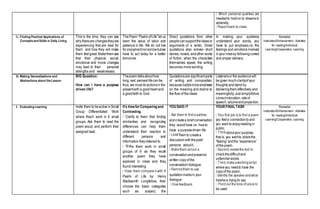
Direct quotations from other
peoplecansupporttheideasor
arguments of a writer, Direct
quotations also enliven short
stories, novels, andother works
of fiction, when the characters
themselves speak, the writing
becomes more exciting.
In making your audience
understand your words, you
have to put emphasis on the
feelings and emotions involved
inyour linesby followingcorrect
and proper delivery.
Remedial
Instruction/Enhancement Activities
for reading/Individual
Learning/Cooperative Learning
H. Making Generalizations and
Abstractions about the Lesson
BIG Question:
How can I have a purpose
driven life?
Thepoem talksabouthow
long,real, earnest lifecanbe,
thus, we must doactionsin the
presentwith a goodheart and
a goodfaith to God.
Quotationsare significantparts
of writing and composition,
becauseitaddsmoreemphasis
on the meaning and drama to
the flow of the ideas.
Listenersor the audiencewill
be given muchclarityof your
thoughts andstand by
deliveringthem effectively and
meaningfully.Just simplyfollow
correctintonation,rateof
speech,volumeandprojection.
I. Evaluating Learning Invite them to beactive inSmall
Group Differentiated Work
where they’ll work in 6 small
groups. Ask them to read the
poem aloud, and perform their
assigned task.
It’s timeforComparing and
Contrasting.
Clarify to them that finding
similarities and recognizing
differences can help them
understand their reaction to
different persons and
information theylistened to.
e them work in small
groups of 6 as they recall
another poem they have
explored in class and they
found interesting.
Psalm of Life by: Henry
Wadsworth Longfellow, then
choose the basic categories
such as: subject, the
YOUSAID IT
andcreatea brief conversation
they wouldhave on howto
have a purposedriven life.
hem to createa
discussionwith thepoet/
persona aboutit.
conversationandpresenta
written copyof the
conversation/dialogue.
quotationmarksin your
dialogue.
YOURFINAL TASK
you feela connectiontoand
you want to enjoyreadingin
public.
aboutyour purpose;
that is, you wantto sharethe
“feeling”andthe “experience”
of the poem.
checkthedifficultand
unfamiliarwords.
whereyou needto have the
copyof the poem.
he/sheis trying to say
be used
Remedial
Instruction/Enhancement Activities
for reading/Individual
Learning/Cooperative Learning
mood/tone, and viewpoint on
general truth in life.
specific points that are similar
enough to enable you to draw
effective comparison.
Let the classchoosetheir
preferredpoem from the
previous lessonsto be used in
the activity.
1. Seven Ages of Man
2. TheBattle With Grendel
changetoslowly, fast, soft, or
loud
to a full pausebut read on to
the next lineto completethe
thought.
Memorize
andunderstandthe text. Plan
your movements
readthe poem aloud.Voice(
quality, projection,volume,
pitch)Delivery ( phrasing,
pausing,intonation,stress)
Facialexpression,gestures,
eye contact
punctuation.Breakdownthe
parts into subjectandits
meaning
meaningratherthanreading
singlewords
to add meaningtothe work
Delivery, Voice, Gestures,and
FacialExpressions
J. Additional Activities for Application or
Remediation
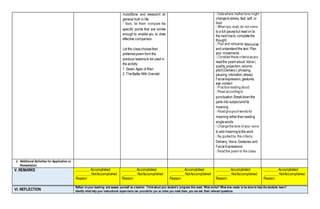
V. REMARKS ________Accomplished
________NotAccomplished
Reason:
________Accomplished
________NotAccomplished
Reason:
________Accomplished
________NotAccomplished
Reason:
________Accomplished
________NotAccomplished
Reason:
________Accomplished
________NotAccomplished
Reason:
VI. REFLECTION
Reflect on your teaching and assess yourself as a teacher. Thinkabout your student’s progress this week. What works? What else needs to be done to help the students learn?
Identify what help your instructional supervisors can providefor you so when you meet them, you can ask them relevant questions.
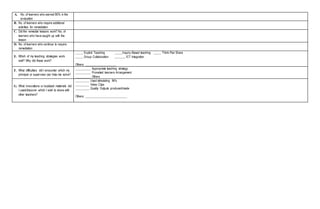
A. No. of learners who earned 80% in the
evaluation
B. No. of learners who require additional
activities for remediation
C. Did the remedial lessons work? No. of
learners who have caught up with the
lesson
D. No. of learners who continue to require
remediation
E. Which of my teaching strategies work
well? Why did these work?
_____ Explicit Teaching _____Inquiry-Based teaching _____ Think-Pair Share
_____ Group Collaboration _______ ICT Integration
Others: ____________________
F. What difficulties did I encounter which my
principal or supervisor can help me solve?
__________ Appropriate teaching strategy
__________ Promoted learners Arrangement
__________ Others
G. What innovations or localized materials did
I used/discover which I wish to share with
other teachers?
_________ Used stimulating IM’s
_________ Video Clips
_________ Quality Outputs produced/made
Others: ___________________________

English 9 Q1 Week 6

  • 1.
    GRADES 1 to12 DAILY LESSON LOG School: Grade Level & Section: Grade 9 Teacher: Learning Area: English Teaching Datesand Time: Week 6 Quarter: First Quarter I. OBJECTIVES MONDAY TUESDAY WEDNESDAY THURSDAY FRIDAY Objectives must be met over the week and connected to the curriculum standards. To meet the objectives, necessary procedures must be followed and if needed, additional lessons, exercises and remedial activities may be done for developing content knowledge and competencies. These are using Formative Assessment strategies. Valuing objectives support the learning of content and competencies and enable children to find significance and joy in learning the lessons. Weekly objectives shall be derived from the curriculum guides. A. Content Standards: The learner demonstrates understanding of how Anglo-American literature and other text types serve as means of valuing other people; also how to use processing information strategies, different forms of adverbs and conditionals for him/her to play an active part in a Chamber Theatre presentation. B. Performance Standards: The learner proficiently plays an active part in a Chamber Theatre presentation through employing effective verbal and non- verbal strategies based on the following criteria: Focus, Voice, Delivery, Facial Expressions, Style and Body Movements or Gestures. C. Learning Competencies/Objectives: Write the LC Code for each EN9OL-If-2.6.2:Usethe appropriategestures(hand, face,and body) EN9G-If-18:Useinterjections to convey meaning ENWC-If-9.1: Identify types and features of poetry. EN9SS-If-1.5.1: Skim to determine keyideas andauthor’s purpose. EN8LT-If-2.2.3:Determine tone, mood,technique,and purposeof the author. EN9V-If-11: Arrive at meaningofwords through wordformation (clipping, blending,acronymy, compounding,folketymology, etc.) EN9G-If-17:Usenormaland inverted word orderin creative writing EN9G-If1.6/1.7:Use appropriatepunctuation marks andcapitalizationto convey meaning EN9LC-If-8.2:Judgethe relevanceandworth of ideas presented EN9VC-If-19:Assess the relevanceandworth of ideas presentedin the material viewed EN8LT-If-14:Analyze literatureas a meansof discoveringtheself Remedial Instruction/Enhancement Activities for reading/Individual Learning/Cooperative Learning II. CONTENT Content is what the lesson is all about. It pertains to the subject matter that the teacher aims to teach. In the CG, the content can be tackled in a week or two. Lesson 5 Living With a Purpose III. LEARNING RESOURCES Lists the materials to be used in different days. Varied sources of materials sustain children’s interest in the lesson and in learning. Ensure that there is a mix of concrete and manipulative materials as well as paper-based materials. Hands-on learning promotes concept development. D. References 1. Teacher’s Guide Pages Page 70-75 on Teacher’s Guide Page 75-80 on Teacher’s Guide Page 56-57 on Teacher’s Guide Page 58-62 on Teacher’s Guide 2. Learner’s Materials Pages Page 85-87 on Learner’s Materials Page 89-91 on Learner’s Materials Page 94-96 on Learner’s Materials Page 95-99 on Learner’s Materials 3. Textbook Pages Page 85-87 in Learner’s Book Anglo American Literature Page 89-91 in Learner’s Book Anglo American Literature Page 94-96on Learner’sBook Anglo American Literature Page 95-99 in Learner’s Book Anglo American Literature 4. Additional Materials from Learning Resource (LR) portal E. Other Learning Resources ICT ICT ICT ICT
  • 2.
    (Television, Laptops, Video Clips) Copyof the Text Textbook (Television, Laptops, Video Clips) Copy of the Text Textbook (Television, Laptops, Video Clips) Copy of the Text Textbook (Television, Laptops, Video Clips) Copy of the Text Rubric Textbook IV. PROCEDURES MONDAY TUESDAY WEDNESDAY THURSDAY FRIDAY These steps should be done across the week. Spread out the activities appropriately so that students will learn well. Always be guided by demonstration of learning by the students which you can infer from formative assessment activities. Sustain learning systematically by providing students with multiple ways to learn new things, practice their learning, question their learning processes, and draw conclusions about what they learned in relation to their life experiences and previous knowledge. Indicate the time allotment for each step. A. Reviewing Previous Lesson or Presenting the New Lesson Invite your students to read the YOUR JOURNEY phase and clarifythat this is the time, they cansee whythereare changes they are experiencing that are best for them andhowthey will make them feel great. Make them see that their physical, social, emotional and moral changes may lead to their personal strengths and weaknesses. Leadthem to the BIG Question: How canI have a purpose driven life? that will serve as the gravitational core of the ideas they’ll share. RECALL: “ThePsalm ofLife” By: Henry Wadsworth Longfellow REVIEW: “ThePsalmofLife” 1. Tone 2. Mood 3. Theme Review the previous lesson. “MOTHER TO SON” By: Langston Hughes Ask the class to share their personal thoughts about the poem Acceptvaried answersfrom the class. Remedial Instruction/Enhancement Activities for reading/Individual Learning/Cooperative Learning B. Establishing a Purpose for the Lesson Inform them thatthe discussion / exploration they’ll engaged in this lesson will naturally tie together with the information carried in the varied activities following / supporting the overall theme : Enhancing The Self. Theelementsof the poem they’ll revisit and explore more fully gravitate around the sub- theme living with a purpose. SHARE: Today,we are goingto identify anddeterminethepurposeof HenryWardsworth Longfellow in writingthe poem. RECALL: Makethem lookfor wordsin the poem whichareoppositein meaningtoeachof the following.Have them check their answersagainstthese ones. 1. happy = forlorn 2. smart = dumb 3. Ridiculous = sublime 4. Unserious = solemn 5. cheerful = mournful 6. open = bivouac 7. built = shipwrecked 8. moves = slumbers Sharethe objectivesset for the lesson.
  • 3.
    9. Insincere= earnest 10.harmony= strife 11.permanent= fleeting 12. Loud= muffled C. Presenting Examples/Instances of the Lesson Stress at them it is expected that they are to demonstrate how their language communication and literary skills can be continuously developed as they explore chosen poem highlighting the importance of living with a purpose. Remind them that their expected output will be poetry reading, and the criteria for assessment will be: Delivery, Voice, Gestures, Facial Expression and Eye Contact ASK: What are the values expressed in the poem? Do the peopleof todaystill expressthe values expressed in the poem “Psalm ofLife”? Remind them that even in poems, especially in dramatic or narrative poems, quotation marks ( “ “ ) are used to enclosethe exactwords of the speaker/ persona,character. Make them considerthese lines from the poems. SHARE: At Thispointof the lesson,you are goingto craft your own interpretationonhow to cope up withchallengestovaried literarywriting D. Discussing New Concepts and Practicing New Skills #1 Leadthem to YOUR INITIAL TASKS part. First ask them to try SQUEEZED. Ask them if they are fond of listening to music. Explainto them that listeningto music is the same as looking closely at the picture/ drawing/ illustration just as it is like reading a poem to unfold its meaning. eckonwhat problem they have in unfoldingthemeaning of a poem andwhat willthey’ll do to improvein this area. question as they work on the phases of this lesson. answers to Do you believethat Longfellowhas a strong view in life? of life comparewithyour own view? linesin the poem that andoptimistic view inlife you think/believe the young people might/mightnot agreewith. INTRODUCE: He meta pilgrim shadow- “ Shadow,”said he, “whereit canbe- Thislandof Eldorado?” from: “ EL DORADO”by Edgar Allan Poe Theysay, “ Timeassuages.”from :” Verse 13” by EmilyDickinson. Task1 STRIVE thoughts onhow canapoem helpyoung peoplewhoare having trouble. Remedial Instruction/Enhancement Activities for reading/Individual Learning/Cooperative Learning E. Discussing New Concepts and Practicing New Skills #2 HOW DO YOU LOOK AT LIFE? DISCUSS:  Howto identifythe Subjectof the poem? TASK12 On Using QUOTATIONMARKS. Task2 Sharing with the Persona Remedial Instruction/Enhancement Activities for reading/Individual Learning/Cooperative Learning
  • 4.
    Makethem readthe following quotationsand “Tobewhatwe are, andto becomewhatwearecapable of becomingistheonlyend of life.” --- Robert Louise Svenson “Life is a bigsea full of many fish. I let downmy nets and pull.” LangstonHughes what ask them if they agreeonwhat eachsuggestsandprove their contention.  Howto determinethe tone/moodof the poem  Howto lookfor the themeof the poem read? Instruct them to work with three or four of your classmates for them todiscusstheiranswersto the following questions. tion marks used in verse No. 1? verse no. 2 ? open and close quotation marks) positioned in sentences? quotation marks? use of the quotationmarksfrom verse no.1 differ from verse no.2? single quotation mark ( ‘ ‘ )? quotation marks? them to report backto class,andsharetheir findings. Give feedback. imagineyoumeetthe persona. discusswithhim changehismindstrengthenhis resolve about somethingorsee somethingabouthimselfand others in a newlight. F. Developing Mastery (Leads to Formative Assessment 3) Introduceto themthePoem “A Psalmof Life”byHenry Wardsworth Longfellow Let the classreadthe poem in chorus DISCUSS: “PSALM OF LIFE” a. Subject b. TheTone/Mood c. Themeorgeneraltruth observed in life Let the learnerssharetheirown viewpoints from the poem. Makethem do the QUOTEME exerciseasthey recall their mostliked / interestinglines(at least three) from the poems exploredinclass. persona/poet is personally talkingto them. directlywhat the persona/poet is saying by writing these lines throughusingquotationmarks. Task 3 Your Turn receiving the Medal of Honor Award for the inspirational poem you shared. bout how grateful you are for the award. plainwhyyou cameupwith the masterpiece. voice projection, facial expression, eye contact and may apply the advice given by Longfellow in the poem you were prevented from pursuing your dreams or goals
  • 5.
    neededto holdon todreamsin adversity. G. Finding Practical Applications of Concepts and Skills in Daily Living This is the time, they can see why thereare changestheyare experiencing that are best for them and how they will make them feelgreat.Makethem see that their physical, social, emotional and moral changes may lead to their personal strengths and weaknesses. ThePoem “Psalm ofLife”let us learn the value of labor and patience in life. We do not live for enjoymentnorsorrowbutwe have to act today for a better tomorrow. Direct quotations from other peoplecansupporttheideasor arguments of a writer, Direct quotations also enliven short stories, novels, andother works of fiction, when the characters themselves speak, the writing becomes more exciting. In making your audience understand your words, you have to put emphasis on the feelings and emotions involved inyour linesby followingcorrect and proper delivery. Remedial Instruction/Enhancement Activities for reading/Individual Learning/Cooperative Learning H. Making Generalizations and Abstractions about the Lesson BIG Question: How can I have a purpose driven life? Thepoem talksabouthow long,real, earnest lifecanbe, thus, we must doactionsin the presentwith a goodheart and a goodfaith to God. Quotationsare significantparts of writing and composition, becauseitaddsmoreemphasis on the meaning and drama to the flow of the ideas. Listenersor the audiencewill be given muchclarityof your thoughts andstand by deliveringthem effectively and meaningfully.Just simplyfollow correctintonation,rateof speech,volumeandprojection. I. Evaluating Learning Invite them to beactive inSmall Group Differentiated Work where they’ll work in 6 small groups. Ask them to read the poem aloud, and perform their assigned task. It’s timeforComparing and Contrasting. Clarify to them that finding similarities and recognizing differences can help them understand their reaction to different persons and information theylistened to. e them work in small groups of 6 as they recall another poem they have explored in class and they found interesting. Psalm of Life by: Henry Wadsworth Longfellow, then choose the basic categories such as: subject, the YOUSAID IT andcreatea brief conversation they wouldhave on howto have a purposedriven life. hem to createa discussionwith thepoet/ persona aboutit. conversationandpresenta written copyof the conversation/dialogue. quotationmarksin your dialogue. YOURFINAL TASK you feela connectiontoand you want to enjoyreadingin public. aboutyour purpose; that is, you wantto sharethe “feeling”andthe “experience” of the poem. checkthedifficultand unfamiliarwords. whereyou needto have the copyof the poem. he/sheis trying to say be used Remedial Instruction/Enhancement Activities for reading/Individual Learning/Cooperative Learning
  • 6.
    mood/tone, and viewpointon general truth in life. specific points that are similar enough to enable you to draw effective comparison. Let the classchoosetheir preferredpoem from the previous lessonsto be used in the activity. 1. Seven Ages of Man 2. TheBattle With Grendel changetoslowly, fast, soft, or loud to a full pausebut read on to the next lineto completethe thought. Memorize andunderstandthe text. Plan your movements readthe poem aloud.Voice( quality, projection,volume, pitch)Delivery ( phrasing, pausing,intonation,stress) Facialexpression,gestures, eye contact punctuation.Breakdownthe parts into subjectandits meaning meaningratherthanreading singlewords to add meaningtothe work Delivery, Voice, Gestures,and FacialExpressions J. Additional Activities for Application or Remediation V. REMARKS ________Accomplished ________NotAccomplished Reason: ________Accomplished ________NotAccomplished Reason: ________Accomplished ________NotAccomplished Reason: ________Accomplished ________NotAccomplished Reason: ________Accomplished ________NotAccomplished Reason: VI. REFLECTION Reflect on your teaching and assess yourself as a teacher. Thinkabout your student’s progress this week. What works? What else needs to be done to help the students learn? Identify what help your instructional supervisors can providefor you so when you meet them, you can ask them relevant questions.
  • 7.
    A. No. oflearners who earned 80% in the evaluation B. No. of learners who require additional activities for remediation C. Did the remedial lessons work? No. of learners who have caught up with the lesson D. No. of learners who continue to require remediation E. Which of my teaching strategies work well? Why did these work? _____ Explicit Teaching _____Inquiry-Based teaching _____ Think-Pair Share _____ Group Collaboration _______ ICT Integration Others: ____________________ F. What difficulties did I encounter which my principal or supervisor can help me solve? __________ Appropriate teaching strategy __________ Promoted learners Arrangement __________ Others G. What innovations or localized materials did I used/discover which I wish to share with other teachers? _________ Used stimulating IM’s _________ Video Clips _________ Quality Outputs produced/made Others: ___________________________