DIVISION CAPABILITY BUILDING ON
EVALUATING CLASSROOM-BASED
ACTION/BASIC RESEARCH
SESSION 4:
STATING THE PROBLEM
DEPARTMENT OF EDUCATION
Research Problem Statement
Where does it all begin?
Stating the PROBLEM
DEPARTMENT OF EDUCATION
Research Problem Statement
ACTION RESEARCH PROBLEM
- Greek word “Probaloin”
- A situation for which there is no ready or successful response as of
the moment.
A. Sources of Problems
1. Field of specialization
2. Academic or professional encounters
3. Collateral reading
a. Extensive reading – covers a range of topics for setting
background purposes
b. Intensive Reading – covers selected themes for in depth,
analytical or evaluative purposes.
4. Existing practices
5. Published/unpublished research reports
DEPARTMENT OF EDUCATION
Research Problem Statement
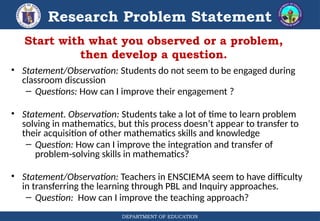
• Statement/Observation: Students do not seem to be engaged during
classroom discussion
– Questions: How can I improve their engagement ?
• Statement. Observation: Students take a lot of time to learn problem
solving in mathematics, but this process doesn’t appear to transfer to
their acquisition of other mathematics skills and knowledge
– Question: How can I improve the integration and transfer of
problem-solving skills in mathematics?
• Statement/Observation: Teachers in ENSCIEMA seem to have difficulty
in transferring the learning through PBL and Inquiry approaches.
– Question: How can I improve the teaching approach?
Start with what you observed or a problem,
then develop a question.
DEPARTMENT OF EDUCATION
Research Problem Statement
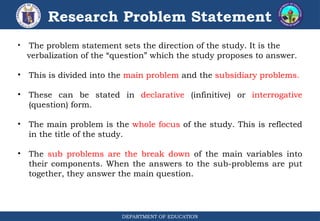
• The problem statement sets the direction of the study. It is the
verbalization of the “question” which the study proposes to answer.
• This is divided into the main problem and the subsidiary problems.
• These can be stated in declarative (infinitive) or interrogative
(question) form.
• The main problem is the whole focus of the study. This is reflected
in the title of the study.
• The sub problems are the break down of the main variables into
their components. When the answers to the sub-problems are put
together, they answer the main question.
DEPARTMENT OF EDUCATION
Research Problem Statement
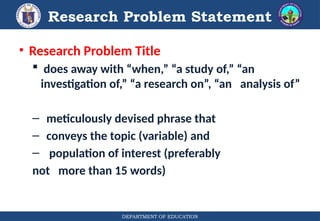
• Research Problem Title
 does away with “when,” “a study of,” “an
investigation of,” “a research on”, “an analysis of”
– meticulously devised phrase that
– conveys the topic (variable) and
– population of interest (preferably
not more than 15 words)
DEPARTMENT OF EDUCATION
Research Problem Statement
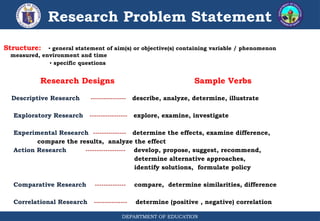
Structure: ▪ general statement of aim(s) or objective(s) containing variable / phenomenon
measured, environment and time
▪ specific questions
Research Designs Sample Verbs
Descriptive Research ---------------- describe, analyze, determine, illustrate
Exploratory Research ----------------- explore, examine, investigate
Experimental Research --------------- determine the effects, examine difference,
compare the results, analyze the effect
Action Research ------------------ develop, propose, suggest, recommend,
determine alternative approaches,
identify solutions, formulate policy
Comparative Research -------------- compare, determine similarities, difference
Correlational Research --------------- determine (positive , negative) correlation
DEPARTMENT OF EDUCATION
Research Problem Statement
Hypothesis – scholarly guess
Two types:
a. Substantive hypothesis
b. Statistical Hypothesis
Guidelines:
1. it must be identical to the problem
2. it must have a direct relation to at least one subsidiary problem
3. it must actually be tested by the research to determine its workability
Examples: Hypotheses
Null Hypothesis 1. There is no significant difference in the inhibitory
effect of the USPF local flora extracts to the species of dysenteric bacilli?
Null Hypothesis 2. There is no significant difference in the susceptibility rate
of the species of dysenteric bacilli to the USPF local flora extracts.
DEPARTMENT OF EDUCATION
Research Problem Statement
Variables – Characteristics or property whereby the members of the group set
differ from one another.

A. Independent Variables – “X variable or Response Variable”
- Characteristics or condition that is introduced, removed or
manipulated to cause a change in the dependent variable that is to be observed
or measured.
- Predictor of Input
B. Dependent Variable – “Y variable or Outcome Variable”
- Characteristics or condition that is observed and measured to find
out how the independent variable affects it.
- (Outcome or attitude variable)
DEPARTMENT OF EDUCATION
Research Problem Statement
Verbose:
• The Effects of Computer-Assisted
Instruction on the Writing Skills of Third
Year High School Students of Holy Name
University, School Year 2008-2009.
Brief: Effects of Computer- Assisted
Instruction on Writing Skills
DEPARTMENT OF EDUCATION
Research Problem Statement
Wordy: A Study on Maternal Role
Identity of Primiparas of the
Municipality of Corella, Year 2004-2005
Improved: Maternal Role Identity of
Primiparas
DEPARTMENT OF EDUCATION
Research Problem Statement
Wordy: A Study on the Evaluation of the
Implementation of Dynamic Learning Program in
the First District of the Division of Bohol
Improved: Implementation of
Dynamic Learning Program
DEPARTMENT OF EDUCATION
Research Problem Statement
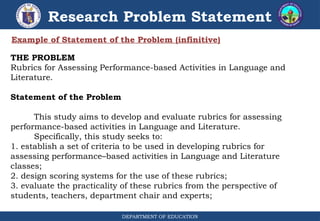
THE PROBLEM
Rubrics for Assessing Performance-based Activities in Language and
Literature.
Statement of the Problem
This study aims to develop and evaluate rubrics for assessing
performance-based activities in Language and Literature.
Specifically, this study seeks to:
1. establish a set of criteria to be used in developing rubrics for
assessing performance–based activities in Language and Literature
classes;
2. design scoring systems for the use of these rubrics;
3. evaluate the practicality of these rubrics from the perspective of
students, teachers, department chair and experts;
Example of Statement of the Problem (infinitive)
DEPARTMENT OF EDUCATION
Research Problem Statement
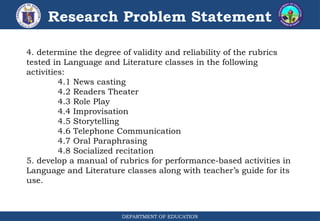
4. determine the degree of validity and reliability of the rubrics
tested in Language and Literature classes in the following
activities:
4.1 News casting
4.2 Readers Theater
4.3 Role Play
4.4 Improvisation
4.5 Storytelling
4.6 Telephone Communication
4.7 Oral Paraphrasing
4.8 Socialized recitation
5. develop a manual of rubrics for performance-based activities in
Language and Literature classes along with teacher’s guide for its
use.
DEPARTMENT OF EDUCATION
Research Problem Statement
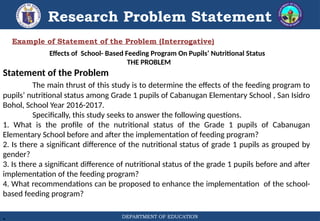
Example of Statement of the Problem (Interrogative)
Effects of School- Based Feeding Program On Pupils’ Nutritional Status
THE PROBLEM
Statement of the Problem
The main thrust of this study is to determine the effects of the feeding program to
pupils’ nutritional status among Grade 1 pupils of Cabanugan Elementary School , San Isidro
Bohol, School Year 2016-2017.
Specifically, this study seeks to answer the following questions.
1. What is the profile of the nutritional status of the Grade 1 pupils of Cabanugan
Elementary School before and after the implementation of feeding program?
2. Is there a significant difference of the nutritional status of grade 1 pupils as grouped by
gender?
3. Is there a significant difference of nutritional status of the grade 1 pupils before and after
implementation of the feeding program?
4. What recommendations can be proposed to enhance the implementation of the school-
based feeding program?
.
DEPARTMENT OF EDUCATION
Research Problem Statement
Self Test :Identify the variables in the following titles and
tell whether such variable is independent or dependent:
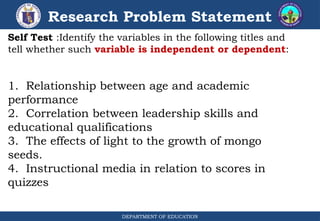
1. Relationship between age and academic
performance
2. Correlation between leadership skills and
educational qualifications
3. The effects of light to the growth of mongo
seeds.
4. Instructional media in relation to scores in
quizzes
DEPARTMENT OF EDUCATION
Research Problem Statement
Self Test :Identify the variables in the following titles and
tell whether such variable is independent or dependent:
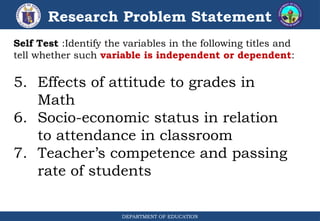
5. Effects of attitude to grades in
Math
6. Socio-economic status in relation
to attendance in classroom
7. Teacher’s competence and passing
rate of students
RESEARCH AGENDA THEMES
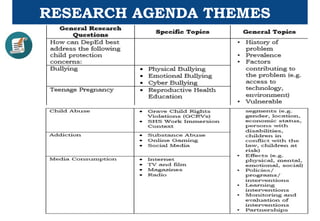
DO 39, s. 2016
Basic Education Research Agenda
FOUR (4) Themes
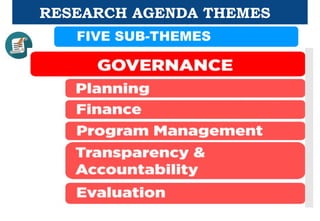
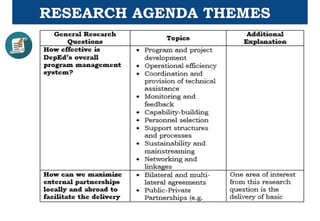
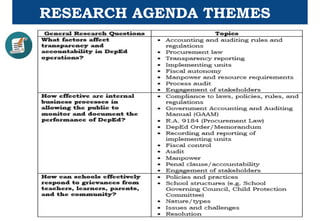
GOVERNANCE
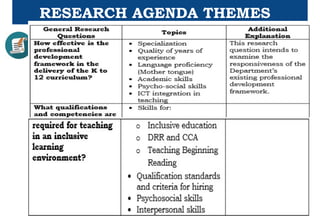
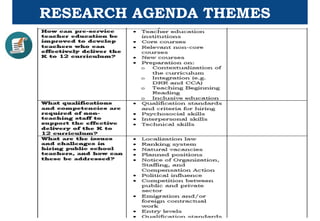
TEACHING AND LEARNING
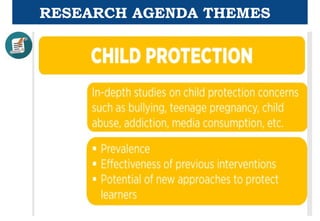
CHILD PROTECTION
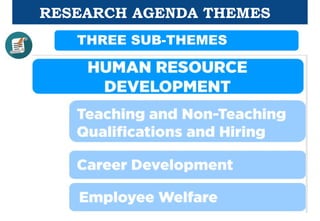
HUMAN RESOURCE
DEVELOPMENT
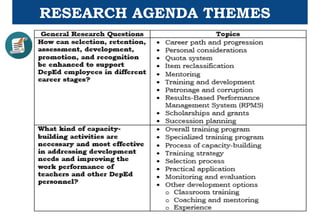
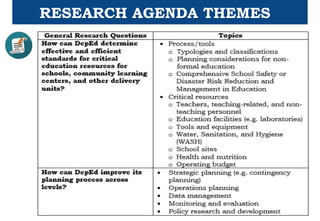
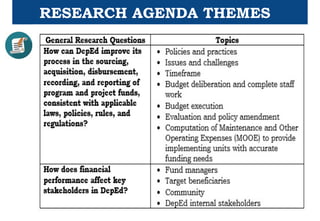
RESEARCH AGENDA THEMES
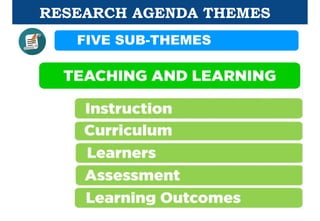
FIVE SUB-THEMES
DEPARTMENT OF EDUCATION
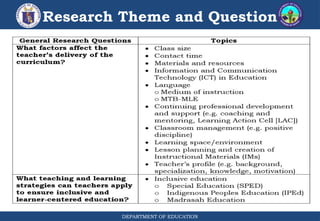
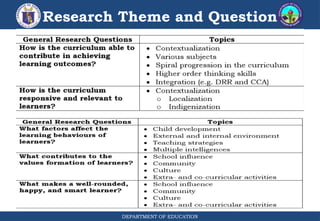
Research Theme and Question
DEPARTMENT OF EDUCATION
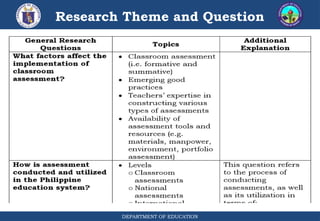
Research Theme and Question
DEPARTMENT OF EDUCATION
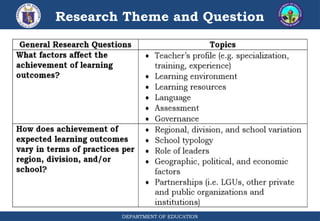
Research Theme and Question
DEPARTMENT OF EDUCATION
Research Theme and Question
RESEARCH AGENDA THEMES
THREE SUB-THEMES
RESEARCH AGENDA THEMES
FIVE SUB-THEMES
RESEARCH AGENDA THEMES
DEPARTMENT OF EDUCATION
Individual Work: Make a title, statement of the problem,
sub-problems and hypothesis based on the case study.
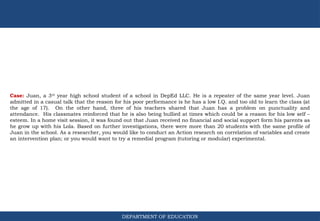
Case: Juan, a 3rd
year high school student of a school in DepEd LLC. He is a repeater of the same year level. Juan
admitted in a casual talk that the reason for his poor performance is he has a low I.Q. and too old to learn the class (at
the age of 17). On the other hand, three of his teachers shared that Juan has a problem on punctuality and
attendance. His classmates reinforced that he is also being bullied at times which could be a reason for his low self –
esteem. In a home visit session, it was found out that Juan received no financial and social support form his parents as
he grow up with his Lola. Based on further investigations, there were more than 20 students with the same profile of
Juan in the school. As a researcher, you would like to conduct an Action research on correlation of variables and create
an intervention plan; or you would want to try a remedial program (tutoring or modular) experimental.
DEPARTMENT OF EDUCATION
Research Problem Statement
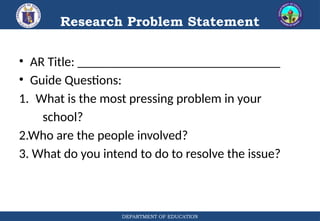
• AR Title: _______________________________
• Guide Questions:
1. What is the most pressing problem in your
school?
2.Who are the people involved?
3. What do you intend to do to resolve the issue?
SHS IMPLEMENTATION
DEPARTMENT OF EDUCATION
Daghang Salamat!
Doing MORE with LESS…
By Dr. J

Session4-Stating-the-Problem-_Aug-Sept.2018_final.pptx

  • 1.
    DIVISION CAPABILITY BUILDINGON EVALUATING CLASSROOM-BASED ACTION/BASIC RESEARCH
  • 2.
  • 3.
    DEPARTMENT OF EDUCATION ResearchProblem Statement Where does it all begin? Stating the PROBLEM
  • 4.
    DEPARTMENT OF EDUCATION ResearchProblem Statement ACTION RESEARCH PROBLEM - Greek word “Probaloin” - A situation for which there is no ready or successful response as of the moment. A. Sources of Problems 1. Field of specialization 2. Academic or professional encounters 3. Collateral reading a. Extensive reading – covers a range of topics for setting background purposes b. Intensive Reading – covers selected themes for in depth, analytical or evaluative purposes. 4. Existing practices 5. Published/unpublished research reports
  • 5.
    DEPARTMENT OF EDUCATION ResearchProblem Statement • Statement/Observation: Students do not seem to be engaged during classroom discussion – Questions: How can I improve their engagement ? • Statement. Observation: Students take a lot of time to learn problem solving in mathematics, but this process doesn’t appear to transfer to their acquisition of other mathematics skills and knowledge – Question: How can I improve the integration and transfer of problem-solving skills in mathematics? • Statement/Observation: Teachers in ENSCIEMA seem to have difficulty in transferring the learning through PBL and Inquiry approaches. – Question: How can I improve the teaching approach? Start with what you observed or a problem, then develop a question.
  • 6.
    DEPARTMENT OF EDUCATION ResearchProblem Statement • The problem statement sets the direction of the study. It is the verbalization of the “question” which the study proposes to answer. • This is divided into the main problem and the subsidiary problems. • These can be stated in declarative (infinitive) or interrogative (question) form. • The main problem is the whole focus of the study. This is reflected in the title of the study. • The sub problems are the break down of the main variables into their components. When the answers to the sub-problems are put together, they answer the main question.
  • 7.
    DEPARTMENT OF EDUCATION ResearchProblem Statement • Research Problem Title  does away with “when,” “a study of,” “an investigation of,” “a research on”, “an analysis of” – meticulously devised phrase that – conveys the topic (variable) and – population of interest (preferably not more than 15 words)
  • 8.
    DEPARTMENT OF EDUCATION ResearchProblem Statement Structure: ▪ general statement of aim(s) or objective(s) containing variable / phenomenon measured, environment and time ▪ specific questions Research Designs Sample Verbs Descriptive Research ---------------- describe, analyze, determine, illustrate Exploratory Research ----------------- explore, examine, investigate Experimental Research --------------- determine the effects, examine difference, compare the results, analyze the effect Action Research ------------------ develop, propose, suggest, recommend, determine alternative approaches, identify solutions, formulate policy Comparative Research -------------- compare, determine similarities, difference Correlational Research --------------- determine (positive , negative) correlation
  • 9.
    DEPARTMENT OF EDUCATION ResearchProblem Statement Hypothesis – scholarly guess Two types: a. Substantive hypothesis b. Statistical Hypothesis Guidelines: 1. it must be identical to the problem 2. it must have a direct relation to at least one subsidiary problem 3. it must actually be tested by the research to determine its workability Examples: Hypotheses Null Hypothesis 1. There is no significant difference in the inhibitory effect of the USPF local flora extracts to the species of dysenteric bacilli? Null Hypothesis 2. There is no significant difference in the susceptibility rate of the species of dysenteric bacilli to the USPF local flora extracts.
  • 10.
    DEPARTMENT OF EDUCATION ResearchProblem Statement Variables – Characteristics or property whereby the members of the group set differ from one another. A. Independent Variables – “X variable or Response Variable” - Characteristics or condition that is introduced, removed or manipulated to cause a change in the dependent variable that is to be observed or measured. - Predictor of Input B. Dependent Variable – “Y variable or Outcome Variable” - Characteristics or condition that is observed and measured to find out how the independent variable affects it. - (Outcome or attitude variable)
  • 11.
    DEPARTMENT OF EDUCATION ResearchProblem Statement Verbose: • The Effects of Computer-Assisted Instruction on the Writing Skills of Third Year High School Students of Holy Name University, School Year 2008-2009. Brief: Effects of Computer- Assisted Instruction on Writing Skills
  • 12.
    DEPARTMENT OF EDUCATION ResearchProblem Statement Wordy: A Study on Maternal Role Identity of Primiparas of the Municipality of Corella, Year 2004-2005 Improved: Maternal Role Identity of Primiparas
  • 13.
    DEPARTMENT OF EDUCATION ResearchProblem Statement Wordy: A Study on the Evaluation of the Implementation of Dynamic Learning Program in the First District of the Division of Bohol Improved: Implementation of Dynamic Learning Program
  • 14.
    DEPARTMENT OF EDUCATION ResearchProblem Statement THE PROBLEM Rubrics for Assessing Performance-based Activities in Language and Literature. Statement of the Problem This study aims to develop and evaluate rubrics for assessing performance-based activities in Language and Literature. Specifically, this study seeks to: 1. establish a set of criteria to be used in developing rubrics for assessing performance–based activities in Language and Literature classes; 2. design scoring systems for the use of these rubrics; 3. evaluate the practicality of these rubrics from the perspective of students, teachers, department chair and experts; Example of Statement of the Problem (infinitive)
  • 15.
    DEPARTMENT OF EDUCATION ResearchProblem Statement 4. determine the degree of validity and reliability of the rubrics tested in Language and Literature classes in the following activities: 4.1 News casting 4.2 Readers Theater 4.3 Role Play 4.4 Improvisation 4.5 Storytelling 4.6 Telephone Communication 4.7 Oral Paraphrasing 4.8 Socialized recitation 5. develop a manual of rubrics for performance-based activities in Language and Literature classes along with teacher’s guide for its use.
  • 16.
    DEPARTMENT OF EDUCATION ResearchProblem Statement Example of Statement of the Problem (Interrogative) Effects of School- Based Feeding Program On Pupils’ Nutritional Status THE PROBLEM Statement of the Problem The main thrust of this study is to determine the effects of the feeding program to pupils’ nutritional status among Grade 1 pupils of Cabanugan Elementary School , San Isidro Bohol, School Year 2016-2017. Specifically, this study seeks to answer the following questions. 1. What is the profile of the nutritional status of the Grade 1 pupils of Cabanugan Elementary School before and after the implementation of feeding program? 2. Is there a significant difference of the nutritional status of grade 1 pupils as grouped by gender? 3. Is there a significant difference of nutritional status of the grade 1 pupils before and after implementation of the feeding program? 4. What recommendations can be proposed to enhance the implementation of the school- based feeding program? .
  • 17.
    DEPARTMENT OF EDUCATION ResearchProblem Statement Self Test :Identify the variables in the following titles and tell whether such variable is independent or dependent: 1. Relationship between age and academic performance 2. Correlation between leadership skills and educational qualifications 3. The effects of light to the growth of mongo seeds. 4. Instructional media in relation to scores in quizzes
  • 18.
    DEPARTMENT OF EDUCATION ResearchProblem Statement Self Test :Identify the variables in the following titles and tell whether such variable is independent or dependent: 5. Effects of attitude to grades in Math 6. Socio-economic status in relation to attendance in classroom 7. Teacher’s competence and passing rate of students
  • 19.
    RESEARCH AGENDA THEMES DO39, s. 2016 Basic Education Research Agenda FOUR (4) Themes GOVERNANCE TEACHING AND LEARNING CHILD PROTECTION HUMAN RESOURCE DEVELOPMENT
  • 20.
  • 21.
  • 22.
  • 23.
  • 24.
  • 25.
  • 26.
  • 27.
  • 28.
  • 29.
  • 30.
  • 31.
  • 32.
  • 33.
  • 34.
  • 35.
  • 36.
    DEPARTMENT OF EDUCATION IndividualWork: Make a title, statement of the problem, sub-problems and hypothesis based on the case study. Case: Juan, a 3rd year high school student of a school in DepEd LLC. He is a repeater of the same year level. Juan admitted in a casual talk that the reason for his poor performance is he has a low I.Q. and too old to learn the class (at the age of 17). On the other hand, three of his teachers shared that Juan has a problem on punctuality and attendance. His classmates reinforced that he is also being bullied at times which could be a reason for his low self – esteem. In a home visit session, it was found out that Juan received no financial and social support form his parents as he grow up with his Lola. Based on further investigations, there were more than 20 students with the same profile of Juan in the school. As a researcher, you would like to conduct an Action research on correlation of variables and create an intervention plan; or you would want to try a remedial program (tutoring or modular) experimental.
  • 37.
    DEPARTMENT OF EDUCATION ResearchProblem Statement • AR Title: _______________________________ • Guide Questions: 1. What is the most pressing problem in your school? 2.Who are the people involved? 3. What do you intend to do to resolve the issue?
  • 38.
    SHS IMPLEMENTATION DEPARTMENT OFEDUCATION Daghang Salamat! Doing MORE with LESS… By Dr. J

Editor's Notes

  • #19 Based on a review of the Agency’s policies and programs, survey of literature, and nationwide consultations with representatives of DepEd central and field offices, four research themes or basic education topics were identified. It is expected that the findings generated from each theme will fuel evidence-based actions that strategically support the attainment of the Department’s vision and mission, as well as target outcomes of ensuring: (1) access to complete basic education; (2) quality education; and (3) effective, transparent, and engaging governance of basic education.
  • #20 Research Agenda looks into the strategies, best practices, and facilitating and hindering factors relative to five sub-themes, namely: instruction, curriculum, learners, assessment, and learning outcomes.
  • #25 Research Agenda looks into the strategies, best practices, and facilitating and hindering factors relative to five sub-themes, namely: instruction, curriculum, learners, assessment, and learning outcomes.
  • #26 Research Agenda looks into the strategies, best practices, and facilitating and hindering factors relative to five sub-themes, namely: instruction, curriculum, learners, assessment, and learning outcomes.