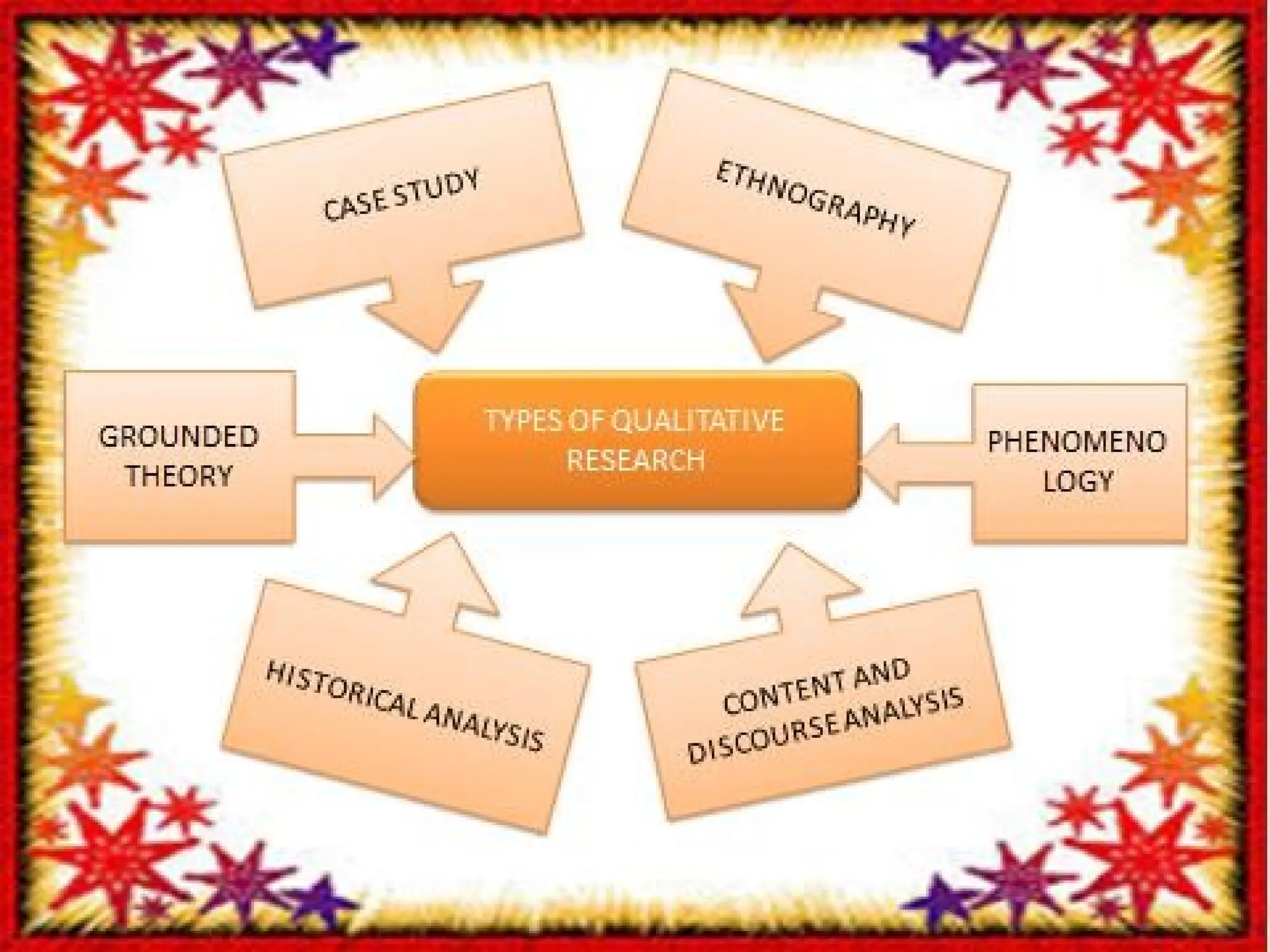
QUALITATIVE
RESEARCH
DESIGNS
PRACTICL RESEARCH 1
2ND
SEMESTER-2016-2017
COMPETENCY
• Choose appropriate qualitative research
design
OBJECTIVES:
A. Identify the different qualitative designs
B. Differentiate the types of descriptive designs
C. Choose critically the appropriate research
design in the study
1. HISTORICAL DESIGN- A research that
integrates narrative or descriptive past
events or facts written in the spirit of
critical inquiry fro the whole truth.
2. EXPERIMENTAL DESIGN- A problem-
solving approach that the study is
described in the future on what will be
when variables are carefully controlled
or manipulated.
3. CASE STUDY DESIGN- is a problem solving
techniques wherein the study is described
from the past, present, and future.
- is an intensive investigation of a
particular individual, institution, community,
or any group considered as a unit which
includes the developmental adjustment,
remedial, or corrective procedure that
suitably follows diagnose of the cause of
maladjustment or of favorable development.
4. DESCRIPTIVE DESIGN- the study focuses at
the present with the purpose to find a new
truth.
- The truth may have different forms such as
increased quantity of knowledge, a new
generalization or a new “law,” an increased
insight into factors which are operating, the
discovery of a new causal relationship, a more
accurate formulation of the problem to be
solved, and many others.
• DESCRIPTIVE RESEARCHES ARE VALUABLE
IN…
1. providing facts on which scientific judgments
may be based.
2. providing essential knowledge about the
nature of objects and persons.
3. for closer observation into the practices,
behavior, methods and procedures.
4. playing a large part in the development of
instruments for the measurement of many
things.
5. formulating of policies in the local, national,
or international level.
TYPES OF DESCRIPTIVE DESIGNS
1. DESCRIPTIVE- SURVEY- Suitable
wherever the subjects vary
among themselves and one is
interested to know the extent to
which different conditions and
situations are obtained among
these subjects.
2. DESCRIPTIVE- NORMATIVE SURVEY
- frequently made to ascertain the
normal or typical condition for
practice, or to compare local test
results with a state or normal norm.
- the results and findings of the study
should be compared with the norm.
3. DESCRIPTIVE- STATUS
- This approach to problem-
solving seeks to answer questions
to real facts relating to existing
conditions.
- stress current conditions with
the assumption that things will
change.
4. DESCRIPTIVE- ANALYSIS
- Determines or describes the nature of
an object by separating it into its parts.
- Its purpose is to discover the nature of
things.
5. DESCRIPTIVE- CLASSIFICATION
- This method is employed in natural
sciences like Biology, Botany, Zoology and
others.
6. DESCRIPTIVE- EVALUATIVE
- This design is to appraise carefully
the worthiness of the current study
7. EVALUATIVE- COMPARATIVE
- This is a design where the
researcher considers two variables and
establishes a formal procedure to
compare and conclude that one is
better than the other.
8. CORRELATIONAL SURVEY
- This is designed to determine the relationship
of two variables (X and Y) whether the
relationship is perfect, very high, high marked or
moderate, slight or negligible.
9. LONGITUDINAL SURVEY
- This involves much time allotted for
investigation of the same subjects of two or
more points in time.
APPLICATION
• BRAINSTORM WITH YOUR GROUP
THE APPROPRIATE RESEARCH
DESIGN IN YOUR STUDY. THEN
EXPLAIN ITS RELEVANVE TO YOUR
STUDY.
ASSESSMENT
• PRESENTATION OF GROUP’S
RESEARCH DESIGN
ASSIGMENT
•CRAFT YOUR
RESEARCH
METHODOLOGY
CONCLUDING ACTIVITY

PRACTICAL RESEARCH qualitative research design.pptx

  • 1.
  • 2.
    COMPETENCY • Choose appropriatequalitative research design OBJECTIVES: A. Identify the different qualitative designs B. Differentiate the types of descriptive designs C. Choose critically the appropriate research design in the study
  • 4.
    1. HISTORICAL DESIGN-A research that integrates narrative or descriptive past events or facts written in the spirit of critical inquiry fro the whole truth. 2. EXPERIMENTAL DESIGN- A problem- solving approach that the study is described in the future on what will be when variables are carefully controlled or manipulated.
  • 5.
    3. CASE STUDYDESIGN- is a problem solving techniques wherein the study is described from the past, present, and future. - is an intensive investigation of a particular individual, institution, community, or any group considered as a unit which includes the developmental adjustment, remedial, or corrective procedure that suitably follows diagnose of the cause of maladjustment or of favorable development.
  • 6.
    4. DESCRIPTIVE DESIGN-the study focuses at the present with the purpose to find a new truth. - The truth may have different forms such as increased quantity of knowledge, a new generalization or a new “law,” an increased insight into factors which are operating, the discovery of a new causal relationship, a more accurate formulation of the problem to be solved, and many others.
  • 7.
    • DESCRIPTIVE RESEARCHESARE VALUABLE IN… 1. providing facts on which scientific judgments may be based. 2. providing essential knowledge about the nature of objects and persons. 3. for closer observation into the practices, behavior, methods and procedures. 4. playing a large part in the development of instruments for the measurement of many things. 5. formulating of policies in the local, national, or international level.
  • 8.
    TYPES OF DESCRIPTIVEDESIGNS 1. DESCRIPTIVE- SURVEY- Suitable wherever the subjects vary among themselves and one is interested to know the extent to which different conditions and situations are obtained among these subjects.
  • 9.
    2. DESCRIPTIVE- NORMATIVESURVEY - frequently made to ascertain the normal or typical condition for practice, or to compare local test results with a state or normal norm. - the results and findings of the study should be compared with the norm.
  • 10.
    3. DESCRIPTIVE- STATUS -This approach to problem- solving seeks to answer questions to real facts relating to existing conditions. - stress current conditions with the assumption that things will change.
  • 11.
    4. DESCRIPTIVE- ANALYSIS -Determines or describes the nature of an object by separating it into its parts. - Its purpose is to discover the nature of things. 5. DESCRIPTIVE- CLASSIFICATION - This method is employed in natural sciences like Biology, Botany, Zoology and others.
  • 12.
    6. DESCRIPTIVE- EVALUATIVE -This design is to appraise carefully the worthiness of the current study 7. EVALUATIVE- COMPARATIVE - This is a design where the researcher considers two variables and establishes a formal procedure to compare and conclude that one is better than the other.
  • 13.
    8. CORRELATIONAL SURVEY -This is designed to determine the relationship of two variables (X and Y) whether the relationship is perfect, very high, high marked or moderate, slight or negligible. 9. LONGITUDINAL SURVEY - This involves much time allotted for investigation of the same subjects of two or more points in time.
  • 14.
    APPLICATION • BRAINSTORM WITHYOUR GROUP THE APPROPRIATE RESEARCH DESIGN IN YOUR STUDY. THEN EXPLAIN ITS RELEVANVE TO YOUR STUDY.
  • 15.
    ASSESSMENT • PRESENTATION OFGROUP’S RESEARCH DESIGN
  • 16.
  • 17.