Oral Communication in
Context
Oral Communication 1 1
Dear Heavenly Father,
As we gather for this class, we ask
for your guidance and wisdom.
Help us to learn with open minds,
share with kindness, and support
each other in our journey. May we
use this time to grow and achieve
our best.
Amen.
P
r
a
y
e
r
Greetings
Checking of
attedance
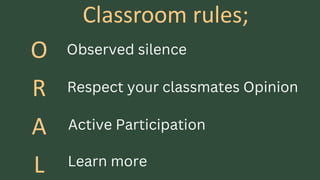
Classroom rules;
O
R
A
L
Observed silence
Respect your classmates Opinion
Active Participation
Learn more
REVIEW
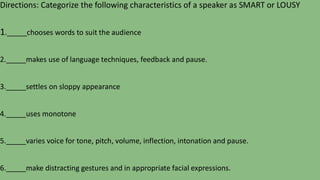
Directions: Categorize the following characteristics of a speaker as SMART or LOUSY
1._____chooses words to suit the audience
2._____makes use of language techniques, feedback and pause.
3._____settles on sloppy appearance
4._____uses monotone
5._____varies voice for tone, pitch, volume, inflection, intonation and pause.
6._____make distracting gestures and in appropriate facial expressions.
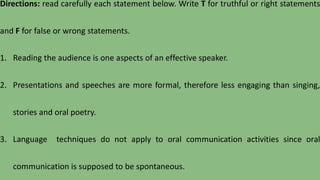
Directions: read carefully each statement below. Write T for truthful or right statements
and F for false or wrong statements.
1. Reading the audience is one aspects of an effective speaker.
2. Presentations and speeches are more formal, therefore less engaging than singing,
stories and oral poetry.
3. Language techniques do not apply to oral communication activities since oral
communication is supposed to be spontaneous.
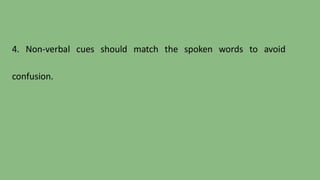
4. Non-verbal cues should match the spoken words to avoid
confusion.
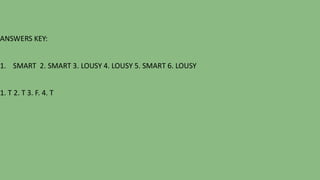
ANSWERS KEY:
1. SMART 2. SMART 3. LOUSY 4. LOUSY 5. SMART 6. LOUSY
1. T 2. T 3. F. 4. T
Motivational Activity
Activity 1 - (Low Whispers)
The class will be divided into three groups. In this game,
participants sit in a line, and one person starts by
whispering a message to the next person. Each person
then passes the message along by whispering it to the
next player. The last person says the message aloud wins,
and everyone compares it to the original message to see
how it has changed during the relay. This game highlights
how messages can become distorted as they are passed
from one person to another.
Learning Objectives;
Classify oral communication
activities;
Describe and give examples
of each type;
The students should be organize a 2 50-word essay as
objective evaluation to the types of oral communication
situations; and able to show appreciation to themselves
through writing a letter.
01
02
03
04
Specifically, after working on this module, you should be
able to do the following:
Perform tasks with confidence.
Oral Communication
in Context
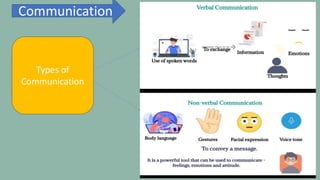
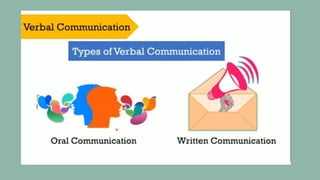
What is oral
communication
Oral communication involves
exchanging information through
spoken words, tailored to the
context, audience, and setting to
achieve specific goals like
informing, persuading, or
entertaining. Effective
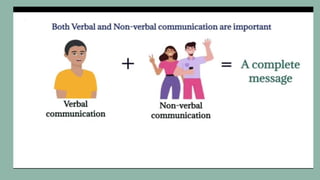
communication requires attention
to non-verbal cues and feedback
to ensure the message is clear
and appropriately received.
Communication
Types of
Communication
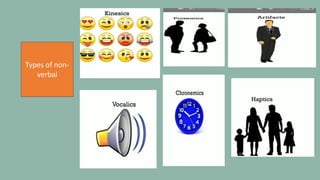
Types of non-
verbal
Six Types of Oral
Communication
Activities
One-on-One Speaking (Student-Student or Student-
Teacher
This can range from moments punctuating a lecture, where students are
asked to discuss or explain some question or problem with the person next to
them, to formal student conferences with their instructor.
Examples: Interviews, Confession, Telephone calls
Small-Group or Team-
Based Oral Work
• Smaller-scale settings for discussion,
deliberation, and problem solving.
• Appropriate for smaller classes and
allows levels of participation.
• Small group or team based oral work
encourages collaboration and
participation among individuals within
the group.
• Examples: Group reporting, Group
activities, Role-playing in smaller
groups
Full-Class Discussions
(Teacher or Student-Led)
• Typically, it is less agonistic, argument-based,
and competitive than debate and deliberation
but still dialogic in character.
• Often creates an atmosphere of collective, out-
loud thinking about some question, idea,
problem, text, event, or artifact.
• A good way to encourage active learning.
• Examples: Classroom setting either student led
or teacher led and Meetings
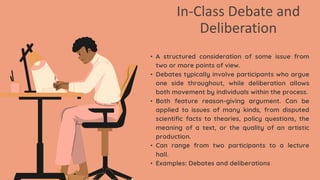
In-Class Debate and
Deliberation
• A structured consideration of some issue from
two or more points of view.
• Debates typically involve participants who argue
one side throughout, while deliberation allows
both movement by individuals within the process.
• Both feature reason-giving argument. Can be
applied to issues of many kinds, from disputed
scientific facts to theories, policy questions, the
meaning of a text, or the quality of an artistic
production.
• Can range from two participants to a lecture
hall.
• Examples: Debates and deliberations
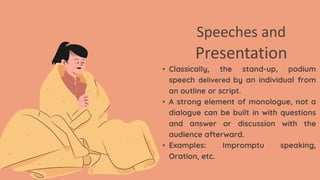
Speeches and
Presentation
• Classically, the stand-up, podium
speech delivered by an individual from
an outline or script.
• A strong element of monologue, not a
dialogue can be built in with questions
and answer or discussion with the
audience afterward.
• Examples: Impromptu speaking,
Oration, etc.
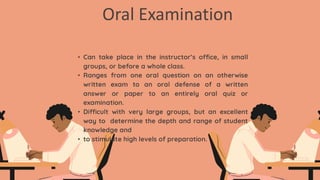
Oral Examination
• Can take place in the instructor’s office, in small
groups, or before a whole class.
• Ranges from one oral question on an otherwise
written exam to an oral defense of a written
answer or paper to an entirely oral quiz or
examination.
• Difficult with very large groups, but an excellent
way to determine the depth and range of student
knowledge and
• to stimulate high levels of preparation.
Other sample oral activites:
Oral poetry - contains most of the elements
found in written poetry. Aside from rhythm, it
also uses figurative language. The
difference is, it is delivered or performed to
a live audience, hence, the body language
and emotions are better expressed,
creating a higher degree of response
among the listeners. Some features of oral
poetry are tone, meter, repetition, inflection,
mood and it perfects imagery.
2. Songs - do not differ much from oral poetry. Songs
play a huge role in communication. It has religious,
social and political functions. It has similar features to
poetry added the lyrical element. A special musical
feature found in many different genres of music is
syncopation, an artistic play of rhythm, deviating from
the natural flow. Rap is a popular style of popular music
that magnifies the use of syncopation. It’s grooving
effect appeals mostly to young people.
Storytelling- is roughly defined as the sharing
of events and experiences that is meant to
entertain, inform, as well as to teach morals. By
stories, we may avoid communication barriers
by passing morals to children and young adults
indirectly. Everyone loves a good gossip or
story. It is a safe and brilliant way to keep the
children at home.
Activity 2 - Write me up!!
In this activity, the class will be
divided into six groups. In your own
words, briefly describe each type of
oral communication activity and give
examples each. Use your notebook to
accomplish this. Write a 2 50- word
essay about your understanding on
the types of oral communication
activities in relation to purposes of
oral communication.
Assessment
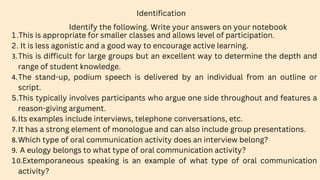
Identify the following. Write your answers on your notebook
Identification
1.This is appropriate for smaller classes and allows level of participation.
2. It is less agonistic and a good way to encourage active learning.
3.This is difficult for large groups but an excellent way to determine the depth and
range of student knowledge.
4.The stand-up, podium speech is delivered by an individual from an outline or
script.
5.This typically involves participants who argue one side throughout and features a
reason-giving argument.
6.Its examples include interviews, telephone conversations, etc.
7.It has a strong element of monologue and can also include group presentations.
8.Which type of oral communication activity does an interview belong?
9. A eulogy belongs to what type of oral communication activity?
10.Extemporaneous speaking is an example of what type of oral communication
activity?
Enumerate at least 5 types of oral communication activities.
Each number is contains 2 points
Enumeration
Think Critically
for 5 points
Essay
Think Critically
Essay
How do the different formats of oral communication—such
as one-on-one speaking, small-group discussions, full-class
dialogues, debates, and speeches—impact the
effectiveness of student engagement and learning
outcomes in various educational settings?
Answer key
1.Small Group or Team-Based oral work
2.Full-Class Discussion
3.Oral Examination
4.Speeches and Presentations
5.In-class debate and deliberation
6.One-to-one Speaking
7.Speeches and Presentations
8.One-to-one Speaking
9.Speeches and Presentations
10.Speeches and Presentations
Performance
Choose of any the following exercises.
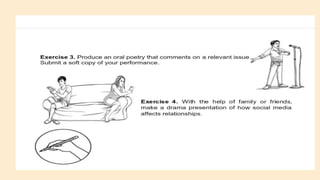
Exercise 1. Tell a story about communication barriers at home ,
film yourself and showcase and submit it to your teacher. you
may choose your own interest.
Exercise 2. Make a musical production with original lyrics and film
with the help of your family or friends. you can talk about
someone or something worth acknowledging, you may choose any
musical genre.
Thank you for
listening!
Oral Communication 1 1

Week-5-Sample Oral Communication.pdf ppt

  • 1.
  • 2.
    Dear Heavenly Father, Aswe gather for this class, we ask for your guidance and wisdom. Help us to learn with open minds, share with kindness, and support each other in our journey. May we use this time to grow and achieve our best. Amen. P r a y e r
  • 3.
  • 4.
  • 5.
    Classroom rules; O R A L Observed silence Respectyour classmates Opinion Active Participation Learn more
  • 6.
  • 7.
    Directions: Categorize thefollowing characteristics of a speaker as SMART or LOUSY 1._____chooses words to suit the audience 2._____makes use of language techniques, feedback and pause. 3._____settles on sloppy appearance 4._____uses monotone 5._____varies voice for tone, pitch, volume, inflection, intonation and pause. 6._____make distracting gestures and in appropriate facial expressions.
  • 8.
    Directions: read carefullyeach statement below. Write T for truthful or right statements and F for false or wrong statements. 1. Reading the audience is one aspects of an effective speaker. 2. Presentations and speeches are more formal, therefore less engaging than singing, stories and oral poetry. 3. Language techniques do not apply to oral communication activities since oral communication is supposed to be spontaneous.
  • 9.
    4. Non-verbal cuesshould match the spoken words to avoid confusion.
  • 10.
    ANSWERS KEY: 1. SMART2. SMART 3. LOUSY 4. LOUSY 5. SMART 6. LOUSY 1. T 2. T 3. F. 4. T
  • 11.
  • 12.
    Motivational Activity Activity 1- (Low Whispers) The class will be divided into three groups. In this game, participants sit in a line, and one person starts by whispering a message to the next person. Each person then passes the message along by whispering it to the next player. The last person says the message aloud wins, and everyone compares it to the original message to see how it has changed during the relay. This game highlights how messages can become distorted as they are passed from one person to another.
  • 13.
    Learning Objectives; Classify oralcommunication activities; Describe and give examples of each type; The students should be organize a 2 50-word essay as objective evaluation to the types of oral communication situations; and able to show appreciation to themselves through writing a letter. 01 02 03 04 Specifically, after working on this module, you should be able to do the following: Perform tasks with confidence.
  • 14.
  • 15.
    What is oral communication Oralcommunication involves exchanging information through spoken words, tailored to the context, audience, and setting to achieve specific goals like informing, persuading, or entertaining. Effective communication requires attention to non-verbal cues and feedback to ensure the message is clear and appropriately received.
  • 16.
  • 18.
  • 20.
    Six Types ofOral Communication Activities
  • 21.
    One-on-One Speaking (Student-Studentor Student- Teacher This can range from moments punctuating a lecture, where students are asked to discuss or explain some question or problem with the person next to them, to formal student conferences with their instructor. Examples: Interviews, Confession, Telephone calls
  • 22.
    Small-Group or Team- BasedOral Work • Smaller-scale settings for discussion, deliberation, and problem solving. • Appropriate for smaller classes and allows levels of participation. • Small group or team based oral work encourages collaboration and participation among individuals within the group. • Examples: Group reporting, Group activities, Role-playing in smaller groups
  • 23.
    Full-Class Discussions (Teacher orStudent-Led) • Typically, it is less agonistic, argument-based, and competitive than debate and deliberation but still dialogic in character. • Often creates an atmosphere of collective, out- loud thinking about some question, idea, problem, text, event, or artifact. • A good way to encourage active learning. • Examples: Classroom setting either student led or teacher led and Meetings
  • 24.
    In-Class Debate and Deliberation •A structured consideration of some issue from two or more points of view. • Debates typically involve participants who argue one side throughout, while deliberation allows both movement by individuals within the process. • Both feature reason-giving argument. Can be applied to issues of many kinds, from disputed scientific facts to theories, policy questions, the meaning of a text, or the quality of an artistic production. • Can range from two participants to a lecture hall. • Examples: Debates and deliberations
  • 25.
    Speeches and Presentation • Classically,the stand-up, podium speech delivered by an individual from an outline or script. • A strong element of monologue, not a dialogue can be built in with questions and answer or discussion with the audience afterward. • Examples: Impromptu speaking, Oration, etc.
  • 26.
    Oral Examination • Cantake place in the instructor’s office, in small groups, or before a whole class. • Ranges from one oral question on an otherwise written exam to an oral defense of a written answer or paper to an entirely oral quiz or examination. • Difficult with very large groups, but an excellent way to determine the depth and range of student knowledge and • to stimulate high levels of preparation.
  • 27.
    Other sample oralactivites: Oral poetry - contains most of the elements found in written poetry. Aside from rhythm, it also uses figurative language. The difference is, it is delivered or performed to a live audience, hence, the body language and emotions are better expressed, creating a higher degree of response among the listeners. Some features of oral poetry are tone, meter, repetition, inflection, mood and it perfects imagery.
  • 28.
    2. Songs -do not differ much from oral poetry. Songs play a huge role in communication. It has religious, social and political functions. It has similar features to poetry added the lyrical element. A special musical feature found in many different genres of music is syncopation, an artistic play of rhythm, deviating from the natural flow. Rap is a popular style of popular music that magnifies the use of syncopation. It’s grooving effect appeals mostly to young people.
  • 29.
    Storytelling- is roughlydefined as the sharing of events and experiences that is meant to entertain, inform, as well as to teach morals. By stories, we may avoid communication barriers by passing morals to children and young adults indirectly. Everyone loves a good gossip or story. It is a safe and brilliant way to keep the children at home.
  • 30.
    Activity 2 -Write me up!! In this activity, the class will be divided into six groups. In your own words, briefly describe each type of oral communication activity and give examples each. Use your notebook to accomplish this. Write a 2 50- word essay about your understanding on the types of oral communication activities in relation to purposes of oral communication.
  • 31.
  • 32.
    Identify the following.Write your answers on your notebook Identification 1.This is appropriate for smaller classes and allows level of participation. 2. It is less agonistic and a good way to encourage active learning. 3.This is difficult for large groups but an excellent way to determine the depth and range of student knowledge. 4.The stand-up, podium speech is delivered by an individual from an outline or script. 5.This typically involves participants who argue one side throughout and features a reason-giving argument. 6.Its examples include interviews, telephone conversations, etc. 7.It has a strong element of monologue and can also include group presentations. 8.Which type of oral communication activity does an interview belong? 9. A eulogy belongs to what type of oral communication activity? 10.Extemporaneous speaking is an example of what type of oral communication activity?
  • 33.
    Enumerate at least5 types of oral communication activities. Each number is contains 2 points Enumeration
  • 34.
  • 35.
    Think Critically Essay How dothe different formats of oral communication—such as one-on-one speaking, small-group discussions, full-class dialogues, debates, and speeches—impact the effectiveness of student engagement and learning outcomes in various educational settings?
  • 36.
    Answer key 1.Small Groupor Team-Based oral work 2.Full-Class Discussion 3.Oral Examination 4.Speeches and Presentations 5.In-class debate and deliberation 6.One-to-one Speaking 7.Speeches and Presentations 8.One-to-one Speaking 9.Speeches and Presentations 10.Speeches and Presentations
  • 37.
    Performance Choose of anythe following exercises. Exercise 1. Tell a story about communication barriers at home , film yourself and showcase and submit it to your teacher. you may choose your own interest. Exercise 2. Make a musical production with original lyrics and film with the help of your family or friends. you can talk about someone or something worth acknowledging, you may choose any musical genre.
  • 39.