DEPARTMENT OF EDUCATION
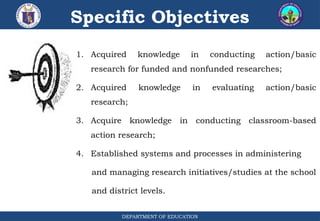
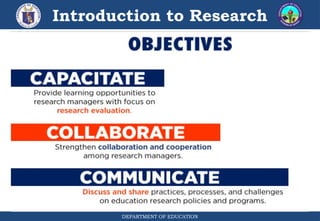
SpecificObjectives
1. Acquired knowledge in conducting action/basic
research for funded and nonfunded researches;
2. Acquired knowledge in evaluating action/basic
research;
3. Acquire knowledge in conducting classroom-based
action research;
4. Established systems and processes in administering
and managing research initiatives/studies at the school
and district levels.
8.
DEPARTMENT OF EDUCATION
Introductionto Research
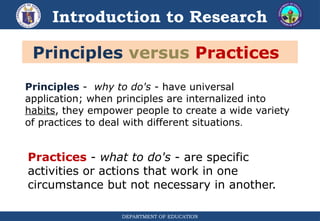
Principles versus Practices
Principles - why to do's - have universal
application; when principles are internalized into
habits, they empower people to create a wide variety
of practices to deal with different situations.
Practices - what to do's - are specific
activities or actions that work in one
circumstance but not necessary in another.
9.
DEPARTMENT OF EDUCATION
Introductionto Research
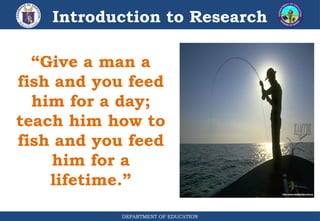
“Give a man a
fish and you feed
him for a day;
teach him how to
fish and you feed
him for a
lifetime.”
DEPARTMENT OF EDUCATION
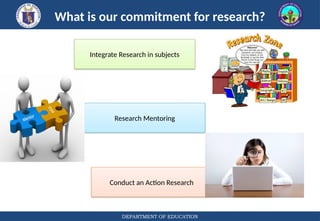
Whatis our commitment for research?
Conduct an Action Research
Integrate Research in subjects
Research Mentoring
20.
DEPARTMENT OF EDUCATION
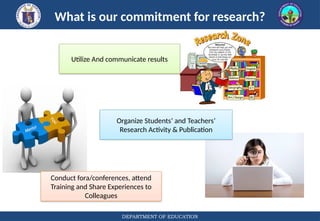
Whatis our commitment for research?
Conduct fora/conferences, attend
Training and Share Experiences to
Colleagues
Utilize And communicate results
Organize Students’ and Teachers’
Research Activity & Publication
21.
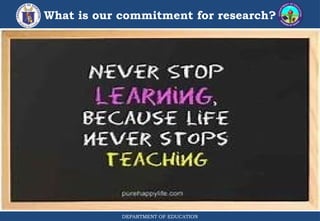
What is ourcommitment for research?
DEPARTMENT OF EDUCATION
22.
Rationale and Backgraound
DEPARTMENTOF EDUCATION
R.A. 9155
Chapter 1, Section 5:
“[DepEd] shall have authority,
accountability and responsibility for the
following:
…5. National educational research
and studies.”
DEPARTMENT OF EDUCATION
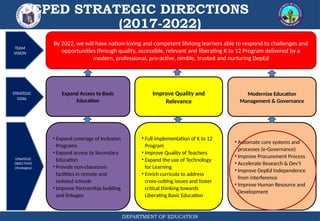
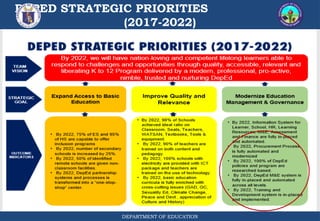
DEPEDSTRATEGIC DIRECTIONS
(2017-2022)
Expand Access to Basic
Education
Improve Quality and
Relevance
Modernize Education
Management & Governance
• Automate core systems and
processes (e-Governance)
• Improve Procurement Process
• Accelerate Research & Dev’t
• Improve DepEd Independence
from interference
• Improve Human Resource and
Development
• Expand coverage of Inclusion
Programs
• Expand access to Secondary
Education
• Provide non-classroom
facilities in remote and
isolated schools
• Improve Partnership building
and linkages
• Full implementation of K to 12
Program
• Improve Quality of Teachers
• Expand the use of Technology
for Learning
• Enrich curricula to address
cross-cutting issues and foster
critical thinking towards
Liberating Basic Education
By 2022, we will have nation-loving and competent lifelong learners able to respond to challenges and
opportunities through quality, accessible, relevant and liberating K to 12 Program delivered by a
modern, professional, pro-active, nimble, trusted and nurturing DepEd
TEAM
VISION
STRATEGIC
GOAL
STRATEGIC
OBJECTIVES
(Strategies)
Introduction to Research
DEPARTMENTOF EDUCATION
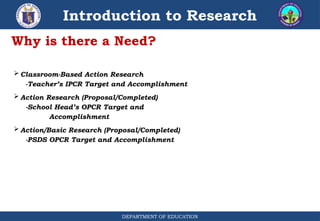
Classroom-Based Action Research
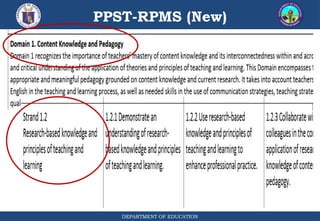
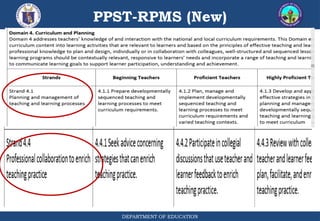
-Teacher’s IPCR Target and Accomplishment
Action Research (Proposal/Completed)
-School Head’s OPCR Target and
Accomplishment
Action/Basic Research (Proposal/Completed)
-PSDS OPCR Target and Accomplishment
Why is there a Need?
38.
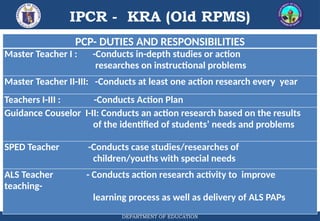
IPCR - KRA(Old RPMS)
DEPARTMENT OF EDUCATION
PCP- DUTIES AND RESPONSIBILITIES
Master Teacher I : -Conducts in-depth studies or action
researches on instructional problems
Master Teacher II-III: -Conducts at least one action research every year
Teachers I-III : -Conducts Action Plan
Guidance Couselor I-II: Conducts an action research based on the results
of the identified of students’ needs and problems
SPED Teacher -Conducts case studies/researches of
children/youths with special needs
ALS Teacher - Conducts action research activity to improve
teaching-
learning process as well as delivery of ALS PAPs
IPCR - KRA
DEPARTMENTOF EDUCATION
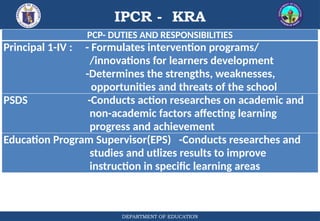
PCP- DUTIES AND RESPONSIBILITIES
Principal 1-IV : - Formulates intervention programs/
/innovations for learners development
-Determines the strengths, weaknesses,
opportunities and threats of the school
PSDS -Conducts action researches on academic and
non-academic factors affecting learning
progress and achievement
Education Program Supervisor(EPS) -Conducts researches and
studies and utlizes results to improve
instruction in specific learning areas
45.
IPCR - KRA
DEPARTMENTOF EDUCATION
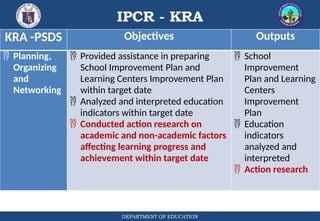
KRA -PSDS Objectives Outputs
Planning,
Organizing
and
Networking
Provided assistance in preparing
School Improvement Plan and
Learning Centers Improvement Plan
within target date
Analyzed and interpreted education
indicators within target date
Conducted action research on
academic and non-academic factors
affecting learning progress and
achievement within target date
School
Improvement
Plan and Learning
Centers
Improvement
Plan
Education
indicators
analyzed and
interpreted
Action research
46.
IPCR - KRA
DEPARTMENTOF EDUCATION
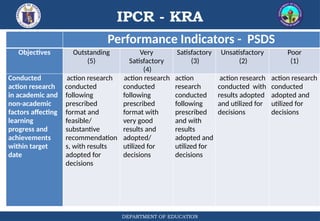
Performance Indicators - PSDS
Objectives Outstanding
(5)
Very
Satisfactory
(4)
Satisfactory
(3)
Unsatisfactory
(2)
Poor
(1)
Conducted
action research
in academic and
non-academic
factors affecting
learning
progress and
achievements
within target
date
action research
conducted
following
prescribed
format and
feasible/
substantive
recommendation
s, with results
adopted for
decisions
action research
conducted
following
prescribed
format with
very good
results and
adopted/
utilized for
decisions
action
research
conducted
following
prescribed
and with
results
adopted and
utilized for
decisions
action research
conducted with
results adopted
and utilized for
decisions
action research
conducted
adopted and
utilized for
decisions
47.
Introduction to Research
DEPARTMENTOF EDUCATION
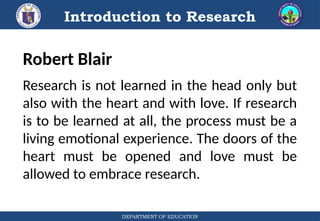
Robert Blair
Research is not learned in the head only but
also with the heart and with love. If research
is to be learned at all, the process must be a
living emotional experience. The doors of the
heart must be opened and love must be
allowed to embrace research.
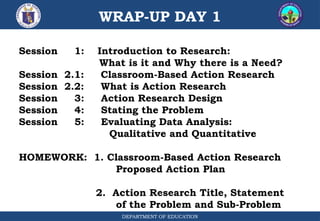
WRAP-UP DAY 1
DEPARTMENTOF EDUCATION
Session 1: Introduction to Research:
What is it and Why there is a Need?
Session 2.1: Classroom-Based Action Research
Session 2.2: What is Action Research
Session 3: Action Research Design
Session 4: Stating the Problem
Session 5: Evaluating Data Analysis:
Qualitative and Quantitative
HOMEWORK: 1. Classroom-Based Action Research
Proposed Action Plan
2. Action Research Title, Statement
of the Problem and Sub-Problem
50.
WRAP-UP DAY 1
DEPARTMENTOF EDUCATION
Officer of the Day for Day 2:
Opening Preliminaries
MOL
Energizer
SHS IMPLEMENTATION
DEPARTMENT OFEDUCATION
Daghang Salamat!
Presented by : Amelia L. Cortidor
Senior Education Program Specialist
Division Research Coordinator
Editor's Notes
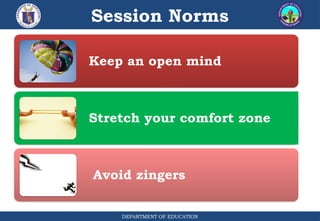
#5 Keeping an open mind is one of the most difficult things to practice. It means you are open to everyone and everything that comes your way, allowing yourself to embrace different possibilities, opportunities, people, views, suggestions and interests.
it means doing things that you don't feel comfortable with doing. Getting outside of your comfort levels. I encourage you to push yourself in unfamiliar places, to do things that you wouldn't normally do.
Avoid zingers a clever, witty remark or a quick and clever comment that criticizes or insults someone
#8 Principle- is you learn HOW to do it; ways or manner in doing., extent or degree.
Practice - is WHAT to do and if you know HOW to do it, do it. Doing it, is practice.
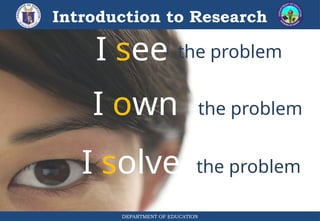
#10 You see so many problem in the school, but not all problems can be solved. Look for a problem which is realistic and researchable.
Own the problem because you want to inprove the situation. Its a persistent phenomenon.
Solve the problem, not let others solve it... Do research!
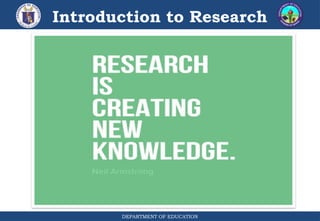
#11 What is research?... careful or diligent search.
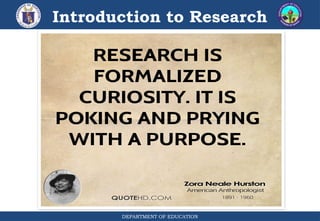
#12 What is research? Prying (adj.) Insistently or impertinently curious or inquisitive.
#14 Plagiarism - an act or instance of using or closely imitating the language and thoughts of another author without authorization and the representation of that author's work as one's own, as by not crediting the original author.
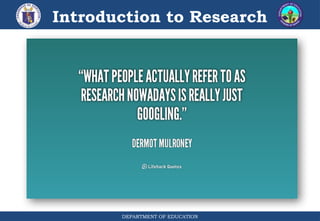
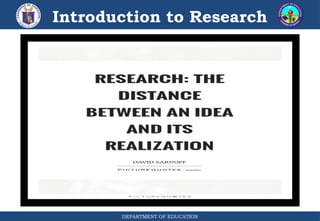
#15 Start with a concept or idea and look for a solution or the realization of that idea. The between there is the how... gathering of data, analyses, discussions of conclusion and recommendation, then action whcih is the realization.
#32 Long Term Goal is anchor to the the Global Goals which are the SDG - Sustainable Development Goals.
Why is there a need for research?
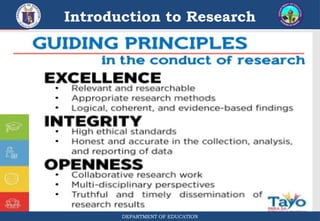
#36 We must always abide to Our belief/norm or standard and attitude in the conduct of a research.
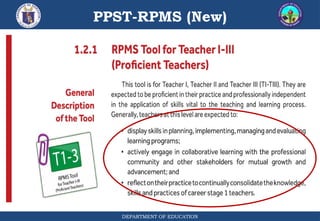
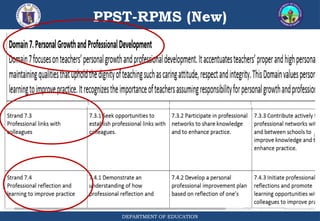
#39 By conducting classroom-based action research with action plan/s and or Action/Basic Researches, teachers are displaying skills in planning, implementing, evaluating learning programs;
Actively engage in colloborative learning;
Reflect their practices continuously.



![Rationale and Backgraound
DEPARTMENT OF EDUCATION
R.A. 9155
Chapter 1, Section 5:
“[DepEd] shall have authority,
accountability and responsibility for the
following:
…5. National educational research
and studies.”](https://image.slidesharecdn.com/session1-introductiontoresearchaug-sept-250302053920-65f7ff67/85/Session1-Introduction-to-Research_Aug-Sept-2018_final-pptx-22-320.jpg)






![ACTION RESEARCH SLIDES [Autosaved].pptx](https://cdn.slidesharecdn.com/ss_thumbnails/actionresearchslidesautosaved-221026022057-b77604cb-thumbnail.jpg?width=640&height=640&fit=bounds)


