Avoiding Plagiarism
Akmal Samsor
asamsor@jscs.af
What is plagiarism ?
• Plagiarism means using another’s work
without giving them credit and saying that it is
your own.
OR
• Presenting someone's words and/or ideas as
your own is called plagiarism.
Types of Plagiarism
1. Copying
2. Patchwork
3. Paraphrasing
4. Unintentional
Types of Plagiarism: Copying
• The most well-known, the most common and
simple type of plagiarism.
• If you copy someone else's work and put your
name on it, you have plagiarized.
Types: Patchwork Plagiarism
• The second most common type of
plagiarism is patchwork plagiarism.
• This occurs when the plagiarizer
borrows the "phrases and clauses from
the original source and weaves them
into his own writing” without putting
the phrases in quotation marks or
citing the author.
Types: Paraphrasing Plagiarism
• This occurs when the plagiarizer paraphrases or
summarizes another's work without citing the
source.
• Even changing the words a little or using synonyms
but retaining the author's essential thoughts,
sentence structure, and/or style without citing the
source is still considered plagiarism.
Types: Unintentional
• It occurs when the writer incorrectly quotes
and/or incorrectly cites a source they are
using.
How to Avoid Plagiarism?
• Avoiding plagiarism is quite simple.
• The best method for avoiding it is to simply be honest;
when you've used a source in your paper, give credit
where it's due.
• Acknowledge the author of the original work you've
used.
APA Citation
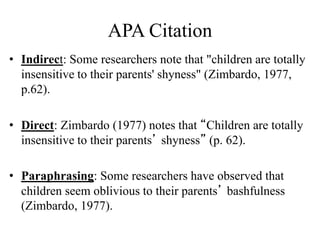
• Indirect: Some researchers note that "children are totally
insensitive to their parents' shyness" (Zimbardo, 1977,
p.62).
• Direct: Zimbardo (1977) notes that “Children are totally
insensitive to their parents’ shyness” (p. 62).
• Paraphrasing: Some researchers have observed that
children seem oblivious to their parents’ bashfulness
(Zimbardo, 1977).
Examples-Print
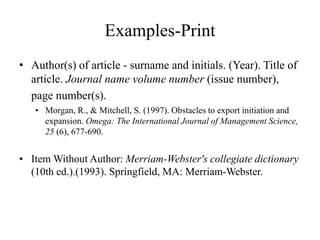
• Author(s) of article - surname and initials. (Year). Title of
article. Journal name volume number (issue number),
page number(s).
• Morgan, R., & Mitchell, S. (1997). Obstacles to export initiation and
expansion. Omega: The International Journal of Management Science,
25 (6), 677-690.
• Item Without Author: Merriam-Webster's collegiate dictionary
(10th ed.).(1993). Springfield, MA: Merriam-Webster.
Examples-Print (Book)
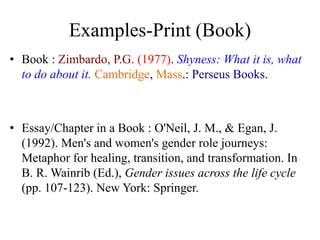
• Book : Zimbardo, P.G. (1977). Shyness: What it is, what
to do about it. Cambridge, Mass.: Perseus Books.
• Essay/Chapter in a Book : O'Neil, J. M., & Egan, J.
(1992). Men's and women's gender role journeys:
Metaphor for healing, transition, and transformation. In
B. R. Wainrib (Ed.), Gender issues across the life cycle
(pp. 107-123). New York: Springer.
Examples-Online
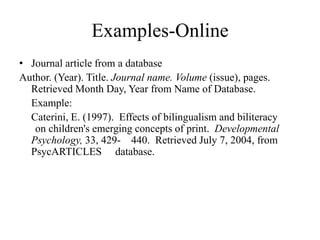
• Journal article from a database
Author. (Year). Title. Journal name. Volume (issue), pages.
Retrieved Month Day, Year from Name of Database.
Example:
Caterini, E. (1997). Effects of bilingualism and biliteracy
on children's emerging concepts of print. Developmental
Psychology, 33, 429- 440. Retrieved July 7, 2004, from
PsycARTICLES database.
Examples-Online
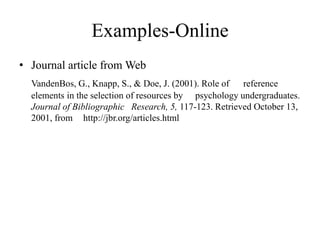
• Journal article from Web
VandenBos, G., Knapp, S., & Doe, J. (2001). Role of reference
elements in the selection of resources by psychology undergraduates.
Journal of Bibliographic Research, 5, 117-123. Retrieved October 13,
2001, from http://jbr.org/articles.html
When to Quote or Paraphrase or
Summarize ?
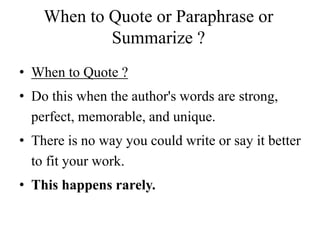
• When to Quote ?
• Do this when the author's words are strong,
perfect, memorable, and unique.
• There is no way you could write or say it better
to fit your work.
• This happens rarely.
When to Quote or Paraphrase or
Summarize ?
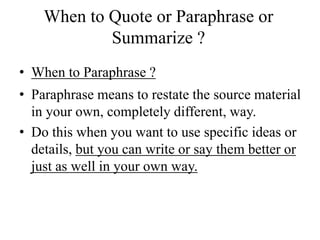
• When to Paraphrase ?
• Paraphrase means to restate the source material
in your own, completely different, way.
• Do this when you want to use specific ideas or
details, but you can write or say them better or
just as well in your own way.
When to Quote or Paraphrase or
Summarize ?
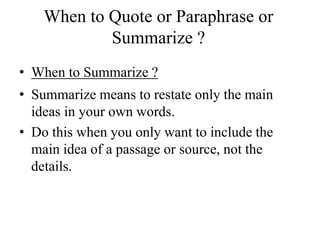
• When to Summarize ?
• Summarize means to restate only the main
ideas in your own words.
• Do this when you only want to include the
main idea of a passage or source, not the
details.
To Cite or not to Cite?
1. Delhi is the capital of India. [you read this in a book]
2. Capital punishment is wrong. [you think this and you saw it on a web
page]
3. 45% of brown dogs have fleas. [you learned this from the TV news]
4. Sardar Dawood Khan was the 5th prime minister of the Afghanistan[you
remember this]
5. Sardar Dawood Khan had two pairs of eyeglasses, a pen, and a wallet in
his pockets when he was killed. [you read this in a biography]
6. American University tuition fee will go up by 7% next year. [you learned
this in an interview with the dean]
7. American University is expensive compared to other state universities.
[you think this]
8. When elephants see blue, their heart rate increases [you read this
somewhere last year]
To Cite or not to Cite?
• There are two things that you do not need to
cite, even if you did find them in a source.
1. Your own thoughts and opinions
2. Common knowledge: This is something an
educated person should know OR could
easily find out.
Thank You
• Please Follow the detailed Guide Present in
Your Training Materials
FaceBook Group
Afghan Universities Research Group
(AURG)

How to Avoid Plagiarism ?

  • 1.
  • 2.
    What is plagiarism? • Plagiarism means using another’s work without giving them credit and saying that it is your own. OR • Presenting someone's words and/or ideas as your own is called plagiarism.
  • 4.
    Types of Plagiarism 1.Copying 2. Patchwork 3. Paraphrasing 4. Unintentional
  • 5.
    Types of Plagiarism:Copying • The most well-known, the most common and simple type of plagiarism. • If you copy someone else's work and put your name on it, you have plagiarized.
  • 6.
    Types: Patchwork Plagiarism •The second most common type of plagiarism is patchwork plagiarism. • This occurs when the plagiarizer borrows the "phrases and clauses from the original source and weaves them into his own writing” without putting the phrases in quotation marks or citing the author.
  • 7.
    Types: Paraphrasing Plagiarism •This occurs when the plagiarizer paraphrases or summarizes another's work without citing the source. • Even changing the words a little or using synonyms but retaining the author's essential thoughts, sentence structure, and/or style without citing the source is still considered plagiarism.
  • 8.
    Types: Unintentional • Itoccurs when the writer incorrectly quotes and/or incorrectly cites a source they are using.
  • 9.
    How to AvoidPlagiarism? • Avoiding plagiarism is quite simple. • The best method for avoiding it is to simply be honest; when you've used a source in your paper, give credit where it's due. • Acknowledge the author of the original work you've used.
  • 10.
    APA Citation • Indirect:Some researchers note that "children are totally insensitive to their parents' shyness" (Zimbardo, 1977, p.62). • Direct: Zimbardo (1977) notes that “Children are totally insensitive to their parents’ shyness” (p. 62). • Paraphrasing: Some researchers have observed that children seem oblivious to their parents’ bashfulness (Zimbardo, 1977).
  • 11.
    Examples-Print • Author(s) ofarticle - surname and initials. (Year). Title of article. Journal name volume number (issue number), page number(s). • Morgan, R., & Mitchell, S. (1997). Obstacles to export initiation and expansion. Omega: The International Journal of Management Science, 25 (6), 677-690. • Item Without Author: Merriam-Webster's collegiate dictionary (10th ed.).(1993). Springfield, MA: Merriam-Webster.
  • 12.
    Examples-Print (Book) • Book: Zimbardo, P.G. (1977). Shyness: What it is, what to do about it. Cambridge, Mass.: Perseus Books. • Essay/Chapter in a Book : O'Neil, J. M., & Egan, J. (1992). Men's and women's gender role journeys: Metaphor for healing, transition, and transformation. In B. R. Wainrib (Ed.), Gender issues across the life cycle (pp. 107-123). New York: Springer.
  • 13.
    Examples-Online • Journal articlefrom a database Author. (Year). Title. Journal name. Volume (issue), pages. Retrieved Month Day, Year from Name of Database. Example: Caterini, E. (1997). Effects of bilingualism and biliteracy on children's emerging concepts of print. Developmental Psychology, 33, 429- 440. Retrieved July 7, 2004, from PsycARTICLES database.
  • 14.
    Examples-Online • Journal articlefrom Web VandenBos, G., Knapp, S., & Doe, J. (2001). Role of reference elements in the selection of resources by psychology undergraduates. Journal of Bibliographic Research, 5, 117-123. Retrieved October 13, 2001, from http://jbr.org/articles.html
  • 15.
    When to Quoteor Paraphrase or Summarize ? • When to Quote ? • Do this when the author's words are strong, perfect, memorable, and unique. • There is no way you could write or say it better to fit your work. • This happens rarely.
  • 16.
    When to Quoteor Paraphrase or Summarize ? • When to Paraphrase ? • Paraphrase means to restate the source material in your own, completely different, way. • Do this when you want to use specific ideas or details, but you can write or say them better or just as well in your own way.
  • 17.
    When to Quoteor Paraphrase or Summarize ? • When to Summarize ? • Summarize means to restate only the main ideas in your own words. • Do this when you only want to include the main idea of a passage or source, not the details.
  • 18.
    To Cite ornot to Cite? 1. Delhi is the capital of India. [you read this in a book] 2. Capital punishment is wrong. [you think this and you saw it on a web page] 3. 45% of brown dogs have fleas. [you learned this from the TV news] 4. Sardar Dawood Khan was the 5th prime minister of the Afghanistan[you remember this] 5. Sardar Dawood Khan had two pairs of eyeglasses, a pen, and a wallet in his pockets when he was killed. [you read this in a biography] 6. American University tuition fee will go up by 7% next year. [you learned this in an interview with the dean] 7. American University is expensive compared to other state universities. [you think this] 8. When elephants see blue, their heart rate increases [you read this somewhere last year]
  • 19.
    To Cite ornot to Cite? • There are two things that you do not need to cite, even if you did find them in a source. 1. Your own thoughts and opinions 2. Common knowledge: This is something an educated person should know OR could easily find out.
  • 20.
    Thank You • PleaseFollow the detailed Guide Present in Your Training Materials
  • 21.

Editor's Notes

  • #19   Cite 3, 5, 6, 8 – you found this information somewhere AND it's not commonly known. Don't cite 1, 4 – common knowledge: even if you didn‟t know it, you could easily find it in many sources. Don't cite 2, 7 – your opinion.