SAMPLING DESIGN
J. JANARDHAN
CENSUS AND SAMPLE SURVEY
 In any field of inquiry constitute a ‘Universe’ or ‘Population’
 A complete enumeration of all items in the ‘population’ is known
as a census inquiry
 many a time it is not possible to examine complete population
 Sometimes, it is possible to obtain sufficiently accurate results by
study only a part of total population
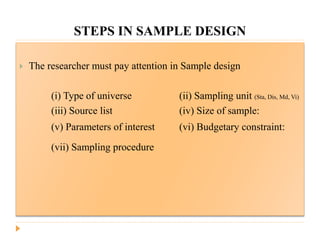
STEPS IN SAMPLE DESIGN
 The researcher must pay attention in Sample design
(i) Type of universe (ii) Sampling unit (Sta, Dis, Md, Vi)
(iii) Source list (iv) Size of sample:
(v) Parameters of interest (vi) Budgetary constraint:
(vii) Sampling procedure
CHARACTERISTICS OF
SAMPLE DESIGN
 (a) Sample design must result in a truly representative sample
 (b) It must be such which results in a small sampling error
 (c) it must be viable in the context of funds
 (d) It can be controlled in a better way
 (e) The results of the sample study can be applied, in general, for
 the universe with a reasonable level of confidence
DIFFERENT TYPES
 There are different types of sample designs
probability sampling
non-probability sampling
 Probability sampling is based on the concept of random selection
 non-probability sampling is ‘non-random’ sampling
 non-probability sampling is also having different types
deliberate sampling,
purposive sampling
judgment sampling
Quota sampling
PROBABILITY SAMPLING
 Every item of the universe has an equal chance
 By a lottery, individual units are picked up whole group
 we can measure the errors of estimation or the significance
 of results
 This fact brings out the superiority of random sampling design
 (a) It gives equal priority to each element in the population
 (b) It gives each possible sample combination an equal probability
of being chosen
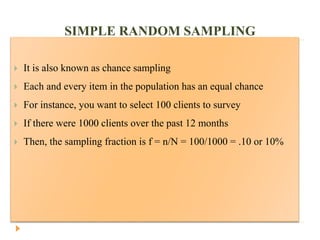
SIMPLE RANDOM SAMPLING
 It is also known as chance sampling
 Each and every item in the population has an equal chance
 For instance, you want to select 100 clients to survey
 If there were 1000 clients over the past 12 months
 Then, the sampling fraction is f = n/N = 100/1000 = .10 or 10%
STRATIFIED RANDOM SAMPLING
 It is used when the population does not constitute a homogeneous
group
 Under this sampling the population is divided into several sub-
populations ( ‘Strata’)
 We select items from each stratum to constitute a sample
 Since each stratum is more homogeneous than the total population
 We are able to get more precise estimates for each stratum
 Stratified sampling results in more reliable and detailed
information
SYSTEMATIC RANDOM SAMPLING
 (i) Systematic random sampling:
 The most practical way of sampling is to select every ith item on a
list.
 For instance, if a 4 per cent sample is desired,
 the first item would be selected randomly from the first twenty-
five
 Thereafter every 25th item would automatically be included in the
sample
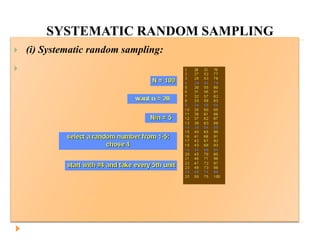
SYSTEMATIC RANDOM SAMPLING
 (i) Systematic random sampling:

COMPLEX RANDOM SAMPLING
(iii) Cluster sampling:
 If the total area of interest happens to be a big one
 Sample can be taken is to divide the area into a number of smaller
non-overlapping areas (clusters)
 Cluster sampling, no doubt, reduces cost
 Cluster sampling is used only because of the economic advantage
 But, certainly it is less precise than random sampling
(iv) Area sampling: If clusters happen to be some geographic sub-
divisions
(v) Multi-stage sampling: Banking Sector in India
COMPLEX RANDOM SAMPLING
 (vii) Sequential sampling:
 This sampling design is some what complex sample design.
 The ultimate size of the sample under this technique is not fixed
in advance,
 But is determined according to mathematical decision rules on the
basis of information yielded as survey progresses
QUOTA SAMPLING
 Taking random samples from individual strata is often so
expensive
 that interviewers are simply given quota to be filled from different
strata
 The actual selection is left to the interviewer’s judgment
 The size of the quota for each stratum is generally proportionate
to the size of that stratum in the population
 Quota samples generally happen to be judgment samples rather
than random samples
DELIBERATE SAMPLING
 Deliberate sampling is also known as purposive or non-
probability sampling
 This sampling method involves purposive or deliberate selection
of particular units
THANK YOU

Sample design 31.08.2017

  • 1.
  • 2.
    CENSUS AND SAMPLESURVEY  In any field of inquiry constitute a ‘Universe’ or ‘Population’  A complete enumeration of all items in the ‘population’ is known as a census inquiry  many a time it is not possible to examine complete population  Sometimes, it is possible to obtain sufficiently accurate results by study only a part of total population
  • 3.
    STEPS IN SAMPLEDESIGN  The researcher must pay attention in Sample design (i) Type of universe (ii) Sampling unit (Sta, Dis, Md, Vi) (iii) Source list (iv) Size of sample: (v) Parameters of interest (vi) Budgetary constraint: (vii) Sampling procedure
  • 4.
    CHARACTERISTICS OF SAMPLE DESIGN (a) Sample design must result in a truly representative sample  (b) It must be such which results in a small sampling error  (c) it must be viable in the context of funds  (d) It can be controlled in a better way  (e) The results of the sample study can be applied, in general, for  the universe with a reasonable level of confidence
  • 5.
    DIFFERENT TYPES  Thereare different types of sample designs probability sampling non-probability sampling  Probability sampling is based on the concept of random selection  non-probability sampling is ‘non-random’ sampling  non-probability sampling is also having different types deliberate sampling, purposive sampling judgment sampling Quota sampling
  • 6.
    PROBABILITY SAMPLING  Everyitem of the universe has an equal chance  By a lottery, individual units are picked up whole group  we can measure the errors of estimation or the significance  of results  This fact brings out the superiority of random sampling design  (a) It gives equal priority to each element in the population  (b) It gives each possible sample combination an equal probability of being chosen
  • 7.
    SIMPLE RANDOM SAMPLING It is also known as chance sampling  Each and every item in the population has an equal chance  For instance, you want to select 100 clients to survey  If there were 1000 clients over the past 12 months  Then, the sampling fraction is f = n/N = 100/1000 = .10 or 10%
  • 8.
    STRATIFIED RANDOM SAMPLING It is used when the population does not constitute a homogeneous group  Under this sampling the population is divided into several sub- populations ( ‘Strata’)  We select items from each stratum to constitute a sample  Since each stratum is more homogeneous than the total population  We are able to get more precise estimates for each stratum  Stratified sampling results in more reliable and detailed information
  • 9.
    SYSTEMATIC RANDOM SAMPLING (i) Systematic random sampling:  The most practical way of sampling is to select every ith item on a list.  For instance, if a 4 per cent sample is desired,  the first item would be selected randomly from the first twenty- five  Thereafter every 25th item would automatically be included in the sample
  • 10.
    SYSTEMATIC RANDOM SAMPLING (i) Systematic random sampling: 
  • 11.
    COMPLEX RANDOM SAMPLING (iii)Cluster sampling:  If the total area of interest happens to be a big one  Sample can be taken is to divide the area into a number of smaller non-overlapping areas (clusters)  Cluster sampling, no doubt, reduces cost  Cluster sampling is used only because of the economic advantage  But, certainly it is less precise than random sampling (iv) Area sampling: If clusters happen to be some geographic sub- divisions (v) Multi-stage sampling: Banking Sector in India
  • 12.
    COMPLEX RANDOM SAMPLING (vii) Sequential sampling:  This sampling design is some what complex sample design.  The ultimate size of the sample under this technique is not fixed in advance,  But is determined according to mathematical decision rules on the basis of information yielded as survey progresses
  • 13.
    QUOTA SAMPLING  Takingrandom samples from individual strata is often so expensive  that interviewers are simply given quota to be filled from different strata  The actual selection is left to the interviewer’s judgment  The size of the quota for each stratum is generally proportionate to the size of that stratum in the population  Quota samples generally happen to be judgment samples rather than random samples
  • 14.
    DELIBERATE SAMPLING  Deliberatesampling is also known as purposive or non- probability sampling  This sampling method involves purposive or deliberate selection of particular units
  • 15.