CLOUDBURST IN
UTTARAKHAND
APPLYING PRINCIPLE OF SIX
THINKING HATS TO PREPARE A
REPORT
De Bono’s 6 Thinking Hats
Dr EDWARD DE BONO
Edward de Bono (born 19 May 1933) is
a Maltese physician, author, inventor and consultant. He
originated the term lateral thinking, wrote the book Six
Thinking Hats and is a proponent of the teaching of thinking
as a subject in schools.
Professor de Bono has held faculty appointments at the
universities of Oxford, Cambridge, London and Harvard.
He has written 57 books with translations into 34
languages. He has taught his thinking methods to
government agencies, corporate clients, organizations
and individuals, privately or publicly in group sessions
THE SIX THIKING HATS
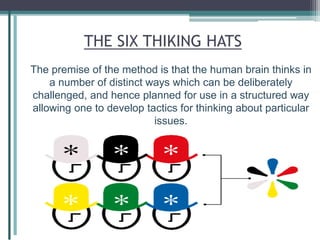
The premise of the method is that the human brain thinks in
a number of distinct ways which can be deliberately
challenged, and hence planned for use in a structured way
allowing one to develop tactics for thinking about particular
issues.
Six distinct directions are identified and assigned a
colour.
Managing Blue - what is the subject? what are we
thinking about? what is the goal?
Information White - considering purely what
information is available, what are the facts?
• Emotions Red - intuitive or instinctive gut reactions or
statements of emotional feeling (but not any justification) .
• Discernment Black - logic applied to identifying reasons to
be cautious and conservative
• Optimistic response Yellow - logic applied to identifying
benefits, seeking harmony
• Creativity Green - statements of provocation and
investigation, seeing where a thought goes.
WE MASKE USE OF THE DE BONO’S
SIX THINKING HATS TO ANALIZE A
SITUATION OR A HAPPENING IN
SURROUNDINGS.
WE APPLY THIS CONCEPT TO
CONDUCT A CRITICAL STUDY BEFORE
WRITING A REPORT(.i.e On cloudburst
in Uttarakhand)
THIS ENABLES US TO FOLLOW A
STRATEGY WHICH MAKES THE
REPORT CLEAN AND COMPLETE
CLOUDBUR
ST
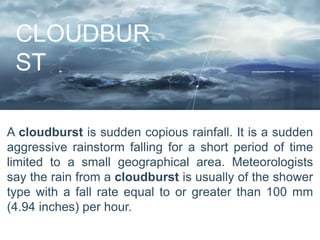
A cloudburst is sudden copious rainfall. It is a sudden
aggressive rainstorm falling for a short period of time
limited to a small geographical area. Meteorologists
say the rain from a cloudburst is usually of the shower
type with a fall rate equal to or greater than 100 mm
(4.94 inches) per hour.
In June 2013, a multi-day cloudburst cantered on
the North Indian state, Uttarakhand caused
devastating floods and landslides becoming the
country's worst natural disaster since the 2004
tsunami
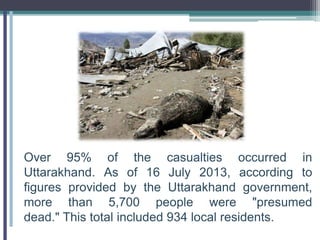
Over 95% of the casualties occurred in
Uttarakhand. As of 16 July 2013, according to
figures provided by the Uttarakhand government,
more than 5,700 people were "presumed
dead." This total included 934 local residents.
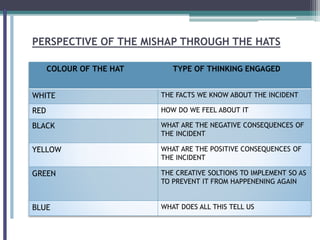
PERSPECTIVE OF THE MISHAP THROUGH THE HATS
COLOUR OF THE HAT TYPE OF THINKING ENGAGED
WHITE THE FACTS WE KNOW ABOUT THE INCIDENT
RED HOW DO WE FEEL ABOUT IT
BLACK WHAT ARE THE NEGATIVE CONSEQUENCES OF
THE INCIDENT
YELLOW WHAT ARE THE POSITIVE CONSEQUENCES OF
THE INCIDENT
GREEN THE CREATIVE SOLTIONS TO IMPLEMENT SO AS
TO PREVENT IT FROM HAPPENENING AGAIN
BLUE WHAT DOES ALL THIS TELL US
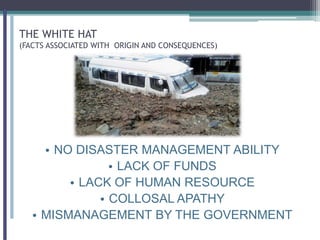
THE WHITE HAT
(FACTS ASSOCIATED WITH ORIGIN AND CONSEQUENCES)
• NO DISASTER MANAGEMENT ABILITY
• LACK OF FUNDS
• LACK OF HUMAN RESOURCE
• COLLOSAL APATHY
• MISMANAGEMENT BY THE GOVERNMENT
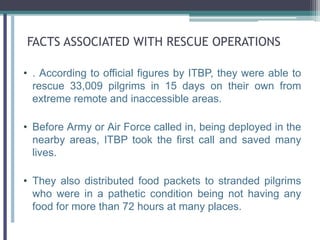
FACTS ASSOCIATED WITH RESCUE OPERATIONS
• . According to official figures by ITBP, they were able to
rescue 33,009 pilgrims in 15 days on their own from
extreme remote and inaccessible areas.
• Before Army or Air Force called in, being deployed in the
nearby areas, ITBP took the first call and saved many
lives.
• They also distributed food packets to stranded pilgrims
who were in a pathetic condition being not having any
food for more than 72 hours at many places.
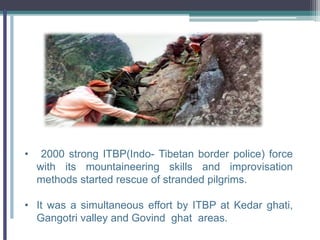
• 2000 strong ITBP(Indo- Tibetan border police) force
with its mountaineering skills and improvisation
methods started rescue of stranded pilgrims.
• It was a simultaneous effort by ITBP at Kedar ghati,
Gangotri valley and Govind ghat areas.
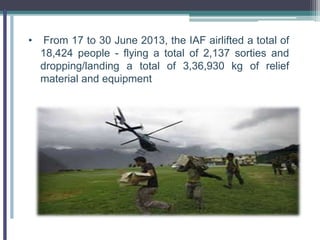
• From 17 to 30 June 2013, the IAF airlifted a total of
18,424 people - flying a total of 2,137 sorties and
dropping/landing a total of 3,36,930 kg of relief
material and equipment
THE RED HAT (FEELINGS RELATED TO THE INCIDENT)
• THE ENVIRONMENTALIST’S TAKE-
• The mishap was attributed, by environmentalists, to
unscientific developmental activities undertaken in
recent decades contributing to high level of loss of
property and lives.
• Roads constructed in haphazard style, new resorts and
hotels built on fragile river banks and more than 70
hydroelectric projects in the watersheds of the state led
to……
• A "DISASTER WAITING TO HAPPEN" as termed by
certain environmentalists.
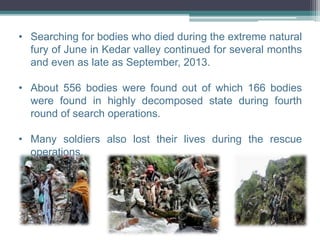
• Searching for bodies who died during the extreme natural
fury of June in Kedar valley continued for several months
and even as late as September, 2013.
• About 556 bodies were found out of which 166 bodies
were found in highly decomposed state during fourth
round of search operations.
• Many soldiers also lost their lives during the rescue
operations.
THE BLACK HAT(NEGATIVE CONSEQUENCES OF INCIDENT)
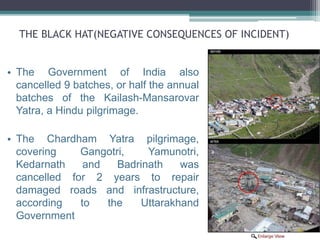
• The Government of India also
cancelled 9 batches, or half the annual
batches of the Kailash-Mansarovar
Yatra, a Hindu pilgrimage.
• The Chardham Yatra pilgrimage,
covering Gangotri, Yamunotri,
Kedarnath and Badrinath was
cancelled for 2 years to repair
damaged roads and infrastructure,
according to the Uttarakhand
Government
• Government agencies and priests of Kedarnath temple
were planning mass cremation of the hundreds of victims,
after one week of tragedy.
• Local youths from several affected villages near Gangotri
helped stranded tourists and pilgrims, by sending
messages to their places and by providing food.
• Rescuers also retrieved approximately 10
million (US$160,000) and other jewellery from local
persons, including some people dressed like sadhu
babas, who reportedly collected it from a destroyed
building of a Bank and damaged shops.
YELLOW HAT(THE POSITIVE CONSEQUENCES)
• As a cloudburst is a natural calamity , a positive emphasis
on the incident is quiet unnatural.
• And as any calamity happens , we cannot rule out obvious
reasons that caused the mishap to occur.
• But this would serve as an example for the ignorance of
mother nature by the human race .
• The government cancelled the permission of construction
of almost 70 hydroelectric power plants after the mishap.
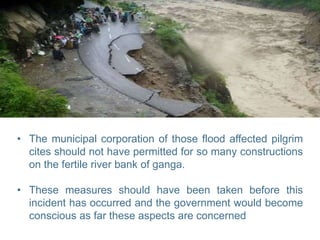
• The municipal corporation of those flood affected pilgrim
cites should not have permitted for so many constructions
on the fertile river bank of ganga.
• These measures should have been taken before this
incident has occurred and the government would become
conscious as far these aspects are concerned
THE GREEN HAT
(SOLUTIONS TO PREVENT IT FROM HAPPENING AGAIN)
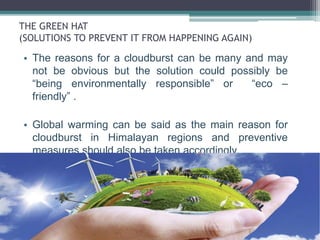
• The reasons for a cloudburst can be many and may
not be obvious but the solution could possibly be
“being environmentally responsible” or “eco –
friendly” .
• Global warming can be said as the main reason for
cloudburst in Himalayan regions and preventive
measures should also be taken accordingly.
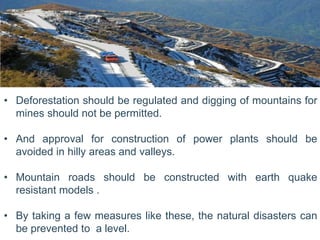
• Deforestation should be regulated and digging of mountains for
mines should not be permitted.
• And approval for construction of power plants should be
avoided in hilly areas and valleys.
• Mountain roads should be constructed with earth quake
resistant models .
• By taking a few measures like these, the natural disasters can
be prevented to a level.
BLUE HAT (CONCLUSION)
• India is on its way in acquiring global recognition for its
development and such calamities or disasters have a
devastating effect on its people and would hamper the
growth of the country globally and economically .
• The government should take preventive measures and
initiatives to avoid such mishaps from happening again .
• They need to have a clear analysis about the calamity
and should take required steps towards prevention.
REFERENCES-
• http://www.quora.com/What-causes-a-
cloudburst-What-can-be-done-to-prevent-it
• http://en.wikipedia.org/wiki/Cloudburst
• http://en.wikipedia.org/wiki/2013_North_Indi
a_floods

Cloudburst in uk new ppt

  • 1.
    CLOUDBURST IN UTTARAKHAND APPLYING PRINCIPLEOF SIX THINKING HATS TO PREPARE A REPORT
  • 2.
    De Bono’s 6Thinking Hats Dr EDWARD DE BONO Edward de Bono (born 19 May 1933) is a Maltese physician, author, inventor and consultant. He originated the term lateral thinking, wrote the book Six Thinking Hats and is a proponent of the teaching of thinking as a subject in schools.
  • 3.
    Professor de Bonohas held faculty appointments at the universities of Oxford, Cambridge, London and Harvard. He has written 57 books with translations into 34 languages. He has taught his thinking methods to government agencies, corporate clients, organizations and individuals, privately or publicly in group sessions
  • 4.
    THE SIX THIKINGHATS The premise of the method is that the human brain thinks in a number of distinct ways which can be deliberately challenged, and hence planned for use in a structured way allowing one to develop tactics for thinking about particular issues.
  • 5.
    Six distinct directionsare identified and assigned a colour. Managing Blue - what is the subject? what are we thinking about? what is the goal? Information White - considering purely what information is available, what are the facts?
  • 6.
    • Emotions Red- intuitive or instinctive gut reactions or statements of emotional feeling (but not any justification) . • Discernment Black - logic applied to identifying reasons to be cautious and conservative • Optimistic response Yellow - logic applied to identifying benefits, seeking harmony • Creativity Green - statements of provocation and investigation, seeing where a thought goes.
  • 7.
    WE MASKE USEOF THE DE BONO’S SIX THINKING HATS TO ANALIZE A SITUATION OR A HAPPENING IN SURROUNDINGS. WE APPLY THIS CONCEPT TO CONDUCT A CRITICAL STUDY BEFORE WRITING A REPORT(.i.e On cloudburst in Uttarakhand) THIS ENABLES US TO FOLLOW A STRATEGY WHICH MAKES THE REPORT CLEAN AND COMPLETE
  • 8.
    CLOUDBUR ST A cloudburst issudden copious rainfall. It is a sudden aggressive rainstorm falling for a short period of time limited to a small geographical area. Meteorologists say the rain from a cloudburst is usually of the shower type with a fall rate equal to or greater than 100 mm (4.94 inches) per hour.
  • 9.
    In June 2013,a multi-day cloudburst cantered on the North Indian state, Uttarakhand caused devastating floods and landslides becoming the country's worst natural disaster since the 2004 tsunami
  • 10.
    Over 95% ofthe casualties occurred in Uttarakhand. As of 16 July 2013, according to figures provided by the Uttarakhand government, more than 5,700 people were "presumed dead." This total included 934 local residents.
  • 11.
    PERSPECTIVE OF THEMISHAP THROUGH THE HATS COLOUR OF THE HAT TYPE OF THINKING ENGAGED WHITE THE FACTS WE KNOW ABOUT THE INCIDENT RED HOW DO WE FEEL ABOUT IT BLACK WHAT ARE THE NEGATIVE CONSEQUENCES OF THE INCIDENT YELLOW WHAT ARE THE POSITIVE CONSEQUENCES OF THE INCIDENT GREEN THE CREATIVE SOLTIONS TO IMPLEMENT SO AS TO PREVENT IT FROM HAPPENENING AGAIN BLUE WHAT DOES ALL THIS TELL US
  • 12.
    THE WHITE HAT (FACTSASSOCIATED WITH ORIGIN AND CONSEQUENCES) • NO DISASTER MANAGEMENT ABILITY • LACK OF FUNDS • LACK OF HUMAN RESOURCE • COLLOSAL APATHY • MISMANAGEMENT BY THE GOVERNMENT
  • 13.
    FACTS ASSOCIATED WITHRESCUE OPERATIONS • . According to official figures by ITBP, they were able to rescue 33,009 pilgrims in 15 days on their own from extreme remote and inaccessible areas. • Before Army or Air Force called in, being deployed in the nearby areas, ITBP took the first call and saved many lives. • They also distributed food packets to stranded pilgrims who were in a pathetic condition being not having any food for more than 72 hours at many places.
  • 14.
    • 2000 strongITBP(Indo- Tibetan border police) force with its mountaineering skills and improvisation methods started rescue of stranded pilgrims. • It was a simultaneous effort by ITBP at Kedar ghati, Gangotri valley and Govind ghat areas.
  • 15.
    • From 17to 30 June 2013, the IAF airlifted a total of 18,424 people - flying a total of 2,137 sorties and dropping/landing a total of 3,36,930 kg of relief material and equipment
  • 16.
    THE RED HAT(FEELINGS RELATED TO THE INCIDENT) • THE ENVIRONMENTALIST’S TAKE- • The mishap was attributed, by environmentalists, to unscientific developmental activities undertaken in recent decades contributing to high level of loss of property and lives. • Roads constructed in haphazard style, new resorts and hotels built on fragile river banks and more than 70 hydroelectric projects in the watersheds of the state led to…… • A "DISASTER WAITING TO HAPPEN" as termed by certain environmentalists.
  • 17.
    • Searching forbodies who died during the extreme natural fury of June in Kedar valley continued for several months and even as late as September, 2013. • About 556 bodies were found out of which 166 bodies were found in highly decomposed state during fourth round of search operations. • Many soldiers also lost their lives during the rescue operations.
  • 18.
    THE BLACK HAT(NEGATIVECONSEQUENCES OF INCIDENT) • The Government of India also cancelled 9 batches, or half the annual batches of the Kailash-Mansarovar Yatra, a Hindu pilgrimage. • The Chardham Yatra pilgrimage, covering Gangotri, Yamunotri, Kedarnath and Badrinath was cancelled for 2 years to repair damaged roads and infrastructure, according to the Uttarakhand Government
  • 19.
    • Government agenciesand priests of Kedarnath temple were planning mass cremation of the hundreds of victims, after one week of tragedy. • Local youths from several affected villages near Gangotri helped stranded tourists and pilgrims, by sending messages to their places and by providing food. • Rescuers also retrieved approximately 10 million (US$160,000) and other jewellery from local persons, including some people dressed like sadhu babas, who reportedly collected it from a destroyed building of a Bank and damaged shops.
  • 20.
    YELLOW HAT(THE POSITIVECONSEQUENCES) • As a cloudburst is a natural calamity , a positive emphasis on the incident is quiet unnatural. • And as any calamity happens , we cannot rule out obvious reasons that caused the mishap to occur. • But this would serve as an example for the ignorance of mother nature by the human race . • The government cancelled the permission of construction of almost 70 hydroelectric power plants after the mishap.
  • 21.
    • The municipalcorporation of those flood affected pilgrim cites should not have permitted for so many constructions on the fertile river bank of ganga. • These measures should have been taken before this incident has occurred and the government would become conscious as far these aspects are concerned
  • 22.
    THE GREEN HAT (SOLUTIONSTO PREVENT IT FROM HAPPENING AGAIN) • The reasons for a cloudburst can be many and may not be obvious but the solution could possibly be “being environmentally responsible” or “eco – friendly” . • Global warming can be said as the main reason for cloudburst in Himalayan regions and preventive measures should also be taken accordingly.
  • 23.
    • Deforestation shouldbe regulated and digging of mountains for mines should not be permitted. • And approval for construction of power plants should be avoided in hilly areas and valleys. • Mountain roads should be constructed with earth quake resistant models . • By taking a few measures like these, the natural disasters can be prevented to a level.
  • 24.
    BLUE HAT (CONCLUSION) •India is on its way in acquiring global recognition for its development and such calamities or disasters have a devastating effect on its people and would hamper the growth of the country globally and economically . • The government should take preventive measures and initiatives to avoid such mishaps from happening again . • They need to have a clear analysis about the calamity and should take required steps towards prevention.
  • 25.