FISHING SINKER
MANI BHASKAR KUMAR
1802101018
FEN- 121
2nd SEM
INTRODUCTION
 A fishing sinker or knoch is a weight used in conjunction with a fishing lure
or hook to increase its rate of sink, anchoring ability, and casting distance.
 Fishing sinkers may be as small as 1 gram for applications in shallow
water, and even smaller for fly fishing applications, or as large as several
pounds or considerably more for deep sea fishing.
 They are formed into nearly innumerable shapes for diverse fishing
applications. Environmental concerns surround the usage of lead and
other materials in fishing sinkers.
TYPE OF SINKER
 A large variety of sinkers exist which are used depending on the fish being
pursued, the environment, the current and personal preference.
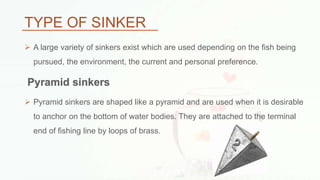
Pyramid sinkers
 Pyramid sinkers are shaped like a pyramid and are used when it is desirable
to anchor on the bottom of water bodies. They are attached to the terminal
end of fishing line by loops of brass.
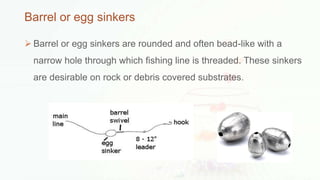
Barrel or egg sinkers
 Barrel or egg sinkers are rounded and often bead-like with a
narrow hole through which fishing line is threaded. These sinkers
are desirable on rock or debris covered substrates.
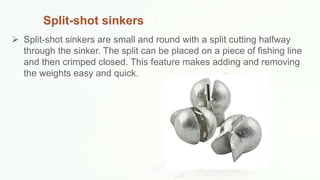
Split-shot sinkers
 Split-shot sinkers are small and round with a split cutting halfway
through the sinker. The split can be placed on a piece of fishing line
and then crimped closed. This feature makes adding and removing
the weights easy and quick.
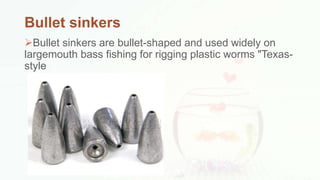
Bullet sinkers
Bullet sinkers are bullet-shaped and used widely on
largemouth bass fishing for rigging plastic worms "Texas-
style
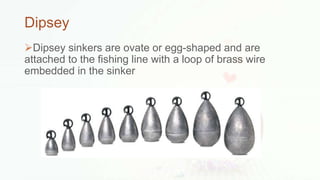
Dipsey
Dipsey sinkers are ovate or egg-shaped and are
attached to the fishing line with a loop of brass wire
embedded in the sinker
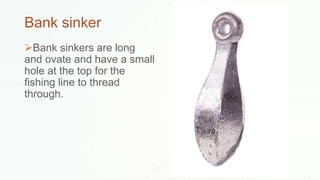
Bank sinker
Bank sinkers are long
and ovate and have a small
hole at the top for the
fishing line to thread
through.
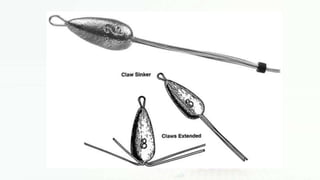
Claw sinker
A claw sinker consists of a sinker weight which is typically of
round shape, and a number of metal wire spikes grouped
around the sinker weight acting as barbs.
Claw sinkers are used in surf fishing on sandy bottoms with
strong currents, mainly to prevent the sinker from getting
carried off with the current.
Upon casting a claw sinker, the line is briefly tugged so that
the claws will dig themselves into the sand, allowing the rig to
stay in place.
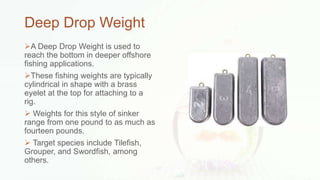
Deep Drop Weight
A Deep Drop Weight is used to
reach the bottom in deeper offshore
fishing applications.
These fishing weights are typically
cylindrical in shape with a brass
eyelet at the top for attaching to a
rig.
 Weights for this style of sinker
range from one pound to as much as
fourteen pounds.
 Target species include Tilefish,
Grouper, and Swordfish, among
others.
Materials
 An ideal material for a fishing sinker is environmentally acceptable, cheap
and dense.
 Density is desirable as weights must be as small as possible, in order to
minimize visual cues which could drive fish away from a fishing operation.
 Steel, brass, and bismuth sinkers have been marketed, but anglers have
not widely adopted them due to their lower density and higher cost
compared to lead. Sandsinkers have also been developed, using sand as
weight.
 However, sand has a comparably low density to that of lead and makes a
poor replacement.
 Tungsten is now in use, especially among largemouth bass anglers.
Although several times costlier than lead, tungsten is just under twice as
dense as lead and thus found desirable.
 The environmental effects of tungsten, however, are essentially unknown.
 More recently, terminal tackle manufacturers are experimenting with high
density composite resins.
 These materials present a non-toxic alternative to lead sinkers at a lower
monetary cost than alternative metallic sinkers
Fishing sinker mani

Fishing sinker mani

  • 1.
    FISHING SINKER MANI BHASKARKUMAR 1802101018 FEN- 121 2nd SEM
  • 2.
    INTRODUCTION  A fishingsinker or knoch is a weight used in conjunction with a fishing lure or hook to increase its rate of sink, anchoring ability, and casting distance.  Fishing sinkers may be as small as 1 gram for applications in shallow water, and even smaller for fly fishing applications, or as large as several pounds or considerably more for deep sea fishing.  They are formed into nearly innumerable shapes for diverse fishing applications. Environmental concerns surround the usage of lead and other materials in fishing sinkers.
  • 3.
    TYPE OF SINKER A large variety of sinkers exist which are used depending on the fish being pursued, the environment, the current and personal preference. Pyramid sinkers  Pyramid sinkers are shaped like a pyramid and are used when it is desirable to anchor on the bottom of water bodies. They are attached to the terminal end of fishing line by loops of brass.
  • 4.
    Barrel or eggsinkers  Barrel or egg sinkers are rounded and often bead-like with a narrow hole through which fishing line is threaded. These sinkers are desirable on rock or debris covered substrates.
  • 5.
    Split-shot sinkers  Split-shotsinkers are small and round with a split cutting halfway through the sinker. The split can be placed on a piece of fishing line and then crimped closed. This feature makes adding and removing the weights easy and quick.
  • 6.
    Bullet sinkers Bullet sinkersare bullet-shaped and used widely on largemouth bass fishing for rigging plastic worms "Texas- style
  • 7.
    Dipsey Dipsey sinkers areovate or egg-shaped and are attached to the fishing line with a loop of brass wire embedded in the sinker
  • 8.
    Bank sinker Bank sinkersare long and ovate and have a small hole at the top for the fishing line to thread through.
  • 9.
    Claw sinker A clawsinker consists of a sinker weight which is typically of round shape, and a number of metal wire spikes grouped around the sinker weight acting as barbs. Claw sinkers are used in surf fishing on sandy bottoms with strong currents, mainly to prevent the sinker from getting carried off with the current. Upon casting a claw sinker, the line is briefly tugged so that the claws will dig themselves into the sand, allowing the rig to stay in place.
  • 11.
    Deep Drop Weight ADeep Drop Weight is used to reach the bottom in deeper offshore fishing applications. These fishing weights are typically cylindrical in shape with a brass eyelet at the top for attaching to a rig.  Weights for this style of sinker range from one pound to as much as fourteen pounds.  Target species include Tilefish, Grouper, and Swordfish, among others.
  • 12.
    Materials  An idealmaterial for a fishing sinker is environmentally acceptable, cheap and dense.  Density is desirable as weights must be as small as possible, in order to minimize visual cues which could drive fish away from a fishing operation.  Steel, brass, and bismuth sinkers have been marketed, but anglers have not widely adopted them due to their lower density and higher cost compared to lead. Sandsinkers have also been developed, using sand as weight.  However, sand has a comparably low density to that of lead and makes a poor replacement.
  • 13.
     Tungsten isnow in use, especially among largemouth bass anglers. Although several times costlier than lead, tungsten is just under twice as dense as lead and thus found desirable.  The environmental effects of tungsten, however, are essentially unknown.  More recently, terminal tackle manufacturers are experimenting with high density composite resins.  These materials present a non-toxic alternative to lead sinkers at a lower monetary cost than alternative metallic sinkers