Normal Labor and Delivery
Resident Lecturer: A. Polintan, MD
Moderator: V. Espallardo, MD, FPOGS
Outline:
• Definition of Labor
• Mechanism of Labor
• Stages of Labor
• Management of Normal Labor
Definition ofLabor:
• The process that leads to childbirth
• Begins with the onset of regular
uterine contractions
• Ends with delivery of the newborn
and expulsion of the placenta
Chapter 22: Normal Labor. William’s Obstetrics 24th Edition.
Outline:
• Definition of Labor
• Mechanism of Labor
• Stages of Labor
• Management of Normal Labor
Mechanism of Labor
• Important relationship to be
considered:
• Fetal lie
• Fetal presentation
• Fetal attitude or posture
• Fetal position
Chapter 22: Normal Labor. William’s Obstetrics 24th Edition.
Mechanismof Labor:
Fetal Lie
• Definition: The relation of the fetal
long axis to that of the mother.
• Longitudinal
• Transverse
• Oblique
Chapter 22: Normal Labor. William’s Obstetrics 24th Edition.
Mechanismof Labor:
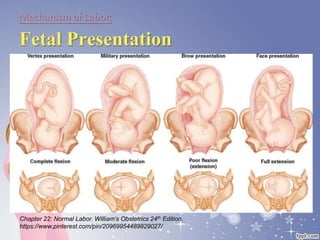
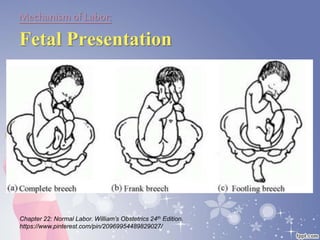
Fetal Presentation
• Definition: The presenting part is that
portion of the fetal body that is either
foremost within the birth canal or in
closest proximity to it.
Chapter 22: Normal Labor. William’s Obstetrics 24th Edition.
Mechanismof Labor:
Fetal Presentation
• Longitudinal Lie
• Cephalic
• Breech
• Transverse Lie
Chapter 22: Normal Labor. William’s Obstetrics 24th Edition.
Mechanismof Labor:
Fetal Presentation
Chapter 22: Normal Labor. William’s Obstetrics 24th Edition.
https://www.pinterest.com/pin/20969954489829027/
Mechanismof Labor:
Fetal Presentation
Chapter 22: Normal Labor. William’s Obstetrics 24th Edition.
https://www.pinterest.com/pin/20969954489829027/
Mechanismof Labor:
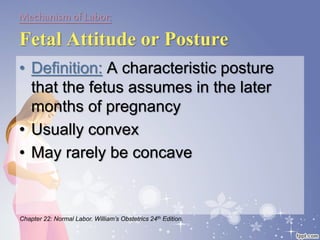
Fetal Attitude or Posture
• Definition: A characteristic posture
that the fetus assumes in the later
months of pregnancy
• Usually convex
• May rarely be concave
Chapter 22: Normal Labor. William’s Obstetrics 24th Edition.
Mechanismof Labor:
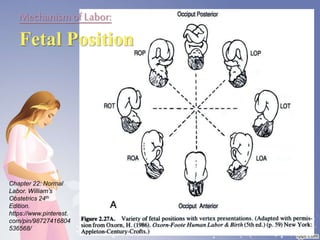
Fetal Position
• Definition: Refers to the relationship
of an arbitrary chosen portion of the
fetal presenting part to the right or left
side of the birth canal.
• May be directed anteriorly,
transversely or posteriorly
Chapter 22: Normal Labor. William’s Obstetrics 24th Edition.
Mechanismof Labor:
Fetal Position
Chapter 22: Normal
Labor. William’s
Obstetrics 24th
Edition.
https://www.pinterest.
com/pin/98727416804
536568/
Mechanismof Labor:
Abdominal Palpation – Leopolds
Maneuver
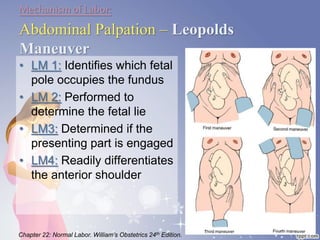
• LM 1: Identifies which fetal
pole occupies the fundus
• LM 2: Performed to
determine the fetal lie
• LM3: Determined if the
presenting part is engaged
• LM4: Readily differentiates
the anterior shoulder
Chapter 22: Normal Labor. William’s Obstetrics 24th Edition.
Mechanism of Labor:
Cardinal Movements of
Labor
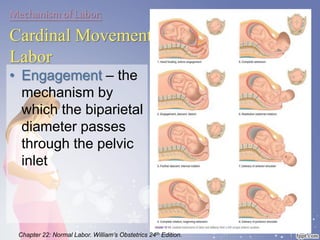
• Engagement – the
mechanism by
which the biparietal
diameter passes
through the pelvic
inlet
Chapter 22: Normal Labor. William’s Obstetrics 24th Edition.
Mechanism of Labor:
Cardinal Movements of
Labor
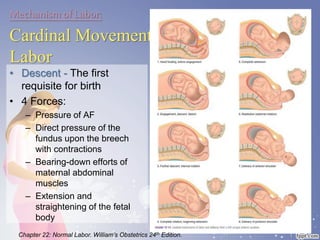
• Descent - The first
requisite for birth
• 4 Forces:
– Pressure of AF
– Direct pressure of the
fundus upon the breech
with contractions
– Bearing-down efforts of
maternal abdominal
muscles
– Extension and
straightening of the fetal
body
Chapter 22: Normal Labor. William’s Obstetrics 24th Edition.
Mechanism of Labor:
Cardinal Movements of
Labor
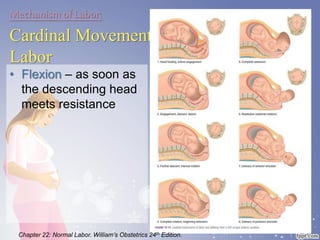
• Flexion – as soon as
the descending head
meets resistance
Chapter 22: Normal Labor. William’s Obstetrics 24th Edition.
Mechanism of Labor:
Cardinal Movements of
Labor
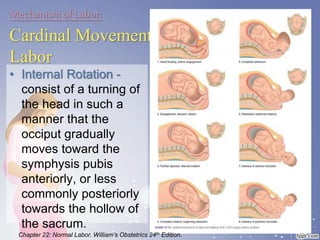
• Internal Rotation -
consist of a turning of
the head in such a
manner that the
occiput gradually
moves toward the
symphysis pubis
anteriorly, or less
commonly posteriorly
towards the hollow of
the sacrum.
Chapter 22: Normal Labor. William’s Obstetrics 24th Edition.
Mechanism of Labor:
Cardinal Movements of
Labor
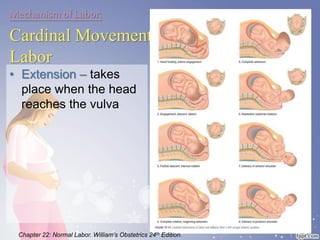
• Extension – takes
place when the head
reaches the vulva
Chapter 22: Normal Labor. William’s Obstetrics 24th Edition.
Mechanism of Labor:
Cardinal Movements of
Labor
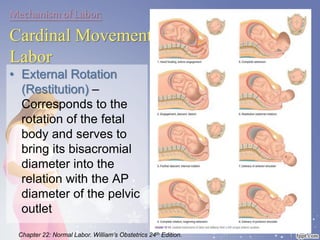
• External Rotation
(Restitution) –
Corresponds to the
rotation of the fetal
body and serves to
bring its bisacromial
diameter into the
relation with the AP
diameter of the pelvic
outlet
Chapter 22: Normal Labor. William’s Obstetrics 24th Edition.
Mechanism of Labor:
Cardinal Movements of
Labor
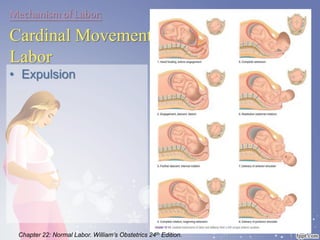
• Expulsion
Chapter 22: Normal Labor. William’s Obstetrics 24th Edition.
Outline:
• Definition of Labor
• Mechanism of Labor
• Stages of Labor
• Management of Normal Labor
Stages of Labor
• Strict definition of labor – uterine
contractions that bring about
demonstrable effacement and
dilatation of the cervix
Chapter 22: Normal Labor. William’s Obstetrics 24th Edition.
Stages of Labor
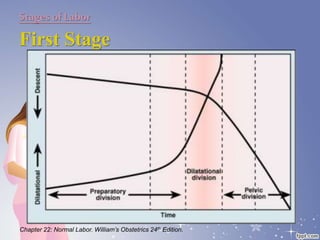
First Stage
Chapter 22: Normal Labor. William’s Obstetrics 24th Edition.
Stages of Labor
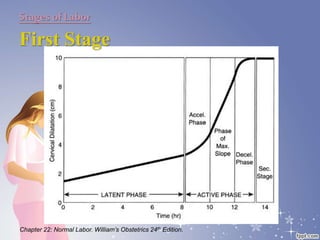
First Stage
Chapter 22: Normal Labor. William’s Obstetrics 24th Edition.
Stages of Labor
Second Stage
Chapter 22: Normal Labor. William’s Obstetrics 24th Edition.
• Begins with complete cervical dilatation
• Ends with fetal delivery
Outline:
• Definition of Labor
• Mechanism of Labor
• Stages of Labor
• Management of Normal Labor
Management of NormalLabor:
• 1. Birthing should be recognized as a
normal physiological process that
most women experience without
complications
• 2. Intrapartum complications, often
arising quickly and unexpectedly,
should be anticipated.
Chapter 22: Normal Labor. William’s Obstetrics 24th Edition.
Managementof NormalLabor:
Admission Procedures
• Urge to report early in labor rather
than until delivery is imminent
Chapter 22: Normal Labor. William’s Obstetrics 24th Edition.
Managementof NormalLabor:
Identification of Labor
• Uterine contractions 5 minutes apart
for 1 hour
• Cervical dilatation ≥4cm
Chapter 22: Normal Labor. William’s Obstetrics 24th Edition.
Managementof NormalLabor:
Electronic Fetal Monitoring
• Routine for high risk pregnancies
from admission
• May be used for low-risk pregnancies
as admission test, then followed by
intermittent assessment for the
remainder of labor
Chapter 22: Normal Labor. William’s Obstetrics 24th Edition.
Managementof NormalLabor:
Initial Evaluation
• Baseline:
• BP
• Temperature
• Pulse
• RR
• Membranes
• Cervical assessment
Chapter 22: Normal Labor. William’s Obstetrics 24th Edition.
Managementof NormalLabor:
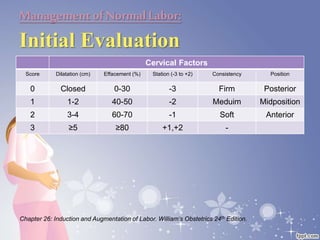
Initial Evaluation
Cervical Factors
Score Dilatation (cm) Effacement (%) Station (-3 to +2) Consistency Position
0 Closed 0-30 -3 Firm Posterior
1 1-2 40-50 -2 Meduim Midposition
2 3-4 60-70 -1 Soft Anterior
3 ≥5 ≥80 +1,+2 -
Chapter 26: Induction and Augmentation of Labor. William’s Obstetrics 24th Edition.
Managementof NormalLabor:
Initial Evaluation
• Laboratory Studies
– CBC
– UA
– Blood Typing
– HbsAg, VDRL
– HIV screening
Chapter 22: Normal Labor. William’s Obstetrics 24th Edition.
Managementof NormalLabor:
First Stage of Labor
• Intrapartum Fetal Monitoring
– OB Normal
• FHT monitoring at least every 30 minutes during
the 1st stage
• FHT monitoing at least every 15 minutes during
the 2nd stage
– FHT
• Immediately after a contraction at least every 30
minutes and then every 15 minutes during the 2nd
stage
Chapter 22: Normal Labor. William’s Obstetrics 24th Edition.
Managementof NormalLabor:
First Stage of Labor
• Intrapartum Fetal Monitoring
– High Risk Pregnancy
• FHT monitoring every 15 minutes and every 5
minutes during the 2nd stage of labor
Chapter 22: Normal Labor. William’s Obstetrics 24th Edition.
Managementof NormalLabor:
First Stage of Labor
• Cervical Examination
– 2-3 hours intervals during the 1st stage of
labor
• Oral Intake
– Food should be witheld during active labor
and delivery
Chapter 22: Normal Labor. William’s Obstetrics 24th Edition.
Managementof NormalLabor:
First Stage of Labor
• Intravenous Fluid
– No actual need unless analgesia has been
given
– 60 -120mL/hour
• Maternal Position
– Let the woman assume the position most
comfortable to her
Chapter 22: Normal Labor. William’s Obstetrics 24th Edition.
Managementof NormalLabor:
Second Stage of Labor
• Bearing-down efforts
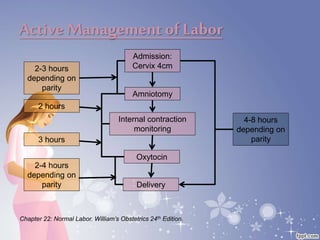
• Active Management of Labor
– Amniotomy
– Oxytocin
Chapter 22: Normal Labor. William’s Obstetrics 24th Edition.
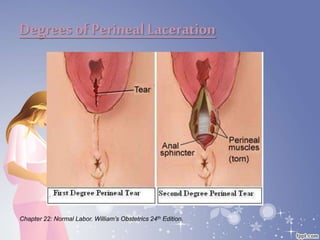
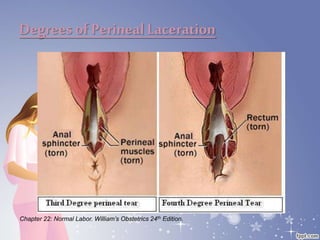
Degreesof Perineal Laceration
Chapter 22: Normal Labor. William’s Obstetrics 24th Edition.
Degreesof Perineal Laceration
Chapter 22: Normal Labor. William’s Obstetrics 24th Edition.
Active Management of Labor
Chapter 22: Normal Labor. William’s Obstetrics 24th Edition.
Admission:
Cervix 4cm
Amniotomy
Internal contraction
monitoring
Oxytocin
Delivery
4-8 hours
depending on
parity
2-3 hours
depending on
parity
2 hours
3 hours
2-4 hours
depending on
parity
THANK YOU!

Normal labor and delivery

  • 1.
    Normal Labor andDelivery Resident Lecturer: A. Polintan, MD Moderator: V. Espallardo, MD, FPOGS
  • 2.
    Outline: • Definition ofLabor • Mechanism of Labor • Stages of Labor • Management of Normal Labor
  • 3.
    Definition ofLabor: • Theprocess that leads to childbirth • Begins with the onset of regular uterine contractions • Ends with delivery of the newborn and expulsion of the placenta Chapter 22: Normal Labor. William’s Obstetrics 24th Edition.
  • 4.
    Outline: • Definition ofLabor • Mechanism of Labor • Stages of Labor • Management of Normal Labor
  • 5.
    Mechanism of Labor •Important relationship to be considered: • Fetal lie • Fetal presentation • Fetal attitude or posture • Fetal position Chapter 22: Normal Labor. William’s Obstetrics 24th Edition.
  • 6.
    Mechanismof Labor: Fetal Lie •Definition: The relation of the fetal long axis to that of the mother. • Longitudinal • Transverse • Oblique Chapter 22: Normal Labor. William’s Obstetrics 24th Edition.
  • 7.
    Mechanismof Labor: Fetal Presentation •Definition: The presenting part is that portion of the fetal body that is either foremost within the birth canal or in closest proximity to it. Chapter 22: Normal Labor. William’s Obstetrics 24th Edition.
  • 8.
    Mechanismof Labor: Fetal Presentation •Longitudinal Lie • Cephalic • Breech • Transverse Lie Chapter 22: Normal Labor. William’s Obstetrics 24th Edition.
  • 9.
    Mechanismof Labor: Fetal Presentation Chapter22: Normal Labor. William’s Obstetrics 24th Edition. https://www.pinterest.com/pin/20969954489829027/
  • 10.
    Mechanismof Labor: Fetal Presentation Chapter22: Normal Labor. William’s Obstetrics 24th Edition. https://www.pinterest.com/pin/20969954489829027/
  • 11.
    Mechanismof Labor: Fetal Attitudeor Posture • Definition: A characteristic posture that the fetus assumes in the later months of pregnancy • Usually convex • May rarely be concave Chapter 22: Normal Labor. William’s Obstetrics 24th Edition.
  • 12.
    Mechanismof Labor: Fetal Position •Definition: Refers to the relationship of an arbitrary chosen portion of the fetal presenting part to the right or left side of the birth canal. • May be directed anteriorly, transversely or posteriorly Chapter 22: Normal Labor. William’s Obstetrics 24th Edition.
  • 13.
    Mechanismof Labor: Fetal Position Chapter22: Normal Labor. William’s Obstetrics 24th Edition. https://www.pinterest. com/pin/98727416804 536568/
  • 14.
    Mechanismof Labor: Abdominal Palpation– Leopolds Maneuver • LM 1: Identifies which fetal pole occupies the fundus • LM 2: Performed to determine the fetal lie • LM3: Determined if the presenting part is engaged • LM4: Readily differentiates the anterior shoulder Chapter 22: Normal Labor. William’s Obstetrics 24th Edition.
  • 15.
    Mechanism of Labor: CardinalMovements of Labor • Engagement – the mechanism by which the biparietal diameter passes through the pelvic inlet Chapter 22: Normal Labor. William’s Obstetrics 24th Edition.
  • 16.
    Mechanism of Labor: CardinalMovements of Labor • Descent - The first requisite for birth • 4 Forces: – Pressure of AF – Direct pressure of the fundus upon the breech with contractions – Bearing-down efforts of maternal abdominal muscles – Extension and straightening of the fetal body Chapter 22: Normal Labor. William’s Obstetrics 24th Edition.
  • 17.
    Mechanism of Labor: CardinalMovements of Labor • Flexion – as soon as the descending head meets resistance Chapter 22: Normal Labor. William’s Obstetrics 24th Edition.
  • 18.
    Mechanism of Labor: CardinalMovements of Labor • Internal Rotation - consist of a turning of the head in such a manner that the occiput gradually moves toward the symphysis pubis anteriorly, or less commonly posteriorly towards the hollow of the sacrum. Chapter 22: Normal Labor. William’s Obstetrics 24th Edition.
  • 19.
    Mechanism of Labor: CardinalMovements of Labor • Extension – takes place when the head reaches the vulva Chapter 22: Normal Labor. William’s Obstetrics 24th Edition.
  • 20.
    Mechanism of Labor: CardinalMovements of Labor • External Rotation (Restitution) – Corresponds to the rotation of the fetal body and serves to bring its bisacromial diameter into the relation with the AP diameter of the pelvic outlet Chapter 22: Normal Labor. William’s Obstetrics 24th Edition.
  • 21.
    Mechanism of Labor: CardinalMovements of Labor • Expulsion Chapter 22: Normal Labor. William’s Obstetrics 24th Edition.
  • 22.
    Outline: • Definition ofLabor • Mechanism of Labor • Stages of Labor • Management of Normal Labor
  • 23.
    Stages of Labor •Strict definition of labor – uterine contractions that bring about demonstrable effacement and dilatation of the cervix Chapter 22: Normal Labor. William’s Obstetrics 24th Edition.
  • 24.
    Stages of Labor FirstStage Chapter 22: Normal Labor. William’s Obstetrics 24th Edition.
  • 25.
    Stages of Labor FirstStage Chapter 22: Normal Labor. William’s Obstetrics 24th Edition.
  • 26.
    Stages of Labor SecondStage Chapter 22: Normal Labor. William’s Obstetrics 24th Edition. • Begins with complete cervical dilatation • Ends with fetal delivery
  • 27.
    Outline: • Definition ofLabor • Mechanism of Labor • Stages of Labor • Management of Normal Labor
  • 28.
    Management of NormalLabor: •1. Birthing should be recognized as a normal physiological process that most women experience without complications • 2. Intrapartum complications, often arising quickly and unexpectedly, should be anticipated. Chapter 22: Normal Labor. William’s Obstetrics 24th Edition.
  • 29.
    Managementof NormalLabor: Admission Procedures •Urge to report early in labor rather than until delivery is imminent Chapter 22: Normal Labor. William’s Obstetrics 24th Edition.
  • 30.
    Managementof NormalLabor: Identification ofLabor • Uterine contractions 5 minutes apart for 1 hour • Cervical dilatation ≥4cm Chapter 22: Normal Labor. William’s Obstetrics 24th Edition.
  • 31.
    Managementof NormalLabor: Electronic FetalMonitoring • Routine for high risk pregnancies from admission • May be used for low-risk pregnancies as admission test, then followed by intermittent assessment for the remainder of labor Chapter 22: Normal Labor. William’s Obstetrics 24th Edition.
  • 32.
    Managementof NormalLabor: Initial Evaluation •Baseline: • BP • Temperature • Pulse • RR • Membranes • Cervical assessment Chapter 22: Normal Labor. William’s Obstetrics 24th Edition.
  • 33.
    Managementof NormalLabor: Initial Evaluation CervicalFactors Score Dilatation (cm) Effacement (%) Station (-3 to +2) Consistency Position 0 Closed 0-30 -3 Firm Posterior 1 1-2 40-50 -2 Meduim Midposition 2 3-4 60-70 -1 Soft Anterior 3 ≥5 ≥80 +1,+2 - Chapter 26: Induction and Augmentation of Labor. William’s Obstetrics 24th Edition.
  • 34.
    Managementof NormalLabor: Initial Evaluation •Laboratory Studies – CBC – UA – Blood Typing – HbsAg, VDRL – HIV screening Chapter 22: Normal Labor. William’s Obstetrics 24th Edition.
  • 35.
    Managementof NormalLabor: First Stageof Labor • Intrapartum Fetal Monitoring – OB Normal • FHT monitoring at least every 30 minutes during the 1st stage • FHT monitoing at least every 15 minutes during the 2nd stage – FHT • Immediately after a contraction at least every 30 minutes and then every 15 minutes during the 2nd stage Chapter 22: Normal Labor. William’s Obstetrics 24th Edition.
  • 36.
    Managementof NormalLabor: First Stageof Labor • Intrapartum Fetal Monitoring – High Risk Pregnancy • FHT monitoring every 15 minutes and every 5 minutes during the 2nd stage of labor Chapter 22: Normal Labor. William’s Obstetrics 24th Edition.
  • 37.
    Managementof NormalLabor: First Stageof Labor • Cervical Examination – 2-3 hours intervals during the 1st stage of labor • Oral Intake – Food should be witheld during active labor and delivery Chapter 22: Normal Labor. William’s Obstetrics 24th Edition.
  • 38.
    Managementof NormalLabor: First Stageof Labor • Intravenous Fluid – No actual need unless analgesia has been given – 60 -120mL/hour • Maternal Position – Let the woman assume the position most comfortable to her Chapter 22: Normal Labor. William’s Obstetrics 24th Edition.
  • 39.
    Managementof NormalLabor: Second Stageof Labor • Bearing-down efforts • Active Management of Labor – Amniotomy – Oxytocin Chapter 22: Normal Labor. William’s Obstetrics 24th Edition.
  • 40.
    Degreesof Perineal Laceration Chapter22: Normal Labor. William’s Obstetrics 24th Edition.
  • 41.
    Degreesof Perineal Laceration Chapter22: Normal Labor. William’s Obstetrics 24th Edition.
  • 42.
    Active Management ofLabor Chapter 22: Normal Labor. William’s Obstetrics 24th Edition. Admission: Cervix 4cm Amniotomy Internal contraction monitoring Oxytocin Delivery 4-8 hours depending on parity 2-3 hours depending on parity 2 hours 3 hours 2-4 hours depending on parity
  • 43.

Editor's Notes

  • #6 Intro: At the onset of labor, the position of the fetus with respect to the birth canal is critical to the route of delivery and thus should be determined in early labor.
  • #7 Intro: At the onset of labor, the position of the fetus with respect to the birth canal is critical to the route of delivery and thus should be determined in early labor. It may either be any of the 3: Longitudinal lie is seen in 99% of pregnancies Predisposition to transverse lie include multiparity, placenta previa, hydamios and uterine animalies Oblique lie is when the fetal and maternal axes may cross at a 45degree angle, it is unstable and becomes either longitudinal or transverse during labor
  • #10 The cephalic presentation is classified according to the relationship between the head and body of the fetus. Vertex or Occiput Presentation – Head is flexed sharply so that the chin is in contact with the thorax. The posterior (occipital) fontanel is the presenting part. Face Presentation- Fetal neck is sharply extended to that the occiput and back come in contact. Sinciput (Military) Presentation- midway between vertex and face, the anterior (bregma) fontanel is the presenting part. Brow Presentation – the head is partially extended.
  • #11 If the fetus is breech in presentation, the fetus often changes polarity to make us of the roomier fundus for its bulkier and more mobile podalic pole (breech). Incidence of breech presentation decreases with gestational age: 25% at 28weeks 17% at 30weeks 11% at 32 weeks 3% at term Complete Breech – the lower extremities are flexed at the hip, and wither one of both knees are flexed Frank Breech – the lower extremities are flexed at the hips and extended at the knees Footling Presentation – a presentation wherein one of both feet are below the breech
  • #12 Convex meaning the fetus is folded or bent on itself, in such that the shin is touching the chest and the thighs are flexed over the abdomen, and the umbilical cord lies in the space between them. Concave occurs as the fetal head becomes progressively more extended from the vertex to the face presentation.
  • #13 The fetal occiput, chin, and sacrum are the determining points in vertex, face and breech presentations. LO, RO, LM, RM, LS and RS A, T, P
  • #14 Approximately 2/3 of vertex presentation are in the left occiput position, an done third in the right. In shoulder presentation, the acromion is the portion of the fetus arbitrary chosen for orientation with the maternal pelvis. The acromion may be directed anteriorly or posteriorly and superiorly or inferiorly. It is impossible to differentiate exactly the several varieties of shoulder presentation by clinical examination and serves no practical purpose. More practically it may be written as transverse lie or shoulder presentation with back up or back down which is clinically important when deciding the incision type for cesarean delivery.
  • #15 LM1: Breech – sensation of a large, nodular mass Head – hard and round, mobile and ballotable LM2: Hard resistant structure Numerous small, irregular, mobile parts LM3: Not engaged – movable mass Engaged
  • #16 Asynclitism – lateral deflection to a more anterior or posterior position in the pelvis Anterior asynclitism – the sagittal suture approaches the sacral promotory, more of the anterior parietal bone presents itself to the examining fingers. Posterior asynclitism – the sagittal suture lies close to the symphysis, more of the posterior parietal bone will present If severe, the condition, is a common reason for CPD even with an otherwise normal sized pelvis.
  • #17 Nulliparas- engagement may take place before the onset of labor, and further descent may not follow until the onset of the 2nd stage Multiparas – descent usually begins with engagement
  • #25 Functional Labor Division: Preparatory Division cervix dilates littles, connective tissue components change considerably Sedation and conduction of analgesia are capable of arresting this labor division Dilatation Division dilatation proceeds at its most rapid rate Unaffected by sedation Pelvic Division a. Commence with the deceleration phase of cervical dilatation
  • #26 Two phases of cervical dilatation: Latent Phase – corresponds to the preparatory division Point at which the mother perceives regular contractions 3-5cm dilatation Active Phase – subdivided into: Acceleration Phase Phase of Maximum Slope Decceleration Phase
  • #27 Median duration is 50 minutes for nulliparas and 20 minutes for multiparas
  • #33 Rupture of Membranes is significant for 3 reasons: If the presenting part is not fixed in the pelvis, the possibility of umbilical cord prolapse and compression is greatly increased Labor is likely to begin soon if the pregnancy is at or near term If delivery is delayed after membrane rupture, intrauterine infection is more likely as the time interval increases Cervical Assessment includes: Degree of cervical effacement – expressed in terms of the length of the cervical canal compared to that of an uneffaced cervix Cervical dilatation – determined by estimating the average diameter of the cervical opening by sweeping the examining finger from the margin of the cervical opening. Position – detremined by the relationship of the cervical os to the fetal head (posterior, mid-posterior or anterior) Consistency is detremined to be soft, firm or intermediate Level or Station – described in relationship to the ischial spine, and is designated to be station 0, negative stations above station 0 and plus stations below station 0 at an increment of 1cm
  • #35 Wome with no prior prenatal consultations should be considered to be high risk for syphilis, hepatits and HIV
  • #36 Women with no prior prenatal consultations should be considered to be high risk for syphilis, hepatits and HIV
  • #37 Women with no prior prenatal consultations should be considered to be high risk for syphilis, hepatits and HIV