SALES TRAINING
What is Selling ?
“…involves person-to-person communication with a prospect. It is a
process of developing relationships; discovering needs; matching
the appropriate products [and services] with those needs; and
communicating benefits through informing, reminding, or
persuading.”
Selling involves
 People
 Package of emotions and feelings
Before You Do Anything Else…
• Sell yourself/ Your Brand
• Know your product
• Know the value equation
• Know your competition
• Know why your customer should buy from you instead of your
competition
The Body of the Presentation
• Use all senses possible
• Be aware of clues—body language, questions, etc
• Sell benefits not features
• Make it logical and end by filling the need
A successful sales person needs
 Domain knowledge
 Proficiency in skills
 Right attitude
Domain Knowledge needed by the sales
Person
• Knowledge about Industry
• Knowing the Product
• Knowing the process
• Understanding customers’ objections
Skills required to be successful sales person
• Listening skills
Sales people need to be good listeners
• Questioning skills
Ask right questions to the prospect
• Identifying buying signals
Based on these signals, a sales person can plan his next move or question.
• Negotiating and closing skills
Creating a win-win situation for both the customer and themselves
Attitude that are very important for a sales
Person
• Confident
Confidence helps them to take rejections in their stride and bounce back
with enthusiasm.
• Persistent and determinant
The determined person refuses to accept defeat and goes on to attain
what he wants.
• Maintain a long-term relationship with customers
Need to view each sale as a stepping stone towards earning the goodwill of
their customers.
• Having a friendly personality
• Accountable for themselves, their customers and their organization
• Sales people need to be receptive and willing to change
Attitude
Attitude of salespeople determines the altitude to which they can
rise in their career and in an organization.
Always believe
Selling ideas or products to known people involves different
dynamics than selling to strangers does
Some Characteristics of Professional Selling
• Driven to make it a career
• Focus on the long term
• Desire to improve to become an expert
• Focus on matching vs. telling
• Strength in all aspects of the Basic Sales Cycle
The Basic Sales Cycle
• Listening/Observing - Needs Analysis
• Analyze/Recommend – Recommendation
• Identify/Handle Objections – Preparing the Close
• Ask for the Sale – Closing
• Build Follow Up Opportunity – Repeat/Referral
Business
Recommend
Prepare
the Close
Close
Repeat/Referral
Business
Needs
Analysis
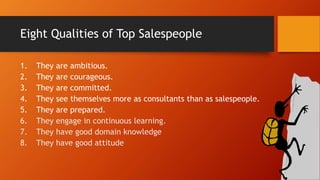
Eight Qualities of Top Salespeople
1. They are ambitious.
2. They are courageous.
3. They are committed.
4. They see themselves more as consultants than as salespeople.
5. They are prepared.
6. They engage in continuous learning.
7. They have good domain knowledge
8. They have good attitude
Forbidden Phrases
“WHY DO YOU
NEED TO KNOW?”
“NO.”
“YOU’RE WRONG.”
“WE’VE NEVER DONE
IT THAT WAY.”
“YOU’LL HAVE TO.”
“THAT’S NOT MY JOB.”
“THAT’S AGAINST
COMPANY POLICY.”
“I DON’T KNOW.”
Why are some salespeople so successful?
• 80% of Sales success is psychological.
• Top salespeople are OPTIMISTS.
• They have a positive mental attitude.
• 20% of the salespeople make 80% of the sales and 80% of the
commissions
• 10% of salespeople open 80% of new accounts (“hunters”)
• The top 10% of sales professionals today earn 5X, 10X, 15X and even 20X
the average of the other 80%-90%.
The Three Most Common Sales Mistakes
• Not listening to the buyer
• Not asking for the order
• Forgetting to sell existing customers
Hooray! I Made the Sale!
Question Time
THANK YOU

Sales Training

  • 1.
  • 2.
    What is Selling? “…involves person-to-person communication with a prospect. It is a process of developing relationships; discovering needs; matching the appropriate products [and services] with those needs; and communicating benefits through informing, reminding, or persuading.”
  • 3.
    Selling involves  People Package of emotions and feelings
  • 4.
    Before You DoAnything Else… • Sell yourself/ Your Brand • Know your product • Know the value equation • Know your competition • Know why your customer should buy from you instead of your competition
  • 5.
    The Body ofthe Presentation • Use all senses possible • Be aware of clues—body language, questions, etc • Sell benefits not features • Make it logical and end by filling the need
  • 6.
    A successful salesperson needs  Domain knowledge  Proficiency in skills  Right attitude
  • 7.
    Domain Knowledge neededby the sales Person • Knowledge about Industry • Knowing the Product • Knowing the process • Understanding customers’ objections
  • 8.
    Skills required tobe successful sales person • Listening skills Sales people need to be good listeners • Questioning skills Ask right questions to the prospect • Identifying buying signals Based on these signals, a sales person can plan his next move or question. • Negotiating and closing skills Creating a win-win situation for both the customer and themselves
  • 9.
    Attitude that arevery important for a sales Person • Confident Confidence helps them to take rejections in their stride and bounce back with enthusiasm. • Persistent and determinant The determined person refuses to accept defeat and goes on to attain what he wants. • Maintain a long-term relationship with customers Need to view each sale as a stepping stone towards earning the goodwill of their customers. • Having a friendly personality • Accountable for themselves, their customers and their organization • Sales people need to be receptive and willing to change
  • 10.
    Attitude Attitude of salespeopledetermines the altitude to which they can rise in their career and in an organization.
  • 11.
    Always believe Selling ideasor products to known people involves different dynamics than selling to strangers does
  • 12.
    Some Characteristics ofProfessional Selling • Driven to make it a career • Focus on the long term • Desire to improve to become an expert • Focus on matching vs. telling • Strength in all aspects of the Basic Sales Cycle
  • 13.
    The Basic SalesCycle • Listening/Observing - Needs Analysis • Analyze/Recommend – Recommendation • Identify/Handle Objections – Preparing the Close • Ask for the Sale – Closing • Build Follow Up Opportunity – Repeat/Referral Business Recommend Prepare the Close Close Repeat/Referral Business Needs Analysis
  • 14.
    Eight Qualities ofTop Salespeople 1. They are ambitious. 2. They are courageous. 3. They are committed. 4. They see themselves more as consultants than as salespeople. 5. They are prepared. 6. They engage in continuous learning. 7. They have good domain knowledge 8. They have good attitude
  • 15.
    Forbidden Phrases “WHY DOYOU NEED TO KNOW?” “NO.” “YOU’RE WRONG.” “WE’VE NEVER DONE IT THAT WAY.” “YOU’LL HAVE TO.” “THAT’S NOT MY JOB.” “THAT’S AGAINST COMPANY POLICY.” “I DON’T KNOW.”
  • 16.
    Why are somesalespeople so successful? • 80% of Sales success is psychological. • Top salespeople are OPTIMISTS. • They have a positive mental attitude. • 20% of the salespeople make 80% of the sales and 80% of the commissions • 10% of salespeople open 80% of new accounts (“hunters”) • The top 10% of sales professionals today earn 5X, 10X, 15X and even 20X the average of the other 80%-90%.
  • 17.
    The Three MostCommon Sales Mistakes • Not listening to the buyer • Not asking for the order • Forgetting to sell existing customers
  • 18.
    Hooray! I Madethe Sale!
  • 19.
  • 20.