CLOSING SKILLS
Presented By Nilesh Sharad Sawant
OBJECTIVES FOR THE DAY
By the end of the session, you will be able to improve on sales closing skills by
understanding:
 Buying cycle & decisions making process
 Closing Skill in sales
 Principles of Closing Sales
 Eight Closing Techniques
HOW DO CUSTOMERS BUY?
ANSWER THE FOLLOWING QUESTIONS
 What did you buy?
 Why did you buy?
 Where did you buy it from?
 Why did you buy it from that place/shop?
 Did you explore some options before buying what you bought?
 Did you explore some alternative products
 Did you ask any question before buying?
 Were all your questions answered to your satisfaction?
 Did you bargain on price?
 Did you buy the product?
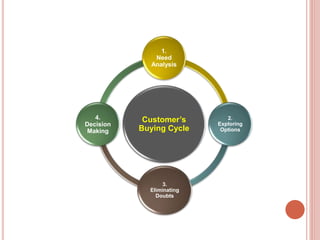
Customer’s
Buying Cycle
1.
Need
Analysis
2.
Exploring
Options
3.
Eliminating
Doubts
4.
Decision
Making
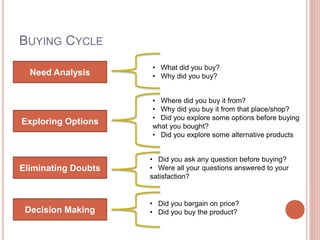
BUYING CYCLE
Need Analysis
Exploring Options
Eliminating Doubts
Decision Making
• What did you buy?
• Why did you buy?
• Where did you buy it from?
• Why did you buy it from that place/shop?
• Did you explore some options before buying
what you bought?
• Did you explore some alternative products
• Did you ask any question before buying?
• Were all your questions answered to your
satisfaction?
• Did you bargain on price?
• Did you buy the product?
HOW DO WE SELL?
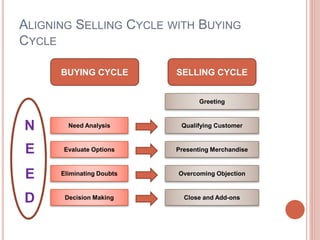
ALIGNING SELLING CYCLE WITH BUYING
CYCLE
Need Analysis
Evaluate Options
Eliminating Doubts
Decision Making
Qualifying Customer
Presenting Merchandise
Overcoming Objection
Close and Add-ons
Greeting
BUYING CYCLE SELLING CYCLE
N
E
E
D
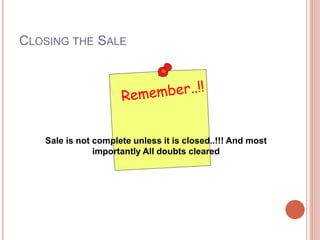
CLOSING THE SALE
Sale is not complete unless it is closed..!!! And most
importantly All doubts cleared
CLOSING A SALE
When?? How??
PRINCIPLES OF CLOSING SALES
 Closing the Sale is an integral part of Sales Process
 No Salesperson has ever closed Every Sale
 Selling is a numbers Game
 The Right Time to close is when the customer is ready
to buy
 Look for more than one opportunity to close the sale
 Buyer Resistance is natural and should be expected
 Buyers seldom ask you for the order
CLOSING TECHNIQUES
 Ask for the order
 The Assumptive Close
 The Alternative Close
 Closing on a Small Issue
 The Pressure Close
 Converting on Objections
 The Negotiated Close
 The Trail Close
Closing skills

Closing skills

  • 1.
    CLOSING SKILLS Presented ByNilesh Sharad Sawant
  • 2.
    OBJECTIVES FOR THEDAY By the end of the session, you will be able to improve on sales closing skills by understanding:  Buying cycle & decisions making process  Closing Skill in sales  Principles of Closing Sales  Eight Closing Techniques
  • 3.
  • 4.
    ANSWER THE FOLLOWINGQUESTIONS  What did you buy?  Why did you buy?  Where did you buy it from?  Why did you buy it from that place/shop?  Did you explore some options before buying what you bought?  Did you explore some alternative products  Did you ask any question before buying?  Were all your questions answered to your satisfaction?  Did you bargain on price?  Did you buy the product?
  • 5.
  • 6.
    BUYING CYCLE Need Analysis ExploringOptions Eliminating Doubts Decision Making • What did you buy? • Why did you buy? • Where did you buy it from? • Why did you buy it from that place/shop? • Did you explore some options before buying what you bought? • Did you explore some alternative products • Did you ask any question before buying? • Were all your questions answered to your satisfaction? • Did you bargain on price? • Did you buy the product?
  • 7.
    HOW DO WESELL?
  • 8.
    ALIGNING SELLING CYCLEWITH BUYING CYCLE Need Analysis Evaluate Options Eliminating Doubts Decision Making Qualifying Customer Presenting Merchandise Overcoming Objection Close and Add-ons Greeting BUYING CYCLE SELLING CYCLE N E E D
  • 9.
    CLOSING THE SALE Saleis not complete unless it is closed..!!! And most importantly All doubts cleared
  • 10.
  • 11.
    PRINCIPLES OF CLOSINGSALES  Closing the Sale is an integral part of Sales Process  No Salesperson has ever closed Every Sale  Selling is a numbers Game  The Right Time to close is when the customer is ready to buy  Look for more than one opportunity to close the sale  Buyer Resistance is natural and should be expected  Buyers seldom ask you for the order
  • 12.
    CLOSING TECHNIQUES  Askfor the order  The Assumptive Close  The Alternative Close  Closing on a Small Issue  The Pressure Close  Converting on Objections  The Negotiated Close  The Trail Close

Editor's Notes

  • #12 1. Closing the Sale is an integral part of the sales process This means that closing techniques in themselves are not enough to ensure success, if the other parts of the sales process have been neglected. Before a buyer will place an order with you, he or she will have to see a need for your product and be convinced that your particular product represents the best solution to the problem represented by that need. That is, the cost is reasonable, they have confidence in your ability to deliver your promises and so on. 2. No salesperson ever closed every sale Everyone who has ever sold professionally has had to get used to living with rejection. A good salesperson will always be rejected more times than he or she is successful. In fact if this is not the case the salesperson probably isn't trying hard enough. The secret is to `learn to live with rejection'. Every time you fail, you move closer to the time you will succeed. 3. Selling is a `numbers game' Given a `basic' level of skill in sales techniques, the amount you sell is directly related to the number of calls you make. The more customers you see, therefore, the more business you will close. 5. The right time to close is when the customer is ready to buy This is so important. Closing tends to happen towards the end of the sales call but don't assume this will always be the case. If the customer wants to buy early into your sales presentation then you should get commitment straight away. There may be more information you need to give, however, having gained commitment the customer will be more relaxed and less likely to raise objections at a later stage. 6. Look for more than one opportunity to close the sale There will be several occasions during the sale when the customer is ready to buy. There will also be more than one opportunity for you to close the sale. Just because the customer says `no' now, it doesn't mean it won't be `yes' in ten minutes' time. `No' can mean various things: • Not on the terms you describe • Not at the moment • Not in your timescale • Not at that price • Convince me further • I'm getting interested but I need more information 7. Buyer resistance is natural and should be expected During the sales process the buyer is under as much pressure as the salesperson. The buyer is often thinking about the consequences of agreeing to your proposal. The buyer may be thinking: Does this represent value for money? What will my wife think? Are they as reliable as she says they are? He says they can achieve significant growth. Is that true? Is her product better than her competitor? Can I afford the monthly payments? Often when the buyer hesitates during the closing stages he or she is seeking reassurance from the salesperson in a consultative, non-threatening way, that the decision that is about to be made, is a good decision. 8. Buyers seldom ask you for the order Most buyers rely on the salesperson to make the buying process easy for them. However, they rarely ask for the order outright so the most effective and most obvious closing technique, having gone through the several stages of the call, is to ask the buyer if he or she wishes to place an order. By this stage, if you have carried out the other stages of the call, it is likely the customer will be ready to buy, but more importantly, you have earned the right to ask for the order. It is a fact, however, that around 70% of sales calls end with the salesperson failing to ask for the order. This is due to the salesperson's fear of rejection.
  • #13 1. Ask for the order It has been estimated that 7 out of every 10 presentations end without the salesperson asking for the order. Of the 3 salespeople who do ask for the order, 2 give up after the second refusal. Having presented to your customer in a professional way you have the right to ask for the order and the customer expects you to do so. This technique alone will improve your sales results and give you more confidence in the selling situation. Remember that closing is about timing. The best closers recognize there is a time to ask for commitment and they have the confidence to do so. If you get rejected, so what? What have you actually lost? In fact you are better off because even if you get rejected at least you now know where you stand. 2. The Assumptive Close By assuming that the order is being placed you can remove the responsibility for decision-making away from the buyer. This uses the buyer's natural inertia. The assumptive close uses words like `will' and `when' This will solve a lot of problems when it is installed. When will be the best time to deliver? Will 4 units be sufficient to meet your requirements? 3. The Alternative Close This close gives the buyer the choice between 2 alternatives, both of which have been chosen by you Do you require delivery Tuesday or will next week be more convenient? Will you take the option of alloy wheels or do you prefer central locking? © www.salestraining.co.uk 9 Would you prefer the green or the red? 4. Closing on a small issue Often the buyer finds it easier to make small decisions than large ones. However, having made the smaller decision the larger one becomes easier to make. Choose a minor feature of your product and gain agreement from the buyer on that feature. Delivery can be made on a weekly basis. Does that meet your requirements? We can arrange for the colors to match your company logo. Would that be what you are looking for? If storage is a problem we can arrange for a split delivery at no extra cost. How does that sound? 5. The Pressure Close This enables you to put pressure on the buyer in terms of special offers or inducements that are available or penalties for not placing the order. This price is only available up until the end of the month. If you order the smaller quantity the higher price will apply. We are giving a free mobile phone with orders of 500 units and above. This offer ends tomorrow. 6. Converting on Objections An objection can be a very strong buying signal. If the buyer raises an objection and it is the only objection that is preventing the order from being placed you can use this to gain commitment to buy. You have said Mr Jones that you are interested in our products but the discount terms that we offer are unacceptable. Is this the only objection you have? If we were able to work out a compromise would you be willing to place the order today? 7. The Negotiated Close Standard negotiating techniques are very useful at the closing stages of the sales process. If I can reduce my price by 15 per unit will you agree to place the order today? If I can agree your delivery terms can we agree today on a long-term commitment for you to use us as your main supplier? I will ring my boss now. If he agrees to reduce the price by 10% do we have a deal? 8. The Trial Close During your presentation the buyer may make a remark that suggests a decision to buy may have been made. In these situations • listen to what the buyer says • summarize what has been said • ask for the order/close the sale