How to win over a
Customer?
Lets Try Something
Different??
1. Product Knowledge
2. Identifying your Market/Customer
3. Plan your visits/Calls
4. Active Listening
5. Body language & Etiquettes
6. Building Trust
7. Creating Demand/Need
8. Win-Win Situation
9. Closure
10. Referrals
11. After Sales Service
Product Knowledge
In marketing, a Product is anything that can be offered to a market that
might satisfy a want or need. A service is another common product type.
What is Product Knowledge?
Product knowledge is an essential sales skill. Understanding
your products' features allows you to present their benefits accurately and
persuasively. Customers respond to enthusiastic sales staff who are
passionate about their products and eager to share the benefits with them.
Why is it important?
Product knowledge is the most important tool for closing sales. It instills
faith, trust, and respect in the customer, which creates a positive customer
experience. It helps in
1. Answering difficult questions
2. Building Trust
3. Making lasting impressions
Identify your Market
1. Identifying customer needs – We need to understand what the Customer wants
and why?
2. Identify your customers - Market research would help us understand the potential
Customers and also help you develop a more detailed picture of them and
understand how to target them.
3. Understand why they shop- Once you've identified who your customers are, you
can find out what motivates them to buy products and services. For example,
consider if they make decisions based on: work demands, family needs, budget
pressures, social or emotional needs, brand preferences.
4. Identify preferred shopping methods- As well as understanding why they shop,
you will also want to understand how they shop. To learn about your customers'
preferred method and means of shopping, consider if they: shop online, over the
phone or in stores, make spontaneous or carefully considered buying decisions.
5. Consider their spending habits - Different types of customers will be willing to
spend different amounts. Find out what financial capacity and spending habits your
customers have. For example, consider: their average income, the portion of their
income they spend on the type of products or services you sell, if they budget.
6. Find out what they think of you- Learn about your customers' views and
expectations of your business and rivals. For example, find out what they think of
your: products and services, customer service, competitors.
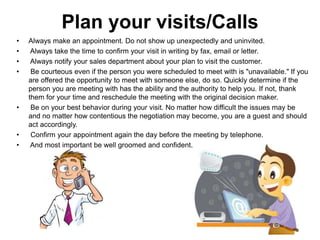
Plan your visits/Calls
• Always make an appointment. Do not show up unexpectedly and uninvited.
• Always take the time to confirm your visit in writing by fax, email or letter.
• Always notify your sales department about your plan to visit the customer.
• Be courteous even if the person you were scheduled to meet with is "unavailable." If you
are offered the opportunity to meet with someone else, do so. Quickly determine if the
person you are meeting with has the ability and the authority to help you. If not, thank
them for your time and reschedule the meeting with the original decision maker.
• Be on your best behavior during your visit. No matter how difficult the issues may be
and no matter how contentious the negotiation may become, you are a guest and should
act accordingly.
• Confirm your appointment again the day before the meeting by telephone.
• And most important be well groomed and confident.
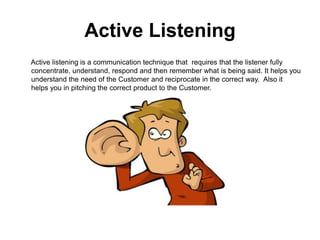
Active Listening
Active listening is a communication technique that requires that the listener fully
concentrate, understand, respond and then remember what is being said. It helps you
understand the need of the Customer and reciprocate in the correct way. Also it
helps you in pitching the correct product to the Customer.
Body Language & Etiquettes
Body language is a type of nonverbal communication in which physical behavior, as
opposed to words, are used to express or convey information. Such behavior
includes facial expressions, body posture, gestures, eye movement, touch and the
use of space. Etiquettes is the customary code of polite behavior in society or among
members of a particular profession or group. It also includes being well groomed.
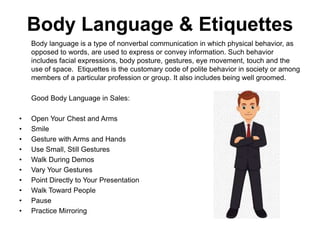
Good Body Language in Sales:
• Open Your Chest and Arms
• Smile
• Gesture with Arms and Hands
• Use Small, Still Gestures
• Walk During Demos
• Vary Your Gestures
• Point Directly to Your Presentation
• Walk Toward People
• Pause
• Practice Mirroring
Building Trust & Credibility
If you want to build trust and credibility with your customers, and hold on to them for
life, follow these 10 important tips:
• Avoid selling a solution that isn’t in the customer’s best interest.
• Never misrepresent the features, advantages and benefits of a product or service.
• Don’t promise anything you can’t deliver.
• Accepting or offering bribes or gifts is always unethical.
• Keep pricing consistent to all departments within the same company.
• When problems develop after the sale, don’t make excuses and don’t place blame; fix
the problem. You are the face of the company; it is your duty as sales professional to
deliver on the promise you made.
• Don’t withhold bad news.
• If and when you must speak of the competition, be respectful at all times.
• Always honor the relationships that other sales professionals on your team have with
their accounts. Stealing accounts from your team members is just that–stealing.
• And finally: make promises and keep them.
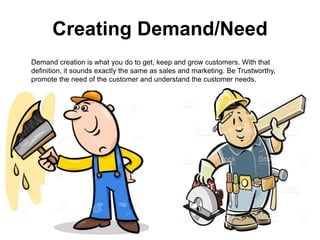
Creating Demand/Need
Demand creation is what you do to get, keep and grow customers. With that
definition, it sounds exactly the same as sales and marketing. Be Trustworthy,
promote the need of the customer and understand the customer needs.
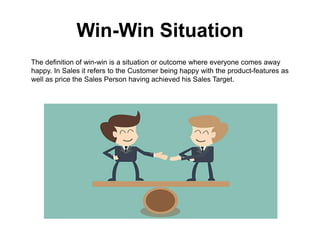
Win-Win Situation
The definition of win-win is a situation or outcome where everyone comes away
happy. In Sales it refers to the Customer being happy with the product-features as
well as price the Sales Person having achieved his Sales Target.
Closure
Closing is a sales term which refers to the process of making a sale. The sales
sense springs from real estate, where closing is the final step of a transaction. In
sales, it is used more generally to mean achievement of the desired outcome, which
may be an exchange of money or acquiring a signature.
How do you close a Sale?
By ensuring you are not selling rather you are suggesting the buyer to buy. Always
ensure you are not selling a product but you are selling a Need of the Customer.
Few basic points which you also need to consider-
1. Be Real
2. Create a sense of urgency but don’t be desperate
3. Overcome objections
4. Watch what you say.
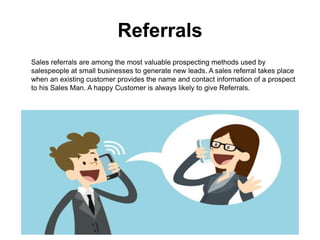
Referrals
Sales referrals are among the most valuable prospecting methods used by
salespeople at small businesses to generate new leads. A sales referral takes place
when an existing customer provides the name and contact information of a prospect
to his Sales Man. A happy Customer is always likely to give Referrals.
After Sales Service & Support
After-sales support is a service that is provided after merchandise or services have
been sold. It is designed to assist a customer in using a product correctly, which could
generate repeat customers, develop brand loyalty among customers and ensure
customer satisfaction.
Congratulations

How to win over a Customer.pptx

  • 1.
    How to winover a Customer?
  • 2.
    Lets Try Something Different?? 1.Product Knowledge 2. Identifying your Market/Customer 3. Plan your visits/Calls 4. Active Listening 5. Body language & Etiquettes 6. Building Trust 7. Creating Demand/Need 8. Win-Win Situation 9. Closure 10. Referrals 11. After Sales Service
  • 3.
    Product Knowledge In marketing,a Product is anything that can be offered to a market that might satisfy a want or need. A service is another common product type. What is Product Knowledge? Product knowledge is an essential sales skill. Understanding your products' features allows you to present their benefits accurately and persuasively. Customers respond to enthusiastic sales staff who are passionate about their products and eager to share the benefits with them. Why is it important? Product knowledge is the most important tool for closing sales. It instills faith, trust, and respect in the customer, which creates a positive customer experience. It helps in 1. Answering difficult questions 2. Building Trust 3. Making lasting impressions
  • 4.
    Identify your Market 1.Identifying customer needs – We need to understand what the Customer wants and why? 2. Identify your customers - Market research would help us understand the potential Customers and also help you develop a more detailed picture of them and understand how to target them. 3. Understand why they shop- Once you've identified who your customers are, you can find out what motivates them to buy products and services. For example, consider if they make decisions based on: work demands, family needs, budget pressures, social or emotional needs, brand preferences. 4. Identify preferred shopping methods- As well as understanding why they shop, you will also want to understand how they shop. To learn about your customers' preferred method and means of shopping, consider if they: shop online, over the phone or in stores, make spontaneous or carefully considered buying decisions. 5. Consider their spending habits - Different types of customers will be willing to spend different amounts. Find out what financial capacity and spending habits your customers have. For example, consider: their average income, the portion of their income they spend on the type of products or services you sell, if they budget. 6. Find out what they think of you- Learn about your customers' views and expectations of your business and rivals. For example, find out what they think of your: products and services, customer service, competitors.
  • 5.
    Plan your visits/Calls •Always make an appointment. Do not show up unexpectedly and uninvited. • Always take the time to confirm your visit in writing by fax, email or letter. • Always notify your sales department about your plan to visit the customer. • Be courteous even if the person you were scheduled to meet with is "unavailable." If you are offered the opportunity to meet with someone else, do so. Quickly determine if the person you are meeting with has the ability and the authority to help you. If not, thank them for your time and reschedule the meeting with the original decision maker. • Be on your best behavior during your visit. No matter how difficult the issues may be and no matter how contentious the negotiation may become, you are a guest and should act accordingly. • Confirm your appointment again the day before the meeting by telephone. • And most important be well groomed and confident.
  • 6.
    Active Listening Active listeningis a communication technique that requires that the listener fully concentrate, understand, respond and then remember what is being said. It helps you understand the need of the Customer and reciprocate in the correct way. Also it helps you in pitching the correct product to the Customer.
  • 7.
    Body Language &Etiquettes Body language is a type of nonverbal communication in which physical behavior, as opposed to words, are used to express or convey information. Such behavior includes facial expressions, body posture, gestures, eye movement, touch and the use of space. Etiquettes is the customary code of polite behavior in society or among members of a particular profession or group. It also includes being well groomed. Good Body Language in Sales: • Open Your Chest and Arms • Smile • Gesture with Arms and Hands • Use Small, Still Gestures • Walk During Demos • Vary Your Gestures • Point Directly to Your Presentation • Walk Toward People • Pause • Practice Mirroring
  • 8.
    Building Trust &Credibility If you want to build trust and credibility with your customers, and hold on to them for life, follow these 10 important tips: • Avoid selling a solution that isn’t in the customer’s best interest. • Never misrepresent the features, advantages and benefits of a product or service. • Don’t promise anything you can’t deliver. • Accepting or offering bribes or gifts is always unethical. • Keep pricing consistent to all departments within the same company. • When problems develop after the sale, don’t make excuses and don’t place blame; fix the problem. You are the face of the company; it is your duty as sales professional to deliver on the promise you made. • Don’t withhold bad news. • If and when you must speak of the competition, be respectful at all times. • Always honor the relationships that other sales professionals on your team have with their accounts. Stealing accounts from your team members is just that–stealing. • And finally: make promises and keep them.
  • 9.
    Creating Demand/Need Demand creationis what you do to get, keep and grow customers. With that definition, it sounds exactly the same as sales and marketing. Be Trustworthy, promote the need of the customer and understand the customer needs.
  • 10.
    Win-Win Situation The definitionof win-win is a situation or outcome where everyone comes away happy. In Sales it refers to the Customer being happy with the product-features as well as price the Sales Person having achieved his Sales Target.
  • 11.
    Closure Closing is asales term which refers to the process of making a sale. The sales sense springs from real estate, where closing is the final step of a transaction. In sales, it is used more generally to mean achievement of the desired outcome, which may be an exchange of money or acquiring a signature. How do you close a Sale? By ensuring you are not selling rather you are suggesting the buyer to buy. Always ensure you are not selling a product but you are selling a Need of the Customer. Few basic points which you also need to consider- 1. Be Real 2. Create a sense of urgency but don’t be desperate 3. Overcome objections 4. Watch what you say.
  • 12.
    Referrals Sales referrals areamong the most valuable prospecting methods used by salespeople at small businesses to generate new leads. A sales referral takes place when an existing customer provides the name and contact information of a prospect to his Sales Man. A happy Customer is always likely to give Referrals.
  • 13.
    After Sales Service& Support After-sales support is a service that is provided after merchandise or services have been sold. It is designed to assist a customer in using a product correctly, which could generate repeat customers, develop brand loyalty among customers and ensure customer satisfaction.
  • 14.