Sales Promotion

MKT 846
Professor West
Agenda
 Thinking
         beyond creating awareness, interest, and
 an image for your brand

 Providing   incentives to purchase

 Battling   for shoppers in the aisle
Sales Promotions

 Advertising   has a long and colorful history
   Many of the images created by advertisers have become
    cultural icons
   The Marlboro Man, Ronald McDonald, Pillsbury

    Doughboy, Energizer Bunny, AFLAC duck...
Sales Promotions

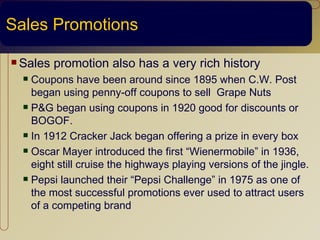
 Sales   promotion also has a very rich history
   Coupons have been around since 1895 when C.W. Post
    began using penny-off coupons to sell Grape Nuts
   P&G began using coupons in 1920 good for discounts or

    BOGOF.
   In 1912 Cracker Jack began offering a prize in every box

   Oscar Mayer introduced the first “Wienermobile” in 1936,

    eight still cruise the highways playing versions of the jingle.
   Pepsi launched their “Pepsi Challenge” in 1975 as one of

    the most successful promotions ever used to attract users
    of a competing brand
Sales Promotions

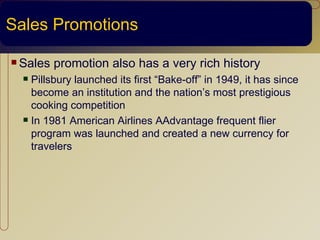
 Sales   promotion also has a very rich history
   Pillsbury launched its first “Bake-off” in 1949, it has since
    become an institution and the nation’s most prestigious
    cooking competition
   In 1981 American Airlines AAdvantage frequent flier

    program was launched and created a new currency for
    travelers
Sales Promotion

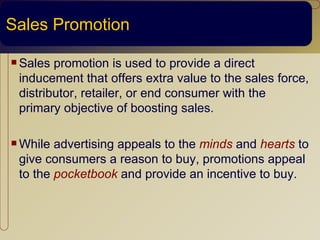
 Sales promotion is used to provide a direct
 inducement that offers extra value to the sales force,
 distributor, retailer, or end consumer with the
 primary objective of boosting sales.

 While advertising appeals to the minds and hearts to
 give consumers a reason to buy, promotions appeal
 to the pocketbook and provide an incentive to buy.
Sales Promotion

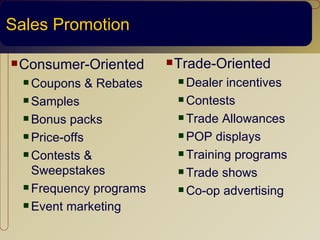
 Consumer-Oriented        Trade-Oriented

   Coupons   & Rebates     Dealer incentives
   Samples                 Contests

   Bonus  packs            Trade Allowances

   Price-offs              POP displays

   Contests &              Training programs

    Sweepstakes             Trade shows
   Frequency programs      Co-op advertising
   Event marketing
Trends

 Consumer     sales promotion increased from $56
  billion in 1991 to nearly $100 billion in 2001. An
  additional $150 billion is targeted to retailers and
  wholesalers.
 Starting in the late ’80s a shift in marketing budgets

  has boosted sales promotion sharply. Currently,
  marketers spend between 60 and 75 percent of their
  budget on sales promotion, with the remainder
  allocated to media advertising. Seventeen percent
  of advertising is devoted to promotional messages.
Reasons for Growth

 Mature  industry and increased accountability…
  manager’s pay depends on sales relative to cost
 Growing power of retailers (optical scanners,

  consolidation)
 Market saturation (nearly 30,000 products are

  launched each year compared to 2,700 on 1980)
 Advertising clutter & fragmentation (regional efforts

  and targeted markets are better suited to
  promotions)
 Short-term Focus …it generates immediate and

  measurable results
Slippery slope…

 Increased     promotional sensitivity
   Forty-two percent of package-good volume was
    purchased on promotion. Twenty-four percent
    involved the use of a coupon.
   More than seventy percent of purchase decisions

    are made in the store, where people are likely to
    respond to POP offers.
   (1999 study by Promotion Decisions Inc. tracked 33,000 consumers)
Slippery slope…

 Declining   brand loyalty
   Consumers   tend to have more than one brand in
   their “repertoire” and have been conditioned to
   switch when deals are offered.
 What
     is this doing to the brand equity
 companies have paid so dearly to build?
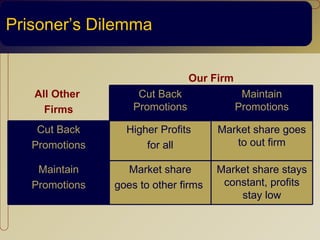
Prisoner’s Dilemma


                                 Our Firm
   All Other         Cut Back                Maintain
     Firms          Promotions              Promotions

    Cut Back      Higher Profits      Market share goes
   Promotions         for all            to out firm

    Maintain      Market share        Market share stays
   Promotions   goes to other firms    constant, profits
                                          stay low
Non-franchise Building Promotions
 Price  oriented “deals,” such as coupons, samples,
  bonus packs, and discounts are useful mechanisms
  for encouraging trial and acquiring new customers…
 However, you run the risk of eroding profits and
  increasing consumer price sensitivity
    Price discounts don’t allow you to discriminate
     between price sensitive and insensitive buyers
    Coupons allow you to price discriminate, but they
     tend to be used by your loyal consumers
    Consumers tend to forward buy, or stockpile when
     deals are offered
Franchise Building Promotions

 Ratherthan using a one-time offer, many companies
 are developing frequency programs that encourage
 repeat purchase and long-term patronage
     In order for this to be effective you have to make sure that
      the rewards are meaningful and are actually generating
      additional revenue
Franchise-Building Promotions

 Contests are used to energize the brand
 Trade promotions can be used to create win-win

  opportunities
“Brawny Man” contest took the Reggie
 Despite over 90% awareness, Georgia-Pacific recognized
  that the Brawny Man icon no longer seemed relevant to
  consumers, and it needed to work out a new regimen to
  increase sales
 They launched a summertime contest that asked women to

  send in photos and 150-word descriptions explaining why
  their guy is as rugged as the product.
 One dozen semi-finalists traveled to New York City for photo

  sessions, and the grand-prize winner got a Dodge Durango
  and a limited run as the packaging model. Dedicated TV
  spots, print ads in USA Today and People magazine, and an
  eight-market mobile tour supported.
Results
 During  the promotion period (May-October), brand
  volume grew more than 12.3%, five times more than
  the entire category
 Brand share increased from 10.5% to 11.5% during
  these months
 At the campaign's peak in June 2002, brand volume
  was up 31% vs. the year before and Brawny had its
  highest monthly dollar (13.2%) and unit (12.8%)
  share for the year.
 Profits for Brawny increased $5 million as a direct
  result of the promotion.
Nike at the Finish Line

 Choose    to play campaign…
   Target Market: 19 year-old action addicted college
    students who are role models for teenagers and adults
    wistfully recalling their college days.
   Objectives:

      To support Nike brand as a leader in exciting, stylish,
       innovative and high performance footwear and apparel
       among 65 percent of Finish Line customers.
      Create a competitive advantage for Finish Line and the
       destination for Nike products among 85 percent of
       target consumers.
Nike at the Finish Line

 Choose      to play campaign…
     Objectives:
       Increase retail store traffic and web traffic by 20
        percent
       Increase sale of Nike brand products through Finish
        Line by 15 percent in one year.
Other Elements

 Finish Line “Magalog” featured articles on athletes
  such as MJ, Mia Hamm, and Derek Jeter
 Training of sales associates using Nike’s “Ekins”

 Direct mail and winner’s circle frequency program
Results

 Overall  sales of Nike brand through Finish Line
  increased by 20 percent
 Calls to Finish Line store locator increased by 200

  percent following the first run of print advertising
 Retail traffic increased by 17 percent

 FL customer tracking study showed that the

  percentage of customers viewing FL as the best
  destination for Nike increased from 20 to 62 percent
  after one year.
Battling for shoppers in the aisles

 Marketers make their products “shout” at
  consumers from the store shelves
 The Portable Shopping System is being issued to

  consumers upon entering the store
   Upload shopping lists via the internet
   Lets you know when your prescriptions, photos, and deli

    orders are ready
 Floor
      mat ads make audio announcements when
 people step on them
Battling for shoppers in the aisles

 Storesare trying to reduce the clutter of marketing
  messages (shopping spam) delivered in the stores.
 Supermarkets are being designed more around the

  consumer’s mind-set rather than the traditional
  warehouse.
     Trader Joes & Central Market
Battling for shoppers in the aisles

 Retailer’s
           new mantra is to brand the shopping
 experience so customers are aware of where
 they’re shopping.
Next Week…
Dr. Osei Appiah will be here on Monday
 to talk about advertising research and
 copy testing methods
Ken Levy will be here to talk about

 measuring advertising effectiveness and
 return on investment

sales promotion

  • 1.
  • 2.
    Agenda  Thinking beyond creating awareness, interest, and an image for your brand  Providing incentives to purchase  Battling for shoppers in the aisle
  • 3.
    Sales Promotions  Advertising has a long and colorful history  Many of the images created by advertisers have become cultural icons  The Marlboro Man, Ronald McDonald, Pillsbury Doughboy, Energizer Bunny, AFLAC duck...
  • 4.
    Sales Promotions  Sales promotion also has a very rich history  Coupons have been around since 1895 when C.W. Post began using penny-off coupons to sell Grape Nuts  P&G began using coupons in 1920 good for discounts or BOGOF.  In 1912 Cracker Jack began offering a prize in every box  Oscar Mayer introduced the first “Wienermobile” in 1936, eight still cruise the highways playing versions of the jingle.  Pepsi launched their “Pepsi Challenge” in 1975 as one of the most successful promotions ever used to attract users of a competing brand
  • 5.
    Sales Promotions  Sales promotion also has a very rich history  Pillsbury launched its first “Bake-off” in 1949, it has since become an institution and the nation’s most prestigious cooking competition  In 1981 American Airlines AAdvantage frequent flier program was launched and created a new currency for travelers
  • 6.
    Sales Promotion  Salespromotion is used to provide a direct inducement that offers extra value to the sales force, distributor, retailer, or end consumer with the primary objective of boosting sales.  While advertising appeals to the minds and hearts to give consumers a reason to buy, promotions appeal to the pocketbook and provide an incentive to buy.
  • 7.
    Sales Promotion  Consumer-Oriented  Trade-Oriented  Coupons & Rebates  Dealer incentives  Samples  Contests  Bonus packs  Trade Allowances  Price-offs  POP displays  Contests &  Training programs Sweepstakes  Trade shows  Frequency programs  Co-op advertising  Event marketing
  • 8.
    Trends  Consumer sales promotion increased from $56 billion in 1991 to nearly $100 billion in 2001. An additional $150 billion is targeted to retailers and wholesalers.  Starting in the late ’80s a shift in marketing budgets has boosted sales promotion sharply. Currently, marketers spend between 60 and 75 percent of their budget on sales promotion, with the remainder allocated to media advertising. Seventeen percent of advertising is devoted to promotional messages.
  • 9.
    Reasons for Growth Mature industry and increased accountability… manager’s pay depends on sales relative to cost  Growing power of retailers (optical scanners, consolidation)  Market saturation (nearly 30,000 products are launched each year compared to 2,700 on 1980)  Advertising clutter & fragmentation (regional efforts and targeted markets are better suited to promotions)  Short-term Focus …it generates immediate and measurable results
  • 10.
    Slippery slope…  Increased promotional sensitivity  Forty-two percent of package-good volume was purchased on promotion. Twenty-four percent involved the use of a coupon.  More than seventy percent of purchase decisions are made in the store, where people are likely to respond to POP offers. (1999 study by Promotion Decisions Inc. tracked 33,000 consumers)
  • 11.
    Slippery slope…  Declining brand loyalty  Consumers tend to have more than one brand in their “repertoire” and have been conditioned to switch when deals are offered.  What is this doing to the brand equity companies have paid so dearly to build?
  • 12.
    Prisoner’s Dilemma Our Firm All Other Cut Back Maintain Firms Promotions Promotions Cut Back Higher Profits Market share goes Promotions for all to out firm Maintain Market share Market share stays Promotions goes to other firms constant, profits stay low
  • 13.
    Non-franchise Building Promotions Price oriented “deals,” such as coupons, samples, bonus packs, and discounts are useful mechanisms for encouraging trial and acquiring new customers…  However, you run the risk of eroding profits and increasing consumer price sensitivity  Price discounts don’t allow you to discriminate between price sensitive and insensitive buyers  Coupons allow you to price discriminate, but they tend to be used by your loyal consumers  Consumers tend to forward buy, or stockpile when deals are offered
  • 14.
    Franchise Building Promotions Ratherthan using a one-time offer, many companies are developing frequency programs that encourage repeat purchase and long-term patronage  In order for this to be effective you have to make sure that the rewards are meaningful and are actually generating additional revenue
  • 15.
    Franchise-Building Promotions  Contestsare used to energize the brand  Trade promotions can be used to create win-win opportunities
  • 16.
    “Brawny Man” contesttook the Reggie  Despite over 90% awareness, Georgia-Pacific recognized that the Brawny Man icon no longer seemed relevant to consumers, and it needed to work out a new regimen to increase sales  They launched a summertime contest that asked women to send in photos and 150-word descriptions explaining why their guy is as rugged as the product.  One dozen semi-finalists traveled to New York City for photo sessions, and the grand-prize winner got a Dodge Durango and a limited run as the packaging model. Dedicated TV spots, print ads in USA Today and People magazine, and an eight-market mobile tour supported.
  • 17.
    Results  During the promotion period (May-October), brand volume grew more than 12.3%, five times more than the entire category  Brand share increased from 10.5% to 11.5% during these months  At the campaign's peak in June 2002, brand volume was up 31% vs. the year before and Brawny had its highest monthly dollar (13.2%) and unit (12.8%) share for the year.  Profits for Brawny increased $5 million as a direct result of the promotion.
  • 18.
    Nike at theFinish Line  Choose to play campaign…  Target Market: 19 year-old action addicted college students who are role models for teenagers and adults wistfully recalling their college days.  Objectives:  To support Nike brand as a leader in exciting, stylish, innovative and high performance footwear and apparel among 65 percent of Finish Line customers.  Create a competitive advantage for Finish Line and the destination for Nike products among 85 percent of target consumers.
  • 19.
    Nike at theFinish Line  Choose to play campaign…  Objectives:  Increase retail store traffic and web traffic by 20 percent  Increase sale of Nike brand products through Finish Line by 15 percent in one year.
  • 20.
    Other Elements  FinishLine “Magalog” featured articles on athletes such as MJ, Mia Hamm, and Derek Jeter  Training of sales associates using Nike’s “Ekins”  Direct mail and winner’s circle frequency program
  • 21.
    Results  Overall sales of Nike brand through Finish Line increased by 20 percent  Calls to Finish Line store locator increased by 200 percent following the first run of print advertising  Retail traffic increased by 17 percent  FL customer tracking study showed that the percentage of customers viewing FL as the best destination for Nike increased from 20 to 62 percent after one year.
  • 22.
    Battling for shoppersin the aisles  Marketers make their products “shout” at consumers from the store shelves  The Portable Shopping System is being issued to consumers upon entering the store  Upload shopping lists via the internet  Lets you know when your prescriptions, photos, and deli orders are ready  Floor mat ads make audio announcements when people step on them
  • 23.
    Battling for shoppersin the aisles  Storesare trying to reduce the clutter of marketing messages (shopping spam) delivered in the stores.  Supermarkets are being designed more around the consumer’s mind-set rather than the traditional warehouse.  Trader Joes & Central Market
  • 24.
    Battling for shoppersin the aisles  Retailer’s new mantra is to brand the shopping experience so customers are aware of where they’re shopping.
  • 25.
    Next Week… Dr. OseiAppiah will be here on Monday to talk about advertising research and copy testing methods Ken Levy will be here to talk about measuring advertising effectiveness and return on investment

Editor's Notes

  • #14 Floor graphics were placed in 9,000 stores promoting the contest and encouraging consumers to visit brawnyman.com for entry, and these were backed by television spots. Finally, the Brawny Brigade traveled across America to help find a real-life Brawny Man, stopping in eight major cities to participate in local clean-up projects and make donations to non-profit causes. During the overall promotion period (May-October), brand volume grew more than 12.3%, five times more than the entire category, which was up 2.4%; brand share increased during these months 10% to an 11.5% share from 10.5%. At the campaign's peak in June 2002, brand volume was up 31% vs. the year before; also in June, Brawny had its highest monthly dollar (13.2%) and unit (12.8%) share for the year. And profits for Brawny increased $5 million vs. plan as a direct result of the promotion.
  • #15 Floor graphics were placed in 9,000 stores promoting the contest and encouraging consumers to visit brawnyman.com for entry, and these were backed by television spots. Finally, the Brawny Brigade traveled across America to help find a real-life Brawny Man, stopping in eight major cities to participate in local clean-up projects and make donations to non-profit causes. During the overall promotion period (May-October), brand volume grew more than 12.3%, five times more than the entire category, which was up 2.4%; brand share increased during these months 10% to an 11.5% share from 10.5%. At the campaign's peak in June 2002, brand volume was up 31% vs. the year before; also in June, Brawny had its highest monthly dollar (13.2%) and unit (12.8%) share for the year. And profits for Brawny increased $5 million vs. plan as a direct result of the promotion.
  • #17 Floor graphics were placed in 9,000 stores promoting the contest and encouraging consumers to visit brawnyman.com for entry, and these were backed by television spots. Finally, the Brawny Brigade traveled across America to help find a real-life Brawny Man, stopping in eight major cities to participate in local clean-up projects and make donations to non-profit causes. During the overall promotion period (May-October), brand volume grew more than 12.3%, five times more than the entire category, which was up 2.4%; brand share increased during these months 10% to an 11.5% share from 10.5%. At the campaign's peak in June 2002, brand volume was up 31% vs. the year before; also in June, Brawny had its highest monthly dollar (13.2%) and unit (12.8%) share for the year. And profits for Brawny increased $5 million vs. plan as a direct result of the promotion.