IDENTIFICATION OF
FISH & SHRIMP SEED
Concept of Fish seed…
Fish seed is the small sized fish which is stocked in ponds to
make it in marketable size fish.
Fish seed refers from hatchling life stage to fingerling stage.
Hatchling Spawn Fry Fingerling
References: Assessment of freshwater fish seed resources for sustainable aquaculture – FAO FISHERIES
Hatchling:
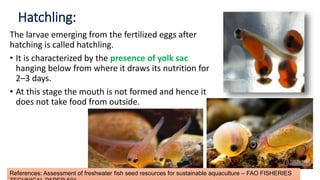
The larvae emerging from the fertilized eggs after
hatching is called hatchling.
• It is characterized by the presence of yolk sac
hanging below from where it draws its nutrition for
2–3 days.
• At this stage the mouth is not formed and hence it
does not take food from outside.
References: Assessment of freshwater fish seed resources for sustainable aquaculture – FAO FISHERIES
Spawn:
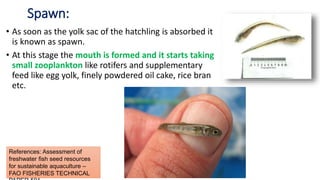
• As soon as the yolk sac of the hatchling is absorbed it
is known as spawn.
• At this stage the mouth is formed and it starts taking
small zooplankton like rotifers and supplementary
feed like egg yolk, finely powdered oil cake, rice bran
etc.
References: Assessment of
freshwater fish seed resources
for sustainable aquaculture –
FAO FISHERIES TECHNICAL
Fry:
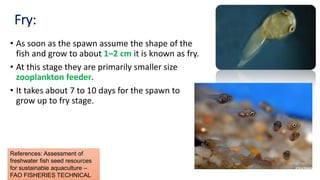
• As soon as the spawn assume the shape of the
fish and grow to about 1–2 cm it is known as fry.
• At this stage they are primarily smaller size
zooplankton feeder.
• It takes about 7 to 10 days for the spawn to
grow up to fry stage.
References: Assessment of
freshwater fish seed resources
for sustainable aquaculture –
FAO FISHERIES TECHNICAL
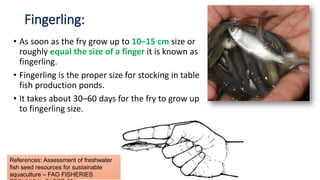
Fingerling:
• As soon as the fry grow up to 10–15 cm size or
roughly equal the size of a finger it is known as
fingerling.
• Fingerling is the proper size for stocking in table
fish production ponds.
• It takes about 30–60 days for the fry to grow up
to fingerling size.
References: Assessment of freshwater
fish seed resources for sustainable
aquaculture – FAO FISHERIES
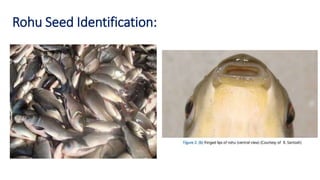
Rohu Seed Identification:
Catla seed identification:
Upper lip is absent and the lower lip is thick
References: Assessment of freshwater fish seed resources for sustainable aquaculture – FAO FISHERIES
TECHNICAL PAPER 501
Mrigal seed identification:
Mouth terminal and wide, lips without fringe
References: Assessment of freshwater fish seed resources for
Tilapia seed:
Regular and definitive stripes on the caudal fin
References: Assessment of freshwater fish seed
resources for sustainable aquaculture – FAO
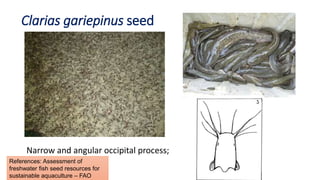
Clarias gariepinus seed
Narrow and angular occipital process;
References: Assessment of
freshwater fish seed resources for
sustainable aquaculture – FAO
Clarias batrachus seed:
• Occipital process more or less triangular
References: Assessment of freshwater fish seed resources for sustainable aquaculture – FAO FISHERIES
Chitala seed:
Differs from C. ornata in never having ocellated spots and from C. blanci and C. lopis in
never having a black spot on the pectoral fin base
C. blanci
References: Assessment of freshwater fish seed resources for sustainable aquaculture – FAO FISHERIES
TECHNICAL PAPER 501
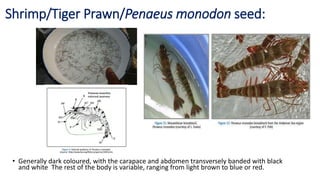
Shrimp/Tiger Prawn/Penaeus monodon seed:
• Generally dark coloured, with the carapace and abdomen transversely banded with black
and white The rest of the body is variable, ranging from light brown to blue or red.
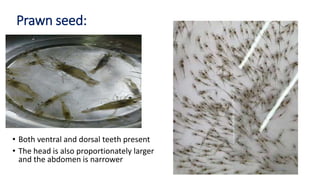
Prawn seed:
• Both ventral and dorsal teeth present
• The head is also proportionately larger
and the abdomen is narrower
P. vannamei seed:
• The eyestalks and antennal scales are
bluish and the margins of the uropods
are blue with a bright red fringe.
• the antennules are spotted (Racek,
1955).
What do we mean by seed quality?
• The fish seed quality considerations are those which meet the
expectations and demands of the producer (grow-out operations) and the
final consumer of the end product.
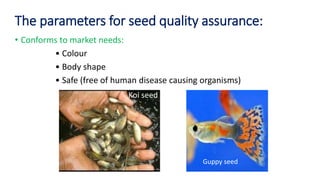
The parameters for seed quality assurance:
• Conforms to market needs:
• Colour
• Body shape
• Safe (free of human disease causing organisms)
Koi seed
Guppy seed
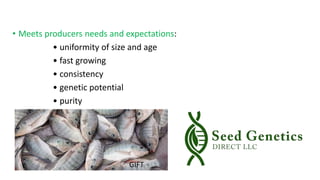
• Meets producers needs and expectations:
• uniformity of size and age
• fast growing
• consistency
• genetic potential
• purity
GIFT
• Minimizes risk to the farmer:
− high survival
− disease resistance
− healthy (nutritionally fit and free of disease)
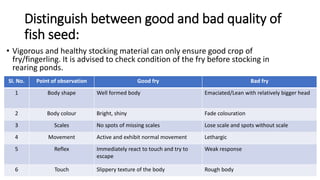
Distinguish between good and bad quality of
fish seed:
• Vigorous and healthy stocking material can only ensure good crop of
fry/fingerling. It is advised to check condition of the fry before stocking in
rearing ponds.
Sl. No. Point of observation Good fry Bad fry
1 Body shape Well formed body Emaciated/Lean with relatively bigger head
2 Body colour Bright, shiny Fade colouration
3 Scales No spots of missing scales Lose scale and spots without scale
4 Movement Active and exhibit normal movement Lethargic
5 Reflex Immediately react to touch and try to
escape
Weak response
6 Touch Slippery texture of the body Rough body
Protozoan diseases:
Ichthyopthiriasis Minute white spots,
nodular in form and in
size on the skin, fins and
gills.
Trichodiniasis: Grayish blue veil like
coating over the body
surface along with
darkening of the skin
excessive mucus
secretion
References: An overview of diseases in fish hatcheries and
nurseries, Md. Ali Reza Faruk et. al
Myxosporidiean
diseases
whirling swimming action ;
form, boils or cysts on the
body surface
Disease caused by
monogenetic trematode
the colour of the gills
becomes faded and there is
excessive secretion of mucus
due to the presence of gill
fluke. Clinical signs of skin
fluke infestation include
fading of the normal body
colour and small spots of
blood on the body surface.
References: An overview of diseases in fish hatcheries and
nurseries, Md. Ali Reza Faruk et. al
Diseases caused by crustaceans:
• Attachment sites shows sign of ulceration
• Lernaea burrows deep into the body fluids
References: An overview of diseases in fish hatcheries and
nurseries, Md. Ali Reza Faruk et. al
Bacterial Diseases:
Dropsy in
spawn
Vibriosis
Edwardsellosis
Hemorrhages in catfish
References: An overview of diseases in
fish hatcheries and nurseries, Md. Ali
Reza Faruk et. al
Fungal diseases:
• Saprolegniasis or cotton wool disease
References: An overview of diseases in fish hatcheries and
nurseries, Md. Ali Reza Faruk et. al
Viral disease:
Grass carp hemorrhagic virus
(GCHV)
Koi herpes virus disease (KHVD)
References: An overview of diseases in fish hatcheries and
nurseries, Md. Ali Reza Faruk et. al
Environmental Mediated Diseases:
Gas bubble disease
Hypoxia
References: An overview of diseases in fish hatcheries and
nurseries, Md. Ali Reza Faruk et. al
How do we achieve quality seed?
• The Working Group discussed what were the important features of
good quality seed and what factors would influence good quality:
1) Genetic quality which concerns the following aspects:
(i) genetic management of domesticated stocks
(ii) development of improved broodstock
(iii) availability of good quality broodstock
(iv) access to good quality broodstock
2) Good hatchery and/or nursery management which concerns the
following aspects:
(i) good nutrition of broodstock, larvae and fry
(ii) good record keeping
(iii) bio-security
(iv) financing
(v) disease control
(vi) standardization of protocols
(vii) implementing of technology (e.g. 3n and monosex)
(viii) human resource capacity (training, skills development)
(ix) knowledge base/ information resources.
FACTORS CAUSES FISH SEED MORTALITY
• Diseases caused by bacteria, parasite.
• Over crowing.
• Dissolve oxygen.
• Carbon –di-oxide.
• Ammonia.
• Improper temperature.
• Overfeeding.
• Poor pond hygene.
• Dirty water etc.
Conclusion:
• Good quality fish seed can grow healthy fish and satisfy consumers’ need.
If the quality of the seed deteriorates then it should hamper fish market
policy and indirectly affect the GDP of fisheries.
• Broodstock, Husbandry (hatchery and nursery), Seed movements
and availability (transport, holding and distribution, trans-
boundary movements), Pathogens and diseases (important parasitic,
bacterial, fungal and viral diseases) act as determining factors of the
quality of seed.
• Hence to enrich the fisheries world the first and foremost step is to
identify the correct and quality fish seed.
References:
• http://www.fao.org/docrep/field/003/AC381E/AC381E23.htm
• https://www.google.com/search?q=fish+seed+quality&source=lnms&tbm=isch&sa=X&ved=0ahUKEwif
wdfHxJrfAhUKsY8KHbfeD0EQ_AUIDygC&biw=1366&bih=657#imgrc=_
• http://www.fao.org/docrep/field/003/AC378E/AC378E02.htm
• http://www.fao.org/fishery/culturedspecies/Clarias_gariepinus/en
• http://www.fao.org/fishery/affris/species-profiles/nile-tilapia/nile-tilapia-home/en/
• https://www.google.com/search?biw=1366&bih=608&tbm=isch&sa=1&ei=xncTXKzTL9Cm9QPL655I&q=
male+and+female+shrimp+seed&oq=male+and+female+shrimp+seed&gs_l=img.3...42400.47017..4734
9...0.0..0.246.2133.0j5j6......0....1..gws-wiz-img.......0j0i5i30j0i8i30.1wS61fWdHJM#imgrc=_
• http://www.fao.org/docrep/field/003/AC381E/AC381E02.htm
FACULTY OF FISHERY SCIENCES
A SEMINAR ON-
SUBMITTED BY
SAILESH MAHAPATRA B.F.Sc 3rd
yr. 1st sem
ROLL NO. F/2016/21
SUBMITTED TO:
PROF. Gadadhar dash
H.O.D.
DEPT. OF AAH
THANK
YOU

Identification of fish seed

  • 3.
  • 4.
    Concept of Fishseed… Fish seed is the small sized fish which is stocked in ponds to make it in marketable size fish. Fish seed refers from hatchling life stage to fingerling stage. Hatchling Spawn Fry Fingerling References: Assessment of freshwater fish seed resources for sustainable aquaculture – FAO FISHERIES
  • 5.
    Hatchling: The larvae emergingfrom the fertilized eggs after hatching is called hatchling. • It is characterized by the presence of yolk sac hanging below from where it draws its nutrition for 2–3 days. • At this stage the mouth is not formed and hence it does not take food from outside. References: Assessment of freshwater fish seed resources for sustainable aquaculture – FAO FISHERIES
  • 6.
    Spawn: • As soonas the yolk sac of the hatchling is absorbed it is known as spawn. • At this stage the mouth is formed and it starts taking small zooplankton like rotifers and supplementary feed like egg yolk, finely powdered oil cake, rice bran etc. References: Assessment of freshwater fish seed resources for sustainable aquaculture – FAO FISHERIES TECHNICAL
  • 7.
    Fry: • As soonas the spawn assume the shape of the fish and grow to about 1–2 cm it is known as fry. • At this stage they are primarily smaller size zooplankton feeder. • It takes about 7 to 10 days for the spawn to grow up to fry stage. References: Assessment of freshwater fish seed resources for sustainable aquaculture – FAO FISHERIES TECHNICAL
  • 8.
    Fingerling: • As soonas the fry grow up to 10–15 cm size or roughly equal the size of a finger it is known as fingerling. • Fingerling is the proper size for stocking in table fish production ponds. • It takes about 30–60 days for the fry to grow up to fingerling size. References: Assessment of freshwater fish seed resources for sustainable aquaculture – FAO FISHERIES
  • 9.
  • 10.
    Catla seed identification: Upperlip is absent and the lower lip is thick References: Assessment of freshwater fish seed resources for sustainable aquaculture – FAO FISHERIES TECHNICAL PAPER 501
  • 11.
    Mrigal seed identification: Mouthterminal and wide, lips without fringe References: Assessment of freshwater fish seed resources for
  • 12.
    Tilapia seed: Regular anddefinitive stripes on the caudal fin References: Assessment of freshwater fish seed resources for sustainable aquaculture – FAO
  • 13.
    Clarias gariepinus seed Narrowand angular occipital process; References: Assessment of freshwater fish seed resources for sustainable aquaculture – FAO
  • 14.
    Clarias batrachus seed: •Occipital process more or less triangular References: Assessment of freshwater fish seed resources for sustainable aquaculture – FAO FISHERIES
  • 15.
    Chitala seed: Differs fromC. ornata in never having ocellated spots and from C. blanci and C. lopis in never having a black spot on the pectoral fin base C. blanci References: Assessment of freshwater fish seed resources for sustainable aquaculture – FAO FISHERIES TECHNICAL PAPER 501
  • 16.
    Shrimp/Tiger Prawn/Penaeus monodonseed: • Generally dark coloured, with the carapace and abdomen transversely banded with black and white The rest of the body is variable, ranging from light brown to blue or red.
  • 17.
    Prawn seed: • Bothventral and dorsal teeth present • The head is also proportionately larger and the abdomen is narrower
  • 18.
    P. vannamei seed: •The eyestalks and antennal scales are bluish and the margins of the uropods are blue with a bright red fringe. • the antennules are spotted (Racek, 1955).
  • 19.
    What do wemean by seed quality? • The fish seed quality considerations are those which meet the expectations and demands of the producer (grow-out operations) and the final consumer of the end product.
  • 20.
    The parameters forseed quality assurance: • Conforms to market needs: • Colour • Body shape • Safe (free of human disease causing organisms) Koi seed Guppy seed
  • 21.
    • Meets producersneeds and expectations: • uniformity of size and age • fast growing • consistency • genetic potential • purity GIFT
  • 22.
    • Minimizes riskto the farmer: − high survival − disease resistance − healthy (nutritionally fit and free of disease)
  • 23.
    Distinguish between goodand bad quality of fish seed: • Vigorous and healthy stocking material can only ensure good crop of fry/fingerling. It is advised to check condition of the fry before stocking in rearing ponds. Sl. No. Point of observation Good fry Bad fry 1 Body shape Well formed body Emaciated/Lean with relatively bigger head 2 Body colour Bright, shiny Fade colouration 3 Scales No spots of missing scales Lose scale and spots without scale 4 Movement Active and exhibit normal movement Lethargic 5 Reflex Immediately react to touch and try to escape Weak response 6 Touch Slippery texture of the body Rough body
  • 24.
    Protozoan diseases: Ichthyopthiriasis Minutewhite spots, nodular in form and in size on the skin, fins and gills. Trichodiniasis: Grayish blue veil like coating over the body surface along with darkening of the skin excessive mucus secretion References: An overview of diseases in fish hatcheries and nurseries, Md. Ali Reza Faruk et. al
  • 25.
    Myxosporidiean diseases whirling swimming action; form, boils or cysts on the body surface Disease caused by monogenetic trematode the colour of the gills becomes faded and there is excessive secretion of mucus due to the presence of gill fluke. Clinical signs of skin fluke infestation include fading of the normal body colour and small spots of blood on the body surface. References: An overview of diseases in fish hatcheries and nurseries, Md. Ali Reza Faruk et. al
  • 26.
    Diseases caused bycrustaceans: • Attachment sites shows sign of ulceration • Lernaea burrows deep into the body fluids References: An overview of diseases in fish hatcheries and nurseries, Md. Ali Reza Faruk et. al
  • 27.
    Bacterial Diseases: Dropsy in spawn Vibriosis Edwardsellosis Hemorrhagesin catfish References: An overview of diseases in fish hatcheries and nurseries, Md. Ali Reza Faruk et. al
  • 28.
    Fungal diseases: • Saprolegniasisor cotton wool disease References: An overview of diseases in fish hatcheries and nurseries, Md. Ali Reza Faruk et. al
  • 29.
    Viral disease: Grass carphemorrhagic virus (GCHV) Koi herpes virus disease (KHVD) References: An overview of diseases in fish hatcheries and nurseries, Md. Ali Reza Faruk et. al
  • 30.
    Environmental Mediated Diseases: Gasbubble disease Hypoxia References: An overview of diseases in fish hatcheries and nurseries, Md. Ali Reza Faruk et. al
  • 31.
    How do weachieve quality seed? • The Working Group discussed what were the important features of good quality seed and what factors would influence good quality: 1) Genetic quality which concerns the following aspects: (i) genetic management of domesticated stocks (ii) development of improved broodstock (iii) availability of good quality broodstock (iv) access to good quality broodstock
  • 32.
    2) Good hatcheryand/or nursery management which concerns the following aspects: (i) good nutrition of broodstock, larvae and fry (ii) good record keeping (iii) bio-security (iv) financing (v) disease control (vi) standardization of protocols (vii) implementing of technology (e.g. 3n and monosex) (viii) human resource capacity (training, skills development) (ix) knowledge base/ information resources.
  • 33.
    FACTORS CAUSES FISHSEED MORTALITY • Diseases caused by bacteria, parasite. • Over crowing. • Dissolve oxygen. • Carbon –di-oxide. • Ammonia. • Improper temperature. • Overfeeding. • Poor pond hygene. • Dirty water etc.
  • 34.
    Conclusion: • Good qualityfish seed can grow healthy fish and satisfy consumers’ need. If the quality of the seed deteriorates then it should hamper fish market policy and indirectly affect the GDP of fisheries. • Broodstock, Husbandry (hatchery and nursery), Seed movements and availability (transport, holding and distribution, trans- boundary movements), Pathogens and diseases (important parasitic, bacterial, fungal and viral diseases) act as determining factors of the quality of seed. • Hence to enrich the fisheries world the first and foremost step is to identify the correct and quality fish seed.
  • 35.
    References: • http://www.fao.org/docrep/field/003/AC381E/AC381E23.htm • https://www.google.com/search?q=fish+seed+quality&source=lnms&tbm=isch&sa=X&ved=0ahUKEwif wdfHxJrfAhUKsY8KHbfeD0EQ_AUIDygC&biw=1366&bih=657#imgrc=_ •http://www.fao.org/docrep/field/003/AC378E/AC378E02.htm • http://www.fao.org/fishery/culturedspecies/Clarias_gariepinus/en • http://www.fao.org/fishery/affris/species-profiles/nile-tilapia/nile-tilapia-home/en/ • https://www.google.com/search?biw=1366&bih=608&tbm=isch&sa=1&ei=xncTXKzTL9Cm9QPL655I&q= male+and+female+shrimp+seed&oq=male+and+female+shrimp+seed&gs_l=img.3...42400.47017..4734 9...0.0..0.246.2133.0j5j6......0....1..gws-wiz-img.......0j0i5i30j0i8i30.1wS61fWdHJM#imgrc=_ • http://www.fao.org/docrep/field/003/AC381E/AC381E02.htm
  • 36.
    FACULTY OF FISHERYSCIENCES A SEMINAR ON- SUBMITTED BY SAILESH MAHAPATRA B.F.Sc 3rd yr. 1st sem ROLL NO. F/2016/21 SUBMITTED TO: PROF. Gadadhar dash H.O.D. DEPT. OF AAH
  • 37.

Editor's Notes

  • #5 Fingerling
  • #25 Early developmental stages (spawn, fry and fingerlings in the case of fish; nauplii, mysis and post-larvae [PL] in the case of prawn) of most cultured species are susceptible to a variety of pathogens.