11VESTAENT OPPORTUNITIES IN
FISH SEED TECHNOLOGY
by
H.C% BARKER
Rockwater Fish Farms Limited
Rayfield
P. O. Bo;c 1725
Jos
INTRODUCTION
The successful development of the embryoal, eLpeeu:itare ilvaaeLzy in
Nigeria will be dependent on the availabiJily of suffic)ent numbers
of high quality fish seed for the stocking of proposed projects. At
present existing and newly emerging projects are aware of the acute
shortage OT such seeds. Current availability of fish seed is
limited to less than half a dozen hatcheries nation wide of which
several are only producing small numbers of seed for sale to out-
side projects. Government fish seed multiplication projects have
.to date been largely ineffective and cannot supply any quantity of
fish seed for their own projects let alone to the private individual.
One alternative is the Collection Of wild fish seed from areas where
available. Four major disadvantages must be stated:-
Fish seeds are from random, wild spawning and thus are not
being selected for improved traits required in domestica-
tion e.g fast growth, high muscle: body length ratio, slow
maturity rates etc.
Wild collection whilst a possible short term solution,
will in the long term drastically deplete the natural
fishery of its future recruits.
Availability of wild fish seed is seasonal whilst
stocking requirements are throughout the year.
Wild collected sed is already expensive and will
become more so.
Today's fish farmer in Nigeria therefore can recognise the need
to produce fish seed not only for his owa self sufficiency but
also as a means of extra income by the sales of fry to outside
projects (N.B even Government Projects). The rapidly increasing
number of newly developing aquaculture projects of varying sizes
within the country is leading to a rapid increase in demand for
fish seed. Certainly the fish seed market is booming and prices
currently being paid for fingerlings by many new projects are
artifically high. Therefore in terms of the fish seed market the
first investors into the business will enjoy the possible temporary
high prices being obtained for fish fry of any quality provided.
However, for the purpose of this paper I am looking only at the
establishment of projects which-intend to not only provide quanti-
ties of seedlings but also of the highest quality. The trust
placed by a client in a seed supplier is great and he relies on
157
the fact that what he asks for is what he is provided with. Fish
fry produced from inferior broodstock will themselves be of the
same low quality e.g. slow growing, early maturing etc. Such fry
are easily sold as "premium quality" seed with the consequent
disappointment to the buyer only becoming apparent many months
later.
SPECIES SELECTION - WHAT SPECIES OF FISH ARE TO BE GROWN?
Production of fish seed may be to supply one of two markets in
Food fish
Ornamental and aquarium fish.
In this context ornamental fish are considered in the world market
sense as 4ish for outdoor "Cool" water ponds. Species involved
are principally Koi Carp and the various types of Gold- Fish.
Aquarium fish are generally tropical warm water types of which
there are thousands of species e.g. Guppies, Mollies, Platys,
Gouramis, etc.
In the case of food fish the seed producer is looking to supply
principally Nigeria aquaculture projects, although with suitable
access to air transport services a potential market within West
Africa also exists. However tapping this market may be very
difficult from the logistic and 'marketing stand points.
2.1 Fish culture at present in Nigeria uses many indigenous
and principally one exotic species of fish. Of the
indigenous species only one or two species are propagated
successfully under controlled condition. The first of
these is Tilapia and at present moSt Tilapia stocked are
obtained from natural spawning not controlled propagation.
However, as will be discussed further, its controlled
propagation has been extensively developed elsewhere in
the world and that technology is now being employed in
Nigeria. Secondly darlas lazera, the mudfish (catfish)
can be bred by artificial propagation. However, this fish
is new to fish culture and it is only within the last 10
years that its controlled propagation has been developed.
In Nigeria no single fish farm can say that it is producing
darlas fingerlings on an as yet commercial scale, (i.e.
over 100,000 per year).
The exotic species that is cultured in Nigeria is aprinus
Carpio - the common carp. This fish originating from the
great rivers of China has been cultured for some 600 years.
Its culture under controlled conditions is precisely known
and it is therefore certainly one of the principal species
that will be utilized in the developing system of aquaculture
in NIgeria.
The freshwater of Nigeria is very rich in the diversity of
fish to be found. Some 200 species are known at present
and undoubtedly a few more lesser species are yet to be
described. Of these many are known to have a real potential
for future developement as cultured species, leading
candidates amongst the fish of Nigeria for such developement
are:
i) Heterotis niloticus
158
Gymnarchus niloticus
Labeo coubie
Heterobranchus spp.
Bagrus dogmac
Chrysichthys nigrodigitaus
Channa obscura
Lates niloticus
However, it must be strongly re-emphasised that none
of these(species, as yet, have been developed into
culture species. Certainly the breeding of such species
as above is little known and in some cases even unknown.
Thus no commercial operation can start off with the
intention of initially mass producing any of these. Only
Carp and Tilapia are sufficiently developed for commercial
production of their fry. Even darlas still remains to be
fully developed.
Consequently this document will concentrate on the
propagational requirements for only Carp and Tilapia as
a commercial proposition. The development of the other
species is in the eventual interest of fish farmers in
Nigeria but cannot be supported as part of a newly
developing commercial project.
2.2 CARP - CYPRINUS CARPIO
The fecundity or reproductive potential of the common
carp iE very high. Single females of 1kg can provide
up to 100,000 eggs. Normally a broodstock of 50 female
breeders of 3kg average weight is capable of providing a
minimum 1,500,000 fingerlings per annum. This brood-
stock is continually being replaced with young selected
fish from the same genetic line. Older broodstock above
4-5 years gradually become- less productive and should be
sold off.
A female brood herd of 50 fish with total biomass of
150kg can be kept in a broodstock pond of 0.15 ha.
Breeder males which will be kept separately are ased at a
smaller size, generally around 0.8 - 1.0kc 100 mais
are more than adequate to service a female breeding herd
of 50 fish. A further broodatock pond of 0.1 ha.
required for the male breeder herd. This means that the
total pond area required for the maintenance of such a
carp breeding herd is 0.25 ha.
Sources of broodstock in the country are very few and
one or two farms only exist where blood lines pf
improved carp are maintained.
Any new fish seed project intending to directly purchr
broodstock ready for breeding must expect to pay a price
commensurate to the fry that will be obtained as a result o.
propagation.
150.
native is to obtain fry or fingerlings and rear and
.L_J:Iduce the broodstock obviously a delay of at least
L z_13 6ccur prior to first spawning.
Blood stock within Nigeria of carp is generally poor due to many
yE,ars Of uncontrolled Spawning of original stocks brought in
during the 1950s and 1960s. However, some selected lines are now
ip-j_ng re-established both at Rockwater Fish Farm, Jos and a few
o her places.
;Ji-aportation of fast growing strains from overseas is the third
alternative but certainly will entail provision of carp fry for
on growing and broodstock selection.
2.3 TILAPIA
Tilapia is known as an excellent fish for fish culture
operations having a high quality flesh, good growth rate
as well as.being tolerant to high water temperatures, high
levels of ammonia and nitrite and low dissolved oxygen
levels. Their principal disadvantage is early maturation
in ponds and subsequent wild spawning and over population.
This over population causes 'a dramatic reduction in the
yield of the pond.
Three steps can be taken to control this problem, either singly or,
Most efficiently together.
- entry of wild fish into the pond during
water transfer. This will involve the use of screens
or gravel filters to exclude even the smallest fry and,
in some species, the fertilized planktonic eggs.
o predators to remove weed fish and any
Tjùly_a Ifry resulting from breeding within the pond.
PLinciPal problems here are critical stocking sizes
of predator e.g. Ciarías lazera relative to stocked
Stocking of single sex populations of Tilapia to prevent
breee)jng. Also in Tilapia, generally, the male fish is
fa.: -L,:ir'own rate than the female. Consequently
;
111;:ae Tilapia is desirable. Such male
p rlapia may be obtained in one of three
a) Hand sexing of a juvenile population: This method is
labour intensive, wasteful (females discarded) and liable
to operator error.
a) Hormone treatment of fry. Until recently this method
Len limited to pilot scale production due to
bechnical problems. These have now largely beeen solved
and such production is reaching a commercial scale in
countries such as Israel, Phillipines etc. It is
necessary that this method be practised and developed
in this project.
c) Hybridization. This method has the added advantage that
the off-spring exhibit hybrid vigour. Whilst simple in
theory; the realization of commercial production is
complicated in practise and certain stages of production
160
must be carefully monitored. ProductiOn of hybrLd
fry is described in detail later. However, the
broodstock requirements may be detailed at this stage.
Many species have been found to be suitable for
hybridization. The most frequently used crosses
are:- Oreochromis mossambicus x Oreochromis hornorum.
Oreochromis niloticus x Oreochromis aureus.
Oreochromis niloticus x Oreochromis hornorum.
Use of the O. niloticus x O. aureus cross is most common
although inthe constantlYwarm water temperatures of
Bendel State the O. niloticus x O. hornorum cross may
also thrive.
For such hybrid production two lines of meticulously
isolated grand parent broodstock must be maintained in
order to previde true line parents for the hybrid cross.
The total number of fry that can be recovered from i00-
400g parents is, at most, 1500 fry per female per season.
Thus, in order to guarantee a production of 500,000 hybrid
fry per year a female broodstock of 400 fish will be
required and similar number of males.
The pure line grand parent stock required to produce
these breeders will be small but highly selected. Some
20 pairs Qf each will provide enough fry and sufficient
population strength for self maintenance and selection.
Again this will be continuallY replaced with true line
elected.
Removal of hybrid fry, from the brood ponds must be
continuous in order to prevent cross breeding of
parents and fry. This is usually accomplished by the
complete harvesting of all fry every two weeks. It
is convenient to have a second broodstock pond prepared
ready for restocking of the breeders immediately after
removal from the first broodstock pond.
Broodstock pond requirements for TilaPia production o2
500,000 fry are as follows:-
Grand parent stock - O. niloticus 1 pond 0,05 ha.
Grand parent stock - O. aureue 1 pond 0.05 ha.
Hybrid breeding pond 3 x 0.1 ha = 0.3 ha.
Total area 0,4 ha.
In conclusion the broodstock pond requirements for the production
of 1,500,000 carp fingerlings and 500,000 Maple fingerliage is
0.65 ha. water area. It is intended to provide an additional 3
ponds each of 0.1 ha, for the growth of potential broodstock of
other local species such as Clarias, Heterotis etc, etc., resulting
in broodstock ponds covering a total water area of 0.95 ha,
161
2.4 NURSERY PONDS
It is estimated therefore that the hatchery will produce
up to 2,000,000 carp and tilapia fry per annum.
Instantaneous stocking of all 2 million fry at a normal
stocking density of 700,000 fry per hectare would
require, a total of 2.8 ha. of nursery ponds. However,
as such production is not instantaneous but stagered
throughout the season a total of 15 ponds will provide a
more than adequate facility or total area 2 ha. This
number of ponds will allow suitable flexibility for stock
management and manipulation.
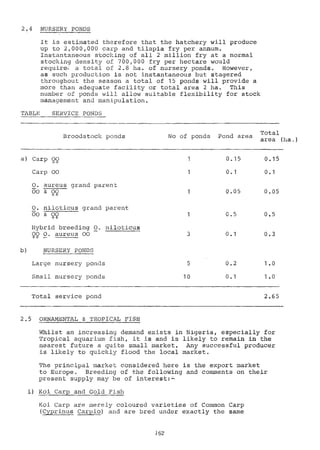
TABLE SERVICE PONDS
Broodstock ponds
2.5 ORNAMENTAL & TROPICAL FISH
162
Total
No of ponds Pond area
area (ha,)
Whilst an increasing demand exists in Nigeria, especially for
Tropical aQuarium fish, it is and is likely to remain in the
nearest future a quite small market. Any successful producer
is likely tp quickly flood the local market.
The principal market considered here is the export market
to Europe. Breeding of the folloWing and comments on their
present supply may be of interest:A
i) Koi Carp and Gold Fish
Koi Carp are merely coloured varieties of Common Carp
(Cyprinu,s Carpio) and are bred under exactly the same
a) Carp yy 0.15 0.15
Carp 00 1 0.1 0.1
O. aureus grand parent
oo & yy 1 0.05 0.05
O. niloticus grand parent
00 & yy 1 0.5 0.5
Hybrid breeding O. niloticus
b)
yy O. aureus 00 3 0.1 0.3
NURSERY poNns
Large nursery ponds 5 0.2 1.0
Small nursery ponds 10 0.1 1.0
Total service pond 2.65
conditions. Their price in Europe has been high (E0.50-
0.70p wholesale price per 7-8cm. fish).
In the past all fish have come from Japan and the far
East. The Israeli fish farmers, however, have now
entered this part of the market in a big way in the
last year or so and are already pushing down the prices
providing high quality Koi from Israeli - less than 5
hours flying time to Europe. It must be moted that Koi
do not breed 'true and from any crossing up to 40-50%
may be discarded as sub standard quality.
Many varieties of Goldfish (Carasscus auratus) exist
e.g. comet, veil-tail, shubunkin, Oranda etc. Their
sale value depending on the variety, which too is
linked with the difficulty of rearing some of the
varieties. Common Red Comet Goldfish may only fetch
£0.10 to the breeder whereas some of the exotic
Oranda's and Shubunkin's up to £1.00.
Breeding of these is normally carried out in semi natural
conditions with subsequent transfer of the fertilized,
deposited eggs on spawning mats, into prepared nursery
ponds.
Both Koi and Goldfish breed best under seasonal conditions
where a rise in water temperatures from below 18°C to
approximately 20-21°C may be experienced. This limits
ideal Koi and Goldfish production to certain parts of the
Country.
ii) Tropical Aquarium Fish
Most of these are small spec;es that are bred under natural
conditions in small ponds. Ctrrent European supply of
farmed tropical fish is from Singapore, Malaya etc.
specializing in species such as Guppies (Poecilia reticulata)
platys (Xiphorus maculatus) Mollies (Poecilia vellifera etc.)
Gourami's (Trichopterus spp). Siamese Fighting Fish (Beta
splenden) etc.
Prices obtainable for these are variable between £0.10
and £0.60 per unit.
Interestingly the market for African tropical,fish which
has been restricted to specialist fish - keepers for
many years, is beginning to open up. At present most
if not al]. the West African fish sent to Europe are
captured wild. Unfortunately the buyers in Europe
complain bitterly about the quality of the shipments
that they receive. It does not surprise me. Techniques
capture storage, transportation, packaging and despatch
are for the most cases deplorable.
A clear opportunity exists for some one to propagate
some of the more popular and valuable species under
controlled, hygeinic conditions and export them enmasse.
Possibilities include certain lynodontis spp., Pantodon
buccholzi (Butterfly fish), Pelmatachromis spp. Para
auchenOglanis spp. Schilbe mystus - etc.
163
HATCHERY FACILITIES
Three main facilities must be .considered:-
WATER SUPPLY
FreqUently the.)Adst'..negeleoted.asPeet'in the tsi.gri.:o
fish,seed pro.jecVs but undoubtedly the most littport.
lt iS....not....possible to "make do" with a water supply
SySteM to a hatchery._
if you are going to invest heavily in a hatchry Ifrk)j-,:t;
the investment must be safe-gaurded by sufficieA.- oLpitai
out lay to find a site that can provide enouc.Th 11,,lter
suitable quality. if necessary water t-fe.4:.tiont
required a's. 1.4y possible rco:Lrculatio.
The smothering effect of sOpended_solidS.
newly hatched larvae is one of the "commonest c.4
mortalities in many poorly designed hatcherie&.
of primary sedimentation ponds, aquatic macrophvves aA.,6
gravel...filters are the...simplest solutlphe th4t.cau.W.:
emplolied tO ±-emove inOrganiC-SUspensiOne,
Organic suspensions, frequently accompanied by hi9h
bacterial loads will normally rcquire some ..D'))*cfoliebil
treatment system e.g, biological filterr biodrlyms
Many of the highly sophisticated bacteria], reOxkoing
systems are not only very expensiVe but froquenly".
disappointing in their efficiency e.g. Ozone rc-Iduce
U.V. sterilizers.
,,.The quantity of water required is obviously 'Ll.nally
dependent on whether any recirculation is tanIng
However, total input_ requiremen'ts for a medium s',.1;ed
hatchery and accompanying service ponds are of th
of 2:M0Widay.
A single large PUmp (miniMUm 6" sUctiOn)...pUmplug
hoUs a da y may be considered in preferenwe to u ..;Y,A;Aler
pumv_working. all mostcon(;inuously;,:
The use of boreholes is possible but the-require 4,7oLt.cut of
water may. dlctate-Qne More:4arge volume units,.
HATCHERy
Hatchery de sin are many and-are generally
for any intended project, It should .oe noted tndt can
be built entirely from available materials wititou
importation oí specialist hatch,ary
depending on the limit of sophistication req,uire6
imported components may be required (e.g. Wai;ar
Alonitor,...automatic..fseders etc.).
Egg incuhator if required can he alade:locall-
efficiently based on a modi;7ied zonA jaz
it is necessarv tiles(:; Lo Ilave not: only
but also"a constart pressure.... supply to avbit't uyoz. 't,t';der
irrigation ok the developin4 eg4 vihich can Lv
164
Fry tanks can be made very easily and effectively using
fine rendered concrete blocks and plastic and galvanized
piping for the water control and filtration system. Whilst
not portable as are glass fibre tanks, they are economical,
efficient, strong and easily maintained. Concrete asbestor$
tanks are available in limited sizes and designs.. They have
the advantage of being cheap and portable. They are howeve:c,
brittle and care needs to be taken in their use to prevent
breakages.
The question of roofing hatcheries is a complex one. Idea-
lly a hatchery should be roofed to protect the fry tanks
from climatic excesses. The hatchery can however be operated
with partly open air facilities. Rockwater Fish Farm on the
Jos Plateau has the main fry tanks and holding tanks out
doors with Indoor facilities for controlled breeding, egg
incubation, laboratory facilities and Artemia culture.
c) PONDS
These include the broodstock and nursery ponds and in
requirement terms haVe been discussed previously.
Construction methods are standard for earthen ponds
using small monks or turn down pipes for water control.
In terms of design ideally many small ponds facilitate
the separate stocking of varying batches of fry produced
from the hatchery. Fry of different ages should never
be stocked in the same pond morder to prevent cannibalism
of the smaller fry.
4 HATCHERY MANAGEMENT
Without a totally dedicated, well trained and concientious
staff any Fish Hatchery Project is doomed to failure.
This may well be seen as one of the principal current
constraints to the developement of such projects at present.
Quite simply the only hatchery technicians available at
present-in Nigeria are those trained and working at the
few developed hatcheries in Nigeria e.g. Rockwater. More
than training however is the importance of dedication,
interest and concientiousness.
Working in the hatchery regularly is at any hour of the
day on any day of the week. Few projects will be able
to pay a salary of the level that would fully compensate
the efforts of a good hatchery worker. In the end fish
hatchery technicians give effort over and above the
requirements of their paid salaries. Staff must live
on the hatchery site in order to be constantly available.
SUMMARY
The operatioltì of a successful Fish Hatchery and fry
production system will depend on the following
i) Correct initial planning for intended production (both
species and intended numbers).
1 65
Design of the appropriate facilities to enable
requ&red production.
Selection of top calibre, dedicated and experienced
hatchery staff.
The ethical responsibility taken by the hatchery
management to produce only the highest quality
seed under th'e best possible conditions. Purchasing
farmers are dependent on this.

157

  • 1.
    11VESTAENT OPPORTUNITIES IN FISHSEED TECHNOLOGY by H.C% BARKER Rockwater Fish Farms Limited Rayfield P. O. Bo;c 1725 Jos INTRODUCTION The successful development of the embryoal, eLpeeu:itare ilvaaeLzy in Nigeria will be dependent on the availabiJily of suffic)ent numbers of high quality fish seed for the stocking of proposed projects. At present existing and newly emerging projects are aware of the acute shortage OT such seeds. Current availability of fish seed is limited to less than half a dozen hatcheries nation wide of which several are only producing small numbers of seed for sale to out- side projects. Government fish seed multiplication projects have .to date been largely ineffective and cannot supply any quantity of fish seed for their own projects let alone to the private individual. One alternative is the Collection Of wild fish seed from areas where available. Four major disadvantages must be stated:- Fish seeds are from random, wild spawning and thus are not being selected for improved traits required in domestica- tion e.g fast growth, high muscle: body length ratio, slow maturity rates etc. Wild collection whilst a possible short term solution, will in the long term drastically deplete the natural fishery of its future recruits. Availability of wild fish seed is seasonal whilst stocking requirements are throughout the year. Wild collected sed is already expensive and will become more so. Today's fish farmer in Nigeria therefore can recognise the need to produce fish seed not only for his owa self sufficiency but also as a means of extra income by the sales of fry to outside projects (N.B even Government Projects). The rapidly increasing number of newly developing aquaculture projects of varying sizes within the country is leading to a rapid increase in demand for fish seed. Certainly the fish seed market is booming and prices currently being paid for fingerlings by many new projects are artifically high. Therefore in terms of the fish seed market the first investors into the business will enjoy the possible temporary high prices being obtained for fish fry of any quality provided. However, for the purpose of this paper I am looking only at the establishment of projects which-intend to not only provide quanti- ties of seedlings but also of the highest quality. The trust placed by a client in a seed supplier is great and he relies on 157
  • 2.
    the fact thatwhat he asks for is what he is provided with. Fish fry produced from inferior broodstock will themselves be of the same low quality e.g. slow growing, early maturing etc. Such fry are easily sold as "premium quality" seed with the consequent disappointment to the buyer only becoming apparent many months later. SPECIES SELECTION - WHAT SPECIES OF FISH ARE TO BE GROWN? Production of fish seed may be to supply one of two markets in Food fish Ornamental and aquarium fish. In this context ornamental fish are considered in the world market sense as 4ish for outdoor "Cool" water ponds. Species involved are principally Koi Carp and the various types of Gold- Fish. Aquarium fish are generally tropical warm water types of which there are thousands of species e.g. Guppies, Mollies, Platys, Gouramis, etc. In the case of food fish the seed producer is looking to supply principally Nigeria aquaculture projects, although with suitable access to air transport services a potential market within West Africa also exists. However tapping this market may be very difficult from the logistic and 'marketing stand points. 2.1 Fish culture at present in Nigeria uses many indigenous and principally one exotic species of fish. Of the indigenous species only one or two species are propagated successfully under controlled condition. The first of these is Tilapia and at present moSt Tilapia stocked are obtained from natural spawning not controlled propagation. However, as will be discussed further, its controlled propagation has been extensively developed elsewhere in the world and that technology is now being employed in Nigeria. Secondly darlas lazera, the mudfish (catfish) can be bred by artificial propagation. However, this fish is new to fish culture and it is only within the last 10 years that its controlled propagation has been developed. In Nigeria no single fish farm can say that it is producing darlas fingerlings on an as yet commercial scale, (i.e. over 100,000 per year). The exotic species that is cultured in Nigeria is aprinus Carpio - the common carp. This fish originating from the great rivers of China has been cultured for some 600 years. Its culture under controlled conditions is precisely known and it is therefore certainly one of the principal species that will be utilized in the developing system of aquaculture in NIgeria. The freshwater of Nigeria is very rich in the diversity of fish to be found. Some 200 species are known at present and undoubtedly a few more lesser species are yet to be described. Of these many are known to have a real potential for future developement as cultured species, leading candidates amongst the fish of Nigeria for such developement are: i) Heterotis niloticus 158
  • 3.
    Gymnarchus niloticus Labeo coubie Heterobranchusspp. Bagrus dogmac Chrysichthys nigrodigitaus Channa obscura Lates niloticus However, it must be strongly re-emphasised that none of these(species, as yet, have been developed into culture species. Certainly the breeding of such species as above is little known and in some cases even unknown. Thus no commercial operation can start off with the intention of initially mass producing any of these. Only Carp and Tilapia are sufficiently developed for commercial production of their fry. Even darlas still remains to be fully developed. Consequently this document will concentrate on the propagational requirements for only Carp and Tilapia as a commercial proposition. The development of the other species is in the eventual interest of fish farmers in Nigeria but cannot be supported as part of a newly developing commercial project. 2.2 CARP - CYPRINUS CARPIO The fecundity or reproductive potential of the common carp iE very high. Single females of 1kg can provide up to 100,000 eggs. Normally a broodstock of 50 female breeders of 3kg average weight is capable of providing a minimum 1,500,000 fingerlings per annum. This brood- stock is continually being replaced with young selected fish from the same genetic line. Older broodstock above 4-5 years gradually become- less productive and should be sold off. A female brood herd of 50 fish with total biomass of 150kg can be kept in a broodstock pond of 0.15 ha. Breeder males which will be kept separately are ased at a smaller size, generally around 0.8 - 1.0kc 100 mais are more than adequate to service a female breeding herd of 50 fish. A further broodatock pond of 0.1 ha. required for the male breeder herd. This means that the total pond area required for the maintenance of such a carp breeding herd is 0.25 ha. Sources of broodstock in the country are very few and one or two farms only exist where blood lines pf improved carp are maintained. Any new fish seed project intending to directly purchr broodstock ready for breeding must expect to pay a price commensurate to the fry that will be obtained as a result o. propagation. 150.
  • 4.
    native is toobtain fry or fingerlings and rear and .L_J:Iduce the broodstock obviously a delay of at least L z_13 6ccur prior to first spawning. Blood stock within Nigeria of carp is generally poor due to many yE,ars Of uncontrolled Spawning of original stocks brought in during the 1950s and 1960s. However, some selected lines are now ip-j_ng re-established both at Rockwater Fish Farm, Jos and a few o her places. ;Ji-aportation of fast growing strains from overseas is the third alternative but certainly will entail provision of carp fry for on growing and broodstock selection. 2.3 TILAPIA Tilapia is known as an excellent fish for fish culture operations having a high quality flesh, good growth rate as well as.being tolerant to high water temperatures, high levels of ammonia and nitrite and low dissolved oxygen levels. Their principal disadvantage is early maturation in ponds and subsequent wild spawning and over population. This over population causes 'a dramatic reduction in the yield of the pond. Three steps can be taken to control this problem, either singly or, Most efficiently together. - entry of wild fish into the pond during water transfer. This will involve the use of screens or gravel filters to exclude even the smallest fry and, in some species, the fertilized planktonic eggs. o predators to remove weed fish and any Tjùly_a Ifry resulting from breeding within the pond. PLinciPal problems here are critical stocking sizes of predator e.g. Ciarías lazera relative to stocked Stocking of single sex populations of Tilapia to prevent breee)jng. Also in Tilapia, generally, the male fish is fa.: -L,:ir'own rate than the female. Consequently ; 111;:ae Tilapia is desirable. Such male p rlapia may be obtained in one of three a) Hand sexing of a juvenile population: This method is labour intensive, wasteful (females discarded) and liable to operator error. a) Hormone treatment of fry. Until recently this method Len limited to pilot scale production due to bechnical problems. These have now largely beeen solved and such production is reaching a commercial scale in countries such as Israel, Phillipines etc. It is necessary that this method be practised and developed in this project. c) Hybridization. This method has the added advantage that the off-spring exhibit hybrid vigour. Whilst simple in theory; the realization of commercial production is complicated in practise and certain stages of production 160
  • 5.
    must be carefullymonitored. ProductiOn of hybrLd fry is described in detail later. However, the broodstock requirements may be detailed at this stage. Many species have been found to be suitable for hybridization. The most frequently used crosses are:- Oreochromis mossambicus x Oreochromis hornorum. Oreochromis niloticus x Oreochromis aureus. Oreochromis niloticus x Oreochromis hornorum. Use of the O. niloticus x O. aureus cross is most common although inthe constantlYwarm water temperatures of Bendel State the O. niloticus x O. hornorum cross may also thrive. For such hybrid production two lines of meticulously isolated grand parent broodstock must be maintained in order to previde true line parents for the hybrid cross. The total number of fry that can be recovered from i00- 400g parents is, at most, 1500 fry per female per season. Thus, in order to guarantee a production of 500,000 hybrid fry per year a female broodstock of 400 fish will be required and similar number of males. The pure line grand parent stock required to produce these breeders will be small but highly selected. Some 20 pairs Qf each will provide enough fry and sufficient population strength for self maintenance and selection. Again this will be continuallY replaced with true line elected. Removal of hybrid fry, from the brood ponds must be continuous in order to prevent cross breeding of parents and fry. This is usually accomplished by the complete harvesting of all fry every two weeks. It is convenient to have a second broodstock pond prepared ready for restocking of the breeders immediately after removal from the first broodstock pond. Broodstock pond requirements for TilaPia production o2 500,000 fry are as follows:- Grand parent stock - O. niloticus 1 pond 0,05 ha. Grand parent stock - O. aureue 1 pond 0.05 ha. Hybrid breeding pond 3 x 0.1 ha = 0.3 ha. Total area 0,4 ha. In conclusion the broodstock pond requirements for the production of 1,500,000 carp fingerlings and 500,000 Maple fingerliage is 0.65 ha. water area. It is intended to provide an additional 3 ponds each of 0.1 ha, for the growth of potential broodstock of other local species such as Clarias, Heterotis etc, etc., resulting in broodstock ponds covering a total water area of 0.95 ha, 161
  • 6.
    2.4 NURSERY PONDS Itis estimated therefore that the hatchery will produce up to 2,000,000 carp and tilapia fry per annum. Instantaneous stocking of all 2 million fry at a normal stocking density of 700,000 fry per hectare would require, a total of 2.8 ha. of nursery ponds. However, as such production is not instantaneous but stagered throughout the season a total of 15 ponds will provide a more than adequate facility or total area 2 ha. This number of ponds will allow suitable flexibility for stock management and manipulation. TABLE SERVICE PONDS Broodstock ponds 2.5 ORNAMENTAL & TROPICAL FISH 162 Total No of ponds Pond area area (ha,) Whilst an increasing demand exists in Nigeria, especially for Tropical aQuarium fish, it is and is likely to remain in the nearest future a quite small market. Any successful producer is likely tp quickly flood the local market. The principal market considered here is the export market to Europe. Breeding of the folloWing and comments on their present supply may be of interest:A i) Koi Carp and Gold Fish Koi Carp are merely coloured varieties of Common Carp (Cyprinu,s Carpio) and are bred under exactly the same a) Carp yy 0.15 0.15 Carp 00 1 0.1 0.1 O. aureus grand parent oo & yy 1 0.05 0.05 O. niloticus grand parent 00 & yy 1 0.5 0.5 Hybrid breeding O. niloticus b) yy O. aureus 00 3 0.1 0.3 NURSERY poNns Large nursery ponds 5 0.2 1.0 Small nursery ponds 10 0.1 1.0 Total service pond 2.65
  • 7.
    conditions. Their pricein Europe has been high (E0.50- 0.70p wholesale price per 7-8cm. fish). In the past all fish have come from Japan and the far East. The Israeli fish farmers, however, have now entered this part of the market in a big way in the last year or so and are already pushing down the prices providing high quality Koi from Israeli - less than 5 hours flying time to Europe. It must be moted that Koi do not breed 'true and from any crossing up to 40-50% may be discarded as sub standard quality. Many varieties of Goldfish (Carasscus auratus) exist e.g. comet, veil-tail, shubunkin, Oranda etc. Their sale value depending on the variety, which too is linked with the difficulty of rearing some of the varieties. Common Red Comet Goldfish may only fetch £0.10 to the breeder whereas some of the exotic Oranda's and Shubunkin's up to £1.00. Breeding of these is normally carried out in semi natural conditions with subsequent transfer of the fertilized, deposited eggs on spawning mats, into prepared nursery ponds. Both Koi and Goldfish breed best under seasonal conditions where a rise in water temperatures from below 18°C to approximately 20-21°C may be experienced. This limits ideal Koi and Goldfish production to certain parts of the Country. ii) Tropical Aquarium Fish Most of these are small spec;es that are bred under natural conditions in small ponds. Ctrrent European supply of farmed tropical fish is from Singapore, Malaya etc. specializing in species such as Guppies (Poecilia reticulata) platys (Xiphorus maculatus) Mollies (Poecilia vellifera etc.) Gourami's (Trichopterus spp). Siamese Fighting Fish (Beta splenden) etc. Prices obtainable for these are variable between £0.10 and £0.60 per unit. Interestingly the market for African tropical,fish which has been restricted to specialist fish - keepers for many years, is beginning to open up. At present most if not al]. the West African fish sent to Europe are captured wild. Unfortunately the buyers in Europe complain bitterly about the quality of the shipments that they receive. It does not surprise me. Techniques capture storage, transportation, packaging and despatch are for the most cases deplorable. A clear opportunity exists for some one to propagate some of the more popular and valuable species under controlled, hygeinic conditions and export them enmasse. Possibilities include certain lynodontis spp., Pantodon buccholzi (Butterfly fish), Pelmatachromis spp. Para auchenOglanis spp. Schilbe mystus - etc. 163
  • 8.
    HATCHERY FACILITIES Three mainfacilities must be .considered:- WATER SUPPLY FreqUently the.)Adst'..negeleoted.asPeet'in the tsi.gri.:o fish,seed pro.jecVs but undoubtedly the most littport. lt iS....not....possible to "make do" with a water supply SySteM to a hatchery._ if you are going to invest heavily in a hatchry Ifrk)j-,:t; the investment must be safe-gaurded by sufficieA.- oLpitai out lay to find a site that can provide enouc.Th 11,,lter suitable quality. if necessary water t-fe.4:.tiont required a's. 1.4y possible rco:Lrculatio. The smothering effect of sOpended_solidS. newly hatched larvae is one of the "commonest c.4 mortalities in many poorly designed hatcherie&. of primary sedimentation ponds, aquatic macrophvves aA.,6 gravel...filters are the...simplest solutlphe th4t.cau.W.: emplolied tO ±-emove inOrganiC-SUspensiOne, Organic suspensions, frequently accompanied by hi9h bacterial loads will normally rcquire some ..D'))*cfoliebil treatment system e.g, biological filterr biodrlyms Many of the highly sophisticated bacteria], reOxkoing systems are not only very expensiVe but froquenly". disappointing in their efficiency e.g. Ozone rc-Iduce U.V. sterilizers. ,,.The quantity of water required is obviously 'Ll.nally dependent on whether any recirculation is tanIng However, total input_ requiremen'ts for a medium s',.1;ed hatchery and accompanying service ponds are of th of 2:M0Widay. A single large PUmp (miniMUm 6" sUctiOn)...pUmplug hoUs a da y may be considered in preferenwe to u ..;Y,A;Aler pumv_working. all mostcon(;inuously;,: The use of boreholes is possible but the-require 4,7oLt.cut of water may. dlctate-Qne More:4arge volume units,. HATCHERy Hatchery de sin are many and-are generally for any intended project, It should .oe noted tndt can be built entirely from available materials wititou importation oí specialist hatch,ary depending on the limit of sophistication req,uire6 imported components may be required (e.g. Wai;ar Alonitor,...automatic..fseders etc.). Egg incuhator if required can he alade:locall- efficiently based on a modi;7ied zonA jaz it is necessarv tiles(:; Lo Ilave not: only but also"a constart pressure.... supply to avbit't uyoz. 't,t';der irrigation ok the developin4 eg4 vihich can Lv 164
  • 9.
    Fry tanks canbe made very easily and effectively using fine rendered concrete blocks and plastic and galvanized piping for the water control and filtration system. Whilst not portable as are glass fibre tanks, they are economical, efficient, strong and easily maintained. Concrete asbestor$ tanks are available in limited sizes and designs.. They have the advantage of being cheap and portable. They are howeve:c, brittle and care needs to be taken in their use to prevent breakages. The question of roofing hatcheries is a complex one. Idea- lly a hatchery should be roofed to protect the fry tanks from climatic excesses. The hatchery can however be operated with partly open air facilities. Rockwater Fish Farm on the Jos Plateau has the main fry tanks and holding tanks out doors with Indoor facilities for controlled breeding, egg incubation, laboratory facilities and Artemia culture. c) PONDS These include the broodstock and nursery ponds and in requirement terms haVe been discussed previously. Construction methods are standard for earthen ponds using small monks or turn down pipes for water control. In terms of design ideally many small ponds facilitate the separate stocking of varying batches of fry produced from the hatchery. Fry of different ages should never be stocked in the same pond morder to prevent cannibalism of the smaller fry. 4 HATCHERY MANAGEMENT Without a totally dedicated, well trained and concientious staff any Fish Hatchery Project is doomed to failure. This may well be seen as one of the principal current constraints to the developement of such projects at present. Quite simply the only hatchery technicians available at present-in Nigeria are those trained and working at the few developed hatcheries in Nigeria e.g. Rockwater. More than training however is the importance of dedication, interest and concientiousness. Working in the hatchery regularly is at any hour of the day on any day of the week. Few projects will be able to pay a salary of the level that would fully compensate the efforts of a good hatchery worker. In the end fish hatchery technicians give effort over and above the requirements of their paid salaries. Staff must live on the hatchery site in order to be constantly available. SUMMARY The operatioltì of a successful Fish Hatchery and fry production system will depend on the following i) Correct initial planning for intended production (both species and intended numbers). 1 65
  • 10.
    Design of theappropriate facilities to enable requ&red production. Selection of top calibre, dedicated and experienced hatchery staff. The ethical responsibility taken by the hatchery management to produce only the highest quality seed under th'e best possible conditions. Purchasing farmers are dependent on this.