Tissues
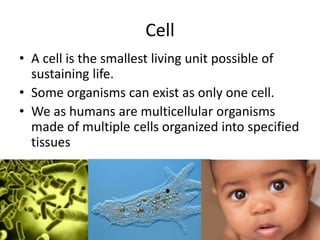
Cell
• A cell is the smallest living unit possible of
sustaining life.
• Some organisms can exist as only one cell.
• We as humans are multicellular organisms
made of multiple cells organized into specified
tissues
Tissues
• Tissues
– Groups of cells similar in structure that perform
common or related function
• Histology
– Study of tissues
© 2013 Pearson Education, Inc.
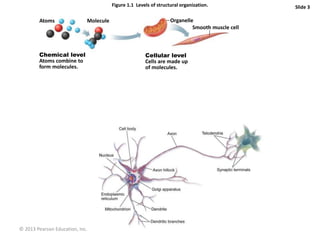
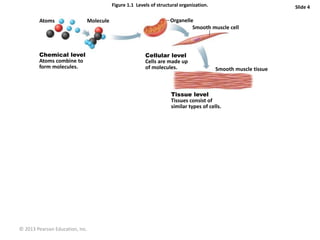
Figure 1.1 Levels of structural organization. Slide 3
Atoms Molecule Organelle
Smooth muscle cell
Chemical level
Atoms combine to
form molecules.
Cellular level
Cells are made up
of molecules.
© 2013 Pearson Education, Inc.
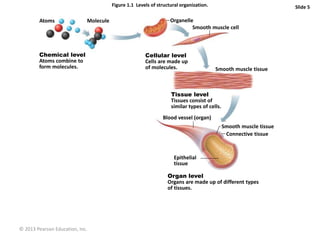
Figure 1.1 Levels of structural organization. Slide 4
Atoms Molecule Organelle
Smooth muscle cell
Chemical level
Atoms combine to
form molecules.
Cellular level
Cells are made up
of molecules.
Tissue level
Tissues consist of
similar types of cells.
Smooth muscle tissue
© 2013 Pearson Education, Inc.
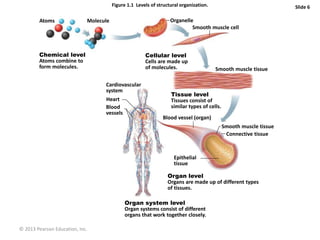
Figure 1.1 Levels of structural organization. Slide 5
Atoms Molecule Organelle
Smooth muscle cell
Chemical level
Atoms combine to
form molecules.
Cellular level
Cells are made up
of molecules.
Smooth muscle tissue
Tissue level
Tissues consist of
similar types of cells.
Blood vessel (organ)
Smooth muscle tissue
Connective tissue
Epithelial
tissue
Organ level
Organs are made up of different types
of tissues.
© 2013 Pearson Education, Inc.
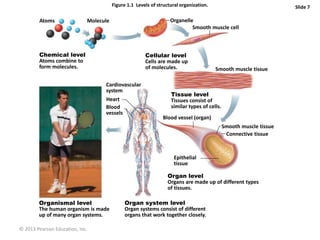
Figure 1.1 Levels of structural organization. Slide 6
Atoms Molecule Organelle
Smooth muscle cell
Chemical level
Atoms combine to
form molecules.
Cellular level
Cells are made up
of molecules.
Smooth muscle tissue
Cardiovascular
system
Heart
Blood
vessels
Tissue level
Tissues consist of
similar types of cells.
Blood vessel (organ)
Smooth muscle tissue
Connective tissue
Organ level
Organs are made up of different types
of tissues.
Organ system level
Organ systems consist of different
organs that work together closely.
Epithelial
tissue
© 2013 Pearson Education, Inc.
Figure 1.1 Levels of structural organization. Slide 7
Atoms Molecule Organelle
Smooth muscle cell
Chemical level
Atoms combine to
form molecules.
Cellular level
Cells are made up
of molecules.
Smooth muscle tissue
Cardiovascular
system
Heart
Blood
vessels
Tissue level
Tissues consist of
similar types of cells.
Blood vessel (organ)
Smooth muscle tissue
Connective tissue
Organ level
Organs are made up of different types
of tissues.
Organismal level
The human organism is made
up of many organ systems.
Organ system level
Organ systems consist of different
organs that work together closely.
Epithelial
tissue
© 2013 Pearson Education, Inc.
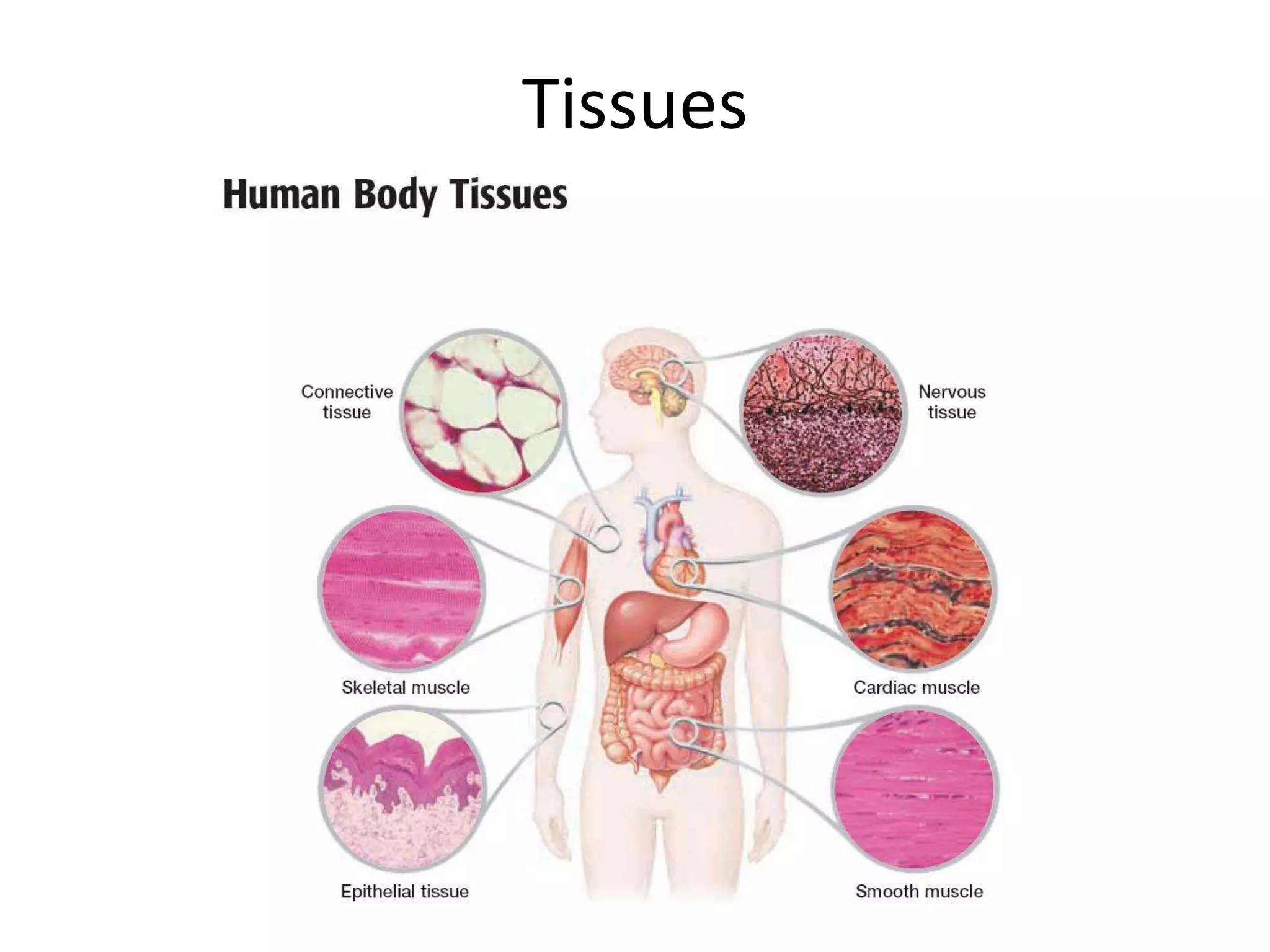
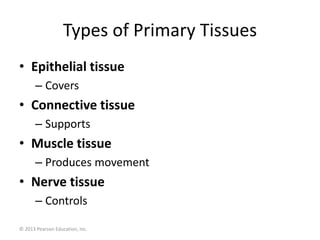
Types of Primary Tissues
• Epithelial tissue
– Covers
• Connective tissue
– Supports
• Muscle tissue
– Produces movement
• Nerve tissue
– Controls
© 2013 Pearson Education, Inc.
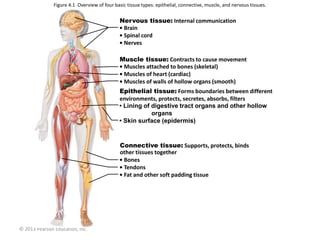
• Brain
• Spinal cord
• Nerves
Nervous tissue: Internal communication
• Muscles attached to bones (skeletal)
• Muscles of heart (cardiac)
• Muscles of walls of hollow organs (smooth)
Muscle tissue: Contracts to cause movement
Epithelial tissue: Forms boundaries between different
environments, protects, secretes, absorbs, filters
• Lining of digestive tract organs and other hollow
organs
• Skin surface (epidermis)
• Bones
• Tendons
• Fat and other soft padding tissue
Connective tissue: Supports, protects, binds
other tissues together
Figure 4.1 Overview of four basic tissue types: epithelial, connective, muscle, and nervous tissues.
© 2013 Pearson Education, Inc.
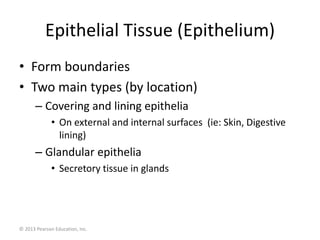
Epithelial Tissue (Epithelium)
• Form boundaries
• Two main types (by location)
– Covering and lining epithelia
• On external and internal surfaces (ie: Skin, Digestive
lining)
– Glandular epithelia
• Secretory tissue in glands
© 2013 Pearson Education, Inc.
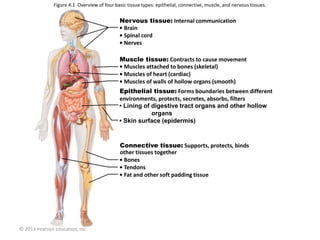
• Brain
• Spinal cord
• Nerves
Nervous tissue: Internal communication
• Muscles attached to bones (skeletal)
• Muscles of heart (cardiac)
• Muscles of walls of hollow organs (smooth)
Muscle tissue: Contracts to cause movement
Epithelial tissue: Forms boundaries between different
environments, protects, secretes, absorbs, filters
• Lining of digestive tract organs and other hollow
organs
• Skin surface (epidermis)
• Bones
• Tendons
• Fat and other soft padding tissue
Connective tissue: Supports, protects, binds
other tissues together
Figure 4.1 Overview of four basic tissue types: epithelial, connective, muscle, and nervous tissues.
© 2013 Pearson Education, Inc.
Connective Tissue
• Most abundant and widely distributed of
primary tissues
• Four main classes
– Connective tissue proper
– Cartilage
– Bone
– Blood
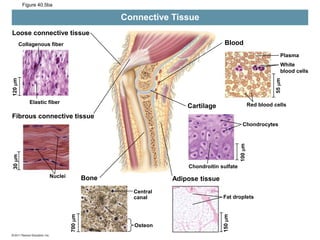
Figure 40.5ba
Blood
Connective Tissue
Plasma
White
blood cells
55
m
Red blood cells
Cartilage
Chondrocytes
Chondroitin sulfate
100
m
Adipose tissue
Fat droplets
150
m
Bone
Central
canal
Osteon
700
m
Nuclei
Fibrous connective tissue
Elastic fiber
30
m
120
m
Collagenous fiber
Loose connective tissue
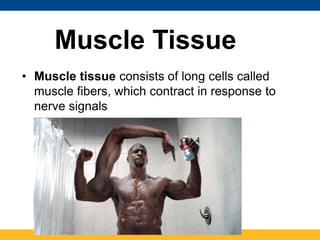
Muscle Tissue
• Muscle tissue consists of long cells called
muscle fibers, which contract in response to
nerve signals
Nervous Tissue
• Nervous tissue senses stimuli and transmits
signals throughout the animal
• Nervous tissue contains
– Neurons, or nerve cells, that transmit nerve
impulses
– Glial cells, or glia, that help nourish,
insulate, and replenish neurons
© 2011 Pearson Education, Inc.
© 2013 Pearson Education, Inc.
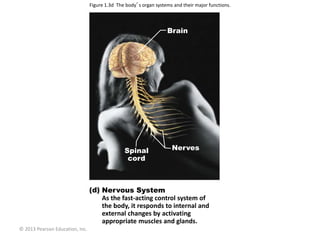
Figure 1.3d The body’s organ systems and their major functions.
Brain
Nerves
Spinal
cord
Nervous System
As the fast-acting control system of
the body, it responds to internal and
external changes by activating
appropriate muscles and glands.

Sage tissues

  • 1.
  • 2.
    Cell • A cellis the smallest living unit possible of sustaining life. • Some organisms can exist as only one cell. • We as humans are multicellular organisms made of multiple cells organized into specified tissues
  • 3.
    Tissues • Tissues – Groupsof cells similar in structure that perform common or related function • Histology – Study of tissues
  • 4.
    © 2013 PearsonEducation, Inc. Figure 1.1 Levels of structural organization. Slide 3 Atoms Molecule Organelle Smooth muscle cell Chemical level Atoms combine to form molecules. Cellular level Cells are made up of molecules.
  • 5.
    © 2013 PearsonEducation, Inc. Figure 1.1 Levels of structural organization. Slide 4 Atoms Molecule Organelle Smooth muscle cell Chemical level Atoms combine to form molecules. Cellular level Cells are made up of molecules. Tissue level Tissues consist of similar types of cells. Smooth muscle tissue
  • 6.
    © 2013 PearsonEducation, Inc. Figure 1.1 Levels of structural organization. Slide 5 Atoms Molecule Organelle Smooth muscle cell Chemical level Atoms combine to form molecules. Cellular level Cells are made up of molecules. Smooth muscle tissue Tissue level Tissues consist of similar types of cells. Blood vessel (organ) Smooth muscle tissue Connective tissue Epithelial tissue Organ level Organs are made up of different types of tissues.
  • 7.
    © 2013 PearsonEducation, Inc. Figure 1.1 Levels of structural organization. Slide 6 Atoms Molecule Organelle Smooth muscle cell Chemical level Atoms combine to form molecules. Cellular level Cells are made up of molecules. Smooth muscle tissue Cardiovascular system Heart Blood vessels Tissue level Tissues consist of similar types of cells. Blood vessel (organ) Smooth muscle tissue Connective tissue Organ level Organs are made up of different types of tissues. Organ system level Organ systems consist of different organs that work together closely. Epithelial tissue
  • 8.
    © 2013 PearsonEducation, Inc. Figure 1.1 Levels of structural organization. Slide 7 Atoms Molecule Organelle Smooth muscle cell Chemical level Atoms combine to form molecules. Cellular level Cells are made up of molecules. Smooth muscle tissue Cardiovascular system Heart Blood vessels Tissue level Tissues consist of similar types of cells. Blood vessel (organ) Smooth muscle tissue Connective tissue Organ level Organs are made up of different types of tissues. Organismal level The human organism is made up of many organ systems. Organ system level Organ systems consist of different organs that work together closely. Epithelial tissue
  • 9.
    © 2013 PearsonEducation, Inc. Types of Primary Tissues • Epithelial tissue – Covers • Connective tissue – Supports • Muscle tissue – Produces movement • Nerve tissue – Controls
  • 10.
    © 2013 PearsonEducation, Inc. • Brain • Spinal cord • Nerves Nervous tissue: Internal communication • Muscles attached to bones (skeletal) • Muscles of heart (cardiac) • Muscles of walls of hollow organs (smooth) Muscle tissue: Contracts to cause movement Epithelial tissue: Forms boundaries between different environments, protects, secretes, absorbs, filters • Lining of digestive tract organs and other hollow organs • Skin surface (epidermis) • Bones • Tendons • Fat and other soft padding tissue Connective tissue: Supports, protects, binds other tissues together Figure 4.1 Overview of four basic tissue types: epithelial, connective, muscle, and nervous tissues.
  • 11.
    © 2013 PearsonEducation, Inc. Epithelial Tissue (Epithelium) • Form boundaries • Two main types (by location) – Covering and lining epithelia • On external and internal surfaces (ie: Skin, Digestive lining) – Glandular epithelia • Secretory tissue in glands
  • 12.
    © 2013 PearsonEducation, Inc. • Brain • Spinal cord • Nerves Nervous tissue: Internal communication • Muscles attached to bones (skeletal) • Muscles of heart (cardiac) • Muscles of walls of hollow organs (smooth) Muscle tissue: Contracts to cause movement Epithelial tissue: Forms boundaries between different environments, protects, secretes, absorbs, filters • Lining of digestive tract organs and other hollow organs • Skin surface (epidermis) • Bones • Tendons • Fat and other soft padding tissue Connective tissue: Supports, protects, binds other tissues together Figure 4.1 Overview of four basic tissue types: epithelial, connective, muscle, and nervous tissues.
  • 13.
    © 2013 PearsonEducation, Inc. Connective Tissue • Most abundant and widely distributed of primary tissues • Four main classes – Connective tissue proper – Cartilage – Bone – Blood
  • 14.
    Figure 40.5ba Blood Connective Tissue Plasma White bloodcells 55 m Red blood cells Cartilage Chondrocytes Chondroitin sulfate 100 m Adipose tissue Fat droplets 150 m Bone Central canal Osteon 700 m Nuclei Fibrous connective tissue Elastic fiber 30 m 120 m Collagenous fiber Loose connective tissue
  • 15.
    Muscle Tissue • Muscletissue consists of long cells called muscle fibers, which contract in response to nerve signals
  • 16.
    Nervous Tissue • Nervoustissue senses stimuli and transmits signals throughout the animal • Nervous tissue contains – Neurons, or nerve cells, that transmit nerve impulses – Glial cells, or glia, that help nourish, insulate, and replenish neurons © 2011 Pearson Education, Inc.
  • 17.
    © 2013 PearsonEducation, Inc. Figure 1.3d The body’s organ systems and their major functions. Brain Nerves Spinal cord Nervous System As the fast-acting control system of the body, it responds to internal and external changes by activating appropriate muscles and glands.