INTRODUCTION TO
AVIATION SAFETY
By Bluebeck
CONTENTS TO COVER
Terminologies and Definitions
What is Safety in aviation ?
What is Safety Management System ?
What is the Importance of Annex 19 ?
Safety Regulatory Framework
 What is a Safety Culture ?
Importance of a Safety Culture
Ways of mitigating risks and
promoting Safety
Conclusion
TERMINOLOGIES AND
DEFINITIONS
 Safety. The state in which risks associated with aviation
activities, related to, or in direct support of the operation of
 aircraft, are reduced and controlled to an acceptable level.
 *Hazard. A condition or an object with the potential to cause or
contribute to an aircraft incident or accident.
 *Safety management system (SMS). A systematic approach to
managing safety, including the necessary organizational
structures, accountability, responsibilities, policies and
procedures.
 RISK - Risk is defined as the probability and possible
severity of accident or loss from exposure to various
hazards, including injury to people and loss of resources.
WHAT IS SAFETY ?
 The state in which risks or hazards associated with aviation
activities, related to, or in direct support of the operation of
 aircraft, are reduced and controlled to an acceptable level.
ICAO ANNEX 19 - SAFETY
MANAGEMENT SYSTEM (SMS)
 With air traffic projected to doubled in the next couple of years
 safety risks must be addressed proactively to ensure that this
significant capacity expansion is carefully managed and supported
through strategic regulatory and infrastructure Développements,
 – An Annex dedicated to safety management will re-enforce the
role played by the State in managing safety at the State level,
stressing the concept of overall safety performance in all domains,
in coordination with service providers
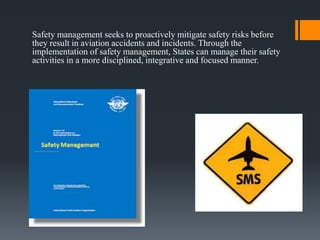
Safety management seeks to proactively mitigate safety risks before
they result in aviation accidents and incidents. Through the
implementation of safety management, States can manage their safety
activities in a more disciplined, integrative and focused manner.
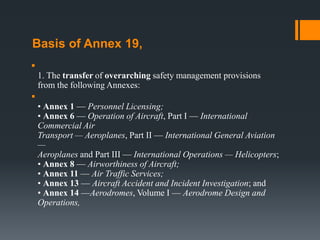
Basis of Annex 19,

1. The transfer of overarching safety management provisions
from the following Annexes:

• Annex 1 — Personnel Licensing;
• Annex 6 — Operation of Aircraft, Part I — International
Commercial Air
Transport — Aeroplanes, Part II — International General Aviation
—
Aeroplanes and Part III — International Operations — Helicopters;
• Annex 8 — Airworthiness of Aircraft;
• Annex 11 — Air Traffic Services;
• Annex 13 — Aircraft Accident and Incident Investigation; and
• Annex 14 —Aerodromes, Volume I — Aerodrome Design and
Operations,
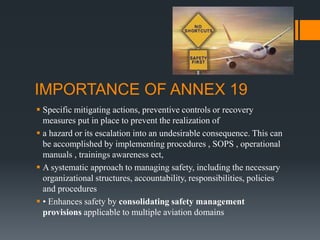
IMPORTANCE OF ANNEX 19
 Specific mitigating actions, preventive controls or recovery
measures put in place to prevent the realization of
 a hazard or its escalation into an undesirable consequence. This can
be accomplished by implementing procedures , SOPS , operational
manuals , trainings awareness ect,
 A systematic approach to managing safety, including the necessary
organizational structures, accountability, responsibilities, policies
and procedures
 • Enhances safety by consolidating safety management
provisions applicable to multiple aviation domains
SAFETY Regulatory Framework
 Safety oversight. A function performed by a State to ensure that individuals
and organizations performing an aviation activity comply with safety-related
national laws and regulations. Standard and Recommended Practices
(SARPS)
 State safety programme (SSP). An integrated set of regulations and
activities aimed at improving safety.
 This Safety program is supervised, implemented and controlled by the
National Aviation Authority of a state,
 e,g (Civil Aviation Authority)
 States should ensure they have effective safety oversight systems in place
 The SSP is developed and maintained by each State as a structured
approach to assist in managing its aviation safety performance
 *Surveillance. The State activities through which the State proactively verifies through
inspections and audits that aviation licences, certificates, authorization or approval holders
continue to meet the established requirements and function at the level of competency and
safety required by the State.
 Responsibilities
 – This chapter outlines safety management responsibilities directly applicable to the State,
including the SMS requirements be implemented by the following service providers* (as
described in the relevant Annexes):
 1. Approved training organizations;
 2. Operators of aeroplanes or helicopters authorized to conduct international
 commercial air transport;
 3. Approved maintenance organizations providing services to operators as described in
 bullet 2
 4. Organizations responsible for the type design or manufacture of aircraft;
 5. Air traffic services (ATS) providers, and;
 6. Operators of certified aerodromes.
 4 A State shall require that an SMS is developed and maintained by those service providers
under its authority, as identified in Annex 19 — Safety Management, to continuously improve
safety performance by identifying hazards, collecting and analysing data, and continuously
assessing and managing safety risks ,
SAFETY CULTURE
 A safety culture is the natural consequence of having humans in the
aviation system. Safety culture has been described as “how people
behave in relation to safety and risk when no one is watching”. It is an
expression of how
 Safety is perceived, valued and prioritized by management and
employees in an organization, and is reflected in the
 extent to which individuals and groups are:
 a) aware of the risks and known hazards faced by the organization and
its activities;
 b) continuously behaving to preserve and enhance safety;
 c) able to access the resources required for safe operations;
 d) willing and able to adapt when facing safety issues;
 e) willing to communicate safety issues; and
 f) consistently assessing the safety related behaviours throughout the
organization
The safety culture of an organization therefore
significantly influences how their SSP or SMS
develops and how effective it becomes. Safety culture is
arguably the single most important influence on the
management of safety. If an organization has instituted
all the safety management requirements but does not
have a positive safety culture, it is likely to
underperform.
IMPORTANCE OF A SAFE
CULTURE ,
 Safety Culture can have a direct impact on safe performance. If
someone believes that safety is not really important, even temporarily,
then workarounds, cutting corners, or making unsafe decisions or
judgements will be the result, especially when there is a small
perceived risk rather than an obvious danger.
 Personnels must make safety a part of them and do things right even
when no one is looking,
 An open culture to report incidents and mistakes,
 Makes the organisation personnels have a voice in decision making,
 - Everyone behaves in a manner that continuously preserves and
enhances safety

WAYS OF MITIGATING RISKS AND PROMOTING
SAFETY, :
REMEMBER SAFETY IS EVERYONES
RESPONSIBILITY ,
Possessing a clear understanding of its role and
contribution to safety to operations enables a State,
and its aviation industry to develop high standard of
smooth operations,
 Identifying a risk or hazard and find a solution on how to solve it , or
contact appropriate unit or division to take care of it,
 Follow Rules and Procedures,
 Knowing the DO’s and DONT’s,
 Safety Awareness through traings and seminars
 Being aware of safety at the airside , ramp or runway,
 Understanding the Signage and Symbols,
 Understanding the manuals and operational guidelines,
 DEVELOP A SAFETY CULTURE MINDSET THROUGH YOUR
PRACTICES
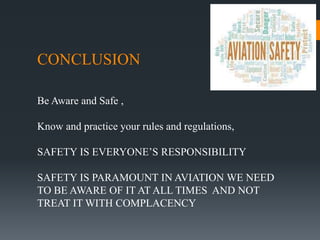
CONCLUSION
Be Aware and Safe ,
Know and practice your rules and regulations,
SAFETY IS EVERYONE’S RESPONSIBILITY
SAFETY IS PARAMOUNT IN AVIATION WE NEED
TO BE AWARE OF IT AT ALL TIMES AND NOT
TREAT IT WITH COMPLACENCY
SAFETY SMS.pptx
SAFETY SMS.pptx
SAFETY SMS.pptx
SAFETY SMS.pptx

SAFETY SMS.pptx

  • 1.
  • 2.
    CONTENTS TO COVER Terminologiesand Definitions What is Safety in aviation ? What is Safety Management System ? What is the Importance of Annex 19 ? Safety Regulatory Framework  What is a Safety Culture ? Importance of a Safety Culture Ways of mitigating risks and promoting Safety Conclusion
  • 3.
    TERMINOLOGIES AND DEFINITIONS  Safety.The state in which risks associated with aviation activities, related to, or in direct support of the operation of  aircraft, are reduced and controlled to an acceptable level.  *Hazard. A condition or an object with the potential to cause or contribute to an aircraft incident or accident.  *Safety management system (SMS). A systematic approach to managing safety, including the necessary organizational structures, accountability, responsibilities, policies and procedures.  RISK - Risk is defined as the probability and possible severity of accident or loss from exposure to various hazards, including injury to people and loss of resources.
  • 4.
    WHAT IS SAFETY?  The state in which risks or hazards associated with aviation activities, related to, or in direct support of the operation of  aircraft, are reduced and controlled to an acceptable level.
  • 5.
    ICAO ANNEX 19- SAFETY MANAGEMENT SYSTEM (SMS)  With air traffic projected to doubled in the next couple of years  safety risks must be addressed proactively to ensure that this significant capacity expansion is carefully managed and supported through strategic regulatory and infrastructure Développements,  – An Annex dedicated to safety management will re-enforce the role played by the State in managing safety at the State level, stressing the concept of overall safety performance in all domains, in coordination with service providers
  • 6.
    Safety management seeksto proactively mitigate safety risks before they result in aviation accidents and incidents. Through the implementation of safety management, States can manage their safety activities in a more disciplined, integrative and focused manner.
  • 7.
    Basis of Annex19,  1. The transfer of overarching safety management provisions from the following Annexes:  • Annex 1 — Personnel Licensing; • Annex 6 — Operation of Aircraft, Part I — International Commercial Air Transport — Aeroplanes, Part II — International General Aviation — Aeroplanes and Part III — International Operations — Helicopters; • Annex 8 — Airworthiness of Aircraft; • Annex 11 — Air Traffic Services; • Annex 13 — Aircraft Accident and Incident Investigation; and • Annex 14 —Aerodromes, Volume I — Aerodrome Design and Operations,
  • 8.
    IMPORTANCE OF ANNEX19  Specific mitigating actions, preventive controls or recovery measures put in place to prevent the realization of  a hazard or its escalation into an undesirable consequence. This can be accomplished by implementing procedures , SOPS , operational manuals , trainings awareness ect,  A systematic approach to managing safety, including the necessary organizational structures, accountability, responsibilities, policies and procedures  • Enhances safety by consolidating safety management provisions applicable to multiple aviation domains
  • 9.
    SAFETY Regulatory Framework Safety oversight. A function performed by a State to ensure that individuals and organizations performing an aviation activity comply with safety-related national laws and regulations. Standard and Recommended Practices (SARPS)  State safety programme (SSP). An integrated set of regulations and activities aimed at improving safety.  This Safety program is supervised, implemented and controlled by the National Aviation Authority of a state,  e,g (Civil Aviation Authority)  States should ensure they have effective safety oversight systems in place  The SSP is developed and maintained by each State as a structured approach to assist in managing its aviation safety performance
  • 10.
     *Surveillance. TheState activities through which the State proactively verifies through inspections and audits that aviation licences, certificates, authorization or approval holders continue to meet the established requirements and function at the level of competency and safety required by the State.  Responsibilities  – This chapter outlines safety management responsibilities directly applicable to the State, including the SMS requirements be implemented by the following service providers* (as described in the relevant Annexes):  1. Approved training organizations;  2. Operators of aeroplanes or helicopters authorized to conduct international  commercial air transport;  3. Approved maintenance organizations providing services to operators as described in  bullet 2  4. Organizations responsible for the type design or manufacture of aircraft;  5. Air traffic services (ATS) providers, and;  6. Operators of certified aerodromes.  4 A State shall require that an SMS is developed and maintained by those service providers under its authority, as identified in Annex 19 — Safety Management, to continuously improve safety performance by identifying hazards, collecting and analysing data, and continuously assessing and managing safety risks ,
  • 11.
    SAFETY CULTURE  Asafety culture is the natural consequence of having humans in the aviation system. Safety culture has been described as “how people behave in relation to safety and risk when no one is watching”. It is an expression of how  Safety is perceived, valued and prioritized by management and employees in an organization, and is reflected in the  extent to which individuals and groups are:  a) aware of the risks and known hazards faced by the organization and its activities;  b) continuously behaving to preserve and enhance safety;  c) able to access the resources required for safe operations;  d) willing and able to adapt when facing safety issues;  e) willing to communicate safety issues; and  f) consistently assessing the safety related behaviours throughout the organization
  • 12.
    The safety cultureof an organization therefore significantly influences how their SSP or SMS develops and how effective it becomes. Safety culture is arguably the single most important influence on the management of safety. If an organization has instituted all the safety management requirements but does not have a positive safety culture, it is likely to underperform.
  • 13.
    IMPORTANCE OF ASAFE CULTURE ,  Safety Culture can have a direct impact on safe performance. If someone believes that safety is not really important, even temporarily, then workarounds, cutting corners, or making unsafe decisions or judgements will be the result, especially when there is a small perceived risk rather than an obvious danger.  Personnels must make safety a part of them and do things right even when no one is looking,  An open culture to report incidents and mistakes,  Makes the organisation personnels have a voice in decision making,  - Everyone behaves in a manner that continuously preserves and enhances safety 
  • 14.
    WAYS OF MITIGATINGRISKS AND PROMOTING SAFETY, : REMEMBER SAFETY IS EVERYONES RESPONSIBILITY , Possessing a clear understanding of its role and contribution to safety to operations enables a State, and its aviation industry to develop high standard of smooth operations,
  • 15.
     Identifying arisk or hazard and find a solution on how to solve it , or contact appropriate unit or division to take care of it,  Follow Rules and Procedures,  Knowing the DO’s and DONT’s,  Safety Awareness through traings and seminars  Being aware of safety at the airside , ramp or runway,  Understanding the Signage and Symbols,  Understanding the manuals and operational guidelines,  DEVELOP A SAFETY CULTURE MINDSET THROUGH YOUR PRACTICES
  • 16.
    CONCLUSION Be Aware andSafe , Know and practice your rules and regulations, SAFETY IS EVERYONE’S RESPONSIBILITY SAFETY IS PARAMOUNT IN AVIATION WE NEED TO BE AWARE OF IT AT ALL TIMES AND NOT TREAT IT WITH COMPLACENCY