AERODROME SAFETY
MANAGEMENT SYSTEM
INTRODUCTION
An effective Safety Management System (SMS) is an organised approach to managing
safety, including the necessary organisational structures, accountabilities, policies and
procedures, and forms the primary safety oversight covering the way an aerodrome
manages safety. It also provides an identifiable and easily audited systematic control of
the management of safety at an aerodrome. By applying lessons learned, an SMS should
aim to make measurable improvements to the overall level of safety.
An aerodrome SMS should be commensurate with the size of the aerodrome and the
level of complexity of the services provided.
Guidance on SMS can be found on the CAA website: www.caa.co.uk/sms.
The ICAO SMS framework consists of four components and twelve elements, and where
possible, aerodrome licence holders should include or refer to the ICAO SMS elements
below. ICAO publishes SMS guidance in Document 9859 Safety Management manual
(SMM)
SMS FRAMEWORK
Safety policy and objectives
Management commitment and responsibility
•An effective safety policy, endorsed by the accountable manager, sets a clear
direction for the aerodrome to follow and contributes to all aspects of business and
safety performance. The safety policy should include a statement about the provision
of adequate resources and show the commitment of senior management to manage
safety effectively. Safety accountability .
•The aerodrome licence holder should identify an accountable manager who is
accountable for ensuring that all operational activities can be financed and carried
out to the standard required. Appointment of key personnel.
•The aerodrome licence holder should identify a manager to be the focal point for the
implementation and day-to-day maintenance of an effective SMS.
Co-ordination of emergency response planning
•The aerodrome licence holder should ensure that an emergency response plan
provides for the orderly and efficient transition from normal to emergency operations
and the return to normal operations. The plan should be properly co-ordinated with
the emergency response plans of those organisations it must interface with during the
provision of its services. (CAP 168, chapter 9 gives further guidance on emergency
planning.) SMS documentation.
•The aerodrome licence holder should develop and maintain documentation
describing the safety policy and objectives, the safety accountabilities and
responsibilities of senior managers, the SMS processes and procedures and any
outputs from the SMS. SMS documentation may be integrated in the existing
aerodrome manual or a separate safety management system manual may be
developed.
SAFETY RISK MANAGEMENT
Hazard identification
The aerodrome licence holder should develop and maintain an effective process to
identify safety hazards affecting the operation. Hazard identification should be based
on a combination of reactive (using safety data from an event that has happened),
proactive (using safety data from a near-miss report) and predictive (actively looking
at normal day-to-day operations to see where potential problems could occur)
methods of safety data collection.
Safety risk assessment and mitigation
The aerodrome licence holder should develop and maintain an effective process that
ensures analysis and assessment of the safety risks in aerodrome operations, and
should implement any remedial action necessary to maintain risks at a level as low as
reasonably practicable. Risk assessments should be reviewed regularly, and when
changes occur that may affect the safety hazards or the associated risks.
SAFETY ASSURANCE
Safety performance monitoring and measurement
The aerodrome licence holder should ensure that safety performance is measured to
determine whether safety measures are effective and to identify where improvement is
needed. Self-monitoring such as incident investigation, safety inspections and safety
audits is a part of this process.
Management of change
•The aerodrome licence holder should assess the safety impact of any safety
significant changes upon other procedures and processes, individuals and the
operation and organisation as a whole. This should be done in the planning stages of
any project, and updated as required. Continuous improvement of the SMS.
•The aerodrome licence holder should identify and determine the implications of sub-
standard performance of the SMS in operation, and eliminate or mitigate such causes.
SAFETY PROMOTION
Training and education
•The aerodrome licence holder should ensure all aerodrome personnel and third
party contractors receive safety training as appropriate to their role to ensure
they understand their safety responsibilities within the aerodrome’s SMS.
Safety communication
•The aerodrome licence holder should develop and maintain safety
communication mechanisms which ensure safety critical information is conveyed
effectively and explain why particular safety actions are taken and why safety
procedures are introduced or changed.
ACCOUNTABLE MANAGER
•Schedule 12 of the ANO requires an aerodrome to nominate an accountable manager and include the name
and status of the accountable manager in the aerodrome manual.
•The nominee will often be the chief executive, chief operating officer, board chairman, president, managing
director, general manager or similar title; it is not necessary for him/her to be the ‘controlling mind’ of the
organisation. It is possible for an accountable manager to be answerable to and directed by another person or
persons, and still retain the appropriate level of authority to ensure that activities are financed and carried out
to the standard required. The organisational title of this post is at the licence holder’s discretion; however, the
person named to the post must be advised to the CAA as the accountable manager.
•The accountable manager should: ƒ
1. ensure that all necessary resources are available to operate the aerodrome in accordance with the
aerodrome manual. Where a reduction in the level of resources or abnormal circumstances which may
affect aircraft safety occurs, the accountable manager should ensure that a corresponding reduction in the
level of operations at the aerodrome is implemented as required; ƒ
2. establish, implement and promote the safety policy; and ƒ
3. ensure compliance with relevant regulations, licensing criteria and the organisation’s Safety Management
System.
•The accountable manager should have: ƒ
1. appropriate seniority within the organisation; ƒ
2. an appropriate level of authority to ensure that activities are financed and carried out to the standard
required; ƒ
3. knowledge and understanding of the documents that prescribe relevant aerodrome safety standards; ƒ
4. understanding of the requirements for competence of aerodrome management personnel so as to ensure
that competent persons are in place; ƒ
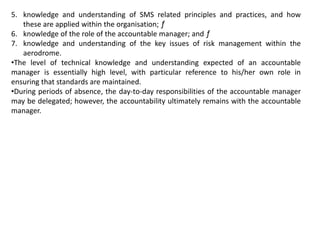
5. knowledge and understanding of SMS related principles and practices, and how
these are applied within the organisation; ƒ
6. knowledge of the role of the accountable manager; and ƒ
7. knowledge and understanding of the key issues of risk management within the
aerodrome.
•The level of technical knowledge and understanding expected of an accountable
manager is essentially high level, with particular reference to his/her own role in
ensuring that standards are maintained.
•During periods of absence, the day-to-day responsibilities of the accountable manager
may be delegated; however, the accountability ultimately remains with the accountable
manager.
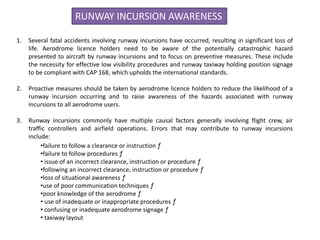
RUNWAY INCURSION AWARENESS
1. Several fatal accidents involving runway incursions have occurred, resulting in significant loss of
life. Aerodrome licence holders need to be aware of the potentially catastrophic hazard
presented to aircraft by runway incursions and to focus on preventive measures. These include
the necessity for effective low visibility procedures and runway taxiway holding position signage
to be compliant with CAP 168, which upholds the international standards.
2. Proactive measures should be taken by aerodrome licence holders to reduce the likelihood of a
runway incursion occurring and to raise awareness of the hazards associated with runway
incursions to all aerodrome users.
3. Runway incursions commonly have multiple causal factors generally involving flight crew, air
traffic controllers and airfield operations. Errors that may contribute to runway incursions
include:
•failure to follow a clearance or instruction ƒ
•failure to follow procedures ƒ
• issue of an incorrect clearance, instruction or procedure ƒ
•following an incorrect clearance, instruction or procedure ƒ
•loss of situational awareness ƒ
•use of poor communication techniques ƒ
•poor knowledge of the aerodrome ƒ
• use of inadequate or inappropriate procedures ƒ
• confusing or inadequate aerodrome signage ƒ
• taxiway layout
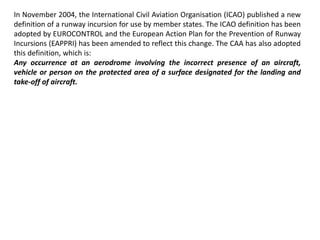
In November 2004, the International Civil Aviation Organisation (ICAO) published a new
definition of a runway incursion for use by member states. The ICAO definition has been
adopted by EUROCONTROL and the European Action Plan for the Prevention of Runway
Incursions (EAPPRI) has been amended to reflect this change. The CAA has also adopted
this definition, which is:
Any occurrence at an aerodrome involving the incorrect presence of an aircraft,
vehicle or person on the protected area of a surface designated for the landing and
take-off of aircraft.

AERODROME SAFETY MANAGEMENT SYSTEM.pptx

  • 1.
  • 2.
    INTRODUCTION An effective SafetyManagement System (SMS) is an organised approach to managing safety, including the necessary organisational structures, accountabilities, policies and procedures, and forms the primary safety oversight covering the way an aerodrome manages safety. It also provides an identifiable and easily audited systematic control of the management of safety at an aerodrome. By applying lessons learned, an SMS should aim to make measurable improvements to the overall level of safety. An aerodrome SMS should be commensurate with the size of the aerodrome and the level of complexity of the services provided. Guidance on SMS can be found on the CAA website: www.caa.co.uk/sms. The ICAO SMS framework consists of four components and twelve elements, and where possible, aerodrome licence holders should include or refer to the ICAO SMS elements below. ICAO publishes SMS guidance in Document 9859 Safety Management manual (SMM)
  • 3.
    SMS FRAMEWORK Safety policyand objectives Management commitment and responsibility •An effective safety policy, endorsed by the accountable manager, sets a clear direction for the aerodrome to follow and contributes to all aspects of business and safety performance. The safety policy should include a statement about the provision of adequate resources and show the commitment of senior management to manage safety effectively. Safety accountability . •The aerodrome licence holder should identify an accountable manager who is accountable for ensuring that all operational activities can be financed and carried out to the standard required. Appointment of key personnel. •The aerodrome licence holder should identify a manager to be the focal point for the implementation and day-to-day maintenance of an effective SMS.
  • 4.
    Co-ordination of emergencyresponse planning •The aerodrome licence holder should ensure that an emergency response plan provides for the orderly and efficient transition from normal to emergency operations and the return to normal operations. The plan should be properly co-ordinated with the emergency response plans of those organisations it must interface with during the provision of its services. (CAP 168, chapter 9 gives further guidance on emergency planning.) SMS documentation. •The aerodrome licence holder should develop and maintain documentation describing the safety policy and objectives, the safety accountabilities and responsibilities of senior managers, the SMS processes and procedures and any outputs from the SMS. SMS documentation may be integrated in the existing aerodrome manual or a separate safety management system manual may be developed.
  • 5.
    SAFETY RISK MANAGEMENT Hazardidentification The aerodrome licence holder should develop and maintain an effective process to identify safety hazards affecting the operation. Hazard identification should be based on a combination of reactive (using safety data from an event that has happened), proactive (using safety data from a near-miss report) and predictive (actively looking at normal day-to-day operations to see where potential problems could occur) methods of safety data collection. Safety risk assessment and mitigation The aerodrome licence holder should develop and maintain an effective process that ensures analysis and assessment of the safety risks in aerodrome operations, and should implement any remedial action necessary to maintain risks at a level as low as reasonably practicable. Risk assessments should be reviewed regularly, and when changes occur that may affect the safety hazards or the associated risks.
  • 6.
    SAFETY ASSURANCE Safety performancemonitoring and measurement The aerodrome licence holder should ensure that safety performance is measured to determine whether safety measures are effective and to identify where improvement is needed. Self-monitoring such as incident investigation, safety inspections and safety audits is a part of this process. Management of change •The aerodrome licence holder should assess the safety impact of any safety significant changes upon other procedures and processes, individuals and the operation and organisation as a whole. This should be done in the planning stages of any project, and updated as required. Continuous improvement of the SMS. •The aerodrome licence holder should identify and determine the implications of sub- standard performance of the SMS in operation, and eliminate or mitigate such causes.
  • 7.
    SAFETY PROMOTION Training andeducation •The aerodrome licence holder should ensure all aerodrome personnel and third party contractors receive safety training as appropriate to their role to ensure they understand their safety responsibilities within the aerodrome’s SMS. Safety communication •The aerodrome licence holder should develop and maintain safety communication mechanisms which ensure safety critical information is conveyed effectively and explain why particular safety actions are taken and why safety procedures are introduced or changed.
  • 8.
    ACCOUNTABLE MANAGER •Schedule 12of the ANO requires an aerodrome to nominate an accountable manager and include the name and status of the accountable manager in the aerodrome manual. •The nominee will often be the chief executive, chief operating officer, board chairman, president, managing director, general manager or similar title; it is not necessary for him/her to be the ‘controlling mind’ of the organisation. It is possible for an accountable manager to be answerable to and directed by another person or persons, and still retain the appropriate level of authority to ensure that activities are financed and carried out to the standard required. The organisational title of this post is at the licence holder’s discretion; however, the person named to the post must be advised to the CAA as the accountable manager. •The accountable manager should: ƒ 1. ensure that all necessary resources are available to operate the aerodrome in accordance with the aerodrome manual. Where a reduction in the level of resources or abnormal circumstances which may affect aircraft safety occurs, the accountable manager should ensure that a corresponding reduction in the level of operations at the aerodrome is implemented as required; ƒ 2. establish, implement and promote the safety policy; and ƒ 3. ensure compliance with relevant regulations, licensing criteria and the organisation’s Safety Management System. •The accountable manager should have: ƒ 1. appropriate seniority within the organisation; ƒ 2. an appropriate level of authority to ensure that activities are financed and carried out to the standard required; ƒ 3. knowledge and understanding of the documents that prescribe relevant aerodrome safety standards; ƒ 4. understanding of the requirements for competence of aerodrome management personnel so as to ensure that competent persons are in place; ƒ
  • 9.
    5. knowledge andunderstanding of SMS related principles and practices, and how these are applied within the organisation; ƒ 6. knowledge of the role of the accountable manager; and ƒ 7. knowledge and understanding of the key issues of risk management within the aerodrome. •The level of technical knowledge and understanding expected of an accountable manager is essentially high level, with particular reference to his/her own role in ensuring that standards are maintained. •During periods of absence, the day-to-day responsibilities of the accountable manager may be delegated; however, the accountability ultimately remains with the accountable manager.
  • 10.
    RUNWAY INCURSION AWARENESS 1.Several fatal accidents involving runway incursions have occurred, resulting in significant loss of life. Aerodrome licence holders need to be aware of the potentially catastrophic hazard presented to aircraft by runway incursions and to focus on preventive measures. These include the necessity for effective low visibility procedures and runway taxiway holding position signage to be compliant with CAP 168, which upholds the international standards. 2. Proactive measures should be taken by aerodrome licence holders to reduce the likelihood of a runway incursion occurring and to raise awareness of the hazards associated with runway incursions to all aerodrome users. 3. Runway incursions commonly have multiple causal factors generally involving flight crew, air traffic controllers and airfield operations. Errors that may contribute to runway incursions include: •failure to follow a clearance or instruction ƒ •failure to follow procedures ƒ • issue of an incorrect clearance, instruction or procedure ƒ •following an incorrect clearance, instruction or procedure ƒ •loss of situational awareness ƒ •use of poor communication techniques ƒ •poor knowledge of the aerodrome ƒ • use of inadequate or inappropriate procedures ƒ • confusing or inadequate aerodrome signage ƒ • taxiway layout
  • 11.
    In November 2004,the International Civil Aviation Organisation (ICAO) published a new definition of a runway incursion for use by member states. The ICAO definition has been adopted by EUROCONTROL and the European Action Plan for the Prevention of Runway Incursions (EAPPRI) has been amended to reflect this change. The CAA has also adopted this definition, which is: Any occurrence at an aerodrome involving the incorrect presence of an aircraft, vehicle or person on the protected area of a surface designated for the landing and take-off of aircraft.