RYAN ROGER DIAZ
 Safety, Health and Environmental Officer,
Acro Distribution Network Inc.
 D.O.L.E. Certified Safety Officer Level 2
 Philippine Red Cross Trained First Aider
MANDATORY 8-
HOUR SAFETY
AND HEALTH
SEMINAR FOR
WORKERS
PURSUANT TO SECTION 16
(B) OF R.A. 11058 AND
SECTION 3 OF D.O. 198-18
MODULE 1:
Overview
 OBJECTIVES:
To be able to express
appreciation on OSH and
recognize the importance of
various data and legislation
relating to OSH
What is OSH?
 Occupational Safety and Health
 A discipline with a broad scope
involving:
1. Occupational Safety
2. Occupational Health
3. Industrial Hygiene
Occupational
Safety
Deals with understanding the
causes of accidents at work and
ways to prevent unsafe acts and
unsafe conditions
Safety at work discusses concepts
on good housekeeping, proper
materials handling and storage,
machine safety, electrical safety,
fire prevention and control, safety
inspection and accident
investigation
Occupational
Health
 Explains how the different
hazards and risks at work may
cause illness and emphasizes
that health programs are
essential in controlling work-
related diseases
Industrial
Hygiene  It is the science of anticipating,
recognizing, evaluating, and
controlling workplace conditions
that may cause workers' injury or
illness.
OSH aims
at:
 The promotion and maintenance
of the highest degree of physical,
mental and social well-being of
workers
 Prevention of the adverse health
effects of the working conditions
 Placing and maintenance of
workers in an occupational
environment adapted to their
physical and mental needs
 The adaptation of work to
humans
OSH Situationer
According to Integrated Survey on Labor and
Employment:
 Total of 38, 235 occupational accidents
occurred in 2018
 As a result, about 46, 238 cases of occupational
injuries
 43.9 % - non fatal with lost workdays
 1 % - fatal
 55. 1 % - non fatal without lost workdays
By industry:
 Manufacturing – 49. 7 %
 Wholesale and retail trade, repair of vehicles
– 11. 4 %
 Administrative and support service activities – 7.
2 %
Cases of
Occupational
Injuries with
Workdays Lost
By
Qualification
Type of
injury
 Superficial injuries and open
wounds
- 50.8 %
 Dislocations, sprains and strains
- 12.0 %
 Fractures
- 10.7 %
Part of
body
injured
 Wrist and hand
- 35.9 %
 Lower extremities
- 18.7 %
 Arm and shoulder
- 17.6 %
Cause of
injury
 Stepping, striking against or
struck by objects, excluding
falling objects
- 36.3 %
 Caught in or between objects
- 21.0 %
 Falls of persons
- 10.5 %
Agent of
injury
 Machines and equipment
- 26.2 %
 Materials and objects
- 24.4 %
 Hand tools
- 18.3 %
Occupation
 Plant machine operators and
assemblers
- 30.2 %
 Service and sales workers
- 19.3 %
Occupational
Diseases
 Back pains
- 31.3 %
 Hypertension
- 15.5 %
 Neck and shoulder pains
- 11.4 %
 Occupational asthma
- 5.4 %
 Other infections
- 5.3 %
Occupational
Diseases  Workers engaged in
administrative and support
service activities
- 31.8 %
 Manufacturing
- 28.9 %
OSH Legislation
 Philippine Constitution
 Labor Code (PD 442) – 1974
 OSH Standard – 1979, Rev. 1989
 RA 11058 and its IRR
RA 11058 and DO 198-18
An act strengthening compliance with
Occupational Safety and Health Standards and
providing penalties for violations thereof
Coverage  It shall apply to all establishments ,
projects and sites and all other
places where work is being
undertaken
Duties and
Responsibilities
 Employer’s Duties
1. Equip a place of employment free
from hazardous conditions that
may cause or are likely to cause
death, illness or physical harm
2. Provide complete job safety
instructions to all workers
Duties and
Responsibilities  Employer’s Duties
3. Ensure that chemical, physical and
biological substances and
ergonomic and psychosocial
stresses under control are without
risk to health
4. Use only approved specific industry
set of standards of devices and
equipment
Duties and
Responsibilities
 Employer’s Duties
5. Comply with OSH Standards
including training, and where
necessary, provisions on protective
and safety devices
6. Make arrangement for workers
and their representatives to have
the time and resource to
participate in the process of
organizing, planning and
implementation, monitoring,
evaluation and action for
improvement of the OSH
management system
Duties and
Responsibilities  Employer’s Duties
7. Provide for measures identifying
trainings and drills, evacuation
plans to deal with emergencies,
fires and accidents
8. Comply with all reportorial
requirements of OSH Standards
9. Register establishment to DOLE as
provided under the OSH Standards
Duties and
Responsibilities  Duties of Workers
1. Participate in capacity building
activities on safety and health and
other OSH related topics and
programs
2. Proper use of all safeguards and
safety devices furnished for
workers’ protection and that of
others
Duties and
Responsibilities
3. Comply with the instructions to
prevent accidents or imminent
danger situations in the workplace
4. Observe prescribed steps to be
taken in cases of emergency
5. Report any work hazard that may
be discovered in the workplace
Duties and
Responsibilities  Duties of Other Persons
1. Any other persons, including
builder or contractor who visits,
builds, renovates or installs devices
or conducts business in any
establishments or workplace shall
comply with the provisions of these
rules and all other regulations
issued by the Secretary of the
Department of Labor
Duties and
Responsibilities  Duties of Other Persons
 Whenever two or more
undertakings are engaged in
activities simultaneously in one
workplace, it shall be the duty of all
concerned to collaborate and
cooperate to ensure compliance
with OSH Standards and regulations
Workers’
Right to
Know
1. The right to safety and health at
work shall be guaranteed
2. Workers shall be informed by the
employer about all types of
hazards in the workplace and
provide access to training and
education on chemical safety and
orientation on data sheet of
chemical, electrical, mechanical
safety and ergonomics
Workers’
Right to
Know
3. All workers, including new hires,
shall be provided training and
information on all types of hazards
in the workplace in a language
and dialect that workers can
understand
4. A re-orientation on safety and
health for workers in high-risk
establishments must be conducted
regularly and to be conducted
immediately following any
changes in the operations and
production process
Workers’
Right to
Know
5. The worker has the right to refuse
work without threat of reprisal from
the employer in cases of imminent
danger. Affected workers may be
temporarily assigned to other work
areas
6. Section 24 of this rules shall apply
during the period
Workers’
Right to
Report
Accidents
1. Workers shall have the right to
report accidents, dangerous
occurrences, and hazards to the
employer, DOLE and to other
concerned government agencies
2. Reporting to DOLE may be done
through any means of
communication
Workers’
Right to
Personal
Protective
Equipment
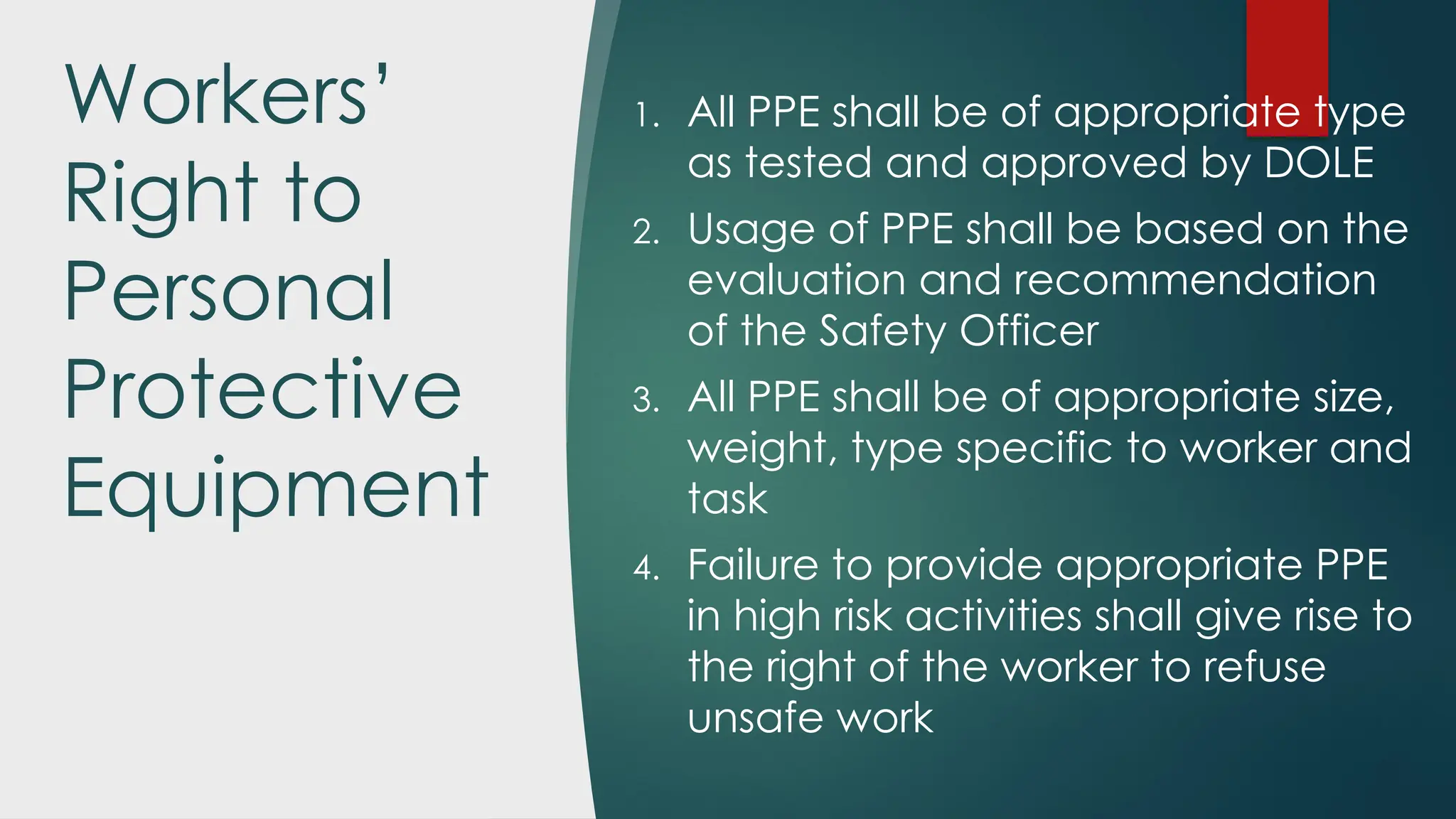
1. All PPE shall be of appropriate type
as tested and approved by DOLE
2. Usage of PPE shall be based on the
evaluation and recommendation
of the Safety Officer
3. All PPE shall be of appropriate size,
weight, type specific to worker and
task
4. Failure to provide appropriate PPE
in high risk activities shall give rise to
the right of the worker to refuse
unsafe work
Safety
Signages
and
Devices
 All establishments, projects, sites
and all other places where work is
being undertaken shall have safety
signages and device to warn
workers and the public to the
hazards in the workplace
Safety in
the Use of
Equipment
1. Employers, contractor or
subcontractor, if any, must comply
with the OSH Standards set by
DOLE on safety and use of such
equipment
2. Appropriate training and
certification by the Technical
Education and Skills Development
Authority, Professional Regulatory
Commission or other concerned
government agency shall be a
requirement
Occupational Safety and
Health Program
 Covered workplaces through the Safety and
Health Committee, shall develop and implement
a suitable OSH Program following the DOLE
prescribed format
 OSH Program shall be submitted and considered
approved upon stamped-received by
concerned DOLE – RO. Pre-approved program
shall be validated during inspection based on
existing laws, rules and regulations
Occupational Safety and
Health Program
 The Health and Safety Committee shall review
and evaluate the OSH Program at least once a
year or as necessary.
 The total cost of implementing the OSH Program
shall be an integral part of the company’s
operations cost
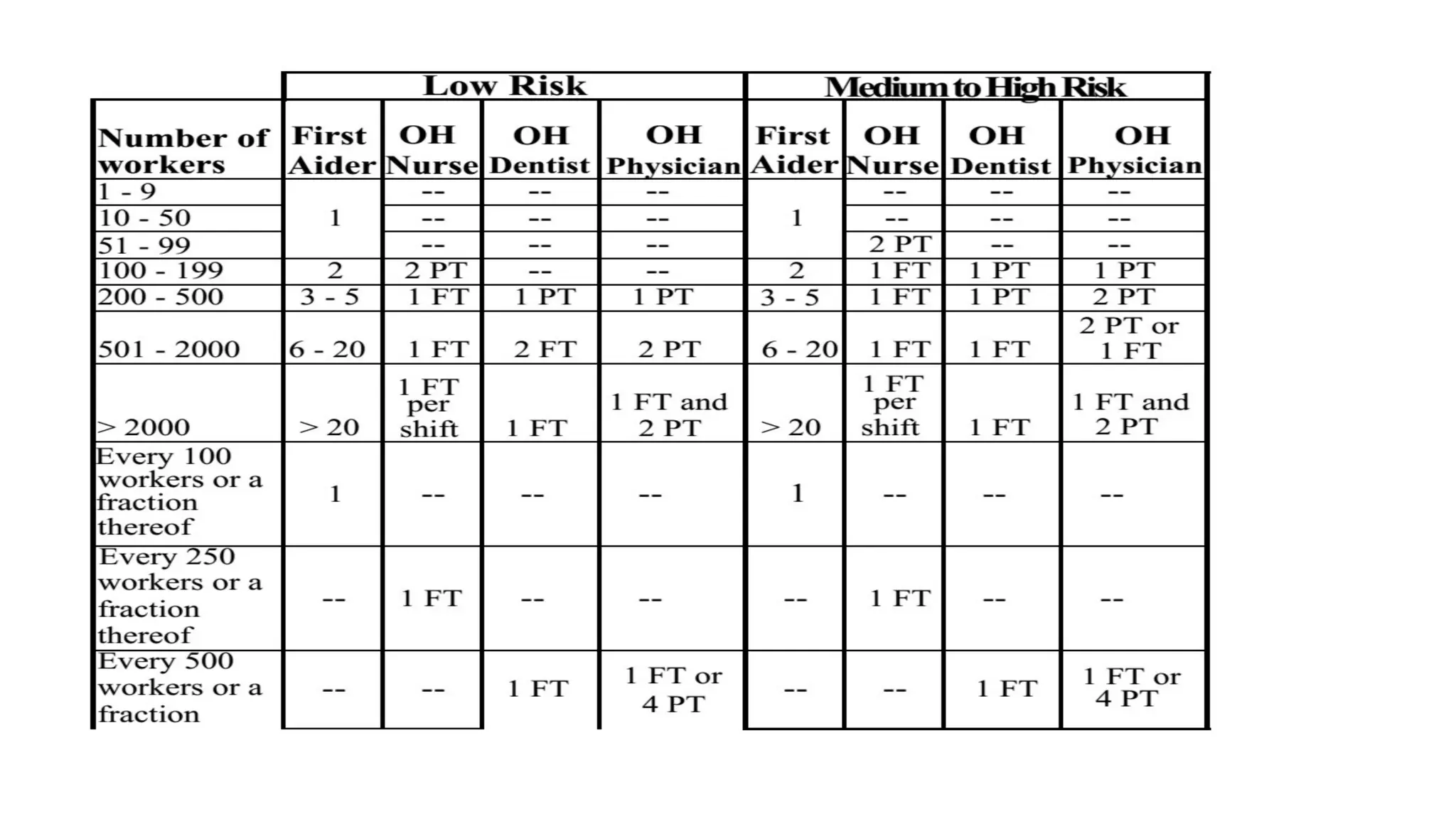
OSH Personnel
 All covered workplaces shall have qualified OSH
personnel:
- Safety Officer
- First Aider
- Nurse
- Dentist
- Physician
Safety and Health Training
Requirements
 All OSH personnel shall undergo the prescribed
mandatory trainings from DOLE-Accredited
safety training organizations
 All workers shall undergo the mandatory 8-hour
OSH seminar
Safety and Health Training
Requirements
 Workers performing critical occupations shall
undergo the mandatory competency
assessment and certification by TESDA
 Workers’ OSH seminars and trainings/orientations
required by the employer or by other regulations
in the performance of their task shall be
undertaken at no expense to the worker and
considered as compensable working time
Occupational Safety and
Health Reports
 Annual Medical Report
 Work Accident/Injury Report
 Annual Work/Injury Exposure Data Report
 OSH Committee Report
Workers’ Welfare Facilities
 All workers shall have FREE access and use of the
following welfare facilities:
1. Adequate supply of safe drinking water
2. Adequate sanitary and washing facilities
3. Suitable living accommodation as may be
applicable
4. Separate sanitary, washing and sleeping
quarters for all genders, as may be applicable
Workers’ Welfare Facilities
5. Lactation station
6. Ramps, railings and the likes
7. Medical facilities (treatment room/clinic)
8. Other workers’ welfare facilities
Employer’s Responsibility
and Liability
 The employer, project owner, contractor or
subcontractor and any persons who manages,
controls or supervises the work being undertaken
shall be jointly and solidarily liable for
compliance with the Occupational Safety and
Health Standards and corresponding penalties
for violations
Incentives
 Incentives may be given to qualified employers
and workers in recognition of their efforts in
ensuring compliance with the OSH Standards
 Incentives shall be given in the form of training,
additional protective equipment, technical
guidance, recognition awards and the likes
Inter-Government Coordination
and Cooperation
 A Joint Coordinating Committee shall be
established to effectively implement the Law
and its IRR
 The Committee shall develop mechanisms for
harmonizing each Agency’s
mandates/policies/guidelines related to OSH,
with reference to the Law
 DOLE to collaboratively work with DENR, DOE,
DoTR, DA, DPWH, DTI, DILG-LGUs, DOH, DICT,
PEZA and other government agencies
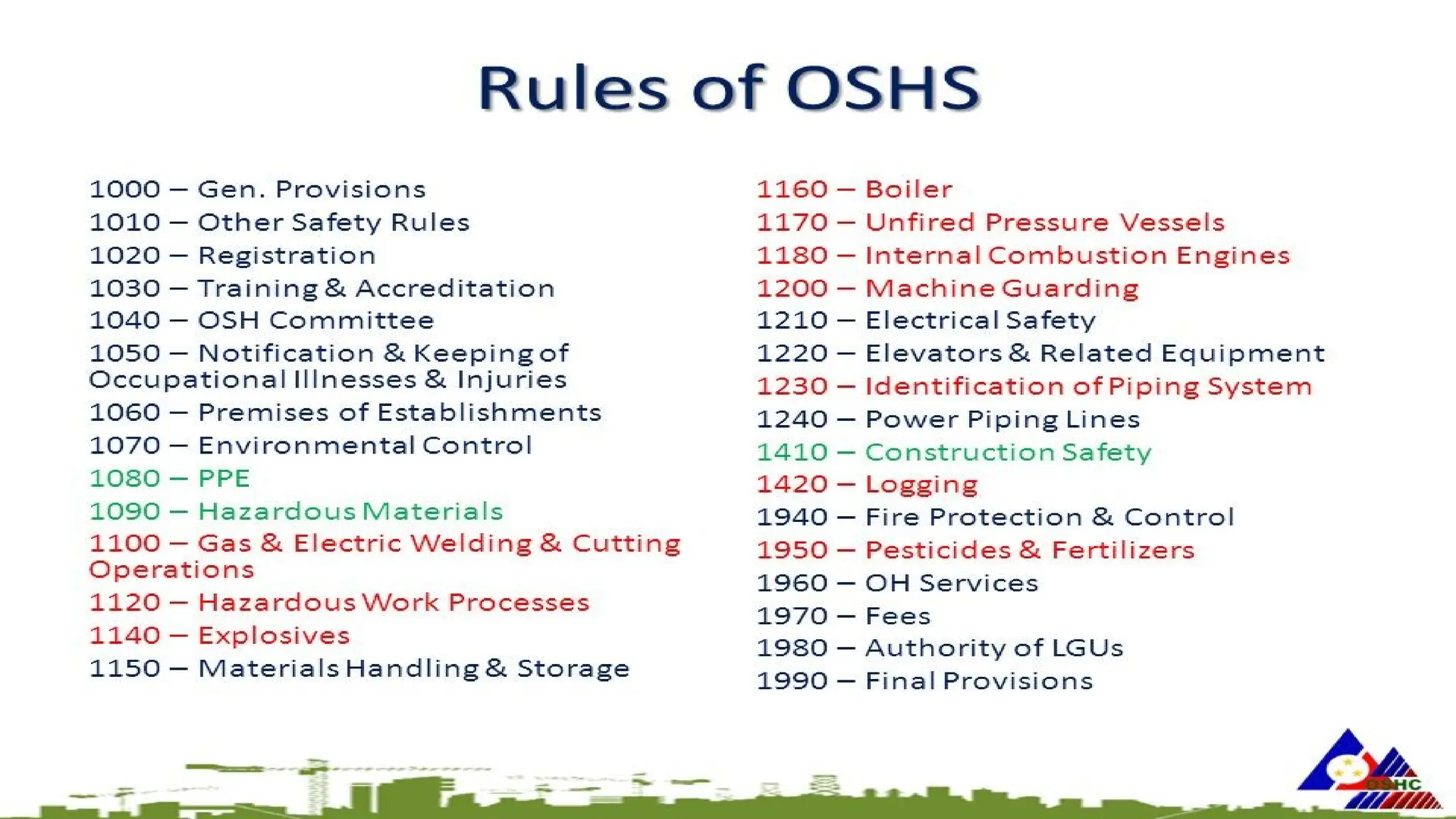
OSH Standards
 1979, Rev. 1989
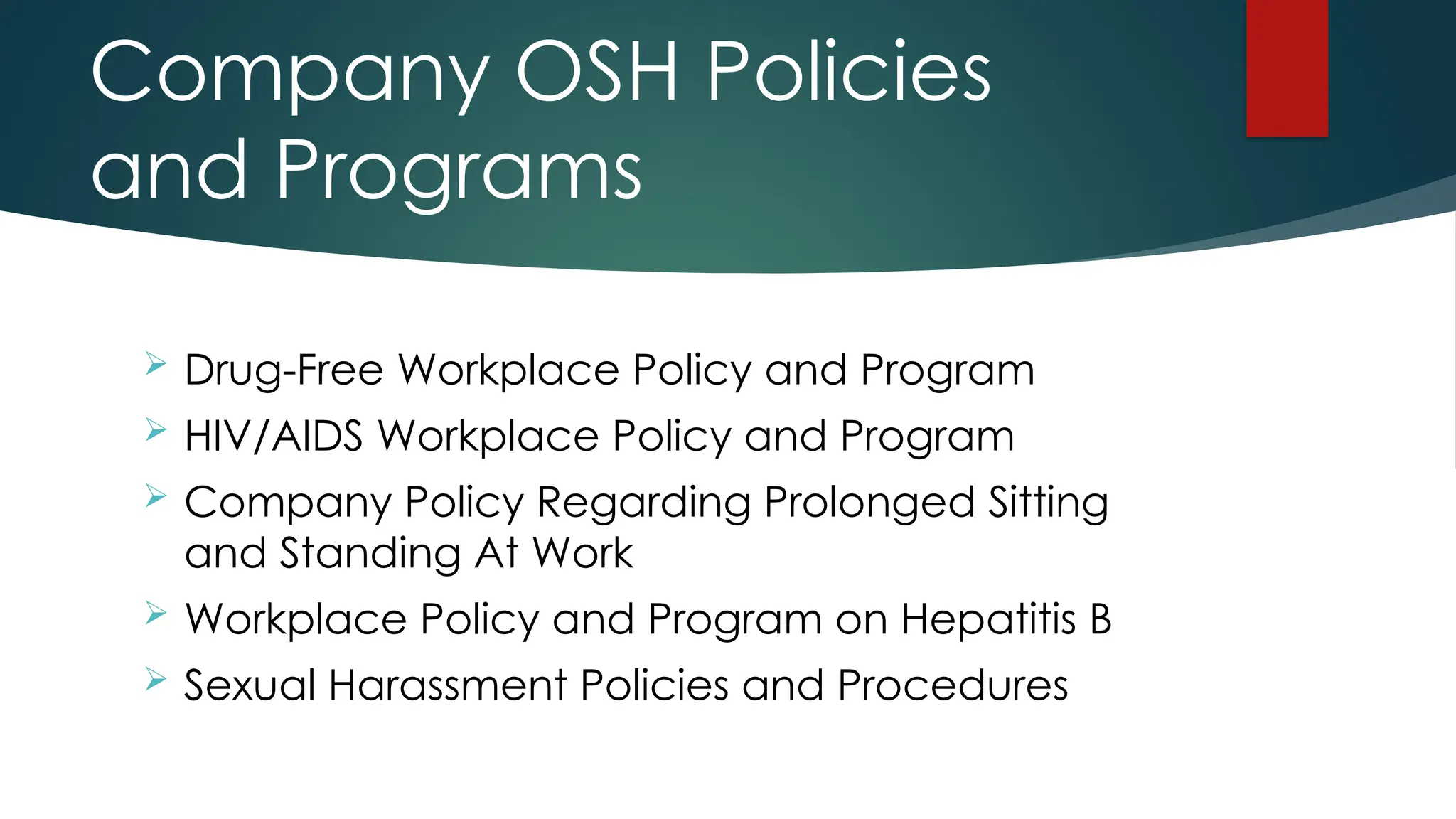
Company OSH Policies
and Programs
 Drug-Free Workplace Policy and Program
 HIV/AIDS Workplace Policy and Program
 Company Policy Regarding Prolonged Sitting
and Standing At Work
 Workplace Policy and Program on Hepatitis B
 Sexual Harassment Policies and Procedures
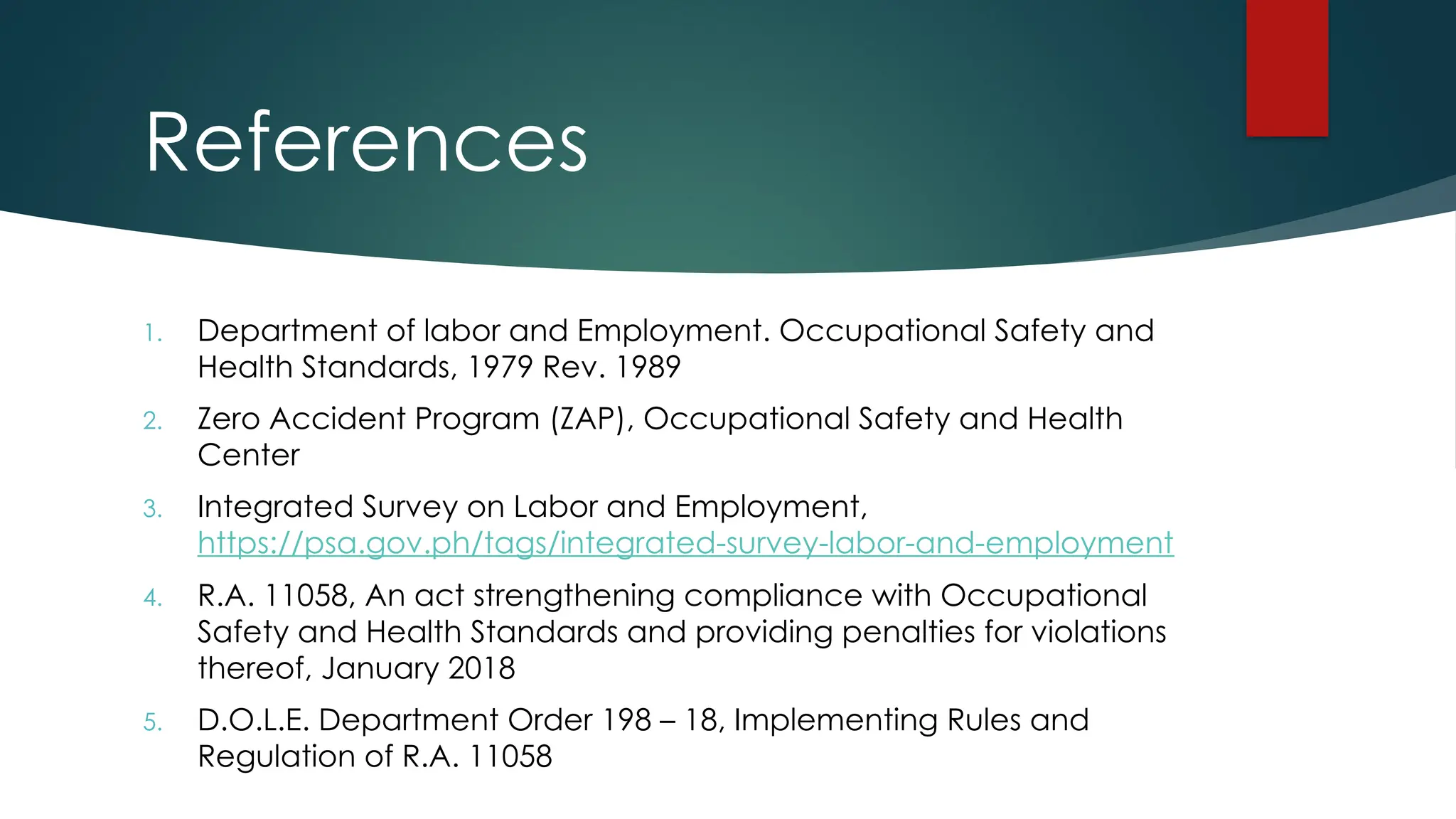
References
1. Department of labor and Employment. Occupational Safety and
Health Standards, 1979 Rev. 1989
2. Zero Accident Program (ZAP), Occupational Safety and Health
Center
3. Integrated Survey on Labor and Employment,
https://psa.gov.ph/tags/integrated-survey-labor-and-employment
4. R.A. 11058, An act strengthening compliance with Occupational
Safety and Health Standards and providing penalties for violations
thereof, January 2018
5. D.O.L.E. Department Order 198 – 18, Implementing Rules and
Regulation of R.A. 11058

Mandatory 8hours OSH training company Safety

  • 1.
    RYAN ROGER DIAZ Safety, Health and Environmental Officer, Acro Distribution Network Inc.  D.O.L.E. Certified Safety Officer Level 2  Philippine Red Cross Trained First Aider
  • 3.
    MANDATORY 8- HOUR SAFETY ANDHEALTH SEMINAR FOR WORKERS PURSUANT TO SECTION 16 (B) OF R.A. 11058 AND SECTION 3 OF D.O. 198-18
  • 4.
    MODULE 1: Overview  OBJECTIVES: Tobe able to express appreciation on OSH and recognize the importance of various data and legislation relating to OSH
  • 5.
    What is OSH? Occupational Safety and Health  A discipline with a broad scope involving: 1. Occupational Safety 2. Occupational Health 3. Industrial Hygiene
  • 6.
    Occupational Safety Deals with understandingthe causes of accidents at work and ways to prevent unsafe acts and unsafe conditions Safety at work discusses concepts on good housekeeping, proper materials handling and storage, machine safety, electrical safety, fire prevention and control, safety inspection and accident investigation
  • 7.
    Occupational Health  Explains howthe different hazards and risks at work may cause illness and emphasizes that health programs are essential in controlling work- related diseases
  • 8.
    Industrial Hygiene  Itis the science of anticipating, recognizing, evaluating, and controlling workplace conditions that may cause workers' injury or illness.
  • 9.
    OSH aims at:  Thepromotion and maintenance of the highest degree of physical, mental and social well-being of workers  Prevention of the adverse health effects of the working conditions  Placing and maintenance of workers in an occupational environment adapted to their physical and mental needs  The adaptation of work to humans
  • 10.
    OSH Situationer According toIntegrated Survey on Labor and Employment:  Total of 38, 235 occupational accidents occurred in 2018  As a result, about 46, 238 cases of occupational injuries  43.9 % - non fatal with lost workdays  1 % - fatal  55. 1 % - non fatal without lost workdays
  • 11.
    By industry:  Manufacturing– 49. 7 %  Wholesale and retail trade, repair of vehicles – 11. 4 %  Administrative and support service activities – 7. 2 %
  • 12.
  • 13.
    Type of injury  Superficialinjuries and open wounds - 50.8 %  Dislocations, sprains and strains - 12.0 %  Fractures - 10.7 %
  • 14.
    Part of body injured  Wristand hand - 35.9 %  Lower extremities - 18.7 %  Arm and shoulder - 17.6 %
  • 15.
    Cause of injury  Stepping,striking against or struck by objects, excluding falling objects - 36.3 %  Caught in or between objects - 21.0 %  Falls of persons - 10.5 %
  • 16.
    Agent of injury  Machinesand equipment - 26.2 %  Materials and objects - 24.4 %  Hand tools - 18.3 %
  • 17.
    Occupation  Plant machineoperators and assemblers - 30.2 %  Service and sales workers - 19.3 %
  • 18.
    Occupational Diseases  Back pains -31.3 %  Hypertension - 15.5 %  Neck and shoulder pains - 11.4 %  Occupational asthma - 5.4 %  Other infections - 5.3 %
  • 19.
    Occupational Diseases  Workersengaged in administrative and support service activities - 31.8 %  Manufacturing - 28.9 %
  • 20.
    OSH Legislation  PhilippineConstitution  Labor Code (PD 442) – 1974  OSH Standard – 1979, Rev. 1989  RA 11058 and its IRR
  • 21.
    RA 11058 andDO 198-18 An act strengthening compliance with Occupational Safety and Health Standards and providing penalties for violations thereof
  • 22.
    Coverage  Itshall apply to all establishments , projects and sites and all other places where work is being undertaken
  • 23.
    Duties and Responsibilities  Employer’sDuties 1. Equip a place of employment free from hazardous conditions that may cause or are likely to cause death, illness or physical harm 2. Provide complete job safety instructions to all workers
  • 24.
    Duties and Responsibilities Employer’s Duties 3. Ensure that chemical, physical and biological substances and ergonomic and psychosocial stresses under control are without risk to health 4. Use only approved specific industry set of standards of devices and equipment
  • 25.
    Duties and Responsibilities  Employer’sDuties 5. Comply with OSH Standards including training, and where necessary, provisions on protective and safety devices 6. Make arrangement for workers and their representatives to have the time and resource to participate in the process of organizing, planning and implementation, monitoring, evaluation and action for improvement of the OSH management system
  • 26.
    Duties and Responsibilities Employer’s Duties 7. Provide for measures identifying trainings and drills, evacuation plans to deal with emergencies, fires and accidents 8. Comply with all reportorial requirements of OSH Standards 9. Register establishment to DOLE as provided under the OSH Standards
  • 27.
    Duties and Responsibilities Duties of Workers 1. Participate in capacity building activities on safety and health and other OSH related topics and programs 2. Proper use of all safeguards and safety devices furnished for workers’ protection and that of others
  • 28.
    Duties and Responsibilities 3. Complywith the instructions to prevent accidents or imminent danger situations in the workplace 4. Observe prescribed steps to be taken in cases of emergency 5. Report any work hazard that may be discovered in the workplace
  • 29.
    Duties and Responsibilities Duties of Other Persons 1. Any other persons, including builder or contractor who visits, builds, renovates or installs devices or conducts business in any establishments or workplace shall comply with the provisions of these rules and all other regulations issued by the Secretary of the Department of Labor
  • 30.
    Duties and Responsibilities Duties of Other Persons  Whenever two or more undertakings are engaged in activities simultaneously in one workplace, it shall be the duty of all concerned to collaborate and cooperate to ensure compliance with OSH Standards and regulations
  • 31.
    Workers’ Right to Know 1. Theright to safety and health at work shall be guaranteed 2. Workers shall be informed by the employer about all types of hazards in the workplace and provide access to training and education on chemical safety and orientation on data sheet of chemical, electrical, mechanical safety and ergonomics
  • 32.
    Workers’ Right to Know 3. Allworkers, including new hires, shall be provided training and information on all types of hazards in the workplace in a language and dialect that workers can understand 4. A re-orientation on safety and health for workers in high-risk establishments must be conducted regularly and to be conducted immediately following any changes in the operations and production process
  • 33.
    Workers’ Right to Know 5. Theworker has the right to refuse work without threat of reprisal from the employer in cases of imminent danger. Affected workers may be temporarily assigned to other work areas 6. Section 24 of this rules shall apply during the period
  • 34.
    Workers’ Right to Report Accidents 1. Workersshall have the right to report accidents, dangerous occurrences, and hazards to the employer, DOLE and to other concerned government agencies 2. Reporting to DOLE may be done through any means of communication
  • 35.
    Workers’ Right to Personal Protective Equipment 1. AllPPE shall be of appropriate type as tested and approved by DOLE 2. Usage of PPE shall be based on the evaluation and recommendation of the Safety Officer 3. All PPE shall be of appropriate size, weight, type specific to worker and task 4. Failure to provide appropriate PPE in high risk activities shall give rise to the right of the worker to refuse unsafe work
  • 36.
    Safety Signages and Devices  All establishments,projects, sites and all other places where work is being undertaken shall have safety signages and device to warn workers and the public to the hazards in the workplace
  • 37.
    Safety in the Useof Equipment 1. Employers, contractor or subcontractor, if any, must comply with the OSH Standards set by DOLE on safety and use of such equipment 2. Appropriate training and certification by the Technical Education and Skills Development Authority, Professional Regulatory Commission or other concerned government agency shall be a requirement
  • 38.
    Occupational Safety and HealthProgram  Covered workplaces through the Safety and Health Committee, shall develop and implement a suitable OSH Program following the DOLE prescribed format  OSH Program shall be submitted and considered approved upon stamped-received by concerned DOLE – RO. Pre-approved program shall be validated during inspection based on existing laws, rules and regulations
  • 39.
    Occupational Safety and HealthProgram  The Health and Safety Committee shall review and evaluate the OSH Program at least once a year or as necessary.  The total cost of implementing the OSH Program shall be an integral part of the company’s operations cost
  • 40.
    OSH Personnel  Allcovered workplaces shall have qualified OSH personnel: - Safety Officer - First Aider - Nurse - Dentist - Physician
  • 43.
    Safety and HealthTraining Requirements  All OSH personnel shall undergo the prescribed mandatory trainings from DOLE-Accredited safety training organizations  All workers shall undergo the mandatory 8-hour OSH seminar
  • 44.
    Safety and HealthTraining Requirements  Workers performing critical occupations shall undergo the mandatory competency assessment and certification by TESDA  Workers’ OSH seminars and trainings/orientations required by the employer or by other regulations in the performance of their task shall be undertaken at no expense to the worker and considered as compensable working time
  • 45.
    Occupational Safety and HealthReports  Annual Medical Report  Work Accident/Injury Report  Annual Work/Injury Exposure Data Report  OSH Committee Report
  • 46.
    Workers’ Welfare Facilities All workers shall have FREE access and use of the following welfare facilities: 1. Adequate supply of safe drinking water 2. Adequate sanitary and washing facilities 3. Suitable living accommodation as may be applicable 4. Separate sanitary, washing and sleeping quarters for all genders, as may be applicable
  • 47.
    Workers’ Welfare Facilities 5.Lactation station 6. Ramps, railings and the likes 7. Medical facilities (treatment room/clinic) 8. Other workers’ welfare facilities
  • 48.
    Employer’s Responsibility and Liability The employer, project owner, contractor or subcontractor and any persons who manages, controls or supervises the work being undertaken shall be jointly and solidarily liable for compliance with the Occupational Safety and Health Standards and corresponding penalties for violations
  • 49.
    Incentives  Incentives maybe given to qualified employers and workers in recognition of their efforts in ensuring compliance with the OSH Standards  Incentives shall be given in the form of training, additional protective equipment, technical guidance, recognition awards and the likes
  • 50.
    Inter-Government Coordination and Cooperation A Joint Coordinating Committee shall be established to effectively implement the Law and its IRR  The Committee shall develop mechanisms for harmonizing each Agency’s mandates/policies/guidelines related to OSH, with reference to the Law  DOLE to collaboratively work with DENR, DOE, DoTR, DA, DPWH, DTI, DILG-LGUs, DOH, DICT, PEZA and other government agencies
  • 51.
  • 54.
    Company OSH Policies andPrograms  Drug-Free Workplace Policy and Program  HIV/AIDS Workplace Policy and Program  Company Policy Regarding Prolonged Sitting and Standing At Work  Workplace Policy and Program on Hepatitis B  Sexual Harassment Policies and Procedures
  • 55.
    References 1. Department oflabor and Employment. Occupational Safety and Health Standards, 1979 Rev. 1989 2. Zero Accident Program (ZAP), Occupational Safety and Health Center 3. Integrated Survey on Labor and Employment, https://psa.gov.ph/tags/integrated-survey-labor-and-employment 4. R.A. 11058, An act strengthening compliance with Occupational Safety and Health Standards and providing penalties for violations thereof, January 2018 5. D.O.L.E. Department Order 198 – 18, Implementing Rules and Regulation of R.A. 11058