Care Act 2014: presentation for LNNM
May 19th 2015
Karl Mason
Community Care Law 1948-2014
Poor Laws
1948 1968 1970
1983 1984
1990
1995 1996 2000
2001
 1948 National Assistance Act
 1968 Health Services and Public
Health Act
 1970 Chronically Sick and Disabled
Person’s Act
 1983 Health & Social Services &
Social Security Adjudications Act
 1984 Disabled Person’s Act
 1990 NHS and Community Care
Act
 1995 Carers (Services and
Recognition) Act
 1996 Community Care (Direct
Payments) Act
 2000 Carers and Disabled
Children Act
 2001 Health and Social Care Act
The Care Act, 2014
• Sea-change for community care law
• Enacted April 2014, for implementaton April 2015
• Revokes a raft of community care legislation (see slide 4)
• Terminology
– Service Users are ‘Adults’
– Does not talk about Disabled People, Sick People, Older
People
– Carers separated from Service Users
1
9
9
0
The Care Act, 2014
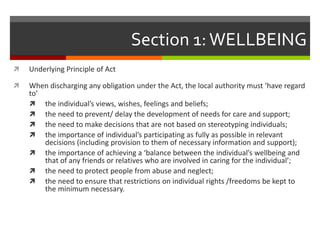
Section 1:WELLBEING
 Underlying Principle of Act
 When discharging any obligation under the Act, the local authority must ‘have regard
to’
 the individual’s views, wishes, feelings and beliefs;
 the need to prevent/ delay the development of needs for care and support;
 the need to make decisions that are not based on stereotyping individuals;
 the importance of individual’s participating as fully as possible in relevant
decisions (including provision to them of necessary information and support);
 the importance of achieving a ‘balance between the individual’s wellbeing and
that of any friends or relatives who are involved in caring for the individual’;
 the need to protect people from abuse and neglect;
 the need to ensure that restrictions on individual rights /freedoms be kept to
the minimum necessary.
Section 2: PREVENTION
 LA has general duty to provide range of preventative services
 Why?
 These services should:
(a) contribute towards preventing or delaying the development by adults
in its area of needs for care and support;
(b) contribute towards preventing or delaying the development by carers
in its area of needs for support;
(c) reduce the needs for care and support of adults in its area;
(d) reduce the needs for support of carers in its area.
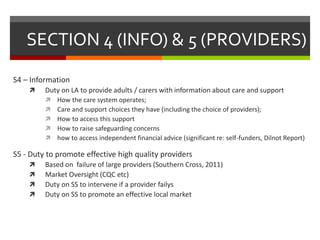
SECTION 4 (INFO) & 5 (PROVIDERS)
S4 – Information
 Duty on LA to provide adults / carers with information about care and support
 How the care system operates;
 Care and support choices they have (including the choice of providers);
 How to access this support
 How to raise safeguarding concerns
 how to access independent financial advice (significant re: self-funders, Dilnot Report)
S5 - Duty to promote effective high quality providers
 Based on failure of large providers (Southern Cross, 2011)
 Market Oversight (CQC etc)
 Duty on SS to intervene if a provider failys
 Duty on SS to promote an effective local market
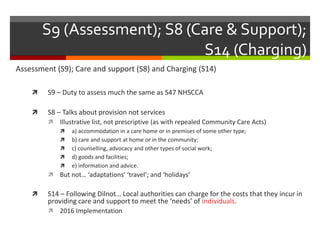
S9 (Assessment); S8 (Care & Support);
S14 (Charging)
Assessment (S9); Care and support (S8) and Charging (S14)
 S9 – Duty to assess much the same as S47 NHSCCA
 S8 – Talks about provision not services
 Illustrative list, not prescriptive (as with repealed Community Care Acts)
 a) accommodation in a care home or in premises of some other type;
 b) care and support at home or in the community;
 c) counselling, advocacy and other types of social work;
 d) goods and facilities;
 e) information and advice.
 But not… ‘adaptations’ ‘travel’; and ‘holidays’
 S14 – Following Dilnot… Local authorities can charge for the costs that they incur in
providing care and support to meet the ‘needs’ of individuals.
 2016 Implementation
Sections 3, 6, 7:
INTEGRATION & COOPERATION
S3, 6, 7 – Integration with the NHS and Cooperation
 Integration with NHS (S3)
 Better Care Fund
 Aimed at releasing acute hospital pressures
 Pooled budgets, shared resources
 Will probably lead to jointly funded integrated posts
 ‘Integration-frenzy’ – where is the evidence?
 Cooperation (S6, 7)
 Based on s27 Children Act, 1987
 Local Authorities can request assistance from health / housing
 This must be provided
S10 - CARERS
 Big changes – no longer dependent on request or level of care provided
 New trigger – the appearance of need
 Extends to carers for children transitioning
 Carers for adults who are not eligible may still be eligible (s20)
 Assessment must ascertain
 whether the carer able / willing to provide and continue to provide the
care;
 the impact on the carers ‘well-being’;
 the outcomes the carer wishes in day-to-day life;
 whether the carer works or wishes to (and / or) to participate in
education, training or
 recreation.
S59-62; S67 –Transition, “Parent Carers”
and “Young Carers”
New Responsibilities – marks a cross-over with Children and Families Act 2014
 Duty to undertake a needs assessment of a disabled child if the child is likely to have
needs for care and support after 18 and the assessment would be of significant
benefit to the child (S59-60)
 Parent Carers in Transition have the same right to have needs assessed (S61-62)
 Cross-ref: S90 Children and Families Act, 2014 – Duty to assess Parent Carers based
on ‘appearance of need’
 Decide is it appropriate for the parent to provide (or continue to) care for disabled
child in light of own needs AND have regard to wellbeing of Parent Carer and the
need to safeguard the child
 Young Carers – first appearance in legislation (prev accessed via S17 Children Act
1987)
 Similar right to be assessed if likely to have need for support post 18
 Cross-ref: Children and Families Act, 2014 S96 – again ‘appearance of need’
 S67 assessments of disabled children / young carers undertaken pre-18, either
continue to apply post-18 until reviewed, or if LA doesn’t consider self to have
ongoing duty – must re-assess
S13 - Eligibility
 Overhaul of FACS
 Critical
 Substantial
 Moderate
 Low
 National Eligibility test based on identifying:
 whether a person’s needs are due to a physical or mental impairment or
illness
 to what extent a person’s needs affect their ability to achieve two or more
specified outcomes (next slide)
 and whether and to what extent this impacts on their wellbeing.
Care Act - Eligibility
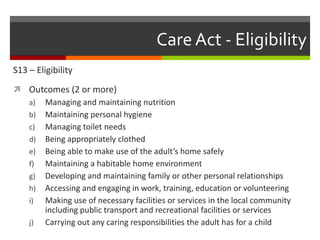
S13 – Eligibility
 Outcomes (2 or more)
a) Managing and maintaining nutrition
b) Maintaining personal hygiene
c) Managing toilet needs
d) Being appropriately clothed
e) Being able to make use of the adult’s home safely
f) Maintaining a habitable home environment
g) Developing and maintaining family or other personal relationships
h) Accessing and engaging in work, training, education or volunteering
i) Making use of necessary facilities or services in the local community
including public transport and recreational facilities or services
j) Carrying out any caring responsibilities the adult has for a child
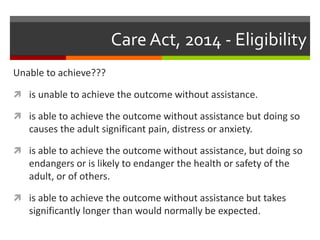
Care Act, 2014 - Eligibility
Unable to achieve???
 is unable to achieve the outcome without assistance.
 is able to achieve the outcome without assistance but doing so
causes the adult significant pain, distress or anxiety.
 is able to achieve the outcome without assistance, but doing so
endangers or is likely to endanger the health or safety of the
adult, or of others.
 is able to achieve the outcome without assistance but takes
significantly longer than would normally be expected.
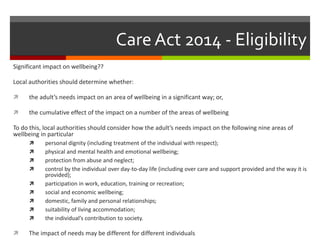
Care Act 2014 - Eligibility
Significant impact on wellbeing??
Local authorities should determine whether:
 the adult’s needs impact on an area of wellbeing in a significant way; or,
 the cumulative effect of the impact on a number of the areas of wellbeing
To do this, local authorities should consider how the adult’s needs impact on the following nine areas of
wellbeing in particular
 personal dignity (including treatment of the individual with respect);
 physical and mental health and emotional wellbeing;
 protection from abuse and neglect;
 control by the individual over day-to-day life (including over care and support provided and the way it is
provided);
 participation in work, education, training or recreation;
 social and economic wellbeing;
 domestic, family and personal relationships;
 suitability of living accommodation;
 the individual’s contribution to society.
 The impact of needs may be different for different individuals
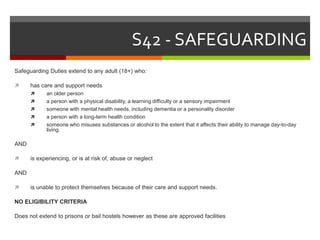
S42 - SAFEGUARDING
Safeguarding Duties extend to any adult (18+) who:
 has care and support needs
 an older person
 a person with a physical disability, a learning difficulty or a sensory impairment
 someone with mental health needs, including dementia or a personality disorder
 a person with a long-term health condition
 someone who misuses substances or alcohol to the extent that it affects their ability to manage day-to-day
living.
AND
 is experiencing, or is at risk of, abuse or neglect
AND
 is unable to protect themselves because of their care and support needs.
NO ELIGIBILITY CRITERIA
Does not extend to prisons or bail hostels however as these are approved facilities
Section 42 - SAFEGUARDING
 New DUTY to ‘make enquiries’
 An action taken by LA in response to SA alert
 Must be proportionate
 Spectrum re: meaning however
 Advocacy
 Principles: wellbeing plus: -empowerment –prevention –
proportionality –protection –partnership –accountability
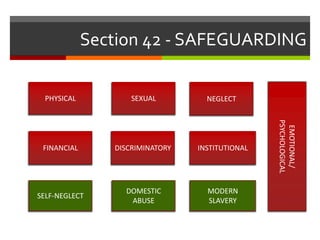
 New categories (7+3)
Section 42 - SAFEGUARDING
PHYSICAL SEXUAL
EMOTIONAL/
PSYCHOLOGICAL
NEGLECT
DISCRIMINATORY INSTITUTIONALFINANCIAL
SELF-NEGLECT
DOMESTIC
ABUSE
MODERN
SLAVERY
S67 – ADVOCACY; S37-38 PORTABILITY
S67 – Independent Advocacy
 New and exciting
 Duty on LA to arrange if person has difficulty participating in assessment
 Similar to IMCA in MCA, 2005 (previous lecture)
S37-38 – Portability
 When people move between authorities, care plans from previous authority
honoured pending new assessment
Things that remain:
 Hospital Discharge (with new names)
 Care and Support Plans (S25-26)
 Direct Payments (S31-33) (extended to res care)
What might have been…..
 Powers of entry debate

Care act presentation for LNNM

  • 1.
    Care Act 2014:presentation for LNNM May 19th 2015 Karl Mason
  • 2.
    Community Care Law1948-2014 Poor Laws 1948 1968 1970 1983 1984 1990 1995 1996 2000 2001  1948 National Assistance Act  1968 Health Services and Public Health Act  1970 Chronically Sick and Disabled Person’s Act  1983 Health & Social Services & Social Security Adjudications Act  1984 Disabled Person’s Act  1990 NHS and Community Care Act  1995 Carers (Services and Recognition) Act  1996 Community Care (Direct Payments) Act  2000 Carers and Disabled Children Act  2001 Health and Social Care Act
  • 3.
    The Care Act,2014 • Sea-change for community care law • Enacted April 2014, for implementaton April 2015 • Revokes a raft of community care legislation (see slide 4) • Terminology – Service Users are ‘Adults’ – Does not talk about Disabled People, Sick People, Older People – Carers separated from Service Users 1 9 9 0 The Care Act, 2014
  • 4.
    Section 1:WELLBEING  UnderlyingPrinciple of Act  When discharging any obligation under the Act, the local authority must ‘have regard to’  the individual’s views, wishes, feelings and beliefs;  the need to prevent/ delay the development of needs for care and support;  the need to make decisions that are not based on stereotyping individuals;  the importance of individual’s participating as fully as possible in relevant decisions (including provision to them of necessary information and support);  the importance of achieving a ‘balance between the individual’s wellbeing and that of any friends or relatives who are involved in caring for the individual’;  the need to protect people from abuse and neglect;  the need to ensure that restrictions on individual rights /freedoms be kept to the minimum necessary.
  • 5.
    Section 2: PREVENTION LA has general duty to provide range of preventative services  Why?  These services should: (a) contribute towards preventing or delaying the development by adults in its area of needs for care and support; (b) contribute towards preventing or delaying the development by carers in its area of needs for support; (c) reduce the needs for care and support of adults in its area; (d) reduce the needs for support of carers in its area.
  • 6.
    SECTION 4 (INFO)& 5 (PROVIDERS) S4 – Information  Duty on LA to provide adults / carers with information about care and support  How the care system operates;  Care and support choices they have (including the choice of providers);  How to access this support  How to raise safeguarding concerns  how to access independent financial advice (significant re: self-funders, Dilnot Report) S5 - Duty to promote effective high quality providers  Based on failure of large providers (Southern Cross, 2011)  Market Oversight (CQC etc)  Duty on SS to intervene if a provider failys  Duty on SS to promote an effective local market
  • 7.
    S9 (Assessment); S8(Care & Support); S14 (Charging) Assessment (S9); Care and support (S8) and Charging (S14)  S9 – Duty to assess much the same as S47 NHSCCA  S8 – Talks about provision not services  Illustrative list, not prescriptive (as with repealed Community Care Acts)  a) accommodation in a care home or in premises of some other type;  b) care and support at home or in the community;  c) counselling, advocacy and other types of social work;  d) goods and facilities;  e) information and advice.  But not… ‘adaptations’ ‘travel’; and ‘holidays’  S14 – Following Dilnot… Local authorities can charge for the costs that they incur in providing care and support to meet the ‘needs’ of individuals.  2016 Implementation
  • 8.
    Sections 3, 6,7: INTEGRATION & COOPERATION S3, 6, 7 – Integration with the NHS and Cooperation  Integration with NHS (S3)  Better Care Fund  Aimed at releasing acute hospital pressures  Pooled budgets, shared resources  Will probably lead to jointly funded integrated posts  ‘Integration-frenzy’ – where is the evidence?  Cooperation (S6, 7)  Based on s27 Children Act, 1987  Local Authorities can request assistance from health / housing  This must be provided
  • 9.
    S10 - CARERS Big changes – no longer dependent on request or level of care provided  New trigger – the appearance of need  Extends to carers for children transitioning  Carers for adults who are not eligible may still be eligible (s20)  Assessment must ascertain  whether the carer able / willing to provide and continue to provide the care;  the impact on the carers ‘well-being’;  the outcomes the carer wishes in day-to-day life;  whether the carer works or wishes to (and / or) to participate in education, training or  recreation.
  • 10.
    S59-62; S67 –Transition,“Parent Carers” and “Young Carers” New Responsibilities – marks a cross-over with Children and Families Act 2014  Duty to undertake a needs assessment of a disabled child if the child is likely to have needs for care and support after 18 and the assessment would be of significant benefit to the child (S59-60)  Parent Carers in Transition have the same right to have needs assessed (S61-62)  Cross-ref: S90 Children and Families Act, 2014 – Duty to assess Parent Carers based on ‘appearance of need’  Decide is it appropriate for the parent to provide (or continue to) care for disabled child in light of own needs AND have regard to wellbeing of Parent Carer and the need to safeguard the child  Young Carers – first appearance in legislation (prev accessed via S17 Children Act 1987)  Similar right to be assessed if likely to have need for support post 18  Cross-ref: Children and Families Act, 2014 S96 – again ‘appearance of need’  S67 assessments of disabled children / young carers undertaken pre-18, either continue to apply post-18 until reviewed, or if LA doesn’t consider self to have ongoing duty – must re-assess
  • 11.
    S13 - Eligibility Overhaul of FACS  Critical  Substantial  Moderate  Low  National Eligibility test based on identifying:  whether a person’s needs are due to a physical or mental impairment or illness  to what extent a person’s needs affect their ability to achieve two or more specified outcomes (next slide)  and whether and to what extent this impacts on their wellbeing.
  • 12.
    Care Act -Eligibility S13 – Eligibility  Outcomes (2 or more) a) Managing and maintaining nutrition b) Maintaining personal hygiene c) Managing toilet needs d) Being appropriately clothed e) Being able to make use of the adult’s home safely f) Maintaining a habitable home environment g) Developing and maintaining family or other personal relationships h) Accessing and engaging in work, training, education or volunteering i) Making use of necessary facilities or services in the local community including public transport and recreational facilities or services j) Carrying out any caring responsibilities the adult has for a child
  • 13.
    Care Act, 2014- Eligibility Unable to achieve???  is unable to achieve the outcome without assistance.  is able to achieve the outcome without assistance but doing so causes the adult significant pain, distress or anxiety.  is able to achieve the outcome without assistance, but doing so endangers or is likely to endanger the health or safety of the adult, or of others.  is able to achieve the outcome without assistance but takes significantly longer than would normally be expected.
  • 14.
    Care Act 2014- Eligibility Significant impact on wellbeing?? Local authorities should determine whether:  the adult’s needs impact on an area of wellbeing in a significant way; or,  the cumulative effect of the impact on a number of the areas of wellbeing To do this, local authorities should consider how the adult’s needs impact on the following nine areas of wellbeing in particular  personal dignity (including treatment of the individual with respect);  physical and mental health and emotional wellbeing;  protection from abuse and neglect;  control by the individual over day-to-day life (including over care and support provided and the way it is provided);  participation in work, education, training or recreation;  social and economic wellbeing;  domestic, family and personal relationships;  suitability of living accommodation;  the individual’s contribution to society.  The impact of needs may be different for different individuals
  • 15.
    S42 - SAFEGUARDING SafeguardingDuties extend to any adult (18+) who:  has care and support needs  an older person  a person with a physical disability, a learning difficulty or a sensory impairment  someone with mental health needs, including dementia or a personality disorder  a person with a long-term health condition  someone who misuses substances or alcohol to the extent that it affects their ability to manage day-to-day living. AND  is experiencing, or is at risk of, abuse or neglect AND  is unable to protect themselves because of their care and support needs. NO ELIGIBILITY CRITERIA Does not extend to prisons or bail hostels however as these are approved facilities
  • 16.
    Section 42 -SAFEGUARDING  New DUTY to ‘make enquiries’  An action taken by LA in response to SA alert  Must be proportionate  Spectrum re: meaning however  Advocacy  Principles: wellbeing plus: -empowerment –prevention – proportionality –protection –partnership –accountability  New categories (7+3)
  • 17.
    Section 42 -SAFEGUARDING PHYSICAL SEXUAL EMOTIONAL/ PSYCHOLOGICAL NEGLECT DISCRIMINATORY INSTITUTIONALFINANCIAL SELF-NEGLECT DOMESTIC ABUSE MODERN SLAVERY
  • 18.
    S67 – ADVOCACY;S37-38 PORTABILITY S67 – Independent Advocacy  New and exciting  Duty on LA to arrange if person has difficulty participating in assessment  Similar to IMCA in MCA, 2005 (previous lecture) S37-38 – Portability  When people move between authorities, care plans from previous authority honoured pending new assessment Things that remain:  Hospital Discharge (with new names)  Care and Support Plans (S25-26)  Direct Payments (S31-33) (extended to res care) What might have been…..  Powers of entry debate