PRESENTATION ON OKRA
PRESENTED BY:
SACHIN G E
M.Sc. 1st year
CH and F
JHALAWAR
PRESENTED TO:
Dr.KAVITA A
Asst. Prof Veg science
CH and F
JHALAWAR
OKRA
BOTANICAL NAME : Abelmoschus esculents
FAMILY : Malvaceae
ORIGIN :Tropical Africa
Chrosome number :2n= 130
Production : 10.87 tons(2014 data)
It is also known as Ladys finger , Bhindi ,and gumbo
It is an annual vegetable crop, grown in tropical and sub tropical
regions of the world.
It is mainly grown in India, brazil, west Africa ,Iran
Internally the fruits contain small round mucilaginous white
coloured seeds.
Introduction
General features
Erect unbranched stem.
Stems are green and sparse hairs on stems
Light green petiole.
Leaves are alternately arranged.
Flowers are solitary , auxiliary.
Calyx of 5 sepals hairy joined
Uses
Used as vegetable
Tender green fruits are cooked in curry and also used in
soups.
The roots and stems are useful for clearing cane juice in
the preparation of jaggary.
The frits are rich source of iodine.
Soil
It can be grown in all kind of soils, sandy- loam and clay - loam
soils are best for its cultivation.
The optimum soil ph range is about 6– 6.8.
The land is prepared by ploughing of about 5– 6 times to make
fine pulvarised soil.
At the time of land preparation apply FYMat rate of 20 – 25tha.
Climate
Okra is a warm season crop requires a long warm growing
season.
In india it is mainly grown in rainy and summer season.
It is highly sensitive to frost.
Seeds germinate poorly at soil temperature 20 degree celcius or
below.
Preparation of field
The land should be well prepared with 2-3 ploughing.
Well decomposed FYM (25 t/ha) is incorporated at the time of land
preparation.
Bhendi is sown on ridges or on flat soil. If soil is heavy, sowing
should be done on ridges.
Application of organic manure like neem cake and poultry manures
improves the plant growth and the yield in this crop. It is possible to
reduce the use fertilizer by using neem cake and poultry manures.
Preparation of field
variety
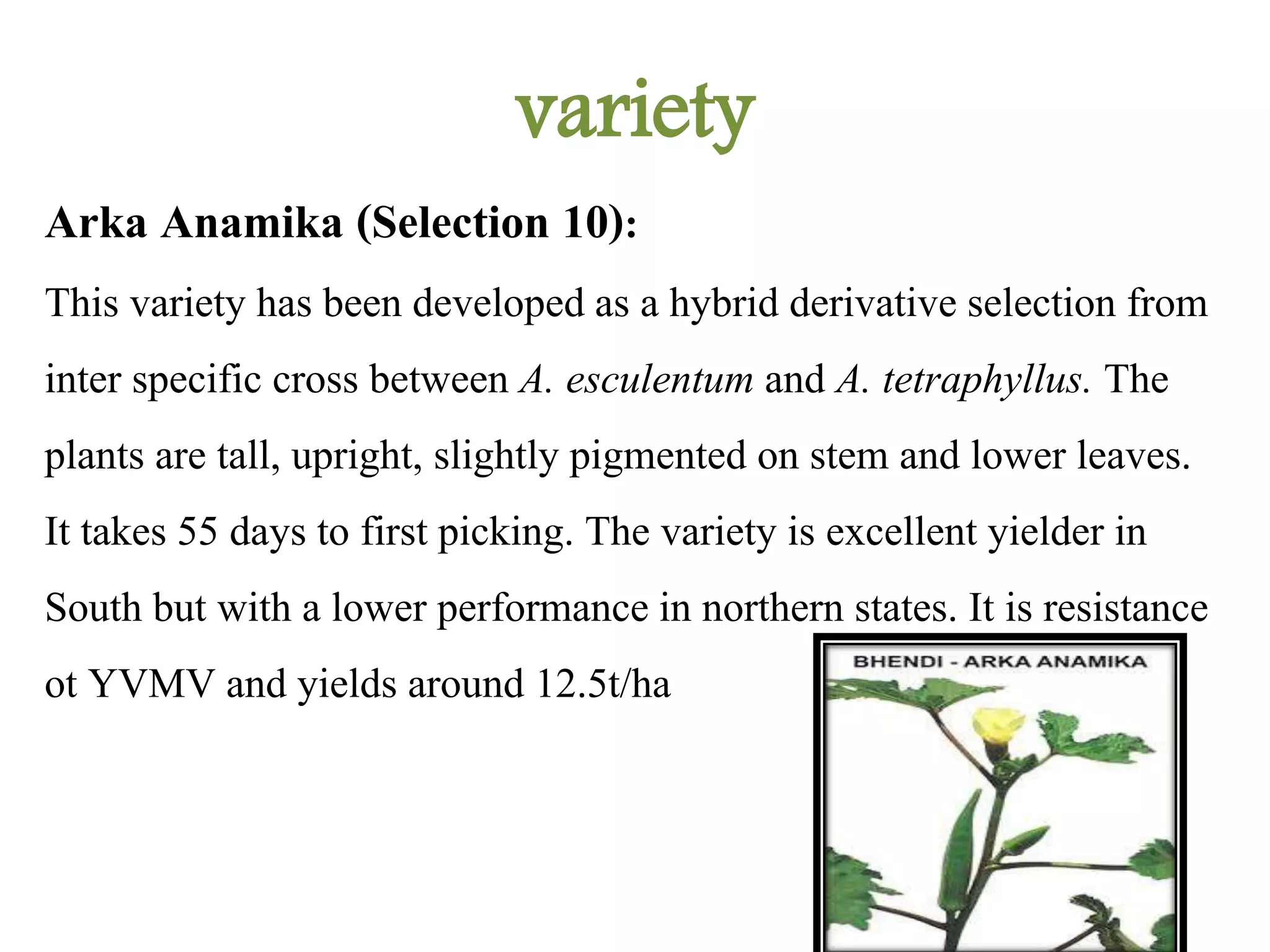
Arka Anamika (Selection 10):
This variety has been developed as a hybrid derivative selection from
inter specific cross between A. esculentum and A. tetraphyllus. The
plants are tall, upright, slightly pigmented on stem and lower leaves.
It takes 55 days to first picking. The variety is excellent yielder in
South but with a lower performance in northern states. It is resistance
ot YVMV and yields around 12.5t/ha
Arka Abhay (Selection):
•An interspecific hybrid between Abelmoschus esculentus(IIHR 20-31)
x A.manihot spp. Tetraphyllus (Res. To YVMV) followed by backcross.
Plants tall, well branched. Fruits lush green, tender and long. Fruits
borne in two flushes. Purple pigment present on both sides of the petal
base. Green stem with purple shade. Fruits free from spines having
delicate aroma. Good keeping and cooking qualities. Resistant to yellow
vein mosaic virus(YVMV) Duration 120-130 days. Yield 18 t/h
Parbhani Kranti:
It is yellow vein mosaic resistant variety released in 1985 by
MAU, Parbhani- It is derived from back cross of Abelmoschus
manihot x A. esculentus. Two back crosses were made using Pusa
sawani (A. esculentus) as a recurrent parent followed by selection
in the subsequent generations- It is a yellow vein mosaic virus
(YVMy) resistant variety isolated in F8 generation. Plants flower
in 45-60 days. Fruits are dark green in colour, smooth, lender and
slender.(MAU, Parbhani)
Pusa Sawani:
Most popular variety known throughout the country. It is a hybrid
derivative selection from the cross between IC 1542 and Pusa
Makhmali. It bears smooth and dark green fruits having 5 ridges
and takes 45-50 days from sowing to harvest. First fruit is borne
on 5th to 7th node. It is suitable for cultivation in both spring
summer as well as Kharif season since it is less sensitive to
temperature fluctuations. Yield is around 12-12.5 t/ha.
Phule Kirti:
It is the F1 hybrid of okra suitable for both the kharif and
summer seasons. It is also suitable for warm and moderate
humid regions. Stem is green in colour with red patches. Fruits
are green in colour. It is resistant to yellow vein mosaic virus.
Shelf life is 3-4 days. It gives on an average yield of 163
quintals per hectare. Besides it is released through the State
Variety Release Committee of Maharashtra, it is also notified
by the Central Sub Committee on Crop Standards, Notification
and Varietal Release at the national level.(MPKV, Ramrri)
Pusa Makhmali:
It is a pure line selection from local type collected from
West Bengal. Fruits are light green tappered, attractive,
12-15 cm long with high yielding (8-10t/ha) potential but is
susceptible to YVMV. It is suited for cultivation in hills and
at virus free season
other varieties
Perkins long green
Varsha uphar
Hissar unnat
Gujarat bhindi
Harbhajan
Azad kranti
Seed rate
Varieties : 8.0 kg / ha
Hybrids : 2.5 kg / ha
In summer sown in January – February
In winter sown in August - September
Seed treatment
Seeds are treated by soaking in 0.2% Bavistin solution protects the
seedlings from damping off disease.
Sowing
Sow three seeds per hill at 30 cm apart and then thin to 2 plants per hill
after 10 days.
Sowing of Bhendi seeds
Spacing
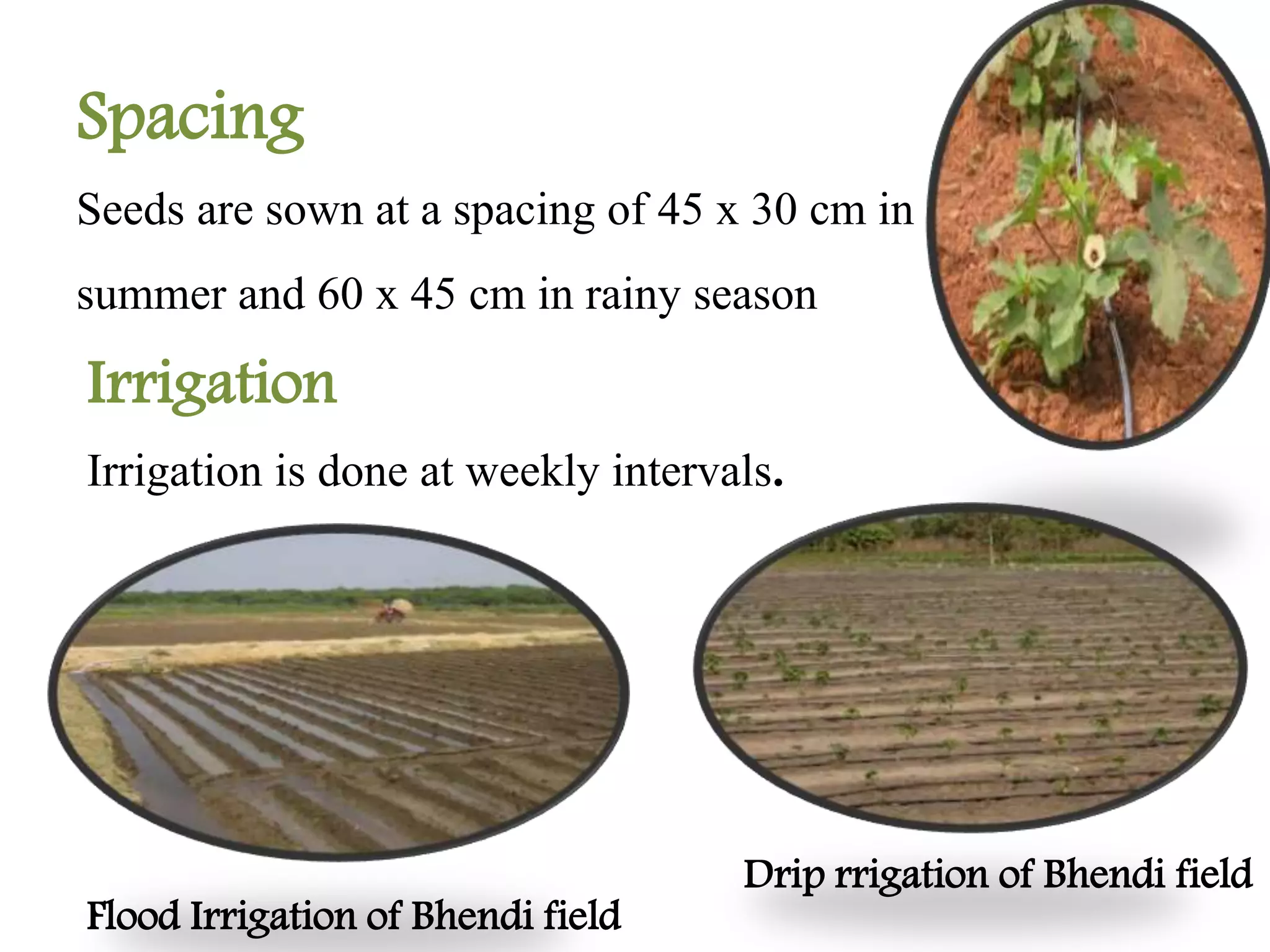
Seeds are sown at a spacing of 45 x 30 cm in
summer and 60 x 45 cm in rainy season
Irrigation
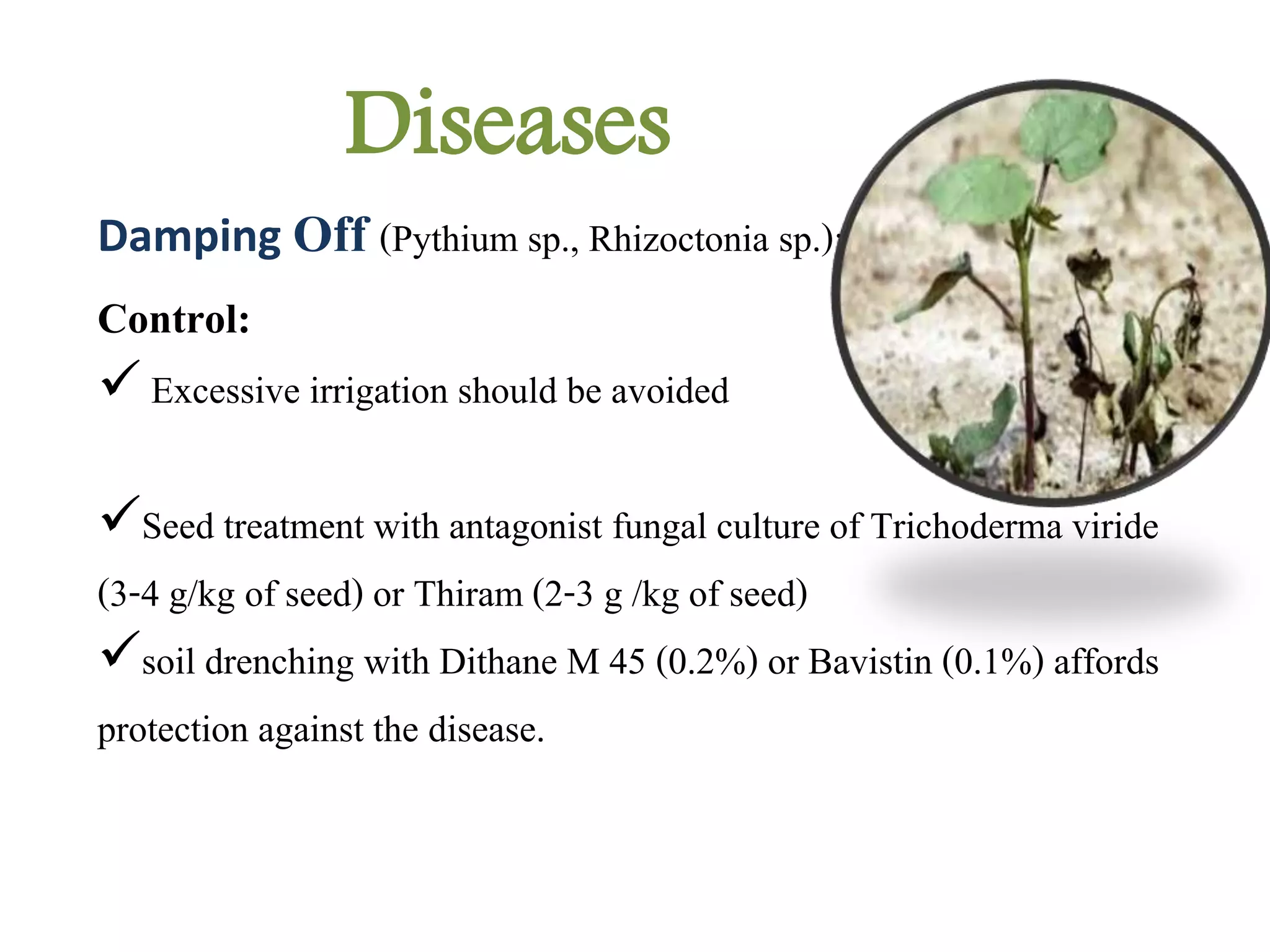
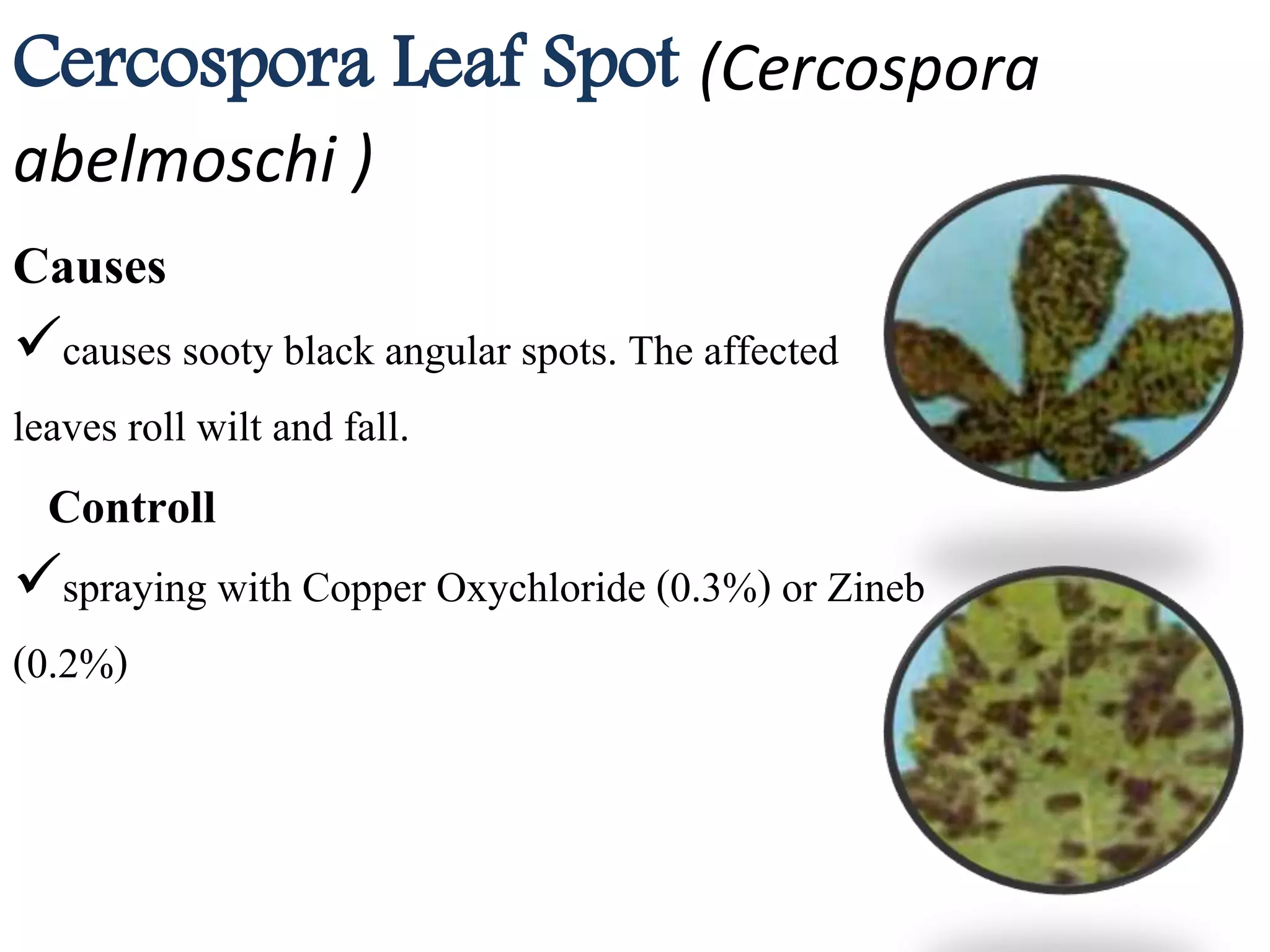
Irrigation is done at weekly intervals.
Flood Irrigation of Bhendi field
Drip rrigation of Bhendi field
weeding
 to control,weeds application basalin @ 2-3 kg a.i/ha or
tenoran 50 WP @ 1 kg a.i. /ha can be used.
 1 or 2 hand weeding
Manures and fertilizers
FYM 20 – 25tha
NPK 100: 60: 50 kgha
Half dose of N and full dose of P& K applied at time of
sowing.
The remaining half dose of N is applied at 30 days after
sowing.
Harvesting
The fruits are ready for harvest in about 45-60 days after seed
sowing depending upon variety and season.
Size of the pod and stage at which it is harvested varies with
variety/hybrid and market preference.
Generally, medium sized (7-10 cm long) tender pods, which can be
easily snapped from the plant, are harvested. As all the fruits do not
mature at the same time, harvesting is carried out once in 3-4 days.
Frequent picking promotes fruit development and prevents the pods
from growing too large.
Yield
Its greatly depending upon variety and season of
cultivation.
On an average bhendi yield 7.5-10 t/ha while the yield of
hybrid varieties ranges from 15-22 t/ha.
Diseases
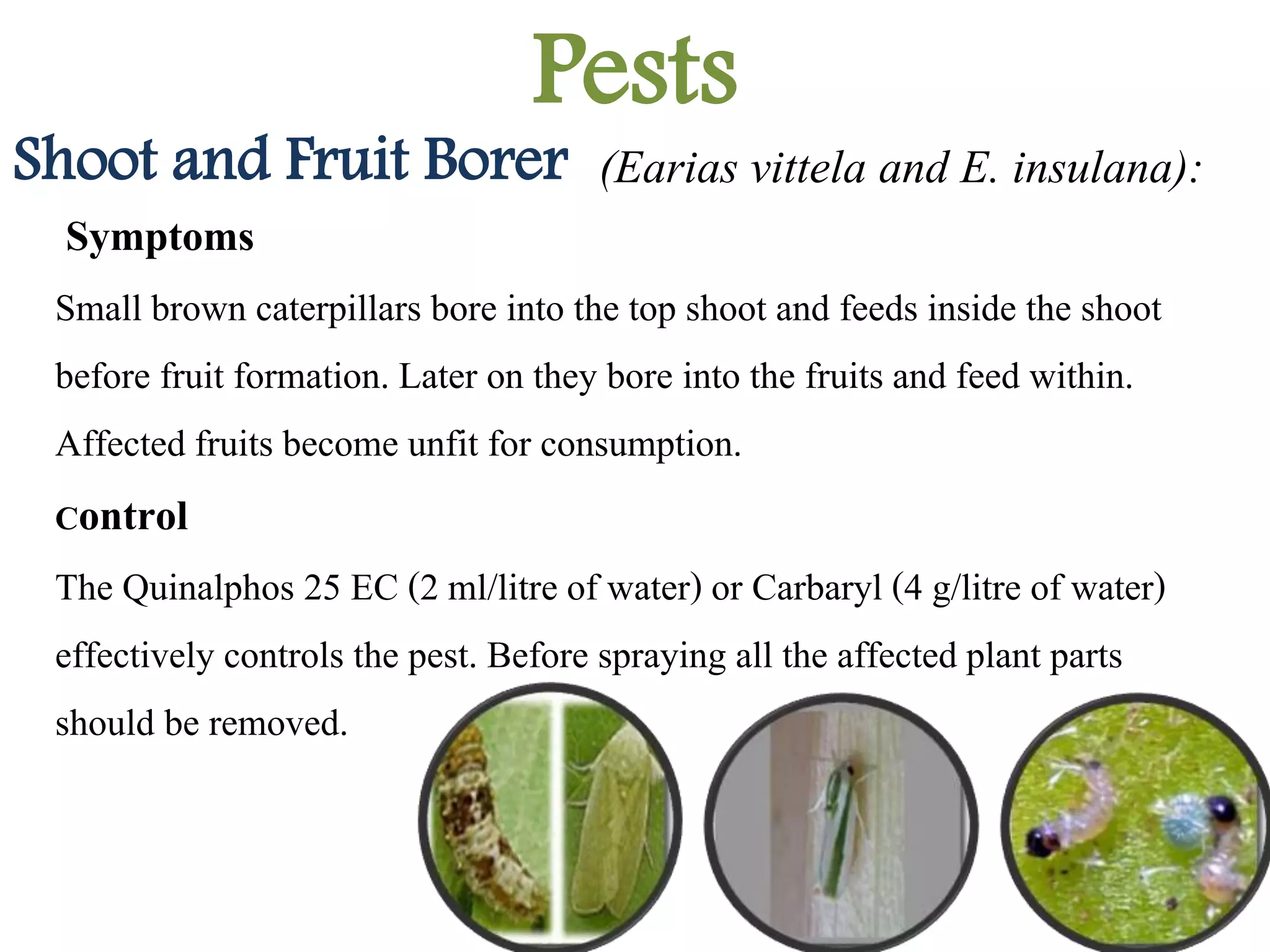
Damping Off (Pythium sp., Rhizoctonia sp.):
Control:
 Excessive irrigation should be avoided
Seed treatment with antagonist fungal culture of Trichoderma viride
(3-4 g/kg of seed) or Thiram (2-3 g /kg of seed)
soil drenching with Dithane M 45 (0.2%) or Bavistin (0.1%) affords
protection against the disease.
Cercospora Leaf Spot (Cercospora
abelmoschi )
Causes
causes sooty black angular spots. The affected
leaves roll wilt and fall.
Controll
spraying with Copper Oxychloride (0.3%) or Zineb
(0.2%)
Yellow Vein Mosaic Virus (YVMV):
Symptoms
This is the most important and destructive viral disease in
bhendi.
The disease infects at all the stages of crop growth and severely
reduces growth and yield.
 The disease is transmitted by white fly.
The characteristic symptoms of the disease are a homogenous
interwoven network of yellow
Control:
 Removal and destruction of virus affected plants and
planting of disease resistance varieties reduces the disease
incidence.
Controlling the whitefly population minimizes the
incidence of YVMV.
Soil application of Carbofuran (1kg a.i./ha) at the time of
sowing and 4-5 foliar sprays of Dimethoate (0.05%) or
Metasystox ( 0.02%) or Nuvacron (0.05%) at an interval of
10 days effectively controls the whitefly population.
Pests
Shoot and Fruit Borer (Earias vittela and E. insulana):
Symptoms
Small brown caterpillars bore into the top shoot and feeds inside the shoot
before fruit formation. Later on they bore into the fruits and feed within.
Affected fruits become unfit for consumption.
Control
The Quinalphos 25 EC (2 ml/litre of water) or Carbaryl (4 g/litre of water)
effectively controls the pest. Before spraying all the affected plant parts
should be removed.
Bhendi fruit borer: Helicoverpa armigera
Symptoms of damage:
Feed on the flowers
Circular boreholes on fruits
Larva thrust only part of their body inside the fruit feed
Management:
destroy the infected fruits and grown up larvae
Grow simultaneously 40 days old American tall marigold and 25
days old tomato seedling at 1:10 rows to attract Helicoverpa adults
for egg laying.
Setup pheromone trap with Helilure at 15/ha
Spray carbaryl 50 WP 2 g/lit or B. thuringiensis
2 g/lit Release Chrysoperla carnea at weekly interval at
50,000 eggs or grubs/ha from 30 DAS
Stem weevil: Pempherulus affinis
Symptoms of damage:
Grub feed on stem and galls are formed in the stem and petiole
Adults feed on leaf buds and terminal shoots
Management:
Soil application of Carbofuran 3 G at 30 kg or Aldicarb 10 G at 10
kg/ha on 20 DAS and earthed up.
Basal application of FYM 25 t/ha or 250 kg/ha of neem cake
Leaf roller: Sylepta derogata
Symptoms of damage:
Caterpillar rolled the leaves
Scrapping the chlorophyll content and feed inside
Defoliation
Management:
Collect and destroy rolled leaves
Spray carbaryl 50 WP 2 g/lit or phosalone 35 EC 2 ml/lit
Leaf Hopper (Amrasca biguttula biguttula):
Symptoms
The adults and the nymphs suck the cell sap from the leaves. As a
result the leaves curl upwards along the margins and have a burnt
look which extend over the entire leaf area.
Control
Soil application of Carbofuran 3 G (1 kg a.i./ha) at the time of
sowing effectively controls the pest. Spraying the crop with
Monocrotophos (0.05%) at fortnightly intervals start
Sachin g e

Sachin g e

  • 2.
    PRESENTATION ON OKRA PRESENTEDBY: SACHIN G E M.Sc. 1st year CH and F JHALAWAR PRESENTED TO: Dr.KAVITA A Asst. Prof Veg science CH and F JHALAWAR
  • 3.
    OKRA BOTANICAL NAME :Abelmoschus esculents FAMILY : Malvaceae ORIGIN :Tropical Africa Chrosome number :2n= 130 Production : 10.87 tons(2014 data)
  • 5.
    It is alsoknown as Ladys finger , Bhindi ,and gumbo It is an annual vegetable crop, grown in tropical and sub tropical regions of the world. It is mainly grown in India, brazil, west Africa ,Iran Internally the fruits contain small round mucilaginous white coloured seeds. Introduction
  • 6.
    General features Erect unbranchedstem. Stems are green and sparse hairs on stems Light green petiole. Leaves are alternately arranged. Flowers are solitary , auxiliary. Calyx of 5 sepals hairy joined
  • 7.
    Uses Used as vegetable Tendergreen fruits are cooked in curry and also used in soups. The roots and stems are useful for clearing cane juice in the preparation of jaggary. The frits are rich source of iodine.
  • 8.
    Soil It can begrown in all kind of soils, sandy- loam and clay - loam soils are best for its cultivation. The optimum soil ph range is about 6– 6.8. The land is prepared by ploughing of about 5– 6 times to make fine pulvarised soil. At the time of land preparation apply FYMat rate of 20 – 25tha.
  • 9.
    Climate Okra is awarm season crop requires a long warm growing season. In india it is mainly grown in rainy and summer season. It is highly sensitive to frost. Seeds germinate poorly at soil temperature 20 degree celcius or below.
  • 10.
    Preparation of field Theland should be well prepared with 2-3 ploughing. Well decomposed FYM (25 t/ha) is incorporated at the time of land preparation. Bhendi is sown on ridges or on flat soil. If soil is heavy, sowing should be done on ridges. Application of organic manure like neem cake and poultry manures improves the plant growth and the yield in this crop. It is possible to reduce the use fertilizer by using neem cake and poultry manures.
  • 11.
  • 12.
    variety Arka Anamika (Selection10): This variety has been developed as a hybrid derivative selection from inter specific cross between A. esculentum and A. tetraphyllus. The plants are tall, upright, slightly pigmented on stem and lower leaves. It takes 55 days to first picking. The variety is excellent yielder in South but with a lower performance in northern states. It is resistance ot YVMV and yields around 12.5t/ha
  • 13.
    Arka Abhay (Selection): •Aninterspecific hybrid between Abelmoschus esculentus(IIHR 20-31) x A.manihot spp. Tetraphyllus (Res. To YVMV) followed by backcross. Plants tall, well branched. Fruits lush green, tender and long. Fruits borne in two flushes. Purple pigment present on both sides of the petal base. Green stem with purple shade. Fruits free from spines having delicate aroma. Good keeping and cooking qualities. Resistant to yellow vein mosaic virus(YVMV) Duration 120-130 days. Yield 18 t/h
  • 14.
    Parbhani Kranti: It isyellow vein mosaic resistant variety released in 1985 by MAU, Parbhani- It is derived from back cross of Abelmoschus manihot x A. esculentus. Two back crosses were made using Pusa sawani (A. esculentus) as a recurrent parent followed by selection in the subsequent generations- It is a yellow vein mosaic virus (YVMy) resistant variety isolated in F8 generation. Plants flower in 45-60 days. Fruits are dark green in colour, smooth, lender and slender.(MAU, Parbhani)
  • 15.
    Pusa Sawani: Most popularvariety known throughout the country. It is a hybrid derivative selection from the cross between IC 1542 and Pusa Makhmali. It bears smooth and dark green fruits having 5 ridges and takes 45-50 days from sowing to harvest. First fruit is borne on 5th to 7th node. It is suitable for cultivation in both spring summer as well as Kharif season since it is less sensitive to temperature fluctuations. Yield is around 12-12.5 t/ha.
  • 16.
    Phule Kirti: It isthe F1 hybrid of okra suitable for both the kharif and summer seasons. It is also suitable for warm and moderate humid regions. Stem is green in colour with red patches. Fruits are green in colour. It is resistant to yellow vein mosaic virus. Shelf life is 3-4 days. It gives on an average yield of 163 quintals per hectare. Besides it is released through the State Variety Release Committee of Maharashtra, it is also notified by the Central Sub Committee on Crop Standards, Notification and Varietal Release at the national level.(MPKV, Ramrri)
  • 17.
    Pusa Makhmali: It isa pure line selection from local type collected from West Bengal. Fruits are light green tappered, attractive, 12-15 cm long with high yielding (8-10t/ha) potential but is susceptible to YVMV. It is suited for cultivation in hills and at virus free season
  • 18.
    other varieties Perkins longgreen Varsha uphar Hissar unnat Gujarat bhindi Harbhajan Azad kranti
  • 19.
    Seed rate Varieties :8.0 kg / ha Hybrids : 2.5 kg / ha In summer sown in January – February In winter sown in August - September Seed treatment Seeds are treated by soaking in 0.2% Bavistin solution protects the seedlings from damping off disease.
  • 20.
    Sowing Sow three seedsper hill at 30 cm apart and then thin to 2 plants per hill after 10 days. Sowing of Bhendi seeds
  • 21.
    Spacing Seeds are sownat a spacing of 45 x 30 cm in summer and 60 x 45 cm in rainy season Irrigation Irrigation is done at weekly intervals. Flood Irrigation of Bhendi field Drip rrigation of Bhendi field
  • 22.
    weeding  to control,weedsapplication basalin @ 2-3 kg a.i/ha or tenoran 50 WP @ 1 kg a.i. /ha can be used.  1 or 2 hand weeding
  • 23.
    Manures and fertilizers FYM20 – 25tha NPK 100: 60: 50 kgha Half dose of N and full dose of P& K applied at time of sowing. The remaining half dose of N is applied at 30 days after sowing.
  • 24.
    Harvesting The fruits areready for harvest in about 45-60 days after seed sowing depending upon variety and season. Size of the pod and stage at which it is harvested varies with variety/hybrid and market preference. Generally, medium sized (7-10 cm long) tender pods, which can be easily snapped from the plant, are harvested. As all the fruits do not mature at the same time, harvesting is carried out once in 3-4 days. Frequent picking promotes fruit development and prevents the pods from growing too large.
  • 25.
    Yield Its greatly dependingupon variety and season of cultivation. On an average bhendi yield 7.5-10 t/ha while the yield of hybrid varieties ranges from 15-22 t/ha.
  • 26.
    Diseases Damping Off (Pythiumsp., Rhizoctonia sp.): Control:  Excessive irrigation should be avoided Seed treatment with antagonist fungal culture of Trichoderma viride (3-4 g/kg of seed) or Thiram (2-3 g /kg of seed) soil drenching with Dithane M 45 (0.2%) or Bavistin (0.1%) affords protection against the disease.
  • 27.
    Cercospora Leaf Spot(Cercospora abelmoschi ) Causes causes sooty black angular spots. The affected leaves roll wilt and fall. Controll spraying with Copper Oxychloride (0.3%) or Zineb (0.2%)
  • 28.
    Yellow Vein MosaicVirus (YVMV): Symptoms This is the most important and destructive viral disease in bhendi. The disease infects at all the stages of crop growth and severely reduces growth and yield.  The disease is transmitted by white fly. The characteristic symptoms of the disease are a homogenous interwoven network of yellow
  • 29.
    Control:  Removal anddestruction of virus affected plants and planting of disease resistance varieties reduces the disease incidence. Controlling the whitefly population minimizes the incidence of YVMV. Soil application of Carbofuran (1kg a.i./ha) at the time of sowing and 4-5 foliar sprays of Dimethoate (0.05%) or Metasystox ( 0.02%) or Nuvacron (0.05%) at an interval of 10 days effectively controls the whitefly population.
  • 30.
    Pests Shoot and FruitBorer (Earias vittela and E. insulana): Symptoms Small brown caterpillars bore into the top shoot and feeds inside the shoot before fruit formation. Later on they bore into the fruits and feed within. Affected fruits become unfit for consumption. Control The Quinalphos 25 EC (2 ml/litre of water) or Carbaryl (4 g/litre of water) effectively controls the pest. Before spraying all the affected plant parts should be removed.
  • 31.
    Bhendi fruit borer:Helicoverpa armigera Symptoms of damage: Feed on the flowers Circular boreholes on fruits Larva thrust only part of their body inside the fruit feed
  • 32.
    Management: destroy the infectedfruits and grown up larvae Grow simultaneously 40 days old American tall marigold and 25 days old tomato seedling at 1:10 rows to attract Helicoverpa adults for egg laying. Setup pheromone trap with Helilure at 15/ha Spray carbaryl 50 WP 2 g/lit or B. thuringiensis 2 g/lit Release Chrysoperla carnea at weekly interval at 50,000 eggs or grubs/ha from 30 DAS
  • 33.
    Stem weevil: Pempherulusaffinis Symptoms of damage: Grub feed on stem and galls are formed in the stem and petiole Adults feed on leaf buds and terminal shoots Management: Soil application of Carbofuran 3 G at 30 kg or Aldicarb 10 G at 10 kg/ha on 20 DAS and earthed up. Basal application of FYM 25 t/ha or 250 kg/ha of neem cake
  • 34.
    Leaf roller: Syleptaderogata Symptoms of damage: Caterpillar rolled the leaves Scrapping the chlorophyll content and feed inside Defoliation Management: Collect and destroy rolled leaves Spray carbaryl 50 WP 2 g/lit or phosalone 35 EC 2 ml/lit
  • 35.
    Leaf Hopper (Amrascabiguttula biguttula): Symptoms The adults and the nymphs suck the cell sap from the leaves. As a result the leaves curl upwards along the margins and have a burnt look which extend over the entire leaf area. Control Soil application of Carbofuran 3 G (1 kg a.i./ha) at the time of sowing effectively controls the pest. Spraying the crop with Monocrotophos (0.05%) at fortnightly intervals start