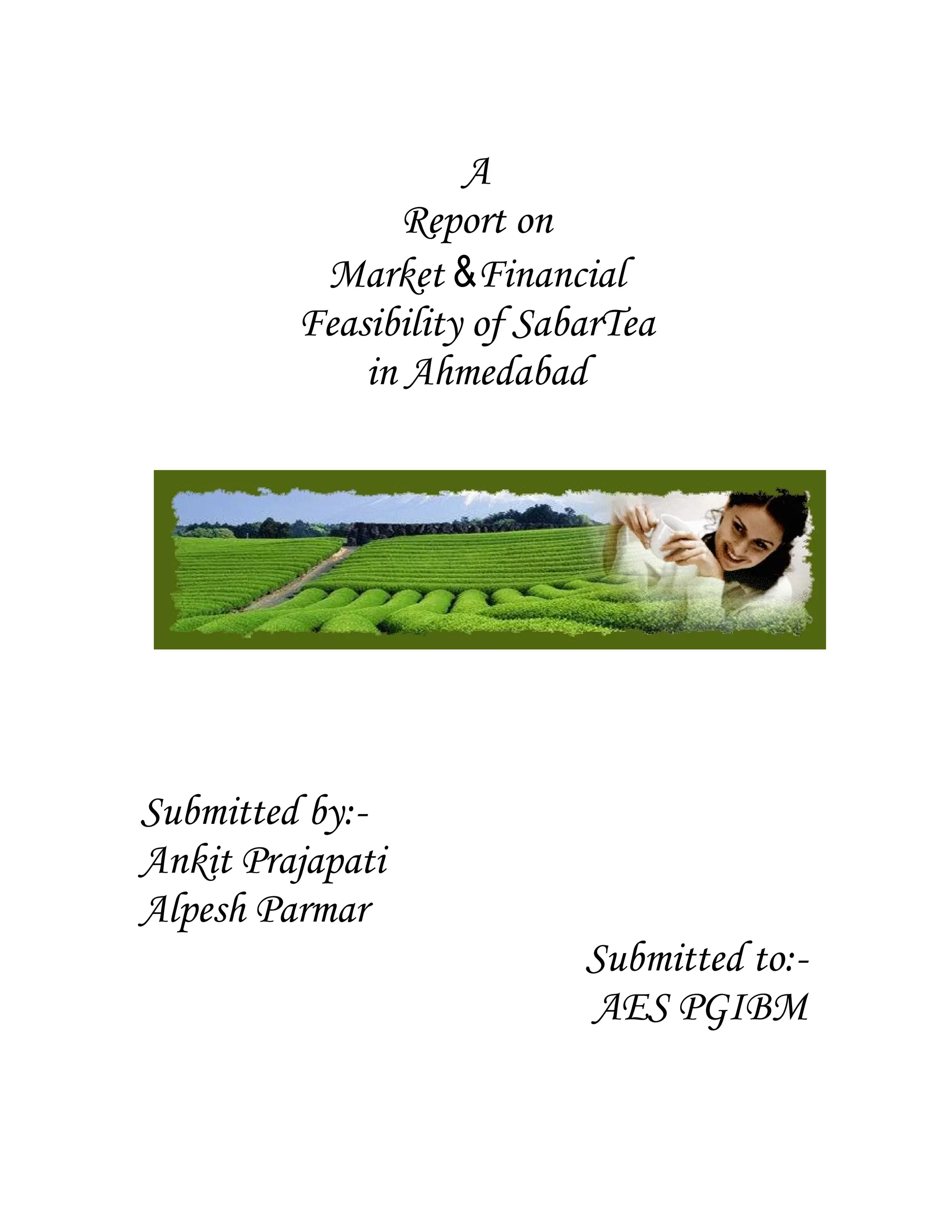
A 
Report on 
Market &Financial 
Feasibility of SabarTea 
in Ahmedabad 
Submitted by:- 
Ankit Prajapati 
Alpesh Parmar 
Submitted to:- 
AES PGIBM
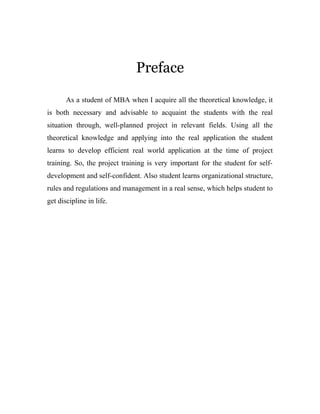
Preface 
As a student of MBA when I acquire all the theoretical knowledge, it 
is both necessary and advisable to acquaint the students with the real 
situation through, well-planned project in relevant fields. Using all the 
theoretical knowledge and applying into the real application the student 
learns to develop efficient real world application at the time of project 
training. So, the project training is very important for the student for self-development 
and self-confident. Also student learns organizational structure, 
rules and regulations and management in a real sense, which helps student to 
get discipline in life.
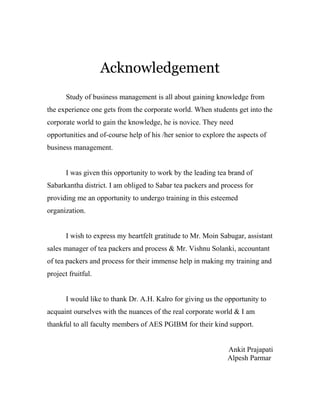
Acknowledgement 
Study of business management is all about gaining knowledge from 
the experience one gets from the corporate world. When students get into the 
corporate world to gain the knowledge, he is novice. They need 
opportunities and of-course help of his /her senior to explore the aspects of 
business management. 
I was given this opportunity to work by the leading tea brand of 
Sabarkantha district. I am obliged to Sabar tea packers and process for 
providing me an opportunity to undergo training in this esteemed 
organization. 
I wish to express my heartfelt gratitude to Mr. Moin Sabugar, assistant 
sales manager of tea packers and process & Mr. Vishnu Solanki, accountant 
of tea packers and process for their immense help in making my training and 
project fruitful. 
I would like to thank Dr. A.H. Kalro for giving us the opportunity to 
acquaint ourselves with the nuances of the real corporate world & I am 
thankful to all faculty members of AES PGIBM for their kind support. 
Ankit Prajapati 
Alpesh Parmar
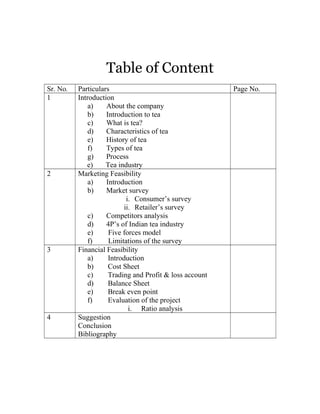
Table of Content 
Sr. No. Particulars Page No. 
1 Introduction 
a) About the company 
b) Introduction to tea 
c) What is tea? 
d) Characteristics of tea 
e) History of tea 
f) Types of tea 
g) Process 
e) Tea industry 
2 Marketing Feasibility 
a) Introduction 
b) Market survey 
i. Consumer’s survey 
ii. Retailer’s survey 
c) Competitors analysis 
d) 4P’s of Indian tea industry 
e) Five forces model 
f) Limitations of the survey 
3 Financial Feasibility 
a) Introduction 
b) Cost Sheet 
c) Trading and Profit & loss account 
d) Balance Sheet 
e) Break even point 
f) Evaluation of the project 
i. Ratio analysis 
4 Suggestion 
Conclusion 
Bibliography
About the company 
SABAR TEA PACKERS AND PROCESS 
Doulat vilas road, Pologround, Himmatnagar – 383 001, Sabarkantha 
Philosophy: 
· Build long lasting relationships through trust and fair play towards all 
stakeholders. 
· Be result oriented. Contribute positively. 
· Be progressive and lead from the front. Change with the times. 
· Be socially responsible. Return to the society a share of the gains 
from commercial enterprise 
History: 
Sabar tea packers and process started its business in tea industry in 
1965 with a vision to be the leader in tea business in India by the sabar 
groups founder Mr. Nisarbhai Sabugar. From 1965 when Sabar group used 
to sell loose tea, now it sells 100 tons to tea each month. 
Growth over the years: 
· 1965 the year when Sabar tea packers and process was established, 
it initially used to sell loose tea. 
· 1970, introduced branded tea in name of ‘Chand sitara’. Daily 
sales was 21 kgs. 
· 1988, started using poly paper for packaging. Daily sales was 100 
kgs. 
· 1998 took registered trademark of Sabar Tea 
· 1990, small packets of amount Rs. 2, Rs. 5 and Rs. 10 where 
introduced.
· 1990, started door to door marketing for rural sector. 
· 1995, introduced premium segment offering special patti, special 
dana and special bhuki. 
· 2003, started their business in Panchmahal and various other 
districts of north Gujarat. 
Management: 
The Sabar group is led by Mr. Nisarbhai Sabugar, a highly regarded 
tea expert and tea taster, with rich experience in the tea business. He 
plays an active role in the tea industry by being an involved member 
and leader of various tea associations. 
Mr. Rafik Sabugar, Managing Director, a commerce graduate and 
also a tea taster with three decades of experience behind him, look 
after the Company's Finance and Taxation matters. 
Mr. Moin Sabugar, Assistant sales manager, an Mba by 
qualification, is a widely travelled professional with rich and varied 
experience in the marketing and production of tea. He plays a key role 
in developing the Company's sales.
Introduction of tea 
Tea is the most popular drink in the world, next to water. Every year, 
an astronomical 7, 68,500,000,000 cups of tea are consumed around the 
globe. Great Britain, famous for the custom of afternoon tea and for the 
introduction of that habit to the world, holds the world record as the largest 
importer of tea. It also boasts of the highest consumption of tea per capita in 
the world - every British man, woman and child drinks nearly 4 cups of tea 
every day! 
Tea, made from the tender leaves and buds of a once wild tree has had 
a strong influence for centuries on the economy of tea producing, trading 
and drinking countries. For a long time, the tea trade had a major impact on 
Britain’s economy. Tea is Sri Lanka’s largest foreign exchange earner. In India, tea holds second 
place as an export earner and the Indian tea trade employs more people than any other industry. 
What is tea?
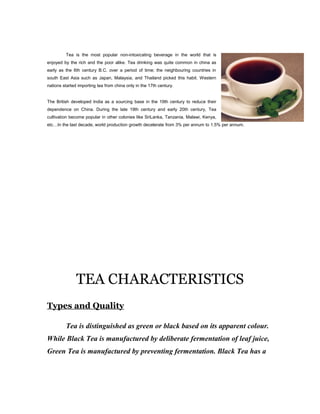
Tea is the most popular non-intoxicating beverage in the world that is 
enjoyed by the rich and the poor alike. Tea drinking was quite common in china as 
early as the 6th century B.C. over a period of time; the neighbouring countries in 
south East Asia such as Japan, Malaysia, and Thailand picked this habit. Western 
nations started importing tea from china only in the 17th century. 
The British developed India as a sourcing base in the 19th century to reduce their 
dependence on China. During the late 19th century and early 20th century, Tea 
cultivation become popular in other colonies like SriLanka, Tanzania, Malawi, Kenya, 
etc…In the last decade, world production growth decelerate from 3% per annum to 1.5% per annum. 
TEA CHARACTERISTICS 
Types and Quality 
Tea is distinguished as green or black based on its apparent colour. 
While Black Tea is manufactured by deliberate fermentation of leaf juice, 
Green Tea is manufactured by preventing fermentation. Black Tea has a
stronger taste and liquor. Green Tea is light and is perceived to have 
pharmaceutical properties. 
Black Tea can be of two varieties: leaf and dust. Leaf Tea can also be processes as orthodox or 
CTC (Crush, Tear, And Curl), CTC production entails fermentation. CTC gives higher cup page (almost 
twice) for the same quantity of Tea and has stronger liquor, while orthodox Tea is light and retain aroma. 
Tea quality is measured on the basis of liquor, aroma/flavour, and leaf appearance. Consumers perceive 
quality on the attributes of taste, pungency, strength, freshness, color, and packaging. 
Value Addition 
The most popular form of value addition is branded Tea. This 
involves not only the packing of Tea but also blending of other varieties to 
maintain consistent taste. To arrive at a blend, expert Tea tasters sample 
hundreds of liquor. Convenient drinks like instant Tea (soluble tea 
powder), Tea bags (bags dipped in hot water), ready-to-drink Tea (served 
in cans), and flavoured Tea (with vanilla or strawberry flavour) are 
becoming popular in developing countries like the US and Japan. 
Productivity And Quality 
The art of plucking, fine-turned over the last 200years, requires two 
fresh Tealeaves and bud to be plucked manually. The productivity can be 
measured as per unit of labour (man year) and per unit of land (hectare). 
Mechanized plucking enhances productivity, but with compromise on 
quality, as coarse leaves also gets plucked. 
For increased production, some producers allow plucking of coarse 
leaves with fresh ones. Ensuring premium quality requires compromise on 
productivity. The productivity also depends on the age of Tea bushes,
genetic material, irrigation, fertilizer, cultivation, techniques, etc; Old bushes 
are re-implanted to improve productivity. 
Inconvenient but Healthy Drink 
Tea is very inconvenient drink to brew. The tendency to form a 
creamy layer of caffeine-tannin adds to the inconvenience. Tea, besides 
having properties of fatigue amelioration, is believed to have chemicals 
that help in maintaining cholesterol level and in preventing cancer. 
History of tea 
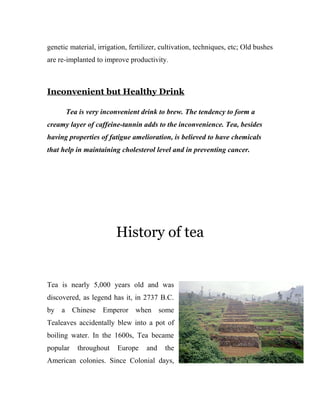
Tea is nearly 5,000 years old and was 
discovered, as legend has it, in 2737 B.C. 
by a Chinese Emperor when some 
Tealeaves accidentally blew into a pot of 
boiling water. In the 1600s, Tea became 
popular throughout Europe and the 
American colonies. Since Colonial days,
Tea has played a role in American culture and customs. Today American 
school children learn about the famous Boston Tea Party protesting the 
British Tea Tax -- one of the acts leading to the Revolutionary War. During 
this century, two major American contributions to the tea industry occurred. 
In 1904, iced tea was created at the World's Fair in St. Louis, and in 1908, 
Thomas Sullivan of New York developed the concept of tea in a bag. Tea 
breaks down into three basic types: Black, Green, and Oolong. 
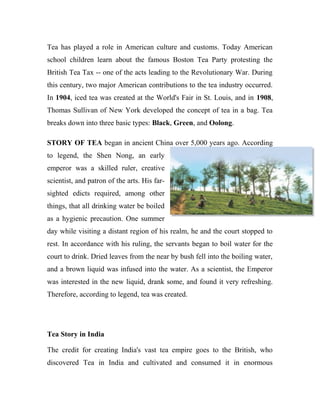
STORY OF TEA began in ancient China over 5,000 years ago. According 
to legend, the Shen Nong, an early 
emperor was a skilled ruler, creative 
scientist, and patron of the arts. His far-sighted 
edicts required, among other 
things, that all drinking water be boiled 
as a hygienic precaution. One summer 
day while visiting a distant region of his realm, he and the court stopped to 
rest. In accordance with his ruling, the servants began to boil water for the 
court to drink. Dried leaves from the near by bush fell into the boiling water, 
and a brown liquid was infused into the water. As a scientist, the Emperor 
was interested in the new liquid, drank some, and found it very refreshing. 
Therefore, according to legend, tea was created. 
Tea Story in India 
The credit for creating India's vast tea empire goes to the British, who 
discovered Tea in India and cultivated and consumed it in enormous
quantities between the early 1800's and India's independence from Great 
Britain in 1947. The Scottish adventurer, Robert Bruce, discovered Tea 
plants growing in Assam in the 1820's. 
At this time, no one thought that Tea existed in India; however Major 
Bruce discovered the plants growing wild in the jungles controlled by the 
tribal chiefs. The British East India Company's other sources to supply the 
English consumers of Tea. In 1834, a Tea committee was appointed to 
investigate the possibility of cultivating Tea in India. After a thorough 
investigation and study of the crop, the first commercial batch of Tea ever 
produced outside of China came from Assam in 1839. The first contract for 
London brokers issued Indian Teas between 500 and 1,000 chests at that 
time. 
TYPES OF TEA 
The classic definition of Tea is the brew made from the infusion of water 
and the leaves of and evergreen plant of the Camellia family. 
In the Tea Industry, Tea is defined as the dried processed leaves of Camellia 
Sinensis or the Sinensis. Commercially, there are the 3 major varieties of 
Camellia Sinensis. The China type, the India (Assam Region) type and the 
hybrid type (a cross breed of the China and India types. 
Tea breaks into 5 basic types. 
· Green Tea 
· White Tea 
· Oolong Tea
· Black Tea 
· Scented Tea 
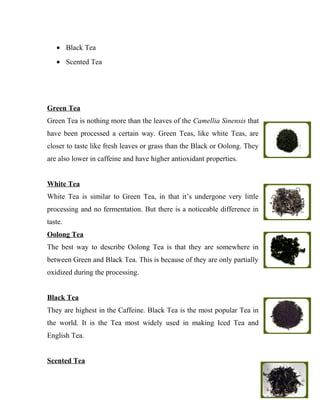
Green Tea 
Green Tea is nothing more than the leaves of the Camellia Sinensis that 
have been processed a certain way. Green Teas, like white Teas, are 
closer to taste like fresh leaves or grass than the Black or Oolong. They 
are also lower in caffeine and have higher antioxidant properties. 
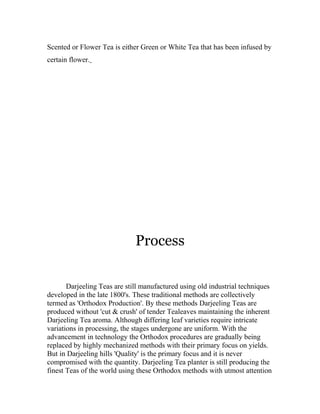
White Tea 
White Tea is similar to Green Tea, in that it’s undergone very little 
processing and no fermentation. But there is a noticeable difference in 
taste. 
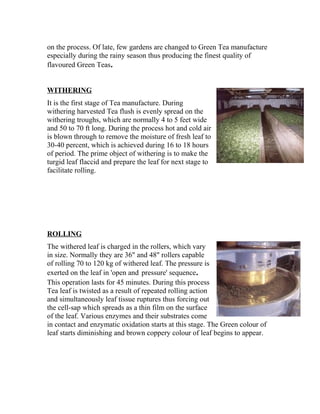
Oolong Tea 
The best way to describe Oolong Tea is that they are somewhere in 
between Green and Black Tea. This is because of they are only partially 
oxidized during the processing. 
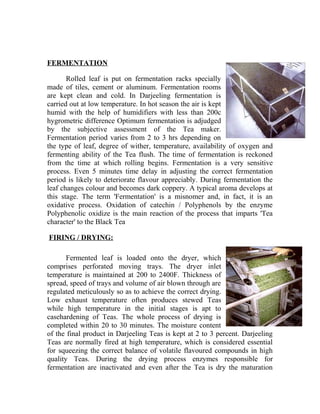
Black Tea 
They are highest in the Caffeine. Black Tea is the most popular Tea in 
the world. It is the Tea most widely used in making Iced Tea and 
English Tea. 
Scented Tea
Scented or Flower Tea is either Green or White Tea that has been infused by 
certain flower. 
Process 
Darjeeling Teas are still manufactured using old industrial techniques 
developed in the late 1800's. These traditional methods are collectively 
termed as 'Orthodox Production'. By these methods Darjeeling Teas are 
produced without 'cut & crush' of tender Tealeaves maintaining the inherent 
Darjeeling Tea aroma. Although differing leaf varieties require intricate 
variations in processing, the stages undergone are uniform. With the 
advancement in technology the Orthodox procedures are gradually being 
replaced by highly mechanized methods with their primary focus on yields. 
But in Darjeeling hills 'Quality' is the primary focus and it is never 
compromised with the quantity. Darjeeling Tea planter is still producing the 
finest Teas of the world using these Orthodox methods with utmost attention
on the process. Of late, few gardens are changed to Green Tea manufacture 
especially during the rainy season thus producing the finest quality of 
flavoured Green Teas. 
WITHERING 
It is the first stage of Tea manufacture. During 
withering harvested Tea flush is evenly spread on the 
withering troughs, which are normally 4 to 5 feet wide 
and 50 to 70 ft long. During the process hot and cold air 
is blown through to remove the moisture of fresh leaf to 
30-40 percent, which is achieved during 16 to 18 hours 
of period. The prime object of withering is to make the 
turgid leaf flaccid and prepare the leaf for next stage to 
facilitate rolling. 
ROLLING 
The withered leaf is charged in the rollers, which vary 
in size. Normally they are 36" and 48" rollers capable 
of rolling 70 to 120 kg of withered leaf. The pressure is 
exerted on the leaf in 'open and pressure' sequence. 
This operation lasts for 45 minutes. During this process 
Tea leaf is twisted as a result of repeated rolling action 
and simultaneously leaf tissue ruptures thus forcing out 
the cell-sap which spreads as a thin film on the surface 
of the leaf. Various enzymes and their substrates come 
in contact and enzymatic oxidation starts at this stage. The Green colour of 
leaf starts diminishing and brown coppery colour of leaf begins to appear.
FERMENTATION 
Rolled leaf is put on fermentation racks specially 
made of tiles, cement or aluminum. Fermentation rooms 
are kept clean and cold. In Darjeeling fermentation is 
carried out at low temperature. In hot season the air is kept 
humid with the help of humidifiers with less than 200c 
hygrometric difference Optimum fermentation is adjudged 
by the subjective assessment of the Tea maker. 
Fermentation period varies from 2 to 3 hrs depending on 
the type of leaf, degree of wither, temperature, availability of oxygen and 
fermenting ability of the Tea flush. The time of fermentation is reckoned 
from the time at which rolling begins. Fermentation is a very sensitive 
process. Even 5 minutes time delay in adjusting the correct fermentation 
period is likely to deteriorate flavour appreciably. During fermentation the 
leaf changes colour and becomes dark coppery. A typical aroma develops at 
this stage. The term 'Fermentation' is a misnomer and, in fact, it is an 
oxidative process. Oxidation of catechin / Polyphenols by the enzyme 
Polyphenolic oxidize is the main reaction of the process that imparts 'Tea 
character' to the Black Tea 
FIRING / DRYING: 
Fermented leaf is loaded onto the dryer, which 
comprises perforated moving trays. The dryer inlet 
temperature is maintained at 200 to 2400F. Thickness of 
spread, speed of trays and volume of air blown through are 
regulated meticulously so as to achieve the correct drying. 
Low exhaust temperature often produces stewed Teas 
while high temperature in the initial stages is apt to 
casehardening of Teas. The whole process of drying is 
completed within 20 to 30 minutes. The moisture content 
of the final product in Darjeeling Teas is kept at 2 to 3 percent. Darjeeling 
Teas are normally fired at high temperature, which is considered essential 
for squeezing the correct balance of volatile flavoured compounds in high 
quality Teas. During the drying process enzymes responsible for 
fermentation are inactivated and even after the Tea is dry the maturation
process continues and Tea attains the mellowness a desirable character of 
Darjeeling Teas. 
SORTING & GRADING: 
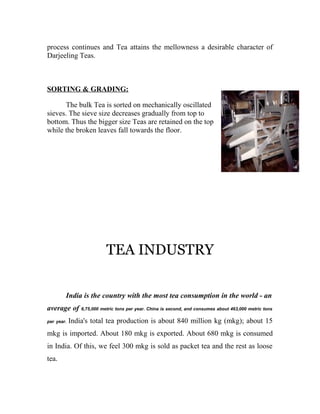
The bulk Tea is sorted on mechanically oscillated 
sieves. The sieve size decreases gradually from top to 
bottom. Thus the bigger size Teas are retained on the top 
while the broken leaves fall towards the floor. 
TEA INDUSTRY 
India is the country with the most tea consumption in the world - an 
average of 6,75,000 metric tons per year. China is second, and consumes about 463,000 metric tons 
per year. India's total tea production is about 840 million kg (mkg); about 15 
mkg is imported. About 180 mkg is exported. About 680 mkg is consumed 
in India. Of this, we feel 300 mkg is sold as packet tea and the rest as loose 
tea.
According to the report, the tea industry in the country accounts for 31 
per cent of global tea production. It is the second largest employer in the 
country, giving employment to more than 1.2 million workers on a 
permanent basis, in addition to one million labourers on a casual basis. An 
estimated 10 million people in the country depend on the tea industry for 
their livelihood and 51 per cent of the workforce comprises women. The 
majority of women are employed to pluck tea - the most labour-intensive 
part of tea production
Introduction 
Market feasibility projects the practical viability of a venture with 
respect to different factors affecting the market. 
Market feasibility includes determining the proper market for the 
product and the different ways for the promotion of the product, it includes 
market research, market segmentation, customer relation, and all the other 
factors related with the market. It also includes deciding on the mediums for 
promoting the product in the market.
Market survey 
We used the questionnaire method for collecting the data from 
consumers and retailers. The questionnaire for consumer and that of the 
retailer are as follows: 
QUESTIONNAIRE FOR CONSUMERS 
1. Personal Detail: 
a. Name: _____________________________________________ 
b. Age: ______ c. Monthly income: _______ 
d. Family members: _____
2. How often do you drink in a day? 
a. One time [ ] b. Two time [ ] c. Three or more time [ ] 
3. How much tea do you purchase in a month? 
a. 250gms [ ] b. 500gms [ ] c. 1kg or more [ ] 
4. Do you purchase same quantity of tea in all seasons? 
Yes [ ] No [ ] 
If No, please specify the reason 
_____________________________________________________ 
_____________________________________________________ 
5. Which type of taste do you prefer in tea? 
a. Strong [ ] b. Light [ ] 
6. Why do you drink tea? 
a. Freshness [ ] b. Habit [ ] 
Other _____________________________ 
7. From which place do you purchase tea? 
a. Retailer [ ] 
b. Supermarket[ ] 
c. Company’s outlet[ ] 
d. Other [ ] 
8. Do you prefer branded tea? 
Yes [ ] No [ ] 
If No, please specify the reason 
_____________________________________________________ 
_____________________________________________________ 
NOTE: Proceed further only if answer of Q.8 is Yes 
9. Which tea brand are you using currently? 
a. Waghbakri [ ] b. Tata Tea [ ] 
c. Brooke Bond [ ] d. Other brands [ ]
10.Since how many years are you using this brand of tea? 
______________________ 
11.Which factor inspires you to purchase this brand? 
Please rank in your order of preference 
a. Price [ ] 
b. Quality [ ] 
c. Free gift [ ] 
d. Packaging [ ] 
e. Advertisement [ ] 
f. Reference groups [ ] 
12.Do you know about Sabar Tea? 
a. Yes [ ] No [ ] 
13.Would you desire to purchase Sabar Tea if you are provided more 
information about this product? 
a. Yes [ ] b. No [ ] 
14.Do you inspire to purchase the brand in which brand ambassador is 
your favorite actor or actress? 
a. Yes [ ] b. No [ ] 
15.According to you what is the most important feature of tea? 
Please rank in your order of preference 
a. Color [ ] 
b. Taste [ ] 
16.Do you think those brands are very good which brand’s 
advertisements come in television? 
Yes [ ] No [ ] 
QUESTIONNAIRE FOR RETAILERS 
1. Personal Detail: 
a. Name of the shop: _________________________________ 
b. Location: ________________
2. Which is the segment that you prefer to sell the most? 
a. Royal segment [ ] b. Premium segment [ ] 
c. Middle segment [ ] d. Economy segment [ ] 
3. Which brand sells the most in the most preferred segment? 
________________________________________________________ 
4. Which size packet sells the most? 
a. 100g. [ ] 
b. 250g. [ ] 
c. 500g. [ ] 
d. 1kg. [ ] 
5. According to you who can be the competitors of Sabar Tea in the 
most preferred segment? 
_________________________________________________________________ 
_ 
6. What is the response of customers when advertisement of new tea 
product comes in any media? 
a. Demand for product [ ] 
b. Ask for suggestion [ ] 
c. Try to get more information [ ] 
d. Not ask anything [ ] 
7. Do you think advertisement is important to sell any product more? If 
No, then why? 
a. Yes [ ] b. No [ ] 
IF No, then please specify the reason 
________________________________________
8. What is customers’ response when you put some new product near 
cash counter or entrance? 
a. Demand for product [ ] 
b. Ask for suggestion [ ] 
c. Try to get more information [ ] 
d. Not ask anything [ ] 
9. Do you think attractive packaging attracts the customer more? 
a. Yes [ ] b. No [ ] 
10.Do you think sometimes packaging attracts the customer but people 
not buy the product because of price? 
a. Yes [ ] 
b. No [ ]
11.If company offers you attractive commission or discount will you 
willing to sell Sabar Tea? 
a. Yes [ ] 
b. No [ ] 
12.Would you like to give any suggestion for promotion activities of 
Sabar Tea? 
_________________________________________________________________ 
_ 
_________________________________________________________________ 
____________________________________________
Research Findings 
Customer 
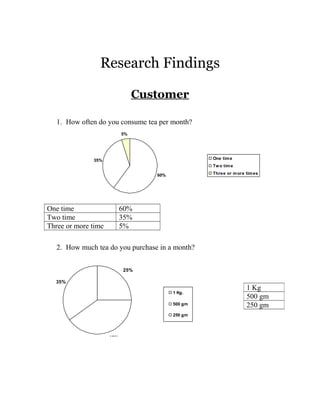
1. How often do you consume tea per month? 
60% 
5% 
35% One time 
Two time 
Three or more times 
One time 60% 
Two time 35% 
Three or more time 5% 
2. How much tea do you purchase in a month? 
25% 
35% 
40% 
1 Kg. 
500 gm 
250 gm 
1 Kg 
500 gm 
250 gm
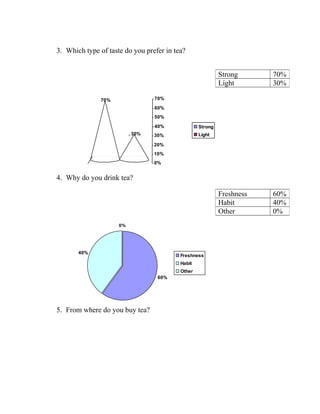
3. Which type of taste do you prefer in tea? 
, 30% 
70% 
70% 
60% 
50% 
40% 
30% 
20% 
10% 
0% 
Strong 
Light 
4. Why do you drink tea? 
60% 
40% 
0% 
Freshness 
Habit 
Other 
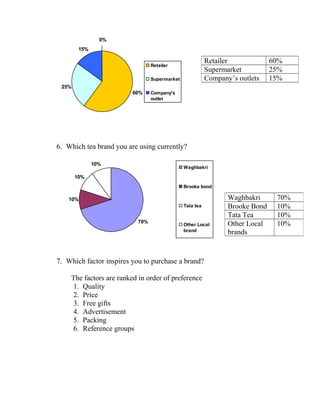
5. From where do you buy tea? 
Strong 70% 
Light 30% 
Freshness 60% 
Habit 40% 
Other 0%
60% 
15% 
0% 
25% 
Retailer 
Supermarket 
Company's 
outlet 
6. Which tea brand you are using currently? 
70% 
10% 
10% 
10% Waghbakri 
Brooke bond 
Tata tea 
Other Local 
brand 
7. Which factor inspires you to purchase a brand? 
The factors are ranked in order of preference 
1. Quality 
2. Price 
3. Free gifts 
4. Advertisement 
5. Packing 
6. Reference groups 
Retailer 60% 
Supermarket 25% 
Company’s outlets 15% 
Waghbakri 70% 
Brooke Bond 10% 
Tata Tea 10% 
Other Local 
10% 
brands
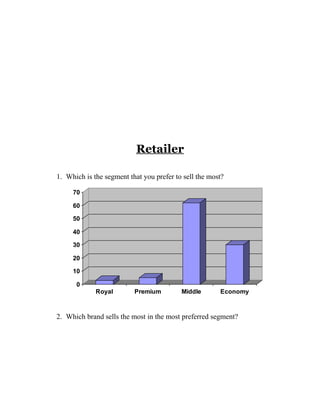
Retailer 
1. Which is the segment that you prefer to sell the most? 
70 
60 
50 
40 
30 
20 
10 
0 
Royal Premium Middle Economy 
2. Which brand sells the most in the most preferred segment?
68% 
12% 
10% 
10% 
Waghbakri 
Brooke bond 
Tata tea 
Other Local 
brand 
3. Which size packet sells the most? 
100.00% 
80.00% 
60.00% 
40.00% 
20.00% 
0.00% 
% 
100gm 250gm 500gm 1kg 
packet size 
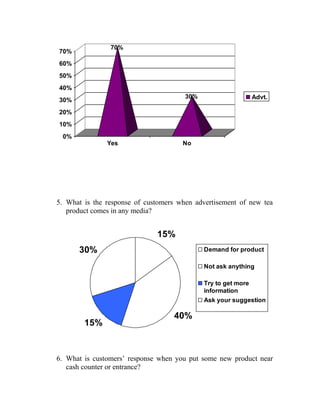
4. Do you think advertisement is important to sell any product more?
70% 
30% 
70% 
60% 
50% 
40% 
30% 
20% 
10% 
0% 
Yes No 
Advt. 
5. What is the response of customers when advertisement of new tea 
product comes in any media? 
15% 
30% Demand for product 
40% 
15% 
Not ask anything 
Try to get more 
information 
Ask your suggestion 
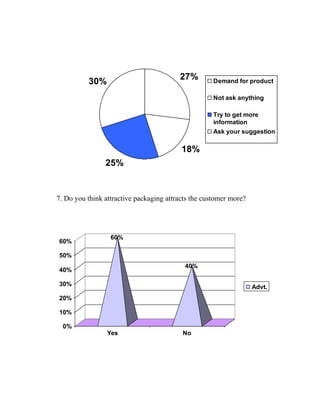
6. What is customers’ response when you put some new product near 
cash counter or entrance?
27% 
30% Demand for product 
18% 
25% 
Not ask anything 
Try to get more 
information 
Ask your suggestion 
7. Do you think attractive packaging attracts the customer more? 
60% 
40% 
60% 
50% 
40% 
30% 
20% 
10% 
0% 
Yes No 
Advt.
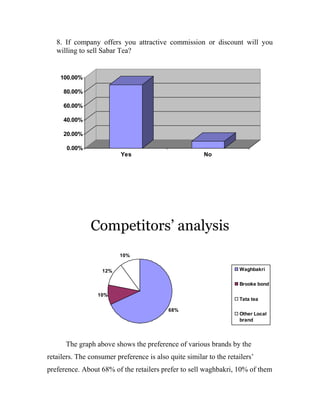
8. If company offers you attractive commission or discount will you 
willing to sell Sabar Tea? 
100.00% 
80.00% 
60.00% 
40.00% 
20.00% 
0.00% 
Yes No 
Competitors’ analysis 
68% 
12% 
10% 
10% 
Waghbakri 
Brooke bond 
Tata tea 
Other Local 
brand 
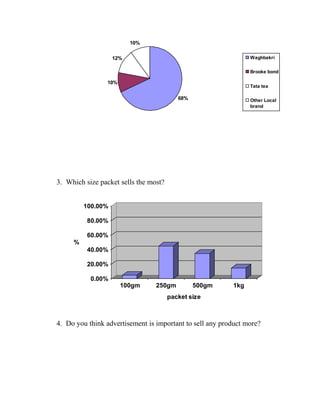
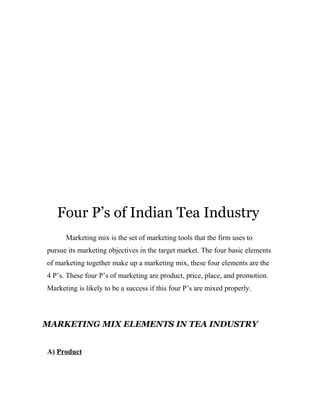
The graph above shows the preference of various brands by the 
retailers. The consumer preference is also quite similar to the retailers’ 
preference. About 68% of the retailers prefer to sell waghbakri, 10% of them
prefer brooke bond, 10% of them prefer Tata tea, and the rest prefer other 
local brands. 
From the graph above it can be said that brooke bond, Tata tea & the 
local brands are the competitors of Sabar Tea. The reason for that is Sabar 
Tea is going to start its business in Ahmedabad and it can straight away 
compete with the market leader. Waghbakri is the market leader in 
Ahmedabad. Thus the competition of Sabar Tea now is with less popular 
brands. 
Waghbakri has a lot of loyal customers, thus it would take time to win 
the Waghbakri customers. 
Sabar Tea will have intense competition from brooke bond, Tata tea & 
the local brands because if we remove the 68% waghbakri share, the there is 
only 32% left and there are many firms who fall in this sector.
Four P’s of Indian Tea Industry 
Marketing mix is the set of marketing tools that the firm uses to 
pursue its marketing objectives in the target market. The four basic elements 
of marketing together make up a marketing mix, these four elements are the 
4 P’s. These four P’s of marketing are product, price, place, and promotion. 
Marketing is likely to be a success if this four P’s are mixed properly. 
MARKETING MIX ELEMENTS IN TEA INDUSTRY 
A) Product
Brand loyalty in the Tea Industry is not a thing of the past, but 
manufacturers can no longer depend on a large, stable base of die-hard 
consumers to support their products. Consumers used to be “true to their tea 
usage” no matter what. But now, because of fierce competition for market 
share, the Tea Industry is over segmented, and the products differ so slightly 
that consumers are confused. Now competition is not only from the coffee 
industry but also from the soft drink industry. Pepsi and Lipton jointly 
introduced a tea based soft drink. This situation creates enormous problems 
for Tea Industry, and thus competitors in the Tea Industry continually seek 
to differentiate their products. Therefore manufactures have to constantly 
come with product innovation like Flavored Tea, Iced Tea, Herbal Tea and 
Tea Pills. 
B) Price 
Price of any product affects the demand of that product, and it applies 
to the tea also. Price competition is now the norm in the industry, and more 
than 50 percent of tea purchases are made due to pricing. As the number of 
firms in the tea industry is increasing, the pricing policy of each firms 
becomes extremely crucial. 
Fluctuating demand for tea in different season makes pricing even 
more important. During summer the tea sales is much lower compared to 
that in winter or rainy season. Export of Asian tea to European countries is 
high since decades. This contributes to reduction in supply for domestic 
market. 
C) Place 
The marketers use the distribution channels to display or deliver the 
physical product or services to the buyer or user. There are physical
distribution channel and service distribution channel they include 
warehouses, transportation vehicles, and various trade channels such as 
distributors wholesalers and retailers. So, the following is the distribution 
channel of the Tea Industry in private selling. 
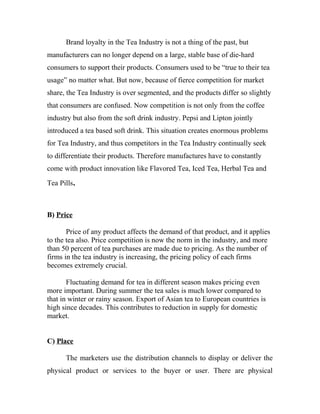
DISTRIBUTION CHANNEL 
D) Promotion 
Sellers 
Brokers 
Agents 
Whole-sellers 
Retailers 
Buyers 
Advertising and promotion are the most important tools used by Tea 
manufacturers to distinguish their products. 
The first Tea advertisement for Tea appeared in 
the London weekly mercurius politicus of the 
September 1658. Since then advertising is one of the 
must. Price competitors in the industry rely upon
endorsements by famous people and reminder advertising to create and 
reinforce the image they want their products to have. Emotional appeals and 
identification tactics are used to increase brand loyalty. 
The promotion of Tea in India is based on two themes 
- Tea is good for health 
- Tea is beverage for the youth. 
The Tea Board of India has been guide to realize this and has launched a 
campaign “PIYO MORE CHAI” in association with the industry to 
encourage the domestic consumption by focusing on its “Miraculous” 
properties. It will also highlight that drinking tea keeps one healthy and 
lowers the risk of heart diseases, cancer. 
But since advertising costs are so high, they are monitored closely, 
and promotions are encouraged and subsidized by the manufacturer.
Five Forces Model 
The five forces model of competition given by Professor Michael 
Porter helps to discover what the main sources of competitive pressure are 
and how strong each competitive force is. 
1) Threat from existing competitors 
The rivalry among the competing sellers for this industry in 
Ahmedabad is high. There are so many companies in this industry 
including major ones like Waghbakri and Tata tea. There are many 
local companies that sell unbranded tea. 
The major threat to a new firm is the threat from the existing 
competitors. Waghbakri holds 70% of the market share and Tata tea is 
the largest tea producing company in India. Other local low prices, 
unbranded tea also exists which may affect Sabar tea. 
2) Threat from new entrants
Threat of new entrant applies only to the existing firms. Since 
Sabar Tea is thinking to establish it in Ahmedabad, it is a new entrant. 
Thus, for Sabar Tea there is no threat of new entrant. Infact Sabar Tea 
is a threat to the existing players. 
However, if there is much delay by Sabar Tea. Then each 
company which enters the market before Sabar Tea is a threat because 
it will increase the competition for Sabar Tea. 
3)Threat from substitute products 
The main substitute product for tea is coffee. However, cold 
beverages, fruit juices and milk are also substitutes of tea. Here the 
threat from such substitute products is very high for tea industry. 
Coffee is the main substitute for tea, it serves the same purpose 
as tea. However the price and choice of the consumer are the main 
reasons for the purchase of tea or coffee. 
The prices of cold beverages have fallen down and are available 
at most of the stores. The promotional strategies and their impact are 
also quite stronger in compare of tea. 
4) Bargaining power of consumer and supplier 
Profits depend on bargaining power of suppliers and consumers. In 
Ahmedabad the consumption of tea is very high and thus there is very 
high demand among consumers, thus the bargaining power of 
consumer is less.
Tea is produced in selected eastern states and few parts of 
Karnataka. Despite of the fact that India is the second largest tea 
producer after China, the bargaining power of suppliers of tea leaves 
is more than that of the consumers. One reason for that is increasing 
exports to European markets. Second is that production is limited. 
Limitations of the survey 
· Out of the whole research and analysis, only few major tea brands 
could be highlighted, leaving aside a medium and small scale Tea 
brands. 
· Data is mostly primary data so some time-collected data may be 
limited. 
· As only few hundreds of people data is to be taken the final analysis 
can or cannot give satisfactory results. 
· The limitation in this report could be of language, because all people 
are not fluent in English, so the questionnaire in English was to be 
explained in Gujarati to get proper response and it can happen that the 
meaning of the question may change to the responded persons so 
accurate data results can’t be determined.
Introduction 
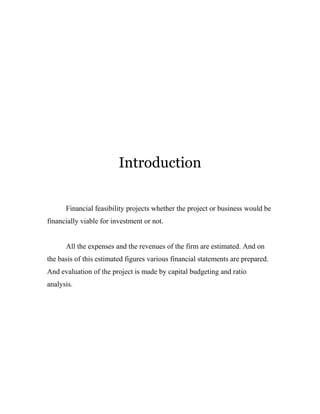
Financial feasibility projects whether the project or business would be 
financially viable for investment or not. 
All the expenses and the revenues of the firm are estimated. And on 
the basis of this estimated figures various financial statements are prepared. 
And evaluation of the project is made by capital budgeting and ratio 
analysis.
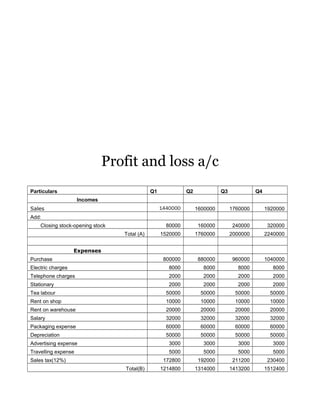
Profit and loss a/c 
Particulars Q1 Q2 Q3 Q4 
Incomes 
Sales 1440000 1600000 1760000 1920000 
Add: 
Closing stock-opening stock 80000 160000 240000 320000 
Total (A) 1520000 1760000 2000000 2240000 
Expenses 
Purchase 800000 880000 960000 1040000 
Electric charges 8000 8000 8000 8000 
Telephone charges 2000 2000 2000 2000 
Stationary 2000 2000 2000 2000 
Tea labour 50000 50000 50000 50000 
Rent on shop 10000 10000 10000 10000 
Rent on warehouse 20000 20000 20000 20000 
Salary 32000 32000 32000 32000 
Packaging expense 60000 60000 60000 60000 
Depreciation 50000 50000 50000 50000 
Advertising expense 3000 3000 3000 3000 
Travelling expense 5000 5000 5000 5000 
Sales tax(12%) 172800 192000 211200 230400 
Total(B) 1214800 1314000 1413200 1512400
Profit (A - B) 305200 446000 586800 727600 
Less: Tax @ 35% + Surcharge 2.5% + 120554 176170 231786 287402 
NPAT 184646 269830 355014 440198 
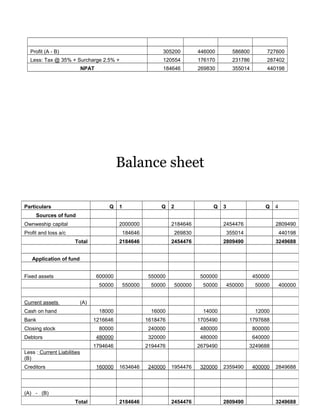
Balance sheet 
Particulars Q 1 Q 2 Q 3 Q 4 
Sources of fund 
Ownweship capital 2000000 2184646 2454476 2809490 
Profit and loss a/c 184646 269830 355014 440198 
Total 2184646 2454476 2809490 3249688 
Application of fund 
Fixed assets 600000 550000 500000 450000 
50000 550000 50000 500000 50000 450000 50000 400000 
Current assets (A) 
Cash on hand 18000 16000 14000 12000 
Bank 1216646 1618476 1705490 1797688 
Closing stock 80000 240000 480000 800000 
Debtors 480000 320000 480000 640000 
1794646 2194476 2679490 3249688 
Less : Current Liabilities 
(B) 
Creditors 160000 1634646 240000 1954476 320000 2359490 400000 2849688 
(A) - (B) 
Total 2184646 2454476 2809490 3249688
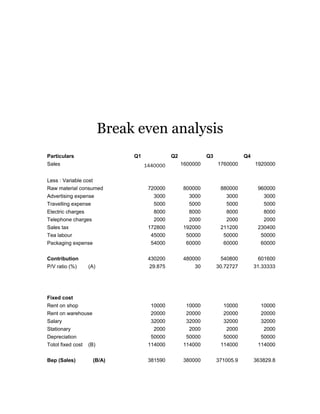
Break even analysis 
Particulars Q1 Q2 Q3 Q4 
Sales 1440000 1600000 1760000 1920000 
Less : Variable cost 
Raw material consumed 720000 800000 880000 960000 
Advertising expense 3000 3000 3000 3000 
Travelling expense 5000 5000 5000 5000 
Electric charges 8000 8000 8000 8000 
Telephone charges 2000 2000 2000 2000 
Sales tax 172800 192000 211200 230400 
Tea labour 45000 50000 50000 50000 
Packaging expense 54000 60000 60000 60000 
Contribution 430200 480000 540800 601600 
P/V ratio (%) (A) 29.875 30 30.72727 31.33333 
Fixed cost 
Rent on shop 10000 10000 10000 10000 
Rent on warehouse 20000 20000 20000 20000 
Salary 32000 32000 32000 32000 
Stationary 2000 2000 2000 2000 
Depreciation 50000 50000 50000 50000 
Totot fixed cost (B) 114000 114000 114000 114000 
Bep (Sales) (B/A) 381590 380000 371005.9 363829.8
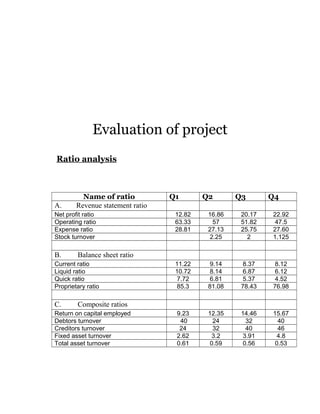
Evaluation of project 
Ratio analysis 
Name of ratio Q1 Q2 Q3 Q4 
A. Revenue statement ratio 
Net profit ratio 12.82 16.86 20.17 22.92 
Operating ratio 63.33 57 51.82 47.5 
Expense ratio 28.81 27.13 25.75 27.60 
Stock turnover 2.25 2 1.125 
B. Balance sheet ratio 
Current ratio 11.22 9.14 8.37 8.12 
Liquid ratio 10.72 8.14 6.87 6.12 
Quick ratio 7.72 6.81 5.37 4.52 
Proprietary ratio 85.3 81.08 78.43 76.98 
C. Composite ratios 
Return on capital employed 9.23 12.35 14.46 15.67 
Debtors turnover 40 24 32 40 
Creditors turnover 24 32 40 46 
Fixed asset turnover 2.62 3.2 3.91 4.8 
Total asset turnover 0.61 0.59 0.56 0.53
Suggestions 
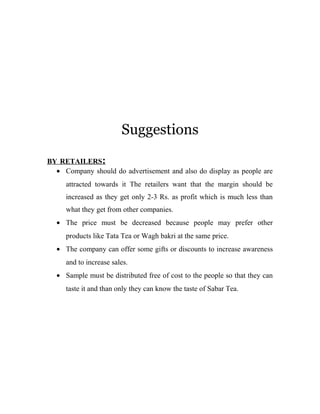
BY RETAILERS : 
· Company should do advertisement and also do display as people are 
attracted towards it The retailers want that the margin should be 
increased as they get only 2-3 Rs. as profit which is much less than 
what they get from other companies. 
· The price must be decreased because people may prefer other 
products like Tata Tea or Wagh bakri at the same price. 
· The company can offer some gifts or discounts to increase awareness 
and to increase sales. 
· Sample must be distributed free of cost to the people so that they can 
taste it and than only they can know the taste of Sabar Tea.
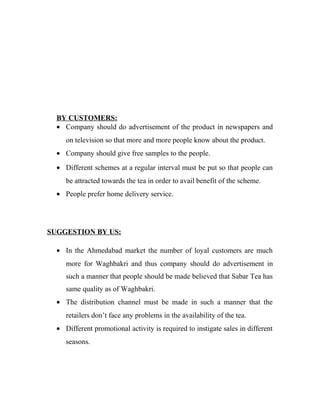
BY CUSTOMERS: 
· Company should do advertisement of the product in newspapers and 
on television so that more and more people know about the product. 
· Company should give free samples to the people. 
· Different schemes at a regular interval must be put so that people can 
be attracted towards the tea in order to avail benefit of the scheme. 
· People prefer home delivery service. 
SUGGESTION BY US: 
· In the Ahmedabad market the number of loyal customers are much 
more for Waghbakri and thus company should do advertisement in 
such a manner that people should be made believed that Sabar Tea has 
same quality as of Waghbakri. 
· The distribution channel must be made in such a manner that the 
retailers don’t face any problems in the availability of the tea. 
· Different promotional activity is required to instigate sales in different 
seasons.
· Quality and price are the most preferred factor affecting sales in 
middle segment, thus if good quality tea is provided at reasonable 
price then Sabar Tea will surely get many customers. 
· The return on capital employed increases with increase in sales thus 
prime focus should be on how to increase sales.
Conclusion 
From the following report and the recommendations we can conclude that 
consumption of tea is very high in Ahmedabad, thus chances of a new firm’s success in tea business in 
Ahmedabad are very good. Thus Sabar Tea should enter the Ahmedabad market. But one of the facts is that as 
Sabar Tea has its establishment and business in Sabarkantha and thus no one is aware of the tea brand Sabar. 
This can be advantageous too. Sabar Tea can create the image as its want, it can create image of premium or 
middle segment. But sales are more in middle segment and competition is also high in middle segment. 
Most of the customers purchase tea from the retailers, thus initially Sabar 
Tea have to give them good margin. One more popular avenue of retailing is through super markets. Many people 
now prefer to purchase tea with rest of the good together. Thus sales through supermarkets should also be taken 
into consideration. 
Price and quality are the two factors that have a major impact on sales. Moreover if Sabar Tea is made 
available at the same price as Wagh bakri or Tata tea people may not prefer to choose Sabar tea. Thus Sabar tea 
need to be launched at a price lower than the competitors and the quality of the products also have to good. 
As the ratio analysis suggests Sabar tea will be successful but a good awareness campaign is required. 
Advertisement and sales promotion have to be aggressive. Different promotion activities during summer will be 
more beneficial. Because during summer sales are lower compared to winter and monsoon. 
Thus the final conclusion from us is that Sabar Tea has to advertise on a 
large basis to gain higher market share in the competitive Ahmedabad tea industry. 
Bibliography 
BOOKS 
· Philip Kotler, Marketing Management, 11th Edition 2003 
(Tata McGraw Hill) Pp 328-336.
MAGAZINES & JOURNALS 
· Times Food Processing Journal, June-July 2005, pp 47-48 
· Contemtory Tea Time, June-August 2005, Vol xiv No. 2, pp 6-52 
WEBSITE LINKS 
· www.teauction.com 
· www.thehindubusinessline.com 
· www.timesb2b.com 
· www.indiateaportal.com 
· www.tea.com 
· www.teaindustry.com 
· www.qualiteas.com 
· www.indianindustry.com/teacoffee
Sabar tea ; ankit & alpesh

Sabar tea ; ankit & alpesh

  • 1.
    A Report on Market &Financial Feasibility of SabarTea in Ahmedabad Submitted by:- Ankit Prajapati Alpesh Parmar Submitted to:- AES PGIBM
  • 2.
    Preface As astudent of MBA when I acquire all the theoretical knowledge, it is both necessary and advisable to acquaint the students with the real situation through, well-planned project in relevant fields. Using all the theoretical knowledge and applying into the real application the student learns to develop efficient real world application at the time of project training. So, the project training is very important for the student for self-development and self-confident. Also student learns organizational structure, rules and regulations and management in a real sense, which helps student to get discipline in life.
  • 3.
    Acknowledgement Study ofbusiness management is all about gaining knowledge from the experience one gets from the corporate world. When students get into the corporate world to gain the knowledge, he is novice. They need opportunities and of-course help of his /her senior to explore the aspects of business management. I was given this opportunity to work by the leading tea brand of Sabarkantha district. I am obliged to Sabar tea packers and process for providing me an opportunity to undergo training in this esteemed organization. I wish to express my heartfelt gratitude to Mr. Moin Sabugar, assistant sales manager of tea packers and process & Mr. Vishnu Solanki, accountant of tea packers and process for their immense help in making my training and project fruitful. I would like to thank Dr. A.H. Kalro for giving us the opportunity to acquaint ourselves with the nuances of the real corporate world & I am thankful to all faculty members of AES PGIBM for their kind support. Ankit Prajapati Alpesh Parmar
  • 4.
    Table of Content Sr. No. Particulars Page No. 1 Introduction a) About the company b) Introduction to tea c) What is tea? d) Characteristics of tea e) History of tea f) Types of tea g) Process e) Tea industry 2 Marketing Feasibility a) Introduction b) Market survey i. Consumer’s survey ii. Retailer’s survey c) Competitors analysis d) 4P’s of Indian tea industry e) Five forces model f) Limitations of the survey 3 Financial Feasibility a) Introduction b) Cost Sheet c) Trading and Profit & loss account d) Balance Sheet e) Break even point f) Evaluation of the project i. Ratio analysis 4 Suggestion Conclusion Bibliography
  • 6.
    About the company SABAR TEA PACKERS AND PROCESS Doulat vilas road, Pologround, Himmatnagar – 383 001, Sabarkantha Philosophy: · Build long lasting relationships through trust and fair play towards all stakeholders. · Be result oriented. Contribute positively. · Be progressive and lead from the front. Change with the times. · Be socially responsible. Return to the society a share of the gains from commercial enterprise History: Sabar tea packers and process started its business in tea industry in 1965 with a vision to be the leader in tea business in India by the sabar groups founder Mr. Nisarbhai Sabugar. From 1965 when Sabar group used to sell loose tea, now it sells 100 tons to tea each month. Growth over the years: · 1965 the year when Sabar tea packers and process was established, it initially used to sell loose tea. · 1970, introduced branded tea in name of ‘Chand sitara’. Daily sales was 21 kgs. · 1988, started using poly paper for packaging. Daily sales was 100 kgs. · 1998 took registered trademark of Sabar Tea · 1990, small packets of amount Rs. 2, Rs. 5 and Rs. 10 where introduced.
  • 7.
    · 1990, starteddoor to door marketing for rural sector. · 1995, introduced premium segment offering special patti, special dana and special bhuki. · 2003, started their business in Panchmahal and various other districts of north Gujarat. Management: The Sabar group is led by Mr. Nisarbhai Sabugar, a highly regarded tea expert and tea taster, with rich experience in the tea business. He plays an active role in the tea industry by being an involved member and leader of various tea associations. Mr. Rafik Sabugar, Managing Director, a commerce graduate and also a tea taster with three decades of experience behind him, look after the Company's Finance and Taxation matters. Mr. Moin Sabugar, Assistant sales manager, an Mba by qualification, is a widely travelled professional with rich and varied experience in the marketing and production of tea. He plays a key role in developing the Company's sales.
  • 8.
    Introduction of tea Tea is the most popular drink in the world, next to water. Every year, an astronomical 7, 68,500,000,000 cups of tea are consumed around the globe. Great Britain, famous for the custom of afternoon tea and for the introduction of that habit to the world, holds the world record as the largest importer of tea. It also boasts of the highest consumption of tea per capita in the world - every British man, woman and child drinks nearly 4 cups of tea every day! Tea, made from the tender leaves and buds of a once wild tree has had a strong influence for centuries on the economy of tea producing, trading and drinking countries. For a long time, the tea trade had a major impact on Britain’s economy. Tea is Sri Lanka’s largest foreign exchange earner. In India, tea holds second place as an export earner and the Indian tea trade employs more people than any other industry. What is tea?
  • 9.
    Tea is themost popular non-intoxicating beverage in the world that is enjoyed by the rich and the poor alike. Tea drinking was quite common in china as early as the 6th century B.C. over a period of time; the neighbouring countries in south East Asia such as Japan, Malaysia, and Thailand picked this habit. Western nations started importing tea from china only in the 17th century. The British developed India as a sourcing base in the 19th century to reduce their dependence on China. During the late 19th century and early 20th century, Tea cultivation become popular in other colonies like SriLanka, Tanzania, Malawi, Kenya, etc…In the last decade, world production growth decelerate from 3% per annum to 1.5% per annum. TEA CHARACTERISTICS Types and Quality Tea is distinguished as green or black based on its apparent colour. While Black Tea is manufactured by deliberate fermentation of leaf juice, Green Tea is manufactured by preventing fermentation. Black Tea has a
  • 10.
    stronger taste andliquor. Green Tea is light and is perceived to have pharmaceutical properties. Black Tea can be of two varieties: leaf and dust. Leaf Tea can also be processes as orthodox or CTC (Crush, Tear, And Curl), CTC production entails fermentation. CTC gives higher cup page (almost twice) for the same quantity of Tea and has stronger liquor, while orthodox Tea is light and retain aroma. Tea quality is measured on the basis of liquor, aroma/flavour, and leaf appearance. Consumers perceive quality on the attributes of taste, pungency, strength, freshness, color, and packaging. Value Addition The most popular form of value addition is branded Tea. This involves not only the packing of Tea but also blending of other varieties to maintain consistent taste. To arrive at a blend, expert Tea tasters sample hundreds of liquor. Convenient drinks like instant Tea (soluble tea powder), Tea bags (bags dipped in hot water), ready-to-drink Tea (served in cans), and flavoured Tea (with vanilla or strawberry flavour) are becoming popular in developing countries like the US and Japan. Productivity And Quality The art of plucking, fine-turned over the last 200years, requires two fresh Tealeaves and bud to be plucked manually. The productivity can be measured as per unit of labour (man year) and per unit of land (hectare). Mechanized plucking enhances productivity, but with compromise on quality, as coarse leaves also gets plucked. For increased production, some producers allow plucking of coarse leaves with fresh ones. Ensuring premium quality requires compromise on productivity. The productivity also depends on the age of Tea bushes,
  • 11.
    genetic material, irrigation,fertilizer, cultivation, techniques, etc; Old bushes are re-implanted to improve productivity. Inconvenient but Healthy Drink Tea is very inconvenient drink to brew. The tendency to form a creamy layer of caffeine-tannin adds to the inconvenience. Tea, besides having properties of fatigue amelioration, is believed to have chemicals that help in maintaining cholesterol level and in preventing cancer. History of tea Tea is nearly 5,000 years old and was discovered, as legend has it, in 2737 B.C. by a Chinese Emperor when some Tealeaves accidentally blew into a pot of boiling water. In the 1600s, Tea became popular throughout Europe and the American colonies. Since Colonial days,
  • 12.
    Tea has playeda role in American culture and customs. Today American school children learn about the famous Boston Tea Party protesting the British Tea Tax -- one of the acts leading to the Revolutionary War. During this century, two major American contributions to the tea industry occurred. In 1904, iced tea was created at the World's Fair in St. Louis, and in 1908, Thomas Sullivan of New York developed the concept of tea in a bag. Tea breaks down into three basic types: Black, Green, and Oolong. STORY OF TEA began in ancient China over 5,000 years ago. According to legend, the Shen Nong, an early emperor was a skilled ruler, creative scientist, and patron of the arts. His far-sighted edicts required, among other things, that all drinking water be boiled as a hygienic precaution. One summer day while visiting a distant region of his realm, he and the court stopped to rest. In accordance with his ruling, the servants began to boil water for the court to drink. Dried leaves from the near by bush fell into the boiling water, and a brown liquid was infused into the water. As a scientist, the Emperor was interested in the new liquid, drank some, and found it very refreshing. Therefore, according to legend, tea was created. Tea Story in India The credit for creating India's vast tea empire goes to the British, who discovered Tea in India and cultivated and consumed it in enormous
  • 13.
    quantities between theearly 1800's and India's independence from Great Britain in 1947. The Scottish adventurer, Robert Bruce, discovered Tea plants growing in Assam in the 1820's. At this time, no one thought that Tea existed in India; however Major Bruce discovered the plants growing wild in the jungles controlled by the tribal chiefs. The British East India Company's other sources to supply the English consumers of Tea. In 1834, a Tea committee was appointed to investigate the possibility of cultivating Tea in India. After a thorough investigation and study of the crop, the first commercial batch of Tea ever produced outside of China came from Assam in 1839. The first contract for London brokers issued Indian Teas between 500 and 1,000 chests at that time. TYPES OF TEA The classic definition of Tea is the brew made from the infusion of water and the leaves of and evergreen plant of the Camellia family. In the Tea Industry, Tea is defined as the dried processed leaves of Camellia Sinensis or the Sinensis. Commercially, there are the 3 major varieties of Camellia Sinensis. The China type, the India (Assam Region) type and the hybrid type (a cross breed of the China and India types. Tea breaks into 5 basic types. · Green Tea · White Tea · Oolong Tea
  • 14.
    · Black Tea · Scented Tea Green Tea Green Tea is nothing more than the leaves of the Camellia Sinensis that have been processed a certain way. Green Teas, like white Teas, are closer to taste like fresh leaves or grass than the Black or Oolong. They are also lower in caffeine and have higher antioxidant properties. White Tea White Tea is similar to Green Tea, in that it’s undergone very little processing and no fermentation. But there is a noticeable difference in taste. Oolong Tea The best way to describe Oolong Tea is that they are somewhere in between Green and Black Tea. This is because of they are only partially oxidized during the processing. Black Tea They are highest in the Caffeine. Black Tea is the most popular Tea in the world. It is the Tea most widely used in making Iced Tea and English Tea. Scented Tea
  • 15.
    Scented or FlowerTea is either Green or White Tea that has been infused by certain flower. Process Darjeeling Teas are still manufactured using old industrial techniques developed in the late 1800's. These traditional methods are collectively termed as 'Orthodox Production'. By these methods Darjeeling Teas are produced without 'cut & crush' of tender Tealeaves maintaining the inherent Darjeeling Tea aroma. Although differing leaf varieties require intricate variations in processing, the stages undergone are uniform. With the advancement in technology the Orthodox procedures are gradually being replaced by highly mechanized methods with their primary focus on yields. But in Darjeeling hills 'Quality' is the primary focus and it is never compromised with the quantity. Darjeeling Tea planter is still producing the finest Teas of the world using these Orthodox methods with utmost attention
  • 16.
    on the process.Of late, few gardens are changed to Green Tea manufacture especially during the rainy season thus producing the finest quality of flavoured Green Teas. WITHERING It is the first stage of Tea manufacture. During withering harvested Tea flush is evenly spread on the withering troughs, which are normally 4 to 5 feet wide and 50 to 70 ft long. During the process hot and cold air is blown through to remove the moisture of fresh leaf to 30-40 percent, which is achieved during 16 to 18 hours of period. The prime object of withering is to make the turgid leaf flaccid and prepare the leaf for next stage to facilitate rolling. ROLLING The withered leaf is charged in the rollers, which vary in size. Normally they are 36" and 48" rollers capable of rolling 70 to 120 kg of withered leaf. The pressure is exerted on the leaf in 'open and pressure' sequence. This operation lasts for 45 minutes. During this process Tea leaf is twisted as a result of repeated rolling action and simultaneously leaf tissue ruptures thus forcing out the cell-sap which spreads as a thin film on the surface of the leaf. Various enzymes and their substrates come in contact and enzymatic oxidation starts at this stage. The Green colour of leaf starts diminishing and brown coppery colour of leaf begins to appear.
  • 17.
    FERMENTATION Rolled leafis put on fermentation racks specially made of tiles, cement or aluminum. Fermentation rooms are kept clean and cold. In Darjeeling fermentation is carried out at low temperature. In hot season the air is kept humid with the help of humidifiers with less than 200c hygrometric difference Optimum fermentation is adjudged by the subjective assessment of the Tea maker. Fermentation period varies from 2 to 3 hrs depending on the type of leaf, degree of wither, temperature, availability of oxygen and fermenting ability of the Tea flush. The time of fermentation is reckoned from the time at which rolling begins. Fermentation is a very sensitive process. Even 5 minutes time delay in adjusting the correct fermentation period is likely to deteriorate flavour appreciably. During fermentation the leaf changes colour and becomes dark coppery. A typical aroma develops at this stage. The term 'Fermentation' is a misnomer and, in fact, it is an oxidative process. Oxidation of catechin / Polyphenols by the enzyme Polyphenolic oxidize is the main reaction of the process that imparts 'Tea character' to the Black Tea FIRING / DRYING: Fermented leaf is loaded onto the dryer, which comprises perforated moving trays. The dryer inlet temperature is maintained at 200 to 2400F. Thickness of spread, speed of trays and volume of air blown through are regulated meticulously so as to achieve the correct drying. Low exhaust temperature often produces stewed Teas while high temperature in the initial stages is apt to casehardening of Teas. The whole process of drying is completed within 20 to 30 minutes. The moisture content of the final product in Darjeeling Teas is kept at 2 to 3 percent. Darjeeling Teas are normally fired at high temperature, which is considered essential for squeezing the correct balance of volatile flavoured compounds in high quality Teas. During the drying process enzymes responsible for fermentation are inactivated and even after the Tea is dry the maturation
  • 18.
    process continues andTea attains the mellowness a desirable character of Darjeeling Teas. SORTING & GRADING: The bulk Tea is sorted on mechanically oscillated sieves. The sieve size decreases gradually from top to bottom. Thus the bigger size Teas are retained on the top while the broken leaves fall towards the floor. TEA INDUSTRY India is the country with the most tea consumption in the world - an average of 6,75,000 metric tons per year. China is second, and consumes about 463,000 metric tons per year. India's total tea production is about 840 million kg (mkg); about 15 mkg is imported. About 180 mkg is exported. About 680 mkg is consumed in India. Of this, we feel 300 mkg is sold as packet tea and the rest as loose tea.
  • 19.
    According to thereport, the tea industry in the country accounts for 31 per cent of global tea production. It is the second largest employer in the country, giving employment to more than 1.2 million workers on a permanent basis, in addition to one million labourers on a casual basis. An estimated 10 million people in the country depend on the tea industry for their livelihood and 51 per cent of the workforce comprises women. The majority of women are employed to pluck tea - the most labour-intensive part of tea production
  • 20.
    Introduction Market feasibilityprojects the practical viability of a venture with respect to different factors affecting the market. Market feasibility includes determining the proper market for the product and the different ways for the promotion of the product, it includes market research, market segmentation, customer relation, and all the other factors related with the market. It also includes deciding on the mediums for promoting the product in the market.
  • 21.
    Market survey Weused the questionnaire method for collecting the data from consumers and retailers. The questionnaire for consumer and that of the retailer are as follows: QUESTIONNAIRE FOR CONSUMERS 1. Personal Detail: a. Name: _____________________________________________ b. Age: ______ c. Monthly income: _______ d. Family members: _____
  • 22.
    2. How oftendo you drink in a day? a. One time [ ] b. Two time [ ] c. Three or more time [ ] 3. How much tea do you purchase in a month? a. 250gms [ ] b. 500gms [ ] c. 1kg or more [ ] 4. Do you purchase same quantity of tea in all seasons? Yes [ ] No [ ] If No, please specify the reason _____________________________________________________ _____________________________________________________ 5. Which type of taste do you prefer in tea? a. Strong [ ] b. Light [ ] 6. Why do you drink tea? a. Freshness [ ] b. Habit [ ] Other _____________________________ 7. From which place do you purchase tea? a. Retailer [ ] b. Supermarket[ ] c. Company’s outlet[ ] d. Other [ ] 8. Do you prefer branded tea? Yes [ ] No [ ] If No, please specify the reason _____________________________________________________ _____________________________________________________ NOTE: Proceed further only if answer of Q.8 is Yes 9. Which tea brand are you using currently? a. Waghbakri [ ] b. Tata Tea [ ] c. Brooke Bond [ ] d. Other brands [ ]
  • 23.
    10.Since how manyyears are you using this brand of tea? ______________________ 11.Which factor inspires you to purchase this brand? Please rank in your order of preference a. Price [ ] b. Quality [ ] c. Free gift [ ] d. Packaging [ ] e. Advertisement [ ] f. Reference groups [ ] 12.Do you know about Sabar Tea? a. Yes [ ] No [ ] 13.Would you desire to purchase Sabar Tea if you are provided more information about this product? a. Yes [ ] b. No [ ] 14.Do you inspire to purchase the brand in which brand ambassador is your favorite actor or actress? a. Yes [ ] b. No [ ] 15.According to you what is the most important feature of tea? Please rank in your order of preference a. Color [ ] b. Taste [ ] 16.Do you think those brands are very good which brand’s advertisements come in television? Yes [ ] No [ ] QUESTIONNAIRE FOR RETAILERS 1. Personal Detail: a. Name of the shop: _________________________________ b. Location: ________________
  • 24.
    2. Which isthe segment that you prefer to sell the most? a. Royal segment [ ] b. Premium segment [ ] c. Middle segment [ ] d. Economy segment [ ] 3. Which brand sells the most in the most preferred segment? ________________________________________________________ 4. Which size packet sells the most? a. 100g. [ ] b. 250g. [ ] c. 500g. [ ] d. 1kg. [ ] 5. According to you who can be the competitors of Sabar Tea in the most preferred segment? _________________________________________________________________ _ 6. What is the response of customers when advertisement of new tea product comes in any media? a. Demand for product [ ] b. Ask for suggestion [ ] c. Try to get more information [ ] d. Not ask anything [ ] 7. Do you think advertisement is important to sell any product more? If No, then why? a. Yes [ ] b. No [ ] IF No, then please specify the reason ________________________________________
  • 25.
    8. What iscustomers’ response when you put some new product near cash counter or entrance? a. Demand for product [ ] b. Ask for suggestion [ ] c. Try to get more information [ ] d. Not ask anything [ ] 9. Do you think attractive packaging attracts the customer more? a. Yes [ ] b. No [ ] 10.Do you think sometimes packaging attracts the customer but people not buy the product because of price? a. Yes [ ] b. No [ ]
  • 26.
    11.If company offersyou attractive commission or discount will you willing to sell Sabar Tea? a. Yes [ ] b. No [ ] 12.Would you like to give any suggestion for promotion activities of Sabar Tea? _________________________________________________________________ _ _________________________________________________________________ ____________________________________________
  • 27.
    Research Findings Customer 1. How often do you consume tea per month? 60% 5% 35% One time Two time Three or more times One time 60% Two time 35% Three or more time 5% 2. How much tea do you purchase in a month? 25% 35% 40% 1 Kg. 500 gm 250 gm 1 Kg 500 gm 250 gm
  • 28.
    3. Which typeof taste do you prefer in tea? , 30% 70% 70% 60% 50% 40% 30% 20% 10% 0% Strong Light 4. Why do you drink tea? 60% 40% 0% Freshness Habit Other 5. From where do you buy tea? Strong 70% Light 30% Freshness 60% Habit 40% Other 0%
  • 29.
    60% 15% 0% 25% Retailer Supermarket Company's outlet 6. Which tea brand you are using currently? 70% 10% 10% 10% Waghbakri Brooke bond Tata tea Other Local brand 7. Which factor inspires you to purchase a brand? The factors are ranked in order of preference 1. Quality 2. Price 3. Free gifts 4. Advertisement 5. Packing 6. Reference groups Retailer 60% Supermarket 25% Company’s outlets 15% Waghbakri 70% Brooke Bond 10% Tata Tea 10% Other Local 10% brands
  • 30.
    Retailer 1. Whichis the segment that you prefer to sell the most? 70 60 50 40 30 20 10 0 Royal Premium Middle Economy 2. Which brand sells the most in the most preferred segment?
  • 31.
    68% 12% 10% 10% Waghbakri Brooke bond Tata tea Other Local brand 3. Which size packet sells the most? 100.00% 80.00% 60.00% 40.00% 20.00% 0.00% % 100gm 250gm 500gm 1kg packet size 4. Do you think advertisement is important to sell any product more?
  • 32.
    70% 30% 70% 60% 50% 40% 30% 20% 10% 0% Yes No Advt. 5. What is the response of customers when advertisement of new tea product comes in any media? 15% 30% Demand for product 40% 15% Not ask anything Try to get more information Ask your suggestion 6. What is customers’ response when you put some new product near cash counter or entrance?
  • 33.
    27% 30% Demandfor product 18% 25% Not ask anything Try to get more information Ask your suggestion 7. Do you think attractive packaging attracts the customer more? 60% 40% 60% 50% 40% 30% 20% 10% 0% Yes No Advt.
  • 34.
    8. If companyoffers you attractive commission or discount will you willing to sell Sabar Tea? 100.00% 80.00% 60.00% 40.00% 20.00% 0.00% Yes No Competitors’ analysis 68% 12% 10% 10% Waghbakri Brooke bond Tata tea Other Local brand The graph above shows the preference of various brands by the retailers. The consumer preference is also quite similar to the retailers’ preference. About 68% of the retailers prefer to sell waghbakri, 10% of them
  • 35.
    prefer brooke bond,10% of them prefer Tata tea, and the rest prefer other local brands. From the graph above it can be said that brooke bond, Tata tea & the local brands are the competitors of Sabar Tea. The reason for that is Sabar Tea is going to start its business in Ahmedabad and it can straight away compete with the market leader. Waghbakri is the market leader in Ahmedabad. Thus the competition of Sabar Tea now is with less popular brands. Waghbakri has a lot of loyal customers, thus it would take time to win the Waghbakri customers. Sabar Tea will have intense competition from brooke bond, Tata tea & the local brands because if we remove the 68% waghbakri share, the there is only 32% left and there are many firms who fall in this sector.
  • 36.
    Four P’s ofIndian Tea Industry Marketing mix is the set of marketing tools that the firm uses to pursue its marketing objectives in the target market. The four basic elements of marketing together make up a marketing mix, these four elements are the 4 P’s. These four P’s of marketing are product, price, place, and promotion. Marketing is likely to be a success if this four P’s are mixed properly. MARKETING MIX ELEMENTS IN TEA INDUSTRY A) Product
  • 37.
    Brand loyalty inthe Tea Industry is not a thing of the past, but manufacturers can no longer depend on a large, stable base of die-hard consumers to support their products. Consumers used to be “true to their tea usage” no matter what. But now, because of fierce competition for market share, the Tea Industry is over segmented, and the products differ so slightly that consumers are confused. Now competition is not only from the coffee industry but also from the soft drink industry. Pepsi and Lipton jointly introduced a tea based soft drink. This situation creates enormous problems for Tea Industry, and thus competitors in the Tea Industry continually seek to differentiate their products. Therefore manufactures have to constantly come with product innovation like Flavored Tea, Iced Tea, Herbal Tea and Tea Pills. B) Price Price of any product affects the demand of that product, and it applies to the tea also. Price competition is now the norm in the industry, and more than 50 percent of tea purchases are made due to pricing. As the number of firms in the tea industry is increasing, the pricing policy of each firms becomes extremely crucial. Fluctuating demand for tea in different season makes pricing even more important. During summer the tea sales is much lower compared to that in winter or rainy season. Export of Asian tea to European countries is high since decades. This contributes to reduction in supply for domestic market. C) Place The marketers use the distribution channels to display or deliver the physical product or services to the buyer or user. There are physical
  • 38.
    distribution channel andservice distribution channel they include warehouses, transportation vehicles, and various trade channels such as distributors wholesalers and retailers. So, the following is the distribution channel of the Tea Industry in private selling. DISTRIBUTION CHANNEL D) Promotion Sellers Brokers Agents Whole-sellers Retailers Buyers Advertising and promotion are the most important tools used by Tea manufacturers to distinguish their products. The first Tea advertisement for Tea appeared in the London weekly mercurius politicus of the September 1658. Since then advertising is one of the must. Price competitors in the industry rely upon
  • 39.
    endorsements by famouspeople and reminder advertising to create and reinforce the image they want their products to have. Emotional appeals and identification tactics are used to increase brand loyalty. The promotion of Tea in India is based on two themes - Tea is good for health - Tea is beverage for the youth. The Tea Board of India has been guide to realize this and has launched a campaign “PIYO MORE CHAI” in association with the industry to encourage the domestic consumption by focusing on its “Miraculous” properties. It will also highlight that drinking tea keeps one healthy and lowers the risk of heart diseases, cancer. But since advertising costs are so high, they are monitored closely, and promotions are encouraged and subsidized by the manufacturer.
  • 40.
    Five Forces Model The five forces model of competition given by Professor Michael Porter helps to discover what the main sources of competitive pressure are and how strong each competitive force is. 1) Threat from existing competitors The rivalry among the competing sellers for this industry in Ahmedabad is high. There are so many companies in this industry including major ones like Waghbakri and Tata tea. There are many local companies that sell unbranded tea. The major threat to a new firm is the threat from the existing competitors. Waghbakri holds 70% of the market share and Tata tea is the largest tea producing company in India. Other local low prices, unbranded tea also exists which may affect Sabar tea. 2) Threat from new entrants
  • 41.
    Threat of newentrant applies only to the existing firms. Since Sabar Tea is thinking to establish it in Ahmedabad, it is a new entrant. Thus, for Sabar Tea there is no threat of new entrant. Infact Sabar Tea is a threat to the existing players. However, if there is much delay by Sabar Tea. Then each company which enters the market before Sabar Tea is a threat because it will increase the competition for Sabar Tea. 3)Threat from substitute products The main substitute product for tea is coffee. However, cold beverages, fruit juices and milk are also substitutes of tea. Here the threat from such substitute products is very high for tea industry. Coffee is the main substitute for tea, it serves the same purpose as tea. However the price and choice of the consumer are the main reasons for the purchase of tea or coffee. The prices of cold beverages have fallen down and are available at most of the stores. The promotional strategies and their impact are also quite stronger in compare of tea. 4) Bargaining power of consumer and supplier Profits depend on bargaining power of suppliers and consumers. In Ahmedabad the consumption of tea is very high and thus there is very high demand among consumers, thus the bargaining power of consumer is less.
  • 42.
    Tea is producedin selected eastern states and few parts of Karnataka. Despite of the fact that India is the second largest tea producer after China, the bargaining power of suppliers of tea leaves is more than that of the consumers. One reason for that is increasing exports to European markets. Second is that production is limited. Limitations of the survey · Out of the whole research and analysis, only few major tea brands could be highlighted, leaving aside a medium and small scale Tea brands. · Data is mostly primary data so some time-collected data may be limited. · As only few hundreds of people data is to be taken the final analysis can or cannot give satisfactory results. · The limitation in this report could be of language, because all people are not fluent in English, so the questionnaire in English was to be explained in Gujarati to get proper response and it can happen that the meaning of the question may change to the responded persons so accurate data results can’t be determined.
  • 44.
    Introduction Financial feasibilityprojects whether the project or business would be financially viable for investment or not. All the expenses and the revenues of the firm are estimated. And on the basis of this estimated figures various financial statements are prepared. And evaluation of the project is made by capital budgeting and ratio analysis.
  • 45.
    Profit and lossa/c Particulars Q1 Q2 Q3 Q4 Incomes Sales 1440000 1600000 1760000 1920000 Add: Closing stock-opening stock 80000 160000 240000 320000 Total (A) 1520000 1760000 2000000 2240000 Expenses Purchase 800000 880000 960000 1040000 Electric charges 8000 8000 8000 8000 Telephone charges 2000 2000 2000 2000 Stationary 2000 2000 2000 2000 Tea labour 50000 50000 50000 50000 Rent on shop 10000 10000 10000 10000 Rent on warehouse 20000 20000 20000 20000 Salary 32000 32000 32000 32000 Packaging expense 60000 60000 60000 60000 Depreciation 50000 50000 50000 50000 Advertising expense 3000 3000 3000 3000 Travelling expense 5000 5000 5000 5000 Sales tax(12%) 172800 192000 211200 230400 Total(B) 1214800 1314000 1413200 1512400
  • 46.
    Profit (A -B) 305200 446000 586800 727600 Less: Tax @ 35% + Surcharge 2.5% + 120554 176170 231786 287402 NPAT 184646 269830 355014 440198 Balance sheet Particulars Q 1 Q 2 Q 3 Q 4 Sources of fund Ownweship capital 2000000 2184646 2454476 2809490 Profit and loss a/c 184646 269830 355014 440198 Total 2184646 2454476 2809490 3249688 Application of fund Fixed assets 600000 550000 500000 450000 50000 550000 50000 500000 50000 450000 50000 400000 Current assets (A) Cash on hand 18000 16000 14000 12000 Bank 1216646 1618476 1705490 1797688 Closing stock 80000 240000 480000 800000 Debtors 480000 320000 480000 640000 1794646 2194476 2679490 3249688 Less : Current Liabilities (B) Creditors 160000 1634646 240000 1954476 320000 2359490 400000 2849688 (A) - (B) Total 2184646 2454476 2809490 3249688
  • 47.
    Break even analysis Particulars Q1 Q2 Q3 Q4 Sales 1440000 1600000 1760000 1920000 Less : Variable cost Raw material consumed 720000 800000 880000 960000 Advertising expense 3000 3000 3000 3000 Travelling expense 5000 5000 5000 5000 Electric charges 8000 8000 8000 8000 Telephone charges 2000 2000 2000 2000 Sales tax 172800 192000 211200 230400 Tea labour 45000 50000 50000 50000 Packaging expense 54000 60000 60000 60000 Contribution 430200 480000 540800 601600 P/V ratio (%) (A) 29.875 30 30.72727 31.33333 Fixed cost Rent on shop 10000 10000 10000 10000 Rent on warehouse 20000 20000 20000 20000 Salary 32000 32000 32000 32000 Stationary 2000 2000 2000 2000 Depreciation 50000 50000 50000 50000 Totot fixed cost (B) 114000 114000 114000 114000 Bep (Sales) (B/A) 381590 380000 371005.9 363829.8
  • 48.
    Evaluation of project Ratio analysis Name of ratio Q1 Q2 Q3 Q4 A. Revenue statement ratio Net profit ratio 12.82 16.86 20.17 22.92 Operating ratio 63.33 57 51.82 47.5 Expense ratio 28.81 27.13 25.75 27.60 Stock turnover 2.25 2 1.125 B. Balance sheet ratio Current ratio 11.22 9.14 8.37 8.12 Liquid ratio 10.72 8.14 6.87 6.12 Quick ratio 7.72 6.81 5.37 4.52 Proprietary ratio 85.3 81.08 78.43 76.98 C. Composite ratios Return on capital employed 9.23 12.35 14.46 15.67 Debtors turnover 40 24 32 40 Creditors turnover 24 32 40 46 Fixed asset turnover 2.62 3.2 3.91 4.8 Total asset turnover 0.61 0.59 0.56 0.53
  • 49.
    Suggestions BY RETAILERS: · Company should do advertisement and also do display as people are attracted towards it The retailers want that the margin should be increased as they get only 2-3 Rs. as profit which is much less than what they get from other companies. · The price must be decreased because people may prefer other products like Tata Tea or Wagh bakri at the same price. · The company can offer some gifts or discounts to increase awareness and to increase sales. · Sample must be distributed free of cost to the people so that they can taste it and than only they can know the taste of Sabar Tea.
  • 50.
    BY CUSTOMERS: ·Company should do advertisement of the product in newspapers and on television so that more and more people know about the product. · Company should give free samples to the people. · Different schemes at a regular interval must be put so that people can be attracted towards the tea in order to avail benefit of the scheme. · People prefer home delivery service. SUGGESTION BY US: · In the Ahmedabad market the number of loyal customers are much more for Waghbakri and thus company should do advertisement in such a manner that people should be made believed that Sabar Tea has same quality as of Waghbakri. · The distribution channel must be made in such a manner that the retailers don’t face any problems in the availability of the tea. · Different promotional activity is required to instigate sales in different seasons.
  • 51.
    · Quality andprice are the most preferred factor affecting sales in middle segment, thus if good quality tea is provided at reasonable price then Sabar Tea will surely get many customers. · The return on capital employed increases with increase in sales thus prime focus should be on how to increase sales.
  • 52.
    Conclusion From thefollowing report and the recommendations we can conclude that consumption of tea is very high in Ahmedabad, thus chances of a new firm’s success in tea business in Ahmedabad are very good. Thus Sabar Tea should enter the Ahmedabad market. But one of the facts is that as Sabar Tea has its establishment and business in Sabarkantha and thus no one is aware of the tea brand Sabar. This can be advantageous too. Sabar Tea can create the image as its want, it can create image of premium or middle segment. But sales are more in middle segment and competition is also high in middle segment. Most of the customers purchase tea from the retailers, thus initially Sabar Tea have to give them good margin. One more popular avenue of retailing is through super markets. Many people now prefer to purchase tea with rest of the good together. Thus sales through supermarkets should also be taken into consideration. Price and quality are the two factors that have a major impact on sales. Moreover if Sabar Tea is made available at the same price as Wagh bakri or Tata tea people may not prefer to choose Sabar tea. Thus Sabar tea need to be launched at a price lower than the competitors and the quality of the products also have to good. As the ratio analysis suggests Sabar tea will be successful but a good awareness campaign is required. Advertisement and sales promotion have to be aggressive. Different promotion activities during summer will be more beneficial. Because during summer sales are lower compared to winter and monsoon. Thus the final conclusion from us is that Sabar Tea has to advertise on a large basis to gain higher market share in the competitive Ahmedabad tea industry. Bibliography BOOKS · Philip Kotler, Marketing Management, 11th Edition 2003 (Tata McGraw Hill) Pp 328-336.
  • 53.
    MAGAZINES & JOURNALS · Times Food Processing Journal, June-July 2005, pp 47-48 · Contemtory Tea Time, June-August 2005, Vol xiv No. 2, pp 6-52 WEBSITE LINKS · www.teauction.com · www.thehindubusinessline.com · www.timesb2b.com · www.indiateaportal.com · www.tea.com · www.teaindustry.com · www.qualiteas.com · www.indianindustry.com/teacoffee