Project Report on 
CREDIT MANAGEMENT & NPA OF 
RAJKOT DISTRICT 
CO-OPERATIVE BANK LTD. 
(RDC BANK) 
A PROJECT REPORT SUBBMITTED IN PARTIAL FULFILLMENT OF THE M.B.A. DEGREE 
PROJECT GUIDE 
Mr. PARSOTAMBHAI TALAVIYA, STATISTICS OFFICER, 
RDC BANK LTD. 
SUBMITTED BY 
DHAMSANIA VISHAL (ROLL NO. )
S.K.PATEL INSTITUTE OF MANAGEMENT AND COMPUTER STUDIES 
GANDHINAGAR, INDIA 
JULY 2005
PREFACE 
Banks are regarded as the blood of the nation’s economy without them one cannot 
imagine economy moving. Therefore banks should be operated very efficiently, co-operative 
banks although a small part of whole banking system in India, but they are very 
important not only from economical point of view but also from social point of view as it 
is more concerned about common people’s welfare and development. 
Advance is heart and recovery is oxygen for the bank and for the bank to survive it is 
necessary to give advances and recover the amount at the appropriate time. Through 
credit management I have tried to cover the various aspects like credit appraisal, NPA 
management, recovery management, etc. E.g. credit management covers all the areas 
right form the beginning like inquiry till the loan has been paid up. 
Though credit management, a very vast topic, I have tried to incorporate to the best of my 
capacity from all possible aspects in this project. 
I do hope that institution will appreciate this project.
ACHNOWLEDGEMENT 
“We can not determine milk of how many cows feed our body.” – Anon 
I believe an ocean is filled by drops and each and every drop should count, similarly I 
should count favor of all my helpers here but this not possible. So forgive me for the 
same. 
First of all I would like to thank Board of Directors. 
I am thankful to manager G.C.Raol to give me permission for the summer training. 
I want to express my sincere obligation to Kotak Sir, Kumarilbhai, Shileshbhai 
Nathwani, Hiteshbhai Rachchh, and all the staff members of RDC BANK BANK, 
where I worked so long in a homely pleasant atmosphere. 
Especially, I would like to thank Salimbhai Bloch and Rajnibhai Raichura, my mentor 
who guided me in my work. 
I am thankful to Mr. Khandelwal (principal of our college) and Mr. viral sir for their 
guidance and Mr. Niraj Amarnani for the arrangement of summer placement. 
Last but not least my family, which is always behind me in my work for support any time.
OBJECTIVE OF STUDY 
Banking is the activity of my interest. I have seen from the annual reports of the various 
banks and find that most of their income is from the interest getting on the credit given so 
I choose and hence I studied on credit management. 
Game of statistics is always attracts me and banking is one the place where we can learn 
it very well. So I have selected bank and have preferred “credit management” as topic for 
my project.
RESEARCH METHODOLOGY 
There are many methods, which are well known today for research methodology, out of 
which one I have chosen is “sampling method”, which is really easier, still producing 
accurate results. 
Sampling in laymen’s language, is nothing but selecting pockets or samples representing 
the whole group and analysis of these samples gives the idea about the respective groups. 
On the basis of this, prediction is done and full information about group is integrated. 
Though this is not a first hand method, it gives sufficiently good outcomes if used 
carefully by experts. It saves the time and energy. The only care should be taken, in order 
to have great accuracy, is selection of sample should be such that it should represent the 
whole group and information we get from them should be cent percent reliable. 
Salient features of my chosen sample 
 The biggest co-operative bank having head office in my vicinity enables me to do 
my work efficiently. This is the striking feature of my sample. 
 The exclusive schedule bank in Rajkot and hence gets priority over the others. 
 Generally the new bank lacks the experience so it is mandatory to select a sample, 
which has enormous experience. RDC BANK has a gigantic experience of 
successful 50 years, under the lights of which work becomes easier. 
 The other enchanting point is that RDC Bank have maximum number of 
shareholder i.e. above 2 lacs.
CONTENT 
Preface 
Acknowledgement 
Objective of study 
Research methodology 
Content 
INTRODUCTION 
Early history of banking 
Origin of word ‘bank’ 
Status wise bifurcation of bank 
Types of bank 
RDC BANK - The Small Man’s Big Bank 
PROJECT 
Main Fund Inflow (sources of funds) 
Main fund outflow (funds used) 
Meaning of credit and credit management 
Forms of credit/advances 
Time wise bifurcation of advances 
Security wise bifurcation of advances 
Process of credit 
CREDIT POLICY 
General eligibility criteria for credit in RDC BANK 
Table of interest rate on various advances 
Scrutiny of credit 
Types of credit 
Explanation of all types of credit 
Data analysis and observation and suggestion 
CREDIT APPRAISAL 
Appraisal format
Observation and suggestion 
CREDIT MONITORING, FOLLOW UP AND REVIEW 
Credit monitoring system in RDC BANK 
Follow up actions for credit monitoring in RDC BANK 
Observation and suggestion 
NPA MANAGEMENT 
Identification of Non Performing Advances 
Asset classification 
Classification of Non Performing Advances 
Provision for NPA 
Findings (reason for NPA) 
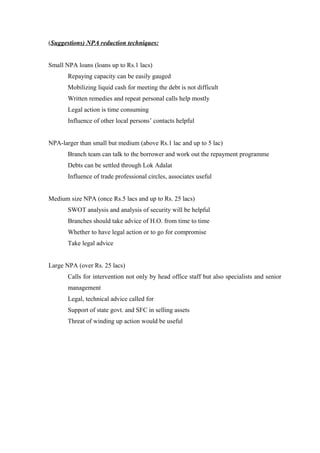
Suggestions (NPA reduction techniques) 
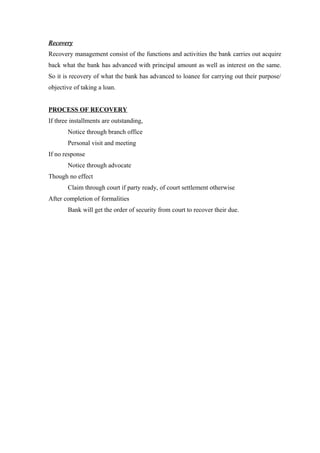
RECOVERY 
Process of recovery 
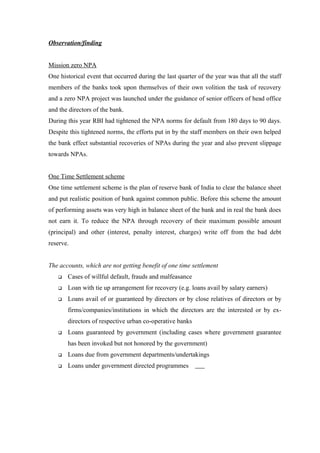
Finding/observation 
LIMITATION OF STUDY 
BIBLIOGRAPHY
IINNTTRROODDUUCCTTIIOONN
EARLY HISTORY OF BANKING 
As early as 2000 B.C., the Babylonians has developed a banking system. There is 
evidence to show the temples of Babylon were used as banks. After a period of time, 
there was a spread of irreligion, which soon destroyed the public sense of security in 
depositing money and valuable in temples. The priests were longer acting as financial 45 
agents. The Romans did minute regulations, as to conduct private banking and to create 
confidence in it. Loan banks were also common in Rome. From these the poor citizens 
received loans without paying interest, against security of land for 3 or 4 years. 
During the early periods, although private individuals mostly did the banking business, 
many countries established public banks either for the purpose of facilitating commerce 
or to serve the government. 
However, upon the revival of civilization, growing necessity forced the issued in the 
middle of the 12th century and banks were established at Venice and Genoa. The Bank of 
Venice established in 1157 is supposed to be the most ancient bank. Originally, it was not 
a bank in the modern sense, during simply an office for the transfer of the public debt. 
Again the origin of modern banking may be traced to the money dealers in Florence, who 
received money on deposit, and were lenders of money in the 14th century and also in 
1349, the business of banking was carried on by drapers of Barcelona. 
In India, as early as the Vedic Period, banking, in most crude from existed. The books of 
Manu contain references regarding deposits, pledges, policy of loans, and rate of interest. 
True, the banking in those days largely mint money lending and they did not know the 
complicated mechanism of modern banking. 
This is true not only in the case of India but also of other countries. Although, the 
business of banking is as old as authentic history, banking institutions have since than 
changed in character and content very much. They have developed from a few simple 
operation involving the satisfaction of a few individual wants to the complicated 
mechanism of modern banking, involving the satisfaction of capital slowly seeking 
employment and thus providing the very life blood of commerce.
THE ORIGIN OF WORD ‘BANK’ 
The word ‘Bank’ itself derived from the word ‘bancus’ or ‘banque’ that is a French. 
There were others of the opinion that the word ‘Bank’ is originally derived from the 
German word ‘back’ meaning joint for which was Italianised into ‘banco’.
STATUS WISE BIFURCATION OF BANKS 
Scheduled Banks. 
Non-Scheduled Banks. 
Scheduled Banks 
In first schedule, Government of India notifies the Primary Banks, which are licensed and 
whose demand and time liability are not less than 50 crores in 1987. 
Government of India notifies the Primary banks, which are licensed and whose demand 
and time liability are not less than 100 crores can only qualify to be included in the 
second schedule since 1993. 
A bank becomes scheduled when it fulfils the followings: 
‘A’ grade rating from RBI 
Demand and Time Liability over 100 Crores 
Satisfy the RBI guidelines related to CRR and SLR 
As per the norms Priority Sector wise lending 
Benefits of Being a Scheduled co-operative are described below: 
RBI would provide Rediscounting facility at nominal rate 
RBI gives remittance facility at par 
The demerit of being a scheduled co-operative bank is that the bank will not get 0.5% 
subsidy from RBI. 
The conferment of scheduled status on the banks has certain advantages like refinance 
facility, directly industrial finance from Reserve Bank of India, avail of Reserve Bank of 
India Remittance facility scheme, accept deposits from local bodies, quasi-government 
organization, religious, and charitable institutions, guarantees and cheques issued by 
Banks are accepted by Government Departments. At the same time, it casts greater 
responsibility on the banks in the maintenance of books of accounts and submission of 
returns. 
Non-Scheduled Bank 
The banks, which are not applicable as per the criteria of Scheduled Banks, are called as a 
Non-scheduled Banks. These are very small banks. 
TYPES OF BANKS 
Regional Rural Bank 
Nationalize Bank
State Bank Group 
Co-operative Bank 
Private Bank 
Foreign Bank 
RESERVE BANK OF INDIA 
The Hilton-young commission, appointed in 1926 has recommended the necessity of 
centrally empowered institution to have effective control over currency and financial 
transaction in the country. Accordingly, the Government had then passed Reserve Bank 
of India Act, 1934 and established the Reserve Bank of India with effect from 1st April 
1935. The principal aim behind this was to organize proper control over the currency 
management in the interest of country benefits and to maintain financial stability. With 
this, the RBI mainly looks after the following important functions: 
To keep effective control over creation of credits and currency supply 
To control the Banking transactions of Central and State Governments 
To act as Central administered Authority of all other Banks in the Country. 
To organize control over Foreign Currency Transaction 
To assist for improvement in financial aspects of the country 
Nationalize Banks 
The Banking Company Act establishes it in July 1969 by nationalization of 14 major 
banks of India. The sent percent ownership of the bank is of government of India. 
State Bank Group 
The State Bank of India was established under the State Bank of India Act, 1955, the 
subsidiary banks under the State Bank of India (subsidiary Banks) Act, 1959. The 
Reserve Bank of India owns the State Bank of India, to a large extent, and rest of the part 
is some private ownership in the share capital of State Bank of India. The State Bank of 
India owns the subsidiary Banks. 
Old Private Banks 
These banks are registered under Company Act, 1956. Basic difference between co-operative 
banks and private banks is its aim. Co-operative banks work for its member and 
private banks work for earn profit.
New Private Banks 
These banks lead the market of Indian banking business in very short period, because of 
its variety of services and approach to handle customer, also because of long working 
hours and speed of services. This is also registered under the Company Act, 1956. 
Foreign Banks 
Foreign Bank means multi-countries bank. In case of India Foreign Banks are such 
Banks, which open its branch office in India and their head office is outside of India. 
Regional Rural Banks (RRB) 
Regional Rural Banks are added in Indian Banking since October 1975. The Government 
of India in terms of the provision of the Regional Rural Bank Act 1976 has established 
these banks. The distinctive feature of Regional Rural Bank is that through it is a separate 
body corporate with the Commercial Bank, which has sponsored the proposal to establish 
it. The Central Government, while establishing a Regional Rural Bank at the request of a 
Commercial Bank, shall specify the local limits within which it shall operate. The 
Regional Rural Bank may establish its branches or agencies at any place within the 
notified area. 
State Bank of Saurashtra sponsors Regional Rural Banks in Saurashtra. 
Co-operative Banks 
State Co-operative Banks 
State Co-operative Bank means the principal Co-operative society in the state. The 
primary objective of which is the financing other co-operative societies in the state. 
Central / District Co-operative Banks 
Central / District co-operative Bank means the principal co-operative society in a district, 
the primary objective of which is the financing of other co-operative in that particular 
district. 
Primary / Urban Co-operative Banks 
The primary objective of principal business of which the transaction is of banking 
business and paid up share capital and reserve of which are not less than rupees 100,000
and bye-laws of which do not permit admission of any other co-operative society as a 
member.
RDC Bank - The Small Man’s Big Bank 
Rajkot District Co-operative Bank is a leading Co-Operative Bank in Gujarat State, India. 
Bank was established in the year 1959 with a small Capital Of Rs. 4890 and Membership 
of 59 persons under the leadership of Late Vallabhbhai P. Patel as a Chairman, and Late 
Janmashankar Antani as a M.D. Bank has made tremendous & real progress under the 
leadership of former Chairman Late Shri Arvindbhai Maniar. 
Bank is celebrating its 50th anniversary (Golden Jubilee) year this year. During past years 
bank has played vital & leading role for the development of industries, business & 
Economy of Rajkot City, Development and nursing of Co-operative movement in the 
Saurashtra region of Gujarat State. Bank was the first co-operative institute to start 
functioning in the erstwhile state of Saurashtra. “SAHAKAR MAHARSHI” late Shri 
Vainkunthbhai Metha inaugurated bank. 
Bank has developed in manifolds with the time. Membership (Share Holder) of bank is 
mounting towards 2,50,000/-, which is a record by itself & provides an example of how a 
mass movement can be turned into the instrument for social upliftment. To day Bank has 
more than 600,000+ deposit accounts with a deposit base of 711+ Crores, And 40000+ 
Establishments/Individuals enjoy the facility of Rs 485+ Crores of Advances. 
Since inception the people with foresight & vision, which Includes the names Like Shri 
Keshubhai Patel, Shri Vajubhai Vala, Shri Shashikant Mehta, Shri Vasantbhai Khokhani, 
Shri Pravinbhai Maniyar, Shri Shivlalbhai Vekaria etc, guided bank. 
Being in the service sector, with a vision of current & future trends, Bank started 
automation & modernization way back in 1987 and by 1995 all the Branches were 
computerized. 
Bank is enjoying the SCHEDULE BANK Status since 1989. Recently in year 2001 Bank 
was registered UNDER MULTI-STATE CO-OPERATIVE SOCIETY ACT. With this 
Bank has opened a Branch In Mumbai, Economic Capital of India and become MULTI-STATE 
SCHEDULE CO-OPERATIVE BANK. 
Parameters for Multi-State: 
NPA level is 15% bellow of total advances. 
Not penalized for continuous 3 years for SLR and CRR.
Customers are the key to success of any commercial organization. The bank has taken up 
number of projects to improve its customer services as well as facilities during the year. 
Some of these are listed below: 
 Banks has started its own website www.rsnbindia.com for the benefit of 
customers. 
 A kiosk has been installed at the Para Bazaar branch for facilitating the customer 
needs for account balances and status without the help of banks staff. This also 
ensures secrecy of customer account. 
 Banks has started issuance of free drafts on its own branches for the benefit of 
customers. 
 Drafts as well as term deposit receipt are now being issued online (immediately) 
at all branches. 
 Computerized passbook printers have been installed at all branches. 
 Locker facility 24 hours available. 
Bank has also taken up the project of installing technologically upgraded core banking 
solution that will network all the branches as well as provide anywhere banking services. 
This project has already been launched and the work is progressing at a fast pace. 
Bank has recently started five new credit products for customers: 
Small business and industrial credit scheme: 
This scheme covers the business and industries, which are in existence for minimum 3 
years. This scheme is for the working capital requirement of business or industry in the 
form of overdraft. “One guarantor and stock statement once a year” - is specialty of this 
scheme. 
Tatkal (On the spot) credit scheme: 
Purpose of this scheme is to fulfill the current requirement (like business, marriage, 
medical treatment, education). This is given in the limit of Rs.1 lac against the security of 
immovable property. This loan is required to be paid in the monthly installments of 12 to 
24. Specialty of the scheme is that within 24 hour you can get the loan
Scheme for the social responsibilities requirement: 
This scheme covers the social responsibilities, medical treatment and other occasions. In 
this scheme loan is sanctioned against security of immovable property in the limit of Rs.5 
lac. Maximum loan repayment period is 36 months. 
Building repairing/renovation loan scheme: 
Recently bank has increased limit of loan amount from Rs.75000 to Rs.200000 for the 
Rajkot, Ahmedabad, Surat city and for other branches to Rs.100000. 
Loan against N.S.C. / K.V.P. / L.I.C. Policy scheme: 
The loan amount is given in the form of overdraft.
PPRROOJJEECCTT
MAIN FUND INFLOW (SOURCES OF FUNDS) 
Owned deposit 
Deposits 
Borrowings 
Others 
Owned deposit 
The owned funds consisting of paid capital of the bank, reserve fund, and other reserves. 
Deposits 
It is sum of current deposits, fixed deposits, saving deposits, special saving deposits, NRI 
deposits, inoperative deposits, etc. It is the main Cash Inflow for any institution. 
Borrowings 
The borrowed funds consisting of borrowings from other banks (as per some writer 
deposits of various types is also part of borrowed funds), debentures offered to public, 
etc. 
Others 
Increase in current liabilities, reduction in debtors, fund from operations like net income, 
depreciation, and reserves, less payment to creditors, reduction in advances, reduction in 
inventories, reduction in cash, sold marketable securities, etc.
MAIN FUND OUTFLOW (FUNDS USED) 
CRR (Cash Reserve Ratio) with Reserve Bank of India 
SLR (Statutory Liquidity Ratio) in Reserve Bank of India approved securities 
Loanable Fund 
Others 
CRR (Cash Reserve Ratio) with Reserve Bank Of India 
The capacity of credits creation of bank is depending upon their cash flow received. To 
restrict this credit creation, the reserve bank of India has directed their terms. In case of 
scheduled banks and sec.18 of banking regulation act are required to maintain the cash 
reserve ratio *@ 4.75% and non-scheduled bank @ 3% of their demand and time liability 
amounts separately. The scheduled banks are required to deposit the cash reserve ratio 
amount with Reserve Bank of India while the non-scheduled banks are required to 
maintain separate account for this. The Reserve Bank of India is also empowered to raise 
the cash reserve ratio up to 15% only in respect of scheduled banks. It is maintained 
reported to RBI every fortnight. 
*30th April RBI declared new credit policy and as per that RBI reduced CRR with 0.25% 
Demand and time liability: 
Time liability is related with time like, fixed deposits 
Demand liability is related with the demand like, Current deposits, inoperative deposit, 
and matured fixed deposits 
SLR (Statutory Liquidity Ratio) 
The cash flow for regular banking transactions mainly depends upon deposit received in 
the bank. The reserve bank of India therefore puts some restrictions on utilization of these 
amounts. The scheduled and non-scheduled banks are required to deposit 25% amount of 
their demand and time liability amount in the security approved by reserve bank of India. 
These securities are converted into cash and therefore they are termed as ‘liquid assets’ 
and 25% amount termed as ‘liquid ratio’. The reserve bank of India is empowered to raise 
this liquidity ratio from 25% to 40%. It is maintained average fortnight and reported to 
RBI. 
Loanable Fund
Credit deposit ratio is not more than 70%. 
Loanable funds means amount of money, which is applicable for lending. Three main 
factors own fund, deposits, and borrowings decide it. Advances can never be more than 
loanable fund. 
Loanable fund is a total of: 
 75% of own funds 
 70% of deposits 
 100% of borrowings 
Others 
Purchase of fixed assets, purchase of marketable securities, addition to advances, addition 
to inventories, payment to creditors, payment of dividend, etc..
Meaning of CREDIT 
The word ‘credit’ is actually derived from the Latin word ‘Credere’. ‘Credere’ means to 
have trust or faith. Thus ‘credit’ is directly related with trust. That is why State Ford 
stated that ‘Credit is nothing more than that of trust’. By this we can say that credit is a 
tool that is resulted by the complete mutual trust/faith. 
‘Credit creation implies a situation when a bank may receive interest simply by 
permitting customer to overdraw their accounts or by purchasing securities and paying for 
them its own cheque or bank may pay amount to borrower or directly to seller of goods 
whom against borrower get amount’. 
CREDIT MANAGEMENT 
Credit management means the total process of lending start from inquiry from potential 
borrower to recover the lending amount from borrower. Whenever my study is concern, 
credit management in sense of banking sector is the set of activities like accept 
application, loan appraisal, Shakh posting, monitoring, recovery, NPA management, etc.
FORMS OF CREDIT/ADVANCES 
Loan (term loan) 
Cash credit and overdrafts 
Purchase /discounting of bills 
Bank guarantee 
ANY OTHER GIVEN 
Loan/term loan 
In case of a loan a specified amount is sanctioned by the banker to the customer, who may 
either draw the amount in case immediately or may like the amount to be credited to his 
current account. But legally it is presumed that he has withdrawn the amount from the 
bank and deposited it in his current account. He is required to pay interest on the full 
amount from the date of sanction. A loan may be repayable in installments or in lump 
sum. 
Cash credit 
Cash credit is the main method of lending in India and accounts for above 70% of total 
bank credit. Under the system, the banker specifies the limit, called the cash credit limit 
for each customer, up to which the customer is permitted to borrower against the security 
of tangible assets or guarantees. The customer withdraws from his cash credit account as 
and when requires the funds and deposits any amount of money, which he finds surplus 
with him on any day. The cash credit amount is thus an active and running account to 
which deposits and withdrawals may be affected frequently. The customer is required to 
provide tangible assets as security to cover the amount borrowed from the banker. The 
borrower is charged interest on the actual amount utilized by borrower and for the period 
actually utilized only. 
Overdrafts 
When a current amount holder is permitted by the banker to draw more than what stands 
to his credit, such an advance is called an overdraft. The banker may take some collateral 
security or may grant such advance on the personal security of the borrower. The 
customer is permitted to withdraw the amount as and when he needs it and to repay it by
means of deposit in his account as and when it is feasible for him. Interest is charged on 
the exact amount overdrawn by the customer and for the period of its actual utilization 
Bills Purchase 
The Banker credits customer’s account with the amount of the bill after deduction his 
charges. As the demand bills are repayable on demand and there is no maturity, the 
banker is entitled to demand their payment immediately on presentation before of drawee. 
Their practice adopted in the case of demand bills, is known as purchase of the bills. 
Bills Discount 
In case of bills discounting, a bank credits the amount of the bill to the drawer’s account 
before the realization of the bill and thus lends its funds to him after deduction his 
charges. The bills purchased and bills discounted by a bank are, therefore, shown in its 
balance sheet as part of loans and advances. In case of a bill maturing after a period of 
time maximum for 180 days in RDC BANK, the banker retains the bill for that period and 
realizes the amount of bill from the drawee on its due date. This practice is called 
discounting of the bill. 
Bank Guarantee 
It is a contract to perform the promise or discharge the liability of a third person in case of 
his default. In case of guarantee, Bank is taking responsibility to pay the amount to seller 
if buyer will not pay amount in time.
TIME WISE BIFURCATION OF ADVANCES 
- Short-term Finance : Up to 26 months 
- Medium-term Finance : 26 to 66 months 
- Long-term Finance : Above 66 months 
SECURITY WISE BIFURCATION OF ADVANCES 
Secured Finance / Advances: 
Secured Advances are those advances, which provide absolute safety to the Banker by 
means of a charge, created on the tangible assets of the borrower in favor of the Banker. 
In such cases, the Banker gets certain rights in the tangible assets over which a charge is 
created. A Secured Loan or Advance means a loan or advance made on the security of 
assets, the market value of which is not at any time less than the amount of such loan or 
advance. 
Unsecured Finance / Advances: 
Unsecured Loan or Advance means a loan or advance, which are not secured, this types 
of advances is not preferable for any banking institutions.
PROCESS OF CREDIT 
Application inward 
Shakh report 
Advocate report 
Branch report 
Loan report 
Inspection report 
Committee report 
Fulfill conditions 
Equitable mortgage and equitable extension 
Make/sign document 
Open account 
Insurance posting 
Record department - filing 
Inward application 
A customer seeking an advance is required to submit an appropriate application form. 
There are different types of application forms for different types of advances available. 
The information furnished in the application covers, inter alias, the following: name and 
address of the borrower and his establishment, the details of borrower’s business, the 
nature and amount of security offered. The application form has to be supported by 
various ancillary statements like the financial statements and financial projections of the 
firm. A separate inquiry department is set under the loan department. Here, different types 
of application forms are available and collect process charge from borrower; application 
is accepted and entered into computer. 
Shakh report 
This is one of the strangest facility of RDC BANK compare with other co-operative 
banks in Rajkot district because of its computerization. This facility provides bank to total 
‘kundali’ of the borrower related to dealing with bank not only as a borrower but also as 
partner, as a director also as a guarantor and same detail of the guarantor also and also 
about all the types of loans, which are already paid up, which are overdue, which are 
running and also about past performance of particular.
Advocate report 
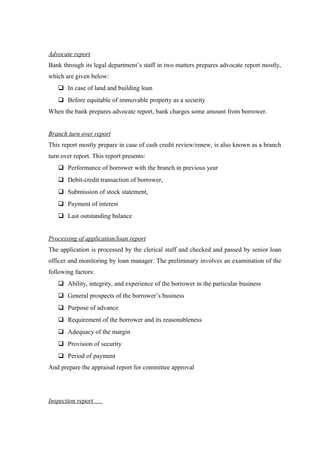
Bank through its legal department’s staff in two matters prepares advocate report mostly, 
which are given below: 
 In case of land and building loan 
 Before equitable of immovable property as a security 
When the bank prepares advocate report, bank charges some amount from borrower. 
Branch turn over report 
This report mostly prepare in case of cash credit review/renew, is also known as a branch 
turn over report. This report presents: 
 Performance of borrower with the branch in previous year 
 Debit-credit transaction of borrower, 
 Submission of stock statement, 
 Payment of interest 
 Last outstanding balance 
Processing of application/loan report 
The application is processed by the clerical staff and checked and passed by senior loan 
officer and monitoring by loan manager. The preliminary involves an examination of the 
following factors: 
 Ability, integrity, and experience of the borrower in the particular business 
 General prospects of the borrower’s business 
 Purpose of advance 
 Requirement of the borrower and its reasonableness 
 Adequacy of the margin 
 Provision of security 
 Period of payment 
And prepare the appraisal report for committee approval 
Inspection report
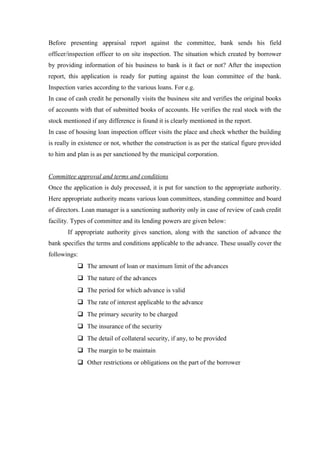
Before presenting appraisal report against the committee, bank sends his field 
officer/inspection officer to on site inspection. The situation which created by borrower 
by providing information of his business to bank is it fact or not? After the inspection 
report, this application is ready for putting against the loan committee of the bank. 
Inspection varies according to the various loans. For e.g. 
In case of cash credit he personally visits the business site and verifies the original books 
of accounts with that of submitted books of accounts. He verifies the real stock with the 
stock mentioned if any difference is found it is clearly mentioned in the report. 
In case of housing loan inspection officer visits the place and check whether the building 
is really in existence or not, whether the construction is as per the statical figure provided 
to him and plan is as per sanctioned by the municipal corporation. 
Committee approval and terms and conditions 
Once the application is duly processed, it is put for sanction to the appropriate authority. 
Here appropriate authority means various loan committees, standing committee and board 
of directors. Loan manager is a sanctioning authority only in case of review of cash credit 
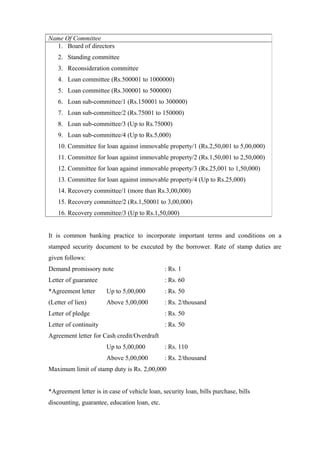
facility. Types of committee and its lending powers are given below: 
If appropriate authority gives sanction, along with the sanction of advance the 
bank specifies the terms and conditions applicable to the advance. These usually cover the 
followings: 
 The amount of loan or maximum limit of the advances 
 The nature of the advances 
 The period for which advance is valid 
 The rate of interest applicable to the advance 
 The primary security to be charged 
 The insurance of the security 
 The detail of collateral security, if any, to be provided 
 The margin to be maintain 
 Other restrictions or obligations on the part of the borrower
Name Of Committee 
1. Board of directors 
2. Standing committee 
3. Reconsideration committee 
4. Loan committee (Rs.500001 to 1000000) 
5. Loan committee (Rs.300001 to 500000) 
6. Loan sub-committee/1 (Rs.150001 to 300000) 
7. Loan sub-committee/2 (Rs.75001 to 150000) 
8. Loan sub-committee/3 (Up to Rs.75000) 
9. Loan sub-committee/4 (Up to Rs.5,000) 
10. Committee for loan against immovable property/1 (Rs.2,50,001 to 5,00,000) 
11. Committee for loan against immovable property/2 (Rs.1,50,001 to 2,50,000) 
12. Committee for loan against immovable property/3 (Rs.25,001 to 1,50,000) 
13. Committee for loan against immovable property/4 (Up to Rs.25,000) 
14. Recovery committee/1 (more than Rs.3,00,000) 
15. Recovery committee/2 (Rs.1,50001 to 3,00,000) 
16. Recovery committee/3 (Up to Rs.1,50,000) 
It is common banking practice to incorporate important terms and conditions on a 
stamped security document to be executed by the borrower. Rate of stamp duties are 
given follows: 
Demand promissory note : Rs. 1 
Letter of guarantee : Rs. 60 
*Agreement letter Up to 5,00,000 : Rs. 50 
(Letter of lien) Above 5,00,000 : Rs. 2/thousand 
Letter of pledge : Rs. 50 
Letter of continuity : Rs. 50 
Agreement letter for Cash credit/Overdraft 
Up to 5,00,000 : Rs. 110 
Above 5,00,000 : Rs. 2/thousand 
Maximum limit of stamp duty is Rs. 2,00,000 
*Agreement letter is in case of vehicle loan, security loan, bills purchase, bills 
discounting, guarantee, education loan, etc.
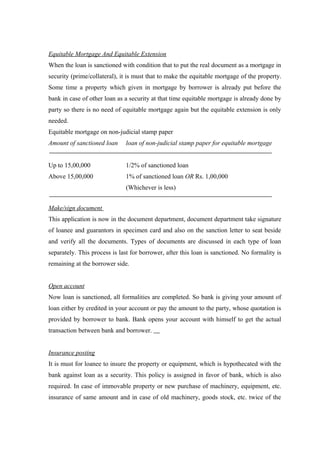
Equitable Mortgage And Equitable Extension 
When the loan is sanctioned with condition that to put the real document as a mortgage in 
security (prime/collateral), it is must that to make the equitable mortgage of the property. 
Some time a property which given in mortgage by borrower is already put before the 
bank in case of other loan as a security at that time equitable mortgage is already done by 
party so there is no need of equitable mortgage again but the equitable extension is only 
needed. 
Equitable mortgage on non-judicial stamp paper 
Amount of sanctioned loan loan of non-judicial stamp paper for equitable mortgage 
Up to 15,00,000 1/2% of sanctioned loan 
Above 15,00,000 1% of sanctioned loan OR Rs. 1,00,000 
(Whichever is less) 
Make/sign document 
This application is now in the document department, document department take signature 
of loanee and guarantors in specimen card and also on the sanction letter to seat beside 
and verify all the documents. Types of documents are discussed in each type of loan 
separately. This process is last for borrower, after this loan is sanctioned. No formality is 
remaining at the borrower side. 
Open account 
Now loan is sanctioned, all formalities are completed. So bank is giving your amount of 
loan either by credited in your account or pay the amount to the party, whose quotation is 
provided by borrower to bank. Bank opens your account with himself to get the actual 
transaction between bank and borrower. 
Insurance posting 
It is must for loanee to insure the property or equipment, which is hypothecated with the 
bank against loan as a security. This policy is assigned in favor of bank, which is also 
required. In case of immovable property or new purchase of machinery, equipment, etc. 
insurance of same amount and in case of old machinery, goods stock, etc. twice of the
price insurance is needed. In case of education loan, the life insurance of student is 
required. Shakh department is posting it in borrower’s account. 
Record department – filing 
Now total process is over and whole documents are need filing for bank record. Record 
department does this work. Record department file the documents and store it to proper 
place.
CCRREEDDIITT 
PPOOLLIICCYY
General Eligibility Criteria For Credit In RDC Bank 
 As per the rules of co-operatives, any one who wants to avail finance has to 
become a member of the bank. 
 As a shareholder of the bank, he/she have to make compulsory deposit, or the 
payment of deposit as per rules and regulations of the bank and thereafter, he/she 
can submit the application for loan. In all the practice with the bank, you are 
known by bank through your compulsory deposit number. 
 The application will have to be submitted in the prescribed form, wherein all 
details and particulars will have to be furnished as demanded in the form. He/she 
has to submit further particulars as may be asked by the bank. 
 The loanee will be advanced loan against the security and he/she has to submit 1 
or 2 guarantors, who will be the recognized member and accepted to the bank. 
 The interest will be calculated on month-to-month basis. 
 Taking in view the total amount of loans taken for different purpose by the firm or 
individual, the interest will be calculated at the same rate on all the advances. 
 It will be necessary to make payment of share deposit or loan deposit at the rate of 
2.5% of the sanction in case of secured loan and 5% of sanctioned loan or in case 
of unsecured loan. The maximum share deposit accepted of Rs.25000 and 
additional deposit over Rs.25000 will be accepted as loan deposit. 
 The rate of interest on share deposit is 15% and that on loan deposit is 10%. 
 The company, who wants to take loan from bank, has to get its name registered 
for the said loan purpose with the registrar of companies and has to submit the 
document of registration charge to the bank. 
 In case of mortgage of immovable property steps are given below: 
Title clear report 
Equitable mortgage on non-judicial stamp paper 
Amount of sanctioned loan loan of non-judicial stamp paper for equitable 
mortgage 
Up to 15,00,000 1/2% of sanctioned loan 
Above 15,00,000 1% of sanctioned loan OR Rs.1,00,000 
(Whichever is less) 
 Some time a property which given in mortgage by borrower is already put before 
the bank in case of other loan as a security at that time equitable mortgage is
already done by party so there is no need of equitable mortgage again but the 
equitable extension is only needed. 
 In case of immovable property or new purchase of machinery, equipment, etc. 
insurance of same amount and in case of old machinery, goods stock, etc. twice of 
the price insurance is needed. In case of education loan, the life insurance of 
student is required. 
 Margin money means gap between purchase value and bank finance. Bank always 
does payment directly to the seller. So loanee has to deposit the margin money in 
the bank.
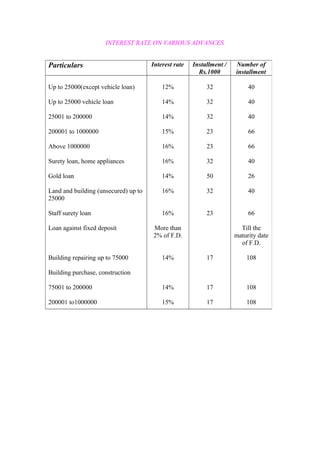
INTEREST RATE ON VARIOUS ADVANCES 
Particulars Interest rate Installment / 
Rs.1000 
Number of 
installment 
Up to 25000(except vehicle loan) 
Up to 25000 vehicle loan 
25001 to 200000 
200001 to 1000000 
Above 1000000 
Surety loan, home appliances 
Gold loan 
Land and building (unsecured) up to 
25000 
Staff surety loan 
Loan against fixed deposit 
Building repairing up to 75000 
Building purchase, construction 
75001 to 200000 
200001 to1000000 
12% 
14% 
14% 
15% 
16% 
16% 
14% 
16% 
16% 
More than 
2% of F.D. 
14% 
14% 
15% 
32 
32 
32 
23 
23 
32 
50 
32 
23 
17 
17 
17 
40 
40 
40 
66 
66 
40 
26 
40 
66 
Till the 
maturity date 
of F.D. 
108 
108 
108
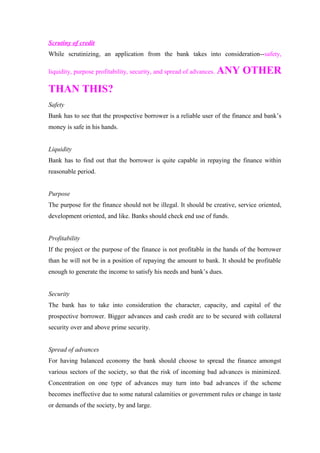
Scrutiny of credit 
While scrutinizing, an application from the bank takes into consideration--safety, 
liquidity, purpose profitability, security, and spread of advances. ANY OTHER 
THAN THIS? 
Safety 
Bank has to see that the prospective borrower is a reliable user of the finance and bank’s 
money is safe in his hands. 
Liquidity 
Bank has to find out that the borrower is quite capable in repaying the finance within 
reasonable period. 
Purpose 
The purpose for the finance should not be illegal. It should be creative, service oriented, 
development oriented, and like. Banks should check end use of funds. 
Profitability 
If the project or the purpose of the finance is not profitable in the hands of the borrower 
than he will not be in a position of repaying the amount to bank. It should be profitable 
enough to generate the income to satisfy his needs and bank’s dues. 
Security 
The bank has to take into consideration the character, capacity, and capital of the 
prospective borrower. Bigger advances and cash credit are to be secured with collateral 
security over and above prime security. 
Spread of advances 
For having balanced economy the bank should choose to spread the finance amongst 
various sectors of the society, so that the risk of incoming bad advances is minimized. 
Concentration on one type of advances may turn into bad advances if the scheme 
becomes ineffective due to some natural calamities or government rules or change in taste 
or demands of the society, by and large.
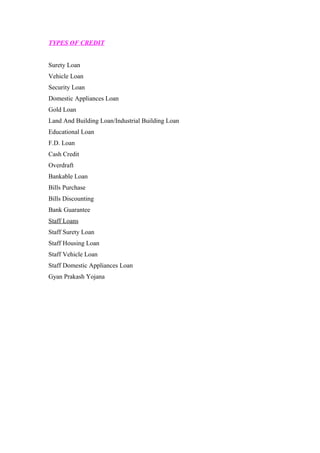
TYPES OF CREDIT 
Surety Loan 
Vehicle Loan 
Security Loan 
Domestic Appliances Loan 
Gold Loan 
Land And Building Loan/Industrial Building Loan 
Educational Loan 
F.D. Loan 
Cash Credit 
Overdraft 
Bankable Loan 
Bills Purchase 
Bills Discounting 
Bank Guarantee 
Staff Loans 
Staff Surety Loan 
Staff Housing Loan 
Staff Vehicle Loan 
Staff Domestic Appliances Loan 
Gyan Prakash Yojana
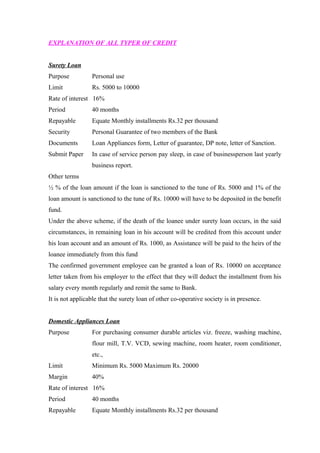
EXPLANATION OF ALL TYPER OF CREDIT 
Surety Loan 
Purpose Personal use 
Limit Rs. 5000 to 10000 
Rate of interest 16% 
Period 40 months 
Repayable Equate Monthly installments Rs.32 per thousand 
Security Personal Guarantee of two members of the Bank 
Documents Loan Appliances form, Letter of guarantee, DP note, letter of Sanction. 
Submit Paper In case of service person pay sleep, in case of businessperson last yearly 
business report. 
Other terms 
½ % of the loan amount if the loan is sanctioned to the tune of Rs. 5000 and 1% of the 
loan amount is sanctioned to the tune of Rs. 10000 will have to be deposited in the benefit 
fund. 
Under the above scheme, if the death of the loanee under surety loan occurs, in the said 
circumstances, in remaining loan in his account will be credited from this account under 
his loan account and an amount of Rs. 1000, as Assistance will be paid to the heirs of the 
loanee immediately from this fund 
The confirmed government employee can be granted a loan of Rs. 10000 on acceptance 
letter taken from his employer to the effect that they will deduct the installment from his 
salary every month regularly and remit the same to Bank. 
It is not applicable that the surety loan of other co-operative society is in presence. 
Domestic Appliances Loan 
Purpose For purchasing consumer durable articles viz. freeze, washing machine, 
flour mill, T.V. VCD, sewing machine, room heater, room conditioner, 
etc., 
Limit Minimum Rs. 5000 Maximum Rs. 20000 
Margin 40% 
Rate of interest 16% 
Period 40 months 
Repayable Equate Monthly installments Rs.32 per thousand
Security Hypothecation of goods, personal guarantee of two members of the bank 
Documents Loan Appliances form, Letter of guarantee, DP note, Hypothecation of 
goods/articles purchased, insurance policy 
Submit Paper In case of service person pay sleep, in case of businessperson last yearly 
business report, quotation of the item obtained from Authorized Dealer 
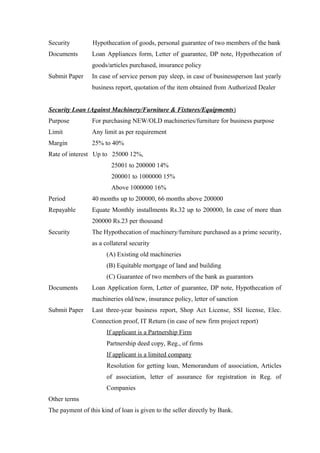
Security Loan (Against Machinery/Furniture & Fixtures/Equipments ) 
Purpose For purchasing NEW/OLD machineries/furniture for business purpose 
Limit Any limit as per requirement 
Margin 25% to 40% 
Rate of interest Up to 25000 12%, 
25001 to 200000 14% 
200001 to 1000000 15% 
Above 1000000 16% 
Period 40 months up to 200000, 66 months above 200000 
Repayable Equate Monthly installments Rs.32 up to 200000, In case of more than 
200000 Rs.23 per thousand 
Security The Hypothecation of machinery/furniture purchased as a prime security, 
as a collateral security 
(A) Existing old machineries 
(B) Equitable mortgage of land and building 
(C) Guarantee of two members of the bank as guarantors 
Documents Loan Application form, Letter of guarantee, DP note, Hypothecation of 
machineries old/new, insurance policy, letter of sanction 
Submit Paper Last three-year business report, Shop Act License, SSI license, Elec. 
Connection proof, IT Return (in case of new firm project report) 
If applicant is a Partnership Firm 
Partnership deed copy, Reg., of firms 
If applicant is a limited company 
Resolution for getting loan, Memorandum of association, Articles 
of association, letter of assurance for registration in Reg. of 
Companies 
Other terms 
The payment of this kind of loan is given to the seller directly by Bank.
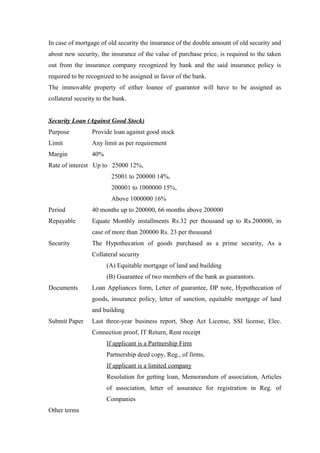
In case of mortgage of old security the insurance of the double amount of old security and 
about new security, the insurance of the value of purchase price, is required to the taken 
out from the insurance company recognized by bank and the said insurance policy is 
required to be recognized to be assigned in favor of the bank. 
The immovable property of either loanee of guarantor will have to be assigned as 
collateral security to the bank. 
Security Loan (Against Good Stock) 
Purpose Provide loan against good stock 
Limit Any limit as per requirement 
Margin 40% 
Rate of interest Up to 25000 12%, 
25001 to 200000 14%, 
200001 to 1000000 15%, 
Above 1000000 16% 
Period 40 months up to 200000, 66 months above 200000 
Repayable Equate Monthly installments Rs.32 per thousand up to Rs.200000, in 
case of more than 200000 Rs. 23 per thousand 
Security The Hypothecation of goods purchased as a prime security, As a 
Collateral security 
(A) Equitable mortgage of land and building 
(B) Guarantee of two members of the bank as guarantors. 
Documents Loan Appliances form, Letter of guarantee, DP note, Hypothecation of 
goods, insurance policy, letter of sanction, equitable mortgage of land 
and building 
Submit Paper Last three-year business report, Shop Act License, SSI license, Elec. 
Connection proof, IT Return, Rent receipt 
If applicant is a Partnership Firm 
Partnership deed copy, Reg., of firms, 
If applicant is a limited company 
Resolution for getting loan, Memorandum of association, Articles 
of association, letter of assurance for registration in Reg. of 
Companies 
Other terms
The payment of this kind of loan is given to the loanee by Bank. 
Insurance is twice of the value of goods price, is required to the taken out from the 
insurance company recognized by bank and the said insurance policy is required to be 
recognized in favor of the bank. 
The immovable property of either loanee of guarantor will have to be assigned as 
collateral security to the bank. 
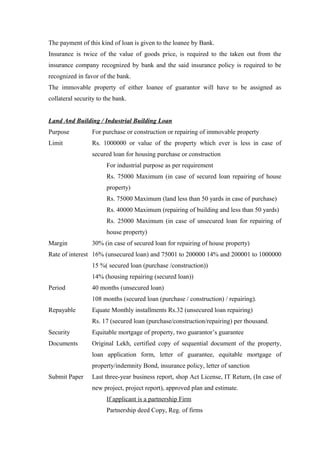
Land And Building / Industrial Building Loan 
Purpose For purchase or construction or repairing of immovable property 
Limit Rs. 1000000 or value of the property which ever is less in case of 
secured loan for housing purchase or construction 
For industrial purpose as per requirement 
Rs. 75000 Maximum (in case of secured loan repairing of house 
property) 
Rs. 75000 Maximum (land less than 50 yards in case of purchase) 
Rs. 40000 Maximum (repairing of building and less than 50 yards) 
Rs. 25000 Maximum (in case of unsecured loan for repairing of 
house property) 
Margin 30% (in case of secured loan for repairing of house property) 
Rate of interest 16% (unsecured loan) and 75001 to 200000 14% and 200001 to 1000000 
15 %( secured loan (purchase /construction)) 
14% (housing repairing (secured loan)) 
Period 40 months (unsecured loan) 
108 months (secured loan (purchase / construction) / repairing). 
Repayable Equate Monthly installments Rs.32 (unsecured loan repairing) 
Rs. 17 (secured loan (purchase/construction/repairing) per thousand. 
Security Equitable mortgage of property, two guarantor’s guarantee 
Documents Original Lekh, certified copy of sequential document of the property, 
loan application form, letter of guarantee, equitable mortgage of 
property/indemnity Bond, insurance policy, letter of sanction 
Submit Paper Last three-year business report, shop Act License, IT Return, (In case of 
new project, project report), approved plan and estimate. 
If applicant is a partnership Firm 
Partnership deed Copy, Reg. of firms
If applicant is a limited company 
Resolution for getting loan, Memorandum of association, Articles 
of association, letter of assurance for registration in Reg. of 
Companies 
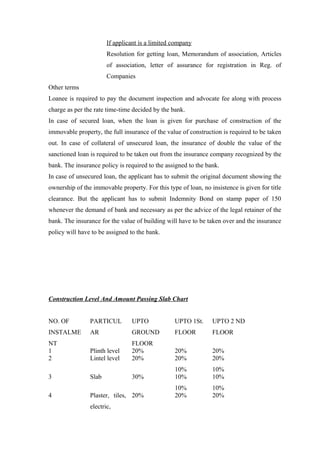
Other terms 
Loanee is required to pay the document inspection and advocate fee along with process 
charge as per the rate time-time decided by the bank. 
In case of secured loan, when the loan is given for purchase of construction of the 
immovable property, the full insurance of the value of construction is required to be taken 
out. In case of collateral of unsecured loan, the insurance of double the value of the 
sanctioned loan is required to be taken out from the insurance company recognized by the 
bank. The insurance policy is required to the assigned to the bank. 
In case of unsecured loan, the applicant has to submit the original document showing the 
ownership of the immovable property. For this type of loan, no insistence is given for title 
clearance. But the applicant has to submit Indemnity Bond on stamp paper of 150 
whenever the demand of bank and necessary as per the advice of the legal retainer of the 
bank. The insurance for the value of building will have to be taken over and the insurance 
policy will have to be assigned to the bank. 
Construction Level And Amount Passing Slab Chart 
NO. OF 
INSTALME 
NT 
PARTICUL 
AR 
UPTO 
GROUND 
FLOOR 
UPTO 1St. 
FLOOR 
UPTO 2 ND 
FLOOR 
1 Plinth level 20% 20% 20% 
2 Lintel level 20% 20% 
10% 
20% 
10% 
3 Slab 30% 10% 
10% 
10% 
10% 
4 Plaster, tiles, 
electric, 
20% 20% 20%
Plumbing 
5 Completion 10% 10% 10% 
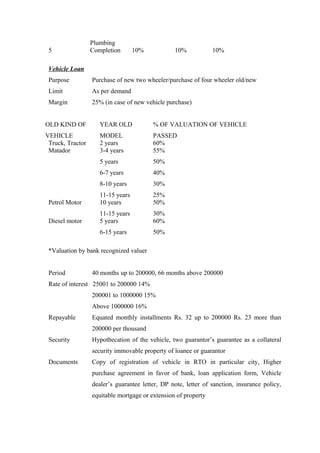
Vehicle Loan 
Purpose Purchase of new two wheeler/purchase of four wheeler old/new 
Limit As per demand 
Margin 25% (in case of new vehicle purchase) 
OLD KIND OF 
VEHICLE 
YEAR OLD 
MODEL 
% OF VALUATION OF VEHICLE 
PASSED 
Truck, Tractor 2 years 60% 
Matador 3-4 years 
5 years 
6-7 years 
8-10 years 
11-15 years 
55% 
50% 
40% 
30% 
25% 
Petrol Motor 10 years 
11-15 years 
50% 
30% 
Diesel motor 5 years 
6-15 years 
60% 
50% 
*Valuation by bank recognized valuer 
Period 40 months up to 200000, 66 months above 200000 
Rate of interest 25001 to 200000 14% 
200001 to 1000000 15% 
Above 1000000 16% 
Repayable Equated monthly installments Rs. 32 up to 200000 Rs. 23 more than 
200000 per thousand 
Security Hypothecation of the vehicle, two guarantor’s guarantee as a collateral 
security immovable property of loanee or guarantor 
Documents Copy of registration of vehicle in RTO in particular city, Higher 
purchase agreement in favor of bank, loan application form, Vehicle 
dealer’s guarantee letter, DP note, letter of sanction, insurance policy, 
equitable mortgage or extension of property
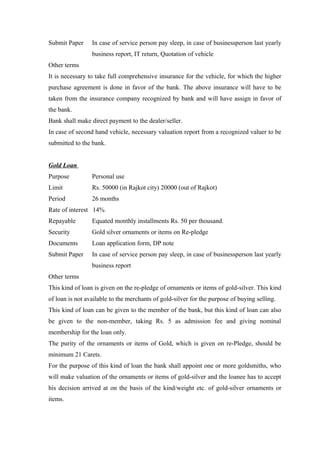
Submit Paper In case of service person pay sleep, in case of businessperson last yearly 
business report, IT return, Quotation of vehicle 
Other terms 
It is necessary to take full comprehensive insurance for the vehicle, for which the higher 
purchase agreement is done in favor of the bank. The above insurance will have to be 
taken from the insurance company recognized by bank and will have assign in favor of 
the bank. 
Bank shall make direct payment to the dealer/seller. 
In case of second hand vehicle, necessary valuation report from a recognized valuer to be 
submitted to the bank. 
Gold Loan 
Purpose Personal use 
Limit Rs. 50000 (in Rajkot city) 20000 (out of Rajkot) 
Period 26 months 
Rate of interest 14% 
Repayable Equated monthly installments Rs. 50 per thousand. 
Security Gold silver ornaments or items on Re-pledge 
Documents Loan application form, DP note 
Submit Paper In case of service person pay sleep, in case of businessperson last yearly 
business report 
Other terms 
This kind of loan is given on the re-pledge of ornaments or items of gold-silver. This kind 
of loan is not available to the merchants of gold-silver for the purpose of buying selling. 
This kind of loan can be given to the member of the bank, but this kind of loan can also 
be given to the non-member, taking Rs. 5 as admission fee and giving nominal 
membership for the loan only. 
The purity of the ornaments or items of Gold, which is given on re-Pledge, should be 
minimum 21 Carets. 
For the purpose of this kind of loan the bank shall appoint one or more goldsmiths, who 
will make valuation of the ornaments or items of gold-silver and the loanee has to accept 
his decision arrived at on the basis of the kind/weight etc. of gold-silver ornaments or 
items.
Per 11.664 Gram (Per TOLA) Rs. 3000 is Valued & 70 % Valued Amount is Sanctioned 
as Loan. 
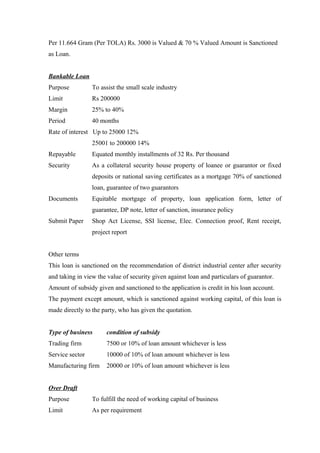
Bankable Loan 
Purpose To assist the small scale industry 
Limit Rs 200000 
Margin 25% to 40% 
Period 40 months 
Rate of interest Up to 25000 12% 
25001 to 200000 14% 
Repayable Equated monthly installments of 32 Rs. Per thousand 
Security As a collateral security house property of loanee or guarantor or fixed 
deposits or national saving certificates as a mortgage 70% of sanctioned 
loan, guarantee of two guarantors 
Documents Equitable mortgage of property, loan application form, letter of 
guarantee, DP note, letter of sanction, insurance policy 
Submit Paper Shop Act License, SSI license, Elec. Connection proof, Rent receipt, 
project report 
Other terms 
This loan is sanctioned on the recommendation of district industrial center after security 
and taking in view the value of security given against loan and particulars of guarantor. 
Amount of subsidy given and sanctioned to the application is credit in his loan account. 
The payment except amount, which is sanctioned against working capital, of this loan is 
made directly to the party, who has given the quotation. 
Type of business condition of subsidy 
Trading firm 7500 or 10% of loan amount whichever is less 
Service sector 10000 of 10% of loan amount whichever is less 
Manufacturing firm 20000 or 10% of loan amount whichever is less 
Over Draft 
Purpose To fulfill the need of working capital of business 
Limit As per requirement
Margin 40% 
Period Up to 1 year 
Rate of interest Up to 25000 12% 
25001 to 200000 14% 
20001 to 1000000 15% 
Above 1000000 16% 
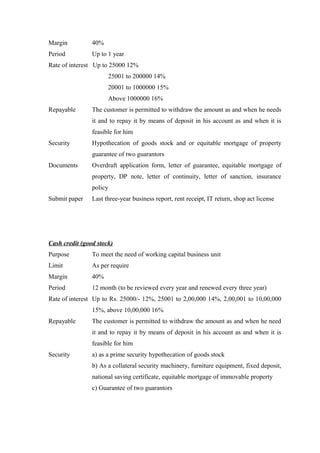
Repayable The customer is permitted to withdraw the amount as and when he needs 
it and to repay it by means of deposit in his account as and when it is 
feasible for him 
Security Hypothecation of goods stock and or equitable mortgage of property 
guarantee of two guarantors 
Documents Overdraft application form, letter of guarantee, equitable mortgage of 
property, DP note, letter of continuity, letter of sanction, insurance 
policy 
Submit paper Last three-year business report, rent receipt, IT return, shop act license 
Cash credit (good stock) 
Purpose To meet the need of working capital business unit 
Limit As per require 
Margin 40% 
Period 12 month (to be reviewed every year and renewed every three year) 
Rate of interest Up to Rs. 25000/- 12%, 25001 to 2,00,000 14%, 2,00,001 to 10,00,000 
15%, above 10,00,000 16% 
Repayable The customer is permitted to withdraw the amount as and when he need 
it and to repay it by means of deposit in his account as and when it is 
feasible for him 
Security a) as a prime security hypothecation of goods stock 
b) As a collateral security machinery, furniture equipment, fixed deposit, 
national saving certificate, equitable mortgage of immovable property 
c) Guarantee of two guarantors
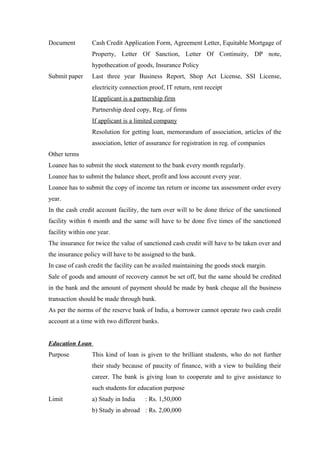
Document Cash Credit Application Form, Agreement Letter, Equitable Mortgage of 
Property, Letter Of Sanction, Letter Of Continuity, DP note, 
hypothecation of goods, Insurance Policy 
Submit paper Last three year Business Report, Shop Act License, SSI License, 
electricity connection proof, IT return, rent receipt 
If applicant is a partnership firm 
Partnership deed copy, Reg. of firms 
If applicant is a limited company 
Resolution for getting loan, memorandum of association, articles of the 
association, letter of assurance for registration in reg. of companies 
Other terms 
Loanee has to submit the stock statement to the bank every month regularly. 
Loanee has to submit the balance sheet, profit and loss account every year. 
Loanee has to submit the copy of income tax return or income tax assessment order every 
year. 
In the cash credit account facility, the turn over will to be done thrice of the sanctioned 
facility within 6 month and the same will have to be done five times of the sanctioned 
facility within one year. 
The insurance for twice the value of sanctioned cash credit will have to be taken over and 
the insurance policy will have to be assigned to the bank. 
In case of cash credit the facility can be availed maintaining the goods stock margin. 
Sale of goods and amount of recovery cannot be set off, but the same should be credited 
in the bank and the amount of payment should be made by bank cheque all the business 
transaction should be made through bank. 
As per the norms of the reserve bank of India, a borrower cannot operate two cash credit 
account at a time with two different banks. 
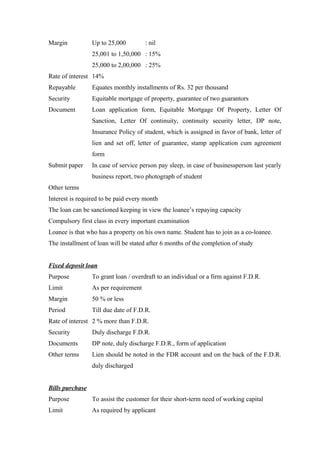
Education Loan 
Purpose This kind of loan is given to the brilliant students, who do not further 
their study because of paucity of finance, with a view to building their 
career. The bank is giving loan to cooperate and to give assistance to 
such students for education purpose 
Limit a) Study in India : Rs. 1,50,000 
b) Study in abroad : Rs. 2,00,000
Margin Up to 25,000 : nil 
25,001 to 1,50,000 : 15% 
25,000 to 2,00,000 : 25% 
Rate of interest 14% 
Repayable Equates monthly installments of Rs. 32 per thousand 
Security Equitable mortgage of property, guarantee of two guarantors 
Document Loan application form, Equitable Mortgage Of Property, Letter Of 
Sanction, Letter Of continuity, continuity security letter, DP note, 
Insurance Policy of student, which is assigned in favor of bank, letter of 
lien and set off, letter of guarantee, stamp application cum agreement 
form 
Submit paper In case of service person pay sleep, in case of businessperson last yearly 
business report, two photograph of student 
Other terms 
Interest is required to be paid every month 
The loan can be sanctioned keeping in view the loanee’s repaying capacity 
Compulsory first class in every important examination 
Loanee is that who has a property on his own name. Student has to join as a co-loanee. 
The installment of loan will be stated after 6 months of the completion of study 
Fixed deposit loan 
Purpose To grant loan / overdraft to an individual or a firm against F.D.R. 
Limit As per requirement 
Margin 50 % or less 
Period Till due date of F.D.R. 
Rate of interest 2 % more than F.D.R. 
Security Duly discharge F.D.R. 
Documents DP note, duly discharge F.D.R., form of application 
Other terms Lien should be noted in the FDR account and on the back of the F.D.R. 
duly discharged 
Bills purchase 
Purpose To assist the customer for their short-term need of working capital 
Limit As required by applicant
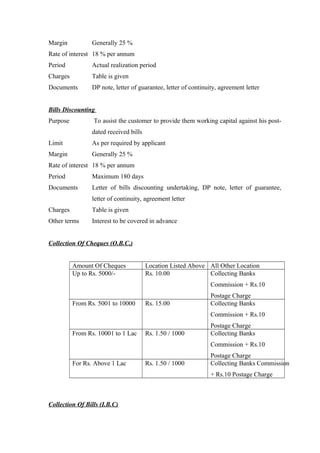
Margin Generally 25 % 
Rate of interest 18 % per annum 
Period Actual realization period 
Charges Table is given 
Documents DP note, letter of guarantee, letter of continuity, agreement letter 
Bills Discounting 
Purpose To assist the customer to provide them working capital against his post-dated 
received bills 
Limit As per required by applicant 
Margin Generally 25 % 
Rate of interest 18 % per annum 
Period Maximum 180 days 
Documents Letter of bills discounting undertaking, DP note, letter of guarantee, 
letter of continuity, agreement letter 
Charges Table is given 
Other terms Interest to be covered in advance 
Collection Of Cheques (O.B.C.) 
Amount Of Cheques Location Listed Above All Other Location 
Up to Rs. 5000/- Rs. 10.00 Collecting Banks 
Commission + Rs.10 
Postage Charge 
From Rs. 5001 to 10000 Rs. 15.00 Collecting Banks 
Commission + Rs.10 
Postage Charge 
From Rs. 10001 to 1 Lac Rs. 1.50 / 1000 Collecting Banks 
Commission + Rs.10 
Postage Charge 
For Rs. Above 1 Lac Rs. 1.50 / 1000 Collecting Banks Commission 
+ Rs.10 Postage Charge 
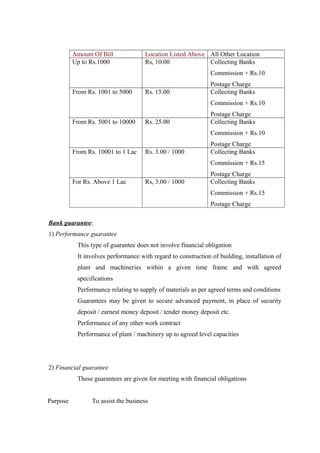
Collection Of Bills (I.B.C)
Amount Of Bill Location Listed Above All Other Location 
Up to Rs.1000 Rs, 10.00 Collecting Banks 
Commission + Rs.10 
Postage Charge 
From Rs. 1001 to 5000 Rs. 15.00 Collecting Banks 
Commission + Rs.10 
Postage Charge 
From Rs. 5001 to 10000 Rs. 25.00 Collecting Banks 
Commission + Rs.10 
Postage Charge 
From Rs. 10001 to 1 Lac Rs. 3.00 / 1000 Collecting Banks 
Commission + Rs.15 
Postage Charge 
For Rs. Above 1 Lac Rs, 3.00 / 1000 Collecting Banks 
Commission + Rs.15 
Postage Charge 
Bank guarantee: 
1) Performance guarantee 
This type of guarantee does not involve financial obligation 
It involves performance with regard to construction of building, installation of 
plant and machineries within a given time frame and with agreed 
specifications 
Performance relating to supply of materials as per agreed terms and conditions 
Guarantees may be given to secure advanced payment, in place of security 
deposit / earnest money deposit / tender money deposit etc. 
Performance of any other work contract 
Performance of plant / machinery up to agreed level capacities 
2) Financial guarantee 
These guarantees are given for meeting with financial obligations 
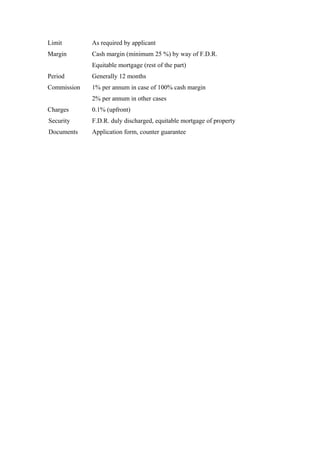
Purpose To assist the business
Limit As required by applicant 
Margin Cash margin (minimum 25 %) by way of F.D.R. 
Equitable mortgage (rest of the part) 
Period Generally 12 months 
Commission 1% per annum in case of 100% cash margin 
2% per annum in other cases 
Charges 0.1% (upfront) 
Security F.D.R. duly discharged, equitable mortgage of property 
Documents Application form, counter guarantee
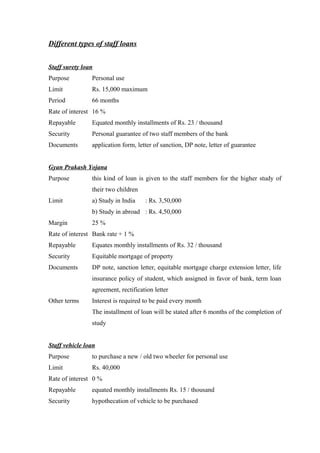
Different types of staff loans 
Staff surety loan 
Purpose Personal use 
Limit Rs. 15,000 maximum 
Period 66 months 
Rate of interest 16 % 
Repayable Equated monthly installments of Rs. 23 / thousand 
Security Personal guarantee of two staff members of the bank 
Documents application form, letter of sanction, DP note, letter of guarantee 
Gyan Prakash Yojana 
Purpose this kind of loan is given to the staff members for the higher study of 
their two children 
Limit a) Study in India : Rs. 3,50,000 
b) Study in abroad : Rs. 4,50,000 
Margin 25 % 
Rate of interest Bank rate + 1 % 
Repayable Equates monthly installments of Rs. 32 / thousand 
Security Equitable mortgage of property 
Documents DP note, sanction letter, equitable mortgage charge extension letter, life 
insurance policy of student, which assigned in favor of bank, term loan 
agreement, rectification letter 
Other terms Interest is required to be paid every month 
The installment of loan will be stated after 6 months of the completion of 
study 
Staff vehicle loan 
Purpose to purchase a new / old two wheeler for personal use 
Limit Rs. 40,000 
Rate of interest 0 % 
Repayable equated monthly installments Rs. 15 / thousand 
Security hypothecation of vehicle to be purchased
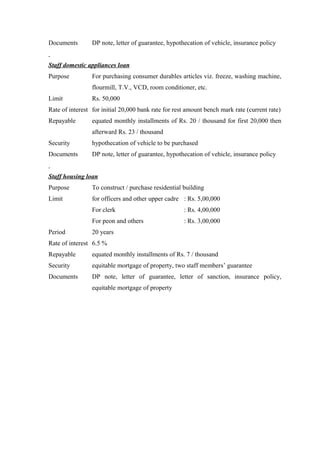
Documents DP note, letter of guarantee, hypothecation of vehicle, insurance policy 
Staff domestic appliances loan 
Purpose For purchasing consumer durables articles viz. freeze, washing machine, 
flourmill, T.V., VCD, room conditioner, etc. 
Limit Rs. 50,000 
Rate of interest for initial 20,000 bank rate for rest amount bench mark rate (current rate) 
Repayable equated monthly installments of Rs. 20 / thousand for first 20,000 then 
afterward Rs. 23 / thousand 
Security hypothecation of vehicle to be purchased 
Documents DP note, letter of guarantee, hypothecation of vehicle, insurance policy 
Staff housing loan 
Purpose To construct / purchase residential building 
Limit for officers and other upper cadre : Rs. 5,00,000 
For clerk : Rs. 4,00,000 
For peon and others : Rs. 3,00,000 
Period 20 years 
Rate of interest 6.5 % 
Repayable equated monthly installments of Rs. 7 / thousand 
Security equitable mortgage of property, two staff members’ guarantee 
Documents DP note, letter of guarantee, letter of sanction, insurance policy, 
equitable mortgage of property
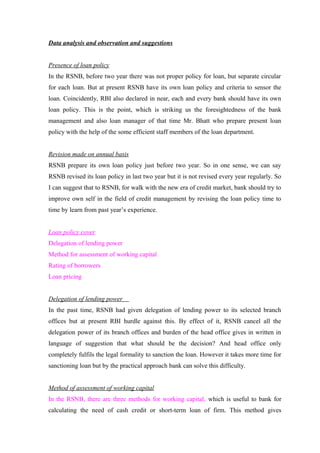
Data analysis and observation and suggestions 
Presence of loan policy 
In the RSNB, before two year there was not proper policy for loan, but separate circular 
for each loan. But at present RSNB have its own loan policy and criteria to sensor the 
loan. Coincidently, RBI also declared in near, each and every bank should have its own 
loan policy. This is the point, which is striking us the foresightedness of the bank 
management and also loan manager of that time Mr. Bhatt who prepare present loan 
policy with the help of the some efficient staff members of the loan department. 
Revision made on annual basis 
RSNB prepare its own loan policy just before two year. So in one sense, we can say 
RSNB revised its loan policy in last two year but it is not revised every year regularly. So 
I can suggest that to RSNB, for walk with the new era of credit market, bank should try to 
improve own self in the field of credit management by revising the loan policy time to 
time by learn from past year’s experience. 
Loan policy cover 
Delegation of lending power 
Method for assessment of working capital 
Rating of borrowers 
Loan pricing 
Delegation of lending power 
In the past time, RSNB had given delegation of lending power to its selected branch 
offices but at present RBI hurdle against this. By effect of it, RSNB cancel all the 
delegation power of its branch offices and burden of the head office gives in written in 
language of suggestion that what should be the decision? And head office only 
completely fulfils the legal formality to sanction the loan. However it takes more time for 
sanctioning loan but by the practical approach bank can solve this difficulty. 
Method of assessment of working capital 
In the RSNB, there are three methods for working capital, which is useful to bank for 
calculating the need of cash credit or short-term loan of firm. This method gives
advantage to bank to find out if the demand borrower is fair. Methods of working capital 
calculation are given below: 
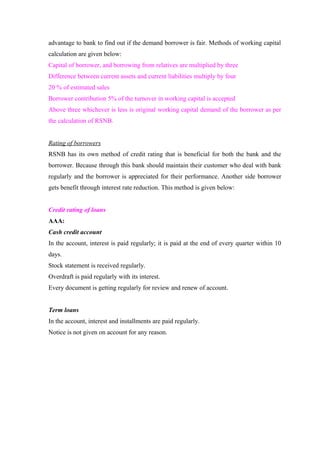
Capital of borrower, and borrowing from relatives are multiplied by three 
Difference between current assets and current liabilities multiply by four 
20 % of estimated sales 
Borrower contribution 5% of the turnover in working capital is accepted 
Above three whichever is less is original working capital demand of the borrower as per 
the calculation of RSNB. 
Rating of borrowers 
RSNB has its own method of credit rating that is beneficial for both the bank and the 
borrower. Because through this bank should maintain their customer who deal with bank 
regularly and the borrower is appreciated for their performance. Another side borrower 
gets benefit through interest rate reduction. This method is given below: 
Credit rating of loans 
AAA: 
Cash credit account 
In the account, interest is paid regularly; it is paid at the end of every quarter within 10 
days. 
Stock statement is received regularly. 
Overdraft is paid regularly with its interest. 
Every document is getting regularly for review and renew of account. 
Term loans 
In the account, interest and installments are paid regularly. 
Notice is not given on account for any reason.
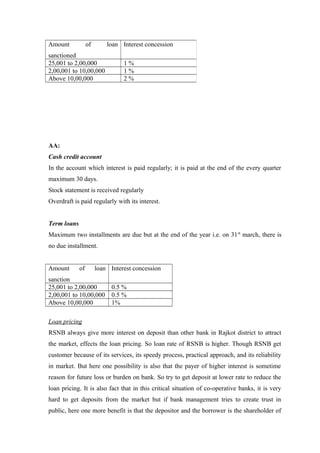
Amount of loan 
sanctioned 
Interest concession 
25,001 to 2,00,000 1 % 
2,00,001 to 10,00,000 1 % 
Above 10,00,000 2 % 
AA: 
Cash credit account 
In the account which interest is paid regularly; it is paid at the end of the every quarter 
maximum 30 days. 
Stock statement is received regularly 
Overdraft is paid regularly with its interest. 
Term loans 
Maximum two installments are due but at the end of the year i.e. on 31st march, there is 
no due installment. 
Amount of loan 
sanction 
Interest concession 
25,001 to 2,00,000 0.5 % 
2,00,001 to 10,00,000 0.5 % 
Above 10,00,000 1% 
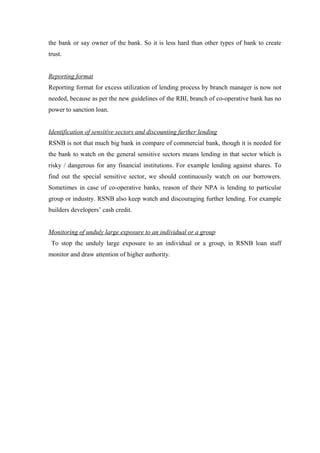
Loan pricing 
RSNB always give more interest on deposit than other bank in Rajkot district to attract 
the market, effects the loan pricing. So loan rate of RSNB is higher. Though RSNB get 
customer because of its services, its speedy process, practical approach, and its reliability 
in market. But here one possibility is also that the payer of higher interest is sometime 
reason for future loss or burden on bank. So try to get deposit at lower rate to reduce the 
loan pricing. It is also fact that in this critical situation of co-operative banks, it is very 
hard to get deposits from the market but if bank management tries to create trust in 
public, here one more benefit is that the depositor and the borrower is the shareholder of
the bank or say owner of the bank. So it is less hard than other types of bank to create 
trust. 
Reporting format 
Reporting format for excess utilization of lending process by branch manager is now not 
needed, because as per the new guidelines of the RBI, branch of co-operative bank has no 
power to sanction loan. 
Identification of sensitive sectors and discounting further lending 
RSNB is not that much big bank in compare of commercial bank, though it is needed for 
the bank to watch on the general sensitive sectors means lending in that sector which is 
risky / dangerous for any financial institutions. For example lending against shares. To 
find out the special sensitive sector, we should continuously watch on our borrowers. 
Sometimes in case of co-operative banks, reason of their NPA is lending to particular 
group or industry. RSNB also keep watch and discouraging further lending. For example 
builders developers’ cash credit. 
Monitoring of unduly large exposure to an individual or a group 
To stop the unduly large exposure to an individual or a group, in RSNB loan staff 
monitor and draw attention of higher authority.
CCRREEDDIITT 
AAPPPPRRAAIISSAALL
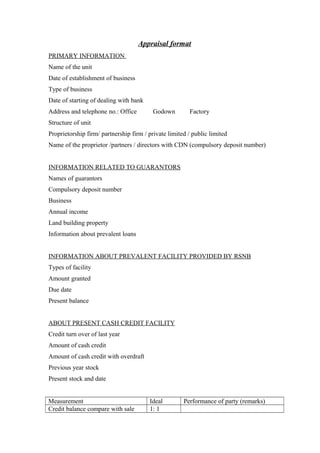
Appraisal format 
PRIMARY INFORMATION 
Name of the unit 
Date of establishment of business 
Type of business 
Date of starting of dealing with bank 
Address and telephone no.: Office Godown Factory 
Structure of unit 
Proprietorship firm/ partnership firm / private limited / public limited 
Name of the proprietor /partners / directors with CDN (compulsory deposit number) 
INFORMATION RELATED TO GUARANTORS 
Names of guarantors 
Compulsory deposit number 
Business 
Annual income 
Land building property 
Information about prevalent loans 
INFORMATION ABOUT PREVALENT FACILITY PROVIDED BY RSNB 
Types of facility 
Amount granted 
Due date 
Present balance 
ABOUT PRESENT CASH CREDIT FACILITY 
Credit turn over of last year 
Amount of cash credit 
Amount of cash credit with overdraft 
Previous year stock 
Present stock and date 
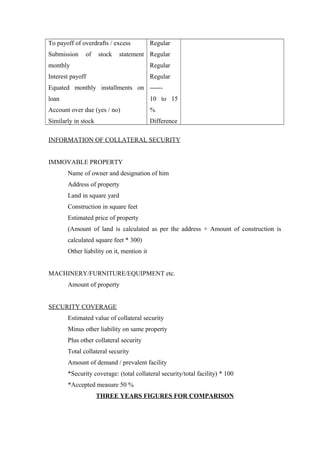
Measurement Ideal Performance of party (remarks) 
Credit balance compare with sale 1: 1
To payoff of overdrafts / excess 
Submission of stock statement 
monthly 
Interest payoff 
Equated monthly installments on 
loan 
Account over due (yes / no) 
Similarly in stock 
Regular 
Regular 
Regular 
Regular 
------ 
10 to 15 
% 
Difference 
INFORMATION OF COLLATERAL SECURITY 
IMMOVABLE PROPERTY 
Name of owner and designation of him 
Address of property 
Land in square yard 
Construction in square feet 
Estimated price of property 
(Amount of land is calculated as per the address + Amount of construction is 
calculated square feet * 300) 
Other liability on it, mention it 
MACHINERY/FURNITURE/EQUIPMENT etc. 
Amount of property 
SECURITY COVERAGE 
Estimated value of collateral security 
Minus other liability on same property 
Plus other collateral security 
Total collateral security 
Amount of demand / prevalent facility 
*Security coverage: (total collateral security/total facility) * 100 
*Accepted measure 50 % 
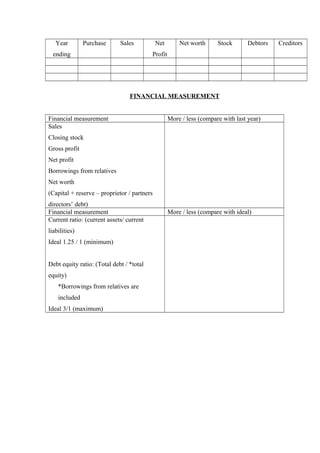
THREE YEARS FIGURES FOR COMPARISON
Year 
ending 
Purchase Sales Net 
Profit 
Net worth Stock Debtors Creditors 
FINANCIAL MEASUREMENT 
Financial measurement More / less (compare with last year) 
Sales 
Closing stock 
Gross profit 
Net profit 
Borrowings from relatives 
Net worth 
(Capital + reserve – proprietor / partners 
directors’ debt) 
Financial measurement More / less (compare with ideal) 
Current ratio: (current assets/ current 
liabilities) 
Ideal 1.25 / 1 (minimum) 
Debt equity ratio: (Total debt / *total 
equity) 
*Borrowings from relatives are 
included 
Ideal 3/1 (maximum)
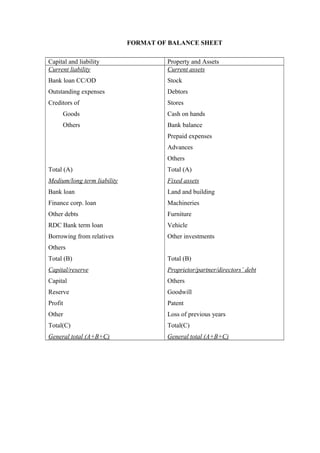
FORMAT OF BALANCE SHEET 
Capital and liability Property and Assets 
Current liability 
Bank loan CC/OD 
Outstanding expenses 
Creditors of 
Goods 
Others 
Total (A) 
Medium/long term liability 
Bank loan 
Finance corp. loan 
Other debts 
RDC Bank term loan 
Borrowing from relatives 
Others 
Total (B) 
Capital/reserve 
Capital 
Reserve 
Profit 
Other 
Total(C) 
General total (A+B+C) 
Current assets 
Stock 
Debtors 
Stores 
Cash on hands 
Bank balance 
Prepaid expenses 
Advances 
Others 
Total (A) 
Fixed assets 
Land and building 
Machineries 
Furniture 
Vehicle 
Other investments 
Total (B) 
Proprietor/partner/directors’ debt 
Others 
Goodwill 
Patent 
Loss of previous years 
Total(C) 
General total (A+B+C)
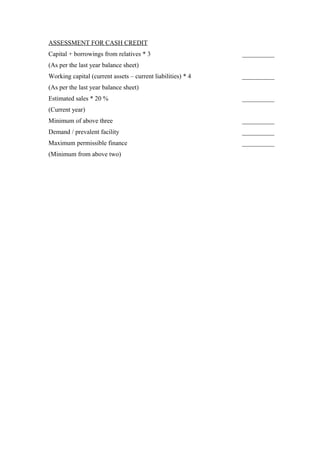
ASSESSMENT FOR CASH CREDIT 
Capital + borrowings from relatives * 3 __________ 
(As per the last year balance sheet) 
Working capital (current assets – current liabilities) * 4 __________ 
(As per the last year balance sheet) 
Estimated sales * 20 % __________ 
(Current year) 
Minimum of above three __________ 
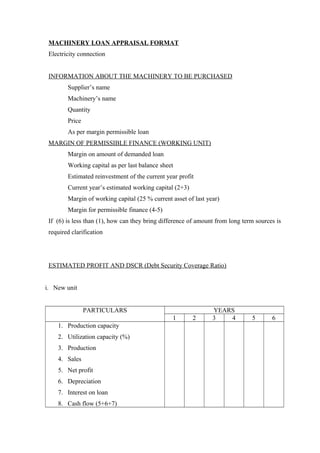
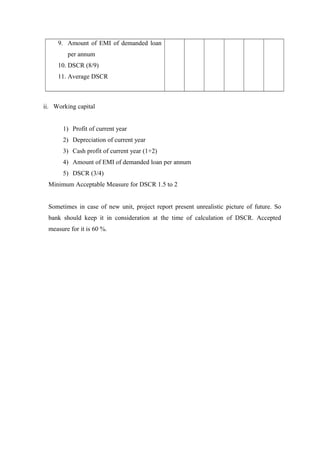
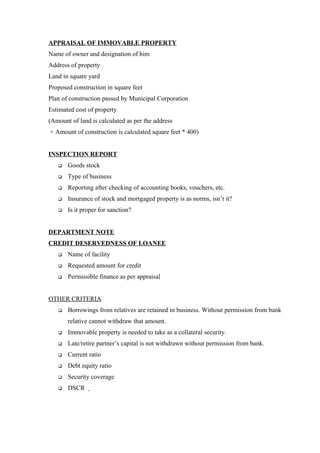
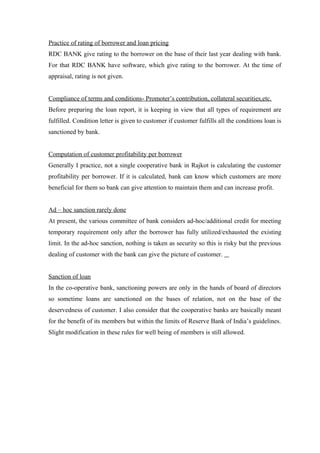
Demand / prevalent facility __________ 
Maximum permissible finance __________ 
(Minimum from above two)
MACHINERY LOAN APPRAISAL FORMAT 
Electricity connection 
INFORMATION ABOUT THE MACHINERY TO BE PURCHASED 
Supplier’s name 
Machinery’s name 
Quantity 
Price 
As per margin permissible loan 
MARGIN OF PERMISSIBLE FINANCE (WORKING UNIT) 
Margin on amount of demanded loan 
Working capital as per last balance sheet 
Estimated reinvestment of the current year profit 
Current year’s estimated working capital (2+3) 
Margin of working capital (25 % current asset of last year) 
Margin for permissible finance (4-5) 
If (6) is less than (1), how can they bring difference of amount from long term sources is 
required clarification 
ESTIMATED PROFIT AND DSCR (Debt Security Coverage Ratio) 
i. New unit 
PARTICULARS YEARS 
1 2 3 4 5 6 
1. Production capacity 
2. Utilization capacity (%) 
3. Production 
4. Sales 
5. Net profit 
6. Depreciation 
7. Interest on loan 
8. Cash flow (5+6+7)
9. Amount of EMI of demanded loan 
per annum 
10. DSCR (8/9) 
11. Average DSCR 
ii. Working capital 
1) Profit of current year 
2) Depreciation of current year 
3) Cash profit of current year (1+2) 
4) Amount of EMI of demanded loan per annum 
5) DSCR (3/4) 
Minimum Acceptable Measure for DSCR 1.5 to 2 
Sometimes in case of new unit, project report present unrealistic picture of future. So 
bank should keep it in consideration at the time of calculation of DSCR. Accepted 
measure for it is 60 %.
APPRAISAL OF IMMOVABLE PROPERTY 
Name of owner and designation of him 
Address of property 
Land in square yard 
Proposed construction in square feet 
Plan of construction passed by Municipal Corporation 
Estimated cost of property 
(Amount of land is calculated as per the address 
+ Amount of construction is calculated square feet * 400) 
INSPECTION REPORT 
 Goods stock 
 Type of business 
 Reporting after checking of accounting books, vouchers, etc. 
 Insurance of stock and mortgaged property is as norms, isn’t it? 
 Is it proper for sanction? 
DEPARTMENT NOTE 
CREDIT DESERVEDNESS OF LOANEE 
 Name of facility 
 Requested amount for credit 
 Permissible finance as per appraisal 
OTHER CRITERIA 
 Borrowings from relatives are retained in business. Without permission from bank 
relative cannot withdraw that amount. 
 Immovable property is needed to take as a collateral security. 
 Late/retire partner’s capital is not withdrawn without permission from bank. 
 Current ratio 
 Debt equity ratio 
 Security coverage 
 DSCR
OBSERVATION AND FINDINGS AND SUGGESTIONS 
Format for collection of minimum information about potential borrower 
It is must for any bank who wants to win market to collect the information about his 
potential customer. RSNB a bank which eager to increase own market share also collect 
the information about future borrower. 
Use of software for credit appraisal 
Bank has own computer department to develop the software for bank but this is in the 
initial stage. Majority time consume work is done by the computer though appraisal of 
credit is done by manually. 
Revision in appraisal format during last two year 
RSNB prepared its policy before two year and decide proper criteria for sanction the loan. 
Different appraisal format for different loan segment 
There is one common format for all loans are not possible because each loan require 
particular information and calculation. Here in RSNB I find different appraisal format for 
different segments. That we see in above appraisal format. 
System of fixation of maximum time for loan sanction and sanction within limit 
On paper, there is no maximum limit for sanction the loan but generally as per the 
opinion of officer within ten days loan is sanctioned. Sometimes because of carelessness 
of the borrower or take time for providing needed documents is reason for delay of 
sanction the loan. 
In house expertise for appraisal of hi tech projects 
Special works always need experts but in RDC BANK we find lack of the expert for 
appraisal of hi tech project and it is dangerous pr say risky for any institution. I think 
RDC BANK have to recruit expert for appraisal of hi tech projects who has special 
knowledge about business sector and mastery of project report study and now because of 
VRS, expert having experience is easily available at low cost.
Practice of rating of borrower and loan pricing 
RDC BANK give rating to the borrower on the base of their last year dealing with bank. 
For that RDC BANK have software, which give rating to the borrower. At the time of 
appraisal, rating is not given. 
Compliance of terms and conditions- Promoter’s contribution, collateral securities,etc. 
Before preparing the loan report, it is keeping in view that all types of requirement are 
fulfilled. Condition letter is given to customer if customer fulfills all the conditions loan is 
sanctioned by bank. 
Computation of customer profitability per borrower 
Generally I practice, not a single cooperative bank in Rajkot is calculating the customer 
profitability per borrower. If it is calculated, bank can know which customers are more 
beneficial for them so bank can give attention to maintain them and can increase profit. 
Ad – hoc sanction rarely done 
At present, the various committee of bank considers ad-hoc/additional credit for meeting 
temporary requirement only after the borrower has fully utilized/exhausted the existing 
limit. In the ad-hoc sanction, nothing is taken as security so this is risky but the previous 
dealing of customer with the bank can give the picture of customer. 
Sanction of loan 
In the co-operative bank, sanctioning powers are only in the hands of board of directors 
so sometime loans are sanctioned on the bases of relation, not on the base of the 
deservedness of customer. I also consider that the cooperative banks are basically meant 
for the benefit of its members but within the limits of Reserve Bank of India’s guidelines. 
Slight modification in these rules for well being of members is still allowed.
CCRREEDDIITT 
MMOONNIITTOORRIINNGG,, 
FFOOLLLLOOWW UUPP AANNDD 
RREEVVIIEEWW
CREDIT MONITORING, FOLLOW UP AND REVIEW 
When we lend, it is essential for us that to keep watch on it till we recover it. This is 
called credit monitoring in terms of banking. 
CREDIT MONITORING SYSTEM IN RSNB 
In the RDC BANK, there is system for credit monitoring specially account, which is 
above 10,00,000 rupees is described below: 
Find out the list of potential NPA accounts above 10,00,000 rupees 
Statements of potential NPA accounts are submitted to head office from branches 
Head office monitoring this every three months and prepare report on it. 
Report is submitted to board of directors. 
Follow up action for credit monitoring in RDC BANK 
Consolidation of data, which comes from the branches and every month, update the data 
and generate this and use it for follow up 
Head office directly sends the notice to account holders of such accounts 
To stop the slippage of the potential NPA accounts, bank organize the committee under 
authorization of Mr. Bhatt(A.G.M.) and Mr. Vadaliya(A.D.M.) with the help every 
branch recovery officers, they try to recover. General manager arranges the meeting for 
that and gives guidelines to the committee member.
OBSERVATION FINDINGS AND SUGGESTIONS 
System of loan portfolio review and monitoring 
There is system of weekly review and monitoring of loan portfolio in the RDC BANK, 
every week a statement is prepare to be acquainted with the present credit deposit ratio, if 
this ratio is less than 70% for example 65%, it represent that bank can finance up to 5 % 
at present. 
Preparation of MIS report for loan portfolio review at board level 
Every week, present situation of loan portfolio is putting against board of directors. 
Compliance of prudential guidelines 
Exposure Ceiling : a) Individual 20% of the total capital fund 
: b) Group 50% of the total capital fund 
Priority sector lending: Priority 60% of the total advances 
: Weaker 15% of the total advances 
This is followed by the RDC BANK 
Items of priority sectors 
Advances to individuals for activities allied to agriculture 
Loans and advances to cottage/small scale industries and equipment /system for 
development of new and renewable sources of energy. 
Advances to road and water transport operators for purchase of one vehicle 
Private retail traders dealing in essential commodities (fair practice shop) 
Other private retail traders with credit limit not exceeding Rs. 5,00,000 
Small business enterprise 
Professionals and self employed persons 
Educational loans 
Housing loans not exceeding Rs. 10,00,000 
Consumption loan 
Items of weaker section 
Scheduled caste/scheduled tribe 
Women 
Others 
Timely renew and review by credit limit
Every year RDC BANK review cash credit accounts and every three years renew that 
accounts. At the time of review bank only keep in view the turnover of business, account 
inspection, field inspection, renew insurance, renew shop act license, proof of rent, 
income tax return or assessment of income tax, turnover with bank. But process of renew 
of accounts is totally inspection of party. Bank considers last three year’s business 
progress of the party and deal with bank also.
NNPPAA 
MMAANNAAGGEEMMEENNTT
How account becomes Non Performing Assets? 
Term loans 
If interest or installment of principal remains past due for a period of any two quarters it 
becomes NPA. 
Past due means is an amount due under any of the facility but not paid within 30 days 
after it becomes due. 
Cash credit and overdrafts 
If the account remains out of order for a period of any two quarters, it becomes NPA. 
Out of order means 
If the out-standing balance remains continuously in excess of the sanctioned 
limit/drawing power 
There is no credit continuously for six months or 
Credit is not enough to cover the interest debited during the same period 
Bills purchase and discounting 
If the bills remains over due and unpaid for the period of two quarters during the year it 
becomes NPA. 
Other credit facility 
If any amount to be received remains past due for a period of two quarters during the 
year, it becomes NPA.
Asset classification 
The primary (urban) co-operative banks should classify their assets into the following 
broad groups, viz. 
Performing assets 
Standard assets 
Non-performing assets 
Sub-standard assets 
Doubtful assets 
Loss assets 
Non-performing assets 
NPAs are loans given by a bank or financial institute where the borrower defaults or 
delays payments of interest or repayment of principal. Asset here also includes a leased 
asset. A NPA was defined a credit facility in respect of which interest and/or installment 
of principal has remained ‘past due’ for a specified period of time. The specified period in 
a phased manner is as under 
Year ending If interest has remained unpaid, account become NPA 
1993 
4 quarters 
1994 
3 quarters 
1995 onward 
2 quarters 
From 2004 
1 quarters 
Performing assets 
Which accounts are not in performing are performing assets. Which accounts are regular 
or cover due installments are less than six is called performing assets.
Classification Of Non-Performing Assets 
After identification of borrowed accounts as NPA the next stage is asset classification 
Standard assets 
Standard Assets is one, which does not disclose any problems and which does not carry 
more than normal risk attached to the business. Such as asset should not be an NPA. 
Sub-standard assets 
In case of sub-standard assets, the current net worth of the borrower/guarantors or the 
current market value of the security charged is not enough to ensure recovery of the dues 
to the banks in full. In other words, such assets will have well defined credit weakness 
that jeopardize the liquidation of the debt and are characterized by the distinct possibility 
that the banks will sustain some loss, if deficiencies are not corrected. 
An asset where the terms of the loan agreement regarding interest and principal have been 
re-negotiated or rescheduled after commencement of production, should be classified a 
sub standard and should remain in such category for at least 18 months of satisfactory 
performance under the re-negotiated or rescheduled terms. If interest and installment of 
loans have been paid regularly as per the terms of re-scheduled. In other words, the 
classification of an asset should not be upgraded merely as a result of rescheduling, unless 
there is satisfactory compliance of this condition. 
Doubtful assets 
An asset is required to be classified as doubtful, if it has remained in the sub-standard 
category for 12 months. As in the case of sub-standard assets, rescheduling does not 
entitle the bank to upgrade the quality of an advance automatically. 
A loan classified as doubtful thus all the weakness inherent as that classified as sub-standard, 
with the added characteristic that the weaknesses make collection or liquidation 
in full, on the basis of currently known facts, conditions and values, highly questionable 
and importable. 
Loss assets 
A loss asset is one where loss has been identified by the bank or internal or external 
auditors or by the co-operation department or by the Reserve Bank Of India inspection 
but the amount has not been written off, wholly or partly, in other words, such an asset is
considered un-collectible and of such little value that its continuance as a bankable asset 
is not warranted although there may be some salvage or recovery value. 
PROVISION FOR NPA 
Assets classification % Of provision to be made 
Standard assets 
Sub standard assets 
(On the balance out standing MINUS amount guarantee 
by ECGC and amount covered by term deposit, NSV, 
IVP, KVP, SV and LIC policy) 
Doubtful assets 
1. On liability covered by ECGC 
2. On secured liability minus amount covered by 
term deposit, NSC, IVP, KVP, SV and LIC 
policy 
A. Doubtful up to 1 year 
B. Doubtful for above 1 year but not 3 year 
C. Doubtful above 3 years 
3. On unsecured liability 
Loss 
(On the balance out standing minus amount guaranteed 
by ECGC) 
0.25 % 
10 % 
Nil 
20 % 
30 % 
50 % 
100 % 
100 % 
Provision against NPA is adequate in RDC BANK, which express the sound condition of 
the bank. The bad and doubtful debt reserve was strengthened and the net NPA levels 
have been brought down to zero.
Findings for NPA 
 Improper selection of borrowers activities 
 Weak appraisal system for credit proposal industries problem/prospects not locked 
into 
 Managerial competence of borrower given less consideration 
 Irregularities in deficiencies in documentation- 
Undated 
Not renewed 
 Assessment of borrower and guarantors net worth on market opinion 
 Lack of review of borrowed accounts 
 Inadequate staff to contact borrowers frequently 
 Lack of proper follow up by banks 
 Failure to take punitive (strict and effective) actions against defaulters 
 Bank’s failure to appreciate the acts of prompt repayers 
 Under financing/non financing in time of projects 
 Mentality and attitude to default willfully 
 Non action/co-operation of government agencies in recovery 
 Effect of agricultural debt relief scheme 
 Inadequate monitoring of court cases and delays in execution 
 Socio-physical pressure by some people/activities 
 Target fulfilling under govt. poverty alleviation programme 
 Lack of income generation due to natural calamities and other uncertainties
(Suggestions) NPA reduction techniques: 
Small NPA loans (loans up to Rs.1 lacs) 
Repaying capacity can be easily gauged 
Mobilizing liquid cash for meeting the debt is not difficult 
Written remedies and repeat personal calls help mostly 
Legal action is time consuming 
Influence of other local persons’ contacts helpful 
NPA-larger than small but medium (above Rs.1 lac and up to 5 lac) 
Branch team can talk to the borrower and work out the repayment programme 
Debts can be settled through Lok Adalat 
Influence of trade professional circles, associates useful 
Medium size NPA (once Rs.5 lacs and up to Rs. 25 lacs) 
SWOT analysis and analysis of security will be helpful 
Branches should take advice of H.O. from time to time 
Whether to have legal action or to go for compromise 
Take legal advice 
Large NPA (over Rs. 25 lacs) 
Calls for intervention not only by head office staff but also specialists and senior 
management 
Legal, technical advice called for 
Support of state govt. and SFC in selling assets 
Threat of winding up action would be useful
RREECCOOVVEERRYY
Recovery 
Recovery management consist of the functions and activities the bank carries out acquire 
back what the bank has advanced with principal amount as well as interest on the same. 
So it is recovery of what the bank has advanced to loanee for carrying out their purpose/ 
objective of taking a loan. 
PROCESS OF RECOVERY 
If three installments are outstanding, 
Notice through branch office 
Personal visit and meeting 
If no response 
Notice through advocate 
Though no effect 
Claim through court if party ready, of court settlement otherwise 
After completion of formalities 
Bank will get the order of security from court to recover their due.
Observation/finding 
Mission zero NPA 
One historical event that occurred during the last quarter of the year was that all the staff 
members of the banks took upon themselves of their own volition the task of recovery 
and a zero NPA project was launched under the guidance of senior officers of head office 
and the directors of the bank. 
During this year RBI had tightened the NPA norms for default from 180 days to 90 days. 
Despite this tightened norms, the efforts put in by the staff members on their own helped 
the bank effect substantial recoveries of NPAs during the year and also prevent slippage 
towards NPAs. 

One Time Settlement scheme 
One time settlement scheme is the plan of reserve bank of India to clear the balance sheet 
and put realistic position of bank against common public. Before this scheme the amount 
of performing assets was very high in balance sheet of the bank and in real the bank does 
not earn it. To reduce the NPA through recovery of their maximum possible amount 
(principal) and other (interest, penalty interest, charges) write off from the bad debt 
reserve. 
The accounts, which are not getting benefit of one time settlement 
 Cases of willful default, frauds and malfeasance 
 Loan with tie up arrangement for recovery (e.g. loans avail by salary earners) 
 Loans avail of or guaranteed by directors or by close relatives of directors or by 
firms/companies/institutions in which the directors are the interested or by ex-directors 
of respective urban co-operative banks 
 Loans guaranteed by government (including cases where government guarantee 
has been invoked but not honored by the government) 
 Loans due from government departments/undertakings 
 Loans under government directed programmes
LIMITATION OF STUDY 
Though I have selected the biggest co-operative bank for my study and no doubt here I 
have learnt a lot, but compared to nationalize bank, its network is small. The procedure of 
credit appraisal, various interest rates on different schemes, recovery programmes are 
specific to Rajkot Nagarik Sahakari Bank Ltd. 
Also credit management is wide topic; I have tried to cover the most related with it.
BIBLIOGRAPHY 
Shekhar K.C. Banking Theory and Practices. New Delhi: Vikas publishing house pvt. 
Ltd., 1985. 
Bedi H.L.; Hardikar V.K. Practical Banking Advances. New Delhi: Institute of banking 
studies, 1975. 
Rao S.S. Handbook for Editors and Writers.ahmedabad: Ahmedabad Management 
Association, 1999.

credit management

  • 1.
    Project Report on CREDIT MANAGEMENT & NPA OF RAJKOT DISTRICT CO-OPERATIVE BANK LTD. (RDC BANK) A PROJECT REPORT SUBBMITTED IN PARTIAL FULFILLMENT OF THE M.B.A. DEGREE PROJECT GUIDE Mr. PARSOTAMBHAI TALAVIYA, STATISTICS OFFICER, RDC BANK LTD. SUBMITTED BY DHAMSANIA VISHAL (ROLL NO. )
  • 2.
    S.K.PATEL INSTITUTE OFMANAGEMENT AND COMPUTER STUDIES GANDHINAGAR, INDIA JULY 2005
  • 3.
    PREFACE Banks areregarded as the blood of the nation’s economy without them one cannot imagine economy moving. Therefore banks should be operated very efficiently, co-operative banks although a small part of whole banking system in India, but they are very important not only from economical point of view but also from social point of view as it is more concerned about common people’s welfare and development. Advance is heart and recovery is oxygen for the bank and for the bank to survive it is necessary to give advances and recover the amount at the appropriate time. Through credit management I have tried to cover the various aspects like credit appraisal, NPA management, recovery management, etc. E.g. credit management covers all the areas right form the beginning like inquiry till the loan has been paid up. Though credit management, a very vast topic, I have tried to incorporate to the best of my capacity from all possible aspects in this project. I do hope that institution will appreciate this project.
  • 4.
    ACHNOWLEDGEMENT “We cannot determine milk of how many cows feed our body.” – Anon I believe an ocean is filled by drops and each and every drop should count, similarly I should count favor of all my helpers here but this not possible. So forgive me for the same. First of all I would like to thank Board of Directors. I am thankful to manager G.C.Raol to give me permission for the summer training. I want to express my sincere obligation to Kotak Sir, Kumarilbhai, Shileshbhai Nathwani, Hiteshbhai Rachchh, and all the staff members of RDC BANK BANK, where I worked so long in a homely pleasant atmosphere. Especially, I would like to thank Salimbhai Bloch and Rajnibhai Raichura, my mentor who guided me in my work. I am thankful to Mr. Khandelwal (principal of our college) and Mr. viral sir for their guidance and Mr. Niraj Amarnani for the arrangement of summer placement. Last but not least my family, which is always behind me in my work for support any time.
  • 5.
    OBJECTIVE OF STUDY Banking is the activity of my interest. I have seen from the annual reports of the various banks and find that most of their income is from the interest getting on the credit given so I choose and hence I studied on credit management. Game of statistics is always attracts me and banking is one the place where we can learn it very well. So I have selected bank and have preferred “credit management” as topic for my project.
  • 6.
    RESEARCH METHODOLOGY Thereare many methods, which are well known today for research methodology, out of which one I have chosen is “sampling method”, which is really easier, still producing accurate results. Sampling in laymen’s language, is nothing but selecting pockets or samples representing the whole group and analysis of these samples gives the idea about the respective groups. On the basis of this, prediction is done and full information about group is integrated. Though this is not a first hand method, it gives sufficiently good outcomes if used carefully by experts. It saves the time and energy. The only care should be taken, in order to have great accuracy, is selection of sample should be such that it should represent the whole group and information we get from them should be cent percent reliable. Salient features of my chosen sample  The biggest co-operative bank having head office in my vicinity enables me to do my work efficiently. This is the striking feature of my sample.  The exclusive schedule bank in Rajkot and hence gets priority over the others.  Generally the new bank lacks the experience so it is mandatory to select a sample, which has enormous experience. RDC BANK has a gigantic experience of successful 50 years, under the lights of which work becomes easier.  The other enchanting point is that RDC Bank have maximum number of shareholder i.e. above 2 lacs.
  • 7.
    CONTENT Preface Acknowledgement Objective of study Research methodology Content INTRODUCTION Early history of banking Origin of word ‘bank’ Status wise bifurcation of bank Types of bank RDC BANK - The Small Man’s Big Bank PROJECT Main Fund Inflow (sources of funds) Main fund outflow (funds used) Meaning of credit and credit management Forms of credit/advances Time wise bifurcation of advances Security wise bifurcation of advances Process of credit CREDIT POLICY General eligibility criteria for credit in RDC BANK Table of interest rate on various advances Scrutiny of credit Types of credit Explanation of all types of credit Data analysis and observation and suggestion CREDIT APPRAISAL Appraisal format
  • 8.
    Observation and suggestion CREDIT MONITORING, FOLLOW UP AND REVIEW Credit monitoring system in RDC BANK Follow up actions for credit monitoring in RDC BANK Observation and suggestion NPA MANAGEMENT Identification of Non Performing Advances Asset classification Classification of Non Performing Advances Provision for NPA Findings (reason for NPA) Suggestions (NPA reduction techniques) RECOVERY Process of recovery Finding/observation LIMITATION OF STUDY BIBLIOGRAPHY
  • 9.
  • 10.
    EARLY HISTORY OFBANKING As early as 2000 B.C., the Babylonians has developed a banking system. There is evidence to show the temples of Babylon were used as banks. After a period of time, there was a spread of irreligion, which soon destroyed the public sense of security in depositing money and valuable in temples. The priests were longer acting as financial 45 agents. The Romans did minute regulations, as to conduct private banking and to create confidence in it. Loan banks were also common in Rome. From these the poor citizens received loans without paying interest, against security of land for 3 or 4 years. During the early periods, although private individuals mostly did the banking business, many countries established public banks either for the purpose of facilitating commerce or to serve the government. However, upon the revival of civilization, growing necessity forced the issued in the middle of the 12th century and banks were established at Venice and Genoa. The Bank of Venice established in 1157 is supposed to be the most ancient bank. Originally, it was not a bank in the modern sense, during simply an office for the transfer of the public debt. Again the origin of modern banking may be traced to the money dealers in Florence, who received money on deposit, and were lenders of money in the 14th century and also in 1349, the business of banking was carried on by drapers of Barcelona. In India, as early as the Vedic Period, banking, in most crude from existed. The books of Manu contain references regarding deposits, pledges, policy of loans, and rate of interest. True, the banking in those days largely mint money lending and they did not know the complicated mechanism of modern banking. This is true not only in the case of India but also of other countries. Although, the business of banking is as old as authentic history, banking institutions have since than changed in character and content very much. They have developed from a few simple operation involving the satisfaction of a few individual wants to the complicated mechanism of modern banking, involving the satisfaction of capital slowly seeking employment and thus providing the very life blood of commerce.
  • 11.
    THE ORIGIN OFWORD ‘BANK’ The word ‘Bank’ itself derived from the word ‘bancus’ or ‘banque’ that is a French. There were others of the opinion that the word ‘Bank’ is originally derived from the German word ‘back’ meaning joint for which was Italianised into ‘banco’.
  • 12.
    STATUS WISE BIFURCATIONOF BANKS Scheduled Banks. Non-Scheduled Banks. Scheduled Banks In first schedule, Government of India notifies the Primary Banks, which are licensed and whose demand and time liability are not less than 50 crores in 1987. Government of India notifies the Primary banks, which are licensed and whose demand and time liability are not less than 100 crores can only qualify to be included in the second schedule since 1993. A bank becomes scheduled when it fulfils the followings: ‘A’ grade rating from RBI Demand and Time Liability over 100 Crores Satisfy the RBI guidelines related to CRR and SLR As per the norms Priority Sector wise lending Benefits of Being a Scheduled co-operative are described below: RBI would provide Rediscounting facility at nominal rate RBI gives remittance facility at par The demerit of being a scheduled co-operative bank is that the bank will not get 0.5% subsidy from RBI. The conferment of scheduled status on the banks has certain advantages like refinance facility, directly industrial finance from Reserve Bank of India, avail of Reserve Bank of India Remittance facility scheme, accept deposits from local bodies, quasi-government organization, religious, and charitable institutions, guarantees and cheques issued by Banks are accepted by Government Departments. At the same time, it casts greater responsibility on the banks in the maintenance of books of accounts and submission of returns. Non-Scheduled Bank The banks, which are not applicable as per the criteria of Scheduled Banks, are called as a Non-scheduled Banks. These are very small banks. TYPES OF BANKS Regional Rural Bank Nationalize Bank
  • 13.
    State Bank Group Co-operative Bank Private Bank Foreign Bank RESERVE BANK OF INDIA The Hilton-young commission, appointed in 1926 has recommended the necessity of centrally empowered institution to have effective control over currency and financial transaction in the country. Accordingly, the Government had then passed Reserve Bank of India Act, 1934 and established the Reserve Bank of India with effect from 1st April 1935. The principal aim behind this was to organize proper control over the currency management in the interest of country benefits and to maintain financial stability. With this, the RBI mainly looks after the following important functions: To keep effective control over creation of credits and currency supply To control the Banking transactions of Central and State Governments To act as Central administered Authority of all other Banks in the Country. To organize control over Foreign Currency Transaction To assist for improvement in financial aspects of the country Nationalize Banks The Banking Company Act establishes it in July 1969 by nationalization of 14 major banks of India. The sent percent ownership of the bank is of government of India. State Bank Group The State Bank of India was established under the State Bank of India Act, 1955, the subsidiary banks under the State Bank of India (subsidiary Banks) Act, 1959. The Reserve Bank of India owns the State Bank of India, to a large extent, and rest of the part is some private ownership in the share capital of State Bank of India. The State Bank of India owns the subsidiary Banks. Old Private Banks These banks are registered under Company Act, 1956. Basic difference between co-operative banks and private banks is its aim. Co-operative banks work for its member and private banks work for earn profit.
  • 14.
    New Private Banks These banks lead the market of Indian banking business in very short period, because of its variety of services and approach to handle customer, also because of long working hours and speed of services. This is also registered under the Company Act, 1956. Foreign Banks Foreign Bank means multi-countries bank. In case of India Foreign Banks are such Banks, which open its branch office in India and their head office is outside of India. Regional Rural Banks (RRB) Regional Rural Banks are added in Indian Banking since October 1975. The Government of India in terms of the provision of the Regional Rural Bank Act 1976 has established these banks. The distinctive feature of Regional Rural Bank is that through it is a separate body corporate with the Commercial Bank, which has sponsored the proposal to establish it. The Central Government, while establishing a Regional Rural Bank at the request of a Commercial Bank, shall specify the local limits within which it shall operate. The Regional Rural Bank may establish its branches or agencies at any place within the notified area. State Bank of Saurashtra sponsors Regional Rural Banks in Saurashtra. Co-operative Banks State Co-operative Banks State Co-operative Bank means the principal Co-operative society in the state. The primary objective of which is the financing other co-operative societies in the state. Central / District Co-operative Banks Central / District co-operative Bank means the principal co-operative society in a district, the primary objective of which is the financing of other co-operative in that particular district. Primary / Urban Co-operative Banks The primary objective of principal business of which the transaction is of banking business and paid up share capital and reserve of which are not less than rupees 100,000
  • 15.
    and bye-laws ofwhich do not permit admission of any other co-operative society as a member.
  • 16.
    RDC Bank -The Small Man’s Big Bank Rajkot District Co-operative Bank is a leading Co-Operative Bank in Gujarat State, India. Bank was established in the year 1959 with a small Capital Of Rs. 4890 and Membership of 59 persons under the leadership of Late Vallabhbhai P. Patel as a Chairman, and Late Janmashankar Antani as a M.D. Bank has made tremendous & real progress under the leadership of former Chairman Late Shri Arvindbhai Maniar. Bank is celebrating its 50th anniversary (Golden Jubilee) year this year. During past years bank has played vital & leading role for the development of industries, business & Economy of Rajkot City, Development and nursing of Co-operative movement in the Saurashtra region of Gujarat State. Bank was the first co-operative institute to start functioning in the erstwhile state of Saurashtra. “SAHAKAR MAHARSHI” late Shri Vainkunthbhai Metha inaugurated bank. Bank has developed in manifolds with the time. Membership (Share Holder) of bank is mounting towards 2,50,000/-, which is a record by itself & provides an example of how a mass movement can be turned into the instrument for social upliftment. To day Bank has more than 600,000+ deposit accounts with a deposit base of 711+ Crores, And 40000+ Establishments/Individuals enjoy the facility of Rs 485+ Crores of Advances. Since inception the people with foresight & vision, which Includes the names Like Shri Keshubhai Patel, Shri Vajubhai Vala, Shri Shashikant Mehta, Shri Vasantbhai Khokhani, Shri Pravinbhai Maniyar, Shri Shivlalbhai Vekaria etc, guided bank. Being in the service sector, with a vision of current & future trends, Bank started automation & modernization way back in 1987 and by 1995 all the Branches were computerized. Bank is enjoying the SCHEDULE BANK Status since 1989. Recently in year 2001 Bank was registered UNDER MULTI-STATE CO-OPERATIVE SOCIETY ACT. With this Bank has opened a Branch In Mumbai, Economic Capital of India and become MULTI-STATE SCHEDULE CO-OPERATIVE BANK. Parameters for Multi-State: NPA level is 15% bellow of total advances. Not penalized for continuous 3 years for SLR and CRR.
  • 17.
    Customers are thekey to success of any commercial organization. The bank has taken up number of projects to improve its customer services as well as facilities during the year. Some of these are listed below:  Banks has started its own website www.rsnbindia.com for the benefit of customers.  A kiosk has been installed at the Para Bazaar branch for facilitating the customer needs for account balances and status without the help of banks staff. This also ensures secrecy of customer account.  Banks has started issuance of free drafts on its own branches for the benefit of customers.  Drafts as well as term deposit receipt are now being issued online (immediately) at all branches.  Computerized passbook printers have been installed at all branches.  Locker facility 24 hours available. Bank has also taken up the project of installing technologically upgraded core banking solution that will network all the branches as well as provide anywhere banking services. This project has already been launched and the work is progressing at a fast pace. Bank has recently started five new credit products for customers: Small business and industrial credit scheme: This scheme covers the business and industries, which are in existence for minimum 3 years. This scheme is for the working capital requirement of business or industry in the form of overdraft. “One guarantor and stock statement once a year” - is specialty of this scheme. Tatkal (On the spot) credit scheme: Purpose of this scheme is to fulfill the current requirement (like business, marriage, medical treatment, education). This is given in the limit of Rs.1 lac against the security of immovable property. This loan is required to be paid in the monthly installments of 12 to 24. Specialty of the scheme is that within 24 hour you can get the loan
  • 18.
    Scheme for thesocial responsibilities requirement: This scheme covers the social responsibilities, medical treatment and other occasions. In this scheme loan is sanctioned against security of immovable property in the limit of Rs.5 lac. Maximum loan repayment period is 36 months. Building repairing/renovation loan scheme: Recently bank has increased limit of loan amount from Rs.75000 to Rs.200000 for the Rajkot, Ahmedabad, Surat city and for other branches to Rs.100000. Loan against N.S.C. / K.V.P. / L.I.C. Policy scheme: The loan amount is given in the form of overdraft.
  • 19.
  • 20.
    MAIN FUND INFLOW(SOURCES OF FUNDS) Owned deposit Deposits Borrowings Others Owned deposit The owned funds consisting of paid capital of the bank, reserve fund, and other reserves. Deposits It is sum of current deposits, fixed deposits, saving deposits, special saving deposits, NRI deposits, inoperative deposits, etc. It is the main Cash Inflow for any institution. Borrowings The borrowed funds consisting of borrowings from other banks (as per some writer deposits of various types is also part of borrowed funds), debentures offered to public, etc. Others Increase in current liabilities, reduction in debtors, fund from operations like net income, depreciation, and reserves, less payment to creditors, reduction in advances, reduction in inventories, reduction in cash, sold marketable securities, etc.
  • 21.
    MAIN FUND OUTFLOW(FUNDS USED) CRR (Cash Reserve Ratio) with Reserve Bank of India SLR (Statutory Liquidity Ratio) in Reserve Bank of India approved securities Loanable Fund Others CRR (Cash Reserve Ratio) with Reserve Bank Of India The capacity of credits creation of bank is depending upon their cash flow received. To restrict this credit creation, the reserve bank of India has directed their terms. In case of scheduled banks and sec.18 of banking regulation act are required to maintain the cash reserve ratio *@ 4.75% and non-scheduled bank @ 3% of their demand and time liability amounts separately. The scheduled banks are required to deposit the cash reserve ratio amount with Reserve Bank of India while the non-scheduled banks are required to maintain separate account for this. The Reserve Bank of India is also empowered to raise the cash reserve ratio up to 15% only in respect of scheduled banks. It is maintained reported to RBI every fortnight. *30th April RBI declared new credit policy and as per that RBI reduced CRR with 0.25% Demand and time liability: Time liability is related with time like, fixed deposits Demand liability is related with the demand like, Current deposits, inoperative deposit, and matured fixed deposits SLR (Statutory Liquidity Ratio) The cash flow for regular banking transactions mainly depends upon deposit received in the bank. The reserve bank of India therefore puts some restrictions on utilization of these amounts. The scheduled and non-scheduled banks are required to deposit 25% amount of their demand and time liability amount in the security approved by reserve bank of India. These securities are converted into cash and therefore they are termed as ‘liquid assets’ and 25% amount termed as ‘liquid ratio’. The reserve bank of India is empowered to raise this liquidity ratio from 25% to 40%. It is maintained average fortnight and reported to RBI. Loanable Fund
  • 22.
    Credit deposit ratiois not more than 70%. Loanable funds means amount of money, which is applicable for lending. Three main factors own fund, deposits, and borrowings decide it. Advances can never be more than loanable fund. Loanable fund is a total of:  75% of own funds  70% of deposits  100% of borrowings Others Purchase of fixed assets, purchase of marketable securities, addition to advances, addition to inventories, payment to creditors, payment of dividend, etc..
  • 23.
    Meaning of CREDIT The word ‘credit’ is actually derived from the Latin word ‘Credere’. ‘Credere’ means to have trust or faith. Thus ‘credit’ is directly related with trust. That is why State Ford stated that ‘Credit is nothing more than that of trust’. By this we can say that credit is a tool that is resulted by the complete mutual trust/faith. ‘Credit creation implies a situation when a bank may receive interest simply by permitting customer to overdraw their accounts or by purchasing securities and paying for them its own cheque or bank may pay amount to borrower or directly to seller of goods whom against borrower get amount’. CREDIT MANAGEMENT Credit management means the total process of lending start from inquiry from potential borrower to recover the lending amount from borrower. Whenever my study is concern, credit management in sense of banking sector is the set of activities like accept application, loan appraisal, Shakh posting, monitoring, recovery, NPA management, etc.
  • 24.
    FORMS OF CREDIT/ADVANCES Loan (term loan) Cash credit and overdrafts Purchase /discounting of bills Bank guarantee ANY OTHER GIVEN Loan/term loan In case of a loan a specified amount is sanctioned by the banker to the customer, who may either draw the amount in case immediately or may like the amount to be credited to his current account. But legally it is presumed that he has withdrawn the amount from the bank and deposited it in his current account. He is required to pay interest on the full amount from the date of sanction. A loan may be repayable in installments or in lump sum. Cash credit Cash credit is the main method of lending in India and accounts for above 70% of total bank credit. Under the system, the banker specifies the limit, called the cash credit limit for each customer, up to which the customer is permitted to borrower against the security of tangible assets or guarantees. The customer withdraws from his cash credit account as and when requires the funds and deposits any amount of money, which he finds surplus with him on any day. The cash credit amount is thus an active and running account to which deposits and withdrawals may be affected frequently. The customer is required to provide tangible assets as security to cover the amount borrowed from the banker. The borrower is charged interest on the actual amount utilized by borrower and for the period actually utilized only. Overdrafts When a current amount holder is permitted by the banker to draw more than what stands to his credit, such an advance is called an overdraft. The banker may take some collateral security or may grant such advance on the personal security of the borrower. The customer is permitted to withdraw the amount as and when he needs it and to repay it by
  • 25.
    means of depositin his account as and when it is feasible for him. Interest is charged on the exact amount overdrawn by the customer and for the period of its actual utilization Bills Purchase The Banker credits customer’s account with the amount of the bill after deduction his charges. As the demand bills are repayable on demand and there is no maturity, the banker is entitled to demand their payment immediately on presentation before of drawee. Their practice adopted in the case of demand bills, is known as purchase of the bills. Bills Discount In case of bills discounting, a bank credits the amount of the bill to the drawer’s account before the realization of the bill and thus lends its funds to him after deduction his charges. The bills purchased and bills discounted by a bank are, therefore, shown in its balance sheet as part of loans and advances. In case of a bill maturing after a period of time maximum for 180 days in RDC BANK, the banker retains the bill for that period and realizes the amount of bill from the drawee on its due date. This practice is called discounting of the bill. Bank Guarantee It is a contract to perform the promise or discharge the liability of a third person in case of his default. In case of guarantee, Bank is taking responsibility to pay the amount to seller if buyer will not pay amount in time.
  • 26.
    TIME WISE BIFURCATIONOF ADVANCES - Short-term Finance : Up to 26 months - Medium-term Finance : 26 to 66 months - Long-term Finance : Above 66 months SECURITY WISE BIFURCATION OF ADVANCES Secured Finance / Advances: Secured Advances are those advances, which provide absolute safety to the Banker by means of a charge, created on the tangible assets of the borrower in favor of the Banker. In such cases, the Banker gets certain rights in the tangible assets over which a charge is created. A Secured Loan or Advance means a loan or advance made on the security of assets, the market value of which is not at any time less than the amount of such loan or advance. Unsecured Finance / Advances: Unsecured Loan or Advance means a loan or advance, which are not secured, this types of advances is not preferable for any banking institutions.
  • 27.
    PROCESS OF CREDIT Application inward Shakh report Advocate report Branch report Loan report Inspection report Committee report Fulfill conditions Equitable mortgage and equitable extension Make/sign document Open account Insurance posting Record department - filing Inward application A customer seeking an advance is required to submit an appropriate application form. There are different types of application forms for different types of advances available. The information furnished in the application covers, inter alias, the following: name and address of the borrower and his establishment, the details of borrower’s business, the nature and amount of security offered. The application form has to be supported by various ancillary statements like the financial statements and financial projections of the firm. A separate inquiry department is set under the loan department. Here, different types of application forms are available and collect process charge from borrower; application is accepted and entered into computer. Shakh report This is one of the strangest facility of RDC BANK compare with other co-operative banks in Rajkot district because of its computerization. This facility provides bank to total ‘kundali’ of the borrower related to dealing with bank not only as a borrower but also as partner, as a director also as a guarantor and same detail of the guarantor also and also about all the types of loans, which are already paid up, which are overdue, which are running and also about past performance of particular.
  • 28.
    Advocate report Bankthrough its legal department’s staff in two matters prepares advocate report mostly, which are given below:  In case of land and building loan  Before equitable of immovable property as a security When the bank prepares advocate report, bank charges some amount from borrower. Branch turn over report This report mostly prepare in case of cash credit review/renew, is also known as a branch turn over report. This report presents:  Performance of borrower with the branch in previous year  Debit-credit transaction of borrower,  Submission of stock statement,  Payment of interest  Last outstanding balance Processing of application/loan report The application is processed by the clerical staff and checked and passed by senior loan officer and monitoring by loan manager. The preliminary involves an examination of the following factors:  Ability, integrity, and experience of the borrower in the particular business  General prospects of the borrower’s business  Purpose of advance  Requirement of the borrower and its reasonableness  Adequacy of the margin  Provision of security  Period of payment And prepare the appraisal report for committee approval Inspection report
  • 29.
    Before presenting appraisalreport against the committee, bank sends his field officer/inspection officer to on site inspection. The situation which created by borrower by providing information of his business to bank is it fact or not? After the inspection report, this application is ready for putting against the loan committee of the bank. Inspection varies according to the various loans. For e.g. In case of cash credit he personally visits the business site and verifies the original books of accounts with that of submitted books of accounts. He verifies the real stock with the stock mentioned if any difference is found it is clearly mentioned in the report. In case of housing loan inspection officer visits the place and check whether the building is really in existence or not, whether the construction is as per the statical figure provided to him and plan is as per sanctioned by the municipal corporation. Committee approval and terms and conditions Once the application is duly processed, it is put for sanction to the appropriate authority. Here appropriate authority means various loan committees, standing committee and board of directors. Loan manager is a sanctioning authority only in case of review of cash credit facility. Types of committee and its lending powers are given below: If appropriate authority gives sanction, along with the sanction of advance the bank specifies the terms and conditions applicable to the advance. These usually cover the followings:  The amount of loan or maximum limit of the advances  The nature of the advances  The period for which advance is valid  The rate of interest applicable to the advance  The primary security to be charged  The insurance of the security  The detail of collateral security, if any, to be provided  The margin to be maintain  Other restrictions or obligations on the part of the borrower
  • 30.
    Name Of Committee 1. Board of directors 2. Standing committee 3. Reconsideration committee 4. Loan committee (Rs.500001 to 1000000) 5. Loan committee (Rs.300001 to 500000) 6. Loan sub-committee/1 (Rs.150001 to 300000) 7. Loan sub-committee/2 (Rs.75001 to 150000) 8. Loan sub-committee/3 (Up to Rs.75000) 9. Loan sub-committee/4 (Up to Rs.5,000) 10. Committee for loan against immovable property/1 (Rs.2,50,001 to 5,00,000) 11. Committee for loan against immovable property/2 (Rs.1,50,001 to 2,50,000) 12. Committee for loan against immovable property/3 (Rs.25,001 to 1,50,000) 13. Committee for loan against immovable property/4 (Up to Rs.25,000) 14. Recovery committee/1 (more than Rs.3,00,000) 15. Recovery committee/2 (Rs.1,50001 to 3,00,000) 16. Recovery committee/3 (Up to Rs.1,50,000) It is common banking practice to incorporate important terms and conditions on a stamped security document to be executed by the borrower. Rate of stamp duties are given follows: Demand promissory note : Rs. 1 Letter of guarantee : Rs. 60 *Agreement letter Up to 5,00,000 : Rs. 50 (Letter of lien) Above 5,00,000 : Rs. 2/thousand Letter of pledge : Rs. 50 Letter of continuity : Rs. 50 Agreement letter for Cash credit/Overdraft Up to 5,00,000 : Rs. 110 Above 5,00,000 : Rs. 2/thousand Maximum limit of stamp duty is Rs. 2,00,000 *Agreement letter is in case of vehicle loan, security loan, bills purchase, bills discounting, guarantee, education loan, etc.
  • 31.
    Equitable Mortgage AndEquitable Extension When the loan is sanctioned with condition that to put the real document as a mortgage in security (prime/collateral), it is must that to make the equitable mortgage of the property. Some time a property which given in mortgage by borrower is already put before the bank in case of other loan as a security at that time equitable mortgage is already done by party so there is no need of equitable mortgage again but the equitable extension is only needed. Equitable mortgage on non-judicial stamp paper Amount of sanctioned loan loan of non-judicial stamp paper for equitable mortgage Up to 15,00,000 1/2% of sanctioned loan Above 15,00,000 1% of sanctioned loan OR Rs. 1,00,000 (Whichever is less) Make/sign document This application is now in the document department, document department take signature of loanee and guarantors in specimen card and also on the sanction letter to seat beside and verify all the documents. Types of documents are discussed in each type of loan separately. This process is last for borrower, after this loan is sanctioned. No formality is remaining at the borrower side. Open account Now loan is sanctioned, all formalities are completed. So bank is giving your amount of loan either by credited in your account or pay the amount to the party, whose quotation is provided by borrower to bank. Bank opens your account with himself to get the actual transaction between bank and borrower. Insurance posting It is must for loanee to insure the property or equipment, which is hypothecated with the bank against loan as a security. This policy is assigned in favor of bank, which is also required. In case of immovable property or new purchase of machinery, equipment, etc. insurance of same amount and in case of old machinery, goods stock, etc. twice of the
  • 32.
    price insurance isneeded. In case of education loan, the life insurance of student is required. Shakh department is posting it in borrower’s account. Record department – filing Now total process is over and whole documents are need filing for bank record. Record department does this work. Record department file the documents and store it to proper place.
  • 33.
  • 34.
    General Eligibility CriteriaFor Credit In RDC Bank  As per the rules of co-operatives, any one who wants to avail finance has to become a member of the bank.  As a shareholder of the bank, he/she have to make compulsory deposit, or the payment of deposit as per rules and regulations of the bank and thereafter, he/she can submit the application for loan. In all the practice with the bank, you are known by bank through your compulsory deposit number.  The application will have to be submitted in the prescribed form, wherein all details and particulars will have to be furnished as demanded in the form. He/she has to submit further particulars as may be asked by the bank.  The loanee will be advanced loan against the security and he/she has to submit 1 or 2 guarantors, who will be the recognized member and accepted to the bank.  The interest will be calculated on month-to-month basis.  Taking in view the total amount of loans taken for different purpose by the firm or individual, the interest will be calculated at the same rate on all the advances.  It will be necessary to make payment of share deposit or loan deposit at the rate of 2.5% of the sanction in case of secured loan and 5% of sanctioned loan or in case of unsecured loan. The maximum share deposit accepted of Rs.25000 and additional deposit over Rs.25000 will be accepted as loan deposit.  The rate of interest on share deposit is 15% and that on loan deposit is 10%.  The company, who wants to take loan from bank, has to get its name registered for the said loan purpose with the registrar of companies and has to submit the document of registration charge to the bank.  In case of mortgage of immovable property steps are given below: Title clear report Equitable mortgage on non-judicial stamp paper Amount of sanctioned loan loan of non-judicial stamp paper for equitable mortgage Up to 15,00,000 1/2% of sanctioned loan Above 15,00,000 1% of sanctioned loan OR Rs.1,00,000 (Whichever is less)  Some time a property which given in mortgage by borrower is already put before the bank in case of other loan as a security at that time equitable mortgage is
  • 35.
    already done byparty so there is no need of equitable mortgage again but the equitable extension is only needed.  In case of immovable property or new purchase of machinery, equipment, etc. insurance of same amount and in case of old machinery, goods stock, etc. twice of the price insurance is needed. In case of education loan, the life insurance of student is required.  Margin money means gap between purchase value and bank finance. Bank always does payment directly to the seller. So loanee has to deposit the margin money in the bank.
  • 36.
    INTEREST RATE ONVARIOUS ADVANCES Particulars Interest rate Installment / Rs.1000 Number of installment Up to 25000(except vehicle loan) Up to 25000 vehicle loan 25001 to 200000 200001 to 1000000 Above 1000000 Surety loan, home appliances Gold loan Land and building (unsecured) up to 25000 Staff surety loan Loan against fixed deposit Building repairing up to 75000 Building purchase, construction 75001 to 200000 200001 to1000000 12% 14% 14% 15% 16% 16% 14% 16% 16% More than 2% of F.D. 14% 14% 15% 32 32 32 23 23 32 50 32 23 17 17 17 40 40 40 66 66 40 26 40 66 Till the maturity date of F.D. 108 108 108
  • 37.
    Scrutiny of credit While scrutinizing, an application from the bank takes into consideration--safety, liquidity, purpose profitability, security, and spread of advances. ANY OTHER THAN THIS? Safety Bank has to see that the prospective borrower is a reliable user of the finance and bank’s money is safe in his hands. Liquidity Bank has to find out that the borrower is quite capable in repaying the finance within reasonable period. Purpose The purpose for the finance should not be illegal. It should be creative, service oriented, development oriented, and like. Banks should check end use of funds. Profitability If the project or the purpose of the finance is not profitable in the hands of the borrower than he will not be in a position of repaying the amount to bank. It should be profitable enough to generate the income to satisfy his needs and bank’s dues. Security The bank has to take into consideration the character, capacity, and capital of the prospective borrower. Bigger advances and cash credit are to be secured with collateral security over and above prime security. Spread of advances For having balanced economy the bank should choose to spread the finance amongst various sectors of the society, so that the risk of incoming bad advances is minimized. Concentration on one type of advances may turn into bad advances if the scheme becomes ineffective due to some natural calamities or government rules or change in taste or demands of the society, by and large.
  • 38.
    TYPES OF CREDIT Surety Loan Vehicle Loan Security Loan Domestic Appliances Loan Gold Loan Land And Building Loan/Industrial Building Loan Educational Loan F.D. Loan Cash Credit Overdraft Bankable Loan Bills Purchase Bills Discounting Bank Guarantee Staff Loans Staff Surety Loan Staff Housing Loan Staff Vehicle Loan Staff Domestic Appliances Loan Gyan Prakash Yojana
  • 39.
    EXPLANATION OF ALLTYPER OF CREDIT Surety Loan Purpose Personal use Limit Rs. 5000 to 10000 Rate of interest 16% Period 40 months Repayable Equate Monthly installments Rs.32 per thousand Security Personal Guarantee of two members of the Bank Documents Loan Appliances form, Letter of guarantee, DP note, letter of Sanction. Submit Paper In case of service person pay sleep, in case of businessperson last yearly business report. Other terms ½ % of the loan amount if the loan is sanctioned to the tune of Rs. 5000 and 1% of the loan amount is sanctioned to the tune of Rs. 10000 will have to be deposited in the benefit fund. Under the above scheme, if the death of the loanee under surety loan occurs, in the said circumstances, in remaining loan in his account will be credited from this account under his loan account and an amount of Rs. 1000, as Assistance will be paid to the heirs of the loanee immediately from this fund The confirmed government employee can be granted a loan of Rs. 10000 on acceptance letter taken from his employer to the effect that they will deduct the installment from his salary every month regularly and remit the same to Bank. It is not applicable that the surety loan of other co-operative society is in presence. Domestic Appliances Loan Purpose For purchasing consumer durable articles viz. freeze, washing machine, flour mill, T.V. VCD, sewing machine, room heater, room conditioner, etc., Limit Minimum Rs. 5000 Maximum Rs. 20000 Margin 40% Rate of interest 16% Period 40 months Repayable Equate Monthly installments Rs.32 per thousand
  • 40.
    Security Hypothecation ofgoods, personal guarantee of two members of the bank Documents Loan Appliances form, Letter of guarantee, DP note, Hypothecation of goods/articles purchased, insurance policy Submit Paper In case of service person pay sleep, in case of businessperson last yearly business report, quotation of the item obtained from Authorized Dealer Security Loan (Against Machinery/Furniture & Fixtures/Equipments ) Purpose For purchasing NEW/OLD machineries/furniture for business purpose Limit Any limit as per requirement Margin 25% to 40% Rate of interest Up to 25000 12%, 25001 to 200000 14% 200001 to 1000000 15% Above 1000000 16% Period 40 months up to 200000, 66 months above 200000 Repayable Equate Monthly installments Rs.32 up to 200000, In case of more than 200000 Rs.23 per thousand Security The Hypothecation of machinery/furniture purchased as a prime security, as a collateral security (A) Existing old machineries (B) Equitable mortgage of land and building (C) Guarantee of two members of the bank as guarantors Documents Loan Application form, Letter of guarantee, DP note, Hypothecation of machineries old/new, insurance policy, letter of sanction Submit Paper Last three-year business report, Shop Act License, SSI license, Elec. Connection proof, IT Return (in case of new firm project report) If applicant is a Partnership Firm Partnership deed copy, Reg., of firms If applicant is a limited company Resolution for getting loan, Memorandum of association, Articles of association, letter of assurance for registration in Reg. of Companies Other terms The payment of this kind of loan is given to the seller directly by Bank.
  • 41.
    In case ofmortgage of old security the insurance of the double amount of old security and about new security, the insurance of the value of purchase price, is required to the taken out from the insurance company recognized by bank and the said insurance policy is required to be recognized to be assigned in favor of the bank. The immovable property of either loanee of guarantor will have to be assigned as collateral security to the bank. Security Loan (Against Good Stock) Purpose Provide loan against good stock Limit Any limit as per requirement Margin 40% Rate of interest Up to 25000 12%, 25001 to 200000 14%, 200001 to 1000000 15%, Above 1000000 16% Period 40 months up to 200000, 66 months above 200000 Repayable Equate Monthly installments Rs.32 per thousand up to Rs.200000, in case of more than 200000 Rs. 23 per thousand Security The Hypothecation of goods purchased as a prime security, As a Collateral security (A) Equitable mortgage of land and building (B) Guarantee of two members of the bank as guarantors. Documents Loan Appliances form, Letter of guarantee, DP note, Hypothecation of goods, insurance policy, letter of sanction, equitable mortgage of land and building Submit Paper Last three-year business report, Shop Act License, SSI license, Elec. Connection proof, IT Return, Rent receipt If applicant is a Partnership Firm Partnership deed copy, Reg., of firms, If applicant is a limited company Resolution for getting loan, Memorandum of association, Articles of association, letter of assurance for registration in Reg. of Companies Other terms
  • 42.
    The payment ofthis kind of loan is given to the loanee by Bank. Insurance is twice of the value of goods price, is required to the taken out from the insurance company recognized by bank and the said insurance policy is required to be recognized in favor of the bank. The immovable property of either loanee of guarantor will have to be assigned as collateral security to the bank. Land And Building / Industrial Building Loan Purpose For purchase or construction or repairing of immovable property Limit Rs. 1000000 or value of the property which ever is less in case of secured loan for housing purchase or construction For industrial purpose as per requirement Rs. 75000 Maximum (in case of secured loan repairing of house property) Rs. 75000 Maximum (land less than 50 yards in case of purchase) Rs. 40000 Maximum (repairing of building and less than 50 yards) Rs. 25000 Maximum (in case of unsecured loan for repairing of house property) Margin 30% (in case of secured loan for repairing of house property) Rate of interest 16% (unsecured loan) and 75001 to 200000 14% and 200001 to 1000000 15 %( secured loan (purchase /construction)) 14% (housing repairing (secured loan)) Period 40 months (unsecured loan) 108 months (secured loan (purchase / construction) / repairing). Repayable Equate Monthly installments Rs.32 (unsecured loan repairing) Rs. 17 (secured loan (purchase/construction/repairing) per thousand. Security Equitable mortgage of property, two guarantor’s guarantee Documents Original Lekh, certified copy of sequential document of the property, loan application form, letter of guarantee, equitable mortgage of property/indemnity Bond, insurance policy, letter of sanction Submit Paper Last three-year business report, shop Act License, IT Return, (In case of new project, project report), approved plan and estimate. If applicant is a partnership Firm Partnership deed Copy, Reg. of firms
  • 43.
    If applicant isa limited company Resolution for getting loan, Memorandum of association, Articles of association, letter of assurance for registration in Reg. of Companies Other terms Loanee is required to pay the document inspection and advocate fee along with process charge as per the rate time-time decided by the bank. In case of secured loan, when the loan is given for purchase of construction of the immovable property, the full insurance of the value of construction is required to be taken out. In case of collateral of unsecured loan, the insurance of double the value of the sanctioned loan is required to be taken out from the insurance company recognized by the bank. The insurance policy is required to the assigned to the bank. In case of unsecured loan, the applicant has to submit the original document showing the ownership of the immovable property. For this type of loan, no insistence is given for title clearance. But the applicant has to submit Indemnity Bond on stamp paper of 150 whenever the demand of bank and necessary as per the advice of the legal retainer of the bank. The insurance for the value of building will have to be taken over and the insurance policy will have to be assigned to the bank. Construction Level And Amount Passing Slab Chart NO. OF INSTALME NT PARTICUL AR UPTO GROUND FLOOR UPTO 1St. FLOOR UPTO 2 ND FLOOR 1 Plinth level 20% 20% 20% 2 Lintel level 20% 20% 10% 20% 10% 3 Slab 30% 10% 10% 10% 10% 4 Plaster, tiles, electric, 20% 20% 20%
  • 44.
    Plumbing 5 Completion10% 10% 10% Vehicle Loan Purpose Purchase of new two wheeler/purchase of four wheeler old/new Limit As per demand Margin 25% (in case of new vehicle purchase) OLD KIND OF VEHICLE YEAR OLD MODEL % OF VALUATION OF VEHICLE PASSED Truck, Tractor 2 years 60% Matador 3-4 years 5 years 6-7 years 8-10 years 11-15 years 55% 50% 40% 30% 25% Petrol Motor 10 years 11-15 years 50% 30% Diesel motor 5 years 6-15 years 60% 50% *Valuation by bank recognized valuer Period 40 months up to 200000, 66 months above 200000 Rate of interest 25001 to 200000 14% 200001 to 1000000 15% Above 1000000 16% Repayable Equated monthly installments Rs. 32 up to 200000 Rs. 23 more than 200000 per thousand Security Hypothecation of the vehicle, two guarantor’s guarantee as a collateral security immovable property of loanee or guarantor Documents Copy of registration of vehicle in RTO in particular city, Higher purchase agreement in favor of bank, loan application form, Vehicle dealer’s guarantee letter, DP note, letter of sanction, insurance policy, equitable mortgage or extension of property
  • 45.
    Submit Paper Incase of service person pay sleep, in case of businessperson last yearly business report, IT return, Quotation of vehicle Other terms It is necessary to take full comprehensive insurance for the vehicle, for which the higher purchase agreement is done in favor of the bank. The above insurance will have to be taken from the insurance company recognized by bank and will have assign in favor of the bank. Bank shall make direct payment to the dealer/seller. In case of second hand vehicle, necessary valuation report from a recognized valuer to be submitted to the bank. Gold Loan Purpose Personal use Limit Rs. 50000 (in Rajkot city) 20000 (out of Rajkot) Period 26 months Rate of interest 14% Repayable Equated monthly installments Rs. 50 per thousand. Security Gold silver ornaments or items on Re-pledge Documents Loan application form, DP note Submit Paper In case of service person pay sleep, in case of businessperson last yearly business report Other terms This kind of loan is given on the re-pledge of ornaments or items of gold-silver. This kind of loan is not available to the merchants of gold-silver for the purpose of buying selling. This kind of loan can be given to the member of the bank, but this kind of loan can also be given to the non-member, taking Rs. 5 as admission fee and giving nominal membership for the loan only. The purity of the ornaments or items of Gold, which is given on re-Pledge, should be minimum 21 Carets. For the purpose of this kind of loan the bank shall appoint one or more goldsmiths, who will make valuation of the ornaments or items of gold-silver and the loanee has to accept his decision arrived at on the basis of the kind/weight etc. of gold-silver ornaments or items.
  • 46.
    Per 11.664 Gram(Per TOLA) Rs. 3000 is Valued & 70 % Valued Amount is Sanctioned as Loan. Bankable Loan Purpose To assist the small scale industry Limit Rs 200000 Margin 25% to 40% Period 40 months Rate of interest Up to 25000 12% 25001 to 200000 14% Repayable Equated monthly installments of 32 Rs. Per thousand Security As a collateral security house property of loanee or guarantor or fixed deposits or national saving certificates as a mortgage 70% of sanctioned loan, guarantee of two guarantors Documents Equitable mortgage of property, loan application form, letter of guarantee, DP note, letter of sanction, insurance policy Submit Paper Shop Act License, SSI license, Elec. Connection proof, Rent receipt, project report Other terms This loan is sanctioned on the recommendation of district industrial center after security and taking in view the value of security given against loan and particulars of guarantor. Amount of subsidy given and sanctioned to the application is credit in his loan account. The payment except amount, which is sanctioned against working capital, of this loan is made directly to the party, who has given the quotation. Type of business condition of subsidy Trading firm 7500 or 10% of loan amount whichever is less Service sector 10000 of 10% of loan amount whichever is less Manufacturing firm 20000 or 10% of loan amount whichever is less Over Draft Purpose To fulfill the need of working capital of business Limit As per requirement
  • 47.
    Margin 40% PeriodUp to 1 year Rate of interest Up to 25000 12% 25001 to 200000 14% 20001 to 1000000 15% Above 1000000 16% Repayable The customer is permitted to withdraw the amount as and when he needs it and to repay it by means of deposit in his account as and when it is feasible for him Security Hypothecation of goods stock and or equitable mortgage of property guarantee of two guarantors Documents Overdraft application form, letter of guarantee, equitable mortgage of property, DP note, letter of continuity, letter of sanction, insurance policy Submit paper Last three-year business report, rent receipt, IT return, shop act license Cash credit (good stock) Purpose To meet the need of working capital business unit Limit As per require Margin 40% Period 12 month (to be reviewed every year and renewed every three year) Rate of interest Up to Rs. 25000/- 12%, 25001 to 2,00,000 14%, 2,00,001 to 10,00,000 15%, above 10,00,000 16% Repayable The customer is permitted to withdraw the amount as and when he need it and to repay it by means of deposit in his account as and when it is feasible for him Security a) as a prime security hypothecation of goods stock b) As a collateral security machinery, furniture equipment, fixed deposit, national saving certificate, equitable mortgage of immovable property c) Guarantee of two guarantors
  • 48.
    Document Cash CreditApplication Form, Agreement Letter, Equitable Mortgage of Property, Letter Of Sanction, Letter Of Continuity, DP note, hypothecation of goods, Insurance Policy Submit paper Last three year Business Report, Shop Act License, SSI License, electricity connection proof, IT return, rent receipt If applicant is a partnership firm Partnership deed copy, Reg. of firms If applicant is a limited company Resolution for getting loan, memorandum of association, articles of the association, letter of assurance for registration in reg. of companies Other terms Loanee has to submit the stock statement to the bank every month regularly. Loanee has to submit the balance sheet, profit and loss account every year. Loanee has to submit the copy of income tax return or income tax assessment order every year. In the cash credit account facility, the turn over will to be done thrice of the sanctioned facility within 6 month and the same will have to be done five times of the sanctioned facility within one year. The insurance for twice the value of sanctioned cash credit will have to be taken over and the insurance policy will have to be assigned to the bank. In case of cash credit the facility can be availed maintaining the goods stock margin. Sale of goods and amount of recovery cannot be set off, but the same should be credited in the bank and the amount of payment should be made by bank cheque all the business transaction should be made through bank. As per the norms of the reserve bank of India, a borrower cannot operate two cash credit account at a time with two different banks. Education Loan Purpose This kind of loan is given to the brilliant students, who do not further their study because of paucity of finance, with a view to building their career. The bank is giving loan to cooperate and to give assistance to such students for education purpose Limit a) Study in India : Rs. 1,50,000 b) Study in abroad : Rs. 2,00,000
  • 49.
    Margin Up to25,000 : nil 25,001 to 1,50,000 : 15% 25,000 to 2,00,000 : 25% Rate of interest 14% Repayable Equates monthly installments of Rs. 32 per thousand Security Equitable mortgage of property, guarantee of two guarantors Document Loan application form, Equitable Mortgage Of Property, Letter Of Sanction, Letter Of continuity, continuity security letter, DP note, Insurance Policy of student, which is assigned in favor of bank, letter of lien and set off, letter of guarantee, stamp application cum agreement form Submit paper In case of service person pay sleep, in case of businessperson last yearly business report, two photograph of student Other terms Interest is required to be paid every month The loan can be sanctioned keeping in view the loanee’s repaying capacity Compulsory first class in every important examination Loanee is that who has a property on his own name. Student has to join as a co-loanee. The installment of loan will be stated after 6 months of the completion of study Fixed deposit loan Purpose To grant loan / overdraft to an individual or a firm against F.D.R. Limit As per requirement Margin 50 % or less Period Till due date of F.D.R. Rate of interest 2 % more than F.D.R. Security Duly discharge F.D.R. Documents DP note, duly discharge F.D.R., form of application Other terms Lien should be noted in the FDR account and on the back of the F.D.R. duly discharged Bills purchase Purpose To assist the customer for their short-term need of working capital Limit As required by applicant
  • 50.
    Margin Generally 25% Rate of interest 18 % per annum Period Actual realization period Charges Table is given Documents DP note, letter of guarantee, letter of continuity, agreement letter Bills Discounting Purpose To assist the customer to provide them working capital against his post-dated received bills Limit As per required by applicant Margin Generally 25 % Rate of interest 18 % per annum Period Maximum 180 days Documents Letter of bills discounting undertaking, DP note, letter of guarantee, letter of continuity, agreement letter Charges Table is given Other terms Interest to be covered in advance Collection Of Cheques (O.B.C.) Amount Of Cheques Location Listed Above All Other Location Up to Rs. 5000/- Rs. 10.00 Collecting Banks Commission + Rs.10 Postage Charge From Rs. 5001 to 10000 Rs. 15.00 Collecting Banks Commission + Rs.10 Postage Charge From Rs. 10001 to 1 Lac Rs. 1.50 / 1000 Collecting Banks Commission + Rs.10 Postage Charge For Rs. Above 1 Lac Rs. 1.50 / 1000 Collecting Banks Commission + Rs.10 Postage Charge Collection Of Bills (I.B.C)
  • 51.
    Amount Of BillLocation Listed Above All Other Location Up to Rs.1000 Rs, 10.00 Collecting Banks Commission + Rs.10 Postage Charge From Rs. 1001 to 5000 Rs. 15.00 Collecting Banks Commission + Rs.10 Postage Charge From Rs. 5001 to 10000 Rs. 25.00 Collecting Banks Commission + Rs.10 Postage Charge From Rs. 10001 to 1 Lac Rs. 3.00 / 1000 Collecting Banks Commission + Rs.15 Postage Charge For Rs. Above 1 Lac Rs, 3.00 / 1000 Collecting Banks Commission + Rs.15 Postage Charge Bank guarantee: 1) Performance guarantee This type of guarantee does not involve financial obligation It involves performance with regard to construction of building, installation of plant and machineries within a given time frame and with agreed specifications Performance relating to supply of materials as per agreed terms and conditions Guarantees may be given to secure advanced payment, in place of security deposit / earnest money deposit / tender money deposit etc. Performance of any other work contract Performance of plant / machinery up to agreed level capacities 2) Financial guarantee These guarantees are given for meeting with financial obligations Purpose To assist the business
  • 52.
    Limit As requiredby applicant Margin Cash margin (minimum 25 %) by way of F.D.R. Equitable mortgage (rest of the part) Period Generally 12 months Commission 1% per annum in case of 100% cash margin 2% per annum in other cases Charges 0.1% (upfront) Security F.D.R. duly discharged, equitable mortgage of property Documents Application form, counter guarantee
  • 53.
    Different types ofstaff loans Staff surety loan Purpose Personal use Limit Rs. 15,000 maximum Period 66 months Rate of interest 16 % Repayable Equated monthly installments of Rs. 23 / thousand Security Personal guarantee of two staff members of the bank Documents application form, letter of sanction, DP note, letter of guarantee Gyan Prakash Yojana Purpose this kind of loan is given to the staff members for the higher study of their two children Limit a) Study in India : Rs. 3,50,000 b) Study in abroad : Rs. 4,50,000 Margin 25 % Rate of interest Bank rate + 1 % Repayable Equates monthly installments of Rs. 32 / thousand Security Equitable mortgage of property Documents DP note, sanction letter, equitable mortgage charge extension letter, life insurance policy of student, which assigned in favor of bank, term loan agreement, rectification letter Other terms Interest is required to be paid every month The installment of loan will be stated after 6 months of the completion of study Staff vehicle loan Purpose to purchase a new / old two wheeler for personal use Limit Rs. 40,000 Rate of interest 0 % Repayable equated monthly installments Rs. 15 / thousand Security hypothecation of vehicle to be purchased
  • 54.
    Documents DP note,letter of guarantee, hypothecation of vehicle, insurance policy Staff domestic appliances loan Purpose For purchasing consumer durables articles viz. freeze, washing machine, flourmill, T.V., VCD, room conditioner, etc. Limit Rs. 50,000 Rate of interest for initial 20,000 bank rate for rest amount bench mark rate (current rate) Repayable equated monthly installments of Rs. 20 / thousand for first 20,000 then afterward Rs. 23 / thousand Security hypothecation of vehicle to be purchased Documents DP note, letter of guarantee, hypothecation of vehicle, insurance policy Staff housing loan Purpose To construct / purchase residential building Limit for officers and other upper cadre : Rs. 5,00,000 For clerk : Rs. 4,00,000 For peon and others : Rs. 3,00,000 Period 20 years Rate of interest 6.5 % Repayable equated monthly installments of Rs. 7 / thousand Security equitable mortgage of property, two staff members’ guarantee Documents DP note, letter of guarantee, letter of sanction, insurance policy, equitable mortgage of property
  • 55.
    Data analysis andobservation and suggestions Presence of loan policy In the RSNB, before two year there was not proper policy for loan, but separate circular for each loan. But at present RSNB have its own loan policy and criteria to sensor the loan. Coincidently, RBI also declared in near, each and every bank should have its own loan policy. This is the point, which is striking us the foresightedness of the bank management and also loan manager of that time Mr. Bhatt who prepare present loan policy with the help of the some efficient staff members of the loan department. Revision made on annual basis RSNB prepare its own loan policy just before two year. So in one sense, we can say RSNB revised its loan policy in last two year but it is not revised every year regularly. So I can suggest that to RSNB, for walk with the new era of credit market, bank should try to improve own self in the field of credit management by revising the loan policy time to time by learn from past year’s experience. Loan policy cover Delegation of lending power Method for assessment of working capital Rating of borrowers Loan pricing Delegation of lending power In the past time, RSNB had given delegation of lending power to its selected branch offices but at present RBI hurdle against this. By effect of it, RSNB cancel all the delegation power of its branch offices and burden of the head office gives in written in language of suggestion that what should be the decision? And head office only completely fulfils the legal formality to sanction the loan. However it takes more time for sanctioning loan but by the practical approach bank can solve this difficulty. Method of assessment of working capital In the RSNB, there are three methods for working capital, which is useful to bank for calculating the need of cash credit or short-term loan of firm. This method gives
  • 56.
    advantage to bankto find out if the demand borrower is fair. Methods of working capital calculation are given below: Capital of borrower, and borrowing from relatives are multiplied by three Difference between current assets and current liabilities multiply by four 20 % of estimated sales Borrower contribution 5% of the turnover in working capital is accepted Above three whichever is less is original working capital demand of the borrower as per the calculation of RSNB. Rating of borrowers RSNB has its own method of credit rating that is beneficial for both the bank and the borrower. Because through this bank should maintain their customer who deal with bank regularly and the borrower is appreciated for their performance. Another side borrower gets benefit through interest rate reduction. This method is given below: Credit rating of loans AAA: Cash credit account In the account, interest is paid regularly; it is paid at the end of every quarter within 10 days. Stock statement is received regularly. Overdraft is paid regularly with its interest. Every document is getting regularly for review and renew of account. Term loans In the account, interest and installments are paid regularly. Notice is not given on account for any reason.
  • 57.
    Amount of loan sanctioned Interest concession 25,001 to 2,00,000 1 % 2,00,001 to 10,00,000 1 % Above 10,00,000 2 % AA: Cash credit account In the account which interest is paid regularly; it is paid at the end of the every quarter maximum 30 days. Stock statement is received regularly Overdraft is paid regularly with its interest. Term loans Maximum two installments are due but at the end of the year i.e. on 31st march, there is no due installment. Amount of loan sanction Interest concession 25,001 to 2,00,000 0.5 % 2,00,001 to 10,00,000 0.5 % Above 10,00,000 1% Loan pricing RSNB always give more interest on deposit than other bank in Rajkot district to attract the market, effects the loan pricing. So loan rate of RSNB is higher. Though RSNB get customer because of its services, its speedy process, practical approach, and its reliability in market. But here one possibility is also that the payer of higher interest is sometime reason for future loss or burden on bank. So try to get deposit at lower rate to reduce the loan pricing. It is also fact that in this critical situation of co-operative banks, it is very hard to get deposits from the market but if bank management tries to create trust in public, here one more benefit is that the depositor and the borrower is the shareholder of
  • 58.
    the bank orsay owner of the bank. So it is less hard than other types of bank to create trust. Reporting format Reporting format for excess utilization of lending process by branch manager is now not needed, because as per the new guidelines of the RBI, branch of co-operative bank has no power to sanction loan. Identification of sensitive sectors and discounting further lending RSNB is not that much big bank in compare of commercial bank, though it is needed for the bank to watch on the general sensitive sectors means lending in that sector which is risky / dangerous for any financial institutions. For example lending against shares. To find out the special sensitive sector, we should continuously watch on our borrowers. Sometimes in case of co-operative banks, reason of their NPA is lending to particular group or industry. RSNB also keep watch and discouraging further lending. For example builders developers’ cash credit. Monitoring of unduly large exposure to an individual or a group To stop the unduly large exposure to an individual or a group, in RSNB loan staff monitor and draw attention of higher authority.
  • 59.
  • 60.
    Appraisal format PRIMARYINFORMATION Name of the unit Date of establishment of business Type of business Date of starting of dealing with bank Address and telephone no.: Office Godown Factory Structure of unit Proprietorship firm/ partnership firm / private limited / public limited Name of the proprietor /partners / directors with CDN (compulsory deposit number) INFORMATION RELATED TO GUARANTORS Names of guarantors Compulsory deposit number Business Annual income Land building property Information about prevalent loans INFORMATION ABOUT PREVALENT FACILITY PROVIDED BY RSNB Types of facility Amount granted Due date Present balance ABOUT PRESENT CASH CREDIT FACILITY Credit turn over of last year Amount of cash credit Amount of cash credit with overdraft Previous year stock Present stock and date Measurement Ideal Performance of party (remarks) Credit balance compare with sale 1: 1
  • 61.
    To payoff ofoverdrafts / excess Submission of stock statement monthly Interest payoff Equated monthly installments on loan Account over due (yes / no) Similarly in stock Regular Regular Regular Regular ------ 10 to 15 % Difference INFORMATION OF COLLATERAL SECURITY IMMOVABLE PROPERTY Name of owner and designation of him Address of property Land in square yard Construction in square feet Estimated price of property (Amount of land is calculated as per the address + Amount of construction is calculated square feet * 300) Other liability on it, mention it MACHINERY/FURNITURE/EQUIPMENT etc. Amount of property SECURITY COVERAGE Estimated value of collateral security Minus other liability on same property Plus other collateral security Total collateral security Amount of demand / prevalent facility *Security coverage: (total collateral security/total facility) * 100 *Accepted measure 50 % THREE YEARS FIGURES FOR COMPARISON
  • 62.
    Year ending PurchaseSales Net Profit Net worth Stock Debtors Creditors FINANCIAL MEASUREMENT Financial measurement More / less (compare with last year) Sales Closing stock Gross profit Net profit Borrowings from relatives Net worth (Capital + reserve – proprietor / partners directors’ debt) Financial measurement More / less (compare with ideal) Current ratio: (current assets/ current liabilities) Ideal 1.25 / 1 (minimum) Debt equity ratio: (Total debt / *total equity) *Borrowings from relatives are included Ideal 3/1 (maximum)
  • 63.
    FORMAT OF BALANCESHEET Capital and liability Property and Assets Current liability Bank loan CC/OD Outstanding expenses Creditors of Goods Others Total (A) Medium/long term liability Bank loan Finance corp. loan Other debts RDC Bank term loan Borrowing from relatives Others Total (B) Capital/reserve Capital Reserve Profit Other Total(C) General total (A+B+C) Current assets Stock Debtors Stores Cash on hands Bank balance Prepaid expenses Advances Others Total (A) Fixed assets Land and building Machineries Furniture Vehicle Other investments Total (B) Proprietor/partner/directors’ debt Others Goodwill Patent Loss of previous years Total(C) General total (A+B+C)
  • 64.
    ASSESSMENT FOR CASHCREDIT Capital + borrowings from relatives * 3 __________ (As per the last year balance sheet) Working capital (current assets – current liabilities) * 4 __________ (As per the last year balance sheet) Estimated sales * 20 % __________ (Current year) Minimum of above three __________ Demand / prevalent facility __________ Maximum permissible finance __________ (Minimum from above two)
  • 65.
    MACHINERY LOAN APPRAISALFORMAT Electricity connection INFORMATION ABOUT THE MACHINERY TO BE PURCHASED Supplier’s name Machinery’s name Quantity Price As per margin permissible loan MARGIN OF PERMISSIBLE FINANCE (WORKING UNIT) Margin on amount of demanded loan Working capital as per last balance sheet Estimated reinvestment of the current year profit Current year’s estimated working capital (2+3) Margin of working capital (25 % current asset of last year) Margin for permissible finance (4-5) If (6) is less than (1), how can they bring difference of amount from long term sources is required clarification ESTIMATED PROFIT AND DSCR (Debt Security Coverage Ratio) i. New unit PARTICULARS YEARS 1 2 3 4 5 6 1. Production capacity 2. Utilization capacity (%) 3. Production 4. Sales 5. Net profit 6. Depreciation 7. Interest on loan 8. Cash flow (5+6+7)
  • 66.
    9. Amount ofEMI of demanded loan per annum 10. DSCR (8/9) 11. Average DSCR ii. Working capital 1) Profit of current year 2) Depreciation of current year 3) Cash profit of current year (1+2) 4) Amount of EMI of demanded loan per annum 5) DSCR (3/4) Minimum Acceptable Measure for DSCR 1.5 to 2 Sometimes in case of new unit, project report present unrealistic picture of future. So bank should keep it in consideration at the time of calculation of DSCR. Accepted measure for it is 60 %.
  • 67.
    APPRAISAL OF IMMOVABLEPROPERTY Name of owner and designation of him Address of property Land in square yard Proposed construction in square feet Plan of construction passed by Municipal Corporation Estimated cost of property (Amount of land is calculated as per the address + Amount of construction is calculated square feet * 400) INSPECTION REPORT  Goods stock  Type of business  Reporting after checking of accounting books, vouchers, etc.  Insurance of stock and mortgaged property is as norms, isn’t it?  Is it proper for sanction? DEPARTMENT NOTE CREDIT DESERVEDNESS OF LOANEE  Name of facility  Requested amount for credit  Permissible finance as per appraisal OTHER CRITERIA  Borrowings from relatives are retained in business. Without permission from bank relative cannot withdraw that amount.  Immovable property is needed to take as a collateral security.  Late/retire partner’s capital is not withdrawn without permission from bank.  Current ratio  Debt equity ratio  Security coverage  DSCR
  • 68.
    OBSERVATION AND FINDINGSAND SUGGESTIONS Format for collection of minimum information about potential borrower It is must for any bank who wants to win market to collect the information about his potential customer. RSNB a bank which eager to increase own market share also collect the information about future borrower. Use of software for credit appraisal Bank has own computer department to develop the software for bank but this is in the initial stage. Majority time consume work is done by the computer though appraisal of credit is done by manually. Revision in appraisal format during last two year RSNB prepared its policy before two year and decide proper criteria for sanction the loan. Different appraisal format for different loan segment There is one common format for all loans are not possible because each loan require particular information and calculation. Here in RSNB I find different appraisal format for different segments. That we see in above appraisal format. System of fixation of maximum time for loan sanction and sanction within limit On paper, there is no maximum limit for sanction the loan but generally as per the opinion of officer within ten days loan is sanctioned. Sometimes because of carelessness of the borrower or take time for providing needed documents is reason for delay of sanction the loan. In house expertise for appraisal of hi tech projects Special works always need experts but in RDC BANK we find lack of the expert for appraisal of hi tech project and it is dangerous pr say risky for any institution. I think RDC BANK have to recruit expert for appraisal of hi tech projects who has special knowledge about business sector and mastery of project report study and now because of VRS, expert having experience is easily available at low cost.
  • 69.
    Practice of ratingof borrower and loan pricing RDC BANK give rating to the borrower on the base of their last year dealing with bank. For that RDC BANK have software, which give rating to the borrower. At the time of appraisal, rating is not given. Compliance of terms and conditions- Promoter’s contribution, collateral securities,etc. Before preparing the loan report, it is keeping in view that all types of requirement are fulfilled. Condition letter is given to customer if customer fulfills all the conditions loan is sanctioned by bank. Computation of customer profitability per borrower Generally I practice, not a single cooperative bank in Rajkot is calculating the customer profitability per borrower. If it is calculated, bank can know which customers are more beneficial for them so bank can give attention to maintain them and can increase profit. Ad – hoc sanction rarely done At present, the various committee of bank considers ad-hoc/additional credit for meeting temporary requirement only after the borrower has fully utilized/exhausted the existing limit. In the ad-hoc sanction, nothing is taken as security so this is risky but the previous dealing of customer with the bank can give the picture of customer. Sanction of loan In the co-operative bank, sanctioning powers are only in the hands of board of directors so sometime loans are sanctioned on the bases of relation, not on the base of the deservedness of customer. I also consider that the cooperative banks are basically meant for the benefit of its members but within the limits of Reserve Bank of India’s guidelines. Slight modification in these rules for well being of members is still allowed.
  • 70.
  • 71.
    CREDIT MONITORING, FOLLOWUP AND REVIEW When we lend, it is essential for us that to keep watch on it till we recover it. This is called credit monitoring in terms of banking. CREDIT MONITORING SYSTEM IN RSNB In the RDC BANK, there is system for credit monitoring specially account, which is above 10,00,000 rupees is described below: Find out the list of potential NPA accounts above 10,00,000 rupees Statements of potential NPA accounts are submitted to head office from branches Head office monitoring this every three months and prepare report on it. Report is submitted to board of directors. Follow up action for credit monitoring in RDC BANK Consolidation of data, which comes from the branches and every month, update the data and generate this and use it for follow up Head office directly sends the notice to account holders of such accounts To stop the slippage of the potential NPA accounts, bank organize the committee under authorization of Mr. Bhatt(A.G.M.) and Mr. Vadaliya(A.D.M.) with the help every branch recovery officers, they try to recover. General manager arranges the meeting for that and gives guidelines to the committee member.
  • 72.
    OBSERVATION FINDINGS ANDSUGGESTIONS System of loan portfolio review and monitoring There is system of weekly review and monitoring of loan portfolio in the RDC BANK, every week a statement is prepare to be acquainted with the present credit deposit ratio, if this ratio is less than 70% for example 65%, it represent that bank can finance up to 5 % at present. Preparation of MIS report for loan portfolio review at board level Every week, present situation of loan portfolio is putting against board of directors. Compliance of prudential guidelines Exposure Ceiling : a) Individual 20% of the total capital fund : b) Group 50% of the total capital fund Priority sector lending: Priority 60% of the total advances : Weaker 15% of the total advances This is followed by the RDC BANK Items of priority sectors Advances to individuals for activities allied to agriculture Loans and advances to cottage/small scale industries and equipment /system for development of new and renewable sources of energy. Advances to road and water transport operators for purchase of one vehicle Private retail traders dealing in essential commodities (fair practice shop) Other private retail traders with credit limit not exceeding Rs. 5,00,000 Small business enterprise Professionals and self employed persons Educational loans Housing loans not exceeding Rs. 10,00,000 Consumption loan Items of weaker section Scheduled caste/scheduled tribe Women Others Timely renew and review by credit limit
  • 73.
    Every year RDCBANK review cash credit accounts and every three years renew that accounts. At the time of review bank only keep in view the turnover of business, account inspection, field inspection, renew insurance, renew shop act license, proof of rent, income tax return or assessment of income tax, turnover with bank. But process of renew of accounts is totally inspection of party. Bank considers last three year’s business progress of the party and deal with bank also.
  • 74.
  • 75.
    How account becomesNon Performing Assets? Term loans If interest or installment of principal remains past due for a period of any two quarters it becomes NPA. Past due means is an amount due under any of the facility but not paid within 30 days after it becomes due. Cash credit and overdrafts If the account remains out of order for a period of any two quarters, it becomes NPA. Out of order means If the out-standing balance remains continuously in excess of the sanctioned limit/drawing power There is no credit continuously for six months or Credit is not enough to cover the interest debited during the same period Bills purchase and discounting If the bills remains over due and unpaid for the period of two quarters during the year it becomes NPA. Other credit facility If any amount to be received remains past due for a period of two quarters during the year, it becomes NPA.
  • 76.
    Asset classification Theprimary (urban) co-operative banks should classify their assets into the following broad groups, viz. Performing assets Standard assets Non-performing assets Sub-standard assets Doubtful assets Loss assets Non-performing assets NPAs are loans given by a bank or financial institute where the borrower defaults or delays payments of interest or repayment of principal. Asset here also includes a leased asset. A NPA was defined a credit facility in respect of which interest and/or installment of principal has remained ‘past due’ for a specified period of time. The specified period in a phased manner is as under Year ending If interest has remained unpaid, account become NPA 1993 4 quarters 1994 3 quarters 1995 onward 2 quarters From 2004 1 quarters Performing assets Which accounts are not in performing are performing assets. Which accounts are regular or cover due installments are less than six is called performing assets.
  • 77.
    Classification Of Non-PerformingAssets After identification of borrowed accounts as NPA the next stage is asset classification Standard assets Standard Assets is one, which does not disclose any problems and which does not carry more than normal risk attached to the business. Such as asset should not be an NPA. Sub-standard assets In case of sub-standard assets, the current net worth of the borrower/guarantors or the current market value of the security charged is not enough to ensure recovery of the dues to the banks in full. In other words, such assets will have well defined credit weakness that jeopardize the liquidation of the debt and are characterized by the distinct possibility that the banks will sustain some loss, if deficiencies are not corrected. An asset where the terms of the loan agreement regarding interest and principal have been re-negotiated or rescheduled after commencement of production, should be classified a sub standard and should remain in such category for at least 18 months of satisfactory performance under the re-negotiated or rescheduled terms. If interest and installment of loans have been paid regularly as per the terms of re-scheduled. In other words, the classification of an asset should not be upgraded merely as a result of rescheduling, unless there is satisfactory compliance of this condition. Doubtful assets An asset is required to be classified as doubtful, if it has remained in the sub-standard category for 12 months. As in the case of sub-standard assets, rescheduling does not entitle the bank to upgrade the quality of an advance automatically. A loan classified as doubtful thus all the weakness inherent as that classified as sub-standard, with the added characteristic that the weaknesses make collection or liquidation in full, on the basis of currently known facts, conditions and values, highly questionable and importable. Loss assets A loss asset is one where loss has been identified by the bank or internal or external auditors or by the co-operation department or by the Reserve Bank Of India inspection but the amount has not been written off, wholly or partly, in other words, such an asset is
  • 78.
    considered un-collectible andof such little value that its continuance as a bankable asset is not warranted although there may be some salvage or recovery value. PROVISION FOR NPA Assets classification % Of provision to be made Standard assets Sub standard assets (On the balance out standing MINUS amount guarantee by ECGC and amount covered by term deposit, NSV, IVP, KVP, SV and LIC policy) Doubtful assets 1. On liability covered by ECGC 2. On secured liability minus amount covered by term deposit, NSC, IVP, KVP, SV and LIC policy A. Doubtful up to 1 year B. Doubtful for above 1 year but not 3 year C. Doubtful above 3 years 3. On unsecured liability Loss (On the balance out standing minus amount guaranteed by ECGC) 0.25 % 10 % Nil 20 % 30 % 50 % 100 % 100 % Provision against NPA is adequate in RDC BANK, which express the sound condition of the bank. The bad and doubtful debt reserve was strengthened and the net NPA levels have been brought down to zero.
  • 79.
    Findings for NPA  Improper selection of borrowers activities  Weak appraisal system for credit proposal industries problem/prospects not locked into  Managerial competence of borrower given less consideration  Irregularities in deficiencies in documentation- Undated Not renewed  Assessment of borrower and guarantors net worth on market opinion  Lack of review of borrowed accounts  Inadequate staff to contact borrowers frequently  Lack of proper follow up by banks  Failure to take punitive (strict and effective) actions against defaulters  Bank’s failure to appreciate the acts of prompt repayers  Under financing/non financing in time of projects  Mentality and attitude to default willfully  Non action/co-operation of government agencies in recovery  Effect of agricultural debt relief scheme  Inadequate monitoring of court cases and delays in execution  Socio-physical pressure by some people/activities  Target fulfilling under govt. poverty alleviation programme  Lack of income generation due to natural calamities and other uncertainties
  • 80.
    (Suggestions) NPA reductiontechniques: Small NPA loans (loans up to Rs.1 lacs) Repaying capacity can be easily gauged Mobilizing liquid cash for meeting the debt is not difficult Written remedies and repeat personal calls help mostly Legal action is time consuming Influence of other local persons’ contacts helpful NPA-larger than small but medium (above Rs.1 lac and up to 5 lac) Branch team can talk to the borrower and work out the repayment programme Debts can be settled through Lok Adalat Influence of trade professional circles, associates useful Medium size NPA (once Rs.5 lacs and up to Rs. 25 lacs) SWOT analysis and analysis of security will be helpful Branches should take advice of H.O. from time to time Whether to have legal action or to go for compromise Take legal advice Large NPA (over Rs. 25 lacs) Calls for intervention not only by head office staff but also specialists and senior management Legal, technical advice called for Support of state govt. and SFC in selling assets Threat of winding up action would be useful
  • 81.
  • 82.
    Recovery Recovery managementconsist of the functions and activities the bank carries out acquire back what the bank has advanced with principal amount as well as interest on the same. So it is recovery of what the bank has advanced to loanee for carrying out their purpose/ objective of taking a loan. PROCESS OF RECOVERY If three installments are outstanding, Notice through branch office Personal visit and meeting If no response Notice through advocate Though no effect Claim through court if party ready, of court settlement otherwise After completion of formalities Bank will get the order of security from court to recover their due.
  • 83.
    Observation/finding Mission zeroNPA One historical event that occurred during the last quarter of the year was that all the staff members of the banks took upon themselves of their own volition the task of recovery and a zero NPA project was launched under the guidance of senior officers of head office and the directors of the bank. During this year RBI had tightened the NPA norms for default from 180 days to 90 days. Despite this tightened norms, the efforts put in by the staff members on their own helped the bank effect substantial recoveries of NPAs during the year and also prevent slippage towards NPAs. One Time Settlement scheme One time settlement scheme is the plan of reserve bank of India to clear the balance sheet and put realistic position of bank against common public. Before this scheme the amount of performing assets was very high in balance sheet of the bank and in real the bank does not earn it. To reduce the NPA through recovery of their maximum possible amount (principal) and other (interest, penalty interest, charges) write off from the bad debt reserve. The accounts, which are not getting benefit of one time settlement  Cases of willful default, frauds and malfeasance  Loan with tie up arrangement for recovery (e.g. loans avail by salary earners)  Loans avail of or guaranteed by directors or by close relatives of directors or by firms/companies/institutions in which the directors are the interested or by ex-directors of respective urban co-operative banks  Loans guaranteed by government (including cases where government guarantee has been invoked but not honored by the government)  Loans due from government departments/undertakings  Loans under government directed programmes
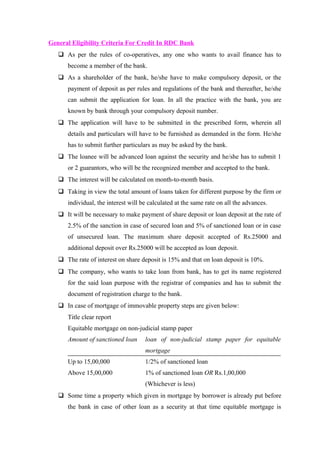
  • 84.
    LIMITATION OF STUDY Though I have selected the biggest co-operative bank for my study and no doubt here I have learnt a lot, but compared to nationalize bank, its network is small. The procedure of credit appraisal, various interest rates on different schemes, recovery programmes are specific to Rajkot Nagarik Sahakari Bank Ltd. Also credit management is wide topic; I have tried to cover the most related with it.
  • 85.
    BIBLIOGRAPHY Shekhar K.C.Banking Theory and Practices. New Delhi: Vikas publishing house pvt. Ltd., 1985. Bedi H.L.; Hardikar V.K. Practical Banking Advances. New Delhi: Institute of banking studies, 1975. Rao S.S. Handbook for Editors and Writers.ahmedabad: Ahmedabad Management Association, 1999.