INTRODUCTORY SEMINAR ON
“Deep Learning-Based Stock Price Prediction
Using LSTM-Based Method And Machine Learning”
Under The Guidance Of
Prof. OMKAR DUDBHURE
PRESENTED BY
MR. SHUBHAM NIPANE MR. PRASHANT KALE
MS. PAYAL KAPSEKAR MS. POOJAAGARWAL
Manoharbhai Patel Institute Of Engineering & Technology
Shahapur, Bhandara.
2020-2021
Contents
 Abstract
 Introduction
 Purpose System
 Modules
Tool Specification
 System Architecture
Advantages And Disadvantages
 System Requirements
Conclusion
 References
Abstract
 In the financial world, the forecasting of stock price gains significant attraction.
 The successful prediction of a stock’s future cost could return noteworthy benefit.
 The focuses on the use of Regression and LSTM (Long Short-Term Memory) based
Machine learning to predict stock values. Factors considered are open, close, low,
high and volume.
 The recent trend in stock market prediction technologies is the use of machine
learning which makes predictions based on the values of current stock market indices
by training on their previous values.
Introduction
 The total market capitalization of the whole stock exchanges in the world started from
$2.5 trillion in 2010. At the end of 2019, it became $68.65 trillion.
 A correct prediction of stocks can lead to huge profits for the seller and the broker.
 In our LSTM model for stock prediction, one sequence was defined as a sequential
collection of the daily dataset of any single stock in a fixed time period (N days).
 A deep learning method known as Gated Recurrent Unit (GRU) consists of same type
of structure like LSTM model, except that the design of the memory cell is simplified
in GRU.
 Introduction of machine learning to the area of stock prediction has appealed to many
researches because of its efficient and accurate measurements.
Proposed System
 In this project we will be looking at data from the stock market, particularly
some technology stocks.
 We will look at a few ways of analysing the risk of a stock, based on its
previous performance history.
We will learn how to use pandas to get stock information, and it is python data
analysis library, which uses python programming language.
 We will also be predicting future stock prices through a Long Short Term
Memory (LSTM) method.
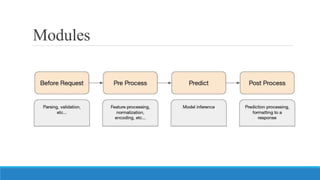
Modules
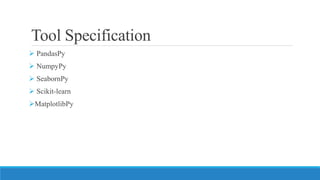
Tool Specification
 PandasPy
 NumpyPy
 SeabornPy
 Scikit-learn
MatplotlibPy
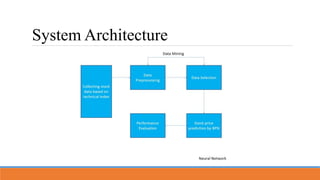
System Architecture
Advantages
 Easily identifies trends and patterns.
 No human intervention needed (automation).
 Continuous Improvement.
 Handling multi-dimensional and multi-variety data.
Disadvantages
 Time and Resources.
 Highly error-prone
System Requirements
 SOFTWARES REQUIREMENTS:
Language : Python, R Programming Langauge, Java.
Tools: Numpy, Pandas, SK-learn, etc.
Dataset : Stock Market Prediction Dataset.
 SERVER HARDWARE REQUIREMENTS:
Operating system : Windows XP above, Linux.
Processor: Intel Core 2 Duo 1.8 GHz
Ram : 1 GB
HDD : 1.5 GB
Conclusion
 This project was an attempt to determine the future prices of the stocks of a
company with greater accuracy and reliability using machine learning and
LSTM techniques.
 Both the techniques have shown an improvement in the accuracy of
predictions, thereby yielding positive results with the LSTM model
proving to be more efficient.
 In future, more functionalities and indicators will be integrated into the system.
Further data analysis or data science components will be emphasized and
added.
References
 C. METZ, "NYTimes," 22 Oct 2017. [Online]. Available:
https://www.nytimes.com/2017/10/22/technology/artificialintelligence-experts-salaries.html. [Accessed 4 Nov 2017].
 I. Wladawsky-Berger, "The Wall Street Journal," 15 Sep 2017.[Online]. Available:
httpsblogsx,wsjcom/cio/2017/09/15/artificialintelligence-is-ready-for-business-are-businesses-ready-for- ai/.[Accessed
4 Nov 2017].
 A.Semeney, Jan 2017. [Online]. Available: https//www.devteamspace/blog/artificial-intelligence-in-
stocktrading-future-trends/. [Accessed 1 Nov 2017]
 "Machine Learning For Stock Trading Strategies," 14 Apr 2016.[Online]. Available:
https://www.nanalyze.com/2016/04/machinelearning-for-stock-trading-strategies/. [Accessed 7 Nov 2017].
 S. Greg Walters, 22 Mar 2017. [Online]. Available:
https://www.livescience.com/58364-ai-investors-rack-up-massivereturns-in-stock-market-study.html. [Accessed 12
Oct 2017].
Thank you….

LSTM based method oh ML.pptx

  • 1.
    INTRODUCTORY SEMINAR ON “DeepLearning-Based Stock Price Prediction Using LSTM-Based Method And Machine Learning” Under The Guidance Of Prof. OMKAR DUDBHURE PRESENTED BY MR. SHUBHAM NIPANE MR. PRASHANT KALE MS. PAYAL KAPSEKAR MS. POOJAAGARWAL Manoharbhai Patel Institute Of Engineering & Technology Shahapur, Bhandara. 2020-2021
  • 2.
    Contents  Abstract  Introduction Purpose System  Modules Tool Specification  System Architecture Advantages And Disadvantages  System Requirements Conclusion  References
  • 3.
    Abstract  In thefinancial world, the forecasting of stock price gains significant attraction.  The successful prediction of a stock’s future cost could return noteworthy benefit.  The focuses on the use of Regression and LSTM (Long Short-Term Memory) based Machine learning to predict stock values. Factors considered are open, close, low, high and volume.  The recent trend in stock market prediction technologies is the use of machine learning which makes predictions based on the values of current stock market indices by training on their previous values.
  • 4.
    Introduction  The totalmarket capitalization of the whole stock exchanges in the world started from $2.5 trillion in 2010. At the end of 2019, it became $68.65 trillion.  A correct prediction of stocks can lead to huge profits for the seller and the broker.  In our LSTM model for stock prediction, one sequence was defined as a sequential collection of the daily dataset of any single stock in a fixed time period (N days).  A deep learning method known as Gated Recurrent Unit (GRU) consists of same type of structure like LSTM model, except that the design of the memory cell is simplified in GRU.  Introduction of machine learning to the area of stock prediction has appealed to many researches because of its efficient and accurate measurements.
  • 5.
    Proposed System  Inthis project we will be looking at data from the stock market, particularly some technology stocks.  We will look at a few ways of analysing the risk of a stock, based on its previous performance history. We will learn how to use pandas to get stock information, and it is python data analysis library, which uses python programming language.  We will also be predicting future stock prices through a Long Short Term Memory (LSTM) method.
  • 6.
  • 7.
    Tool Specification  PandasPy NumpyPy  SeabornPy  Scikit-learn MatplotlibPy
  • 8.
  • 9.
    Advantages  Easily identifiestrends and patterns.  No human intervention needed (automation).  Continuous Improvement.  Handling multi-dimensional and multi-variety data.
  • 10.
    Disadvantages  Time andResources.  Highly error-prone
  • 11.
    System Requirements  SOFTWARESREQUIREMENTS: Language : Python, R Programming Langauge, Java. Tools: Numpy, Pandas, SK-learn, etc. Dataset : Stock Market Prediction Dataset.  SERVER HARDWARE REQUIREMENTS: Operating system : Windows XP above, Linux. Processor: Intel Core 2 Duo 1.8 GHz Ram : 1 GB HDD : 1.5 GB
  • 12.
    Conclusion  This projectwas an attempt to determine the future prices of the stocks of a company with greater accuracy and reliability using machine learning and LSTM techniques.  Both the techniques have shown an improvement in the accuracy of predictions, thereby yielding positive results with the LSTM model proving to be more efficient.  In future, more functionalities and indicators will be integrated into the system. Further data analysis or data science components will be emphasized and added.
  • 13.
    References  C. METZ,"NYTimes," 22 Oct 2017. [Online]. Available: https://www.nytimes.com/2017/10/22/technology/artificialintelligence-experts-salaries.html. [Accessed 4 Nov 2017].  I. Wladawsky-Berger, "The Wall Street Journal," 15 Sep 2017.[Online]. Available: httpsblogsx,wsjcom/cio/2017/09/15/artificialintelligence-is-ready-for-business-are-businesses-ready-for- ai/.[Accessed 4 Nov 2017].  A.Semeney, Jan 2017. [Online]. Available: https//www.devteamspace/blog/artificial-intelligence-in- stocktrading-future-trends/. [Accessed 1 Nov 2017]  "Machine Learning For Stock Trading Strategies," 14 Apr 2016.[Online]. Available: https://www.nanalyze.com/2016/04/machinelearning-for-stock-trading-strategies/. [Accessed 7 Nov 2017].  S. Greg Walters, 22 Mar 2017. [Online]. Available: https://www.livescience.com/58364-ai-investors-rack-up-massivereturns-in-stock-market-study.html. [Accessed 12 Oct 2017].
  • 14.