Rwanda

by Javier Paz
2014
Rwanda
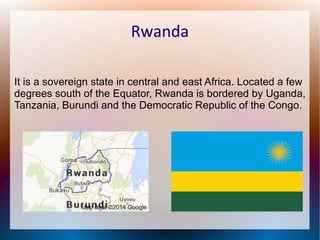
It is a sovereign state in central and east Africa. Located a few
degrees south of the Equator, Rwanda is bordered by Uganda,
Tanzania, Burundi and the Democratic Republic of the Congo.
Rwanda
Population:The total population in Rwanda was last
recorded at 11.5 million people
Land area:26 340 km2
Languages:Kinyarwanda, French, and English are the
official languages of Rwanda.
Main cities:Kigali,Butare,Gitarama,etc.
Monetary unit:Rwandan franc
Neighbouring countries:Burundi,Uganda,Tanzania,etc
Government:Presidential republic
President
Rwanda
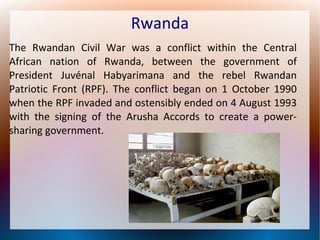
The Rwandan Civil War was a conflict within the Central
African nation of Rwanda, between the government of
President Juvénal Habyarimana and the rebel Rwandan
Patriotic Front (RPF). The conflict began on 1 October 1990
when the RPF invaded and ostensibly ended on 4 August 1993
with the signing of the Arusha Accords to create a powersharing government.
Rwanda
The original inhabitants of Rwanda were the Twa, a Pygmy people
who now make up only 1% of the population. While the Hutu and Tutsi
are often considered to be two separate ethnic groups, scholars point
out that they speak the same language, have a history of
intermarriage, and share many cultural characteristics. Traditionally,
the differences between the two groups were occupational rather than
ethnic. Agricultural people were considered Hutu, while the cattleowning elite were identified as Tutsi. Supposedly Tutsi were tall and
thin, while Hutu were short and square, but it is often impossible to tell
one from the other. The 1933 requirement by the Belgians that
everyone carry an identity card indicating tribal ethnicity as Tutsi or
Hutu enhanced the distinction. Since independence, repeated violence
in both Rwanda and Burundi has increased ethnic differentiation
between the groups.
Rwanda

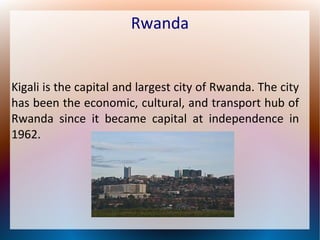
Kigali is the capital and largest city of Rwanda. The city
has been the economic, cultural, and transport hub of
Rwanda since it became capital at independence in
1962.
Rwanda

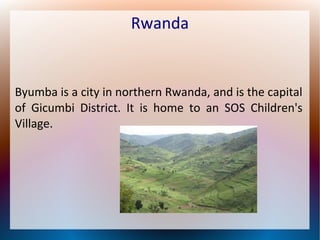
Byumba is a city in northern Rwanda, and is the capital
of Gicumbi District. It is home to an SOS Children's
Village.
Rwanda

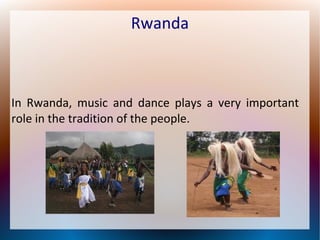
In Rwanda, music and dance plays a very important
role in the tradition of the people.
Rwanda

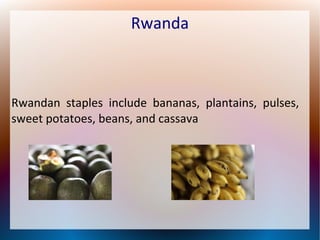
Rwandan staples include bananas, plantains, pulses,
sweet potatoes, beans, and cassava
Rwanda

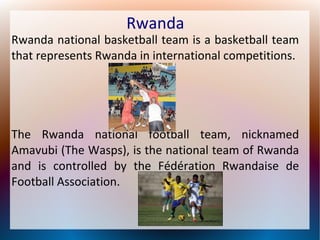
Rwanda national basketball team is a basketball team
that represents Rwanda in international competitions.

The Rwanda national football team, nicknamed
Amavubi (The Wasps), is the national team of Rwanda
and is controlled by the Fédération Rwandaise de
Football Association.
Rwanda

Reference:
www.cia.gov
● www.en.wikipedia.org
●

Rwanda

  • 1.
  • 2.
    Rwanda It is asovereign state in central and east Africa. Located a few degrees south of the Equator, Rwanda is bordered by Uganda, Tanzania, Burundi and the Democratic Republic of the Congo.
  • 3.
    Rwanda Population:The total populationin Rwanda was last recorded at 11.5 million people Land area:26 340 km2 Languages:Kinyarwanda, French, and English are the official languages of Rwanda. Main cities:Kigali,Butare,Gitarama,etc. Monetary unit:Rwandan franc Neighbouring countries:Burundi,Uganda,Tanzania,etc Government:Presidential republic President
  • 4.
    Rwanda The Rwandan CivilWar was a conflict within the Central African nation of Rwanda, between the government of President Juvénal Habyarimana and the rebel Rwandan Patriotic Front (RPF). The conflict began on 1 October 1990 when the RPF invaded and ostensibly ended on 4 August 1993 with the signing of the Arusha Accords to create a powersharing government.
  • 5.
    Rwanda The original inhabitantsof Rwanda were the Twa, a Pygmy people who now make up only 1% of the population. While the Hutu and Tutsi are often considered to be two separate ethnic groups, scholars point out that they speak the same language, have a history of intermarriage, and share many cultural characteristics. Traditionally, the differences between the two groups were occupational rather than ethnic. Agricultural people were considered Hutu, while the cattleowning elite were identified as Tutsi. Supposedly Tutsi were tall and thin, while Hutu were short and square, but it is often impossible to tell one from the other. The 1933 requirement by the Belgians that everyone carry an identity card indicating tribal ethnicity as Tutsi or Hutu enhanced the distinction. Since independence, repeated violence in both Rwanda and Burundi has increased ethnic differentiation between the groups.
  • 6.
    Rwanda Kigali is thecapital and largest city of Rwanda. The city has been the economic, cultural, and transport hub of Rwanda since it became capital at independence in 1962.
  • 7.
    Rwanda Byumba is acity in northern Rwanda, and is the capital of Gicumbi District. It is home to an SOS Children's Village.
  • 8.
    Rwanda In Rwanda, musicand dance plays a very important role in the tradition of the people.
  • 9.
    Rwanda Rwandan staples includebananas, plantains, pulses, sweet potatoes, beans, and cassava
  • 10.
    Rwanda Rwanda national basketballteam is a basketball team that represents Rwanda in international competitions. The Rwanda national football team, nicknamed Amavubi (The Wasps), is the national team of Rwanda and is controlled by the Fédération Rwandaise de Football Association.
  • 11.